EPF Scheme New Rules Changes in 2026

The Employees’ Provident Funds Scheme, 2026 has replaced the EPF Scheme, 1952 under the Code on Social Security, 2020. While the core features of EPF remain unchanged, the new scheme introduces several operational and compliance-related changes.

Important changes under the EPF Scheme 2026

  • EPF Scheme, 1952 replaced: The new EPF Scheme, 2026 came into effect on 29 June 2026, aligning EPF with the Code on Social Security, 2020.
  • Contribution rates remain unchanged: Employees and employers will continue to contribute 12% of wages (10% for specified establishments).
  • Wage ceiling remains Rs. 15,000: The statutory wage ceiling for mandatory EPF contributions has not been revised.
  • Higher wage contributions clarified: For employees earning above the wage ceiling, contributions beyond the statutory limit are voluntary and depend on the employer’s policy or mutual agreement.
  • Improved digital compliance: The scheme introduces greater reliance on electronic filings, digital records, and streamlined EPFO processes for employers and members.
  • Stricter rules for exempted PF trusts: Exempted establishments are now subject to enhanced governance, reporting, and compliance requirements.
  • Government’s emergency powers: The Central Government has been empowered to temporarily modify EPF contribution rates during exceptional circumstances, as permitted under the Code on Social Security.

New EPF Rules Affect PF Contribution or Salary?

For most employees, there will be no immediate impact. The 12% EPF contribution rate, interest rate, and Rs. 15,000 wage ceiling remain unchanged.

However, employees earning above Rs. 15,000 per month could be affected if their employer changes its EPF contribution policy.

  • Higher take-home salary: If contributions are restricted to the statutory minimum, your monthly salary may increase.
  • Lower retirement savings: Reduced EPF contributions from both employer and employee can lead to a smaller retirement corpus over time.
  • No automatic change: Existing contribution practices will generally continue unless your employer formally revises its EPF policy.

EPFO Schemes

The Employees’ Provident Fund Organisation (EPFO) administers three core social security schemes that provide retirement savings, pension income, and life insurance coverage to employees collectively.

1. EPF Scheme 1952 – Contributions & Benefits

The Employees’ Provident Fund (EPF) Scheme, 1952 is a retirement savings scheme where both employer and employee contribute 12% of the employee’s basic salary plus dearness allowance. The accumulated corpus earns an annual interest of 8.25% and is available to the employee as a lump sum at retirement or upon meeting withdrawal conditions. The EPFO also allows partial withdrawals for specific needs such as housing, education, or medical emergencies.

2. EPS 1995 – Pension, Eligibility & Monthly Income

The Employees’ Pension Scheme, 1995 provides a fixed pension income upon retirement. A portion equalling to 8.33% of the employer’s EPF contribution is diverted to EPS. Employees become eligible for pension after completing 10 years of service and reaching 58 years of age. However, early pension can be claimed at a reduce rate from the age of 50 years. 

3. EDLI Scheme 1976 – Insurance Coverage

The Employees’ Deposit Linked Insurance (EDLI) Scheme, 1976 offers life insurance coverage to EPF members. In case of the employee’s death during service, a lump sum benefit is paid to the nominee, and death after resignation or retirement does not qualify. The maximum insurance benefit under EDLI is Rs. 7 lakh, with no contribution required from the employee. However, the minimum assured sum is Rs. 2.5 lakh.

4. Comparison table: EPF vs EPS vs EDLI

FeatureEPF (1952)EPS (1995)EDLI (1976)
PurposeRetirement savings (lump sum)Monthly pension after retirementLife insurance cover
ContributionEmployer + Employee (12% each)8.33% of employer’s contributionEmployer contribution only
Benefit TypeLump sum with interestMonthly pensionLump sum to nominee
EligibilityAll eligible salaried employeesMinimum 10 years of serviceActive EPF members
Payout TimingRetirement or withdrawal conditionsAfter age 58 (or early with reduced rate)On employee’s death during service
Maximum BenefitNo fixed cap (depends on contributions)Pension based on salary & serviceUpto Rs. 7 lakh

EPFO Login – How to Access the Member Portal

The initial step to access the EPFO portal is to activate the Universal Account Number (UAN), which can be easily done on the portal itself.

Employees can access their EPF account online through the EPFO Unified Member Portal to check balance, download passbook, file claims, and update KYC details.

1. Steps to Login to EPFO Member Portal

Step 1: Visit the EPFO Unified Member Portal.

Step 2: Enter your UAN (Universal Account Number) and password.

Step 3: Complete the captcha verification.

Step 4: Click on Sign In.

Step 5: Verify login using OTP sent to your registered mobile number (if prompted).

2. Forgot Password – How to Reset EPFO Login

Step 1: Go to the EPFO Member Portal login page.

Step 2: Click on “Forgot Password”.

Step 3: Enter your UAN and captcha code.

Step 4: Verify your identity using OTP sent to your registered mobile number.

Step 5: Set a new password and confirm.

Step 6: Log in again using your updated credentials.

Note: Members should make sure that their UAN is activated and linked to their Aadhaar and mobile number to avoid login issues. 

EPF Interest Rate 2025-26 The EPF interest rate is 8.25% for FY 2025-26. The interest is credited annually at the end of the financial year, but is calculated monthly on the closing balance of the EPF account. Use ClearTax’s EPF Calculator to know your EPF interest.

Financial YearEPF Interest Rate
2025 – 20268.25%
2024 – 20258.25%
2023 – 20248.25%
2022 – 20238.10%
2021 – 20228.10%

Note: EPF interest rate are reviewed and declared annually by the EPFO.

The EPF interest rate is calculated monthly on the running balance but credited annually at the end of the financial year. The calculation is based on compound interest approach on the closing balance of each month, thus ensuring steady compounding and making EPF a reliable long-term retirement savings instrument. 

EPF Contribution Details

The EPF contributions can be broken down into two parts. The employee contributes 12% and the employer contribute 13% of the basic salary and dearness allowance monthly to the employee’s EPF account. The employee’s contribution of 12%, entirely goes to the EPF account. However, the employer’s contribution of 13% is further divided as follows:

ParticularsPercentage
EPF3.67%
EPS8.33%
EDLI0.5%
EPF Admin Charges0.5%

Illustration

Let us first understand the EPF calculation with an example. Mr A has a salary structure in which his monthly basic pay is Rs. 14,000 and he does not receive dearness allowance as he is not a government employee. Now the PF contribution for employer and employee is as follows:

Employer’s contribution amount = 14000 * 13% = Rs.1,820

Employee’s Contribution amount = 14000* 12% = Rs. 1,680

EPFO New Rules 2025-26

The EPFO is aiming to bring in various updated to make EPFO services faster, more digital and accessible while expanding benefits for members.

1. EPFO 3.0 – ATM Withdrawals & UPI Integration

Under EPFO 3.0, member can access faster EPF withdrawals through proposed features such as UPI integration and ATM based withdrawals. This will allow instant access to EPF funds, reducing dependency on traditional claim processing timelines. EPFO 3.0 also does not require employer approval and allows withdrawals through Aadhaar authentication and has increased the auto-settlement limit to Rs. 5 lakh from the previous Rs. 1 lakh. 

2. EPFO Enrolment Scheme 2025

The EPFO Enrolment Scheme 2025 is a time-bound initiative designed to bring more workers into the formal social security net. It encourages employers to register eligible employees and ensures wider EPF coverage, improving long-term retirement security.

3. Aadhaar-Based Face Authentication

EPFO has introduced Aadhaar-based face authentication to simplify identity verification. This enables members to complete KYC, submit claims, and access services securely without OTP dependency, improving ease of use and reducing fraud risks.

4. Higher Pension on Higher Wages

Following recent policy changes, eligible employees can opt for higher pension under EPS by contributing on actual salary (above the Rs. 15,000 cap). This allows members to receive a significantly higher monthly pension, subject to eligibility criteria, joint option submission, and EPFO approval.

EPFO Services

The following are few of the many services offered by the EPFO to it’s members:

1. Universal Account Number

EPFO introduced UAN, which acts as an umbrella for multiple member IDs allotted to an individual by different employers. UAN is a unique 12-digit number assigned to an employee by EPFO. UAN enables the linking of multiple EPF accounts (member IDs) allotted to a single member. Employees are required to activate their UAN at the UAN portal to avail various online services offered by EPFO.

The UAN portal offers a bouquet of services, such as dynamically updated UAN card, updated EPF passbook (including all transfer details), facility to link previous member IDs with the present ID, SMS regarding the credit of contributions in the PF account, and a facility for auto-triggering transfer request on change of employment.  

2. Online EPF Transfer

While the EPF transfer was possible online earlier under ‘Online Transfer Claim Portal’, with the introduction of UAN, the process of transfer is revised and shifted under the ‘Unified Portal’. This has made EPF transfer from one account to another easy, paper-free, and also hassle-free. Refer to our article on the online EPF transfer process for more information.

3. Online PF Withdrawal

An employee is allowed to withdraw PF amount if he/she is not employed for 60 days post resigning the previous employment. EPFO has enabled online EPF withdrawal with a simple procedure for UANs linked with Aadhar. Refer to our article on online EPF withdrawal.

4. PF Payments Online

It is mandatory for all establishments to make EPF payments online. EPFO has a tie-up arrangement with some banks to collect EPFO dues and the participating banks are SBI, PNB, Indian Bank, Union Bank of India, Bank of Baroda, HDFC Bank, ICICI Bank, Axis Bank, Kotak Mahindra Bank. Refer to our article on PF payment online for more details.

5. Centralised Software for Generation of Certificate of Coverage for International Workers

EPFO has launched an online form through its centralised software to generate the Certificate of Coverage (CoC) to EPF members working in countries having Social Security Agreements with India.

6. SMS Service/Alerts and Missed Call Service

The SMS service and missed call service were launched to give better access to the EPF account to the EPF members who have activated their UAN. Members can access details of KYC status, last contribution, total EPF balance by sending an SMS in the format ‘EPFOHO UAN’ followed by the first three characters of their preferred language to 7738299899.

Members can also obtain details by giving a missed call to 011-22901406. SMS alerts are also sent to the members intimating remittance, withdrawals, interest credit, etc. Also, SMS is sent to the employers for non-deposit of dues.

7. Passbook and Claim Status

Members can view their passbook and check their claim status online. Members can also update/modify basic KYC details online.

EPF Claim Status

  • EPFO Portal: Once a member decides to withdraw their EPF funds, they can log in to the EPFO portal and submit an online request, and track the status of their EPFO claim. 
  • Missed Call: Alternatively, employees can check the claim status by giving a missed call to 99660 44425 from their registered mobile numbers. 
  • SMS Facility: You can use the SMS facility by sending the details in the following format from your registered mobile number : EPFOHO UAN <Language Code>. The details need to be sent to 7738299899 to receive the details.
  • UMANG App: After logging in to UMANG app, you will be redirected to EPFO main page. Click ‘Employee Centric Services > Track Claim > EPF Claim Status’. 

To check the PF status, the member needs to provide the following information:

  • Employment details
  • Extension code (if required)
  • Employer’s EPF regional office
  • Universal Account Number (UAN) 

EPF KYC Update

Follow the below mentioned steps for EPFO KYC update;

  1. Login to your EPFO portal, and click ‘Manage’ option on the top menu bar.
  2. Click KYC option from the drop down menu, and choose the documents that you need to update.
  3. Enter the requisite details, and choose the ‘Save’ option, and you can see the status as ‘KYC Pending Approval’. 
  4. Once your employer approves the KYC details, the status chnges to ‘Digitally Approved KYC’.

If you want to update your bank KYC, it does not require your employer’s approval. You can choose ‘Bank’ field in the KYC menu, and update the requisite details. These details are verified on the basis of Aadhar OTP.

EPF Forms

For every activity in EPFO account, right from account opening, transfer, withdrawal and final settlement, there are various forms using which the appropriate compliance or facility can be availed. Below is a list containing various PF forms:

Form NamePurpose
Form 2Nomination for EPF and EPS
Form 5Details of new employees eligible for EPF (submitted by employer)
Form 10-CClaim pension withdrawal under EPS (for <10 years of service)
Form 10-DMonthly pension claim under EPS (for ≥10 years of service)
Form 11Declaration by a new employee for PF transfer/eligibility
Form 13Transfer of PF account from one employer to another
Form 14For purchasing LIC policy using EPF funds
Form 15G / 15HTo avoid TDS on PF withdrawals (if conditions met)
Form 19Final settlement of PF (withdrawal after leaving job)
Composite Claim FormA single form for PF final settlement, partial withdrawal, pension withdrawal, and more. Available in Aadhaar and Non-Aadhaar versions

EPF Benefits

Here are the advantages of the EPF scheme:

  1. Saving for the future: The EPF scheme enables individuals to save money for the long term.
  2. Convenient deductions: Instead of making a large, one-time investment, deductions are made from the employee’s monthly salary. This allows for significant savings over an extended period.
  3. Financial support in emergencies: The EPF scheme can provide employees with financial assistance during unexpected situations.
  4. Retirement savings: By participating in the EPF scheme, individuals can accumulate funds for their retirement, ensuring a comfortable lifestyle in later years.

EPF Taxation & Exemptions

The EPF contributions made by both the employee and employer have various tax benefits. The employee contribution towards EPF can be claimed as a deduction up to Rs. 1.5 lakh under Section 80C in the old tax regime only. The employer’s contribution of up to 12% of the basic salary is exempt from tax under both the new and old tax regimes. However, the employer’s contribution exceeding Rs. 7.5 lakh is taxable. 

The interest accumulated on the employee’s contribution up to Rs. 2.5 lakh is tax-free. However, the interest on contributions above Rs. 2.5 lakh is taxable. Similarly, contributions by the employee over and above Rs. 2.5 lakh is also taxable and not exempt. The interest on the employer’s contribution is completely tax-free. 

EPFO Grievance

To assist employees in registering grievances, the EPFO has dedicated a section on their member portal where individuals can fill out a grievance registration form and file complaints. Common grievances faced by employees include issues related to withdrawals, PF settlements, account transfers, pension settlements, and more. If you are new to the EPFO’s member portal and wish to register an EPF grievance, follow these steps:

Step 1: Visit the EPFO grievance portal.

Step 2: Click on the “Register grievance” option located on the top bar.

Step 3: Once clicked, the grievance registration form will be displayed.

Step 4: Fill in the registration form by providing the following details:

  • Select your status (Employer, employee, EPS pensioner).
  • Enter your PF account number.
  • Specify the location of your regional EPF office.
  • Enter the name and address of your establishment.
  • Provide your personal details, including name, address, pin code, country, phone number, and email ID.
  • Select the appropriate grievance category from the dropdown menu, such as transfer or withdrawal-related issues, pension settlement, etc

Step 5: Upload your grievance letter, enter the captcha, and submit your grievance registration.

By following these steps, you can register your EPF grievance effectively through the EPFO’s member portal.

EPF Scheme 1952 vs 2026

The EPF Scheme, 2026, modernises the decades-old EPF Scheme, 1952 by simplifying withdrawal rules, digitising member services, and introducing greater flexibility while retaining the core objective of retirement savings. While EPF contributions and benefits largely remain unchanged, the new scheme focuses on faster claim processing and a more user-friendly experience.

ParticularsEPF Scheme, 1952EPF Scheme, 2026
Withdrawal RulesMultiple purpose-specific provisionsSimplified into three broad categories
Claim SettlementStandard processing timelinesFaster digital processing with eligible claims targeted within 3 working days
Member ServicesLimited digital servicesDigital-first experience through EPFO Portal and UMANG
Withdrawal ProcessMultiple forms and conditionsStreamlined online claim process with simplified rules
Contribution RulesExisting EPF contribution frameworkContribution framework largely unchanged with added employer flexibility in specified cases
ObjectiveRetirement savings for employeesRetirement savings with simplified compliance and improved digital access

EPFO 3.0 ATM Withdrawal of PF: To Be or Not To Be a Danger to Pensions | EPFO 3.0

The Centre is working to implement a 100 percent digital withdrawal system of Employees’ Provident Fund (EPF) to enable withdrawal from EPF account of millions of workers instantly through a QR code at ATMs or online transfer through UPI. EPFO is working to implement this system by mid-2026.

Now in the new framework of withdrawal of EPF amount, an EPFO member can check the amount of withdrawal eligible through UMANG app of EPFO, generate a QR code and withdraw the amount immediately from UPI-enabled ATM or through direct UPI transfer. Withdrawal through EPFO’s new framework of withdrawal will be paperless, instant and hassle-free and the amount will be credited to the account of member immediately as against days and weeks taken by EPFO to settle the claims through existing process of withdrawal of EPF amount.

The proposed EPFO 3.0 is part of the digital modernization of EPFO to make provision of provident fund services to its members faster and smoother by reducing processing time and minimizing human intervention. Under EPFO 3.0, members will be able to withdraw/ transfer their EPF account balance instantly through digital platform(s).

A revolution of sorts is on the cards for the EPFO. It will be one of the largest digital reforms in the country’s retirement savings space.

Will ATM-based EPF withdrawals impact pensions?

Clarification by Ministry of Labour and Employment. EPF amount can be withdrawn by employee as well as employer through ATM for the amount contributed by employee towards his/her Provident Fund account, up to 75% of the amount in his/her Provident Fund account.

However, the pension shall remain unaffected since EPS is a defined benefit scheme and pension of member is calculated on the basis of Eligible Service rendered by him/her. Even if member withdraws his/her EPF contributions, his/her EPS service record shall not be impacted and he/she would continue to remain eligible for pension as and when he/she attains the age of superannuation or retires from service, provided he/she has completed at least 10 years of Eligible Service.

What did the Labour Ministry clarify?

The Ministry of Labour & Employment has clarified that Pension would continue to as before and would not get affected in any way due to the proposed EPF withdrawals through UPI. Pension entitlement also would continue to as before at the age of 58.

A member can withdraw the amount accumulated in pension account before completing 10 years of service in any time of these 10 years. However, for entitlement of pension, the member should have rendered minimum 10 years of service in EPS contributing employment.

Even if the member withdraws a substantial part of the EPF account prior to retirement, his/her EPS service record would not get affected and the member would continue to be eligible for pension provided he/she completes the required 10 years of eligible service.

What actually changes?

Currently, a member can apply for withdrawal of his EPF online on EPFO portal or even submit physical application at EPFO office after verification of KYC details of member. Employer also needs to verify and approve the withdrawal application of employee. It generally takes minimum 7-10 days for processing of withdrawal claim and getting the disbursed amount in bank account of member. Withdrawal claims of more than Rs 1 lakh are verified manually by EPFO and if any discrepancy is found in documents submitted by member or employer, then processing of withdrawal claim is delayed or claim is even re-initiated.

In EPFO 3.0, a member can check the amount of his/her eligible PF withdrawal balance through UMANG app and generate a QR code to withdraw funds instantly from a UPI enabled ATM or through a direct UPI transfer. Withdrawals up to amount of Rs 5 lakh can be instantly settled without any intervention of employer.

When will EPFO 3.0 launch?

Labours Minister Mansukh Mandaviya has on Friday confirmed the report stating that EPFO has completed the testing of UPI withdrawal of EPF and it will be launched soon.

“Testing of UPI facility for withdrawal of EPF has been completed and service would be launched soon,” Minister Mandaviya said in a statement.

The Minister did not state a date of launch but said the organization had completed testing of the process where members could withdraw their EPF using the UPI payment gateway and the amount would be credited into the bank account of the member immediately.

As workforce in India is growing formally. Ministry of Labor and Employment, Government of India has put out some great data around formal workforce growth in India. In financial year 2024-25, over 1.29 crore formal workers were added to payrolls of various establishments across India. Unemployment rate in India too has declined sharply and as of financial year 2023-24, stands at 3.2% as against 6% in financial year 2017-18.

The proposed change will thus become one of the biggest digital reforms for the EPFO in the country and will bring ease of withdrawal of retirement savings for millions of salaried employees.

Early EPF withdrawals could be taxed under income tax rules: Report

If employee withdraws his EPF money before completion of 5 years of service from the date of joining, then he shall be liable to pay tax on such withdrawal and employer also shall be liable to deduct TDS on such withdrawal, unless the conditions of exemptions available under the Income Tax Act and Employees’ Provident Fund Organization (EPFO) are satisfied.

Withdrawal of Employees’ Provident Fund (EPF) amount by employee before completion of 5 years of service from the date of joining will attract tax as per Income-tax Act, 2025 and also TDS (Tax Deducted at Source) unless exempt as per conditions mentioned under Income-tax Act, 2025 and Employees’ Provident Fund Organization (EPFO) rules.

Employees’ Provident Fund (EPF) is a long term retirement benefit but the same can be withdrawn in part in case of unemployment or other emergencies even before retirement. The amount of withdrawal is not restricted but the amount so withdrawn before completion of 5 years of service will be considered as part of income and tax thereon will be charged as per the provisions of Income-tax Act, 2025.

A withdrawal, including the interest amount, could attract tax and TDS if not covered under any of the exemptions as specified under the income tax and EPFO rules. The report was first carried by Mint.

EPF investments currently earn an interest rate of 8.25% on a monthly basis.

EPFO rules define when full withdrawal is allowed

What is Full EPF Withdrawal as per EPFO Rules.

As per EPFO rules, EPF in Full can be Withdrawn by Employee in following cases as specified by ClearTax.

  • Retirement after reaching 55 years of age
  • Withdrawal of up to 90% of EPF balance after he/she completes 54 years of age i.e. one year prior to retirement.
  • Employee is unemployed for only 1 month then he can withdraw 75% of his EPF account.
  • Full withdrawal of the EPF balance after the individual is unemployed for a period of two months.

Online withdrawal by EPFO is permitted without approval of employer in following cases.

  • Your Aadhaar number must be mapped to your Universal Account Number (UAN).
  • Employer verification requirements have been completed

The EPF is one of the largest retirement benefits systems in the country to help working people save enough for their old age by themselves or through their employers. Under the EPF scheme, both the employee and the employer every month put aside 12% of the employee’s basic salary and dearness allowance as their contribution to the fund.

The employer’s contribution to Employee’s Provident Fund (EPF) is credited to Employee’s Provident Fund (EPF) account and Employee’s Pension Scheme (EPS) account.

Early withdrawals may trigger tax liability

Any withdrawal from EPF prior to completion of 5 years of continuous service of employee (as specified under Rule 6 of Schedule XI of the Income-tax Act, 2025) shall attract tax.

The tax implications will however not apply in case the withdrawal is permissible under Exemptions notified by EPFO & Income Tax and are admissible.

Exemptions may apply in cases such as:

  • Termination due to ill health
  • Closure or discontinuation of the employer’s business
  • Circumstances beyond the employee’s control

Tax applicable on Early Withdrawal is available on income tax portal web site. The entire amount of withdrawal along with interest made by employee before completion of 5 years of service and not covered under exceptions in above para shall be taxable and TDS would be applicable on such payment.

All previous service will get counted even if EPF was transferred without any withdrawal.

Once the EPF transfer happens, the service of employee with previous employer(s) can also be counted to complete 5 years of service. No TDS will be deducted by employer on withdrawal of EPF balance (along with the interest accrued thereon), as mentioned by ClearTax in the above article.

TDS rules are mainly based on the amount of withdrawal and PAN details.

Tax deducted at source on EPF withdrawal is a function of the amount of withdrawal and the PAN details of the employee available with the employer.

According to ClearTax:

  • No TDS is deducted if EPF withdrawal amount is below ₹ 50,000.
  • 10% TDS will be deducted from EPF withdrawal amount if it is above ₹ 50,000 and PAN details are available with employer.
  • TDS may also be applicable at a higher rate i.e. 20% if PAN details are not available with the employer.

Employees with total income below the taxable limit (i.e. below the threshold limit for taxation) can also have TDS not deducted on EPF withdrawal by filing the following forms:

  • Form 15G
  • Form 15H

In any case, Tax to be deducted can be exempted if these forms are submitted validly. In such cases, Tax shall not be deducted from EPF withdrawals even if amount of withdrawal from EPF is in excess of Rs. 50,000 and total of such taxpayer from all sources is in excess of taxable limit for such taxpayer.

Retirement savings remain central to EPF framework

Withdrawals from EPF under focus as salaried employees become more aware on tax, retirement and employment.

The EPF account of salaried employees is being taxed before retirement, due to frequent job changes, unemployment and urgent withdrawals from their EPF accounts.

Most tax experts today do not recommend the withdrawal of EPF savings, for the simple reason that not only do these grow due to interest but also due to compounding. And, savings that have remained in the account for more than 5 years are taxed in a very tax efficient manner.

Moreover, as noted before, workers can withdraw from their own EPF contributions in case they lose their job or are suffering from serious health issues or are facing other similar crises of larger magnitude where they need to withdraw huge sums of money for meeting urgent needs.

A salaried individual must know the service conditions, the time at which withdrawal can be taken and the documentary evidence required for tax purposes before withdrawing his/her EPF savings prematurely.

Related News

Higher pension contribution under Employees Pension Scheme EPS-95

In 1995, the Government introduced a pension scheme under Section 6A of the EPF Act. The Employees Pension Scheme, 1995 (EPS-95) provided that the employer’s contribution of 8.33% should be towards the pension scheme. The EPS-95 capped the maximum monthly pension at Rs.5,000 or Rs.6,000. Thus, employers had to contribute 8.33% of Rs.5,000, which was later raised to Rs.6,500, towards the pension scheme.

In March 1996, a provision was added to para 11(3) of the EPS-95, giving the employer and employee an option to contribute 8.33% of actual salary (above the cap of Rs.5,000 or Rs.6,500) to the EPS. Such a higher salary would be considered a pensionable salary. However, the EPFO gave six months for the employees to file a joint option form for higher pension contributions to the EPS.

The government amended the EPS-95 scheme effective from 01/09/2014. It increased the maximum pensionable salary to Rs.15,000. It also omitted the provision to para 11(3), i.e. exercise of the option by the employer and employee to contribute EPS on a higher salary amount.

Thus, employers would make an EPS contribution of 8.33% on a maximum of Rs.15,000 for the employees joining the EPF scheme after 01/09/2014, even when they draw a higher salary.

However, the employees who were part of EPS-95 or joined before 01/09/2014 could contribute 8.33% to EPS on the actual salary as against the cap of Rs.15,000 if they filed a new joint option with the EPFO within six months, i.e. 28/02/2015.

There were issues after the 2014 amendment regarding pension contributions on higher salaries. Many employees stated that they did know about the exercise of the joint option for contributing pension on the higher salary amount. The EPFO rejected the joint option filed by many employees. Employers contributed 8.33% of pension on employees’ actual salaries without filing the joint option, but the pensionable salary was taken as Rs.15,000 for pension calculation.

Thus, many employees filed cases in High Courts for receiving higher pensions based on the contributions made on actual salary amounts. The Supreme Court took up this matter. The summary of the Supreme Court decision is as follows:

Status of EmployeeExercise of joint option Eligibility to claim 8.33% pension contribution on a higher salaryMode of higher pension claim
Employees in service as on 01/09/2014 Exercised joint option and rejected by the EPFO Yes By filing a higher pension claim application
Employees in service as on 01/09/2014 Not exercised joint option but contributing to EPS above the cap of Rs.5,000/Rs,6,500YesBy exercising the joint option 
Employees retired before 01/09/2014Exercised joint option and rejected by the EPFOYesBy filing a higher pension claim application
Employees retired before 01/09/2014Not exercised joint option NoNot applicable

The Supreme Court provided that employees who were part of the EPF before 01/09/2014 but have not exercised the joint option can exercise it within 03/05/2023. The EPFO further extended the due date to 11/07/2023. For such employees, a higher EPS contribution will be calculated from the date of their joining. 

For example: 

  • Mr. ‘X’ became a member of the EPF in 1998.
  • He has not exercised the joint option.
  • His salary increased to Rs.50,000 in 2015.
  • His employer contributes Rs.6,000 (i.e. 12% of his basic wage) towards EPF. 
  • Of the employer’s contribution, Rs.1,250 (i.e. 8.33% of Rs.15,000; the statutory wage cap) will go to the EPS. 
  • The remaining Rs.4,750 (i.e. Rs.6,000 – Rs.1,250) will go to the EPF. 
  • He exercises the joint option within 11/07/2023 as per the Supreme Court judgement since the EPS contribution is above the statutory wage cap of Rs.6,500.
  • After submitting the joint option, his employer will contribute Rs.4,165 (i.e. 8.33% of Rs.50,000; his actual salary) and Rs.1,835 (Rs.6,000 – Rs.4,165) towards EPF.
  • The EPFO will calculate the monthly EPS amount of 8.33% of the actual salary and transfer the difference amount from the EPF to the EPS.

In such cases, the EPFO will return to the joining date or 01/11/1995, whichever is later, and transfer the difference from the PF account to the EPS account. But, the higher pension contribution will reduce the EPF lumpsum corpus that the employee gets upon retirement.

How to track EPFO higher pension application status?

You can check the status of the EPFO higher pension application by following the below steps:

Step 1: Visit the EPFO Unified Member portal.

Step 2: Click on the ‘Track Application Status for Pension on Higher Wages’.

Step 3: On the next page, click on ‘Click Here’ under the ‘Track application status for Pension on Higher Wages’ tab.

Step 4: Select and enter the application acknowledgement number, UAN number or PPO number.

Step 5: Enter the Captcha code, tick the consent and click on the ‘Get OTP’ button.

Step 6: Enter the OTP and click on ‘Get Status’. The application status will be displayed on the screen.

EPF higher pension eligibility

EPFO issued a circular in December 2022 providing the eligibility criteria and application process for claiming a higher pension. Below are the eligibility criteria for a higher pension:

  • The employees retired before 01/09/2014.
  • The employees exercised the joint option under para 11(3) of EPS-95 while being a member of EPS-95.
  • The employees and employers contributed EPS on salaries exceeding the wage ceiling of Rs.5,000 or Rs.6,500.
  • The EPFO declined the exercise of such an option.

However, the EPFO circular did not provide a higher pension option for employees who were part of the EPF before 01/09/2014 but still working/retired after 2014. As per the Supreme Court judgement, such employees were also eligible to claim a higher pension.

Thus, the EPFO issued another circular in February mentioning higher pension eligibility criteria for employees in service/retired after 2014. Below are the eligibility criteria to file a joint option for getting a higher pension:

  • The employees who were members before 01/09/2014 continued to be members after that date.
  • The employees and employers contributed to EPS on salaries exceeding the wage ceiling of Rs.5,000 or Rs.6,500.
  • The employees and employers were members of EPS-95 and did not exercise the joint option provided under the deleted para 11(3) of the EPS and amendment of 2014.

However, employees who were members of EPS-95 and exercised the joint options under the deleted para 11(3) of the EPS but did not file new joint options after the amendment of 2014 are not eligible to claim a higher pension. The EPS contributions of such employees will be 8.33% on the maximum amount of Rs.15,000, irrespective of their actual salaries.

EPF higher pension option form

The eligible employees who retired before 2014 can apply for a higher pension claim with the EPFO. They can apply for the higher pension claim online (as shown below) or with the regional EPF offices.

The eligible employees who joined EPS-95 but are retired/working after 2014 can apply the joint option form online (as shown below) or with the concerned regional EPF offices within 11/07/2023 to receive higher pensions.

How to apply for a higher pension in EPF?

Below is the step to claim a higher pension amount for employees retired before 2014:

Step 1: Employees need to visit the EPFO Unified Member portal.

Step 2: Click on the ‘Pension on Higher Salary: Online application for validation of Joint Option’ option.

Step 3: Fill in the details and submit the form.

The EPFO will digitally register each application and provide the receipt number to the applicant. It will forward the applications to the respective employers, who will verify them through e-sign/digital signature for further processing. The APFC/RPFC-II will examine the case and send the higher pension decision to the applicants via email, post, phone or SMS. 

The field officers will examine the application form. If the form is complete, the wage details submitted by the employers will be verified with the the field offices data. Where the field officers data and employers’ details match, the dues will be calculated and an order will be passed by RPFC-II/RPFC-I/APFC for depositing/transferring the dues. The cases where there is a mismatch, it will informed to the employer and the pensioner by the APFC/RPFC-II and one month time will be given to rectify the same. 

In case the application form is not approved by the employer, an opportunity will be given to the employer to provide additional proof/evidence or correct any mistakes/errors before rejection of the form. Such opportunity will be given for a period of one month and under intimation to the  pensioners.

How to apply for a joint option online pension form in EPF?

Below is the step to exercise/apply for joint option under para 11(3) and para 11(4) of EPS-95 to claim for higher pension for employees who are part of EPS-95 but are working or retired after 2014:

Step 1: Employees need to visit the EPFO Unified Member portal.

Step 2: Click on the ‘Pension on Higher Salary: Exercise of Joint Option under para 11(3) and para 11(4) of EPS-1995 on or before 3rd May 2023’ option.

Step 3: Fill in the details and submit the form.

The field officers will examine the joint option forms. If the form is complete, the wage details submitted by the employers will be verified with the the field offices data. Where the field officers data and employers’ details match, the dues will be calculated and an order will be passed by RPFC-II/RPFC-I/APFC for depositing/transferring the dues. The cases where there is a mismatch, it will informed to the employer and the employee by the APFC/RPFC-II and one month time will be given to rectify the same. 

In case the join option is not approved by the employer, an opportunity will be given to the employer to provide additional proof/evidence or correct any mistakes/errors before rejection of the form. Such opportunity will be given for a period of one month and under intimation to the employees.

EPFO guidelines for higher pension

  • The joint option/higher pension claim application should contain a disclaimer or declaration.
  • An employee should give explicit consent in the joint option/application form for a share adjustment from PF to EPS and a re-deposit of the amount.
  • An employee should give an undertaking of the trustee for a share transfer of funds from exempted PF trust to the EPFO pension fund. The undertaking will be effective for the deposit of due contribution and interest up to the payment date within the specified time.
  • The employer’s contribution share refund will be deposited with the interest rate declared under para 60 of the EPF Scheme, 1952, for employees of unexempted establishments.
  • The following documents should be submitted with the higher pension claim application:
    • Proof of joint option verified by the employer filed under para 26(6) of the EPF scheme.
    • Proof of joint option verified by the employer filed under para 11(3) provision.
    • Proof of remittance of EPS contribution in the PF account exceeding the current wage limit of Rs.6,500 or Rs.5,000.
    • Written refusal of APFC or EPFO to such remittance or request.
  • The following documents should be submitted with the joint option application:
    • Proof of remittance of EPS contribution in the PF account exceeding the current wage limit of Rs.6,500 or Rs.5,000.
    • Proof of joint option verified by the employer filed under para 26(6) of the EPF scheme.
  • The EPFO will issue further circulars regarding the deposit method and pension computation.
  • An employee can raise a complaint on EPFiGMS when they face a grievance to get a higher pension after submitting the application and payment of the due contribution if any.

EPF higher pension calculation formula

Calculation of higher pension for employees retired before 2014:

The average monthly pay earned during the contributory period of service in the 12 months before leaving EPFO is considered to determine the pension amount.

Calculation of higher pension for employees retired after 2014:

The average monthly pay earned during the contributory period of service in the 60 months before leaving EPFO is taken into account to determine the pension amount.

Current formula for calculating pension under the EPS scheme is as follows: 

(Average salary of 60 months x service period)/70

epf pension calculator

Latest Update

Employees Pension Scheme 1995 amended to provide withdrawal benefit to members having less than 6 months service; Amendment to benefit more than 7 lakh EPS members every year

Government of India has amended the Employees’ Pension Scheme (EPS), 1995 to ensure that EPS members with less than 6 months of contributory service also receive withdrawal benefit. This amendment will benefit more than 7 lakh EPS members every year who leave the scheme with less than 6 months of contributory service.

Further, the Central Government has modified the Table D and has ensured that every completed month of service rendered is taken into account to give proportionate withdrawal benefit to the members. The amount of withdrawal benefit will henceforth depend upon the number of completed months of service rendered by the member and the wages on which EPS contribution was received. The above measure has rationalized the payment of withdrawal benefit to members. It is estimated that every year more than 23 lakh members will benefit from this modification of the Table D.

Every year, lakhs of EPS 95 members leave the scheme prior to rendering the requisite 10 years of contributory service for pension. Such members are given withdrawal benefit as per the provisions of the Scheme.

More than 30 lakh withdrawal benefit claims were settled in the financial year 2023-24.

Till now, the withdrawal benefit was being calculated on the basis of the period of contributory service in completed years and the wages on which EPS contribution has been paid.

Therefore, only after completing 6 months and above of contributory service, the members were entitled for such withdrawal benefit. Consequently, the members leaving scheme, before contributing for 6 months or more, used to get no withdrawal benefit. This was a cause of many claim rejections and grievances as many members were exiting without having less than 6 months of contributory service. During the financial year 2023-24, approximately 7 lakh claims for withdrawal benefits were rejected due to contributory service being less than 6 months. Henceforth, all such EPS members who have not attained the age of 58 years as on 14.06.2024 will become entitled for withdrawal benefit.

Earlier, the calculation under erstwhile Table D ignored the fractional period of service rendered for less than 6 months after each completed year. This resulted in lesser amount of withdrawal benefit in many cases. With the modification of Table D, the Contributory service for calculating the withdrawal benefit will be now considered in completed months. This will ensure fair payment of withdrawal benefit. E.g. a member taking withdrawal benefit after 2 years and 5 months of contributory service & wages of 15,000/- per months was earlier entitled to Rs. 29,850/- withdrawal benefit. Now he will receive Rs. 36,000/- withdrawal benefit.

Higher pension contribution under EPF Act Monthly Pension EPS-95

In 1995, the Government introduced a pension scheme under Section 6A of the EPF Act. The Employees Pension Scheme, 1995 (EPS-95) provided that the employer’s contribution of 8.33% should be towards the pension scheme. The EPS-95 capped the maximum monthly pension at Rs.5,000 or Rs.6,000. Thus, employers had to contribute 8.33% of Rs.5,000, which was later raised to Rs.6,500, towards the pension scheme.

In March 1996, a provision was added to para 11(3) of the EPS-95, giving the employer and employee an option to contribute 8.33% of actual salary (above the cap of Rs.5,000 or Rs.6,500) to the EPS. Such a higher salary would be considered a pensionable salary. However, the EPFO gave six months for the employees to file a joint option form for higher pension contributions to the EPS.

The government amended the EPS-95 scheme effective from 01/09/2014. It increased the maximum pensionable salary to Rs.15,000. It also omitted the provision to para 11(3), i.e. exercise of the option by the employer and employee to contribute EPS on a higher salary amount.

Thus, employers would make an EPS contribution of 8.33% on a maximum of Rs.15,000 for the employees joining the EPF scheme after 01/09/2014, even when they draw a higher salary.

However, the employees who were part of EPS-95 or joined before 01/09/2014 could contribute 8.33% to EPS on the actual salary as against the cap of Rs.15,000 if they filed a new joint option with the EPFO within six months, i.e. 28/02/2015.

There were issues after the 2014 amendment regarding pension contributions on higher salaries. Many employees stated that they did know about the exercise of the joint option for contributing pension on the higher salary amount. The EPFO rejected the joint option filed by many employees. Employers contributed 8.33% of pension on employees’ actual salaries without filing the joint option, but the pensionable salary was taken as Rs.15,000 for pension calculation.

Thus, many employees filed cases in High Courts for receiving higher pensions based on the contributions made on actual salary amounts. The Supreme Court took up this matter. The summary of the Supreme Court decision is as follows:

Status of EmployeeExercise of joint option Eligibility to claim 8.33% pension contribution on a higher salaryMode of higher pension claim
Employees in service as on 01/09/2014 Exercised joint option and rejected by the EPFO Yes By filing a higher pension claim application
Employees in service as on 01/09/2014 Not exercised joint option but contributing to EPS above the cap of Rs.5,000/Rs,6,500YesBy exercising the joint option 
Employees retired before 01/09/2014Exercised joint option and rejected by the EPFOYesBy filing a higher pension claim application
Employees retired before 01/09/2014Not exercised joint option NoNot applicable

The Supreme Court provided that employees who were part of the EPF before 01/09/2014 but have not exercised the joint option can exercise it within 03/05/2023. The EPFO further extended the due date to 11/07/2023. For such employees, a higher EPS contribution will be calculated from the date of their joining. 

For example: 

  • Mr. ‘X’ became a member of the EPF in 1998.
  • He has not exercised the joint option.
  • His salary increased to Rs.50,000 in 2015.
  • His employer contributes Rs.6,000 (i.e. 12% of his basic wage) towards EPF. 
  • Of the employer’s contribution, Rs.1,250 (i.e. 8.33% of Rs.15,000; the statutory wage cap) will go to the EPS. 
  • The remaining Rs.4,750 (i.e. Rs.6,000 – Rs.1,250) will go to the EPF. 
  • He exercises the joint option within 11/07/2023 as per the Supreme Court judgement since the EPS contribution is above the statutory wage cap of Rs.6,500.
  • After submitting the joint option, his employer will contribute Rs.4,165 (i.e. 8.33% of Rs.50,000; his actual salary) and Rs.1,835 (Rs.6,000 – Rs.4,165) towards EPF.
  • The EPFO will calculate the monthly EPS amount of 8.33% of the actual salary and transfer the difference amount from the EPF to the EPS.

In such cases, the EPFO will return to the joining date or 01/11/1995, whichever is later, and transfer the difference from the PF account to the EPS account. But, the higher pension contribution will reduce the EPF lumpsum corpus that the employee gets upon retirement.

How to track EPFO higher pension application status?

You can check the status of the EPFO higher pension application by following the below steps:

Step 1: Visit the EPFO Unified Member portal.

Step 2: Click on the ‘Track Application Status for Pension on Higher Wages’.

Step 3: On the next page, click on ‘Click Here’ under the ‘Track application status for Pension on Higher Wages’ tab.

Step 4: Select and enter the application acknowledgement number, UAN number or PPO number.

Step 5: Enter the Captcha code, tick the consent and click on the ‘Get OTP’ button.

Step 6: Enter the OTP and click on ‘Get Status’. The application status will be displayed on the screen.

EPF higher pension eligibility

EPFO issued a circular in December 2022 providing the eligibility criteria and application process for claiming a higher pension. Below are the eligibility criteria for a higher pension:

  • The employees retired before 01/09/2014.
  • The employees exercised the joint option under para 11(3) of EPS-95 while being a member of EPS-95.
  • The employees and employers contributed EPS on salaries exceeding the wage ceiling of Rs.5,000 or Rs.6,500.
  • The EPFO declined the exercise of such an option.

However, the EPFO circular did not provide a higher pension option for employees who were part of the EPF before 01/09/2014 but still working/retired after 2014. As per the Supreme Court judgement, such employees were also eligible to claim a higher pension.

Thus, the EPFO issued another circular in February mentioning higher pension eligibility criteria for employees in service/retired after 2014. Below are the eligibility criteria to file a joint option for getting a higher pension:

  • The employees who were members before 01/09/2014 continued to be members after that date.
  • The employees and employers contributed to EPS on salaries exceeding the wage ceiling of Rs.5,000 or Rs.6,500.
  • The employees and employers were members of EPS-95 and did not exercise the joint option provided under the deleted para 11(3) of the EPS and amendment of 2014.

However, employees who were members of EPS-95 and exercised the joint options under the deleted para 11(3) of the EPS but did not file new joint options after the amendment of 2014 are not eligible to claim a higher pension. The EPS contributions of such employees will be 8.33% on the maximum amount of Rs.15,000, irrespective of their actual salaries.

EPF higher pension option form

The eligible employees who retired before 2014 can apply for a higher pension claim with the EPFO. They can apply for the higher pension claim online (as shown below) or with the regional EPF offices.

The eligible employees who joined EPS-95 but are retired/working after 2014 can apply the joint option form online (as shown below) or with the concerned regional EPF offices within 11/07/2023 to receive higher pensions.

How to apply for a higher pension in EPF?

Below is the step to claim a higher pension amount for employees retired before 2014:

Step 1: Employees need to visit the EPFO Unified Member portal.

Step 2: Click on the ‘Pension on Higher Salary: Online application for validation of Joint Option’ option.

Step 3: Fill in the details and submit the form.

The EPFO will digitally register each application and provide the receipt number to the applicant. It will forward the applications to the respective employers, who will verify them through e-sign/digital signature for further processing. The APFC/RPFC-II will examine the case and send the higher pension decision to the applicants via email, post, phone or SMS. 

The field officers will examine the application form. If the form is complete, the wage details submitted by the employers will be verified with the the field offices data. Where the field officers data and employers’ details match, the dues will be calculated and an order will be passed by RPFC-II/RPFC-I/APFC for depositing/transferring the dues. The cases where there is a mismatch, it will informed to the employer and the pensioner by the APFC/RPFC-II and one month time will be given to rectify the same. 

In case the application form is not approved by the employer, an opportunity will be given to the employer to provide additional proof/evidence or correct any mistakes/errors before rejection of the form. Such opportunity will be given for a period of one month and under intimation to the  pensioners.

How to apply for a joint option online pension form in EPF?

Below is the step to exercise/apply for joint option under para 11(3) and para 11(4) of EPS-95 to claim for higher pension for employees who are part of EPS-95 but are working or retired after 2014:

Step 1: Employees need to visit the EPFO Unified Member portal.

Step 2: Click on the ‘Pension on Higher Salary: Exercise of Joint Option under para 11(3) and para 11(4) of EPS-1995 on or before 3rd May 2023’ option.

Step 3: Fill in the details and submit the form.

The field officers will examine the joint option forms. If the form is complete, the wage details submitted by the employers will be verified with the the field offices data. Where the field officers data and employers’ details match, the dues will be calculated and an order will be passed by RPFC-II/RPFC-I/APFC for depositing/transferring the dues. The cases where there is a mismatch, it will informed to the employer and the employee by the APFC/RPFC-II and one month time will be given to rectify the same. 

In case the join option is not approved by the employer, an opportunity will be given to the employer to provide additional proof/evidence or correct any mistakes/errors before rejection of the form. Such opportunity will be given for a period of one month and under intimation to the employees.

EPFO guidelines for higher pension

  • The joint option/higher pension claim application should contain a disclaimer or declaration.
  • An employee should give explicit consent in the joint option/application form for a share adjustment from PF to EPS and a re-deposit of the amount.
  • An employee should give an undertaking of the trustee for a share transfer of funds from exempted PF trust to the EPFO pension fund. The undertaking will be effective for the deposit of due contribution and interest up to the payment date within the specified time.
  • The employer’s contribution share refund will be deposited with the interest rate declared under para 60 of the EPF Scheme, 1952, for employees of unexempted establishments.
  • The following documents should be submitted with the higher pension claim application:
    • Proof of joint option verified by the employer filed under para 26(6) of the EPF scheme.
    • Proof of joint option verified by the employer filed under para 11(3) provision.
    • Proof of remittance of EPS contribution in the PF account exceeding the current wage limit of Rs.6,500 or Rs.5,000.
    • Written refusal of APFC or EPFO to such remittance or request.
  • The following documents should be submitted with the joint option application:
    • Proof of remittance of EPS contribution in the PF account exceeding the current wage limit of Rs.6,500 or Rs.5,000.
    • Proof of joint option verified by the employer filed under para 26(6) of the EPF scheme.
  • The EPFO will issue further circulars regarding the deposit method and pension computation.
  • An employee can raise a complaint on EPFiGMS when they face a grievance to get a higher pension after submitting the application and payment of the due contribution if any.

EPF higher pension calculation formula

Calculation of higher pension for employees retired before 2014:

The average monthly pay earned during the contributory period of service in the 12 months before leaving EPFO is considered to determine the pension amount.

Calculation of higher pension for employees retired after 2014:

The average monthly pay earned during the contributory period of service in the 60 months before leaving EPFO is taken into account to determine the pension amount.

Current formula for calculating pension under the EPS scheme is as follows: 

(Average salary of 60 months x service period)/70

epf pension calculator

Latest Update

Employees Pension Scheme 1995 amended to provide withdrawal benefit to members having less than 6 months service; Amendment to benefit more than 7 lakh EPS members every year

Government of India has amended the Employees’ Pension Scheme (EPS), 1995 to ensure that EPS members with less than 6 months of contributory service also receive withdrawal benefit. This amendment will benefit more than 7 lakh EPS members every year who leave the scheme with less than 6 months of contributory service.

Further, the Central Government has modified the Table D and has ensured that every completed month of service rendered is taken into account to give proportionate withdrawal benefit to the members. The amount of withdrawal benefit will henceforth depend upon the number of completed months of service rendered by the member and the wages on which EPS contribution was received. The above measure has rationalized the payment of withdrawal benefit to members. It is estimated that every year more than 23 lakh members will benefit from this modification of the Table D.

Every year, lakhs of EPS 95 members leave the scheme prior to rendering the requisite 10 years of contributory service for pension. Such members are given withdrawal benefit as per the provisions of the Scheme.

More than 30 lakh withdrawal benefit claims were settled in the financial year 2023-24.

Till now, the withdrawal benefit was being calculated on the basis of the period of contributory service in completed years and the wages on which EPS contribution has been paid.

Therefore, only after completing 6 months and above of contributory service, the members were entitled for such withdrawal benefit. Consequently, the members leaving scheme, before contributing for 6 months or more, used to get no withdrawal benefit. This was a cause of many claim rejections and grievances as many members were exiting without having less than 6 months of contributory service. During the financial year 2023-24, approximately 7 lakh claims for withdrawal benefits were rejected due to contributory service being less than 6 months. Henceforth, all such EPS members who have not attained the age of 58 years as on 14.06.2024 will become entitled for withdrawal benefit.

Earlier, the calculation under erstwhile Table D ignored the fractional period of service rendered for less than 6 months after each completed year. This resulted in lesser amount of withdrawal benefit in many cases. With the modification of Table D, the Contributory service for calculating the withdrawal benefit will be now considered in completed months. This will ensure fair payment of withdrawal benefit. E.g. a member taking withdrawal benefit after 2 years and 5 months of contributory service & wages of 15,000/- per months was earlier entitled to Rs. 29,850/- withdrawal benefit. Now he will receive Rs. 36,000/- withdrawal benefit.

Tax on EPF Interest: New Rules Explained

The interest earned on the EPF contribution by the employees is generally exempt from tax. However, in Budget 2021 it was proposed to make the interest earned on the PF contributions exceeding Rs. 2,50,000 in a financial year taxable. However, for government employees this limit is Rs. 5 lakh. 

Read this article to understand more about the taxability of interest on EPF contributions. 

What is EPF?

Employee Provident Fund (EPF) is a retirement benefits scheme for salaried employees. The Employees Provident Fund Organisation (EPFO) manages this scheme. Every factory/organisation having 20 or more employees must register under the EPFO. Some organisations with fewer than 20 employees can obtain EPF registration voluntarily.

All employees, including regular and contractual workers, whose wages are up to Rs 15,000 should be enrolled in the EPF by the organization.

After registration, the employee needs to contribute to the fund and the employer will also make a matching contribution. The employees cannot register for EPF on their own. So if the employee who is drawing a salary more than Rs 15,000 wishes to contribute to EPF account, they can do so with the consent of their employer.

Latest Update on Withdrawal Limit

To ensure quicker access of funds to its members, the EPFO has announced that the threshold limit for auto-settlement for advance claims has been increased from Rs. 1 lakh to Rs. 5 lakh.  

Some Important Features of the EPF Scheme

The following are some of the important features of the EPF Scheme:

  • The employee should make EPF contributions of Rs 1,800 or 12% on the basic salary and the dearness allowance, whichever is lower. Most companies deduct 12% of salary + DA.
  • The employer must also make an equal contribution to the EPF account. 
  • However, the EPF contributions are payable at a maximum wage ceiling of Rs 15,000 per month. Therefore, some employers make the minimum contribution of Rs 1,800 per month (12% of Rs 15,000) to increase the in-hand salary of the employee. However, most employers choose to contribute 12% of basic salary + DA.
  • The employee can contribute at a higher rate via VPF (voluntary provident fund), but the employer is not under any obligation to match contributions above 12% of basic salary + DA. 
  • The interest on the PF contribution is credited to the PF account at the end of the financial year. The EPF interest rates are fixed by the government each year. 
  • Usually, interest is credited to the EPF account after the financial year has ended. 
  • As per the EPFO guidelines, an organisation with less than 20 employees has to make an EPF contribution of 10% instead of 12%. 
  • After retirement, the employee will get a lump-sum retirement amount, which includes the contributions of both the employee and the employer with interest accrued.  

What is VPF?

An employee can voluntarily enhance the monthly PF contribution up to 100% of the basic salary as a Voluntary Provident Fund (VPF). The employer is under no obligation to match this excess contribution (beyond 12% of the basic salary + DA). This amount would be credited to the same EPF account as there is no separate account for VPF, and the interest offered would be the same as EPF.

What are the Taxation Rules for Income from EPF Contributions?

Tax on interest credited to EPF account

After Budget 2021, interest on an employee’s contribution to an EPF account above Rs 2.5 lakh during the financial year is taxable in the hands of the employee. This interest is also subject to TDS. 

This rule will only apply to the contributions made by the employee, while contributions made by the employer will not be taxed. The calculation of interest on the threshold limit of Rs 2.5 lakh shall also include VPF contributions.

For example, an employee’s basic salary (no dearness allowance) is Rs 50,000 per month. The employer deducts 12% of the employee’s basic salary, i.e., Rs 6,000 towards EPF contribution. However, the employee voluntarily contributes Rs 3.28 lakh in VPF during the financial year. Hence, the employee’s total EPF contribution during the financial year will be Rs 4 lakh (Rs 6,000 x 12 + Rs 3.28 lakh).

The employee will be required to pay tax on interest accrued/earned on the excess contribution of Rs 2.5 lakh [Rs 72,000(EPF) + Rs 3.28 lakh(VPF) – Rs 2.5 lakh]. 

In the case of government employees who contribute to GPF, the threshold of Rs 2.5 lakh has been raised to Rs 5 lakh. That is to say interest on GPF contribution in excess of Rs 5 lakh will be taxable for the employee. 

Before FY 2021-22, the interest credited to the EPF account on any amount of contribution was tax-free. Now a cap of Rs 2.5 lakh has been introduced, interest on contributions beyond this shall be taxable.  

Tax Deduction on Contribution to EPF Account

An employee’s contribution to the EPF account is allowed as a deduction up to Rs 1.5 lakh under Section 80C of the IT Act. 

From FY 2020-21 onwards, the employer’s contribution to the EPF account shall become taxable if the contribution to EPF, NPS and/or superannuation fund exceeds Rs 7.5 lakh in a financial year. The excess contribution will become taxable. The employer needs to calculate the amount that will be taxed as a prerequisite, and this will be reflected in the employee’s Form 16.

Effective Date

This amendment has got applicable from 1st April 2021. It means the interest on the employee’s EPF contributions above Rs 2.5 lakh shall be taxable for the FY 2024-25 also.

How to Calculate the Taxable Portion of EPF interest?

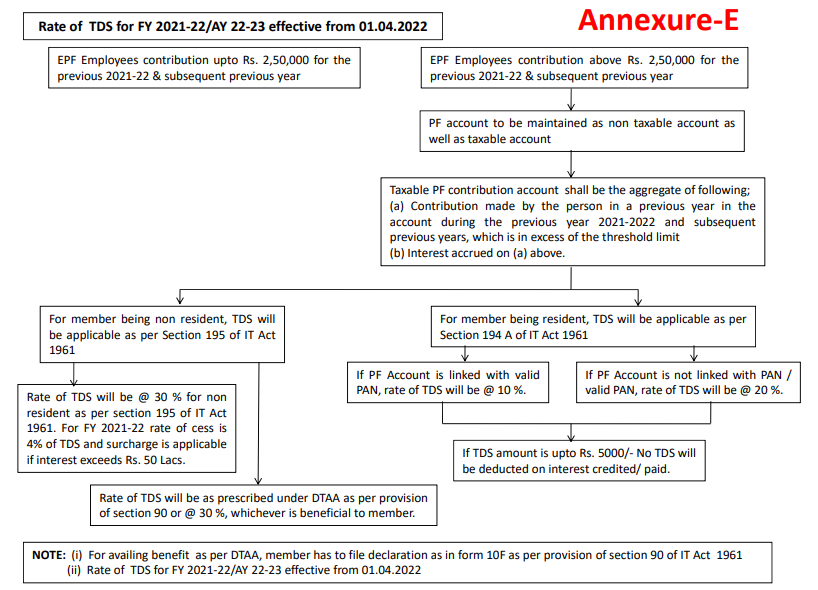
As per notification No. 95/2021 dated 31st August 2021, for calculating taxable interest, the PF department shall maintain separate accounts, one with taxable contribution and another with non-taxable contribution, for all the subscribers starting from the financial year 2021-22 and onwards. 

The taxpayer shall be liable to pay tax on the interest accrued in the taxable contribution account. The EPFO shall deduct TDS on such interest. 

Under what Circumstances will TDS on interest be deducted?

TDS will be deducted at 10% on taxable interest income accrued above the threshold limit during the year as per Section 194A of the IT Act. 

What is the Threshold Limit on Interest income above which TDS will be deducted?

For resident Indians, TDS is deductible if the interest accrued in the PF account for the financial year exceeds Rs 5,000. 

However, for non-residents, there is no threshold limit. Tax is deductible even if the interest income for the year is less than Rs 5,000.

Do Employees need to Pay tax if TDS is deducted?

The employee shall pay tax on the interest accrued on the taxable portion of the PF contribution. The amount of taxable PF interest should be added as income under the head ‘income from other sources’ on which tax shall be calculated as per the applicable income tax slab rates. The employee can claim a tax credit for the TDS deducted from the interest income.

To know the amount of taxable PF interest, the employee can view the PF account statement. To know how to view the PF account statement, click here. 

The New TDS Rule

The new TDS rule shall apply to all the below:-

  • Exempted establishments
  • Unexempted establishments
  • Exempted trusts
  • In the case of the death of PF members
  • International workers

When will the TDS be Deducted?

TDS on the taxable interest of the PF account shall be deducted in the following scenarios-

  • At the time of processing the annual accounts of EPFO,
  • PF payment during the year to outgoing members on a final settlement, 
  • Transfer claims for transfer from exempted establishments to EPFO and vice versa, 
  • Transfer claims for transfer from one trust to another, and 
  • Transfer of past accumulations.

Who is Liable to deduct TDS on Taxable PF interest?

The TDS on taxable interest on the PF account shall be deducted as per Section 194A of the Income Tax Act. The law states that the payer of the income should deduct TDS. Hence, the payer of interest on the PF account is the provident fund department and not the employer. Therefore, TDS will be deducted by EPFO and deposited to the government. Further, the EPFO will issue Form 16A for the same.

What is the Date of TDS Deduction on Taxable PF interest?

The new TDS rule will apply to the government and private sector employees on contributions from the financial year 2021-22 and subsequent years. No TDS will be applicable on past accumulation till 31st March 2021. It will be applicable to contributions made from 1st April 2021, which exceed the threshold limit of Rs 2.5 lakh.

If the case does not include a final settlement or transfer, the PF department will deduct tax at source (TDS) on the date of credit of interest on the EPF account. The PF department credits interest in the PF account at the end of the financial year.

In any other case such as final settlement, transfer claims, on transfer from EPFO to exempted establishments, and vice versa, the TDS shall be deducted either on 1st April 2024 or on final settlement or on the transfer date, whichever is later.

What is the Rate of TDS deduction on Taxable interest on EPF Contributions? 

  • For resident Indians-

If PF account is linked with a valid PAN, then TDS rate will be 10%.  

If PF account is not linked with PAN, then the TDS rate will double to 20%.

However, for resident Indians, the TDS will be deducted only if the interest amount exceeds Rs 5,000.

  • For non-residents

The TDS will be deducted at 30%, and it shall be deducted under Section 195 of the Income Tax Act. However, if the rate of TDS specified under the Double Taxation Avoidance Agreement (DTAA) is beneficial to PF members, then such a rate will be applicable. The TDS rate is also 30% if the PF account is not linked with PAN.

There is a 4% cess of TDS amount and surcharge applicable to non-residents. However, a cess of 4% and a surcharge will not be applicable if the TDS is deducted as per DTAA provisions.

For the FY 2023-24, the applicable surcharge rates on NRIs’ interest income are specified below:

Note: The surcharge will be limited to 25% if he opts to pay tax under the new regime.

How will non-resident members claim to benefit from double taxation on taxable interest?

To avail of DTAA benefits, the member must obtain a Tax Residency Certificate (TRC) by filing Form 10F to the income tax department. On receipt application in Form 10F, the Assessing Officer may issue a TRC in Form 10FB on being satisfied on this behalf. Based on such TRC, the non-resident member can claim the benefit from double taxation.

What if there is interest-on-interest from the excess PF contribution? Will it be taxed in future years too?

As per the current accounting system followed by EPFO, interest is credited on an annual basis. The government notifies the EPF interest rates at the end of the relevant financial year. If the EPF and VPF contribution is more than Rs 2.5 lakh during the financial year, the TDS needs to be deducted from the interest accrued on the taxable portion of the PF contribution. 

In the subsequent years, the previous years’ accumulations of the taxable account will be brought forward, and the interest accrued on the opening balance and current years’ contribution (contribution above the threshold limit of Rs 2.5 lakh) of the taxable account shall be taxable.

The interest accrued on the brought forward balance of a non-taxable account will be exempt from tax.

Illustration

Illustration 1- Normal scenario

Mr Q is a salaried employee who contributes Rs 30,000 monthly to the EPF account. The closing balance of his PF account as of 31st March 2023 is Rs 50,00,000.

The calculation of taxable and non-taxable PF interest will be as under:

Period(FY 2023-24)Monthly contribution (Rs.)Cumulative balance at the end of the monthInterest accrued at 8.25% in
  Non-taxable account (Rs)Taxable account (Rs)Non-taxable account (Rs)Taxable account (Rs)
April30,00030,00002060
May30,00060,00004130
June30,00090,00006190
July 30,0001,20,00008250
August30,0001,50,00001,0310
September30,0001,80,00001,2380
October30,0002,10,00001,4440
November30,0002,40,00001,6500
December30,0002,50,00020,0001,719138
January30,0002,50,00050,0001,719344
February30,0002,50,00080,0001,719550
March30,0002,50,0001,10,0001,719756
Balance as on 31.03.24 2,50,0001,10,00014,3001,788

TDS would be deducted as per the below working:
 

ParticularsNon-taxable account
(Amount in Rs.)
Taxable account
(Amount in Rs.)
Carried forward balance as on 31.03.202350,00,0000
Interest accrued on opening balance4,125,000
Total contribution during the FY 2023-242,50,0001,10,000
Interest accrued during the FY 2023-2414,3001,788
Total amount in the accounts to carry forward next year56,76,8001,11,788
TDS @10% (1788 x 10%)0179
Opening balance as on 01.04.202456,76,8001,11,788-179
= 1,11,609
 

We can see that TDS at 10% is deducted on the interest amount of Rs 1,788 accrued in the taxable account. 

If the member’s PAN is not linked to the PF account, TDS should be deducted at 20%.
 

Illustration 2- If funds withdrawn from the PF account

When the member withdraws any amount from the EPF account, firstly, the funds will be withdrawn from the taxable account and thereafter from the non-taxable account.

Let’s calculate the taxable and non-taxable portion of the PF account interest, and TDS calculation.

FY 2023-24

Period(FY 2023-24)Monthly contribution (Rs)Cumulative balance at the end of the monthInterest accrued at 8.25% in
  Non-taxable account (Rs)Taxable account (Rs)Non-taxable account (Rs)Taxable account (Rs)
April40,00040,00002750
May 40,00080,00005500
June40,0001,20,00008250
July40,0001,60,00001,1000
August40,0002,00,00001,3750
September40,0002,40,00001,6500
October40,0002,50,00030,0001,719206
November40,0002,50,00070,0001,719481
December40,0002,50,0001,10,0001,719756
January40,0002,50,0001,50,0001,7191,031
Withdrawal -1,10,000-1,50,000  
February40,0001,80,00001,2380
March40,0002,20,00001,5130
Balance as on 31.03.24 2,20,000015,4002,475

We can see that the withdrawals from the PF account was first fully adjusted from the taxable account and then from the non-taxable account.

TDS would be deducted as per the below working:

ParticularsNon-taxable account
(Amount in Rs)
Taxable account
(Amount in Rs)
Carried forward balance as on 31.03.202450,00,0000
Interest accrued on opening balance4,12,5000
Total contribution during the FY 2024-253,30,0001,50,000
Withdrawals during the FY 2024-25-1,10,000-1,50,000
Interest accrued during the FY 2024-2515,4002,475
Total funds in the accounts to carry forward next year56,47,9002475
TDS @10% (2,430 x 10%)0247
Balance carried forward to next year56,47,9002,430-247
= 2,228

Taxable Interest calculation for the next year.

In the next financial year, if the employee continues to contribute Rs 40,000 monthly  to the PF account, i.e. FY 2024-25, and withdraws Rs 4 lakh in June 24, the taxable interest would be calculated in the following manner:

(Assumption: 8.25 % interest rate for the FY 2024-25)

FY 2024-25

Period (FY 2024-25)Monthly contribution (Rs)Cumulative balance at the end of the monthInterest accrued at 8.25% in
  Non-taxable account (Rs)Taxable account (Rs)Non-taxable account (Rs)Taxable account (Rs)
April40,00040,00002750
May 40,00080,00005500
June40,0001,20,00008250
 (As per below working)-1,20,000000
July40,00040,00002750
August 40,00080,00005500
September40,0001,20,00008250
October40,0001,60,00001,1000
November40,0002,00,00001,3750
December40,0002,40,00001,6500
January40,0002,50,00030,0001,719203
February40,0002,50,00070,0001,719473
March40,0002,50,0001,10,0001,719743
Balance as on 31.03.25 2,50,0001,10,00014,3001,788

Calculation of total interest accrued during the year:

ParticularsNon-Taxable accountTaxable account
 Opening Balance (Rs)During the year transactions (Rs)Opening Balance (Rs)During the year transactions (Rs)
EPF contribution up to June 24 (A)56,47,9001,20,0002,2280
Funds withdrawn inJune, 242,77,772
(4,00,000-1,20,000-2,228)
-1,20,000-2,2280
Balance after withdrawals (B)53,70,128000
Interest accrued Apr 24-Jun 24 (8.25% of A)1,16,4881,650
(as per table above)
460
EPF contributionJul 24-Mar 25 (C)02,50,00001,10,000
Interest accrued Jul 24-Mar 25 (8.25% of B)3,32,27710,932
(as per table above)
01,788 
(as per table above)
Total Interest accrued during the year (D)4,48,76512,582461,788

Calculation of TDS deducted:

ParticularsNon-taxable account 
(Amount in Rs)
Taxable account
(Amount in Rs)
Total funds in the accounts to carry forward next year (A+B+C+D)60,81,4751,11,834
TDS @10% ((1,788 + 46)x 10%)0184
Balance carried forward to next year60,81,4751,11,834-184
= 1,11,650

Flow chart
 

Annexure-E

Tax on EPF withdrawals

If EPF is withdrawn after five years of continuous service, then no tax is required to be paid on the contribution amount and interest received on the same. However, If you withdraw money in case of emergencies (we’ll talk about it) before a specified period of 5 years, then in that case, you won’t be exempted from tax. And the PF department will deduct TDS on EPF withdrawn before five years of continuous service at 10%.
 

Illustration 

Mr. Ram’s total PF contribution (including interest) is Rs.5,50,000 as on 31st March 2023. Ram works in a company registered under EPFO and contributed Rs.3,50,000 to his EPF account in FY 2023-24. He received an interest of 8.25% on his contribution.

Now calculate his taxable and non-taxable contributions for FY 2023-24

ParticularsTaxable contributionNon-Taxable contribution
Closing balance, including interest, as on 31st March 5,50,000
The contribution made in FY 2023-241,00,0002,50,000
Interest accrued for FY 2023-248,25020,625
Total1,08,2508,20,625

Taxation of Interest on EPF Contribution Exceeding Rs 2.5 lakh

The interest earned on the EPF contribution by the employees is generally exempt from tax. However, in Budget 2021 it was proposed to make the interest earned on the PF contributions exceeding Rs. 2,50,000 in a financial year taxable. However, for government employees this limit is Rs. 5 lakh. 

Read this article to understand more about the taxability of interest on EPF contributions. 

What is EPF?

Employee Provident Fund (EPF) is a retirement benefits scheme for salaried employees. The Employees Provident Fund Organisation (EPFO) manages this scheme. Every factory/organisation having 20 or more employees must register under the EPFO. Some organisations with fewer than 20 employees can obtain EPF registration voluntarily.

All employees, including regular and contractual workers, whose wages are up to Rs 15,000 should be enrolled in the EPF by the organization.

After registration, the employee needs to contribute to the fund and the employer will also make a matching contribution. The employees cannot register for EPF on their own. So if the employee who is drawing a salary more than Rs 15,000 wishes to contribute to EPF account, they can do so with the consent of their employer.

Latest Update on Withdrawal Limit

To ensure quicker access of funds to its members, the EPFO has announced that the threshold limit for auto-settlement for advance claims has been increased from Rs. 1 lakh to Rs. 5 lakh.  

Some Important Features of the EPF Scheme

The following are some of the important features of the EPF Scheme:

  • The employee should make EPF contributions of Rs 1,800 or 12% on the basic salary and the dearness allowance, whichever is lower. Most companies deduct 12% of salary + DA.
  • The employer must also make an equal contribution to the EPF account. 
  • However, the EPF contributions are payable at a maximum wage ceiling of Rs 15,000 per month. Therefore, some employers make the minimum contribution of Rs 1,800 per month (12% of Rs 15,000) to increase the in-hand salary of the employee. However, most employers choose to contribute 12% of basic salary + DA.
  • The employee can contribute at a higher rate via VPF (voluntary provident fund), but the employer is not under any obligation to match contributions above 12% of basic salary + DA. 
  • The interest on the PF contribution is credited to the PF account at the end of the financial year. The EPF interest rates are fixed by the government each year. 
  • Usually, interest is credited to the EPF account after the financial year has ended. 
  • As per the EPFO guidelines, an organisation with less than 20 employees has to make an EPF contribution of 10% instead of 12%. 
  • After retirement, the employee will get a lump-sum retirement amount, which includes the contributions of both the employee and the employer with interest accrued.  

What is VPF?

An employee can voluntarily enhance the monthly PF contribution up to 100% of the basic salary as a Voluntary Provident Fund (VPF). The employer is under no obligation to match this excess contribution (beyond 12% of the basic salary + DA). This amount would be credited to the same EPF account as there is no separate account for VPF, and the interest offered would be the same as EPF.

What are the Taxation Rules for Income from EPF Contributions?

Tax on interest credited to EPF account

After Budget 2021, interest on an employee’s contribution to an EPF account above Rs 2.5 lakh during the financial year is taxable in the hands of the employee. This interest is also subject to TDS. 

This rule will only apply to the contributions made by the employee, while contributions made by the employer will not be taxed. The calculation of interest on the threshold limit of Rs 2.5 lakh shall also include VPF contributions.

For example, an employee’s basic salary (no dearness allowance) is Rs 50,000 per month. The employer deducts 12% of the employee’s basic salary, i.e., Rs 6,000 towards EPF contribution. However, the employee voluntarily contributes Rs 3.28 lakh in VPF during the financial year. Hence, the employee’s total EPF contribution during the financial year will be Rs 4 lakh (Rs 6,000 x 12 + Rs 3.28 lakh).

The employee will be required to pay tax on interest accrued/earned on the excess contribution of Rs 2.5 lakh [Rs 72,000(EPF) + Rs 3.28 lakh(VPF) – Rs 2.5 lakh]. 

In the case of government employees who contribute to GPF, the threshold of Rs 2.5 lakh has been raised to Rs 5 lakh. That is to say interest on GPF contribution in excess of Rs 5 lakh will be taxable for the employee. 

Before FY 2021-22, the interest credited to the EPF account on any amount of contribution was tax-free. Now a cap of Rs 2.5 lakh has been introduced, interest on contributions beyond this shall be taxable.  

Tax Deduction on Contribution to EPF Account

An employee’s contribution to the EPF account is allowed as a deduction up to Rs 1.5 lakh under Section 80C of the IT Act. 

From FY 2020-21 onwards, the employer’s contribution to the EPF account shall become taxable if the contribution to EPF, NPS and/or superannuation fund exceeds Rs 7.5 lakh in a financial year. The excess contribution will become taxable. The employer needs to calculate the amount that will be taxed as a prerequisite, and this will be reflected in the employee’s Form 16.

Effective Date

This amendment has got applicable from 1st April 2021. It means the interest on the employee’s EPF contributions above Rs 2.5 lakh shall be taxable for the FY 2024-25 also.

How to Calculate the Taxable Portion of EPF interest?

As per notification No. 95/2021 dated 31st August 2021, for calculating taxable interest, the PF department shall maintain separate accounts, one with taxable contribution and another with non-taxable contribution, for all the subscribers starting from the financial year 2021-22 and onwards. 

The taxpayer shall be liable to pay tax on the interest accrued in the taxable contribution account. The EPFO shall deduct TDS on such interest. 

Under what Circumstances will TDS on interest be deducted?

TDS will be deducted at 10% on taxable interest income accrued above the threshold limit during the year as per Section 194A of the IT Act. 

What is the Threshold Limit on Interest income above which TDS will be deducted?

For resident Indians, TDS is deductible if the interest accrued in the PF account for the financial year exceeds Rs 5,000. 

However, for non-residents, there is no threshold limit. Tax is deductible even if the interest income for the year is less than Rs 5,000.

Do Employees need to Pay tax if TDS is deducted?

The employee shall pay tax on the interest accrued on the taxable portion of the PF contribution. The amount of taxable PF interest should be added as income under the head ‘income from other sources’ on which tax shall be calculated as per the applicable income tax slab rates. The employee can claim a tax credit for the TDS deducted from the interest income.

To know the amount of taxable PF interest, the employee can view the PF account statement. To know how to view the PF account statement, click here. 

The New TDS Rule

The new TDS rule shall apply to all the below:-

  • Exempted establishments
  • Unexempted establishments
  • Exempted trusts
  • In the case of the death of PF members
  • International workers

When will the TDS be Deducted?

TDS on the taxable interest of the PF account shall be deducted in the following scenarios-

  • At the time of processing the annual accounts of EPFO,
  • PF payment during the year to outgoing members on a final settlement, 
  • Transfer claims for transfer from exempted establishments to EPFO and vice versa, 
  • Transfer claims for transfer from one trust to another, and 
  • Transfer of past accumulations.

Who is Liable to deduct TDS on Taxable PF interest?

The TDS on taxable interest on the PF account shall be deducted as per Section 194A of the Income Tax Act. The law states that the payer of the income should deduct TDS. Hence, the payer of interest on the PF account is the provident fund department and not the employer. Therefore, TDS will be deducted by EPFO and deposited to the government. Further, the EPFO will issue Form 16A for the same.

What is the Date of TDS Deduction on Taxable PF interest?

The new TDS rule will apply to the government and private sector employees on contributions from the financial year 2021-22 and subsequent years. No TDS will be applicable on past accumulation till 31st March 2021. It will be applicable to contributions made from 1st April 2021, which exceed the threshold limit of Rs 2.5 lakh.

If the case does not include a final settlement or transfer, the PF department will deduct tax at source (TDS) on the date of credit of interest on the EPF account. The PF department credits interest in the PF account at the end of the financial year.

In any other case such as final settlement, transfer claims, on transfer from EPFO to exempted establishments, and vice versa, the TDS shall be deducted either on 1st April 2024 or on final settlement or on the transfer date, whichever is later.

What is the Rate of TDS deduction on Taxable interest on EPF Contributions? 

  • For resident Indians-

If PF account is linked with a valid PAN, then TDS rate will be 10%.  

If PF account is not linked with PAN, then the TDS rate will double to 20%.

However, for resident Indians, the TDS will be deducted only if the interest amount exceeds Rs 5,000.

  • For non-residents

The TDS will be deducted at 30%, and it shall be deducted under Section 195 of the Income Tax Act. However, if the rate of TDS specified under the Double Taxation Avoidance Agreement (DTAA) is beneficial to PF members, then such a rate will be applicable. The TDS rate is also 30% if the PF account is not linked with PAN.

There is a 4% cess of TDS amount and surcharge applicable to non-residents. However, a cess of 4% and a surcharge will not be applicable if the TDS is deducted as per DTAA provisions.

For the FY 2023-24, the applicable surcharge rates on NRIs’ interest income are specified below:

Note: The surcharge will be limited to 25% if he opts to pay tax under the new regime.

How will non-resident members claim to benefit from double taxation on taxable interest?

To avail of DTAA benefits, the member must obtain a Tax Residency Certificate (TRC) by filing Form 10F to the income tax department. On receipt application in Form 10F, the Assessing Officer may issue a TRC in Form 10FB on being satisfied on this behalf. Based on such TRC, the non-resident member can claim the benefit from double taxation.

What if there is interest-on-interest from the excess PF contribution? Will it be taxed in future years too?

As per the current accounting system followed by EPFO, interest is credited on an annual basis. The government notifies the EPF interest rates at the end of the relevant financial year. If the EPF and VPF contribution is more than Rs 2.5 lakh during the financial year, the TDS needs to be deducted from the interest accrued on the taxable portion of the PF contribution. 

In the subsequent years, the previous years’ accumulations of the taxable account will be brought forward, and the interest accrued on the opening balance and current years’ contribution (contribution above the threshold limit of Rs 2.5 lakh) of the taxable account shall be taxable.

The interest accrued on the brought forward balance of a non-taxable account will be exempt from tax.

Illustration

Illustration 1- Normal scenario

Mr Q is a salaried employee who contributes Rs 30,000 monthly to the EPF account. The closing balance of his PF account as of 31st March 2023 is Rs 50,00,000.

The calculation of taxable and non-taxable PF interest will be as under:

Period(FY 2023-24)Monthly contribution (Rs.)Cumulative balance at the end of the monthInterest accrued at 8.25% in
  Non-taxable account (Rs)Taxable account (Rs)Non-taxable account (Rs)Taxable account (Rs)
April30,00030,00002060
May30,00060,00004130
June30,00090,00006190
July 30,0001,20,00008250
August30,0001,50,00001,0310
September30,0001,80,00001,2380
October30,0002,10,00001,4440
November30,0002,40,00001,6500
December30,0002,50,00020,0001,719138
January30,0002,50,00050,0001,719344
February30,0002,50,00080,0001,719550
March30,0002,50,0001,10,0001,719756
Balance as on 31.03.24 2,50,0001,10,00014,3001,788

TDS would be deducted as per the below working:
 

ParticularsNon-taxable account
(Amount in Rs.)
Taxable account
(Amount in Rs.)
Carried forward balance as on 31.03.202350,00,0000
Interest accrued on opening balance4,125,000
Total contribution during the FY 2023-242,50,0001,10,000
Interest accrued during the FY 2023-2414,3001,788
Total amount in the accounts to carry forward next year56,76,8001,11,788
TDS @10% (1788 x 10%)0179
Opening balance as on 01.04.202456,76,8001,11,788-179
= 1,11,609
 

We can see that TDS at 10% is deducted on the interest amount of Rs 1,788 accrued in the taxable account. 

If the member’s PAN is not linked to the PF account, TDS should be deducted at 20%.
 

Illustration 2- If funds withdrawn from the PF account

When the member withdraws any amount from the EPF account, firstly, the funds will be withdrawn from the taxable account and thereafter from the non-taxable account.

Let’s calculate the taxable and non-taxable portion of the PF account interest, and TDS calculation.

FY 2023-24

Period(FY 2023-24)Monthly contribution (Rs)Cumulative balance at the end of the monthInterest accrued at 8.25% in
  Non-taxable account (Rs)Taxable account (Rs)Non-taxable account (Rs)Taxable account (Rs)
April40,00040,00002750
May 40,00080,00005500
June40,0001,20,00008250
July40,0001,60,00001,1000
August40,0002,00,00001,3750
September40,0002,40,00001,6500
October40,0002,50,00030,0001,719206
November40,0002,50,00070,0001,719481
December40,0002,50,0001,10,0001,719756
January40,0002,50,0001,50,0001,7191,031
Withdrawal -1,10,000-1,50,000  
February40,0001,80,00001,2380
March40,0002,20,00001,5130
Balance as on 31.03.24 2,20,000015,4002,475

We can see that the withdrawals from the PF account was first fully adjusted from the taxable account and then from the non-taxable account.

TDS would be deducted as per the below working:

ParticularsNon-taxable account
(Amount in Rs)
Taxable account
(Amount in Rs)
Carried forward balance as on 31.03.202450,00,0000
Interest accrued on opening balance4,12,5000
Total contribution during the FY 2024-253,30,0001,50,000
Withdrawals during the FY 2024-25-1,10,000-1,50,000
Interest accrued during the FY 2024-2515,4002,475
Total funds in the accounts to carry forward next year56,47,9002475
TDS @10% (2,430 x 10%)0247
Balance carried forward to next year56,47,9002,430-247
= 2,228

Taxable Interest calculation for the next year.

In the next financial year, if the employee continues to contribute Rs 40,000 monthly  to the PF account, i.e. FY 2024-25, and withdraws Rs 4 lakh in June 24, the taxable interest would be calculated in the following manner:

(Assumption: 8.25 % interest rate for the FY 2024-25)

FY 2024-25

Period (FY 2024-25)Monthly contribution (Rs)Cumulative balance at the end of the monthInterest accrued at 8.25% in
  Non-taxable account (Rs)Taxable account (Rs)Non-taxable account (Rs)Taxable account (Rs)
April40,00040,00002750
May 40,00080,00005500
June40,0001,20,00008250
 (As per below working)-1,20,000000
July40,00040,00002750
August 40,00080,00005500
September40,0001,20,00008250
October40,0001,60,00001,1000
November40,0002,00,00001,3750
December40,0002,40,00001,6500
January40,0002,50,00030,0001,719203
February40,0002,50,00070,0001,719473
March40,0002,50,0001,10,0001,719743
Balance as on 31.03.25 2,50,0001,10,00014,3001,788

Calculation of total interest accrued during the year:

ParticularsNon-Taxable accountTaxable account
 Opening Balance (Rs)During the year transactions (Rs)Opening Balance (Rs)During the year transactions (Rs)
EPF contribution up to June 24 (A)56,47,9001,20,0002,2280
Funds withdrawn inJune, 242,77,772
(4,00,000-1,20,000-2,228)
-1,20,000-2,2280
Balance after withdrawals (B)53,70,128000
Interest accrued Apr 24-Jun 24 (8.25% of A)1,16,4881,650
(as per table above)
460
EPF contributionJul 24-Mar 25 (C)02,50,00001,10,000
Interest accrued Jul 24-Mar 25 (8.25% of B)3,32,27710,932
(as per table above)
01,788 
(as per table above)
Total Interest accrued during the year (D)4,48,76512,582461,788

Calculation of TDS deducted:

ParticularsNon-taxable account 
(Amount in Rs)
Taxable account
(Amount in Rs)
Total funds in the accounts to carry forward next year (A+B+C+D)60,81,4751,11,834
TDS @10% ((1,788 + 46)x 10%)0184
Balance carried forward to next year60,81,4751,11,834-184
= 1,11,650

Flow chart
 

Annexure-E

Tax on EPF withdrawals

If EPF is withdrawn after five years of continuous service, then no tax is required to be paid on the contribution amount and interest received on the same. However, If you withdraw money in case of emergencies (we’ll talk about it) before a specified period of 5 years, then in that case, you won’t be exempted from tax. And the PF department will deduct TDS on EPF withdrawn before five years of continuous service at 10%.
 

Illustration 

Mr. Ram’s total PF contribution (including interest) is Rs.5,50,000 as on 31st March 2023. Ram works in a company registered under EPFO and contributed Rs.3,50,000 to his EPF account in FY 2023-24. He received an interest of 8.25% on his contribution.

Now calculate his taxable and non-taxable contributions for FY 2023-24

ParticularsTaxable contributionNon-Taxable contribution
Closing balance, including interest, as on 31st March 5,50,000
The contribution made in FY 2023-241,00,0002,50,000
Interest accrued for FY 2023-248,25020,625
Total1,08,2508,20,625

EPF Higher pension contribution under EPS-95

In 1995, the Government introduced a pension scheme under Section 6A of the EPF Act. The Employees Pension Scheme, 1995 (EPS-95) provided that the employer’s contribution of 8.33% should be towards the pension scheme. The EPS-95 capped the maximum monthly pension at Rs.5,000 or Rs.6,000. Thus, employers had to contribute 8.33% of Rs.5,000, which was later raised to Rs.6,500, towards the pension scheme.

In March 1996, a provision was added to para 11(3) of the EPS-95, giving the employer and employee an option to contribute 8.33% of actual salary (above the cap of Rs.5,000 or Rs.6,500) to the EPS. Such a higher salary would be considered a pensionable salary. However, the EPFO gave six months for the employees to file a joint option form for higher pension contributions to the EPS.

The government amended the EPS-95 scheme effective from 01/09/2014. It increased the maximum pensionable salary to Rs.15,000. It also omitted the provision to para 11(3), i.e. exercise of the option by the employer and employee to contribute EPS on a higher salary amount.

Thus, employers would make an EPS contribution of 8.33% on a maximum of Rs.15,000 for the employees joining the EPF scheme after 01/09/2014, even when they draw a higher salary.

However, the employees who were part of EPS-95 or joined before 01/09/2014 could contribute 8.33% to EPS on the actual salary as against the cap of Rs.15,000 if they filed a new joint option with the EPFO within six months, i.e. 28/02/2015.

There were issues after the 2014 amendment regarding pension contributions on higher salaries. Many employees stated that they did know about the exercise of the joint option for contributing pension on the higher salary amount. The EPFO rejected the joint option filed by many employees. Employers contributed 8.33% of pension on employees’ actual salaries without filing the joint option, but the pensionable salary was taken as Rs.15,000 for pension calculation.

Thus, many employees filed cases in High Courts for receiving higher pensions based on the contributions made on actual salary amounts. The Supreme Court took up this matter. The summary of the Supreme Court decision is as follows:

Status of EmployeeExercise of joint option Eligibility to claim 8.33% pension contribution on a higher salaryMode of higher pension claim
Employees in service as on 01/09/2014 Exercised joint option and rejected by the EPFO Yes By filing a higher pension claim application
Employees in service as on 01/09/2014 Not exercised joint option but contributing to EPS above the cap of Rs.5,000/Rs,6,500YesBy exercising the joint option 
Employees retired before 01/09/2014Exercised joint option and rejected by the EPFOYesBy filing a higher pension claim application
Employees retired before 01/09/2014Not exercised joint option NoNot applicable

The Supreme Court provided that employees who were part of the EPF before 01/09/2014 but have not exercised the joint option can exercise it within 03/05/2023. The EPFO further extended the due date to 11/07/2023. For such employees, a higher EPS contribution will be calculated from the date of their joining. 

For example: 

  • Mr. ‘X’ became a member of the EPF in 1998.
  • He has not exercised the joint option.
  • His salary increased to Rs.50,000 in 2015.
  • His employer contributes Rs.6,000 (i.e. 12% of his basic wage) towards EPF. 
  • Of the employer’s contribution, Rs.1,250 (i.e. 8.33% of Rs.15,000; the statutory wage cap) will go to the EPS. 
  • The remaining Rs.4,750 (i.e. Rs.6,000 – Rs.1,250) will go to the EPF. 
  • He exercises the joint option within 11/07/2023 as per the Supreme Court judgement since the EPS contribution is above the statutory wage cap of Rs.6,500.
  • After submitting the joint option, his employer will contribute Rs.4,165 (i.e. 8.33% of Rs.50,000; his actual salary) and Rs.1,835 (Rs.6,000 – Rs.4,165) towards EPF.
  • The EPFO will calculate the monthly EPS amount of 8.33% of the actual salary and transfer the difference amount from the EPF to the EPS.

In such cases, the EPFO will return to the joining date or 01/11/1995, whichever is later, and transfer the difference from the PF account to the EPS account. But, the higher pension contribution will reduce the EPF lumpsum corpus that the employee gets upon retirement.

How to track EPFO higher pension application status?

You can check the status of the EPFO higher pension application by following the below steps:

Step 1: Visit the EPFO Unified Member portal.

Step 2: Click on the ‘Track Application Status for Pension on Higher Wages’.

Step 3: On the next page, click on ‘Click Here’ under the ‘Track application status for Pension on Higher Wages’ tab.

Step 4: Select and enter the application acknowledgement number, UAN number or PPO number.

Step 5: Enter the Captcha code, tick the consent and click on the ‘Get OTP’ button.

Step 6: Enter the OTP and click on ‘Get Status’. The application status will be displayed on the screen.

EPF higher pension eligibility

EPFO issued a circular in December 2022 providing the eligibility criteria and application process for claiming a higher pension. Below are the eligibility criteria for a higher pension:

  • The employees retired before 01/09/2014.
  • The employees exercised the joint option under para 11(3) of EPS-95 while being a member of EPS-95.
  • The employees and employers contributed EPS on salaries exceeding the wage ceiling of Rs.5,000 or Rs.6,500.
  • The EPFO declined the exercise of such an option.

However, the EPFO circular did not provide a higher pension option for employees who were part of the EPF before 01/09/2014 but still working/retired after 2014. As per the Supreme Court judgement, such employees were also eligible to claim a higher pension.

Thus, the EPFO issued another circular in February mentioning higher pension eligibility criteria for employees in service/retired after 2014. Below are the eligibility criteria to file a joint option for getting a higher pension:

  • The employees who were members before 01/09/2014 continued to be members after that date.
  • The employees and employers contributed to EPS on salaries exceeding the wage ceiling of Rs.5,000 or Rs.6,500.
  • The employees and employers were members of EPS-95 and did not exercise the joint option provided under the deleted para 11(3) of the EPS and amendment of 2014.

However, employees who were members of EPS-95 and exercised the joint options under the deleted para 11(3) of the EPS but did not file new joint options after the amendment of 2014 are not eligible to claim a higher pension. The EPS contributions of such employees will be 8.33% on the maximum amount of Rs.15,000, irrespective of their actual salaries.

EPF higher pension option form

The eligible employees who retired before 2014 can apply for a higher pension claim with the EPFO. They can apply for the higher pension claim online (as shown below) or with the regional EPF offices.

The eligible employees who joined EPS-95 but are retired/working after 2014 can apply the joint option form online (as shown below) or with the concerned regional EPF offices within 11/07/2023 to receive higher pensions.

How to apply for a higher pension in EPF?

Below is the step to claim a higher pension amount for employees retired before 2014:

Step 1: Employees need to visit the EPFO Unified Member portal.

Step 2: Click on the ‘Pension on Higher Salary: Online application for validation of Joint Option’ option.

Step 3: Fill in the details and submit the form.

The EPFO will digitally register each application and provide the receipt number to the applicant. It will forward the applications to the respective employers, who will verify them through e-sign/digital signature for further processing. The APFC/RPFC-II will examine the case and send the higher pension decision to the applicants via email, post, phone or SMS. 

The field officers will examine the application form. If the form is complete, the wage details submitted by the employers will be verified with the the field offices data. Where the field officers data and employers’ details match, the dues will be calculated and an order will be passed by RPFC-II/RPFC-I/APFC for depositing/transferring the dues. The cases where there is a mismatch, it will informed to the employer and the pensioner by the APFC/RPFC-II and one month time will be given to rectify the same. 

In case the application form is not approved by the employer, an opportunity will be given to the employer to provide additional proof/evidence or correct any mistakes/errors before rejection of the form. Such opportunity will be given for a period of one month and under intimation to the  pensioners.

How to apply for a joint option online pension form in EPF?

Below is the step to exercise/apply for joint option under para 11(3) and para 11(4) of EPS-95 to claim for higher pension for employees who are part of EPS-95 but are working or retired after 2014:

Step 1: Employees need to visit the EPFO Unified Member portal.

Step 2: Click on the ‘Pension on Higher Salary: Exercise of Joint Option under para 11(3) and para 11(4) of EPS-1995 on or before 3rd May 2023’ option.

Step 3: Fill in the details and submit the form.

The field officers will examine the joint option forms. If the form is complete, the wage details submitted by the employers will be verified with the the field offices data. Where the field officers data and employers’ details match, the dues will be calculated and an order will be passed by RPFC-II/RPFC-I/APFC for depositing/transferring the dues. The cases where there is a mismatch, it will informed to the employer and the employee by the APFC/RPFC-II and one month time will be given to rectify the same. 

In case the join option is not approved by the employer, an opportunity will be given to the employer to provide additional proof/evidence or correct any mistakes/errors before rejection of the form. Such opportunity will be given for a period of one month and under intimation to the employees.

EPFO guidelines for higher pension

  • The joint option/higher pension claim application should contain a disclaimer or declaration.
  • An employee should give explicit consent in the joint option/application form for a share adjustment from PF to EPS and a re-deposit of the amount.
  • An employee should give an undertaking of the trustee for a share transfer of funds from exempted PF trust to the EPFO pension fund. The undertaking will be effective for the deposit of due contribution and interest up to the payment date within the specified time.
  • The employer’s contribution share refund will be deposited with the interest rate declared under para 60 of the EPF Scheme, 1952, for employees of unexempted establishments.
  • The following documents should be submitted with the higher pension claim application:
    • Proof of joint option verified by the employer filed under para 26(6) of the EPF scheme.
    • Proof of joint option verified by the employer filed under para 11(3) provision.
    • Proof of remittance of EPS contribution in the PF account exceeding the current wage limit of Rs.6,500 or Rs.5,000.
    • Written refusal of APFC or EPFO to such remittance or request.
  • The following documents should be submitted with the joint option application:
    • Proof of remittance of EPS contribution in the PF account exceeding the current wage limit of Rs.6,500 or Rs.5,000.
    • Proof of joint option verified by the employer filed under para 26(6) of the EPF scheme.
  • The EPFO will issue further circulars regarding the deposit method and pension computation.
  • An employee can raise a complaint on EPFiGMS when they face a grievance to get a higher pension after submitting the application and payment of the due contribution if any.

EPF higher pension calculation formula

Calculation of higher pension for employees retired before 2014:

The average monthly pay earned during the contributory period of service in the 12 months before leaving EPFO is considered to determine the pension amount.

Calculation of higher pension for employees retired after 2014:

The average monthly pay earned during the contributory period of service in the 60 months before leaving EPFO is taken into account to determine the pension amount.

Current formula for calculating pension under the EPS scheme is as follows: 

(Average salary of 60 months x service period)/70

epf pension calculator

Latest Update

Employees Pension Scheme 1995 amended to provide withdrawal benefit to members having less than 6 months service; Amendment to benefit more than 7 lakh EPS members every year

Government of India has amended the Employees’ Pension Scheme (EPS), 1995 to ensure that EPS members with less than 6 months of contributory service also receive withdrawal benefit. This amendment will benefit more than 7 lakh EPS members every year who leave the scheme with less than 6 months of contributory service.

Further, the Central Government has modified the Table D and has ensured that every completed month of service rendered is taken into account to give proportionate withdrawal benefit to the members. The amount of withdrawal benefit will henceforth depend upon the number of completed months of service rendered by the member and the wages on which EPS contribution was received. The above measure has rationalized the payment of withdrawal benefit to members. It is estimated that every year more than 23 lakh members will benefit from this modification of the Table D.

Every year, lakhs of EPS 95 members leave the scheme prior to rendering the requisite 10 years of contributory service for pension. Such members are given withdrawal benefit as per the provisions of the Scheme.

More than 30 lakh withdrawal benefit claims were settled in the financial year 2023-24.

Till now, the withdrawal benefit was being calculated on the basis of the period of contributory service in completed years and the wages on which EPS contribution has been paid.

Therefore, only after completing 6 months and above of contributory service, the members were entitled for such withdrawal benefit. Consequently, the members leaving scheme, before contributing for 6 months or more, used to get no withdrawal benefit. This was a cause of many claim rejections and grievances as many members were exiting without having less than 6 months of contributory service. During the financial year 2023-24, approximately 7 lakh claims for withdrawal benefits were rejected due to contributory service being less than 6 months. Henceforth, all such EPS members who have not attained the age of 58 years as on 14.06.2024 will become entitled for withdrawal benefit.

Earlier, the calculation under erstwhile Table D ignored the fractional period of service rendered for less than 6 months after each completed year. This resulted in lesser amount of withdrawal benefit in many cases. With the modification of Table D, the Contributory service for calculating the withdrawal benefit will be now considered in completed months. This will ensure fair payment of withdrawal benefit. E.g. a member taking withdrawal benefit after 2 years and 5 months of contributory service & wages of 15,000/- per months was earlier entitled to Rs. 29,850/- withdrawal benefit. Now he will receive Rs. 36,000/- withdrawal benefit.

Higher pension contribution under EPS-95

In 1995, the Government introduced a pension scheme under Section 6A of the EPF Act. The Employees Pension Scheme, 1995 (EPS-95) provided that the employer’s contribution of 8.33% should be towards the pension scheme. The EPS-95 capped the maximum monthly pension at Rs.5,000 or Rs.6,000. Thus, employers had to contribute 8.33% of Rs.5,000, which was later raised to Rs.6,500, towards the pension scheme.

In March 1996, a provision was added to para 11(3) of the EPS-95, giving the employer and employee an option to contribute 8.33% of actual salary (above the cap of Rs.5,000 or Rs.6,500) to the EPS. Such a higher salary would be considered a pensionable salary. However, the EPFO gave six months for the employees to file a joint option form for higher pension contributions to the EPS.

The government amended the EPS-95 scheme effective from 01/09/2014. It increased the maximum pensionable salary to Rs.15,000. It also omitted the provision to para 11(3), i.e. exercise of the option by the employer and employee to contribute EPS on a higher salary amount.

Thus, employers would make an EPS contribution of 8.33% on a maximum of Rs.15,000 for the employees joining the EPF scheme after 01/09/2014, even when they draw a higher salary.

However, the employees who were part of EPS-95 or joined before 01/09/2014 could contribute 8.33% to EPS on the actual salary as against the cap of Rs.15,000 if they filed a new joint option with the EPFO within six months, i.e. 28/02/2015.

There were issues after the 2014 amendment regarding pension contributions on higher salaries. Many employees stated that they did know about the exercise of the joint option for contributing pension on the higher salary amount. The EPFO rejected the joint option filed by many employees. Employers contributed 8.33% of pension on employees’ actual salaries without filing the joint option, but the pensionable salary was taken as Rs.15,000 for pension calculation.

Thus, many employees filed cases in High Courts for receiving higher pensions based on the contributions made on actual salary amounts. The Supreme Court took up this matter. The summary of the Supreme Court decision is as follows:

Status of EmployeeExercise of joint option Eligibility to claim 8.33% pension contribution on a higher salaryMode of higher pension claim
Employees in service as on 01/09/2014 Exercised joint option and rejected by the EPFO Yes By filing a higher pension claim application
Employees in service as on 01/09/2014 Not exercised joint option but contributing to EPS above the cap of Rs.5,000/Rs,6,500YesBy exercising the joint option 
Employees retired before 01/09/2014Exercised joint option and rejected by the EPFOYesBy filing a higher pension claim application
Employees retired before 01/09/2014Not exercised joint option NoNot applicable

The Supreme Court provided that employees who were part of the EPF before 01/09/2014 but have not exercised the joint option can exercise it within 03/05/2023. The EPFO further extended the due date to 11/07/2023. For such employees, a higher EPS contribution will be calculated from the date of their joining. 

For example: 

  • Mr. ‘X’ became a member of the EPF in 1998.
  • He has not exercised the joint option.
  • His salary increased to Rs.50,000 in 2015.
  • His employer contributes Rs.6,000 (i.e. 12% of his basic wage) towards EPF. 
  • Of the employer’s contribution, Rs.1,250 (i.e. 8.33% of Rs.15,000; the statutory wage cap) will go to the EPS. 
  • The remaining Rs.4,750 (i.e. Rs.6,000 – Rs.1,250) will go to the EPF. 
  • He exercises the joint option within 11/07/2023 as per the Supreme Court judgement since the EPS contribution is above the statutory wage cap of Rs.6,500.
  • After submitting the joint option, his employer will contribute Rs.4,165 (i.e. 8.33% of Rs.50,000; his actual salary) and Rs.1,835 (Rs.6,000 – Rs.4,165) towards EPF.
  • The EPFO will calculate the monthly EPS amount of 8.33% of the actual salary and transfer the difference amount from the EPF to the EPS.

In such cases, the EPFO will return to the joining date or 01/11/1995, whichever is later, and transfer the difference from the PF account to the EPS account. But, the higher pension contribution will reduce the EPF lumpsum corpus that the employee gets upon retirement.

How to track EPFO higher pension application status?

You can check the status of the EPFO higher pension application by following the below steps:

Step 1: Visit the EPFO Unified Member portal.

Step 2: Click on the ‘Track Application Status for Pension on Higher Wages’.

Step 3: On the next page, click on ‘Click Here’ under the ‘Track application status for Pension on Higher Wages’ tab.

Step 4: Select and enter the application acknowledgement number, UAN number or PPO number.

Step 5: Enter the Captcha code, tick the consent and click on the ‘Get OTP’ button.

Step 6: Enter the OTP and click on ‘Get Status’. The application status will be displayed on the screen.

EPF higher pension eligibility

EPFO issued a circular in December 2022 providing the eligibility criteria and application process for claiming a higher pension. Below are the eligibility criteria for a higher pension:

  • The employees retired before 01/09/2014.
  • The employees exercised the joint option under para 11(3) of EPS-95 while being a member of EPS-95.
  • The employees and employers contributed EPS on salaries exceeding the wage ceiling of Rs.5,000 or Rs.6,500.
  • The EPFO declined the exercise of such an option.

However, the EPFO circular did not provide a higher pension option for employees who were part of the EPF before 01/09/2014 but still working/retired after 2014. As per the Supreme Court judgement, such employees were also eligible to claim a higher pension.

Thus, the EPFO issued another circular in February mentioning higher pension eligibility criteria for employees in service/retired after 2014. Below are the eligibility criteria to file a joint option for getting a higher pension:

  • The employees who were members before 01/09/2014 continued to be members after that date.
  • The employees and employers contributed to EPS on salaries exceeding the wage ceiling of Rs.5,000 or Rs.6,500.
  • The employees and employers were members of EPS-95 and did not exercise the joint option provided under the deleted para 11(3) of the EPS and amendment of 2014.

However, employees who were members of EPS-95 and exercised the joint options under the deleted para 11(3) of the EPS but did not file new joint options after the amendment of 2014 are not eligible to claim a higher pension. The EPS contributions of such employees will be 8.33% on the maximum amount of Rs.15,000, irrespective of their actual salaries.

EPF higher pension option form

The eligible employees who retired before 2014 can apply for a higher pension claim with the EPFO. They can apply for the higher pension claim online (as shown below) or with the regional EPF offices.

The eligible employees who joined EPS-95 but are retired/working after 2014 can apply the joint option form online (as shown below) or with the concerned regional EPF offices within 11/07/2023 to receive higher pensions.

How to apply for a higher pension in EPF?

Below is the step to claim a higher pension amount for employees retired before 2014:

Step 1: Employees need to visit the EPFO Unified Member portal.

Step 2: Click on the ‘Pension on Higher Salary: Online application for validation of Joint Option’ option.

Step 3: Fill in the details and submit the form.

The EPFO will digitally register each application and provide the receipt number to the applicant. It will forward the applications to the respective employers, who will verify them through e-sign/digital signature for further processing. The APFC/RPFC-II will examine the case and send the higher pension decision to the applicants via email, post, phone or SMS. 

The field officers will examine the application form. If the form is complete, the wage details submitted by the employers will be verified with the the field offices data. Where the field officers data and employers’ details match, the dues will be calculated and an order will be passed by RPFC-II/RPFC-I/APFC for depositing/transferring the dues. The cases where there is a mismatch, it will informed to the employer and the pensioner by the APFC/RPFC-II and one month time will be given to rectify the same. 

In case the application form is not approved by the employer, an opportunity will be given to the employer to provide additional proof/evidence or correct any mistakes/errors before rejection of the form. Such opportunity will be given for a period of one month and under intimation to the  pensioners.

How to apply for a joint option online pension form in EPF?

Below is the step to exercise/apply for joint option under para 11(3) and para 11(4) of EPS-95 to claim for higher pension for employees who are part of EPS-95 but are working or retired after 2014:

Step 1: Employees need to visit the EPFO Unified Member portal.

Step 2: Click on the ‘Pension on Higher Salary: Exercise of Joint Option under para 11(3) and para 11(4) of EPS-1995 on or before 3rd May 2023’ option.

Step 3: Fill in the details and submit the form.

The field officers will examine the joint option forms. If the form is complete, the wage details submitted by the employers will be verified with the the field offices data. Where the field officers data and employers’ details match, the dues will be calculated and an order will be passed by RPFC-II/RPFC-I/APFC for depositing/transferring the dues. The cases where there is a mismatch, it will informed to the employer and the employee by the APFC/RPFC-II and one month time will be given to rectify the same. 

In case the join option is not approved by the employer, an opportunity will be given to the employer to provide additional proof/evidence or correct any mistakes/errors before rejection of the form. Such opportunity will be given for a period of one month and under intimation to the employees.

EPFO guidelines for higher pension

  • The joint option/higher pension claim application should contain a disclaimer or declaration.
  • An employee should give explicit consent in the joint option/application form for a share adjustment from PF to EPS and a re-deposit of the amount.
  • An employee should give an undertaking of the trustee for a share transfer of funds from exempted PF trust to the EPFO pension fund. The undertaking will be effective for the deposit of due contribution and interest up to the payment date within the specified time.
  • The employer’s contribution share refund will be deposited with the interest rate declared under para 60 of the EPF Scheme, 1952, for employees of unexempted establishments.
  • The following documents should be submitted with the higher pension claim application:
    • Proof of joint option verified by the employer filed under para 26(6) of the EPF scheme.
    • Proof of joint option verified by the employer filed under para 11(3) provision.
    • Proof of remittance of EPS contribution in the PF account exceeding the current wage limit of Rs.6,500 or Rs.5,000.
    • Written refusal of APFC or EPFO to such remittance or request.
  • The following documents should be submitted with the joint option application:
    • Proof of remittance of EPS contribution in the PF account exceeding the current wage limit of Rs.6,500 or Rs.5,000.
    • Proof of joint option verified by the employer filed under para 26(6) of the EPF scheme.
  • The EPFO will issue further circulars regarding the deposit method and pension computation.
  • An employee can raise a complaint on EPFiGMS when they face a grievance to get a higher pension after submitting the application and payment of the due contribution if any.

EPF higher pension calculation formula

Calculation of higher pension for employees retired before 2014:

The average monthly pay earned during the contributory period of service in the 12 months before leaving EPFO is considered to determine the pension amount.

Calculation of higher pension for employees retired after 2014:

The average monthly pay earned during the contributory period of service in the 60 months before leaving EPFO is taken into account to determine the pension amount.

Current formula for calculating pension under the EPS scheme is as follows: 

(Average salary of 60 months x service period)/70

epf pension calculator

Latest Update

Employees Pension Scheme 1995 amended to provide withdrawal benefit to members having less than 6 months service; Amendment to benefit more than 7 lakh EPS members every year

Government of India has amended the Employees’ Pension Scheme (EPS), 1995 to ensure that EPS members with less than 6 months of contributory service also receive withdrawal benefit. This amendment will benefit more than 7 lakh EPS members every year who leave the scheme with less than 6 months of contributory service.

Further, the Central Government has modified the Table D and has ensured that every completed month of service rendered is taken into account to give proportionate withdrawal benefit to the members. The amount of withdrawal benefit will henceforth depend upon the number of completed months of service rendered by the member and the wages on which EPS contribution was received. The above measure has rationalized the payment of withdrawal benefit to members. It is estimated that every year more than 23 lakh members will benefit from this modification of the Table D.

Every year, lakhs of EPS 95 members leave the scheme prior to rendering the requisite 10 years of contributory service for pension. Such members are given withdrawal benefit as per the provisions of the Scheme.

More than 30 lakh withdrawal benefit claims were settled in the financial year 2023-24.

Till now, the withdrawal benefit was being calculated on the basis of the period of contributory service in completed years and the wages on which EPS contribution has been paid.

Therefore, only after completing 6 months and above of contributory service, the members were entitled for such withdrawal benefit. Consequently, the members leaving scheme, before contributing for 6 months or more, used to get no withdrawal benefit. This was a cause of many claim rejections and grievances as many members were exiting without having less than 6 months of contributory service. During the financial year 2023-24, approximately 7 lakh claims for withdrawal benefits were rejected due to contributory service being less than 6 months. Henceforth, all such EPS members who have not attained the age of 58 years as on 14.06.2024 will become entitled for withdrawal benefit.

Earlier, the calculation under erstwhile Table D ignored the fractional period of service rendered for less than 6 months after each completed year. This resulted in lesser amount of withdrawal benefit in many cases. With the modification of Table D, the Contributory service for calculating the withdrawal benefit will be now considered in completed months. This will ensure fair payment of withdrawal benefit. E.g. a member taking withdrawal benefit after 2 years and 5 months of contributory service & wages of 15,000/- per months was earlier entitled to Rs. 29,850/- withdrawal benefit. Now he will receive Rs. 36,000/- withdrawal benefit.

EPFO rules 2025: EPFO introduced 4 major reforms in 2025

The Employees Provident Fund Organisation (EPFO) introduced several reforms in 2025 to simplify and digitise the process. Here are the five most significant changes made by EPFO this year.

Digitisation of the joint declaration process

EPFO has digitised the joint declaration process from 16 January 2025 onwards. By linking the Universal Account Number (UAN) to Aadhaar, EPF members can finish the joint declaration online. However, if the UAN is not linked to Aadhaar, it becomes essential to submit the joint declaration physically.

Profile updation

A joint declaration is mandatory for employees to request changes to their profile details, which are verified by the employer. Hence, digitising the joint declaration helps with updating profile details such as name, date of birth, gender, nationality, parents’ names, marital status, spouse’s name, and other details online without any additional documents.

However, in certain cases for UANs created before 1 October 2017, members may need the approval of their employers.

Provident fund transfer for changing jobs

Earlier, transferring the provident fund when changing jobs required the approval of the employer. From 15 January 2025 onwards, the approval of the old or new employer is not necessary to transfer the provident fund.

Centralised Pension Payment System

EPFO implemented the Centralised Pension Payment System (CPPS) from 1 January 2025 onwards. This system allows pensioners to access their pensions from any bank nationwide, streamlining the process by removing physical verifications and decreasing the necessity for Pension Payment Order (PPO) transfers.

Previously, PPOs were shifted from one regional office to another for pension payment. Additionally, PPO is now compulsorily linked to UAN.

According to EPFO provisional payroll data for March 2025, there has been a net addition of 14.58 lakh members, a 1.15 per cent surge compared to March 2024. EPFO enrolled nearly 7.54 lakh new subscribers in March 2025, a 2.03 per cent increase from February 2025.

Latest update: EPFO, earlier this year, had decided to retain the interest rate of 8.25 per cent on employees‘ provident fund (EPF) deposits for the financial year 2024-25 (FY25)

EPS-95 Pension May Rise 8 Times – 7,500 Monthly Payouts

EPS-95 Pension: In a significant development for pensioners across India, the EPS-95 pension scheme is set for a substantial enhancement, with monthly payouts anticipated to reach ₹7,500 soon. This move is expected to bring much-needed financial relief to numerous retirees who have been awaiting an increase in their pensions.

Anticipating the EPS-95 Pension Increase

The Employees’ Pension Scheme (EPS-95), which has been a lifeline for many retired employees, is poised for a major revamp. This change is set to improve the quality of life for pensioners by increasing their monthly pension benefits, thus helping them meet the rising cost of living.

Key Highlights of the EPS-95 Pension Enhancement
  • Increase in monthly pension payouts to ₹7,500.
  • Improved financial security for retired employees.
  • Potential boost in the purchasing power of pensioners.
  • Implementation expected to roll out soon.

Understanding the Impact on Pensioners

The proposed hike in EPS-95 pension is not just a number; it represents a significant step towards acknowledging the hard work and dedication of retired employees. This increase will likely have a ripple effect on the economy as pensioners gain more financial freedom.

For many, this boost means better health care, the ability to afford essentials, and an overall improved standard of living. Additionally, it aligns with the government’s efforts to uplift the senior citizens of the country.

Benefits to Expect from the EPS-95 Pension Increase

EPS-95 Pension Scheme: A Closer Look

CategoryCurrent PensionProposed Pension
General Pensioners₹4,500₹7,500
Widow Pension₹3,500₹5,000
Disability Pension₹2,500₹4,000
Orphan Pension₹1,500₹2,500

How to Prepare for the New EPS-95 Pension

Pensioners should be proactive in understanding how this increase will affect them personally.

Steps to Take for Benefiting from the EPS-95 Increase

ActionDetails
Verify Pension AccountEnsure your pension account details are up-to-date.
Contact EPFOReach out to the Employee Provident Fund Organisation for queries.
Update Bank InformationConfirm that your bank details are correct.
Seek Financial AdviceConsider consulting a financial advisor for investment planning.
Stay InformedKeep abreast of any further announcements from the government.

Frequently Asked Questions

What is the EPS-95 pension scheme?

The EPS-95 pension scheme is a social security initiative for retired employees, providing them with a monthly pension post-retirement.

  • Who is eligible for the EPS-95 pension?
  • How will the pension increase affect current beneficiaries?
  • When is the new pension increase expected to be implemented?
  • What steps should pensioners take to ensure they receive the increased amount?

As the nation prepares for this significant change, it is crucial for pensioners to stay informed and take necessary actions to benefit from the increased EPS-95 pension. This enhancement marks a progressive step towards supporting the elderly population, ensuring their well-being and financial security.

Stay Updated: Keep an eye out for official notifications from the government regarding the implementation of the new EPS-95 pension rates.

Verify Your Details: Double-check your pension account and bank details to avoid any discrepancies in receiving the enhanced pension.

Contact Authorities: If you have any questions or concerns, don’t hesitate to reach out to the EPFO or your local pension office for assistance.

Plan Ahead: With the increased pension, consider planning your finances and investments to maximize benefits.

Spread the Word: Inform fellow pensioners about the upcoming changes to ensure everyone is prepared for the transition.

EPS Pension Hike to ₹7,500: Big Relief for Private Sector Employees

In a move that promises to bring substantial financial respite to millions of retired private-sector employees across India, the Employees’ Provident Fund Organisation (EPFO) is reportedly set to hike the minimum pension under the Employees’ Pension Scheme (EPS) to ₹7,500 per month. This potential increase from the current meager minimum of ₹1,000 has been a long-standing demand from pensioners and labor unions alike, who argue that the existing amount is woefully inadequate to cope with rising inflation and the increasing cost of living.  

For years, the plight of EPS pensioners, many of whom rely solely on this pension for their sustenance after dedicating decades to the private sector, has been a pressing issue. The current minimum pension, fixed at ₹1,000 in 2014, has remained unchanged despite significant economic shifts, leaving many retirees struggling to make ends meet, particularly with escalating healthcare expenses.  

The demand for a more dignified pension has gained significant momentum in recent times. Several meetings have been held between pensioner associations, labor organizations, and government representatives, including Finance Minister Nirmala Sitharaman. These discussions have highlighted the urgent need for a substantial increase to ensure a basic standard of living for the elderly population who have contributed to the nation’s economy.  

The proposed hike to ₹7,500 represents a significant step towards providing financial security and a sense of dignity to retired private-sector employees. If implemented, this increase is expected to have a far-reaching positive impact:

  • Improved Financial Independence: A higher pension will reduce the financial strain on retirees, allowing them to manage their daily expenses with greater ease and less dependence on their families.
  • Enhanced Quality of Life: With increased financial stability, pensioners will be better positioned to afford essential needs, including healthcare, nutrition, and housing, leading to an improved overall quality of life in their post-retirement years.
  • Increased Consumer Spending: A rise in pension payouts could also potentially boost the economy through increased consumer spending, particularly in sectors catering to senior citizens.
  • Social Security and Dignity: The hike acknowledges the contributions of these individuals to the workforce and provides them with a more respectable and secure retirement, reinforcing the government’s commitment to social welfare.

While the potential hike has been met with widespread enthusiasm, discussions are also underway regarding the financial implications and the sustainability of the scheme. The EPFO is currently assessing the fiscal ramifications of this significant increase. Considerations include the need for potential adjustments to contributions from both employers and employees to ensure the long-term viability of the EPS.

Eligibility and Entitlement:

Under the existing EPS rules, an employee who has completed at least 10 years of service in an establishment covered by the EPFO is eligible for a pension upon reaching 58 years of age. The proposed hike is expected to benefit both current pensioners and those who will retire in the future, provided the necessary regulatory changes are put in place.  

Looking Ahead:

The potential hike in the minimum EPS pension to ₹7,500 marks a crucial juncture in providing social security to private-sector retirees in India. While the final decision and implementation details are awaited, the ongoing discussions and the government’s apparent consideration of this long-pending demand offer a beacon of hope for a more financially secure and dignified retirement for millions. Pensioners and advocacy groups are keenly anticipating a formal announcement that will translate this proposal into a tangible reality, bringing much-needed relief and security to their lives.

New EPF Rules: EPFO Announces New Policies for 2025

Employees’ Provident Fund Organisation (EPFO) is set to introduce several key changes to its guidelines and services for members, with many of these updates expected to roll out in 2025. These revisions aim to provide greater convenience for both private sector and government employees while helping them better manage their retirement savings.

Key Changes in EPFO Rules

1. Change in Contribution Limits
Currently, employees contribute 12% of their basic salary to their EPF accounts, but there is a limit of ₹15,000. In the future, employees may be able to contribute based on their actual salary, allowing them to save more for retirement and receive a higher pension.

2. ATM Withdrawals for PF Money
Soon, EPFO members will be able to withdraw their provident fund money using an ATM card. This new service, which will be available by 2025-26, will make it easy for members to access their PF money anytime and anywhere.

Sumita Dawra, Secretary of the Labour Ministry, said that this change will improve services for workers by making it easier to access their provident funds.

3. Upgrade to EPFO IT System
EPFO is working on upgrading its IT systems to make the process of withdrawing funds faster and more efficient. The system upgrade is expected to be finished by June 2025, helping members get their claims settled quickly and reducing fraud.

4. Option for Equity Investment
EPFO is thinking about allowing members to invest their money in stocks directly (instead of just Exchange-Traded Funds, or ETFs). This could help members grow their savings faster and diversify their investments.

5. Easier Pension Withdrawals
Under new rules, pensioners will be able to withdraw their pensions from any bank in the country without needing extra verification. This will save time and offer more convenience for pensioners.

EPF Withdrawal Rules 2025

The EPF account consists of contributions from the employer and employee. However, the money in an EPF account cannot be withdrawn on a whim.

Here are some of the important rules about EPF withdrawal:

  • Money in the EPF account can be withdrawn only after retirement and not during employment unlike a bank account. 
  •  Partial withdrawal can be applied online and is applicable under emergencies such as medical treatment, higher education, purchase of residential house or construction. 
  • EPFO allows withdrawal of 90% of the EPF corpus 1 year before retirement, provided the person is not less than 54 years old. 
  • In case of unemployment before retirement due to lock-down or retrenchment, EPF corpus can be withdrawn. 
  • EPFO allows withdrawal of 75% of the corpus after 1 month of unemployment and transfer of the remaining 25% to the new EPF account after new employment
  • Tax exempted on EPF corpus withdrawal if an employee contributes to the EPF account for five continuous years. 
  • On premature withdrawal of the EPF corpus TDS will be deducted, but TDS will not be deducted if the entire amount is less than Rs.50,000. 
  • For premature withdrawal, TDS deduction will be 10% if PAN is submitted and it will be 30% plus tax if PAN not submitted. 
  • EPF status can be checked online, and it can be done directly through EPFO if the UAN and Aadhar is linked, and the employer has approved it. 
  • The EPF subscriber has to declare unemployment in order to withdraw the EPF amount.
  • As per the old rule, 100% EPF withdrawal is allowed after 2 months of unemployment.

Steps for EPF Withdrawal Online

Employees can make a PF withdrawal claim on the EPFO member portal by following the steps mentioned below. As already mentioned, if the employee has seeded his/her Aadhaar card details with one’s UAN account, they do not require the attestation of their employer to make a PF withdrawal.

Step 1: Visit the EPFO member portal.

Step 2: Choose the ‘For Employees’ option under the ‘Our Services’ tab.

Step 3: On the new webpage click on the ‘Member UAN/Online Service (OCS/OTCP)’ option under the ‘Services’ tab of the ‘For Employees’ page.

Step 4: This will redirect you to a new webpage. Log in to the portal using your UAN, password, and the Captcha code.

Step 5: Click on the ‘KYC’ option under the ‘Manage’ tab.

Step 6: You will be redirected to a new webpage. Scroll down to the bottom of the page to find the ‘Digitally Approved KYC’ section and check your KYC details. Ensure the details are correct.

Step 7: Click on the ‘Online Service’ tab from the top menu to proceed with the withdrawal if all the KYC details are correct.

Step 8: Click on the ‘CLAIM (FORM-31, 19 & 10C)’ option from the drop-down menu.

Step 9: You will be redirected to a new webpage with an automatically generated ‘ONLINE CLAIM (FORM 31, 19 & 10C)’ form.

Step 10: You will be required to enter the Last 4 digits of your registered bank account number and verify the same.

Step 11: After the verification of the bank account, a ‘Certificate of Undertaking’ will be generated. Click ‘Yes’ on the certificate pop-up to proceed.

Step 12: Click on the ‘Proceed for Online Claim’ option when prompted.

Step 13: For online fund withdrawal, select the ‘PF ADVANCE (FORM – 31)’ option from the drop-down menu provided next to the ‘I want to apply for’ option.

Step 14: A reason for a claim has to be selected from the drop-down options provided next to the ‘Purpose for which advance is required’ option. The fields provided for the address of the employee and the amount for an advance are also required to be filled in.

Step 15: Click on the checkbox at the end of the page and submit your withdrawal application.

Step 16: You might be required to upload certain scanned documents (depending on the nature of the withdrawal).

Step 17: Once the employer approves the withdrawal request, the withdrawal amount will be withdrawn from the EPF account and will be deposited to the respective bank account. Once the claim has been settled, you will receive an SMS notification on your registered mobile number.

Requirements for PF Withdrawal

To ensure the process of making a withdrawal is seamless, subscribers have to meet the requirements that are listed below, if they wish to carry out a withdrawal without the attestation of their employer.

  1. Subscribers have to ensure that their UAN is active, and their mobile number is seeded with their PF account.
  2. The PF member should also seed his/her Aadhaar card details with their PF account.
  3. The member’s bank account details and the bank’s IFSC code have to be integrated as well.
  4. For final settlements prior to the completion of 5 years in the EPF scheme, the member will be required to seed his/her PAN details.
  5. Check out for more about PF Withdrawal Guidelines

Steps to Enter Exit Date and Withdraw Your PF Easily

If the withdrawal of your Provident Fund (PF) is delayed, then it may happen due to the exit date not being mentioned. Hence, in order to avoid this, The Employees’ Provident Fund Organisation (EPFO) has come up with a facility in the Unified Portal where the employee can enter the date of exit from the previous employer by himself.

Previously, only the employer could enter the exit date, but now even employees can enter the date of exit.

You can change the exit date by logging in to the UAN portal using your Unified Account Number (UAN) and password. However, you must check whether the exit date is mentioned by clicking on ‘Service History‘ under ‘View‘ on the top panel.

Given below are the steps you will have to follow in order to enter the Exit Date:

Step 1: Log in to your UAN portal using your Unified Account Number and Password

Step 2: On the top panel, click on ‘Manage‘ and click on ‘Mark Exit‘ located under it

Step 3: From the drop-down option choose the employer

Step 4: You will be directed to a new page where you will have to enter your date of birth, date of joining, and date of exit. Mention the date of exit as the one mentioned in your resignation letter if your exit date is before the 15th day of the month

Tax-Free Limit for PF Withdrawals

You can get tax breaks when you withdraw money from your PF account. This, however, only applies if you withdraw after providing 5 years of continuous service. It is also decided by the tax bracket in which you fall. Tax deducted at source (TDS) or tax will be imposed on your money if you withdraw your PF balance before the end of the 5-year period.

However, no tax will be levied on EPF withdrawals before 5 years in certain cases depending on the situation.They are:

  1. When you need to withdraw funds for medical emergencies or health issues that cannot be avoided
  2. When your full PF amount is lower than Rs.50,000
  3. When you withdraw your PF balance with Form 15G or Form 15H (If you submit PAN, then there will be a TDS at 10%)
  4. When you transfer your PF balance from a PF account to another account
  5. When the employer’s business is withdrawn

Online Grievances Portal for PF Withdrawal

If you want to register any grievance regarding the services provided by the EPFO, you can visit the EPF grievance management system online. In this system, you can file a grievance, send a reminder, check the status of your complaint or grievance, upload your grievance document, or even change your password.

How to register a Grievance?

Step 1: You will have to go to the EPFO Grievance Management System and click on ‘Register Grievance.

Step 2: You will then see a grievance registration form. Here, you will have to fill all the required fields accurately.

Step 3: You will need to choose your status from the drop-down option.

Step 4: Next, you will have to key in your PF number, your establishment, the address of establishment, the name of the complainant, contact details, grievance details, etc. You can then enter the captcha code and click ‘Submit.

Types of EPFO Grievances

You can register a grievance when you face issues associated with:

  1. Return of cheque or misplacement of cheque
  2. Scheme certificate (10C)
  3. Transfer of your PF accumulations (F-13)
  4. Settlement of your pension (10-D)
  5. Provision of PF balance or PF slip
  6. Others

You can file a grievance online and then check its status on the portal itself. In case your complaint is not resolved within the stipulated period of time, you can send a reminder to them by clicking on ‘Send Reminder. Here, you will need to enter your grievance registration number and password (if you have any).

PF Withdrawal Claim Forms

The PF Withdrawal Claim Forms that must be submitted to withdraw the provident fund or pension fund differ according to the age of the employee, the cause for the claim, and whether or not the employee is still employed. Withdrawals were previously made using Form 19, Form 31, and Form 10C. However, the above-mentioned forms have lately been replaced by a composite claim form. The forms that required the employee’s UAN have been replaced by a composite claim form that requires the employee’s Aadhaar data.

As mentioned earlier, the PF claim form that needs to be submitted varies based on certain criteria.

Criteria for PF Withdrawal

1. When an employee is still under service

  1. If he/she wishes to take an advance from the PF account, the composite claim form (Aadhaar/Non-Aadhaar) has to be submitted.
  2. If he/she wishes to finance his/her LIC policy through the PF account, Form 14 has to be submitted.
  3. If he/she has crossed 58 years of age and wishes to claim the pension fund.
  4. Form 10D should be applied for a monthly pension if 10 years of eligible service has been completed.
  5. The composite claim form (Aadhaar/Non-Aadhaar) should be submitted if 10 years of eligible service has not been completed.

2. When an employee switches the job

  1. And wishes to transfer EPF account, Form 13 should be applied
  2. When an employee leaves an establishment and doesn’t join another
  3. He/she can make a PF and pension fund claim using the composite claim form (Aadhar/Non-Aadhar)
  4. Is above the age of 58 years, and has completed 10 years of eligible service, he/she can make a PF claim using the composite claim form (Aadhaar/Non-Aadhaar) and a pension claim using Form 10D

3. When an employee leaves an establishment due to a physical disability

  1. He/she can make a PF claim using a composite claim form (Aadhaar/Non-Aadhaar).
  2. He/she can make a pension claim using Form 10D.
  3. Is above the age of 58 years and has not completed 10 years of eligible service, he/she can make the PF and pension claim using the composite claim form (Aadhaar/Non-Aadhaar).

4. When an employee is deceased while in service

  1. Before the age of 58 years while still in service, the nominee/heir/beneficiary can apply for the PF settlement using Form 20, monthly pension using Form 10D, and EDLI (Employees’ Deposit Linked Insurance) amount using Form 5IF.
  2. After the age of 58 years and having completed 10 years of eligible service, the nominee/heir/beneficiary can claim the PF using Form 20, the pension using Form 10D, and the EDLI amount using Form 5IF.
  3. After the age of 58 years and had not completed 10 years of eligible service, the nominee/heir/beneficiary can make the PF settlement using Form 20, withdraw the pension using the composite claim form (Aadhaar/Non-Aadhaar), and claim the EDLI amount using Form 5IF.

5. When an employee is deceased

  1. Before the age of 58 years, the nominee/heir/beneficiary may claim the PF amount through Form 20, and the pension amount through Form 10D.
  2. After the age of 58 years and having completed 10 years of eligible service, the nominee/heir/beneficiary can claim the PF amount using Form 20, and the pension amount using Form 10D.
  3. After the age of 58 years and had not completed 10 years of eligible service at the age of 58 years, the nominee, heir or beneficiary can apply for a final PF settlement using Form 20 and for the pension fund using the composite claim form (Aadhaar/Non-Aadhaar).

Reasons for PF Withdrawal

The situations under which you can go ahead and withdraw money from your EPF while you are still working

  • Medical Treatment
  • Marriage purposes
  • Construction of house or purchase of property
  • Repaying the existing home loan
  • Education purposes
  • Alterations or repairs for your house

1. Medical Treatment

IYou can withdraw money from your EPF account to meet the financial requirements of a medical treatment, provided it meets the following conditions:

  1. Any major surgery in a particular hospital
  2. The hospitalisation period is more than a month
  3. The individual is suffering from Tuberculosis, Leprosy, Cancer, Mental Derangement, Paralysis, heart problems, etc. and is on leave that has been granted by the employer for the mentioned illness

You can actually withdraw the money in EPF at any given time during the period of your service. It is not needed that you to have completed a specific number of years in the organisation to claim that money. You can always draw the money for treatment purposes, even if you have completed one or two years in your present organisation.

You must also remember that the maximum amount that can be availed by you is your six months’ salary. This amount may not be very big, but it will offer you some help that you might need in a crisis situation. Not only can this advantage be taken anytime, but also, it can be enjoyed as many times as you want. Thus, your PF will save you for sure.

Certain documents must be provided by you along with Form 31

  1. Your employer must give a certificate stating the insurance scheme offered by him and the benefits that are not available for the member. If not, then the member must provide a certificate issued by Employees’ State Insurance Corporation that would state that fact that the member can no longer avail the cash benefits provided by the Employees’ Insurance Scheme
  2. The doctor must certify that hospitalisation for a period of one month is required in this case. Also, if there is a requirement for surgery, that must also be stated by the doctor in that certificate

2. Marriage Purposes

Money from your EPF can be withdrawn for an occasion like marriage in case you have already completed seven years of your service life. You can use up to 50 % of the amount that is there in your EPF account, and you can enjoy this advantage for a maximum of three times. So, let us consider that you have around INR 5 lacs in your EPF account. However, you must not calculate the entire amount when you wish to withdraw it for your marriage purposes. Just your own contribution towards EPF along with the interest accumulated on it is supposed to be calculated by you. Applicable cases are as follows.

  1. Your own wedding
  2. Wedding of your child
  3. Wedding of your sibling

3. Construction of house or purchase of property

You can withdraw some money from the EPF when you are planning to purchase a house or construct a house. However, you must understand a few rules first.

  1. The land or house that you wish to purchase must be on your name, your spouse’s name or jointly in both your names. Any other combination will not be allowed
  2. You must have completed a period of 5 years in your service
  3. The maximum amount that you can avail from your EPF account is 24 times your monthly salary

If the property that you intend to purchase is in question, then it should first become free from all related disputes. The property must be a registered one and proof of registration must also be provided.

4. Repaying the existing home loan

If you have taken a home loan and wish to prepay it, then you may withdraw some amount from your EPF. But to avail this benefit you must have completed ten years of your service. However, you can only avail this advantage once in your entire lifetime. Also, you can either use the EPF for purchasing a house or property or for repayment of your present home loan. You cannot avail money for both of them.

The property for which you are making the payment must be in your name, your spouse’s name or jointly held by both of you. Many people have joint home loans with their siblings or parents. In such cases, you will not be able to avail this particular benefit. An amount equivalent to 36 times your monthly salary can be availed from the EPF for the repayment of the existing home loan.

5. Education purposes

Some money from your EPF can be withdrawn for educational purposes. This advantage can be availed only for post matriculation educational expenditures. This means, if you admit your daughter or son to any university or college then you will be able to draw money from the EPF account. You must complete seven years of your service before you can avail this benefit.

6. Alteration or Repairs of your house

After several years of staying in a house, you might think that it needs some repairs. Some alterations can also be an option that will make things convenient for you. But this is a costly affair and could very well burn a hole in your pocket. You can avail some money from the EPF for this purpose. But first you need to know some rules.

  1. You can withdraw and enjoy a maximum of 12 times your monthly salary
  2. From the date of construction, the house that you wish to repair must be at least five years old
  3. You must have completed a period of ten years in your service life
  4. This particular facility can be availed only once in an entire lifetime
  5. The house that you wish you repair must be under your name, your spouse’s name or jointly under both of your names

Good News for EPFO to allow instant PF withdrawals via UPI, ATMs

The Employees’ Provident Fund Organisation (EPFO) is likely to introduce a major change that will allow its members to withdraw their provident fund (PF) instantly through UPI and ATMs by the end of May or early June 2025.

With this update, employees will no longer have to go through long and time-consuming procedures to access their PF savings.

The initiative is being implemented with the support of the Ministry of Labour and Employment and has received approval from the National Payments Corporation of India (NPCI).

This move is expected to bring greater convenience to millions of EPFO members across the country.

Sumita Dawra, Secretary at the Ministry of Labour and Employment, said employees will be able to withdraw up to Rs 1 lakh instantly.

She mentioned that members will also be able to check their PF balance directly on UPI platforms and transfer funds to their preferred bank accounts without delays.

This will make it easier for employees to access their money in times of need.

Currently, withdrawing PF funds involves submitting online claims and waiting for approvals, which can take several days or even weeks.

Read more at: EPFO 2025 Update: Revisions and New Services for Subscribers

However, with the upcoming UPI integration, withdrawals will become instant and hassle-free.

Employees will not only be able to withdraw funds quickly but also check their balances and make transactions instantly.

EPFO is also expanding the reasons for which members can withdraw their PF savings. Apart from medical emergencies, employees will now be able to withdraw funds for housing, education, and marriage.

This step aims to give more financial flexibility to employees. “EPFO has made significant improvements in its digital infrastructure by integrating over 120 databases,” Dawra said.

“These efforts have reduced claim processing time to just three days, with 95 per cent of claims now being processed automatically. Further upgrades are also in progress to make the system even more efficient,” she stated.

Pensioners have also benefited from EPFO’s digital initiatives. Since December 2024, around 78 lakh pensioners have been able to access their funds from any bank branch without restrictions.

Earlier, withdrawals were allowed only from specific bank branches.

Read more at: Epfo pension withdrawal new rules

EPFO implements new rule for UAN linked to Aadhaar, now employer is not required

The Employees Provident Fund Organization (EPFO) has changed the rules for updating the members’ profile. According to the new rule, now EPF members can update their personal details linked to their Aadhaar linked Universal Account Number (UAN) without uploading any document.

EPF enrollees can now update their personal details like date of birth, gender, nationality, parents’ name, marital status, spouse’s date, date of joining and date of leaving the job without any document, provided their UAN is verified with Aadhaar.

Delays up to 28 days will end

Previously, members had to seek approval from their Neola (employer) to update their profile, which resulted in a delay of up to 28 days.

According to a statement from the EPFO, “About 45% of the total 8 lakh correction requests received by the EPFO ​​through employers in the financial year 2024-25 can now be approved by the members themselves, without the approval of the employer or the EPFO.”

However, if the UAN was issued before October 1, 2017, any update in the profile will require employer’s approval.

It is mandatory for members to link their Aadhaar and PAN to make any updates or withdrawals in their EPF account. If there is any mismatch between EPF details and Aadhaar, the approval may get delayed. Resolving such mismatches may take a few weeks depending on the approval of the employer and the EPFO.

What is UAN?

UAN is a 12 digit number which helps in managing the Provident Fund Account. It is mandatory to confirm UAN and link bank account with Aadhaar to avail the benefit of Employment Linked Incentive (ELI) scheme being run by EPFO.

EPFO posted on its X (earlier Twitter) account, “Linking Aadhaar with bank account is mandatory to avail the ELI scheme. This scheme is focused on increasing employment in the country. Do it on time to avoid last minute hassles.

How to update EPF profile?

Step 1: Visit the official website of EPFO ​​(http://www.epfindia.gov.in).

Step 2: Log in by entering UAN number, password and captcha.

Step 3: Select the ‘Manage’ option at the top of the menu.

Step 4: Click on ‘Modify Basic Details’ option.

Step 5: Enter personal details as per your Aadhaar card and submit.

Step 6: Track the profile updation process using the ‘Track Request‘ option.

Benefit of Rs 50,000 will be paid, big news for EPFO members

The Employees’ Provident Fund Organization (EPFO) has rolled out some significant updates to the Employees’ Deposit Linked Insurance (EDLI) scheme. These changes were greenlit during the 237th meeting of the Central Board of Trustees (CBT), which was led by Union Labor Minister Mansukh Mandaviya.

So, what’s new?

The ministry announced that the CBT has approved a minimum death benefit for those who pass away within their first year of service. If an EPF member dies before completing a year of continuous service, their beneficiaries will receive a minimum life insurance payout of Rs 50,000.

Coverage even without contributions

Additionally, the CBT has approved benefits for members who die while still in service but after a period without contributions. Previously, if a member was considered out of service, they wouldn’t qualify for EDLI benefits. Now, if a member dies within six months of their last contribution and their name is still on the rolls, they will be eligible for EDLI benefits. This change is expected to help over 14,000 cases of such deaths annually.

Support even with job gaps

The CBT has also given the green light to a proposal that allows for service continuity under the scheme. Previously, if there was a gap of just one or two days (like weekends or holidays) between jobs, members would be denied the minimum EDLI benefit of Rs 2.5 lakh and a maximum of Rs 7 lakh because they hadn’t met the one-year continuous service requirement.

With the new changes, a break of up to two months between jobs will now count as continuous service, making people eligible for EDLI benefits. This update is likely to help over 1,000 families dealing with service-related deaths each year. Plus, it’s projected that these amendments will lead to more than 20,000 cases of service-related deaths receiving increased benefits under EDLI annually.

The Employees’ Provident Fund (EPF) withdrawal process has become significantly streamlined, especially with the online options. Here’s a breakdown of the general steps, keeping in mind that the EPFO is also working towards incorporating UPI based withdrawals.

Key Requirements Before Starting:

Online EPF Withdrawal Process:

  1. Log in to the EPFO Portal:
    • Visit the official EPFO member e-SEWA portal.
    • Log in using your UAN and password.
  2. Verify KYC Details:
    • Ensure all your KYC details (Aadhaar, PAN, and bank account) are verified under the “Manage” tab.
  3. Go to Online Services:
    • Click on the “Online Services” tab.
    • Select “Claim (Form-31, 19, 10C & 10D)” from the drop-down menu.
  4. Verify Bank Account:
    • Enter your bank account number and click “Verify.
    • Click “Yes” to confirm the undertaking certificate.
  5. Proceed for Online Claim:
    • Click on “Proceed for Online Claim.”
  6. Select Withdrawal Type:
    • Choose the appropriate type of withdrawal (e.g., PF Advance (Form 31), full withdrawal).
    • Provide the reason for the withdrawal and the required amount.
  7. Submit the Claim:
  8. Track Claim Status:

Important Considerations:

  • Withdrawal Conditions: EPF withdrawals are subject to specific conditions, such as retirement, unemployment, or certain emergencies.
  • UPI integration: The EPFO is in the process of implementing UPI based withdrawels, which would greatly speed up fund transfers. When this is fully implemented, the process will change somewhat.
  • Forms: The forms mentioned (Form-31, 19, 10C, and 10D) are used for various types of withdrawals and pension claims.

It’s always recommended to refer to the official EPFO website for the most up-to-date information and guidelines.

EPFO Minimum Per Month Pension Hike Will Rs 7,500 demand

EPFO Minimum Pension Hike : Private sector employees under the Employees’ Provident Fund Organisation (EPFO) have long been demanding an increase in their minimum pension, which has remained Rs 1,000 per month since 2014. EPF members contribute 12% of their basic salary towards the provident fund, with employers matching this contribution. Of the employer’s share, 8.33% is allocated to the Employees’ Pension Scheme (EPS), while 3.67% goes towards the EPF scheme.

EPFO Minimum Pension Increase 2025

Ahead of Budget 2025, a delegation of EPS-95 retirees met Finance Minister Nirmala Sitharaman to press for their long-standing demand of a minimum pension of Rs 7,500 per month plus dearness allowance (DA). The EPS-95 National Agitation Committee stated that the finance minister assured them that their demands would be considered with sympathy.

Pensioners have been campaigning for over 7-8 years to raise the minimum pension from Rs 1,000 to Rs 7,500, along with DA benefits and free medical treatment for both retirees and their spouses.

EPFO CBT Meeting

The demand for a pension revision gains importance as the Central Board of Trustees (CBT) of EPFO is set to meet on February 28, 2025, to finalise the interest rate on provident fund deposits for FY 2024-25. While interest rate discussions will be a key focus, the issue of pension enhancement is expected to be a major topic of debate.

For years, pensioners and advocacy groups have criticised the inadequacy of the current pension scheme, arguing that the Rs 1,000 monthly pension is insufficient, especially for those who have spent nearly four decades contributing to the fund. With rising inflation and medical expenses, the pressure is mounting for the government to address these long-pending demands.

All eyes are now on the upcoming CBT meeting, which could determine the future of pension benefits for millions of retirees.

Fixed Interest Rate on EPFO?

The central government is reportedly considering a plan to introduce a fixed interest rate for EPFO subscribers, ensuring stable returns despite market fluctuations.

Interest Stabilisation Fund Under Consideration

According to a report by The Economic Times, the government is exploring the creation of an interest stabilisation reserve fund to maintain a steady interest rate, regardless of investment performance. The proposal is still in its early stages, with the Ministry of Labour and Employment conducting an internal study to assess its feasibility.

EPFO Interest Rate 2024-25: Possible Revision

Several media reports indicate that the EPFO may revise the interest rate for provident fund deposits for 2024-25, likely settling between 8% and 8.25%, in line with the previous financial year (2023-24).

237th CBT Meeting: Key Decisions Ahead

The Central Board of Trustees (CBT), chaired by the Union Minister for Labour and Employment, serves as EPFO’s top decision-making body. It comprises representatives from employer associations, trade unions, and government officials from both central and state governments.

The interest rate proposal follows a structured approval process:

-EPFO proposes the rate

-CBT reviews and approves it

-Finance Ministry grants final clearance

-Approved interest is credited to EPFO subscribers’ accounts

EPFO Interest Rate for 2023-24

For FY 2023-24, the EPFO had set the interest rate at 8.25%, marking an increase from 8.15% in 2022-23. The upcoming CBT meeting will determine whether the rate remains the same or sees a further increase.

With discussions on interest stability and potential rate revisions, the upcoming CBT meeting will be crucial for millions of EPFO subscribers awaiting clarity on their provident fund returns.

Activating Your UAN for ELI Benefits

Employees’ Linked Insurance (ELI) provides crucial financial security to families in the event of an employee’s untimely demise.  A key requirement for accessing these benefits is an active Universal Account Number (UAN). This article provides a comprehensive guide on how to activate your UAN and unlock the valuable protection offered by ELI.   

How to activate EPF UAN through Aadhaar-based OTP

According to a PIB release on November 21, 2024, employees can complete the activation process using an Aadhaar-based OTP (One-Time Password). Here are some simple steps to activate UAN.

  • Step 1: Visit EPFO member portal
  • Step 2: Click on the “Activate UAN” link under “Important Links”
  • Step 3: Enter UAN, Aadhaar number, name, DOB, and Aadhaar-linked mobile number
  • Step 4: Employees should ensure their mobile number is Aadhaar-linked to access the full range of EPFO’s digital service.
  • Step 5: Agree to Aadhaar OTP verification
  • Step 6: Click “Get Authorization PIN” to receive an OTP on your Aadhaar-linked mobile number
  • Step 7: Enter the OTP to complete the activation

A password will be sent to your registered mobile number upon successful activation.

Disclaimer:  Every effort has been made to avoid errors or omissions in this material. In spite of this, errors may creep in. Any mistake, error or discrepancy noted may be brought to our notice which shall be taken care of in the next edition. In no event the author shall be liable for any direct, indirect, special or incidental damage resulting from or arising out of or in connection with the use of this information.

7,500 rupees per month Government’s Big Announcement Possible On EPFO Pension Hike

The countdown to the Union Budget 2025 has begun, with Finance Minister Nirmala Sitharaman all set to present the financial roadmap for the country on the first of February. Among the many speculations surrounding this year’s budget, there’s a hopeful whisper circulating especially among the retired workforce about a possible increase in the Employee Provident Fund Organization (EPFO) pensions.

Long-Awaited Hope for Pensioners

For years, pensioners and their advocacy groups have been vocal about the inadequacy of the current pension scheme under EPFO. The minimum pension, currently standing at a mere 1,000 rupees per month, has been a point of contention. Many argue that this amount is vastly insufficient, particularly for those who have dedicated almost four decades of their working lives contributing to this fund.

The anticipation around this budget centers on a significant shift, with expectations of the minimum pension potentially increasing up to 7,500 rupees per month. For countless pensioners, this change could translate into a substantial improvement in their quality of life, enabling them to better manage their expenses in these times when the cost of living continues to rise.

Experts Weigh In

In conversations with experts, there have been discussions about the inconsistencies in the government’s promises regarding pension reforms. Many share the sentiment that the current pension scheme falls short of meeting the basic needs of retirees, urging the government to prioritize pension increments in the upcoming budget.

One economic analyst reflected, “The current pension amount is not reflective of the years of toil by the workforce. It is not just a matter of fulfilling promises, but an ethical imperative to uplift those who have contributed significantly to the nation’s development.”

The Human Side of Policy

Beyond the numbers and the policies, the implications of such changes touch the lives of millions of individuals, many of whom rely solely on this money to make ends meet. Mr. Ramesh Kumar, a retired factory worker, shared his thoughts, “After working tirelessly for over 40 years, a pension increment would mean a world of difference to me. It’s about dignity and being able to live without depending entirely on children or others.”

For family members supporting their older relatives, the proposed changes are also seen as a potential relief from the financial burden shouldered by younger generations. It promises not only economic reprieve but reinforces the respect and recognition owed to the older generation.

Balancing Act: Government’s Challenge

While the proposed increase is a ray of hope for many, it also presents a challenge for the government. Striking a balance between boosting pensions and maintaining financial stewardship of the country’s budget is no small feat. The responsibility of addressing various sectors’ needs within a single financial year lies heavily on the shoulders of the finance ministry.

Some economic experts have issued cautious optimism, stating that while an increase is beneficial, it is crucial for the government to ensure that the uplift in pensions is sustainable and does not compromise other essential economic activities or sectors.

What’s Next?

As the budget presentation day approaches, the air is thick with anticipation and hope. Many await with bated breath to see whether the promise of better days will finally manifest in tangible financial reform. While predictions remain speculative, the sentiment among pensioners is unified in the wish for change.

The unveiling of the Union Budget 2025 will be an event closely watched by many, especially the retired community hoping for a brighter tomorrow. As discussions continue, the stories of those affected serve as a poignant reminder of the real-life impact of financial policies.

Join the Conversation

Get involved and share your thoughts about the upcoming budget. What changes do you hope to see? How do you think changes to the pension scheme could impact your life or that of your loved ones? As the nation awaits the budget, your voice is more crucial than ever in shaping the conversation.

Epfo pension withdrawal new rules

Significant Changes Coming to EPFO in 2025: What You Need to Know

EPFO is undergoing a significant digital transformation. Once regarded as a traditional department lagging in digitalization, it is now embracing modernization. From 2025, you will even be able to withdraw your PF directly from ATMs.

The Employees Provident Fund Organisation (EPFO) is set to introduce significant changes in the new year. If you’re an EPFO member and regularly contribute to your PF account, this news will be highly relevant for you. Here, we’ll highlight 5 major changes EPFO plans to implement in 2025 and the benefits they will bring.

Employees Provident Fund Organisation: The number of employees who are members of the Employees Provident Fund Organization (EPFO) is increasing continuously. EPFO ​​​​changes the rules from time to time so that the members do not have to face any kind of problem. Some important changes are to be made by EPFO ​​​​in 2025 as well. If you are also a member of EPFO ​​​​and deposit money in the PF account every month, then this news can prove to be very useful for you. Here we are going to tell you about 5 big changes to be made by EPFO ​​​​in 2025.

You will be able to withdraw money from ATM

This is one of the biggest changes to be made under EPFO 3.0. According to various reports, you will be able to withdraw money from the ATM starting in June. Reports also suggest that withdrawals will be capped at 50% of the total PF balance. While EPFO allows linking bank accounts to PF accounts, member employees will have the facility to withdraw money from their PF account. However, it remains unclear whether they will use this linkage for ATM withdrawals or if a new mechanism will be introduced for ATM withdrawals. In the event of the account holder’s death, their beneficiaries will be eligible to use the ATM for withdrawals. To facilitate this, beneficiaries will need to link their bank account to the deceased EPFO account.

The Employees’ Deposit Linked Insurance (EDLI) scheme provides a maximum insurance benefit of Rs 7 lakh to the legal heirs of deceased EPFO members. Reports also suggest that beneficiaries will be able to withdraw insurance claims via the ATM. According to an ANI report, Labour Secretary Sumita Dawra mentioned that a major enhancement is expected by January 2025.

Can Increase Contribution

Under the Employees’ Provident Fund and Miscellaneous Provisions Act, 1952, both the employee and employer contribute 12% each of the basic salary, dearness allowance, and retaining allowance, if any, to the EPF account. The employee’s entire contribution is deposited into the EPF account. Under EPFO 3.0, Out of the employer’s contribution, 8.33% goes into the EPS (Employee Pension Scheme) and the remaining 3.33% goes into the PF account. Another major change this year is that you can deposit additional money into your pension account if desired, which will increase your pension amount after retirement.

Formula- How To Calculate EPS pension

Number of years of pensionable service X Average monthly salary for 60 months)/70.

A Special Mobile App With All Details

Like mobile banking, a special app is set to be introduced for EPF accounts. Through this all the members will be able to track the details of the monthly contributions in their account, pension fund, contributions from previous jobs etc..

Union Labor Minister Mansukh Mandaviya has announced that his ministry will soon introduce a new IT system. This new system will resolve the issue of transferring a member ID when changing jobs, ending the hassle for employees. It will also simplify the process of claiming money from the PF account. Additionally, the upgraded IT system will help employees avoid fraud.

Can invest in equity in Future

EPFO is also considering an equity option for its members. This will help employees to manage their funds better. The idea could help the members to gain higher returns in their PF account.

Withdraw your pension from any bank, anywhere

Pensioners will be able to withdraw their pension from any bank in the country. This is expected to provide relief mainly to those elderly people who return to their villages after retirement.

Arrest Warrant Issues Robin Uthappa Over ₹24 Lakh EPF Fraud

An arrest warrant has been issued for former Indian cricketer Robin Uthappa in relation to an alleged fraud surrounding employee provident fund (EPF) contributions at Centaurus Lifestyle Brands Pvt Ltd, a Bengaluru-based company where he holds a director position.

The warrant is linked to outstanding dues amounting to nearly ₹24 lakh regarding the EPF contributions for the company’s employees. Uthappa has been given a deadline of December 27 to settle the outstanding payment; if he fails to do so, he may face arrest.

Uthappa was a member of India’s 2004 Under-19 World Cup squad and made his international debut two years later. Throughout his career, he played 46 One Day Internationals (ODIs) and 13 Twenty20 Internationals (T20Is) for India, accumulating 934 runs and 249 runs, respectively.

In his first-class career, Uthappa has scored 9,446 runs and has 6,534 runs in List A matches. He has also clinched two IPL trophies, with victories for Kolkata Knight Riders (KKR) in 2014 and Chennai Super Kings (CSK) in 2021.

Lawmakers Urge Government to Revamp Pension Formula and Implement Enhancements Immediately

Demand for Enhanced Pension Under EPS-95 Grows

The demand for the immediate implementation of the enhanced pension under the Employees’ Pension Scheme (EPS-95) is escalating, sparked by recent discussions in the Lok Sabha. N K Premachandran, a member of Parliament from the Revolutionary Socialist Party, highlighted the urgency of the situation on Monday, calling for the government to promptly implement the enhanced pension scheme as endorsed by the Supreme Court.

On November 4, 2022, the Supreme Court ruled in favor of allowing existing employees the option to choose a higher pension under the EPS, 1995. This significant ruling has prompted a surge of interest among employees seeking to maximize their retirement benefits.

Current Status of Applications

As of August 7, 2024, the Employees’ Provident Fund Organization (EPFO) has received a staggering 1,748,775 applications for higher pensions. However, it has only been able to approve an alarming 8,401 of these requests. During the Zero Hour in Parliament, Premachandran emphasized that eligible employees are entitled to these higher pensions under EPS 1995.

Additionally, out of over 1.7 million EPFO members, many have applied for the option to contribute based on their actual higher basic pay. Currently, these applicants are or were contributing based on a fixed threshold of Rs 15,000 per month, regardless of their actual higher salaries.

Government’s Response

Minister of State for Labour & Employment, Shobha Karandlaje, confirmed the implementation of the Supreme Court’s judgment in November 2022, stating that an online facility was provided by the EPFO. As a result, a total of 1.749 million applications for the validation of options were successfully submitted by the applicants.

The EPS-95, introduced by the EPFO on November 19, 1995, is a vital social security initiative designed to meet the retirement needs of employees in the organized sector. Administered by the EPFO, the scheme guarantees pension benefits to eligible employees upon reaching the age of 58.

As discussions continue in Parliament and among the public, the pressure mounts for a timely resolution to ensure that all eligible employees can benefit from the enhanced pension scheme in accordance with the Supreme Court ruling.

EPF Contribution 2024: How to Calculate Your EPF Contribution Accurately

Here’s some information about EPF contributions for 2024:

  • Interest rateThe interest rate for EPF contributions made between April 2023 and March 2024 is 8.25%. This interest is calculated monthly, but credited to the account on March 31st of the financial year. 
  • Contribution limitsEmployees contribute 12% of their salary to EPF, up to a maximum of Rs 23,000 per month. Employers also contribute 12% of their employee’s salary to EPF. 
  • Dormant accountsIf an employee doesn’t contribute to their EPF account for 36 months in a row, the account becomes dormant. Interest is still credited to dormant accounts for employees who haven’t reached retirement age, but not for retired employees. 
  • WithdrawalsEmployees can withdraw the principal amount and interest earned upon retirement. Employees over 54 can withdraw 90% of their accumulated balance, and employees who are unemployed for 60 days or more can withdraw their entire balance. 
  • Voluntary contributionsEmployees can contribute more than the mandatory 12% rate, up to a total of Rs 15,000 per month.

EPF stands for Employees’ Provident Fund, which is a savings scheme created for employees in India. It is a mandatory contribution scheme where both the employer and employee make regular monthly contributions. The funds accumulated in the EPF account are meant to provide financial security and stability for employees after retirement. This scheme also offers partial withdrawals for specific purposes like buying a house, medical emergencies, or education. The EPF is managed by the Employees’ Provident Fund Organization (EPFO), overseen by the government to ensure employees’ financial well-being.

Eligibility for EPF Contribution

Employees Provident Fund (EPF) is a scheme in India that provides various benefits to employees. To be eligible for the EPF scheme, certain criteria must be met:

  • All states in India are covered under the EPF scheme, allowing employees from any state to benefit from it.
  • It is mandatory for salaried employees earning up to ₹15,000 to have an EPF account.
  • Employees earning more than ₹15,000 can also register for an EPF account, but it requires approval from the Assistant PF Commissioner.
  • Organizations with a workforce of 20 or more employees are required to register for the EPF scheme.
  • Organizations with less than twenty employees have the option to voluntarily join the EPF scheme.

Types of EPF Forms

There are several types of EPF forms used for various purposes related to the Employees’ Provident Fund (EPF) in India. Here are some commonly used EPF forms along with their meanings:

  • Form 19: This form is used for the final settlement of an EPF account when an employee leaves their job, retires, or becomes incapacitated. It is used to claim the EPF balance, including the employee’s contribution, employer’s contribution, and any applicable interest.
  • Form 31: This form is used for partial withdrawals from the EPF account before the employee’s retirement. It can be used for various purposes such as medical emergencies, home loan repayments, education, marriage, or construction of a house.
  • Form 13: This form is used for transferring the EPF balance from one employer to another when an employee changes jobs. It is used to initiate the transfer process and consolidate the EPF balance into a single account.
  • Form 20: This form is used to claim the EPF amount in the event of the death of an EPF account holder. It is used by the nominee or legal heir to apply for the settlement of the EPF account.
  • Form 11: This form is used for providing declaration and nomination details by new EPF members to their employers. It includes information such as name, address, family details, and nominee details.

These are just a few examples of the EPF forms used for different purposes. It’s important to note that the EPF forms may be revised or updated periodically, and it is advisable to refer to the official EPF portal or consult with the concerned authorities for the latest versions and guidelines related to EPF forms.

Benefits of EPF Contribution

EPF contribution provides a number of benefits to employees, including:

  • Tax Benefits: EPF contribution is tax-free, which means that the money you contribute towards your EPF account is exempt from income tax. This helps you save more money in the long run.
  • Long-Term Investment: EPF contribution is a long-term investment that helps you build a retirement corpus over time. The interest earned on your EPF account is compounded annually, which means that your savings will grow over time.
  • Withdrawal Flexibility: Partial withdrawals are allowed for specific purposes like housing, medical emergencies, education, etc.
  • Transferability: EPF accounts are transferable when changing jobs, ensuring continuity of savings.
  • Social Security: EPF serves as a social security net, providing income after retirement for a decent standard of living.

EPF Contribution Rules

  • Contribution Percentage: Both the employee and employer are required to contribute a fixed percentage of the employee’s salary to the EPF account. The current contribution rate is 12% of the employee’s basic salary plus dearness allowance (DA).
  • Salary Threshold: EPF contribution is mandatory for employees with a basic salary plus DA of up to ₹15,000 per month. For employees earning above this threshold, it is optional, subject to approval from the Assistant PF Commissioner.
  • Split of Contribution: The employee’s contribution is deducted from their salary, and the employer contributes an equal amount. The entire contribution is deposited into the employee’s EPF account.

EPF Interest Rates for the Last 15 Years

Financial YearRate of Interest p.a.
2023-20248.25%
2022-20238.15%
2021-20228.10%
2020-20218.50%
2019-2020 to 2020-20218.50%
2018-20198.65%
2017-20188.55%
2016-20178.65%
2015-20168.80%
2013-2014 to 2014-20158.75%
2012-20138.50%
2011-20128.25%
2010-20119.50%
2005-2006 to 2009-20108.50%

How EPF Contribution is Calculated?

The EPF contribution in India is calculated based on the employee’s basic salary plus dearness allowance (DA). The employee contribution is fixed at 12% of the sum of basic salary and DA. The employer also contributes an equal amount of 12% of the employee’s basic salary and DA.

Here’s an example to illustrate the calculation:

Let’s assume an employee’s basic salary is ₹20,000 per month and the DA is ₹5,000 per month.

Employee contribution:

12% of (₹20,000 + ₹5,000) = 12% of ₹25,000 = ₹3,000

Employer contribution:

12% of (₹20,000 + ₹5,000) = 12% of ₹25,000 = ₹3,000

So, in this case, the employee and employer would each contribute ₹3,000 towards the EPF account.

It’s important to note that the EPF contribution is based on the basic salary and DA, and it does not include other allowances or components of the salary. The maximum limit for EPF contribution is currently set at ₹15,000 per month. If the employee’s basic salary and DA exceed this limit, the contribution is calculated based on the limit.

It’s advisable to consult the EPF guidelines and consult with the employer or EPFO for accurate calculations and details regarding EPF contributions.

EPF contribution is an important savings scheme that all employees in India should understand and participate in. By regularly contributing to your EPF account, you are creating a financial safety net for your future. Currently set at 12%, the EPF contribution rate may potentially increase to 14% in the future. However, regardless of the rate, it is crucial to consistently contribute to your EPF account to ensure a secure and comfortable retirement. Make it a priority to stay informed and actively participate in this valuable savings opportunity.

Taxation on EPF Interest

An employee’s contribution to the EPF account above Rs. 2.5 lakh in a financial year is taxable in the hands of the employee. The interest accumulated for above Rs. 2.5 lakh contributions is also subject to TDS. However, the interest accumulated on EPF contibutions within Rs. 2.5 lakh are tax-free. The interest collected on dormant accounts is taxable in the hands of the member.

Employees can claim tax deductions on EPF contributions up to Rs. 1.5 lakh under Section 80C of the Indian Income Tax Act, 1961. In addition, there will be no tax deduction on EPF partial withdrawal when the PF funds are withdrawn after 5 years of continuous contribution to the account. 

Related info

EPFO Raises Provident Fund Interest Rate to 8.25% for 2023-24

The Employees’ Provident Fund Organisation (EPFO) has announced an increase in the interest rate for employees’ provident fund to 8.25% for the year 2023-24. This is the highest rate in three years. The decision was made by the EPFO’s Central Board of Trustees and is awaiting approval from the Ministry of Finance. Once approved, the new interest rate will be credited to the accounts of over six crore EPFO subscribers.

EPFO Discontinues Acceptance of Aadhaar Card as Proof of Date of Birth

The Employees’ Provident Fund Organisation (EPFO) in India has announced that it will no longer accept the Aadhaar Card as proof of date of birth. The decision was made with the approval of the Central Provident Fund Commissioner (CPFC). Instead, the EPFO will now consider other documents as valid proof of date of birth, such as marksheets from recognized government boards or universities, school leaving certificates, PAN cards, and passports. The Aadhaar Card is primarily an identity verification tool and not a proof of birth, according to the EPFO. This change was made in response to a directive from the Unique Identification Authority of India (UIDAI).

Methods to Check EPF Balance both Online and Offline

1. EPFO Portal

To check your EPF balance on the EPFO portal, ensure that your UAN (Universal Account Number) is activated. Once activated, follow these steps:

  • Log in to the EPFO portal using your login credentials.
  • Click on the “Our Services” tab.
  • From the dropdown menu, select the “For employees” option.
  • Under the “Services” tab, click on the “Member Passbook” option.
  • On the subsequent login page, enter your UAN and password.
  • After providing the correct details, you will be logged in to your EPF account.
  • From there, you can easily access your EPF passbook and view your current EPF balance.

2. UMANG Application

You can download the UMANG application, also known as the “m-Sewa app of EPFO,” on your mobile device to check your EPF balance. Here’s how:

  • Open the UMANG application and look for the “EPFO” option on the home screen, under the “Employee Centric Services” section.
  • Click on the “Member” option, followed by the “Balance/Passbook” option.
  • Enter your UAN and registered mobile number.
  • After successful verification, you will be able to view your updated EPF balance.
  • If the provided UAN and mobile number are not linked, the system will display a mismatch error message.

Offline Ways to Check EPF Balance

For individuals who are not well-versed in technology, there are a few offline methods to check EPF balance as well. Here’s a brief explanation:

1. SMS

If you have linked your UAN with your KYC details, you can check your EPF balance by sending an SMS in the following format to the designated mobile number:

EPFOHO UAN [Language code]

Replace [Language code] with the first three letters of your preferred language. For example, if you prefer English, you can use “ENG” as the language code. The SMS should be sent to 7738299899.

2. Missed Call

Additionally, you can check your EPF balance by giving a missed call to 011-22901406 from your registered mobile number. However, it’s important to ensure that your UAN is linked with your KYC details for this service to be available. After giving the missed call, you will receive an SMS alert containing your EPF details.

FAQs

Is EPF interest credited monthly or yearly?

The EPF contribution is credited to the EPF account every month, and interest is computed monthly. However, the total interest for the entire financial year will be credited at the end of the financial year.

Is the EPF interest rate fixed or variable?

The EPF interest rates are fixed by the government. The government revises the interest rate from time to time. Currently, the government has fixed the EPF interest rate for the financial year 2023-24 at 8.25%.

What is the method of crediting EPF interest to the subscribers?

The compound interest is credited monthly at the statutory rate declared by the government for each year. For 2023-24, the interest rate declared is 8.25%.

Will EPF interest be credited to my account even when there is no EPF contribution?

Yes, EPF interest will be credited to an account even when there has been no contribution for 3 years. Thus, if your EPF account has no contribution due to unemployment or Non-Resident Indian (NRI) status, you will get interest for 3 consecutive years from the stopping of contribution.

Till what time will I get EPF interest in my account?

You will get EPF interest for up to 3 years after retirement. After 3 years of no contribution to your EPF account, it becomes inoperative and will not earn any interest.

Will I face a loss when there is a delay in the updation of EPF interest in my passbook?

No, you will not suffer any financial loss if there is a delay in updating the interest in your passbook. Updating the member passbook with EPF interest is an entry process. The date on which the EPF interest is entered in the member passbook has no financial bearing as the interest earned for the year is added to the closing balance of that year, and it becomes the opening balance for the next year.

Does PF interest stop after certain number?

If the contribution to PF account is not for 3 years consecutively shall not earn any interest after 3 years from stopping contribution.

Is 100% withdrawal of PF amount withdrawable?

If the individual is unemployed for the next 2 months then they can withdraw 100% of amount.

Will the interest accumulate if I don’t withdraw balance from my PF account?

Yes, interest on PF account will continue to accumulate and the account will be active.

Higher pension contribution under EPS-95

In 1995, the Government introduced a pension scheme under Section 6A of the EPF Act. The Employees Pension Scheme, 1995 (EPS-95) provided that the employer’s contribution of 8.33% should be towards the pension scheme. The EPS-95 capped the maximum monthly pension at Rs.5,000 or Rs.6,000. Thus, employers had to contribute 8.33% of Rs.5,000, which was later raised to Rs.6,500, towards the pension scheme.

In March 1996, a provision was added to para 11(3) of the EPS-95, giving the employer and employee an option to contribute 8.33% of actual salary (above the cap of Rs.5,000 or Rs.6,500) to the EPS. Such a higher salary would be considered a pensionable salary. However, the EPFO gave six months for the employees to file a joint option form for higher pension contributions to the EPS.

The government amended the EPS-95 scheme effective from 01/09/2014. It increased the maximum pensionable salary to Rs.15,000. It also omitted the provision to para 11(3), i.e. exercise of the option by the employer and employee to contribute EPS on a higher salary amount.

Thus, employers would make an EPS contribution of 8.33% on a maximum of Rs.15,000 for the employees joining the EPF scheme after 01/09/2014, even when they draw a higher salary.

However, the employees who were part of EPS-95 or joined before 01/09/2014 could contribute 8.33% to EPS on the actual salary as against the cap of Rs.15,000 if they filed a new joint option with the EPFO within six months, i.e. 28/02/2015.

There were issues after the 2014 amendment regarding pension contributions on higher salaries. Many employees stated that they did know about the exercise of the joint option for contributing pension on the higher salary amount. The EPFO rejected the joint option filed by many employees. Employers contributed 8.33% of pension on employees’ actual salaries without filing the joint option, but the pensionable salary was taken as Rs.15,000 for pension calculation.

Thus, many employees filed cases in High Courts for receiving higher pensions based on the contributions made on actual salary amounts. The Supreme Court took up this matter. The summary of the Supreme Court decision is as follows:

Status of EmployeeExercise of joint option Eligibility to claim 8.33% pension contribution on a higher salaryMode of higher pension claim
Employees in service as on 01/09/2014 Exercised joint option and rejected by the EPFO Yes By filing a higher pension claim application
Employees in service as on 01/09/2014 Not exercised joint option but contributing to EPS above the cap of Rs.5,000/Rs,6,500YesBy exercising the joint option 
Employees retired before 01/09/2014Exercised joint option and rejected by the EPFOYesBy filing a higher pension claim application
Employees retired before 01/09/2014Not exercised joint option NoNot applicable

The Supreme Court provided that employees who were part of the EPF before 01/09/2014 but have not exercised the joint option can exercise it within 03/05/2023. The EPFO further extended the due date to 11/07/2023. For such employees, a higher EPS contribution will be calculated from the date of their joining. 

For example: 

  • Mr. ‘X’ became a member of the EPF in 1998.
  • He has not exercised the joint option.
  • His salary increased to Rs.50,000 in 2015.
  • His employer contributes Rs.6,000 (i.e. 12% of his basic wage) towards EPF. 
  • Of the employer’s contribution, Rs.1,250 (i.e. 8.33% of Rs.15,000; the statutory wage cap) will go to the EPS. 
  • The remaining Rs.4,750 (i.e. Rs.6,000 – Rs.1,250) will go to the EPF. 
  • He exercises the joint option within 11/07/2023 as per the Supreme Court judgement since the EPS contribution is above the statutory wage cap of Rs.6,500.
  • After submitting the joint option, his employer will contribute Rs.4,165 (i.e. 8.33% of Rs.50,000; his actual salary) and Rs.1,835 (Rs.6,000 – Rs.4,165) towards EPF.
  • The EPFO will calculate the monthly EPS amount of 8.33% of the actual salary and transfer the difference amount from the EPF to the EPS.

In such cases, the EPFO will return to the joining date or 01/11/1995, whichever is later, and transfer the difference from the PF account to the EPS account. But, the higher pension contribution will reduce the EPF lumpsum corpus that the employee gets upon retirement.

How to track EPFO higher pension application status?

You can check the status of the EPFO higher pension application by following the below steps:

Step 1: Visit the EPFO Unified Member portal.

Step 2: Click on the ‘Track Application Status for Pension on Higher Wages’.

Step 3: On the next page, click on ‘Click Here’ under the ‘Track application status for Pension on Higher Wages’ tab.

Step 4: Select and enter the application acknowledgement number, UAN number or PPO number.

Step 5: Enter the Captcha code, tick the consent and click on the ‘Get OTP’ button.

Step 6: Enter the OTP and click on ‘Get Status’. The application status will be displayed on the screen.

EPF higher pension eligibility

EPFO issued a circular in December 2022 providing the eligibility criteria and application process for claiming a higher pension. Below are the eligibility criteria for a higher pension:

  • The employees retired before 01/09/2014.
  • The employees exercised the joint option under para 11(3) of EPS-95 while being a member of EPS-95.
  • The employees and employers contributed EPS on salaries exceeding the wage ceiling of Rs.5,000 or Rs.6,500.
  • The EPFO declined the exercise of such an option.

However, the EPFO circular did not provide a higher pension option for employees who were part of the EPF before 01/09/2014 but still working/retired after 2014. As per the Supreme Court judgement, such employees were also eligible to claim a higher pension.

Thus, the EPFO issued another circular in February mentioning higher pension eligibility criteria for employees in service/retired after 2014. Below are the eligibility criteria to file a joint option for getting a higher pension:

  • The employees who were members before 01/09/2014 continued to be members after that date.
  • The employees and employers contributed to EPS on salaries exceeding the wage ceiling of Rs.5,000 or Rs.6,500.
  • The employees and employers were members of EPS-95 and did not exercise the joint option provided under the deleted para 11(3) of the EPS and amendment of 2014.

However, employees who were members of EPS-95 and exercised the joint options under the deleted para 11(3) of the EPS but did not file new joint options after the amendment of 2014 are not eligible to claim a higher pension. The EPS contributions of such employees will be 8.33% on the maximum amount of Rs.15,000, irrespective of their actual salaries.

EPF higher pension option form

The eligible employees who retired before 2014 can apply for a higher pension claim with the EPFO. They can apply for the higher pension claim online (as shown below) or with the regional EPF offices.

The eligible employees who joined EPS-95 but are retired/working after 2014 can apply the joint option form online (as shown below) or with the concerned regional EPF offices within 11/07/2023 to receive higher pensions.

How to apply for a higher pension in EPF?

Below is the step to claim a higher pension amount for employees retired before 2014:

Step 1: Employees need to visit the EPFO Unified Member portal.

Step 2: Click on the ‘Pension on Higher Salary: Online application for validation of Joint Option’ option.

Step 3: Fill in the details and submit the form.

The EPFO will digitally register each application and provide the receipt number to the applicant. It will forward the applications to the respective employers, who will verify them through e-sign/digital signature for further processing. The APFC/RPFC-II will examine the case and send the higher pension decision to the applicants via email, post, phone or SMS. 

The field officers will examine the application form. If the form is complete, the wage details submitted by the employers will be verified with the the field offices data. Where the field officers data and employers’ details match, the dues will be calculated and an order will be passed by RPFC-II/RPFC-I/APFC for depositing/transferring the dues. The cases where there is a mismatch, it will informed to the employer and the pensioner by the APFC/RPFC-II and one month time will be given to rectify the same. 

In case the application form is not approved by the employer, an opportunity will be given to the employer to provide additional proof/evidence or correct any mistakes/errors before rejection of the form. Such opportunity will be given for a period of one month and under intimation to the  pensioners.

How to apply for a joint option online pension form in EPF?

Below is the step to exercise/apply for joint option under para 11(3) and para 11(4) of EPS-95 to claim for higher pension for employees who are part of EPS-95 but are working or retired after 2014:

Step 1: Employees need to visit the EPFO Unified Member portal.

Step 2: Click on the ‘Pension on Higher Salary: Exercise of Joint Option under para 11(3) and para 11(4) of EPS-1995 on or before 3rd May 2023’ option.

Step 3: Fill in the details and submit the form.

The field officers will examine the joint option forms. If the form is complete, the wage details submitted by the employers will be verified with the the field offices data. Where the field officers data and employers’ details match, the dues will be calculated and an order will be passed by RPFC-II/RPFC-I/APFC for depositing/transferring the dues. The cases where there is a mismatch, it will informed to the employer and the employee by the APFC/RPFC-II and one month time will be given to rectify the same. 

In case the join option is not approved by the employer, an opportunity will be given to the employer to provide additional proof/evidence or correct any mistakes/errors before rejection of the form. Such opportunity will be given for a period of one month and under intimation to the employees.

EPFO guidelines for higher pension

  • The joint option/higher pension claim application should contain a disclaimer or declaration.
  • An employee should give explicit consent in the joint option/application form for a share adjustment from PF to EPS and a re-deposit of the amount.
  • An employee should give an undertaking of the trustee for a share transfer of funds from exempted PF trust to the EPFO pension fund. The undertaking will be effective for the deposit of due contribution and interest up to the payment date within the specified time.
  • The employer’s contribution share refund will be deposited with the interest rate declared under para 60 of the EPF Scheme, 1952, for employees of unexempted establishments.
  • The following documents should be submitted with the higher pension claim application:
    • Proof of joint option verified by the employer filed under para 26(6) of the EPF scheme.
    • Proof of joint option verified by the employer filed under para 11(3) provision.
    • Proof of remittance of EPS contribution in the PF account exceeding the current wage limit of Rs.6,500 or Rs.5,000.
    • Written refusal of APFC or EPFO to such remittance or request.
  • The following documents should be submitted with the joint option application:
    • Proof of remittance of EPS contribution in the PF account exceeding the current wage limit of Rs.6,500 or Rs.5,000.
    • Proof of joint option verified by the employer filed under para 26(6) of the EPF scheme.
  • The EPFO will issue further circulars regarding the deposit method and pension computation.
  • An employee can raise a complaint on EPFiGMS when they face a grievance to get a higher pension after submitting the application and payment of the due contribution if any.

EPF higher pension calculation formula

Calculation of higher pension for employees retired before 2014:

The average monthly pay earned during the contributory period of service in the 12 months before leaving EPFO is considered to determine the pension amount.

Calculation of higher pension for employees retired after 2014:

The average monthly pay earned during the contributory period of service in the 60 months before leaving EPFO is taken into account to determine the pension amount.

Current formula for calculating pension under the EPS scheme is as follows: 

(Average salary of 60 months x service period)/70

epf pension calculator

Latest Update

Employees Pension Scheme 1995 amended to provide withdrawal benefit to members having less than 6 months service; Amendment to benefit more than 7 lakh EPS members every year

Government of India has amended the Employees’ Pension Scheme (EPS), 1995 to ensure that EPS members with less than 6 months of contributory service also receive withdrawal benefit. This amendment will benefit more than 7 lakh EPS members every year who leave the scheme with less than 6 months of contributory service.

Further, the Central Government has modified the Table D and has ensured that every completed month of service rendered is taken into account to give proportionate withdrawal benefit to the members. The amount of withdrawal benefit will henceforth depend upon the number of completed months of service rendered by the member and the wages on which EPS contribution was received. The above measure has rationalized the payment of withdrawal benefit to members. It is estimated that every year more than 23 lakh members will benefit from this modification of the Table D.

Every year, lakhs of EPS 95 members leave the scheme prior to rendering the requisite 10 years of contributory service for pension. Such members are given withdrawal benefit as per the provisions of the Scheme.

More than 30 lakh withdrawal benefit claims were settled in the financial year 2023-24.

Till now, the withdrawal benefit was being calculated on the basis of the period of contributory service in completed years and the wages on which EPS contribution has been paid.

Therefore, only after completing 6 months and above of contributory service, the members were entitled for such withdrawal benefit. Consequently, the members leaving scheme, before contributing for 6 months or more, used to get no withdrawal benefit. This was a cause of many claim rejections and grievances as many members were exiting without having less than 6 months of contributory service. During the financial year 2023-24, approximately 7 lakh claims for withdrawal benefits were rejected due to contributory service being less than 6 months. Henceforth, all such EPS members who have not attained the age of 58 years as on 14.06.2024 will become entitled for withdrawal benefit.

Earlier, the calculation under erstwhile Table D ignored the fractional period of service rendered for less than 6 months after each completed year. This resulted in lesser amount of withdrawal benefit in many cases. With the modification of Table D, the Contributory service for calculating the withdrawal benefit will be now considered in completed months. This will ensure fair payment of withdrawal benefit. E.g. a member taking withdrawal benefit after 2 years and 5 months of contributory service & wages of 15,000/- per months was earlier entitled to Rs. 29,850/- withdrawal benefit. Now he will receive Rs. 36,000/- withdrawal benefit.