ITR: Top Reasons You Might Receive an Income Tax Notice

Income Tax Notice- Top Reasons For Which You Can Receive an Income Tax Notice

Reasons For Which You Can Receive an Income Tax Notice: You have already paid your entire tax bill. You have faithfully filed your tax returns. Even so, what should you do if you receive an Income Tax Notice? Do not worry; we will discuss the same in this section.

Let’s see for which reasons you might receive an IT notice-

1) Inaccurate Information on Assets or Income in The Income Tax Return

The Income Tax Department has been taking a series of actions to obstruct as much black money as possible. You might receive a notice requiring you to disclose all your income and asset information inside and outside India.

Additionally, you should carefully complete your income tax return document by entering accurate information such as your name, address, and PAN. You will receive a notification if any of these details are incorrect.

2) Discrepancies in Disclosure of Actual Income & Declared Income

You will receive a notice for non-reportage if the income tax authorities suspect that not all your income from various sources has been reported.

You should gather all your financial documents and proof of all your income sources, such as paycheck stubs, bank statements, invoices, etc., to prevent instances of income non-disclosure when filing your income tax return.

3) Unexpected Alters in Investment Amounts, Elevated Transactions or Income

The tax department will be on a constant lookout in the event of a sudden substantial decrease in income or a steep increase in income levels.

The income tax division may become keen to know and send you a notice if you have acquired real estate, assets, or real estate of a very high value or if your bank account has a lot of high-value transactions. If you place excessive investments in your spouse’s or child’s name, your income will be your own. Therefore, it should be considered when determining your overall taxable income.

You might receive a notice if this income is not reported on your tax returns.

4) Unexpected TDS Inconsistencies When Your TDS Claim Is Incorrect

Your TDS, as of when you filed your ITR, should correspond to the TDS listed on Forms 26AS and 16 or 16A. A notice under Section 143 (1) will be issued if a discrepancy is discovered.

The employer, the bank that holds your fixed deposits, or a bond issuer from whom you have purchased bonds can all deposit TDS. Thus, you will likely receive a notice from the tax department if there are any errors in the TDS deducted and the income and interest you have earned.

5) For Review & Evaluation

You may be served with a notice under Section 143 (2) if the tax authorities have scrutinized the ITR you filedscrutiny can be triggered by discrepancies to incorrect reporting, among other things.

You should also be conscious that the Income Tax Department may penalize you, so respond to the notice as soon as possible.

Also read: Types of Income Tax Notice & Documents required to reply to an Income Tax Notice

6) Delayed Income Tax Return Filing

You must submit your tax return by the deadline for each assessment year. You will get a nudge to file your returns if the ITR filing deadline is approaching and you have not yet.

Under Section 142(1)(i) of the Income Tax Act, which mandates that you furnish the return, notice may be issued. Tax filing and tax payment are two distinct processes. Before; therefore, the tax department may send you an ITR notice if you have only paid the tax and not filed any returns.

You must submit tax returns, even if your business experienced a loss for the fiscal year. Others merely submit their returns online. The process is not over at that point. After uploading the returns, you have 120 days to submit the ITR. A few people submit their tax returns after the deadline. Penalties may result from delays. You may receive a notice from the IT division in such circumstances.

7) Payment of Refunds Against Any Outstanding Debts & Taxes Owed by You

Unintentionally, you may have failed to include some interest income that you have accrued; however, since the interest is credited to your bank account or reinvested in your assets, the department can quickly identify you as the source of the overstatement. You may receive a notice for failure to pay taxes.

The assessing officer might send you a notice informing you that the dues will be subtracted from any refunds you have received for income taxes if you requested one.

8) For Prior Years of Tax Evasion

The Income Tax Act empowers the Internal Revenue Service to re-evaluate prior filed tax returns. The department may issue a notice to the taxpayer under section 147 of the Income Tax Act. Based on predefined criteria, an Assessing Officer can select tax returns for reassessment.

Only when the tax officer seems to have reason to suspect that income accountable to tax has escaped assessment is a notice for reassessment issued.

Also read: Section 143(3) Scrutiny Assessment

Income Tax Notice: Top Reasons You May Receive One

Reasons You May Receive an Income Tax Notice: Even if you have paid your taxes and filed your returns, you may still receive a notice. This section explains why and how to respond.

Let’s see for which reasons you might receive an IT notice-

1) Inaccurate Information on Assets or Income in The Income Tax Return

The Income Tax Department actively works to prevent tax evasion. You may receive a notice requesting disclosure of all income and assets, both in India and abroad.

Additionally, you should carefully complete your income tax return document by ensuring your tax return includes accurate details such as your name, address, and PAN. Incorrect information may result in a notification.e a notice for non-reportage if the income tax authorities suspect that not all your income from various sources has been reported.

You should gather all your financial documents and proof of all your income sources,To avoid non-disclosure issues, gather all financial documents and proof of income, such as pay stubs, bank statements, and invoices, before filing your return.ax department will be on a constant lookout in the event of a sudden substantial decrease in income or a steep increase in income levels.

You may receive a notice if you acquire high-value assets or conduct large transactions. Investments made in the names of your spouse or child may still be considered your income and should be reported accordingly.

Failure to report such income on your tax return may result in a notice.

4) TDS Inconsistencies or Incorrect TDS Claims

Your TDS at the time of filing should match the amounts on Forms 26AS and 16 or 16A. Discrepancies may result in a notice under Section 143 (1).

Employers, banks, and bond issuers may deduct TDS. Errors in TDS deductions or reporting of income and interest can lead to a notice from the tax department.

5) For Review & Evaluation

You may receive a notice under Section 143 (2) if your ITR is selected for scrutiny, often due to discrepancies or incorrect reporting.

You should also be conscious that the Income Tax Department Be aware that the Income Tax Department may impose penalties. Respond to notices promptly. to reply to an Income Tax Notice

6) Delayed Income Tax Return Filing

You must file your tax return by the deadline each assessment year. If the deadline is approaching and you have not filed, you may receive a reminder notice.

Under Section 142(1)(i) of the Income Tax Act, you may receive a notice requiring you to file your return. Filing and payment are separate processes, so paying tax without filing a return can still result in a notice.

You must submit tax returns, even if your business experienced a loss for the fYou must file tax returns even if your business incurred a loss. After uploading your return online, you have 120 days to submit the ITR. Filing after the deadline may result in penalties and a notice from the tax department.Tentionally, you may have failed to include some interest income that you have accrued; however, since the interest is credited to your bank account or reinvested in your assets, the department can quickly identify you as the source of the overstatement. You may receive a notice for failure to pay taxes.

The assessing officer may notify you that any outstanding dues will be deducted from your income tax refund, if applicable.

8) For Prior Years of Tax Evasion

The Income Tax Act empowers the Internal Revenue Service to re-evaluate prior filed tax returns. The department may issue a notice to the taxpayer under section 147 of the Income Tax Act. Based on predefined criteria, an Assessing Officer can select tax returns for reassessment.

Only when the tax officer seems to have reason to suspect that A notice for reassessment is issued only if the tax officer has reason to believe taxable income has not been assessed.

Also read: Section 143(3) Scrutiny Assessment

Income Tax Notices for Salaried Person

The purpose of the notice is to alert the taxpayer about a particular issue or discrepancy that the tax authorities have identified. The notice may ask for additional documentation, correction of errors, or clarification of inconsistencies in the tax filings. It is important to address the notice promptly and accurately within the given deadline to maintain tax compliance and avoid potential fines.

Reasons for Income Tax Notices to Salaried Employees

Salaried individuals can receive income tax notices for various reasons, including but not limited to:

  • Income Discrepancies: If the income you have reported does not match up with what your employer, banks, or other sources have reported to the tax authorities, you may receive a notice requesting clarification.
  • Unreported Income: Neglecting to declare all income streams, such as rent, interest, or income from side gigs, including online platforms or additional part-time work, could result in a notice for income underreporting.
  •  Incorrect Deductions: Claiming deductions or exemptions without sufficient proof, or for which you are not eligible, might lead to a notice. This includes instances where the tax department identifies fraudulent deduction claims, such as submitting fake rent receipts to claim Housing Rent Allowance (HRA) exemptions.
  • High-Value Transactions: Engaging in significant financial transactions that stand out, such as substantial cash deposits, property dealings, or large investments, might prompt the tax authorities to issue a notice to verify these transactions.
  • Form 26AS Mismatch: If the income declared in your tax return does not align with the transactions listed in your Form 26AS, a comprehensive tax statement linked to your PAN, you could receive a notice.
  • Non-Filing or Late Filing of Returns: Not filing your tax return or submitting it past the deadline can lead to a notice asking why there was a delay.
  • Random Scrutiny: The tax department occasionally selects tax returns for random detailed examination to ensure they comply with tax laws and are accurate.
  • Foreign Income and Assets: If you have foreign income or assets and fail to disclose them as mandated by tax laws, you might be flagged for a notice.
  • Undisclosed Gifts or Loans: Failing to report certain gifts or loans, especially those above a specific value, could attract scrutiny from the tax authorities.
  • Ignoring Previous Notices: Not responding to or inadequately addressing previous notices can escalate to more serious follow-up notices from the tax department.

If you have received a tax notice for any of these reasons, our tax experts are ready to help you respond accurately and within the required timeframe.

Types of Income Tax Notices to Salaried Employees

Exploring the type of Income Tax Notices for Salaried Employees:

  • Intimation Under Section 143(1): This is sent after the Income Tax Return (ITR) is processed to inform the taxpayer of the tax computation as determined by the tax department. It indicates whether any tax is due or a refund is owed to the taxpayer.
  • Notice Under Section 142(1): This notice is issued for two main reasons: first, if you’ve filed your return but the tax officer requires further information or documents; second if you haven’t filed your ITR and are being prompted to do so. Non-compliance with this notice can result in penalties of up to ₹10,000 and/or imprisonment of up to one year.
  • Notice Under Section 148: This “income escaping assessment” notice is issued if there’s evidence or reason to believe that income has been underreported or taxes have been underpaid.
  • notice Under Section 139(9): This notice is known as the defective return notice. It’s issued when discrepancies or errors are found in the filed tax return. The taxpayer has an opportunity to rectify these errors by filing a revised return within 15 days of receiving the notice.
  • Notice Under Section 143(2): This notice signifies that the taxpayer’s return has been selected for scrutiny or detailed examination to verify the accuracy of income declarations, tax payments, and loss claims.
  • Notice Under Section 156 (Demand Notice): If there are outstanding amounts like tax dues, penalties, or fines payable by the taxpayer, a demand notice under Section 156 is issued, requiring payment within 30 days.
  • Notice Under Section 245: When unpaid taxes from previous years are present and the tax department intends to offset them against a refund due in the current year, a notice under Section 245 is sent. The taxpayer has 30 days to respond; failing to do so may be interpreted as consent to the adjustment.

Addressing Income Tax Notices for Salaried Employees

Handling income tax notices with precision involves a structured approach and compliance with the directives provided by the tax authorities. Here’s a guideline on how to tackle income tax notices effectively:

  • Comprehensive Review of the Notice: Begin by thoroughly examining the notice to grasp the reasons behind its issuance, identify the particular concerns highlighted, and understand the actions you are required to take.
  • Compilation of Necessary Documentation: Assemble all pertinent documents such as your income tax returns, Form 16, Form 26AS, proofs of investments, bank statements, and any other documents relevant to the notice’s queries.
  • Adherence to Deadlines: Pay close attention to the response deadline specified in the notice. Replying within this timeline is crucial to prevent further complications or penalties.
  • Submission of Supporting Evidence: Along with your response, include all necessary supporting documents that corroborate your provided information. Ensure these documents are well-organized to aid the reviewing officer’s verification process.
  • Consultation with Tax Professionals: If the notice appears intricate or you’re uncertain about how to proceed, it’s advisable to seek advice from tax professionals.  IndiaFilings Tax experts can offer valuable insights and guidance.
  • Monitoring of Response Submission: If you’re responding online, monitor the submission process closely to ensure you receive an acknowledgement or any form of response from the tax department.
  • Vigilant Follow-up: Stay proactive in checking your email, tax portal, and other communication mediums for any follow-up correspondence or additional notices from the tax department, ensuring you address them promptly.

By following these steps, you can respond to income tax notices with clarity and confidence, ensuring compliance and minimizing potential disputes with the tax authorities.

Enhanced Scrutiny on False Deduction Claims by Salaried Taxpayers

In recent developments, the Income Tax Department has intensified its focus on salaried employees who claim unwarranted deductions and exemptions. A significant surge in the issuance of notices, particularly concerning House Rent Allowance (HRA) and other rent-related deductions, has been observed, with many instances involving the submission of fabricated rent receipts.

Under the conventional tax framework, taxpayers are entitled to various deductions and exemptions, such as those for HRA, Leave Travel Allowance (LTA), and interest deductions on housing loans. Despite these legitimate avenues for tax relief, there is a noticeable trend of individuals attempting to exploit these provisions by providing counterfeit documentation to support their claims.

The government has employed sophisticated Artificial Intelligence (AI) technologies to counteract these deceptive practices. These AI systems are adept at identifying and flagging falsified documents and pinpointing taxpayers who submit fraudulent claims for deductions.

Taxpayers planning to file returns with deductions such as HRA or LTA are advised to ensure the authenticity of their supporting documents. Authentic rent receipts are indispensable for substantiating HRA claims to circumvent the risk of receiving a tax notice. Similarly, legitimate travel documents must back LTA claims.

The AI technology employed by the tax authorities is not limited to scrutinizing HRA and LTA claims but extends to a broader range of documentation. As a result, the Income Tax Department has adopted a more rigorous approach, issuing notices to individuals suspected of utilizing fraudulent documents to claim any deductions or exemptions, including but not limited to HRA, LTA, and charitable donations.

How to Avoid Penalties and IT Notices for Salaried Taxpayers?

To steer clear of potential penalties and unwelcome notices from the tax authorities, salaried employees can adopt the following measures:

  • Timely and Accurate Filing: Ensure you file your income tax returns within the prescribed deadline. If you miss the deadline, file a belated return as soon as possible to minimize the risk of penalties and notices.
  • Reconcile with Form 26AS: Make it a practice to cross-check the details in your Income Tax Return (ITR) with the information reflected in Form 26AS. Discrepancies between these documents are common triggers for tax notices.
  • Organize Financial Documentation: Maintain a systematic record of all your financial transactions, including income, expenditures, and relevant receipts or documents. This organized approach will be invaluable in case of an audit.
  • Seek Professional Guidance: Navigating the complexities of tax laws can be daunting. If your tax situation is intricate, it’s wise to consult a tax professional or chartered accountant. For a hassle-free ITR filing experience, consider leveraging IndiaFilings ITR services.
  • Prompt Response to Notices: Should you receive any communication from the tax authorities, you must respond swiftly and adhere to their guidelines. Ignoring such notices can escalate to more severe penalties.
  • Report All Income Sources: Diligently report earnings from all sources to avoid the implications of underreporting. Overlooking significant income streams is a common mistake that can attract scrutiny.
  • Document Deductions and Exemptions: Keep thorough records of all deductions and exemptions claimed in your tax filings, along with the necessary documentary evidence. The tax department may request these documents to verify your claims.

In light of the Income Tax Department’s increasing vigilance, particularly towards salaried individuals, it’s crucial to regularly check for any communication from tax authorities and respond within the given deadlines to avert substantial fines. For seamless ITR filing and to navigate any tax-related queries or notices, consider seeking assistance from IndiaFilings tax experts.

Income Tax Notice Under Section 142(1)

Income Tax Act, 1961, is a key piece of legislation that regulates the collection, administration, and enforcement of income taxes in India. One of its important provisions, Section 142(1), grants tax authorities the power to issue notices to taxpayers requesting additional information or clarification for accurate tax assessment. This provision plays a crucial role in ensuring compliance and transparency in the tax filing process.

This article explores the nuances of Section 142(1), explaining the circumstances under which these notices are issued, the procedures that follow, and the potential consequences for taxpayers who fail to comply. Understanding the purpose and implications of Section 142(1) can help individuals and businesses navigate their tax obligations with greater clarity and confidence.

What is Section 142(1) of the Income Tax Act?

Section 142(1) of the Income Tax Act empowers the Assessing Officer (A.O.) to issue a notice to a taxpayer requesting additional information or documents required for the proper assessment of their income. This provision applies regardless of whether the taxpayer has filed their income tax return under Section 139(1) or has failed to file it altogether. The notice under Section 142(1) acts as a mechanism for tax authorities to gather comprehensive financial data directly from the taxpayer, ensuring accurate and complete tax assessments. It is an important tool to maintain compliance and transparency in the tax process.

When is a Notice under Section 142(1) Issued?

The Income Tax Act’s Section 142(1) allows for the issuance of a notice in the following situations:

  1. Non-Filing of Return: If a taxpayer fails to file their income tax return within the prescribed time under Section 139(1), the Assessing Officer (A.O.) may issue a notice requiring them to furnish the return within a specified period.
  2. Filed Returns: Even when a taxpayer has already filed their income tax return, the Assessing Officer may issue a notice under Section 142(1) to request additional information or clarification to verify the accuracy and completeness of the filed return.
  3. Post Assessment Year: This notice can be issued even after the end of the relevant assessment year, enabling tax authorities to gather necessary information retrospectively for proper assessment and compliance.

Purpose of Notice under Section 142(1)

The primary objective of issuing a notice under Section 142(1) is to facilitate a comprehensive and accurate tax assessment. The notice serves several purposes, including:

  1. Filing of Income Tax Return: This applies to the taxpayer’s own income and, in certain cases, the income of another person for whom the taxpayer is legally responsible, such as a legal guardian or representative of a deceased individual.
  2. Provision of Accounts and Documents: The notice can require the taxpayer to provide various accounts and documents necessary for the assessment process.
  3. Detailed Financial Information: The taxpayer may be asked to furnish written information on specific matters, including a detailed statement of assets and liabilities as of a particular date.

Safeguards for Taxpayers

To prevent harassment and ensure fairness, the law includes several safeguards:

  1. Prior Approval Requirement: Before demanding a statement of assets and liabilities that are not part of the accounts, the Assessing Officer must seek prior approval from the Joint Commissioner.
  2. Time Limitation: The Assessing Officer cannot request accounts related to a period more than three years prior to the previous year, ensuring that the information sought is relevant and recent.
  3. Application to All Taxpayers: Notices under Section 142(1)(i) can be issued to both taxpayers who have filed their returns and those who have not, underscoring its comprehensive scope.

Procedure of Conducting Faceless Assessment

In recent years, the Indian government has introduced the faceless assessment scheme to enhance transparency and efficiency in tax assessments. Under this scheme, assessments are conducted without any physical interaction between the taxpayer and tax authorities. Here’s how the process works:

  1. Issuance of Notice: The notice under Section 142(1) is issued electronically through the income tax portal.
  2. Submission of Response: Taxpayers are required to respond to the notice using the ‘e-Proceedings’ utility within their registered ‘e-Filing’ account.
  3. Review and Analysis: The submitted documents and information are reviewed and analyzed by a team of tax officials, who may request further clarification if needed.
  4. Final Assessment: Based on the provided information, the assessment is finalized and communicated to the taxpayer electronically.

Sample of a Notice under Section 142(1) of the ITA

A typical notice under Section 142(1) will include the following details:

Compliance under Section 142(1) is Mandatory

Responding to a notice under Section 142(1) is mandatory for all taxpayers. Non-compliance can lead to severe consequences, including penalties, prosecution, and a best judgment assessment by the tax authorities.

Penalty for Non-Compliance of Section 142(1) Tax Notice

Failure to comply with a notice under Section 142(1) can result in the following penalties and actions:

  1. Monetary Penalty: A penalty of Rs.10,000 may be levied on the taxpayer under Section 271(1)(b).
  2. Best Judgment Assessment: Under Section 144, the Assessing Officer can make an assessment based on their best judgment, using all relevant information available.
  3. Legal Prosecution: Under Section 276D, legal prosecution could be initiated, potentially leading to imprisonment for up to one year, with or without a fine.
  4. Search Warrant: A search warrant under Section 132 might be issued to conduct a search of the taxpayer’s premises.

How to Submit a Response to the Notice U/S 142(1)?

Responding to a notice under Section 142(1) involves using the ‘e-Proceedings’ utility on the income tax e-filing portal. Here is a step-by-step guide:

  1. Access the Income Tax Portal: Log in to your registered account on the income tax e-filing portal.
  2. Navigate to ‘Pending Actions‘: Go to the ‘Pending Actions‘ tab and select ‘E-Proceedings‘.
  3. View Notices: Click on ‘View Notices‘ to see the notice issued under Section 142(1).
  4. Submit Response: Click on ‘Submit Response’ and choose the response type (Partial or Full Response).
  5. Attach Documents: Attach the required documents in PDF, Excel, or CSV formats.
  6. Submit: Click ‘Continue‘, tick the ‘Declaration‘ box, and submit your response.
  7. Confirmation: Upon successful submission, a confirmation message will be displayed, and you can download the response acknowledgement for your records.

Read more at: Income Tax Notice Section 142(1): Inquiry Before Assessment

FAQs for Section 142(1) of Income Tax Act

Is there any upper limit on the number of years of information or related documents that an AO can seek under Section 142(1)(ii)?

Yes, under Section 142(1)(ii) of the Income Tax Act, the Assessing Officer (AO) is restricted in terms of the number of years for which they can seek accounts or documents. The AO cannot request accounts or information related to a period more than three years prior to the previous year. This limitation ensures that the inquiries remain relevant and focused on recent financial activity, protecting taxpayers from being asked for outdated records.

When is it recommended to file a partial response to a notice under Section 142(1)?

It is recommended to file a partial response to a notice under Section 142(1) when the taxpayer can provide some of the requested information but is unable to furnish all of it within the stipulated time. Submitting a partial response demonstrates the taxpayer’s intention to comply with the notice and can help avoid penalties or negative consequences. The remaining information should be submitted as soon as it becomes available, and it is advisable to communicate with the Assessing Officer about the delay in providing the full response.

Who can serve notice under section 142 for making any inquiry before the assessment?

The Assessing Officer (AO) is authorized to serve a notice under Section 142(1) of the Income Tax Act. The purpose of this notice is to gather necessary information, documents, or clarifications from the taxpayer before proceeding with the assessment of their income. This inquiry ensures that the AO has all the required details to conduct an accurate and thorough assessment.

What is the time limit for issuing section 142(1) notice?

There is no specific time limit prescribed for issuing a notice under Section 142(1) of the Income Tax Act. However, the notice is typically issued during the assessment or reassessment process to gather additional information or clarifications from the taxpayer, ensuring that the Assessing Officer has all the necessary details for accurate tax evaluation before the completion of the assessment.

What is Inquiry Before Assessment in Income Tax?

An inquiry before assessment in income tax refers to the process where the Assessing Officer (AO) seeks additional information or clarification from the taxpayer to ensure that the income declared and taxes paid are accurate. This is typically done under provisions such as Section 142(1) of the Income Tax Act, where the AO issues a notice requesting further documentation, details, or explanations regarding the income tax return filed by the taxpayer. The purpose of this inquiry is to verify the accuracy of the taxpayer’s financial records, identify discrepancies, and gather any missing information before finalizing the tax assessment. This ensures transparency, fairness, and compliance in the tax assessment process.

Read more at: Types of Income Tax Notice & Documents required to reply to an Income Tax Notice

Income Tax Notices for Salaried Individual

The purpose of the notice is to alert the taxpayer about a particular issue or discrepancy that the tax authorities have identified. The notice may ask for additional documentation, correction of errors, or clarification of inconsistencies in the tax filings. It is important to address the notice promptly and accurately within the given deadline to maintain tax compliance and avoid potential fines.

Reasons for Income Tax Notices to Salaried Employees

Salaried individuals can receive income tax notices for various reasons, including but not limited to:

  • Income Discrepancies: If the income you have reported does not match up with what your employer, banks, or other sources have reported to the tax authorities, you may receive a notice requesting clarification.
  • Unreported Income: Neglecting to declare all income streams, such as rent, interest, or income from side gigs, including online platforms or additional part-time work, could result in a notice for income underreporting.
  •  Incorrect Deductions: Claiming deductions or exemptions without sufficient proof, or for which you are not eligible, might lead to a notice. This includes instances where the tax department identifies fraudulent deduction claims, such as submitting fake rent receipts to claim Housing Rent Allowance (HRA) exemptions.
  • High-Value Transactions: Engaging in significant financial transactions that stand out, such as substantial cash deposits, property dealings, or large investments, might prompt the tax authorities to issue a notice to verify these transactions.
  • Form 26AS Mismatch: If the income declared in your tax return does not align with the transactions listed in your Form 26AS, a comprehensive tax statement linked to your PAN, you could receive a notice.
  • Non-Filing or Late Filing of Returns: Not filing your tax return or submitting it past the deadline can lead to a notice asking why there was a delay.
  • Random Scrutiny: The tax department occasionally selects tax returns for random detailed examination to ensure they comply with tax laws and are accurate.
  • Foreign Income and Assets: If you have foreign income or assets and fail to disclose them as mandated by tax laws, you might be flagged for a notice.
  • Undisclosed Gifts or Loans: Failing to report certain gifts or loans, especially those above a specific value, could attract scrutiny from the tax authorities.
  • Ignoring Previous Notices: Not responding to or inadequately addressing previous notices can escalate to more serious follow-up notices from the tax department.

If you have received a tax notice for any of these reasons, our tax experts are ready to help you respond accurately and within the required timeframe.

Types of Income Tax Notices to Salaried Employees

Exploring the type of Income Tax Notices for Salaried Employees:

  • Intimation Under Section 143(1): This is sent after the Income Tax Return (ITR) is processed to inform the taxpayer of the tax computation as determined by the tax department. It indicates whether any tax is due or a refund is owed to the taxpayer.
  • Notice Under Section 142(1): This notice is issued for two main reasons: first, if you’ve filed your return but the tax officer requires further information or documents; second if you haven’t filed your ITR and are being prompted to do so. Non-compliance with this notice can result in penalties of up to ₹10,000 and/or imprisonment of up to one year.
  • Notice Under Section 148: This “income escaping assessment” notice is issued if there’s evidence or reason to believe that income has been underreported or taxes have been underpaid.
  • notice Under Section 139(9): This notice is known as the defective return notice. It’s issued when discrepancies or errors are found in the filed tax return. The taxpayer has an opportunity to rectify these errors by filing a revised return within 15 days of receiving the notice.
  • Notice Under Section 143(2): This notice signifies that the taxpayer’s return has been selected for scrutiny or detailed examination to verify the accuracy of income declarations, tax payments, and loss claims.
  • Notice Under Section 156 (Demand Notice): If there are outstanding amounts like tax dues, penalties, or fines payable by the taxpayer, a demand notice under Section 156 is issued, requiring payment within 30 days.
  • Notice Under Section 245: When unpaid taxes from previous years are present and the tax department intends to offset them against a refund due in the current year, a notice under Section 245 is sent. The taxpayer has 30 days to respond; failing to do so may be interpreted as consent to the adjustment.

Addressing Income Tax Notices for Salaried Employees

Handling income tax notices with precision involves a structured approach and compliance with the directives provided by the tax authorities. Here’s a guideline on how to tackle income tax notices effectively:

  • Comprehensive Review of the Notice: Begin by thoroughly examining the notice to grasp the reasons behind its issuance, identify the particular concerns highlighted, and understand the actions you are required to take.
  • Compilation of Necessary Documentation: Assemble all pertinent documents such as your income tax returns, Form 16, Form 26AS, proofs of investments, bank statements, and any other documents relevant to the notice’s queries.
  • Adherence to Deadlines: Pay close attention to the response deadline specified in the notice. Replying within this timeline is crucial to prevent further complications or penalties.
  • Submission of Supporting Evidence: Along with your response, include all necessary supporting documents that corroborate your provided information. Ensure these documents are well-organized to aid the reviewing officer’s verification process.
  • Consultation with Tax Professionals: If the notice appears intricate or you’re uncertain about how to proceed, it’s advisable to seek advice from tax professionals.  IndiaFilings Tax experts can offer valuable insights and guidance.
  • Monitoring of Response Submission: If you’re responding online, monitor the submission process closely to ensure you receive an acknowledgement or any form of response from the tax department.
  • Vigilant Follow-up: Stay proactive in checking your email, tax portal, and other communication mediums for any follow-up correspondence or additional notices from the tax department, ensuring you address them promptly.

By following these steps, you can respond to income tax notices with clarity and confidence, ensuring compliance and minimizing potential disputes with the tax authorities.

Enhanced Scrutiny on False Deduction Claims by Salaried Taxpayers

In recent developments, the Income Tax Department has intensified its focus on salaried employees who claim unwarranted deductions and exemptions. A significant surge in the issuance of notices, particularly concerning House Rent Allowance (HRA) and other rent-related deductions, has been observed, with many instances involving the submission of fabricated rent receipts.

Under the conventional tax framework, taxpayers are entitled to various deductions and exemptions, such as those for HRA, Leave Travel Allowance (LTA), and interest deductions on housing loans. Despite these legitimate avenues for tax relief, there is a noticeable trend of individuals attempting to exploit these provisions by providing counterfeit documentation to support their claims.

The government has employed sophisticated Artificial Intelligence (AI) technologies to counteract these deceptive practices. These AI systems are adept at identifying and flagging falsified documents and pinpointing taxpayers who submit fraudulent claims for deductions.

Taxpayers planning to file returns with deductions such as HRA or LTA are advised to ensure the authenticity of their supporting documents. Authentic rent receipts are indispensable for substantiating HRA claims to circumvent the risk of receiving a tax notice. Similarly, legitimate travel documents must back LTA claims.

The AI technology employed by the tax authorities is not limited to scrutinizing HRA and LTA claims but extends to a broader range of documentation. As a result, the Income Tax Department has adopted a more rigorous approach, issuing notices to individuals suspected of utilizing fraudulent documents to claim any deductions or exemptions, including but not limited to HRA, LTA, and charitable donations.

How to Avoid Penalties and IT Notices for Salaried Taxpayers?

To steer clear of potential penalties and unwelcome notices from the tax authorities, salaried employees can adopt the following measures:

  • Timely and Accurate Filing: Ensure you file your income tax returns within the prescribed deadline. If you miss the deadline, file a belated return as soon as possible to minimize the risk of penalties and notices.
  • Reconcile with Form 26AS: Make it a practice to cross-check the details in your Income Tax Return (ITR) with the information reflected in Form 26AS. Discrepancies between these documents are common triggers for tax notices.
  • Organize Financial Documentation: Maintain a systematic record of all your financial transactions, including income, expenditures, and relevant receipts or documents. This organized approach will be invaluable in case of an audit.
  • Seek Professional Guidance: Navigating the complexities of tax laws can be daunting. If your tax situation is intricate, it’s wise to consult a tax professional or chartered accountant. For a hassle-free ITR filing experience, consider leveraging IndiaFilings ITR services.
  • Prompt Response to Notices: Should you receive any communication from the tax authorities, you must respond swiftly and adhere to their guidelines. Ignoring such notices can escalate to more severe penalties.
  • Report All Income Sources: Diligently report earnings from all sources to avoid the implications of underreporting. Overlooking significant income streams is a common mistake that can attract scrutiny.
  • Document Deductions and Exemptions: Keep thorough records of all deductions and exemptions claimed in your tax filings, along with the necessary documentary evidence. The tax department may request these documents to verify your claims.

In light of the Income Tax Department’s increasing vigilance, particularly towards salaried individuals, it’s crucial to regularly check for any communication from tax authorities and respond within the given deadlines to avert substantial fines. For seamless ITR filing and to navigate any tax-related queries or notices, consider seeking assistance from IndiaFilings tax experts.

Income Tax Notice Under Section 142(1)

Income Tax Act, 1961, is a key piece of legislation that regulates the collection, administration, and enforcement of income taxes in India. One of its important provisions, Section 142(1), grants tax authorities the power to issue notices to taxpayers requesting additional information or clarification for accurate tax assessment. This provision plays a crucial role in ensuring compliance and transparency in the tax filing process.

This article explores the nuances of Section 142(1), explaining the circumstances under which these notices are issued, the procedures that follow, and the potential consequences for taxpayers who fail to comply. Understanding the purpose and implications of Section 142(1) can help individuals and businesses navigate their tax obligations with greater clarity and confidence.

What is Section 142(1) of the Income Tax Act?

Section 142(1) of the Income Tax Act empowers the Assessing Officer (A.O.) to issue a notice to a taxpayer requesting additional information or documents required for the proper assessment of their income. This provision applies regardless of whether the taxpayer has filed their income tax return under Section 139(1) or has failed to file it altogether. The notice under Section 142(1) acts as a mechanism for tax authorities to gather comprehensive financial data directly from the taxpayer, ensuring accurate and complete tax assessments. It is an important tool to maintain compliance and transparency in the tax process.

When is a Notice under Section 142(1) Issued?

The Income Tax Act’s Section 142(1) allows for the issuance of a notice in the following situations:

  1. Non-Filing of Return: If a taxpayer fails to file their income tax return within the prescribed time under Section 139(1), the Assessing Officer (A.O.) may issue a notice requiring them to furnish the return within a specified period.
  2. Filed Returns: Even when a taxpayer has already filed their income tax return, the Assessing Officer may issue a notice under Section 142(1) to request additional information or clarification to verify the accuracy and completeness of the filed return.
  3. Post Assessment Year: This notice can be issued even after the end of the relevant assessment year, enabling tax authorities to gather necessary information retrospectively for proper assessment and compliance.

Purpose of Notice under Section 142(1)

The primary objective of issuing a notice under Section 142(1) is to facilitate a comprehensive and accurate tax assessment. The notice serves several purposes, including:

  1. Filing of Income Tax Return: This applies to the taxpayer’s own income and, in certain cases, the income of another person for whom the taxpayer is legally responsible, such as a legal guardian or representative of a deceased individual.
  2. Provision of Accounts and Documents: The notice can require the taxpayer to provide various accounts and documents necessary for the assessment process.
  3. Detailed Financial Information: The taxpayer may be asked to furnish written information on specific matters, including a detailed statement of assets and liabilities as of a particular date.

Safeguards for Taxpayers

To prevent harassment and ensure fairness, the law includes several safeguards:

  1. Prior Approval Requirement: Before demanding a statement of assets and liabilities that are not part of the accounts, the Assessing Officer must seek prior approval from the Joint Commissioner.
  2. Time Limitation: The Assessing Officer cannot request accounts related to a period more than three years prior to the previous year, ensuring that the information sought is relevant and recent.
  3. Application to All Taxpayers: Notices under Section 142(1)(i) can be issued to both taxpayers who have filed their returns and those who have not, underscoring its comprehensive scope.

Procedure of Conducting Faceless Assessment

In recent years, the Indian government has introduced the faceless assessment scheme to enhance transparency and efficiency in tax assessments. Under this scheme, assessments are conducted without any physical interaction between the taxpayer and tax authorities. Here’s how the process works:

  1. Issuance of Notice: The notice under Section 142(1) is issued electronically through the income tax portal.
  2. Submission of Response: Taxpayers are required to respond to the notice using the ‘e-Proceedings’ utility within their registered ‘e-Filing’ account.
  3. Review and Analysis: The submitted documents and information are reviewed and analyzed by a team of tax officials, who may request further clarification if needed.
  4. Final Assessment: Based on the provided information, the assessment is finalized and communicated to the taxpayer electronically.

Sample of a Notice under Section 142(1) of the ITA

A typical notice under Section 142(1) will include the following details:

Compliance under Section 142(1) is Mandatory

Responding to a notice under Section 142(1) is mandatory for all taxpayers. Non-compliance can lead to severe consequences, including penalties, prosecution, and a best judgment assessment by the tax authorities.

Penalty for Non-Compliance of Section 142(1) Tax Notice

Failure to comply with a notice under Section 142(1) can result in the following penalties and actions:

  1. Monetary Penalty: A penalty of Rs.10,000 may be levied on the taxpayer under Section 271(1)(b).
  2. Best Judgment Assessment: Under Section 144, the Assessing Officer can make an assessment based on their best judgment, using all relevant information available.
  3. Legal Prosecution: Under Section 276D, legal prosecution could be initiated, potentially leading to imprisonment for up to one year, with or without a fine.
  4. Search Warrant: A search warrant under Section 132 might be issued to conduct a search of the taxpayer’s premises.

How to Submit a Response to the Notice U/S 142(1)?

Responding to a notice under Section 142(1) involves using the ‘e-Proceedings’ utility on the income tax e-filing portal. Here is a step-by-step guide:

  1. Access the Income Tax Portal: Log in to your registered account on the income tax e-filing portal.
  2. Navigate to ‘Pending Actions‘: Go to the ‘Pending Actions‘ tab and select ‘E-Proceedings‘.
  3. View Notices: Click on ‘View Notices‘ to see the notice issued under Section 142(1).
  4. Submit Response: Click on ‘Submit Response’ and choose the response type (Partial or Full Response).
  5. Attach Documents: Attach the required documents in PDF, Excel, or CSV formats.
  6. Submit: Click ‘Continue‘, tick the ‘Declaration‘ box, and submit your response.
  7. Confirmation: Upon successful submission, a confirmation message will be displayed, and you can download the response acknowledgement for your records.

Read more at: Income Tax Notice Section 142(1): Inquiry Before Assessment

FAQs for Section 142(1) of Income Tax Act

Is there any upper limit on the number of years of information or related documents that an AO can seek under Section 142(1)(ii)?

Yes, under Section 142(1)(ii) of the Income Tax Act, the Assessing Officer (AO) is restricted in terms of the number of years for which they can seek accounts or documents. The AO cannot request accounts or information related to a period more than three years prior to the previous year. This limitation ensures that the inquiries remain relevant and focused on recent financial activity, protecting taxpayers from being asked for outdated records.

When is it recommended to file a partial response to a notice under Section 142(1)?

It is recommended to file a partial response to a notice under Section 142(1) when the taxpayer can provide some of the requested information but is unable to furnish all of it within the stipulated time. Submitting a partial response demonstrates the taxpayer’s intention to comply with the notice and can help avoid penalties or negative consequences. The remaining information should be submitted as soon as it becomes available, and it is advisable to communicate with the Assessing Officer about the delay in providing the full response.

Who can serve notice under section 142 for making any inquiry before the assessment?

The Assessing Officer (AO) is authorized to serve a notice under Section 142(1) of the Income Tax Act. The purpose of this notice is to gather necessary information, documents, or clarifications from the taxpayer before proceeding with the assessment of their income. This inquiry ensures that the AO has all the required details to conduct an accurate and thorough assessment.

What is the time limit for issuing section 142(1) notice?

There is no specific time limit prescribed for issuing a notice under Section 142(1) of the Income Tax Act. However, the notice is typically issued during the assessment or reassessment process to gather additional information or clarifications from the taxpayer, ensuring that the Assessing Officer has all the necessary details for accurate tax evaluation before the completion of the assessment.

What is Inquiry Before Assessment in Income Tax?

An inquiry before assessment in income tax refers to the process where the Assessing Officer (AO) seeks additional information or clarification from the taxpayer to ensure that the income declared and taxes paid are accurate. This is typically done under provisions such as Section 142(1) of the Income Tax Act, where the AO issues a notice requesting further documentation, details, or explanations regarding the income tax return filed by the taxpayer. The purpose of this inquiry is to verify the accuracy of the taxpayer’s financial records, identify discrepancies, and gather any missing information before finalizing the tax assessment. This ensures transparency, fairness, and compliance in the tax assessment process.

Read more at: Types of Income Tax Notice & Documents required to reply to an Income Tax Notice

Receives Income Tax Notice For ₹10.61 Crore Transaction

Income tax notice: A wake-up call kind of an incident has come to light regarding misuse of Aadhaar and PAN number details in Bundi, Rajasthan where the family of Vishnu Prajapat, an earthenware maker is in a state of shock these days. Vishnu whose annual income is less than Rs One lakh has been served a show cause notice by the Income Tax department regarding a transaction of Rs 10. 61 crore. 

Resident of a small village Jhaliji Ka Barana in Bundi district, Vishnu barely supports his family by making earthen pots, but he has been told that a diamond and gold trading company is being run in Mumbai using his PAN card. GST evasion and income tax worth crores is pending on this company. 

“ I hardly earn Rs One lakh every year and has never gone to Mumbai. I didn’t know how they got my Aadhaar and PAN number details. When I contacted a Chartered Accountant regarding this notice he dug out the details and told that a company is being run using my Aadhar and PAN card details,” said Vishnu adding that forget about crores, he has not even seen lakh rupees.

Vishnu has lodged a complaint in cyber crime police station regarding this in which he has stated that unknown person has misused his Aadhaar and PAN card and formed a company named Bhumika Trading in Girgaon, Mumbai on 19 March 2020. Along with this, GST registration of a sole proprietorship firm was also done with his documents. The cyber police have registered an FIR on this complaint.

Income Tax Notice Under Section 142(1) of the Income Tax Act, 1961

Income Tax Act, 1961, is a key piece of legislation that regulates the collection, administration, and enforcement of income taxes in India. One of its important provisions, Section 142(1), grants tax authorities the power to issue notices to taxpayers requesting additional information or clarification for accurate tax assessment. This provision plays a crucial role in ensuring compliance and transparency in the tax filing process.

This article explores the nuances of Section 142(1), explaining the circumstances under which these notices are issued, the procedures that follow, and the potential consequences for taxpayers who fail to comply. Understanding the purpose and implications of Section 142(1) can help individuals and businesses navigate their tax obligations with greater clarity and confidence.

What is Section 142(1) of the Income Tax Act?

Section 142(1) of the Income Tax Act empowers the Assessing Officer (A.O.) to issue a notice to a taxpayer requesting additional information or documents required for the proper assessment of their income. This provision applies regardless of whether the taxpayer has filed their income tax return under Section 139(1) or has failed to file it altogether. The notice under Section 142(1) acts as a mechanism for tax authorities to gather comprehensive financial data directly from the taxpayer, ensuring accurate and complete tax assessments. It is an important tool to maintain compliance and transparency in the tax process.

When is a Notice under Section 142(1) Issued?

The Income Tax Act’s Section 142(1) allows for the issuance of a notice in the following situations:

  1. Non-Filing of Return: If a taxpayer fails to file their income tax return within the prescribed time under Section 139(1), the Assessing Officer (A.O.) may issue a notice requiring them to furnish the return within a specified period.
  2. Filed Returns: Even when a taxpayer has already filed their income tax return, the Assessing Officer may issue a notice under Section 142(1) to request additional information or clarification to verify the accuracy and completeness of the filed return.
  3. Post Assessment Year: This notice can be issued even after the end of the relevant assessment year, enabling tax authorities to gather necessary information retrospectively for proper assessment and compliance.

Purpose of Notice under Section 142(1)

The primary objective of issuing a notice under Section 142(1) is to facilitate a comprehensive and accurate tax assessment. The notice serves several purposes, including:

  1. Filing of Income Tax Return: This applies to the taxpayer’s own income and, in certain cases, the income of another person for whom the taxpayer is legally responsible, such as a legal guardian or representative of a deceased individual.
  2. Provision of Accounts and Documents: The notice can require the taxpayer to provide various accounts and documents necessary for the assessment process.
  3. Detailed Financial Information: The taxpayer may be asked to furnish written information on specific matters, including a detailed statement of assets and liabilities as of a particular date.

Safeguards for Taxpayers

To prevent harassment and ensure fairness, the law includes several safeguards:

  1. Prior Approval Requirement: Before demanding a statement of assets and liabilities that are not part of the accounts, the Assessing Officer must seek prior approval from the Joint Commissioner.
  2. Time Limitation: The Assessing Officer cannot request accounts related to a period more than three years prior to the previous year, ensuring that the information sought is relevant and recent.
  3. Application to All Taxpayers: Notices under Section 142(1)(i) can be issued to both taxpayers who have filed their returns and those who have not, underscoring its comprehensive scope.

Procedure of Conducting Faceless Assessment

In recent years, the Indian government has introduced the faceless assessment scheme to enhance transparency and efficiency in tax assessments. Under this scheme, assessments are conducted without any physical interaction between the taxpayer and tax authorities. Here’s how the process works:

  1. Issuance of Notice: The notice under Section 142(1) is issued electronically through the income tax portal.
  2. Submission of Response: Taxpayers are required to respond to the notice using the ‘e-Proceedings’ utility within their registered ‘e-Filing’ account.
  3. Review and Analysis: The submitted documents and information are reviewed and analyzed by a team of tax officials, who may request further clarification if needed.
  4. Final Assessment: Based on the provided information, the assessment is finalized and communicated to the taxpayer electronically.

Sample of a Notice under Section 142(1) of the ITA

A typical notice under Section 142(1) will include the following details:

Compliance under Section 142(1) is Mandatory

Responding to a notice under Section 142(1) is mandatory for all taxpayers. Non-compliance can lead to severe consequences, including penalties, prosecution, and a best judgment assessment by the tax authorities.

Penalty for Non-Compliance of Section 142(1) Tax Notice

Failure to comply with a notice under Section 142(1) can result in the following penalties and actions:

  1. Monetary Penalty: A penalty of Rs.10,000 may be levied on the taxpayer under Section 271(1)(b).
  2. Best Judgment Assessment: Under Section 144, the Assessing Officer can make an assessment based on their best judgment, using all relevant information available.
  3. Legal Prosecution: Under Section 276D, legal prosecution could be initiated, potentially leading to imprisonment for up to one year, with or without a fine.
  4. Search Warrant: A search warrant under Section 132 might be issued to conduct a search of the taxpayer’s premises.

How to Submit a Response to the Notice U/S 142(1)?

Responding to a notice under Section 142(1) involves using the ‘e-Proceedings’ utility on the income tax e-filing portal. Here is a step-by-step guide:

  1. Access the Income Tax Portal: Log in to your registered account on the income tax e-filing portal.
  2. Navigate to ‘Pending Actions‘: Go to the ‘Pending Actions‘ tab and select ‘E-Proceedings‘.
  3. View Notices: Click on ‘View Notices‘ to see the notice issued under Section 142(1).
  4. Submit Response: Click on ‘Submit Response’ and choose the response type (Partial or Full Response).
  5. Attach Documents: Attach the required documents in PDF, Excel, or CSV formats.
  6. Submit: Click ‘Continue‘, tick the ‘Declaration‘ box, and submit your response.
  7. Confirmation: Upon successful submission, a confirmation message will be displayed, and you can download the response acknowledgement for your records.

Read more at: Income Tax Notice Section 142(1): Inquiry Before Assessment

FAQs for Section 142(1) of Income Tax Act

Is there any upper limit on the number of years of information or related documents that an AO can seek under Section 142(1)(ii)?

Yes, under Section 142(1)(ii) of the Income Tax Act, the Assessing Officer (AO) is restricted in terms of the number of years for which they can seek accounts or documents. The AO cannot request accounts or information related to a period more than three years prior to the previous year. This limitation ensures that the inquiries remain relevant and focused on recent financial activity, protecting taxpayers from being asked for outdated records.

When is it recommended to file a partial response to a notice under Section 142(1)?

It is recommended to file a partial response to a notice under Section 142(1) when the taxpayer can provide some of the requested information but is unable to furnish all of it within the stipulated time. Submitting a partial response demonstrates the taxpayer’s intention to comply with the notice and can help avoid penalties or negative consequences. The remaining information should be submitted as soon as it becomes available, and it is advisable to communicate with the Assessing Officer about the delay in providing the full response.

Who can serve notice under section 142 for making any inquiry before the assessment?

The Assessing Officer (AO) is authorized to serve a notice under Section 142(1) of the Income Tax Act. The purpose of this notice is to gather necessary information, documents, or clarifications from the taxpayer before proceeding with the assessment of their income. This inquiry ensures that the AO has all the required details to conduct an accurate and thorough assessment.

What is the time limit for issuing section 142(1) notice?

There is no specific time limit prescribed for issuing a notice under Section 142(1) of the Income Tax Act. However, the notice is typically issued during the assessment or reassessment process to gather additional information or clarifications from the taxpayer, ensuring that the Assessing Officer has all the necessary details for accurate tax evaluation before the completion of the assessment.

What is Inquiry Before Assessment in Income Tax?

An inquiry before assessment in income tax refers to the process where the Assessing Officer (AO) seeks additional information or clarification from the taxpayer to ensure that the income declared and taxes paid are accurate. This is typically done under provisions such as Section 142(1) of the Income Tax Act, where the AO issues a notice requesting further documentation, details, or explanations regarding the income tax return filed by the taxpayer. The purpose of this inquiry is to verify the accuracy of the taxpayer’s financial records, identify discrepancies, and gather any missing information before finalizing the tax assessment. This ensures transparency, fairness, and compliance in the tax assessment process.

Read more at: Types of Income Tax Notice & Documents required to reply to an Income Tax Notice

₹30 CRORE EARNING – Received ₹12.8 CRORE INCOME TAX NOTICE

A boatman’s family from Prayagraj, Uttar Pradesh, who earned a staggering ₹30 crore by ferrying pilgrims during the recent Maha Kumbh Mela, has been served an income tax notice demanding ₹12.8 crore in taxes. Uttar Pradesh Chief Minister Yogi Adityanath revealed this information in the state assembly, sparking widespread discussions online.

The family, led by boatman Pintu Mahara from Arail village, operated around 130 boats for 45 days at the Triveni Sangam during the religious festival. The surge in demand allowed them to amass the substantial earnings, a significant increase from their usual income.

However, the Income Tax Department has now issued a notice under Sections 4 and 68 of the Income Tax Act, 1961, directing the family to pay ₹12.8 crore in taxes. This unexpected development has reportedly left the family in distress.

SEBI research analyst A.K. Mandhan commented on the issue via social media platform X (formerly Twitter), stating that while Pintu Mahara earned a significant amount, he is now facing an overwhelming financial burden. Mandhan explained that, during normal times, the family struggled to earn ₹15,000 per month, with each boat ride generating just ₹500 and only one or two rides occurring daily. However, due to the massive crowds at the Kumbh Mela, they managed to earn around ₹1,000 per ride, leading to the unprecedented earnings.

Mandhan further noted that Mahara, unaware of tax slabs and regulations, is now required to pay an enormous tax amount, turning what seemed like a financial windfall into a major challenge.

This Bank received a Notice of Demand under Section 156 of the Income Tax Act, 1961

Private sector lender Tamilnad Mercantile Bank Ltd announced on Tuesday, March 11, that it has received a Notice of Demand under Section 156 of the Income Tax Act, 1961, from the Income Tax Department’s Assessment Unit for the assessment year 2017-18.

In a regulatory filing, Tamilnad Mercantile Bank stated, “We wish to inform you that the Bank has received a Notice of Demand under Section 156 of the Income Tax Act, 1961, from the Assessment Unit, Income Tax Department for the regular assessment under Section 143(3), pertaining to A.Y. 2017-18.”

The notice concerns a tax demand of ₹58.91 crore due to additions and disallowances made during the assessment under Section 143(3). The bank is currently challenging the order in the appropriate forum regarding the disallowances.

The bank has indicated that it does not anticipate the demand to significantly affect its financials or operations. It is actively pursuing the challenge against the order within the prescribed timelines.

“The Bank does not reasonably expect the aforementioned demand notice to have any material impact on its financials, operations, or other activities. The bank is in the process of contesting this demand notice in the appropriate forum,” it stated.

As of the latest trading session, shares of Tamilnad Mercantile Bank Ltd closed at ₹415.00, reflecting an increase of ₹0.45, or 0.11%, on the BSE.

Many assessees have now received Intimation Orders on 24.02.2025 for demands

Dear Income Tax Department
Please tell us clearly what is your stand regarding Section 87A rebate for AY 2024-2025 ITRs.

Many assessees have now received Intimation Orders on 24.02.2025 for demands – wherein Rebate u/87A has been disallowed against Special rate incomes during processing of the ITRs but same was duly allowed by your Utility while filing the ITR! (Screenshot-1)

Also, in cases where Intimation Orders were served in June, Rectification Orders have been served on 25.02.2024 in many cases with demands for disallowance of 87A Rebate against special rate incomes but same was duly allowed by your Utility and also in Original Intimation Order (Screenshot-2)

Taxpayers please note, the only option right now it seems is to file and Appeal to CIT(A) for Order u/143(1) or 154 – as the case may be, relying on the judgement of
Bombay High Court in the matter of The Chamber of Tax Consultants v Director General of Income Tax (Systems) – dated 24.01.2025.

What is even the use of modifying Utility after this Judgement, if you still are denying rightful claims to taxpayers in Intimation & Rectification Orders.

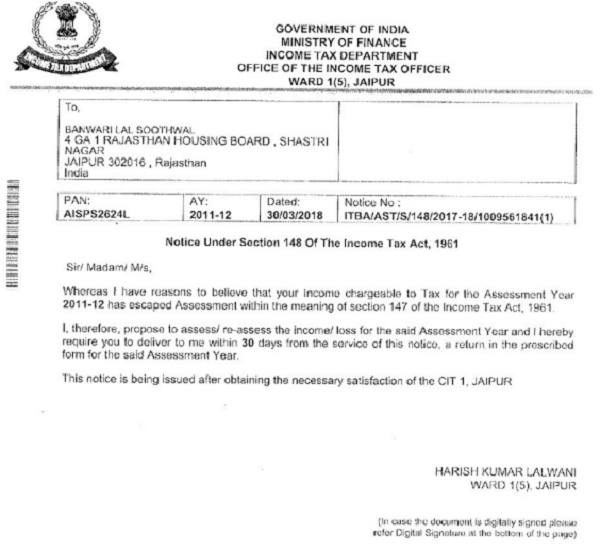
Issue a Income Tax Notice Under Section 148

As per Section 147 of the Income Tax Act, 1961, the Income Tax Department has the power to reassess an individual’s previously filed income tax returns. The Assessing Officer could pick your income tax return for reassessment subject to some pre-defined criteria by sending a notice under section 148 for Income Escaping Assessment.

Budget 2025 Update

  • It was proposed that no updated return can be filed by a person for whom a notice to show-cause under section 148A was issued after the expiry of 36 months from the end of the relevant assessment year.  
  • However, an updated return can be filed upto 48 months from the end of the relevant assessment year if it is found that there is no fit case to issue a notice under section 148 of the Act.

What is Section 148?

Section 148 of the Income Tax Act 1961 gives authority to the Assessing Officer to send notice to a taxpayer whose income has not been properly assessed. This implies that if the Assessing Officer suspects that a taxpayer has not disclosed complete income or has provided an inaccurate representation of it, officers can commence proceedings under this section.

Section 148 Notice is a notice issued by the income tax officer to reassess the taxpayer’s income tax return (ITR) if they disagree with the taxpayer’s assessment and believe that some income has not been properly assessed.

Finance Act 2022 introduced Section 148A, which requires the assessing officer to conduct an inquiry and give the taxpayer an opportunity to explain their case before issuing a notice under Section 148.

The assessing officer must issue a notice to the taxpayer under Section 148A(b), providing information and adverse material suggesting that income has escaped assessment. The taxpayer can respond with their own material and evidence.

In the 2021 budget, the government introduced Section 148A in the Income Tax Act. If the income tax officer has information that the taxpayer has undisclosed income for a specific assessment year, the officer must give the taxpayer a chance to provide an explanation before issuing a notice. The taxpayer has the right to be heard by the officer.

The assessing officer must allow the taxpayer at least seven days but no more than 30 days to provide their explanation.

After considering the taxpayer’s response, the income tax officer will decide whether to issue a notice for reassessment. If the officer decides to reopen the case, they must provide a copy of the order and a notice under Section 148 to the taxpayer.

Normally, a notice cannot be issued if three years have passed since the end of the relevant assessment year. However, if there is evidence of tax evasion of at least Rs 50 lakh, a notice can be issued beyond three years but within 10 years from the end of the relevant assessment year.

Before conducting any inquiries, providing opportunities to the taxpayer, or making any orders, the income tax officer must obtain the approval of the specified authority.

The assessing officer must provide the taxpayer with all the material and information relied upon, along with the notice under Section 148A or the Show Cause Notice.

There must be supporting material to allege that income has escaped assessment. A simple assertion of ‘reason to believe’ is not enough to validate the issuance of a notice under Section 148A.

The assessing officer is required to consider the taxpayer’s reply to the notice referred to in Clause (b) of Section 148A, which is the Show Cause Notice.

If the taxpayer requests a personal hearing, cross-examination of a third party, or a statement from a third party, the assessing officer must provide it with the approval of the specified authority.

Any notice issued under Section 148 after that date without following the procedure under Section 148A (i.e., without giving an opportunity to be heard) would be invalid and against the provisions of the Income Tax Act.

The courts have consistently emphasized that the procedure outlined in Section 148A must be strictly followed in accordance with the legislative intent of introducing the new provisions.

After receiving the order and notice under Section 148, the taxpayer needs to file the income tax return for the relevant assessment year within the prescribed time mentioned in the notice and undergo the reassessment process.

Time Limit to Issue a Notice Under Section 148

No notice under Section 148 will be issued for the relevant assessment year after:
a) Normal time limit: 3 years from the end of the relevant assessment year.
b) Specified time limit: If 3 have passed but not 10 years from the end of the relevant assessment year and the Assessing Officer has evidence of income amounting to Rs 50 lakhs or more that has not been taxed.

The Assessing Officer will issue a notice only if the following conditions are met for the relevant assessment year:
– The taxpayer has filed their returns under Section 139.
– The taxpayer failed to file their returns after receiving a notice under Section 142 or Section 148(1).
– The taxpayer should have provided complete and accurate information required for completing the assessment of that relevant year. 

Replying to Notice Under Section 148

The key thing to bear in mind is to not to take the notice lightly. In case you receive the notice under section 148, please follow the below-mentioned pointers:

  • Firstly, check the notice for reasons to believe which are recorded by the assessing officer for issuing the notice under section 148. If the notice doesn’t include the reasons, then you could request the assessing officer to send a copy of the recorded reasons.
  • You will need to respond to the notice within the given time frame, which is usually 30 days. You can respond to the notice either by filing a return or by providing a written reply to the Assessing Officer along with all the details and proofs.
  • In case you’re satisfied with ‘reasons to believe’ which was recorded by the assessing officer, file the return at the earliest. In the case already filed, send the copy to the assessing officer. 
  • In case you’re filing the income tax return in response to notice issued under section 148, ensure that you file it after performing proper due diligence that you declare all your income and expenses carefully. In case you miss reporting any of your income correctly then it could result in unnecessary penalties.
  • If you believe that the notice served is not valid or reasons provided by the assessing officer for opening assessment under section 147 aren’t valid, then you could challenge the validity of such notice before the assessing officer or higher authorities.
  • In case you win your case, the Court would halt your assessment proceedings. However, in case the decision doesn’t go in your favour, then the assessing officer could proceed with the reassessment.

What Happens if you Do Not Respond to Section 148?

If you don’t respond to a notice under Section 148, the Assessing Officer has the authority to carry out the assessment using the information at hand. Basically, they can make an estimate of your income and evaluate it to the best of their judgment. In case you disagree with their assessment, you have the option to file an appeal with either the Commissioner of Income Tax (Appeals) or the Income Tax Appellate Tribunal.

Who Can Issue a Notice Under Section 148

Section 151(1) of the Income Tax Act, 1961 contains the provisions for issue of notice:

  1. No notice would be issued by an Assessing Officer under section 148, after expiry of three years from the end of relevant AY (assessment year), unless Principal Chief Commissioner or Principal Commissioner or Chief Commissioner or Commissioner is satisfied, on reasons recorded by the AO, that it’s a fit case for issuing such notice.
  2. In cases other than the one mentioned above, no notice would be issued by an Assessing Officer under section 148, where AO is below the rank of a Joint Commissioner unless Joint Commissioner is satisfied, on reasons recorded by such AO, that it’s a fit case for issuing such notice.
  3. For the purposes of above (1) and (2), Principal Chief Commissioner or the Principal Commissioner or the Chief Commissioner or the Joint Commissioner the Commissioner, depending on the case, being satisfied on reasons recorded by AO about the fitness of the case for issuing notice under section 148 of the Income Tax Act, need not issue the notice by himself.

Duties and Rights Of The Assessee After The Receipt Of Notice Under Section 148

1. The assessee must fulfill the duty of filing tax returns for any income considered as “Income Escaping” for the relevant assessment year.

2. Once the returns are filed, the assessee has the right to request a copy of the notice, which outlines the reasons behind the Assessing Officer’s decision to issue the notice under Section 148.

3. If the assessee finds the reasons provided in the copy unsatisfactory or baseless, they have the right to file an objection challenging the validity of the notice.

4. It is essential for the assessee to provide valid reasons while raising objections and questioning the lawfulness of the notice issued under Section 148.

5. In case the Assessing Officer dismisses the assessee’s claims, the assessee retains the right to request the provision of separate reasons for the dismissal.

6. The assessee also has the option to file a writ petition with the appropriate High Court, challenging the legality and validity of the notice issued under Section 148. This can be done even before the assessment or re-assessment is concluded.

7. Even after the assessment is completed and the matter is under appeal, the assessee still has the right to file a writ petition with the relevant High Court, questioning the legality and validity of the notice under Section 148.

8. The assessee must provide evidence of the following actions:

 a. Requesting a copy of the reasons stated by the Assessing Officer for issuing the notice under Section 148.

b. Filing an objection to the reasons presented by the Assessing Officer.

c. Requesting the Assessing

d. Challenging the lawfulness of the notice’s issuance.

Reopening of Income Tax Assessment Cases

As part of the Union Budget 2021, a decision has been made to reduce the time limit for reopening income tax assessment cases. Previously set at six years, it will now be shortened to three years. However, in situations involving significant tax evasion, assessments may be reopened for a period of up to ten years, but only if the concealed income exceeds Rs. 50 lakh. Officer to provide reasons for rejecting the assessee’s objections.

Things to Consider While Replying to a Notice Under Section 148

When responding to a notice issued under Section 148 of the Income Tax Act, 1961, it is important to consider the following factors:

1. Begin by understanding the reasons that prompted the Assessing Officer (AO) to send the notice. If the reasons are not provided in the notice, individuals have the right to request a copy of the same.

2. If the reasons provided in the notice are found to be justifiable, it is crucial to promptly file tax returns to avoid any potential legal complications. If tax returns have already been filed under Section 148, individuals should ensure to submit a copy of the returns to the AO.

3. Exercise caution and diligence while filing income tax returns. Any omission or incorrect reporting of expenses or income could result in legal penalties. It is important to ensure that all relevant information is accurately reported.

4. Familiarize yourself with the provisions outlined in Section 148 of the Income Tax Act to prevent any legal complexities. However, it is advisable for individuals to get their income assessed each assessment year in order to remain tax compliant and avoid any inconveniences.

By considering these factors, individuals can appropriately respond to a notice issued under Section 148 and effectively navigate the income tax assessment process.

Section 148 of the Income Tax Act 1961 plays a significant role in ensuring proper assessment of taxpayers whose income has not been appropriately evaluated. It is vital to take any notice received under this section seriously and respond promptly by providing accurate and complete information about your income and expenses. Failing to respond within the specified timeframe may lead to an assessment based on the Assessing Officer’s discretion, which may not be favorable to you. Therefore, it is important to comply with the requirements and cooperate with the authorities to ensure a fair and lawful assessment of your tax liabilities.

Is it possible to issue a notice under Section 148 for an assessment year after ten years?

No, a notice under Section 148 can only be issued within three or ten years, depending on the amount of escaped income, from the end of the relevant assessment year.

Can a notice under Section 148 be issued if the taxpayer has already submitted a return?

Yes, a notice under Section 148 can be issued even if the taxpayer has already filed an ITR.

What happens if the Assessing Officer conducts a best judgement assessment?

If the Assessing Officer conducts a best judgment assessment, they will estimate your income and expenses using the available information. In case you disagree with the assessment, you have the option to file an appeal with the Commissioner of Income Tax (Appeals) / the Income Tax Appellate Tribunal. It is always advisable to respond to a notice under Section 148 and provide all the important details of your income and expenses to avoid unnecessary complications.

What is the penalty under Section 148?

Section 148 does not specify a specific penalty, as it relates to the issuance of a notice for reassessment. However, if you fail to respond to a notice issued under Section 148, the Assessing Officer may impose penalties under Section 271(1)(b) for concealing income or Section 271(1)(c) for furnishing inaccurate particulars of income. Therefore, it is crucial to respond to a notice under Section 148 and provide precise information regarding your income and expenses to prevent penalties or legal complications.

Income Tax Notice Under Section 142(1)

Income Tax Act, 1961, is a key piece of legislation that regulates the collection, administration, and enforcement of income taxes in India. One of its important provisions, Section 142(1), grants tax authorities the power to issue notices to taxpayers requesting additional information or clarification for accurate tax assessment. This provision plays a crucial role in ensuring compliance and transparency in the tax filing process.

This article explores the nuances of Section 142(1), explaining the circumstances under which these notices are issued, the procedures that follow, and the potential consequences for taxpayers who fail to comply. Understanding the purpose and implications of Section 142(1) can help individuals and businesses navigate their tax obligations with greater clarity and confidence.

What is Section 142(1) of the Income Tax Act?

Section 142(1) of the Income Tax Act empowers the Assessing Officer (A.O.) to issue a notice to a taxpayer requesting additional information or documents required for the proper assessment of their income. This provision applies regardless of whether the taxpayer has filed their income tax return under Section 139(1) or has failed to file it altogether. The notice under Section 142(1) acts as a mechanism for tax authorities to gather comprehensive financial data directly from the taxpayer, ensuring accurate and complete tax assessments. It is an important tool to maintain compliance and transparency in the tax process.

When is a Notice under Section 142(1) Issued?

The Income Tax Act’s Section 142(1) allows for the issuance of a notice in the following situations:

  1. Non-Filing of Return: If a taxpayer fails to file their income tax return within the prescribed time under Section 139(1), the Assessing Officer (A.O.) may issue a notice requiring them to furnish the return within a specified period.
  2. Filed Returns: Even when a taxpayer has already filed their income tax return, the Assessing Officer may issue a notice under Section 142(1) to request additional information or clarification to verify the accuracy and completeness of the filed return.
  3. Post Assessment Year: This notice can be issued even after the end of the relevant assessment year, enabling tax authorities to gather necessary information retrospectively for proper assessment and compliance.

Purpose of Notice under Section 142(1)

The primary objective of issuing a notice under Section 142(1) is to facilitate a comprehensive and accurate tax assessment. The notice serves several purposes, including:

  1. Filing of Income Tax Return: This applies to the taxpayer’s own income and, in certain cases, the income of another person for whom the taxpayer is legally responsible, such as a legal guardian or representative of a deceased individual.
  2. Provision of Accounts and Documents: The notice can require the taxpayer to provide various accounts and documents necessary for the assessment process.
  3. Detailed Financial Information: The taxpayer may be asked to furnish written information on specific matters, including a detailed statement of assets and liabilities as of a particular date.

Safeguards for Taxpayers

To prevent harassment and ensure fairness, the law includes several safeguards:

  1. Prior Approval Requirement: Before demanding a statement of assets and liabilities that are not part of the accounts, the Assessing Officer must seek prior approval from the Joint Commissioner.
  2. Time Limitation: The Assessing Officer cannot request accounts related to a period more than three years prior to the previous year, ensuring that the information sought is relevant and recent.
  3. Application to All Taxpayers: Notices under Section 142(1)(i) can be issued to both taxpayers who have filed their returns and those who have not, underscoring its comprehensive scope.

Procedure of Conducting Faceless Assessment

In recent years, the Indian government has introduced the faceless assessment scheme to enhance transparency and efficiency in tax assessments. Under this scheme, assessments are conducted without any physical interaction between the taxpayer and tax authorities. Here’s how the process works:

  1. Issuance of Notice: The notice under Section 142(1) is issued electronically through the income tax portal.
  2. Submission of Response: Taxpayers are required to respond to the notice using the ‘e-Proceedings’ utility within their registered ‘e-Filing’ account.
  3. Review and Analysis: The submitted documents and information are reviewed and analyzed by a team of tax officials, who may request further clarification if needed.
  4. Final Assessment: Based on the provided information, the assessment is finalized and communicated to the taxpayer electronically.

Sample of a Notice under Section 142(1) of the ITA

A typical notice under Section 142(1) will include the following details:

Compliance under Section 142(1) is Mandatory

Responding to a notice under Section 142(1) is mandatory for all taxpayers. Non-compliance can lead to severe consequences, including penalties, prosecution, and a best judgment assessment by the tax authorities.

Penalty for Non-Compliance of Section 142(1) Tax Notice

Failure to comply with a notice under Section 142(1) can result in the following penalties and actions:

  1. Monetary Penalty: A penalty of Rs.10,000 may be levied on the taxpayer under Section 271(1)(b).
  2. Best Judgment Assessment: Under Section 144, the Assessing Officer can make an assessment based on their best judgment, using all relevant information available.
  3. Legal Prosecution: Under Section 276D, legal prosecution could be initiated, potentially leading to imprisonment for up to one year, with or without a fine.
  4. Search Warrant: A search warrant under Section 132 might be issued to conduct a search of the taxpayer’s premises.

How to Submit a Response to the Notice U/S 142(1)?

Responding to a notice under Section 142(1) involves using the ‘e-Proceedings’ utility on the income tax e-filing portal. Here is a step-by-step guide:

  1. Access the Income Tax Portal: Log in to your registered account on the income tax e-filing portal.
  2. Navigate to ‘Pending Actions‘: Go to the ‘Pending Actions‘ tab and select ‘E-Proceedings‘.
  3. View Notices: Click on ‘View Notices‘ to see the notice issued under Section 142(1).
  4. Submit Response: Click on ‘Submit Response’ and choose the response type (Partial or Full Response).
  5. Attach Documents: Attach the required documents in PDF, Excel, or CSV formats.
  6. Submit: Click ‘Continue‘, tick the ‘Declaration‘ box, and submit your response.
  7. Confirmation: Upon successful submission, a confirmation message will be displayed, and you can download the response acknowledgement for your records.

Read more at: Income Tax Notice Section 142(1): Inquiry Before Assessment

FAQs for Section 142(1) of Income Tax Act

Is there any upper limit on the number of years of information or related documents that an AO can seek under Section 142(1)(ii)?

Yes, under Section 142(1)(ii) of the Income Tax Act, the Assessing Officer (AO) is restricted in terms of the number of years for which they can seek accounts or documents. The AO cannot request accounts or information related to a period more than three years prior to the previous year. This limitation ensures that the inquiries remain relevant and focused on recent financial activity, protecting taxpayers from being asked for outdated records.

When is it recommended to file a partial response to a notice under Section 142(1)?

It is recommended to file a partial response to a notice under Section 142(1) when the taxpayer can provide some of the requested information but is unable to furnish all of it within the stipulated time. Submitting a partial response demonstrates the taxpayer’s intention to comply with the notice and can help avoid penalties or negative consequences. The remaining information should be submitted as soon as it becomes available, and it is advisable to communicate with the Assessing Officer about the delay in providing the full response.

Who can serve notice under section 142 for making any inquiry before the assessment?

The Assessing Officer (AO) is authorized to serve a notice under Section 142(1) of the Income Tax Act. The purpose of this notice is to gather necessary information, documents, or clarifications from the taxpayer before proceeding with the assessment of their income. This inquiry ensures that the AO has all the required details to conduct an accurate and thorough assessment.

What is the time limit for issuing section 142(1) notice?

There is no specific time limit prescribed for issuing a notice under Section 142(1) of the Income Tax Act. However, the notice is typically issued during the assessment or reassessment process to gather additional information or clarifications from the taxpayer, ensuring that the Assessing Officer has all the necessary details for accurate tax evaluation before the completion of the assessment.

What is Inquiry Before Assessment in Income Tax?

An inquiry before assessment in income tax refers to the process where the Assessing Officer (AO) seeks additional information or clarification from the taxpayer to ensure that the income declared and taxes paid are accurate. This is typically done under provisions such as Section 142(1) of the Income Tax Act, where the AO issues a notice requesting further documentation, details, or explanations regarding the income tax return filed by the taxpayer. The purpose of this inquiry is to verify the accuracy of the taxpayer’s financial records, identify discrepancies, and gather any missing information before finalizing the tax assessment. This ensures transparency, fairness, and compliance in the tax assessment process.

Read more at: Types of Income Tax Notice & Documents required to reply to an Income Tax Notice

Reasons for the selection of cases for income tax scrutiny notice

Receiving an income tax notice from the Income Tax office is a situation that most taxpayers dread. Even if you have diligently filed your tax return, there are several reasons why you might still end up with a notice. In this article, we will explore the common mistakes that often attract income tax notices and provide detailed guidance on avoiding them while complying with the Indian Income Tax Act 1961.

Understanding Scrutiny Assessment

Scrutiny assessment is a process where the tax department carefully examines the tax returns filed by taxpayers. If the department has a reason to believe that the information provided is incorrect or incomplete, the case is selected for scrutiny assessment. The taxpayer receives a notice from the department and must take appropriate action as communicated.

The Reasons behind Selection of Cases for Scrutiny

Scrutiny assessments can be of two types: manual and compulsory. While manual selection for scrutiny is often avoidable with careful attention, compulsory selection cannot be prevented.

Let’s delve into some of the common reasons for the selection of cases for scrutiny and explore ways to avoid them effectively:

Reason 1: Non-filing of Income Tax Return (ITR)

One of the primary reasons for receiving an income tax notice is the non-filing of ITR. If your gross income exceeds the exempted limit (INR 2,50,000 for individuals below the age of 60), filing an annual income tax return within the stipulated time frame is mandatory. For resident Indians who own foreign assets or have signing authority in a foreign bank account, filing a tax return is obligatory, irrespective of their income. Even if your employer has already deducted TDS from your pay, you must still file your return to avoid attracting a notice.

How to avoid: Ensure prompt payment of advance taxes and file your returns well before the due date.

Reason 2: Error with Respect to TDS

Discrepancies between the TDS shown in your return and what is reported on the Traces website can raise red flags and lead to an income tax notice.

How to avoid: Request your employer or any entity deducting TDS from your income to deposit the amount with the government treasury and file TDS returns on time. Always reconcile the actual TDS deducted from your income with your Tax Credit Statement (Form 26AS) and promptly report any discrepancies.

Reason 3: Non-disclosure of Other Incomes

One of the most common mistakes is failing to report all earned incomes in the tax return. Many individuals overlook interest income from savings accounts, fixed deposits, and recurring deposits.

Cases where TDS is deducted at a lower rate than the taxpayer’s applicable tax slab can attract scrutiny for non-disclosure or an attempt to minimize tax liability.

How to avoid: Request your bank to provide an interest statement for all your deposits at the year-end. Report all income from any source in your tax return, even if the amount is tax-exempt.

Note: Concealment of income can result in penalties of up to 300% of the tax payable.

Reason 4: Unnatural or High-Value Transactions

Engaging in transactions with significantly higher values than the income declared in your tax return may trigger an income tax notice. For instance, a salaried individual earning Rs. 4,00,000 but depositing more than Rs. 10,00,000 in their bank account may attract attention. All high-value transactions are reported directly to the tax department through annual information returns filed by institutions like brokers and banks.

How to avoid: Ensure you report every transaction, including losses such as those incurred in share trading, to the tax department to avoid notice.

Reason 5: Defect in Income Tax Return

Filing an inaccurate income tax return due to ignorance or lack of knowledge can lead to notices from the tax department. This could be caused by using the wrong ITR form, omitting mandatory information, or other errors.

How to avoid: Prepare all your documents before filing your ITR and seek assistance from a tax expert if you face any challenges in filing your return.

Receiving an income tax notice can be avoided by ensuring accurate and timely filing of income tax returns, meticulous record-keeping, and transparent reporting of all incomes and transactions. Compliance with the provisions of the Indian Income Tax Act 1961 and being proactive in rectifying any mistakes or discrepancies can help taxpayers avoid unwanted scrutiny and maintain a smooth tax journey. By staying informed and vigilant, taxpayers can navigate the complexities of the tax system and prevent potential issues that may arise from common mistakes. Remember, diligent compliance and seeking professional guidance whenever necessary is the key to avoiding income tax notices.

Income Tax Notice Under Section 142(1)

Income Tax Act, 1961, is a key piece of legislation that regulates the collection, administration, and enforcement of income taxes in India. One of its important provisions, Section 142(1), grants tax authorities the power to issue notices to taxpayers requesting additional information or clarification for accurate tax assessment. This provision plays a crucial role in ensuring compliance and transparency in the tax filing process.

This article explores the nuances of Section 142(1), explaining the circumstances under which these notices are issued, the procedures that follow, and the potential consequences for taxpayers who fail to comply. Understanding the purpose and implications of Section 142(1) can help individuals and businesses navigate their tax obligations with greater clarity and confidence.

What is Section 142(1) of the Income Tax Act?

Section 142(1) of the Income Tax Act empowers the Assessing Officer (A.O.) to issue a notice to a taxpayer requesting additional information or documents required for the proper assessment of their income. This provision applies regardless of whether the taxpayer has filed their income tax return under Section 139(1) or has failed to file it altogether. The notice under Section 142(1) acts as a mechanism for tax authorities to gather comprehensive financial data directly from the taxpayer, ensuring accurate and complete tax assessments. It is an important tool to maintain compliance and transparency in the tax process.

When is a Notice under Section 142(1) Issued?

The Income Tax Act’s Section 142(1) allows for the issuance of a notice in the following situations:

  1. Non-Filing of Return: If a taxpayer fails to file their income tax return within the prescribed time under Section 139(1), the Assessing Officer (A.O.) may issue a notice requiring them to furnish the return within a specified period.
  2. Filed Returns: Even when a taxpayer has already filed their income tax return, the Assessing Officer may issue a notice under Section 142(1) to request additional information or clarification to verify the accuracy and completeness of the filed return.
  3. Post Assessment Year: This notice can be issued even after the end of the relevant assessment year, enabling tax authorities to gather necessary information retrospectively for proper assessment and compliance.

Purpose of Notice under Section 142(1)

The primary objective of issuing a notice under Section 142(1) is to facilitate a comprehensive and accurate tax assessment. The notice serves several purposes, including:

  1. Filing of Income Tax Return: This applies to the taxpayer’s own income and, in certain cases, the income of another person for whom the taxpayer is legally responsible, such as a legal guardian or representative of a deceased individual.
  2. Provision of Accounts and Documents: The notice can require the taxpayer to provide various accounts and documents necessary for the assessment process.
  3. Detailed Financial Information: The taxpayer may be asked to furnish written information on specific matters, including a detailed statement of assets and liabilities as of a particular date.

Safeguards for Taxpayers

To prevent harassment and ensure fairness, the law includes several safeguards:

  1. Prior Approval Requirement: Before demanding a statement of assets and liabilities that are not part of the accounts, the Assessing Officer must seek prior approval from the Joint Commissioner.
  2. Time Limitation: The Assessing Officer cannot request accounts related to a period more than three years prior to the previous year, ensuring that the information sought is relevant and recent.
  3. Application to All Taxpayers: Notices under Section 142(1)(i) can be issued to both taxpayers who have filed their returns and those who have not, underscoring its comprehensive scope.

Procedure of Conducting Faceless Assessment

In recent years, the Indian government has introduced the faceless assessment scheme to enhance transparency and efficiency in tax assessments. Under this scheme, assessments are conducted without any physical interaction between the taxpayer and tax authorities. Here’s how the process works:

  1. Issuance of Notice: The notice under Section 142(1) is issued electronically through the income tax portal.
  2. Submission of Response: Taxpayers are required to respond to the notice using the ‘e-Proceedings’ utility within their registered ‘e-Filing’ account.
  3. Review and Analysis: The submitted documents and information are reviewed and analyzed by a team of tax officials, who may request further clarification if needed.
  4. Final Assessment: Based on the provided information, the assessment is finalized and communicated to the taxpayer electronically.

Sample of a Notice under Section 142(1) of the ITA

A typical notice under Section 142(1) will include the following details:

Compliance under Section 142(1) is Mandatory

Responding to a notice under Section 142(1) is mandatory for all taxpayers. Non-compliance can lead to severe consequences, including penalties, prosecution, and a best judgment assessment by the tax authorities.

Penalty for Non-Compliance of Section 142(1) Tax Notice

Failure to comply with a notice under Section 142(1) can result in the following penalties and actions:

  1. Monetary Penalty: A penalty of Rs.10,000 may be levied on the taxpayer under Section 271(1)(b).
  2. Best Judgment Assessment: Under Section 144, the Assessing Officer can make an assessment based on their best judgment, using all relevant information available.
  3. Legal Prosecution: Under Section 276D, legal prosecution could be initiated, potentially leading to imprisonment for up to one year, with or without a fine.
  4. Search Warrant: A search warrant under Section 132 might be issued to conduct a search of the taxpayer’s premises.

How to Submit a Response to the Notice U/S 142(1)?

Responding to a notice under Section 142(1) involves using the ‘e-Proceedings’ utility on the income tax e-filing portal. Here is a step-by-step guide:

  1. Access the Income Tax Portal: Log in to your registered account on the income tax e-filing portal.
  2. Navigate to ‘Pending Actions‘: Go to the ‘Pending Actions‘ tab and select ‘E-Proceedings‘.
  3. View Notices: Click on ‘View Notices‘ to see the notice issued under Section 142(1).
  4. Submit Response: Click on ‘Submit Response’ and choose the response type (Partial or Full Response).
  5. Attach Documents: Attach the required documents in PDF, Excel, or CSV formats.
  6. Submit: Click ‘Continue‘, tick the ‘Declaration‘ box, and submit your response.
  7. Confirmation: Upon successful submission, a confirmation message will be displayed, and you can download the response acknowledgement for your records.

Read more at: Income Tax Notice Section 142(1): Inquiry Before Assessment

FAQs for Section 142(1) of Income Tax Act

Is there any upper limit on the number of years of information or related documents that an AO can seek under Section 142(1)(ii)?

Yes, under Section 142(1)(ii) of the Income Tax Act, the Assessing Officer (AO) is restricted in terms of the number of years for which they can seek accounts or documents. The AO cannot request accounts or information related to a period more than three years prior to the previous year. This limitation ensures that the inquiries remain relevant and focused on recent financial activity, protecting taxpayers from being asked for outdated records.

When is it recommended to file a partial response to a notice under Section 142(1)?

It is recommended to file a partial response to a notice under Section 142(1) when the taxpayer can provide some of the requested information but is unable to furnish all of it within the stipulated time. Submitting a partial response demonstrates the taxpayer’s intention to comply with the notice and can help avoid penalties or negative consequences. The remaining information should be submitted as soon as it becomes available, and it is advisable to communicate with the Assessing Officer about the delay in providing the full response.

Who can serve notice under section 142 for making any inquiry before the assessment?

The Assessing Officer (AO) is authorized to serve a notice under Section 142(1) of the Income Tax Act. The purpose of this notice is to gather necessary information, documents, or clarifications from the taxpayer before proceeding with the assessment of their income. This inquiry ensures that the AO has all the required details to conduct an accurate and thorough assessment.

What is the time limit for issuing section 142(1) notice?

There is no specific time limit prescribed for issuing a notice under Section 142(1) of the Income Tax Act. However, the notice is typically issued during the assessment or reassessment process to gather additional information or clarifications from the taxpayer, ensuring that the Assessing Officer has all the necessary details for accurate tax evaluation before the completion of the assessment.

What is Inquiry Before Assessment in Income Tax?

An inquiry before assessment in income tax refers to the process where the Assessing Officer (AO) seeks additional information or clarification from the taxpayer to ensure that the income declared and taxes paid are accurate. This is typically done under provisions such as Section 142(1) of the Income Tax Act, where the AO issues a notice requesting further documentation, details, or explanations regarding the income tax return filed by the taxpayer. The purpose of this inquiry is to verify the accuracy of the taxpayer’s financial records, identify discrepancies, and gather any missing information before finalizing the tax assessment. This ensures transparency, fairness, and compliance in the tax assessment process.

Read more at: Types of Income Tax Notice & Documents required to reply to an Income Tax Notice

The Reasons behind Selection of Cases for Scrutiny & How to avoid

Receiving an income tax notice from the Income Tax office is a situation that most taxpayers dread. Even if you have diligently filed your tax return, there are several reasons why you might still end up with a notice. In this article, we will explore the common mistakes that often attract income tax notices and provide detailed guidance on avoiding them while complying with the Indian Income Tax Act 1961.

Understanding Scrutiny Assessment

Scrutiny assessment is a process where the tax department carefully examines the tax returns filed by taxpayers. If the department has a reason to believe that the information provided is incorrect or incomplete, the case is selected for scrutiny assessment. The taxpayer receives a notice from the department and must take appropriate action as communicated.

The Reasons behind Selection of Cases for Scrutiny

Scrutiny assessments can be of two types: manual and compulsory. While manual selection for scrutiny is often avoidable with careful attention, compulsory selection cannot be prevented.

Let’s delve into some of the common reasons for the selection of cases for scrutiny and explore ways to avoid them effectively:

Reason 1: Non-filing of Income Tax Return (ITR)

One of the primary reasons for receiving an income tax notice is the non-filing of ITR. If your gross income exceeds the exempted limit (INR 2,50,000 for individuals below the age of 60), filing an annual income tax return within the stipulated time frame is mandatory. For resident Indians who own foreign assets or have signing authority in a foreign bank account, filing a tax return is obligatory, irrespective of their income. Even if your employer has already deducted TDS from your pay, you must still file your return to avoid attracting a notice.

How to avoid: Ensure prompt payment of advance taxes and file your returns well before the due date.

Reason 2: Error with Respect to TDS

Discrepancies between the TDS shown in your return and what is reported on the Traces website can raise red flags and lead to an income tax notice.

How to avoid: Request your employer or any entity deducting TDS from your income to deposit the amount with the government treasury and file TDS returns on time. Always reconcile the actual TDS deducted from your income with your Tax Credit Statement (Form 26AS) and promptly report any discrepancies.

Reason 3: Non-disclosure of Other Incomes

One of the most common mistakes is failing to report all earned incomes in the tax return. Many individuals overlook interest income from savings accounts, fixed deposits, and recurring deposits.

Cases where TDS is deducted at a lower rate than the taxpayer’s applicable tax slab can attract scrutiny for non-disclosure or an attempt to minimize tax liability.

How to avoid: Request your bank to provide an interest statement for all your deposits at the year-end. Report all income from any source in your tax return, even if the amount is tax-exempt.

Note: Concealment of income can result in penalties of up to 300% of the tax payable.

Reason 4: Unnatural or High-Value Transactions

Engaging in transactions with significantly higher values than the income declared in your tax return may trigger an income tax notice. For instance, a salaried individual earning Rs. 4,00,000 but depositing more than Rs. 10,00,000 in their bank account may attract attention. All high-value transactions are reported directly to the tax department through annual information returns filed by institutions like brokers and banks.

How to avoid: Ensure you report every transaction, including losses such as those incurred in share trading, to the tax department to avoid notice.

Reason 5: Defect in Income Tax Return

Filing an inaccurate income tax return due to ignorance or lack of knowledge can lead to notices from the tax department. This could be caused by using the wrong ITR form, omitting mandatory information, or other errors.

How to avoid: Prepare all your documents before filing your ITR and seek assistance from a tax expert if you face any challenges in filing your return.

Receiving an income tax notice can be avoided by ensuring accurate and timely filing of income tax returns, meticulous record-keeping, and transparent reporting of all incomes and transactions. Compliance with the provisions of the Indian Income Tax Act 1961 and being proactive in rectifying any mistakes or discrepancies can help taxpayers avoid unwanted scrutiny and maintain a smooth tax journey. By staying informed and vigilant, taxpayers can navigate the complexities of the tax system and prevent potential issues that may arise from common mistakes. Remember, diligent compliance and seeking professional guidance whenever necessary is the key to avoiding income tax notices.

High value transactions Income tax SMS

The Income Tax Department of India sends SMS messages to taxpayers to inform them about high-value transactions that have been reported to the department by various sources like banks, mutual funds, and companies. These SMS messages are part of the department’s e-campaign, which aims to promote voluntary compliance and reduce the need for notices and scrutiny.

Why you might receive this SMS:

  • Mismatch with your tax return: The information reported to the tax department about your high-value transactions may not match the information you provided in your income tax return. This could be due to various reasons, such as an oversight on your part or an error in the reporting by the third party.
  • Non-filing of tax return: You may have failed to file your income tax return for the relevant assessment year, even though you had high-value transactions.

What to do if you receive this SMS:

  1. Don’t panic: These messages are usually just informative and not necessarily an accusation of wrongdoing.
  2. Check your records: Verify the information in the SMS against your bank statements, investment statements, and other relevant documents.
  3. Respond to the SMS: You can reply to the SMS through the Income Tax Department’s e-filing portal.
  4. Revise your return (if needed): If you find any discrepancies, you can file a revised income tax return to correct the information.
  5. Seek professional help: If you are unsure about how to proceed, you can consult a tax advisor or chartered accountant.

How to respond to the SMS:

  1. Log in to the e-filing portal: Go to the Income Tax Department’s e-filing website and log in using your PAN and password.
  2. Go to the Compliance Portal: On the home page, go to ‘Pending Actions’ > Compliance Portal.
  3. Select the e-Campaign: Click on ‘e-Campaign’ and select the relevant campaign.
  4. Choose the information category and transaction: Select the appropriate category and the specific transaction mentioned in the SMS.
  5. Submit your response: Provide the necessary information and submit your response.

Examples of high-value transactions:

Remember: It’s important to respond to the SMS and take necessary action to avoid any further notices or penalties from the Income Tax Department.

Latest Update:

The Central Board of Direct Taxes (CBDT) has instructed self-reporting organizations (SROs), including banks, post offices, co-operatives, fintechs, and mutual fund houses, to provide detailed information about high-value transactions carried out during the financial year by 31 May of the immediate next financial year.

Here is a list of transactions that may trigger a notice from the Income Tax Department, as this data is collected from the respective reporting authorities:

Sr. No.TransactionThreshold (Rs)Which authority should report?
1Cash payment for purchasing bank draft, pay order, banker’s cheque or prepaid RBI instruments 10,00,000Banks or co-operative society need to disclose a transaction if the amount deposited exceeds the threshold to the Director of Income Tax by filing Form 61A
2Cash deposits in a savings bank account10,00,000– Banks
– Co-operative society 
– Post master general
3Cash deposit or withdrawal from a current account50,00,000Banks or co-operative society
4Sale or purchase of an immovable property30,00,000The Property Registrar/Sub-registrar must report a transaction exceeding the threshold via Form 61A.
5Investments in shares, mutual funds, debentures and bonds in cash

(If amount is transferred from one scheme to another, then reporting is not required)
10,00,000– Company issuing Shares, Debentures, Bonds
– Mutual Fund Trustee
6Payment of credit card bill in cash1,00,000Banks or co-operative society
7Payment of credit card bill other than through cash10,00,000Banks or co-operative society
8– Sale of foreign currency
– Crediting FOREX card
– Spending in foreign currency through a debit or a credit card or through traveler’s cheque or any other instrument
10,00,000Authorised Person under Foreign Exchange Management Act, 1999
9Cash deposits in the fixed deposit or recurring deposit account10,00,000– Bank 
– Co-operative society
– Nidhi Company
– NBFC

Steps taken by the IT Department to Trace High-Value Transactions

Below are some of the measures taken by the department to trace high-value transactions:

  1. Upgraded Form 26AS:
    The Department has upgraded Form 26AS to reflect Specified Financial Transactions (SFT). Moreover, it has introduced ‘Annual Information Statement (AIS)’ where you can view all the financial information. The specified institutions, such as registrars, banks, post offices, stock exchanges, etc., must report transactions exceeding the specified threshold to the income tax department. These transactions are then reflected in the AIS portal so that the taxpayer can voluntarily disclose all the information based on the AIS information.
  2. Applicability of TDS on cash withdrawal: 
    To trace high-value transactions, the government has proposed that the banks must deduct TDS at 2% on cash withdrawals more than Rs 1 crore during the financial year. If the person does not file ITR for the last three financial years, then TDS at 2% shall be deducted for cash withdrawals exceeding Rs 20 lakh, and for cash withdrawals exceeding Rs 1 crore, TDS will be deducted at 5%.
  3. Mandatory filing of returns: 
    An individual is required to file ITR if income exceeds Rs 2,50,000. But, from 1st April 2019, ITR filing is mandatory if the individual has entered into certain specified high-value transactions, even if the income is less than Rs 2,50,000. For example, deposits in one or more current a/c maintained with a bank/co-operative bank are more than Rs 1 crore, foreign travel expenditure is in excess of Rs 2 lakh, or electricity bill expenditure is in excess of Rs.1 lakh during the year.

Action to be taken if Form 26AS Reflects SFT Transactions

Firstly a taxpayer must verify that the SFT transactions reported in the Form 26AS are correct. Subsequently, a taxpayer must ensure to report the said high-value transaction while filing the ITR, and that the tax liability on the same has been accurately calculated. Any error or mismatch in reporting such transactions may trigger an income tax notice.

Launch of E-campaign 

The income tax department has launched an e-campaign for the voluntary compliance of income tax for the convenience of taxpayers. 

The campaign focuses on the assessees/taxpayers who are either:- 

  1. Non-filers of the income tax return
  2. Have discrepancies/deficiencies in their returns

Who receives Email/SMS of E-campaign from Income Tax Department?

Under e-campaign, the income tax department sends emails/SMS to identified taxpayers to verify their financial transactions related to information received by the IT department from various sources such as SFT, TDS, TCS, etc. The department can collect information related to GST, imports/exports, and transactions in securities, derivatives, commodities and mutual funds through various third parties. 
You may receive an email/SMS from the e-campaign when:

  • You have not filed Income Tax Return: Even if the income tax return was filed correctly, you must provide feedback upon receiving such notice.
  • There are discrepancies/deficiencies in your Income Tax Returns: Discrepancies do not always indicate that information has been hidden. Instead, it could be due to the errors in AIS. You must report such errors to the IT department by ‘Providing feedback on AIS’.

How to Comply with E-campaign Notice Online and How to Submit Response?

If you have received an email or SMS for high-value transactions or non-filing of returns, you can respond to the income tax department by following the below steps:

Step 1: Log in to your income tax e-filing account.

Step 2: In the home page, go to ‘Pending Actions’> Compliance Portal > ‘e-Campaign (AY 2021-22 Onwards)’.

For example, in the case of high-value transactions or non-filing of income tax returns, it will show the below information under the ‘e-Campaign’ list.

Step 4: Select the information category
‘e’ would be marked against the information category for which you have received the communication.

Step 5: Select the Transaction
The information on which feedback is required would be marked as ‘Expected’.

Step 6: Submit Response
From the options, select the most appropriate response:
 – Information is correct
 – Information is not fully correct
 – Income is not taxable
 – Information relates to other PAN/year
 – Information is duplicate/included in other displayed information
 – Information is denied

Following are the categories where the response is expected from the taxpayer under e-campaign: 

  • Preliminary Response
  • Feedback on Information on AIS

Preliminary Response

Under the ‘Preliminary Response’ section, the taxpayer is expected to respond to relevant questions. The queries under the Preliminary Response section are based on campaign type (non-filing of return/certain high-value transactions done by the taxpayer).

For example, for campaign type – ‘Non-Filing of income tax Return’, the taxpayer is expected to submit a response whether an income tax return has been filed or not.

Step 1: Click on the ‘Provide Response’ button provided against the ‘Preliminary Response’ section.
Step 2: On the next page, respond by selecting the relevant drop-down.
Step 3: Provide additional details as required by the income tax department. For example, For the question ‘Whether Income Tax Return (ITR) has been filed?’ the following additional details are required: 

  1. If ITR has been filed:
  2. If ITR has not been filed

Step 4: After filling in all the relevant information, submit the response. You can download the preliminary response submitted from the ‘Activity History’ screen.

If you don’t have active e-campaigns or e-verifications, you will get the message – No Compliance Record has been generated for you.

Madras High Court Affirms Exclusive Powers of Jurisdictional Assessing Officer for Section 148 Notices under Income Tax Act

In a landmark decision regarding the authority of income tax officers handling cases of income evasion, the Madras High Court has determined that the Jurisdictional Assessing Officer (JAO) possesses ‘exclusive powers’ to issue notices under Section 148 of the Income Tax Act, 1961. Both the JAO and the Faceless Assessing Officer (FAO) will share concurrent authority for ‘assessment, reassessment, and recomputation’ of specific income in a faceless framework.

Justice Krishnan Ramasamy delivered this judgment on Friday, dismissing the petitions brought forth by Mark Studio India Private Limited from Chennai, which challenged the JAO’s authority to issue notices under Sections 148 and 148 A (d) of the Income Tax Act related to the assessment of escaped income.

During the proceedings, the petitioner’s counsel, G. Vardhini Karthik, argued that the JAO lacked the authority to issue notices for income escaping assessment following the enactment of Section 151 A of the Income Tax Act and the establishment of the E-Assessment of Income Escaping Assessment Scheme, 2022, as of March 29, 2022, along with the Faceless Jurisdiction of Income-tax Authorities Scheme, 2022, dated March 23, 2022.

In contrast, B. Ramasamy, the senior standing counsel representing the Central government, contended that Section 144 B of the Act grants powers to the JAO and that cases are selected by the Directorate of IT (Systems) via the Automated Allocation System (AAS) according to the jurisdiction of the PAN card.

He further asserted that the notices served to Mark Studio India complied with the AAS’s three conditions, relied upon a risk management framework devised by the board, and adhered to the faceless protocol, allowing for online procedures.

Justice Ramasamy stated, “Regarding the issuance of notices under Section 148 of the IT Act, only the JAO has exclusive jurisdiction.” He added, “In terms of assessment, reassessment, or recomputation under Section 147, both the FAO and JAO will have concurrent jurisdiction.”

According to the judge, the Directorate of IT (Systems) is given the authority to allocate cases through the AAS for issuing notices under Sections 148 A and 148 in qualified instances, guided by the risk management strategy of the E-Assessment of Income Escaping Assessment Scheme related to the jurisdiction of the JAO based on the PAN card information.

In this particular case, the judge explained that the impugned notice was issued “in accordance with the Scheme,” aside from a minor procedural issue of not naming the JAO specifically. The Directorate of IT (Systems) assigned cases through the AAS based on the risk management strategy for the faceless issuance of notices.

He remarked that such procedural discrepancies would “not vitiate” the initiation of the notice under Section 148 of the IT Act, as these errors are “curable in nature.”

While the court ultimately dismissed the writ petitions, it permitted the petitioner company to submit a response to the relevant authorities within 30 days. Those authorities are obliged to review the response and issue decisions after allowing an opportunity for a personal hearing.

Income Tax Notice Under Section 142(1)

Income Tax Act, 1961, is a key piece of legislation that regulates the collection, administration, and enforcement of income taxes in India. One of its important provisions, Section 142(1), grants tax authorities the power to issue notices to taxpayers requesting additional information or clarification for accurate tax assessment. This provision plays a crucial role in ensuring compliance and transparency in the tax filing process.

This article explores the nuances of Section 142(1), explaining the circumstances under which these notices are issued, the procedures that follow, and the potential consequences for taxpayers who fail to comply. Understanding the purpose and implications of Section 142(1) can help individuals and businesses navigate their tax obligations with greater clarity and confidence.

What is Section 142(1) of the Income Tax Act?

Section 142(1) of the Income Tax Act empowers the Assessing Officer (A.O.) to issue a notice to a taxpayer requesting additional information or documents required for the proper assessment of their income. This provision applies regardless of whether the taxpayer has filed their income tax return under Section 139(1) or has failed to file it altogether. The notice under Section 142(1) acts as a mechanism for tax authorities to gather comprehensive financial data directly from the taxpayer, ensuring accurate and complete tax assessments. It is an important tool to maintain compliance and transparency in the tax process.

When is a Notice under Section 142(1) Issued?

The Income Tax Act’s Section 142(1) allows for the issuance of a notice in the following situations:

  1. Non-Filing of Return: If a taxpayer fails to file their income tax return within the prescribed time under Section 139(1), the Assessing Officer (A.O.) may issue a notice requiring them to furnish the return within a specified period.
  2. Filed Returns: Even when a taxpayer has already filed their income tax return, the Assessing Officer may issue a notice under Section 142(1) to request additional information or clarification to verify the accuracy and completeness of the filed return.
  3. Post Assessment Year: This notice can be issued even after the end of the relevant assessment year, enabling tax authorities to gather necessary information retrospectively for proper assessment and compliance.

Purpose of Notice under Section 142(1)

The primary objective of issuing a notice under Section 142(1) is to facilitate a comprehensive and accurate tax assessment. The notice serves several purposes, including:

  1. Filing of Income Tax Return: This applies to the taxpayer’s own income and, in certain cases, the income of another person for whom the taxpayer is legally responsible, such as a legal guardian or representative of a deceased individual.
  2. Provision of Accounts and Documents: The notice can require the taxpayer to provide various accounts and documents necessary for the assessment process.
  3. Detailed Financial Information: The taxpayer may be asked to furnish written information on specific matters, including a detailed statement of assets and liabilities as of a particular date.

Safeguards for Taxpayers

To prevent harassment and ensure fairness, the law includes several safeguards:

  1. Prior Approval Requirement: Before demanding a statement of assets and liabilities that are not part of the accounts, the Assessing Officer must seek prior approval from the Joint Commissioner.
  2. Time Limitation: The Assessing Officer cannot request accounts related to a period more than three years prior to the previous year, ensuring that the information sought is relevant and recent.
  3. Application to All Taxpayers: Notices under Section 142(1)(i) can be issued to both taxpayers who have filed their returns and those who have not, underscoring its comprehensive scope.

Procedure of Conducting Faceless Assessment

In recent years, the Indian government has introduced the faceless assessment scheme to enhance transparency and efficiency in tax assessments. Under this scheme, assessments are conducted without any physical interaction between the taxpayer and tax authorities. Here’s how the process works:

  1. Issuance of Notice: The notice under Section 142(1) is issued electronically through the income tax portal.
  2. Submission of Response: Taxpayers are required to respond to the notice using the ‘e-Proceedings’ utility within their registered ‘e-Filing’ account.
  3. Review and Analysis: The submitted documents and information are reviewed and analyzed by a team of tax officials, who may request further clarification if needed.
  4. Final Assessment: Based on the provided information, the assessment is finalized and communicated to the taxpayer electronically.

Sample of a Notice under Section 142(1) of the ITA

A typical notice under Section 142(1) will include the following details:

Compliance under Section 142(1) is Mandatory

Responding to a notice under Section 142(1) is mandatory for all taxpayers. Non-compliance can lead to severe consequences, including penalties, prosecution, and a best judgment assessment by the tax authorities.

Penalty for Non-Compliance of Section 142(1) Tax Notice

Failure to comply with a notice under Section 142(1) can result in the following penalties and actions:

  1. Monetary Penalty: A penalty of Rs.10,000 may be levied on the taxpayer under Section 271(1)(b).
  2. Best Judgment Assessment: Under Section 144, the Assessing Officer can make an assessment based on their best judgment, using all relevant information available.
  3. Legal Prosecution: Under Section 276D, legal prosecution could be initiated, potentially leading to imprisonment for up to one year, with or without a fine.
  4. Search Warrant: A search warrant under Section 132 might be issued to conduct a search of the taxpayer’s premises.

How to Submit a Response to the Notice U/S 142(1)?

Responding to a notice under Section 142(1) involves using the ‘e-Proceedings’ utility on the income tax e-filing portal. Here is a step-by-step guide:

  1. Access the Income Tax Portal: Log in to your registered account on the income tax e-filing portal.
  2. Navigate to ‘Pending Actions‘: Go to the ‘Pending Actions‘ tab and select ‘E-Proceedings‘.
  3. View Notices: Click on ‘View Notices‘ to see the notice issued under Section 142(1).
  4. Submit Response: Click on ‘Submit Response’ and choose the response type (Partial or Full Response).
  5. Attach Documents: Attach the required documents in PDF, Excel, or CSV formats.
  6. Submit: Click ‘Continue‘, tick the ‘Declaration‘ box, and submit your response.
  7. Confirmation: Upon successful submission, a confirmation message will be displayed, and you can download the response acknowledgement for your records.

Read more at: Income Tax Notice Section 142(1): Inquiry Before Assessment

FAQs for Section 142(1) of Income Tax Act

Is there any upper limit on the number of years of information or related documents that an AO can seek under Section 142(1)(ii)?

Yes, under Section 142(1)(ii) of the Income Tax Act, the Assessing Officer (AO) is restricted in terms of the number of years for which they can seek accounts or documents. The AO cannot request accounts or information related to a period more than three years prior to the previous year. This limitation ensures that the inquiries remain relevant and focused on recent financial activity, protecting taxpayers from being asked for outdated records.

When is it recommended to file a partial response to a notice under Section 142(1)?

It is recommended to file a partial response to a notice under Section 142(1) when the taxpayer can provide some of the requested information but is unable to furnish all of it within the stipulated time. Submitting a partial response demonstrates the taxpayer’s intention to comply with the notice and can help avoid penalties or negative consequences. The remaining information should be submitted as soon as it becomes available, and it is advisable to communicate with the Assessing Officer about the delay in providing the full response.

Who can serve notice under section 142 for making any inquiry before the assessment?

The Assessing Officer (AO) is authorized to serve a notice under Section 142(1) of the Income Tax Act. The purpose of this notice is to gather necessary information, documents, or clarifications from the taxpayer before proceeding with the assessment of their income. This inquiry ensures that the AO has all the required details to conduct an accurate and thorough assessment.

What is the time limit for issuing section 142(1) notice?

There is no specific time limit prescribed for issuing a notice under Section 142(1) of the Income Tax Act. However, the notice is typically issued during the assessment or reassessment process to gather additional information or clarifications from the taxpayer, ensuring that the Assessing Officer has all the necessary details for accurate tax evaluation before the completion of the assessment.

What is Inquiry Before Assessment in Income Tax?

An inquiry before assessment in income tax refers to the process where the Assessing Officer (AO) seeks additional information or clarification from the taxpayer to ensure that the income declared and taxes paid are accurate. This is typically done under provisions such as Section 142(1) of the Income Tax Act, where the AO issues a notice requesting further documentation, details, or explanations regarding the income tax return filed by the taxpayer. The purpose of this inquiry is to verify the accuracy of the taxpayer’s financial records, identify discrepancies, and gather any missing information before finalizing the tax assessment. This ensures transparency, fairness, and compliance in the tax assessment process.

Read more at: Types of Income Tax Notice & Documents required to reply to an Income Tax Notice

Updated timeline of income tax notices released by income tax department

The timeline for income tax notices has seen updates this year, and taxpayers are keen to access the newly revised schedule. The Income Tax Department has released a fresh tax chart delineating the deadlines for dispatching various income tax notices. This chart also clarifies the sections applicable for each notice in the event of a tax provision breach. Continue reading to find out how, why, and when you could potentially receive an income tax notice.

What the Income Tax Department has stated about tax notice delivery
Below are the timelines and types of assessments associated with the different income tax notices you may receive if you violate several tax regulations:

Section 143 (1) – Summary Assessment: “To complete the assessment, it should be finalized within 9 months from the conclusion of the financial year in which the return has been submitted,” the tax department stated. Consequently, for income accrued during the financial year 2023-24, with the ITR filed in 2024-25, the deadline for receiving this notice will be December 31, 2025.

A summary assessment intimation notice under Section 143(1) is sent to the taxpayer once the tax department has finished processing the submitted income tax return (ITR). This notice allows you to verify the tax calculations you reported through the ITR and those accepted by the tax department. If there is any tax refund owed to you, the notice will detail that amount.

Section 143(3) – Scrutiny Assessment: “This notice must be delivered within 3 months from the end of the financial year in which the return is filed. The assessment for this section is to be completed within 12 months from the conclusion of the Assessment Year when the income was initially assessable. In cases involving an updated return, the 12-month limit begins at the end of the financial year in which the updated return is filed,” according to the Income Tax Department. Thus, for this instance, the notice must be sent by June 30, 2025, and the assessment should be completed by March 31, 2026.

The Income Tax Department has two principal roles: enforcing tax law and serving taxpayers. Historically, before the digital age, the IT Department would publish advertisements in newspapers regarding due dates for filing returns and paying advance tax. In the current digital era, the department is leveraging all platforms, including its official website, to share compliance timelines as part of taxpayer services.

A Scrutiny Assessment notice under Section 143(3) is issued if the tax department uncovers any evidence of suspicious reporting in your submitted ITR. “According to the guidelines set by the tax department each year (including categories deemed high risk), a specific percentage of filed tax returns are selected for scrutiny assessment. To enhance efficiency and accountability, this scrutiny process is conducted without face-to-face interaction.

Notices are sent to taxpayers via email, and they are also accessible in their e-filing accounts under the ‘e-proceedings’ tab. Taxpayers must respond to the notices issued by the officer, providing explanations and necessary documentary proofs. Should the tax officer disagree with any aspect of the computations submitted, they are obliged to issue a show-cause notice. Ultimately, the assessment is concluded with the issuance of an assessment order under Section 143(3), which may either accept the income return or include additions to the income or deny any claimed deductions.

Section 144 – Best Judgement Assessment: “This notice is served within 12 months from the end of the Assessment Year in which the income was initially assessable,” declared the tax department. In the situation above, the deadline for this notice will be March 31, 2026.

Income Tax Notice Timelines

SectionType of AssessmentNotice Issuance TimelineAssessment Completion Timeline
Section 143(1)Summary AssessmentN/A
Within 9 months from the end of the financial year in which the return is furnished
Section 143(3)Scrutiny AssessmentWithin 3 months from the end of the financial year in which the return is furnishedWithin 12 months from the end of the Assessment Year when the income was first assessable
Section 144Best Judgment AssessmentN/AWithin 12 months from the end of the Assessment Year when the income was first assessable
Section 147Re-assessment– Until 31-08-2024: Within 3/10 years from the end of the relevant assessment year in which income has escaped assessment<br>- From 01-09-2024: Section 148 notice to be issued within 3 years and 3 months or within 5 years and 3 months from the end of the relevant assessment year in which income has escaped assessment; Section 148A notice to be issued within 3 years or within 5 years from the end of the relevant assessment year in which income has escaped assessmentWithin 12 months from the end of the financial year when notice for reassessment was served
Fresh AssessmentN/AN/AWithin 12 months from the end of the financial year in which the order was received or passed
Effect of Appeal ResultsN/AN/AWithin 3 months from the end of the month in which the order was received or passed
Direction FindingsN/AN/AWithin 12 months from the end of the month in which such order is received or passed
Partner AssessmentN/AN/AWithin 12 months from the end of the month in which the assessment order is passed in case of the firm

Validity of Income Tax Act Section 148 Notices Issued to Deceased Individuals

Section 148 of the Income Tax Act, 1961 (‘the Act’ for short) provides that before making the assessment, reassessment or recomputation under section 147, the Assessing Officer shall serve on the assessee a notice requiring him to furnish within such period, as may be specified in the notice, a return of his income or the income of any other person in respect of which he is assessable under this Act during the previous year corresponding to the relevant assessment year, in the prescribed form and verified in the prescribed manner and setting forth such other particulars as may be prescribed and the provisions of this Act shall, so far as may be, apply accordingly as if such return were a return required to be furnished under section 139.

The issuance of valid notice is a foundation for the valid assessment or re-assessment proceedings. The notice prescribed under section 148 is not a mere procedural requirement, but is a condition precedent to the validity of assessment or reassessment proceedings. If no notice is issued or if the notice issued is shown to be invalid, the proceedings initiated by the Assessing Officer would be invalid and void.

As a dead individual is not a person in the eyes of law, assessment or reassessment proceedings or subsequent proceedings taken in his name will be invalid. The Department must bring all the legal legal representatives on record and continue proceedings against them as required under and in accordance with section 159 of the Act. No assessment or reassessment proceedings or subsequent proceedings can be undertaken against a dead person. Framing assessment or reassessment proceedings on a non-existent person is a jurisdictional defect and cannot cured under section 292B or under section 292BB. For taking refuge under section 292BB the legal representatives or the assessee has to point out the defect in the notice or in its service during the course of assessment or reassessment proceedings.

Once the assessee is dead, no valid assessment or reassessment can be made on him by issuing notice under section 148 in the name of the deceased or framing assessment in his name. It is because on death of a person his legal personality ceases to exist and thereafter no order can be passed against such dead person. Thus, the assessment or reassessment in the hands of dead person is void. Therefore, for a valid reassessment of escaped income of the deceased, the Assessing Officer has to bring all the legal representatives on record and issue notices under section 148 to all.

Section 159 provides that any re- assessment proceeding taken against the deceased before his death may be continued against the legal representative from the stage at which it stood on the date of the death of the deceased and accordingly, all the provisions of this Act shall apply to that legal representative.

Section 292B also cannot cure jurisdictional defects:

Section 292B provides that no return of income, assessment, notice, summons or other proceedings shall not be invalid merely by reason of ‘any mistake, defect, or omission. Section 292B of the Act was enacted to save purely technical obligations without substantially coming in the way of the validity of the assessment proceedings. Issue of a valid notice is a condition precedent for initiating proceedings under section 148 of the Income-tax Act. If it is issued on a dead person it will be illegal and without jurisdiction which cannot be saved by section 292B of the Act.

Operation of Section 292BB in cases of issue of notice under section 148(1)/making assessment or reassessment on a dead person

Section 292BB prohibits an assessee in any enquiry or proceedings, to raise the plea of non-service, untimely service or improper service of a notice, if he has participated in the assessment or reassessment proceedings and such objection has not been raised before completion such assessment or reassessment proceedings. This Section was inserted by Finance Act 2018 w.e.f. 01.04.2008 and, thus, will not be applicable for earlier assessment years. Also, where the LR raises the plea of non-service of the notice before completion of reassessment, main provision cannot be invoked to correct the error. Further, the issuance and service of the notice under section 148(1) is jurisdictional aspect and therefore, a defect in the notice cannot be cured under section 292BB.

Assessing Officer issued notice under section 148 to assessee to file return on 31.03.2021 and writ applicant, legal representative of assessee, had informed about death of assessee on 22.11.2020, since writ applicant had not surrendered to jurisdiction of Assessing Officer by submitting return in response to impugned notice and Assessing Officer had not issued notice to him as legal representative representing estate of deceased assessee, impugned notice issued by Assessing Officer was invalid and should be quashed

The High Court has drawn distinction between clause (a) of sub-section (2) of section 159 and clause (b) of sub-section (2) of section 159. Clause (b) of sub-section (2) of section 159 permits initiation of any proceedings, which could have been taken against the deceased through legal representative. However, in the instant case, the impugned notice dated 31.03.2021 under section 148hasbeenissued upon the deceased assessee, who had expired prior to the issuance of such notice. The instant case does not fall under clause (a) of sub-section (2) of section 159 and in such circumstances, even the proceedings pursuant to such notices as sought to be initiated by the Assessing Officer cannot be continued upon the deceased assessee.

Assessing Officer issued a notice under section 148 on 31.03.2021 to assessee calling upon to him file return of income. Writ-applicant, son of assessee, responded to said notice by submitting that assessee had died on 22.11.2020 and prayed for quashing of said notice and, further, requested to drop proceeding. However, Assessing Officer issued notice under section 142(1) again in name of deceased assessee.

In the peculiar facts and circumstances as emerged from the records, more particularly upon perusal of the contents of the objections-cum-reply filed by the writ-applicant dated 10.04.2021 and 15.12.2021, it transpires that he has not surrendered to the jurisdiction of the Assessing Officer by submitting return in response to the impugned notices neither the jurisdictional Assessing Officer has issued notice upon writ-applicant as legal representative representing estate of deceased assessee. Thus, it is to be held that the proceeding initiated by the Assessing Officer against the deceased assessee was not tenable in the eye of law and was required to be quashed and set aside. In the result, the impugned notice was invalid and does not confer jurisdiction upon the Assessing Officer to proceed against the writ applicant. [In favour of assessee] (Related Assessment year : 2015-16) – [Kanubhai Dhirubhai Patel v. ITO (2022) 444 ITR 405 : 139 taxmann.com 580 (Guj.)]

Assessing Officer issued notice under section 148 against a dead person, impugned notice was null and void and required to be set aside

Petitioner herein is the son of Late Mr. Amrit SinghThapar, the deceased assessee, who expired on 2-8-2020. It is the case of the Petitioner that impugned notice dated 6-4-2021 was issued by Respondent No. 1 stating therein that income chargeable to tax for the assessment year 2013-14 had escaped assessment within the meaning of section 147 of the Act and 30 days were granted to file a return in the prescribed form. Soon thereafter vide an email dated 30-4-2021, Petitioner’s mother, i.e., the wife of the deceased assessee informed Respondent No. 1 of the demise of her husband and also sent the Death Certificate. Despite the said intimation, the revenue authorities issued further notices to the deceased assessee, including one under Section 148A(b) of the Income Tax Act, pursuant to an order passed by the Supreme Court. Against the notices issued by the revenue authorities, the petitioner Davinder Singh Thapar, i.e., the son of the deceased assessee, filed a writ petition before the Delhi High Court.

The petitioner Davinder Singh Thapar submitted before the High Court that the notices issued by the revenue department against the assessee were invalid in law since they were issued against a dead person. The petitioner averred that under Section 148 of the Income Tax Act, there is a statutory requirement that the Assessing Officer shall serve a notice on the assessee. The petitioner contended that since the assessee had expired prior to the issuance of the first notice, the said statutory requirement was not fulfilled.

The petitioner submitted that the Delhi High Court in the case of Savita Kapila versus ACIT, (2020) had held that a notice under Section 148 of the Income Tax Act against a dead person is null and void and, therefore, all consequential proceedings and orders are invalid.

The revenue department averred that notices were issued against the deceased assessee pursuant to an order passed by the Supreme Court in the case of Union of India v. Ashish Agarwal (2022) 286 Taxman 183 : 138 taxmann.com 64 (SC).

The Court observed that the judgment of the Supreme Court in Union of India & Ors. v.  Ashish Agarwal (2022) did not deal with the issue of whether the notices could be issued against the assesses who had expired. However, on a pointed query by the Court as to whether the judgment deals with the issue if notices can be issued in cases where the assessees have expired, the answer was in the negative.

The Court noted that the Division Bench of the Delhi High Court in the case of Sangeeta Vig versus ITO, Delhi (2022), after referring to the decision rendered in Savita Kapila v. ACIT (2020) 426 ITR 502 : 273 Taxman 148 : 118 taxmann.com 46 (Del.) had set aside an order passed under Section 148A(d) and the consequential notice issued under Section 148 of the Income Tax Act against a deceased assessee.

The Court observed that the case of the assessee was covered by the judgments of the Delhi High Court. Accordingly, the impugned notices are hereby quashed and set aside. Needless to state that it is open to the Respondents to take such steps as may be permitted in law and if and when such steps are taken, with which the Petitioner is aggrieved, it would be open to the Petitioner to resort to the remedies in accordance with law. [In favour of assessee] (Related Assessment year : 2013-14) – [ACIT v. Davinder Singh Thapar (2022) 141 taxmann.com 4 (ITAT Delhi)]

Petitioner, legal representative, challenged impugned notice issued under section 148 on ground that notice had been issued in name of his deceased father, revenue was to be directed to issue appropriate notice to petitioner under section 148 as a legal representative of deceased assessee

I am inclined to allow this writ petition at the stage of admission by giving liberty to the respondent to issue appropriate notice to the petitioner under section 148 as a legal representative of the deceased assessee, namely, Jeyachandran. The time spent in the impugned proceeding till the date of receipt of this order shall be excluded. Considering the fact that the time for completing the assessment would expire on 31.03.2022, the respondent is given liberty to issue a fresh notice to the petitioner within a period of two weeks from the date of receipt of copy of this order. The respondent shall thereafter proceed to pass appropriate orders on merits and in accordance with law within a period of 75 days. The entire exercise shall be completed by the respondent within a period of 90 days from the date of receipt of copy of this order. Therefore, where petitioner, legal representative challenged impugned notice dated 29.03.2021 issued under section 148 on ground that notice had been issued in name of his father who died on 17.01.2014, revenue was to be directed to issue appropriate notice to petitioner under section 148 as a legal representative of deceased assessee. Consequently, the connected Miscellaneous Petitions are closed. [In favour of assessee] (Related Assessment year :  2015-16) – [J. Kishorekumar v. ITO (2022) 139 taxmann.com 47 (Mad.)]

Legal representatives of deceased not obliged to intimate death to Income tax department & get PAN cancelled

It is the case of the petitioner, that Late Shri Gupta had, however, expired on 17.06.2014 and in support of this submission, the petitioner has placed on record the Death Certificate of Late Shri Gupta issued by the Department of Public Health, Corporation of Chennai.

Delhi High Court quashed reopening notice as well as reassessment order & all consequential proceedings initiated in the name of deceased & also held, interalia, that the Legal representatives of deceased are not obliged to intimate death to Income tax department & get PAN cancelled & that reassessment order can be challenged in such cases in writ petition. (Related Assessment year : 2012-13) – [Sripathi Subbaraya Manohara L/H Late Sripathi Subbaraya Gupta v. PCIT – Date of Judgement : 14.07.2021 (Del.)]

Reassessment of deceased assessee’s legal heirs, invalid sans procedure under section 159, incurable u/nder section 292B

Karnataka High Court allows writ petition challenging initiation of reassessment against legal heirs where notice under section 148 was issued in the name of deceased Assessee; Assessee, late Mr. Kurkal Gopal Shetty passed away 2014 whereas a notice under section 148 for Assessment year 2011-12 dated 23.03.2018 was issued to him; During the course of assessment proceedings, Revenue was informed of the Assessee’s demise whereafter Revenue issued notices under section 142(1) to the legal heirs and passed an ex parte reassessment order; Legal heirs challenged the validity of reassessment notice, reassessment order and consequential recovery and penalty notices; High Court observes that legal heirs received the notice under section 142(1) but no fresh notice under section 148 was issued to them; High Court further observes that the notice to the deceased Assessee is invalid from its inception as the the only remedy available to the Revenue against a dead person is to issue notice to the legal representatives under section 159, and except this procedure no other procedure has been envisaged in law; High Court relies on the Madras High Court ruling in Alamelu Veerappan v. ITO (2018) 257 Taxman 72 : 95 taxmann.com 155 (Mad.) wherein it was held that “notice issued to the legal representatives beyond the period of limitation prescribed is without jurisdiction and unenforceable in law” and notes that Delhi High Court ruling in Rajender Kumar Sehgal v. ITO (2019) 414 ITR 286 : 260 Taxman 412 : 101 taxmann.com 233 (Del.) is also on the similar lines; Refers to Section 292B and holds that the notice issued against a dead person ought to have been issued under Section 159(2)(b) to the legal representatives and such notice cannot be saved by recourse to Section 292B; Relying on the Supreme Court ruling in CIT v. Kurban Hussain Ibrahimji Mithiborwala (1971) 82 ITR 821 (SC), High Court remarks that the position of law on validity of the notice vitiating the pursuant proceedings is well-settled and thus, sets aside the reassessment order and consequential demand and penalty notices. [In favour of assessee] – [Vanitha Gopal Shetty v. ACIT [TS-646-HC-2021(KAR)] – Date of Judgement : 05.07.2021 (Karn.)]

In absence of a statutory provision, a duty cannot be cast upon legal representatives to intimate factum of death of assessee to department and, thus, where Assessing Officer issued a notice to assessee under section 148 after his death and, in such a case, it could not have been validly served upon assessee, said notice being invalid, was to be quashed

An information was received by Assessing Officer that assessee had deposited certain amount in his bank account source of which was not explained. Assessing Officer thus issued a notice to asseessee under section 148 seeking to reopen assessment – Petitioner i.e. legal representative of assessee filed instant petition challenging validity of said notice by contending that it was issued subsequent to death of assessee and, thus, statutory requirement of service of notice had not been fulfilled. In absence of a statutory provision, a duty cannot be cast upon legal representatives to intimate factum of death of assessee to department. Therefore, question as to whether PAN record was updated or not or whether department was made aware by legal representatives or not is irrelevant. In view of aforesaid legal position and, having regard to fact that impugned notice could not have been served upon assessee, same deserved to be quashed. [In favour of assessee] (Related Assessment year : 2012-13) – [Savita Kapila v. ACIT (2020) 426 ITR 502 : 273 Taxman 148 : 118 taxmann.com 46 (Del.)]

Petitioner, a widow of original assessee, produced death certificate of her deceased husband, which indicated that notice under section 148 was issued against a dead person, impugned notice was invalid and was to be set aside

This Petition is filed by the widow of Late Shri Shyamsundar Pundalik Dhumatkar. Late Shri Shyamsundar Dhumatkar was engaged in his individual business. He filed return of his income till the year 2007-08. According to Petitioner, however, since thereafter he had no taxable income, he had stopped filing returns of income. The Assessing Officer issued a notice dated 27.03.2018 in the name of Late Shri Shyamsundar Dhumatkar under section 148 of the Income-tax Act, 1961 (for short ‘the Act’) reopening the assessment for the assessment year 2011-12. Shri Shyamsundar Pundalik Dhumatkar expired on 14.10.2016. Thus, the notice dated 27.03.2018 was issued on a dead person. The Petitioner as a widow and legal heir of the deceased Shri Shyamsundar Dhumatkar brought these facts to the notice of the income tax department. Despite this, the Assessing Officer issued a notice under section 142(1) of the Act on 29.08.2018 and therefore the Petitioner has filed this Petition challenging the said notice dated 27.03.2018.

The facts are not seriously in dispute. The Petitioner had produced the death certificate of Shri Shyamsundar Dhumatkar before the Income-tax authorities, indicating that he died on 14/10/2016. Thus, the impugned notice of reopening of assessment was issued on a dead person. There are several judgments of different High Courts holding that the notice or reopening of assessment is invalid in law. A reference in this respect can be made to a decision of Gujarat High Court in the case of Chandreshbhai Jayantibhai Patel v. ITO (2019) 413 ITR 276 : 261 Taxman 137 : 101 taxmann.com 362 (Guj.). As also the decision of Madras High Court in the case of Alamelu Veerappan v. ITO (2018) 257 Taxman 72 : 95 taxmann.com 155 (Mad.). It is not necessary to refer to all the judgments on the point. Suffice it to say, as per the settled law, notice for reopening of assessment against a dead person is invalid. In the result, the impugned notice is set aside. Petition is disposed of accordingly. Consequentially, the order of assessment dated 31.12.2018 also stands annulled. [In favour of assessee] (Related Assessment year : 2011-12) – [Rupa Shyamsundar Dhumatkar (2020) 420 ITR 256 :  275 Taxman 453 : 120 taxmann.com 323 (Bom.)]

Notice seeking to reopen assessment was issued in name of deceased assessee, since she could not have participated in reassessment proceedings, provisions of section 292BB were not applicable to assessee’s case and as a consequence, impugned reassessment proceedings deserved to be quashed

For relevant year, assessee filed her return declaring certain taxable income. Return was processed in a routine manner and assessee was intimated about it. After death of assessee, Assessing Officer issued a notice under section 148 in her name seeking to reopen assessment. Legal representative of assessee filed instant petition contending that Act did not provide any mechanism for issuing and carrying on reassessment in respect of a dead person, if reassessment notice was issued against a deceased. Revenue, on other hand, raised a plea that error in issuing notice to a non-existent person or entity was capable of correction by reason of section 292BB. On facts, if original assessee had lived and later participated in proceedings, then, by reason of section 292BB, she would have been precluded from saying that no notice was factually served upon her. However, in instant case, since notice was issued in name of assessee when she was no longer alive, it was inconceivable that she could have participated in reassessment proceedings to be estopped from contending that she did not receive it. Therefore, provisions of section 292BB were not applicable to assessee’s case and as a consequence, impugned reassessment proceedings deserved to be quashed. [In favour of assessee] (Related Assessment year : 2010-11) – [Rajender Kumar Sehgal v. ITO (2019) 414 ITR 286 : 260 Taxman 412 : 101 taxmann.com 233 (Del.)]

Assessing Officer had issued notice under section 148 in name of deceased assessee to reopen his assessment, for acquiring jurisdiction to reopen an assessment, notice should be issued in name of living person, i.e., legal heir of deceased assessee and section 292B could not be invoked to correct a fundamental/substantial error

The Assessing Officer issued a notice dated 29.03.2018 under section 148 in the name of the dead person, i.e., the deceased assessee [B] to reopen his assessment for the assessment year 2011-12. The petitioner, who was the registered legal heir of ‘B’, challenged the impugned notice on the ground that it was without jurisdiction. The Assessing Officer by order dated 13.11.2018 rejected the petitioner’s preliminary objection inter alia on the ground that the defect in the notice would stand rectified by virtue of section 292B. On writ:

The issue of a notice under section 148 is a foundation for reopening of assessment. The sine qua non for acquiring jurisdiction to reopen an assessment is that such notice should be issued in the name of the correct person. This requirement of issuing notice to a correct person and not to a dead person is not merely a procedural requirement but is a condition precedent to the impugned notice being valid in law. Thus a notice which has been issued in the name of the dead person is also not protected either by provisions of section 292B or section 292BB. This is so as the requirement of issuing a notice in the name of correct person is the foundational requirement to acquire jurisdiction to reopen the assessment. This is evident from section 148, which requires that before a proceeding can be taken up for reassessment, a notice must be served upon the assessee. The assessee on whom the notice must be sent must be a living person, i.e., legal heir of the deceased assessee, for the same to be responded. This in fact is the intent and purpose of the Act. Therefore, section 292B cannot be invoked to correct a foundational/substantial error as it is meant so as to meet the jurisdictional requirement. Therefore, both the impugned notice dated 29.03.2018 and the impugned order dated 13.11.2018 required to be quashed and set aside. [In favour of assessee] (Related Assessment year : 2011-12) – [Sumit Balkrishna Gupta v. ACIT (2019) 414 ITR 292 : 262 Taxman 61 : 103 taxmann.com 188 (Bom.)]

Proceedings were initiated against deceased assessee, notice issued on deceased person could not make legal heirs binding unless proper notice was issued on legal heirs – Any notice issued in name of deceased person was invalid and could not be enforced in law

The Assessing Officer issued notice under section 148 in the name of a dead person who had expired in 2009. Notice was received by the legal heir/wife of the assessee. The legal heir replied to the Assessing Officer stating that her husband expired in 2009 and did not furnish the return of income. On the ground that there was no compliance for the notice under section 148, the Assessing Officer completed the assessment under section 144, read with section 147, in the name of the legal heir. On appeal, the Commissioner (Appeals) confirmed order of the Assessing Officer.

In the instant case before the Tribunal, the legal heir contended that issuance of notice on dead person and the consequent assessment order made in her name was invalid as the Assessing Officer proceeded to complete the assessment in the name of the legal heir without issuing notice under section 148.

The assessee expired on 03.11.2009. In support, death certificate was also enclosed in the paper book. Subsequent to the death of the assessee, reassessment proceedings were initiated and the notice under section 148 was issued in the name of the dead person. In response to the notice issued by the Assessing Officer, the wife of the deceased had intimated the death of the assessee. However, no effort was made by the Assessing Officer to bring the legal heir on record; instead, the Assessing Officer proceeded to complete the assessment in the name of the legal heir without issuing notice under section 148.

In the instant case, the proceedings were initiated against the dead person after the death of the assessee; hence the notice issued on the dead person could not make the legal heirs binding unless a proper notice was issued on the legal heirs. After the death of the assessee, proceedings must be initiated against the legal heirs to treat the legal heirs as deemed assessees. As per section 159 (2)(b), the Assessing Officer is free to initiate proceedings against the legal representatives which could have been initiated against the deceased and determine the tax liability of the deceased person and the same is binding on the Legal representatives. Any notice issued in the name of a deceased person is invalid and cannot be enforced in the law. The Madras High Court in the case of Alamelu Veerappan v. ITO (2018) 257 Taxman 72 : 95 taxmann.com 155 (Mad.) has held that the notice issued on a dead person is invalid and cannot be enforced.

It was further held that the date when the notice was issued, the assessee was already dead and if the Department intended to proceed under section 147, it could have done so prior to expiry of period of limitation by issuing the notice to the legal heirs of the deceased and beyond that date, it could not have proceeded in the matter even by issuing notice to the legal representatives of the assessee. It was further held that even if the provisions of section 159 are attracted, in that case also, the notice was required to be issued against and in the name of the heirs of the deceased assessee and under the said circumstances, section 159 shall not be of any assistance to the revenue.

The Bombay High Court in the case of Sumit Balkrishna Gupta v. ACIT (2019) 262 Taxman 61 : 103 taxmann.com 188 (Bom.) held that the notice issued on a dead person is invalid unenforceable in law. It was further held that a notice which has been issued in the name of the person is also not protected either by provisions of section 292B or 292BB the requirement of issuing a notice in the name of correct person is the foundational requirement to acquire jurisdiction to reopen the assessment. This is evident from section 148, which requires that before a proceeding can be taken up for reassessment, a notice must be served upon the assessee. The assessee on whom the notice must be sent must be a living person i.e, legal heir of the deceased assessee, for the same to be responded. Thus, the notice under section 148 on a dead person was invalid and accordingly, quashed. Consequent assessments made under section 144, read with section 147, is to be annulled. [In favour of assessee] (Related Assessment year : 2007-08) – [Aemala Venkateswara Rao v. ITO, Guntur (2019) 176 ITD 431 : 105 taxmann.com 14 (ITAT Visakhapatnam)]

Assessee did not inherit anything from his father and, moreover, he had nothing to do with his father’s bank account, having regard to provisions of section 159, impugned assessment order passed under section 144, read with section 147 on ground that there were huge deposits in said account in relevant year prior to death of his father, was not sustainable

Liability of a legal representative under Act is limited to extent to which estate is capable of meeting said liability. Therefore, where assessee did not inherit anything from his father and, moreover, he had nothing to do with his father’s bank account, impugned assessment order passed under section 144, read with section 147, on ground that there were huge deposits in said account in relevant year prior to death of his father, was not sustainable and, thus, same deserved to be set aside. [In favour of assessee] – [C. Naveen Kumar v. ITO (2019) 266 Taxman 74 : 108 taxmann.com 219 (Mad.)]

Initiation of reassessment proceedings, in absence of service of notices under section 148 on all LRs of deceased assessee was bad in law, being void ab initio

Deceased assessee was survived by two sons and one daughter as her Legal Representatives (LRs) – After expiry of assessee, proceedings were initiated under section 148. Assessing Officer, however, issued notice to only one son ‘P’ who participated in reassessment proceedings. Subsequently, ‘P’ raised an objection before Commissioner (Appeals) that since notice was not served on all legal representatives, reassessment proceedings were invalid. Commissioner (Appeals) rejected said objection holding that once ‘P’ voluntarily participated in reassessment proceedings, he could not take a stand at appellate stage that notice was not served upon all legal heirs.

It would also be pertinent to notice here the provisions of section 159(4) of the Act, as per which, the personal liability of every LR for any tax payable by him in his capacity as such LR, if he creates a charge on or disposes of or parts with any asset of the estate of the deceased, shall be limited to the value of the asset so charged, dispose of or parted with. This is entirely in consonance with the requirement of serving reassessment notices on all the LRs of a deceased assessee, so as to enable a complete representation of the estate of the deceased in order to make the recovery of the liability fruitful and to enable the passing of an order effective to realize the entire sum due from the deceased assessee. The rights and interest of the LRs in the estate of the deceased cannot be taken away from them without giving them a proper opportunity of defending their rights and interest, in accordance with the natural justice principle of audi alterem partem, as held in ITO v. Umedram (1995) 54 ITD 191 (ITAT Jaipur). Therefore, initiation of reassessment proceedings, in absence of service of notices under section 148 on all LRs of deceased assessee was bad in law, being void ab initio. [In favour of assessee] (Related Assessment year : 2008-09) – [Shanta Kapoor v. ACIT, Agra (2018) 93 taxmann.com 226 (ITAT Agra)]

Revenue can not compel legal-heir to participate in deceased’s re-assessment; Death non-intimation irrelevant

Madras High Court allows petitioner’s (deceased assessee’s spouse) writ, quashes re-assessment notice issued under section 148 in the name of deceased-assessee, holds that petitioner cannot be compelled to participate in the proceedings and respond to Section 148 notice; In response to Section 148 notice issued in the name of assessee (within prescribed time-limit), petitioner intimated about assessee’s death and the subsequent notice was issued by Revenue beyond the limitation period; High Court remarks that merely because the Department was not intimated about the death of the assessee, that cannot, by itself, extend the period of limitation prescribed under the Statute.”, also clarifies that the issue relating to limitation is not a curable defect for the Revenue to invoke Section 292B; Further notes that Revenue could not show that there is a statutory obligation on the part of the legal representatives to immediately intimate the death of the assessee or take steps to cancel the PAN registration; Moreover, rules that proceedings under section 159 can be invoked only if the proceedings have already been initiated when assessee was alive and was permitted for the proceedings to be continued as against the legal heirs, however, observes that in present facts, Section 159 is not applicable, relies on Delhi High Court rulings in Vipin Walia v. ITO (2016) 382 ITR 19 : 238 Taxman 1 : 67 taxmann.com 56 : (2017) 295 CTR 505 (Del.) and Spice Entertainment Ltd., distinguishes Revenue’s reliance on Delhi High Court ruling in Sky Light Hospitality LLP on facts. [In favour of assesse] (Related Assessment year : 2010-11) – [Alamelu Veerappan v. ITO [TS-315-HC-2018(MAD)] – Date of Judgement : 07.06.2018 (Mad.)]

Department intended to proceed under section 147 against assessee when he was already dead, it could have been done so by issuing a notice to legal representative of assessee within period of limitation for issuance of notice

Notice under section 148 for relevant assessment year was issued upon original assessee when he was already dead. However, department continued with proceedings under section 147 in name of petitioner, as a legal heir of original assessee. Petitioner contended that proceedings initiated were barred by limitation. If department intended to proceed under section 147, it could have been done so prior to period of limitation by issuing a notice to legal representative of deceased assessee and beyond that date it could not have proceeded in matter even by issuing notice to Legal Representatives of assessee, therefore, subsequent proceedings under section 147 against petitioner were wholly misconceived and were to be quashed. [In favour of assessee] (Related Assessment year :2008-09) – [Vipin Walia v. ITO (2016) 382 ITR 19 : 238 Taxman 1 : 67 taxmann.com 56 : (2017) 295 CTR 505 (Del.)]

Original assessee, namely, ‘B’ died on 02.12.2009 and after a period of six years Assessing Officer issued notice under section 148 in her name to reopen assessment for assessment year 2009-10 and further despite pointing out by heir of ‘B’ that ‘B’ had expired long back, he relying upon section 159 continued with reassessment proceedings against ‘B’, section 159 would not applicable to instant case and, therefore impugned notice was liable to be set aside

Original assessee, namely, ‘B’ died on 02.12.2009. After a period of six years, Assessing Officer issued a notice under section 148 in name of ‘B’ to reopen assessment for assessment year 2009-10.  Thereupon petitioner-heir and legal representative of ‘B’ informed Assessing Officer that ‘B’ had already expired on 02.12.2009 and, therefore, notice in her name was not valid. Despite it, Assessing Officer relying upon section 159 informed petitioner to file return of income for assessment year 2009-10 and continued with reassessment proceedings against ‘B’. Even if section 159 relied upon by Assessing Officer was attracted in instant case, in that case also, notice under section 148 was required to be issued against and in name of heir of ‘B’. Under circumstances section 159 shall not be any assistance to Assessing Officer. Therefore, impugned notice issued under section 148 was liable to be set aside. [In favour of assessee] (Related Assessment year : 2009-10) – [Rasid Lala v. ITO (2017) 77 taxmann.com 39 (Guj.)]

Notice under section 148 was addressed to an assessee who was already dead even on date of issue of notice and notice was not served upon legal representatives of deceased but it was served on munim, defect in such notice was not cured by section 292B and as such notice was not valid

In the case of CIT v. Shital Prasad Kharag Prasad (2006) 280 ITR 541, a Division Bench of this court has held that the notice contemplated under section 148 of the Income-tax Act, 1961, is a jurisdictional notice and is not curable under section 292B of the Act, if it was not served in accordance with the provisions of the Act.

In the present case, the notice under section 148 was addressed to an assessee who was already dead even on the date of issue of notice. The notice was issued on 28.03.1985, while the assessee, Ganga Prasad Jaiswal had died on 20.03.1985. The notice was not served upon the legal representatives of Ganga Prasad Jaiswal but it was served on one Keshav Ram, munim. Even the name of the deceased assessee was not correctly mentioned in the notice. The notice was addressed to Ganga Prasad Jaiswal while the correct name of the assessee was Ganga Ram Jaiswal.

Where the notice under section 148 was addressed to an assessee who was already dead even on the date of issue of notice and the notice was not served upon the legal representatives of the deceased but it was served on munim, the defect in such notice was not cured by section 292B and as such the notice was not valid. [In favour of assessee] – [CIT v. Suresh Chandra Jaiswal (2010) 325 ITR 563 (All.)]

Non-service of notice upon all legal representatives of deceased-assessee, is an irregularity which is curable and not an illegality sufficient for annulling assessment or reassessment proceedings

The assessee filed return for the assessment year 1992-93, declaring an income. The returns were processed under section 143(1A). Thereafter, the assessee passed away. A notice under section 148 was issued to the appellant, the legal representative of the deceased-assessee which was served upon him proposing to reopen assessment for relevant assessment years. The appellant appeared before the Assessing Officer through his chartered accountant and furnished the requisite explanations. There-after, reassessment orders were passed by the Assessing Officer for the relevant assessment years determining the income of the deceased- assessee. On appeals before the Commissioner (Appeals), the appellant, inter alia, contended that since a notice had not been issued to the other legal heirs left behind by the deceased-assessee, namely, his widow, sons and daughter, the orders of reassessment made by the Assessing Officer were illegal and unsustainable. The Commissioner (Appeals) upheld the contention of the appellant and annulled the reassessment orders. On revenue’s appeal, the Tribunal held that non-service of notice upon all the legal representatives of the deceased-assessee was an irregularity which was curable and not an illegality sufficient for annulling the assessment or reassessment proceedings. On appeals :

Held : The Tribunal had correctly held that the matter stood authoritatively concluded by the judgment of the Supreme Court in CIT v. Jai Prakash Singh (1996) 219 ITR 737 : 85 Taxman 407 (SC). The Apex Court in the said case held that non-issue of notices to other legal representatives of the deceased-assessee was not sufficient to avoid the assessment or reassessment orders made by the Assessing Officer. In the light of the said decision, the Commissioner was indeed in error in upsetting the reassessment orders passed by the Assessing Officer.

In the light of what had been stated above, no substantial question of law arose for consideration. The appeal failed and was, accordingly, dismissed. (Related Assessment years : 1992-93 and 1993-94) -[Shahid Atiq v. CIT (2006) 200 CTR 451 : 152 Taxman 71 (Del.)]

Notice of reassessment proceedings was served on four sons of deceased assessee – One of sons filed returns and pursued matter till passing of reassessment orders – At no stage, he objected to reassessment proceedings on ground that two of legal representatives of deceased had not been given notice – On facts, respondent – Legal representatives did not have locus standi to question orders of reassessment on ground of lack of notice to other legal representatives and appellate authority gravely erred in quashing reassessment orders only on ground that notice had not been given to remaining legal representatives – Further non-issuance of notice to some of legal heirs of deceased was merely an irregularity which did not affect validity of reassessment orders

For the assessment years 1979-80, 1985-86 and 1986-87, the Assessing Officer completed the assessment under section 143(1). Later on, he received information that the deceased had large deposits in banks which had not been properly explained. He then initiated reassessment proceedings for all these years and issued notices under section 148. The notices were duly served on all the legal heirs of the deceased. One of his sons, ‘H’ contested the notices. The Assessing Officer reassessed the income on deceased. The appeals filed by ‘H’ and three others were allowed by the Commissioner (Appeals) on the ground that notices of reassessment proceedings had not been given to two of the legal heirs of the deceased. Further appeals filed by the revenue were dismissed by the Tribunal. On reference :

Held : The notice of reassessment proceedings was served on four sons of the deceased. One of them, namely ‘H’, filed the returns without raising any objection. He pursued the matter till the passing of the orders. At no stage, he objected to reassessment proceedings on the ground that two of the legal representatives of the deceased had not been given notice. In this view of the matter, the legal representatives did not have the locus standi to question the orders of reassessment on the ground of lack of notice to other legal representatives and the appellate authority gravely erred in quashing the reassessment orders only on the ground that the notice had not been given to the remaining legal representatives. For the same reason, the order passed by the Tribunal was liable to be declared as vitiated by an error of law.

Further, non-issuance of notice to some of the legal heirs of the deceased was merely an irregularity and the same did not affect the validity of the reassessment orders. [In favour of the revenue] (Related Assessment years : 1979-80, 1985-86 and 1986-87) – [CIT v. Hukam Singh (2005) 276 ITR 347 : 198 CTR 92 (P&H)]

A notice under section 148 was issued upon original assessee when he was no more – Thereafter, department issued notice of demand under section 221(1) calling upon him to show cause as to why penalty should not be imposed for non-payment of dues – Notice under section 148 could not have been served upon deceased – Since department had not placed any material to show that notice under section 148 was served on petitioner, it could be said that notice was not served on him – Therefore, subsequent proceedings were bad in law as there was breach of principles of natural justice as well as mandatory provisions contained under section 148 – Therefore, notice of demand, notice under section 221(1) as also order of assessment and order of penalty were to be quashed

A notice under section 148 was issued in the name of the original assessee when he was no more. Thereafter, a notice of demand under section 156 was issued in the name of the petitioner, as a legal heir of original assessee, for the assessment year 1996-97. A notice under section 221(1), was also issued calling upon the petitioner to show cause as to why a penalty should not be imposed for non-payment of the dues. On writ :

Held : Obviously, the notice could not have been served upon the deceased. Moreover, there was nothing on record to show that the notice under section 148 was served on the petitioner either. The revenue had submitted that section 148 mandated service of the notice on the assessee, however, in view of section 2(7) read with section 159(2)(b), the petitioner, being a legal representative of the deceased, would be deemed to be an assessee. However, nothing was placed before the High Court to show that any notice was served even on the deemed assessee. As such, it was clear that notice under section 148 was neither served on the original assessee nor on the deemed assessee. Therefore, the subsequent proceedings were bad in law as there was breach of the principles of natural justice as well as the mandatory provisions contained in section 148. The principle of audi alteram ought to have been followed by the revenue. Therefore, the notice of demand, the notice under section 221(1) as also the order of assessment and the order of penalty were to be quashed. In other words, all proceedings, notices, orders pursuant to the said notice under section 148 were quashed and set aside. The writ petitions were accordingly, allowed. [In favour of the assessee] (Related Assessment year : 1996-97) –

Notice under section 148 was served on one of seven legal heirs of deceased assessee, assumption of jurisdiction under section 147/148 by Assessing Officer was bad in law and assessment completed on basis of such a notice was ab initio void

As a consequence of search operations, a notice under section 148 was served on ‘BP’, one of the legal heirs of deceased assessee. Certain other letters in regard to certain enquiries as also certain notices were issued subsequently in the names of legal heirs which included BP, LN and LD. After the notices were sent under section 148, various additions were made by the Assessing Officer. On appeal, the appellant contended that initiation of proceedings under section 148 was bad in law inasmuch as the notice was issued in the name of one legal heir only and was not issued to all the legal heirs as required under the provisions of law and, consequently, the assessment so completed on the basis of certain notices issued under section 148 was void ab initio. The Commissioner (Appeals) upheld the contention of the assessee and held that the assessment being void ab initio stood annulled. On revenue’s appeal :

Held : If the said irregularity was cured, as on the date of the judgment, the Assessing Officer was not competent to issue notice under section 148 to other legal heirs because of the provisions of section 149, and as such, by no means estate could be represented on the basis of notice issued under section 148 to ‘BP’, who was also stated to have expired long back. In these circumstances, the assumption of jurisdiction by the Assessing Officer under section 147/148 was bad in law. The defect of not sending notices to all the legal representatives was not curable under the Act. The issue of notices under sections 142(1) and 142(2) is entirely on the different footing. The processing of the returns under section 143(3) simpliciter and the one processed under section 148 after assuming jurisdiction to initiate reassessment proceedings are totally different. The assumption of jurisdiction is a very important step under the Act, which is based on certain happenings; whereas the proceedings under section 142(1)/142(2) are quite procedural and ordinary. The proceedings under section 147/148 affect the rights of the assessee. There was no infirmity in the findings of the Commissioner (Appeals). [In favour of assessee] (Related Assessment year : 1988-89) –  [ACIT v. Mangi Lal (2004) 83 TTJ 590 : 4 SOT 130 (ITAT Jodhpur)]

As against seven legal heirs of deceased assessee assessment proceedings were initiated only against ‘A’, who attended same and never objected to proceedings before Assessing Officer and never took plea for impleading all legal heirs, it would be wrong to hold proceedings to be void ab initio on ground that notice was issued to one legal heir only – Assessing Officer was rightly directed in such a case to re-process matter but after bringing other legal heirs on record

For the assessment years 1983-84 to 1985-86, the interest income on FDRs was assessed under section 147 read with section 143. On appeal, the assessee took the plea, inter alia that notices having been served on only one out of seven legal heirs, assessments framed were invalid and required to be annulled. The appellate authority, however, without annulling the assessments, restored the matter back to the file of the Assessing Officer asking him to make enquiries for ascertaining the legal heirs so that notices could be issued to all of them.

On second appeal, the Accountant Member noted that out of seven legal heirs, only one ‘A’ was proceeded against, and ‘A’ having attended the proceedings never objected to the proceedings and raised a plea for impleading all the legal heirs before the Assessing Officer. In view of this, he held that the proceedings. Under section 148 had been validly initiated against ‘A’ as legal heir of the deceased and the assessments consequent to assuming jurisdiction by issue of notices under section 148 were valid. On the merits of the case vis-a-vis the addition itself the Accountant Member confirmed the view taken by the Dy. Commissioner (Appeals) to direct the Assessing Officer to make necessary enquiries and redecide the matter. The Judicial Member, however, held that the notices under section 148 read with section 147(a) issued to one of the legal heirs only were void ab initio and the assessments which followed did not suffer from curable infirmity but were non est in law.

HELD (PER THIRD MEMBER)

The Accountant Member in his order had approved the action of the first appellate authority in restoring the matter back to the file of the Assessing Officer asking him to re-process the same de novo but after bringing the other legal heirs on record. This direction was in conformity with the judgment of the Supreme Court in CIT v. Jai Prakash Singh (1996) 219 ITR 737 : 85 Taxman 40 (SC). Therefore, on the facts and the legal position, the view expressed by the Accountant Member had to be confirmed. (Related Assessment years : 1979-80 to 1981-82 and 1983-84 to 1985-86) –[Ashok Kumar v. ITO (2002) 80 ITD 33 : 74 TTJ 702 (ITAT Amritsar) (TM)]

Deceased derived income through his son (i.e. assessee herein). As returns for assessment years in question were not filed, ITO issued notices under sections 148 and 142(1) and made assessments in name of said son of deceased. Neither son in whose name assessments were made nor any other legal representative and heir of deceased had ever raised any objection about non-impleadment of all heirs and legal representatives before ITO during course of assessment proceedings nor before AAC on appeal. Assessee, on other hand, co-operated with ITO in making assessments. However, before Tribunal assessee submitted that despite giving names of all heirs of deceased ITO continued to treat him as sole heir of deceased and, hence, in these circumstances, assumption of jurisdiction by ITO was wrong. Tribunal quashed all assessment orders. For all practical purposes assessee represented estate of deceased and all other heirs and legal representatives of deceased wilfully abandoned plea of abatement and chose to be governed by assessment orders passed by ITO and, therefore, assessment proceedings were not nullity – Therefore, Tribunal erred in quashing assessment made on assessee

For the assessment years 1971-72, 1973-74, 1975-76 and 1976-77, the deceased derived income through his son (assessee) from hire charges of a cinema. As the returns were not filed, the ITO issuednotices under section 148, which was followed, by notice under section 142(1). The notices were again issued on 27.09.1977. Returns were ultimately filed for each of the four assessment years in question on 17.11.1977, for each of these years. The ITO after making certain disallowances and additions completed the assessment for these four years. The appeal before the AAC failed.

On second appeal the assessee raised a preliminary objection before the Tribunal that though in reply to the notices issued under section 143(3) he had given the names of all the heirs of the deceased but even then the ITO continued to treat the assessee as the sole heir of the deceased. In these circumstances, it was argued before the Tribunal that the assumption of jurisdiction by the ITO was wrong. The Tribunal accepted the preliminary objection raised by the assessee and quashed the assessment orders for all the assessment years in question. On reference :

Held : From a perusal of section 159, it will be seen that a legal representative has been made liable to pay any sum which the deceased would have been liable to pay, if he had not died, in the like manner and to the same extent as the deceased and all the provisions of the Act, have been made applicable in such a case. Further, the legal representative of the deceased has been treated as a deemed assessee and hasbeen made personally liable for any tax liability of the deceased to the extent to which the estate of the deceased is capable of meeting the liability.

It was found that neither the assessee in whose name the assessments were made nor any other legal representative and the heirs of the deceased had ever raised any objection about non-impleadment of all the heirs and the legal representatives before the ITO during the course of the assessment proceedings. On the other hand, the assessee co-operated with the Assessing Officer in making the assessments. Thus, for all practical purposes he represented the estate of the deceased before the Assessing Officer. All other heirs and legal representatives of the deceased wilfully abandoned the plea of abatement and chose to be governed by the assessment orders passed by the ITO and the assessment proceedings were not a nullity.

The estate of the deceased, was sufficiently represented by the assessee and the assessments for the aforementioned assessment years had rightly been made in the name of the assessee. The Tribunal had erred in quashing the said assessments. [In favour of revenue] (Related Assessment years : 1971-72, 1973-74, 1975-76 and 1976-77) – [CIT v. Chandra Mohan Verma (2000) 244 ITR 430 : (1999) 155 CTR 328 (All.)]

Notice under section 148 was issued in name of deceased assessee – Assessee’s widow filed return under protest – Since widow of assessee had participated in proceedings, defect, if any, in issuing notice was automatically cured

The assessee gifted a sum to his wife which was invested by her in firm. The ITO noticing that the share income of the wife of the assessee from said firm which was includible in the assessee’s hands under section 64 had escaped assessment initiated proceedings under section 147. The assessee subsequently expired. The ITO issuednotices under section 148 for all the assessment years in the name of the assessee. The widow of the deceased, filed returns under protest. The notices under section 143(2) were not responded to and the ITO completed the assessment for all the six years under section 144, read with section 147. Thereafter the widow of the assessee, as a legal heir of the assessee filed an appeal ,contending that the reassessment proceedings were initiated on the dead person and the entire proceedings should be held to be void. The AAC rejected the contention. The Tribunal also negatived the widow’s contention. On reference:

Held : In the instant case whether the issue of notice on a dead person under section 292B should be treated to be a procedural irregularity or whether it was a nullity, was academic since the widow of the deceased had already participated in the proceedings, this legal issue needed not be decided in the instant case. However, the very fact that the widow of the assessee had participated in the proceedings, the defect, if any, stood automatically cured. Hence, the Tribunal was justified in holding that the reassessment proceedings were valid when the notice under section 148 was issued in the name of a dead person and was served upon a person not shown to be authorized on behalf of the legal representatives of the assessee.

With regard to the second question as to whether the income of the widow, should be includible in the income of the deceased or not, on the basis of the material placed on record, the Tribunal had found the income of the widow was includible in the income of the assessee. There was no reason to take a different view from the one taken by the Tribunal. [In favour of revenue] (Related Assessment years : 1975-76 to 1980-81) – [Smt. Kaushalyabai v. CIT (1999) 238 ITR 1008 : 149 CTR 205 (MP)]

Intimation Under Section 143(1) of Income Tax Act

Income tax return can be either filed voluntarily under Section 139 or on demand by the income tax department under Section 142(1). It is necessary to understand what happens after the taxpayer has filed the return of income. 

The process of examining the return filed by the taxpayer by the income tax department is termed assessment. The IT department carries out a preliminary assessment of all the returns filed and informs taxpayers of the result of such preliminary assessment. This assessment primarily includes arithmetical errors, internal inconsistencies, tax calculation and verification of tax payment. The preliminary evaluation process is fully computerised (automated), and is delegated to the Central Processing Centre (CPC).

Thereafter, the system generates the intimation under Section 143(1), which generally indicates obvious errors identified by the mainframe system.

When Does One Receive an Intimation u/s 143(1)?

Every assessee shall receive the intimation under section 143(1) upon successful processing of the return.

As mentioned above, it is an automated system-driven process that verifies the arithmetical accuracy, information available with the department, details available in return, and the provision of income tax law, and it generates the comparison report. Such an automated process eliminates the manual job of the income tax officer to a great extent.

Centralized Processing Center

With the rapid increase in the number of income tax returns and a jurisdiction-based processing model for all the returns filed, the tax department faced problems leading to delayed processing of income tax returns.

Therefore, the Finance Act, 2008 empowered the Central Board of Direct Taxes (CBDT) to make a scheme for the centralised processing of returns with a view to expeditiously determine the tax payable by, or the refund due to the taxpayers. Based on the recommendations of the Technical Advisory Group, the department adopted the strategy that CPC at Bangalore would process paper and e-returns without any interface with taxpayers and in a jurisdiction free manner.

CPC project envisaged benefits for the citizens as well as the tax department. For citizens, it led to faster and hassle-free preliminary processing of their returns and also relieved the department from the burden of preliminary assessment that can be computerised,  enabling them to concentrate on hardcore activities.

Any communication from the income tax department creates panic for taxpayers. However, Section 143(1) intimation is not something one needs to worry about. In this article, we would be discussing the intimation sent under Section 143(1) in detail to  help taxpayers easily deal with such intimation.

Preliminary Assessment Under 143(1)

Initial processing of returns by CPC is completely automated and Section 143(1) Intimation is also a computer generated record. CPC validates data provided in each tax return with details available with the income tax department’s own record (such as Form 26AS generated through details provided by collecting banks, TDS returns, etc.) and this notice usually only points out apparent mistakes found out by the mainframe system.

  • Once the return is filed, total income or loss is recomputed by the computerised system as per the department’s record and provides a comparison with data filed by the taxpayer
  • The intimation has two columns: ‘As provided by the taxpayer in the Return of Income’ and ‘As computed under Section 143 (1)
  • Comparison is made for major categories such as
    • Income under various heads, 
    • Gross total income,
    • Deductions under Chapter VIA (80C, 80D, etc.), and 
    • Tax deducted at source, and tax paid by taxpayers in the form of advance tax and self assessment tax
  • Appropriate adjustments are made to income as computed under Section 143(1) and final tax liability or refund is arrived at
  • The adjustments are carried out only after giving an intimation to the taxpayer of the proposed adjustments either in writing or electronic mode i.e., to the email id provided in the income tax return filed
  • Response received from the taxpayer within 30 days from the issuance date of intimation will be considered before making the final adjustment and in case no response is received within such period, adjustments arrived at initially will be incorporated.
  • After arriving at final tax liability, the same is adjusted against TDS and tax payments and other relief under Section 90/91, if any.
  • An intimation shall be prepared and sent to the taxpayer.  
    Kind of intimations possible are discussed below:
    • Intimation with no demand or no refund – This generally happens if the department has accepted the return as filed without carrying out any adjustments to it.
    • Intimation determining demand – Issued in case of adjustments made under Section 143(1) due to a discrepancy found and tax liability is arrived at.
    • Intimation determining refund – Issued where any tax is found to be refundable either where no discrepancy in the return filed or after making adjustments as referred to in Section 143(1) and after giving credit to the taxes and interest paid by the taxpayer.
  • While demand notice is sent in case of final tax liability, refunds if any shall be granted to the taxpayer.

Nature of Adjustments Under 143(1)

Total income or loss is computed under Section 143(1) after making the following adjustments:

  • Arithmetical error in the return
  • Any incorrect claim which is apparent from any information in the return where incorrect claim which may include the following:
    • The claim of an item in the return which is inconsistent with another entry of the same or some other item in such return – for example, income from other sources are deducted from business income but not declared under income from other sources.
    • Disallowance of set-off of loss in the financial year which is carried forward from previous years in which return was filed beyond the specified due date
    • Disallowance of expenditure is indicated in the audit report but not indicated in the return of income.

Time Limit for Issue of 143(1)

Section 143(1) intimation has to be sent within nine months from the end of the financial year in which the return is being filed. For eg: if the taxpayer has filed return pertaining to the financial year 2023-24 in July 2024, intimation can be sent any time till 31 December 2025. If a taxpayer does not receive any intimation within such period, it simply means there are no adjustments carried out to the return filed by the taxpayer and no change in tax liability/refund, and the acknowledgement filed itself is deemed to be Section 143(1) intimation.

What is the Password for Intimation u/s 143(1)?

The intimation received under Section 143(1) is password protected. The ITR intimation password will be your PAN (in lowercase) followed by your date of birth in DDMMYYYY format without giving any space.

For example: Assuming your PAN is ABCDE1234E and the date of birth is 01/01/2000, the password to open the intimation will be “abcde1234e01012000”.

Action to be Taken by the Taxpayer after Receiving a 143(1)

  • As a first step, review certain things in Section 143(1) intimation to ensure the document pertains to your return itself and the data provided pertain to the same financial year as mentioned in Section 143(1) intimation. 
  • Check the name, PAN, address, assessment year for which notice has been sent and e-filing acknowledgement number. 
  • In case you are able to identify the mistakes you have made while filing your return from the 143(1) intimation, and they can be rectified by filing a revised return, please do so by logging into the income tax e-filing website. Please refer our article on how you can go about revising your return online.
  • However, if no mistakes have been made and you do not agree with the adjustments made by CPC/computerised system, you can file an online rectification application under Section 154(1) intimating the correction of mistake appearing in the Section 143(1) intimation. Refer our article on filing rectification application. 
  • Also, submit your response in the e-filing portal where there is a tax demand- whether you agree or disagree with the same.
  • In case you are not satisfied with the processing of your rectification return by CPC, you can also file online grievances or contact your assessing officer. In case of no satisfactory action from CPC/assessing officer, you can file a complaint to the income tax ombudsman. 

However, if taxpayer agrees to the tax demand raised by income tax department after carrying out adjustments as above, taxpayer is required to pay such taxes. Refer our article on OLTAS challan payment on how to pay taxes. However, while paying tax on demand raised under this Section, please choose ‘Tax on regular assessment (400)’ under ‘Type of payment’ field in the challan. 
If you wish to pay challan physically, the pre-filled challan is attached with the intimation as below.

Important

What if I do not receive my intimation under section 143(1) even after the end of the specified period?

The acknowledgement of the return shall be deemed to be the intimation in a case where no sum is payable by or refundable to, the taxpayer and where no adjustment has been made.

I received a demand notice under section 143(1) of Rs5000. What should I do?

First of all, verify the reason for tax liability and if you agree with the tax demand, you are required to pay the tax. 
Choose the Tax on regular assessment (400) under type of payment in the challan. If you don’t agree with the demand, submit a response for the same.

What is the reason for the difference in TDS as per taxpayer and as computed u/s 143(1)?

The difference in TDS as per taxpayer and as computed u/s 143(1) is because the TDS reflected in 26AS is different from that of the TDS claimed in your tax return. If the TDS claimed in your tax return is correct, then you can file an online rectification application under section 154(1) for mistakes in intimation order under section 143(1).

If I have a disagreement with the refund mentioned in the intimation order, what can be done?

If you disagree with the reduced refund calculated by the CPC in the intimation order, you will either be required to file a revised or rectification return. A revised return can be filed for any mistakes committed in your original return. A rectification return can be filed only if you find any error in the order passed by the Income Tax Department.

How to get the Intimation u/s 143(1) again?

The following are the steps to get intimation u/s 143(1) again, in case you are not being able to receive your intimation on your registered mail ID: 

What if I have not received an intimation order even after one year from the relevant Assessment year?

If you have not received an intimation order till the expiry of one year, then it means that there is no tax liability nor there is a refund due to you. In such a case, ITR filed is deemed to be your intimation. 

How to file rectification for intimation u/s 143?

Filing rectification for intimation u/s 143, Log into your account, and go to ‘My Account’ and select ‘Rectification’ and provide the required details and click on submit.

What is the password for intimation received under section 143 (1)?

You will receive the intimation under section 143(1) password protected. You have to enter your PAN in lowercase and followed by your date of birth without giving space.

Income Tax Notices for Salaried Individuals: Dos and Don’ts to Stay Compliant

Salaried individuals, we diligently file our income tax returns every year, claiming deductions and exemptions as per the provisions of the tax laws. However, the Income Tax Department has recently intensified its scrutiny of tax filings, leading to an increase in notices being sent to salaried taxpayers. Recently, the Income Tax department has sent notices to around 1 Lakh taxpayers suspecting excessive deduction and exemption claims. These notices demand documentary proof for the claimed deductions and exemptions.

With integration of data from multiple sources, income tax authorities have access to a lot of taxpayers information. It includes data from share brokers, crypto exchanges, employers, bank statements, etc. Using data analytics and AI, income tax notices are being sent to assessees based on the risk parameters. Hence, it is very important to not miss out on reporting any income or required disclosures.

In this blog, we will discuss the Do’s and Don’ts to help you avoid such notices and guide you on the appropriate steps to take if you receive one.

Do’s to Avoid Income Tax Notices:

Keep Accurate Records

Ensure you maintain comprehensive records of all financial transactions, including investments, expenses, and deductions claimed during the year. Accurate documentation (including the receipts) will help you support your claims in case of any scrutiny by the tax authorities. A good practice is to keep all the documents in a folder while filing the ITR, so it is handy in case of any notice from the IT department.

File on Time

File your income tax return well before the due date to avoid last-minute mistakes and errors. Filing early allows you ample time to review your return and rectify any discrepancies. In case you understand after filing of any discrepancy, you can file revised return under section 139(5) to avoid IT notices.

Verify Form 26AS

Before filing your return, verify the Form 26AS, which provides details of taxes deducted at source (TDS) and tax credits available against your PAN. Cross-check this information with your records to ensure accuracy. In case of any discrepancy, communicate with the TDS deductor and get it corrected.

Scrutinize your Bank statements

In case you forget any significant transactions undertaken during the year, a quick scan of your bank statement might remind you of the same.

Verify AIS and TIS details

Annual Information Statement (AIS) and Taxpayer Information Summary (TIS) are available on the income tax portal which provides you information about the transactions undertaken during the year which might be required to be reported in the Income Tax Returns to avoid IT notices. As it was introduced recently by the IT department, it is also possible to provide feedback on the data available in these statements to get it corrected. You can learn more about AIS and TIS in this blog – The Taxpayer Information Statement, or TIS, is a relatively new document introduced by the Income Tax Department. It provides detailed information about a taxpayer’s income tax returns, demand, and refund status. The TIS aims to provide a taxpayer with all their tax-related information at a glance.

What is the difference between AIS and TIS in income tax?

Although both AIS and TIS provide essential tax-related information, they serve different purposes and contain different kinds of data:

Type of information: AIS provides information about your financial transactions, such as investments, purchase or sale of property, etc., during the financial year. On the other hand, TIS contains data related to your income tax returns, demand, and refund status.

Purpose: The primary purpose of AIS is to assist taxpayers in cross-verifying their income and investments with the details available with the tax department, thereby ensuring accurate income tax return filing. TIS is designed to give taxpayers an overview of their tax payment, return filing, and refund status.

Access: Both AIS and TIS are accessible from the Income Tax Department’s e-filing portal. Taxpayers can log in using their credentials to view and download these statements.

How to Use AIS and TIS?

Utilizing AIS and TIS efficiently can greatly assist in managing your tax affairs:

Reconciling Income and Investments: Use AIS as a reference document to reconcile your income and investments when filing your income tax return. This can prevent discrepancies and notice from the tax department.

Tracking Tax Payment Status: TIS can help you track your tax payment, demand, and refund status. Regularly checking TIS can keep you updated about your tax liabilities or refunds due.

Claim eligible and legal deductions only

Only claim deductions and exemptions for which you are eligible under the Income Tax Act. Avoid indulging in any fraudulent activities or bogus deductions. In case of any doubt or missing documentation, connect with an expert to understand the risk involved and claim deductions accordingly.

Consult a Tax Professional

Seek advice from a qualified tax professional or financial advisor to ensure that your tax return is accurate and compliant with the latest tax laws and regulations. IT notices might turn out to be more expensive than the fees of a professional. With changing rules and regulations, it is important to seek advice from a tax professional if any transaction outside of the normal income has been undertaken.

Don’ts to Avoid Income Tax Notices:

Don’t Conceal Income

Never under-report your income or engage in tax evasion. Concealing income can lead to severe penalties and legal consequences. In case of any doubts regarding reporting of any of the transactions, consult with an expert to avoid Income Tax Notices.

Don’t Ignore Notices and communications from IT department

If you receive a notice from the Income Tax Department, do not ignore it. Ignoring the notice can lead to further complications. Respond promptly and seek professional guidance if needed. Also, regular communications by the Income tax department can help you keep compliant with the Income tax Act.

Don’t Rely on Unverified Information

Avoid taking tax advice from unreliable sources or unverified websites. Rely on official government portals or consult qualified professionals for accurate information. In case of any misrepresentation from your end, it might lead to Income tax notices.

Don’t Delay Responses

If you receive a notice seeking documentary proof, respond within the specified timeline. Failing to do so might lead to adverse actions from the tax department. Income tax authorities have been empowered by the Income tax act, to pass one sided judgements in case of non cooperation from the taxpayer.

What to Do When You Receive an Income Tax Notice

Do not panic

Receiving a notice can be unnerving, but staying calm is crucial. Review the notice carefully to understand the specific requirements and reasons for the inquiry. Income tax authorities may also send notices to a large group of people in anticipation of any non compliance. Income tax notices do not necessarily lead to payment of taxes.

Check authenticity of the notice

Starting 1st October, 2019, every communication by the Income Tax Department is required to bear a unique Document Identification Number (DIN). The same can be verified on the Income tax website.

Gather Documentation

Collect all the necessary documents and evidence to support the deductions and exemptions claimed in your tax return. Ensure they are organized and readily available for submission.

Seek Professional Help

If you are unsure about how to respond to the IT notice or require assistance with preparing the response, consult a tax professional immediately. Timely connecting with a professional can help you plan better in responding to the Income Tax Notices

Respond Promptly

Timely response to the Income tax notices is essential. Ignoring or delaying the response can lead to escalated actions from the tax department. You can also ask seek time from the tax authorities.

Top Mistakes Attract to Income Tax Notices and How to Avoid Them

Receiving an income tax notice from the Income Tax office is a situation that most taxpayers dread. Even if you have diligently filed your tax return, there are several reasons why you might still end up with a notice. In this article, we will explore the common mistakes that often attract income tax notices and provide detailed guidance on avoiding them while complying with the Indian Income Tax Act 1961.

Understanding Scrutiny Assessment

Scrutiny assessment is a process where the tax department carefully examines the tax returns filed by taxpayers. If the department has a reason to believe that the information provided is incorrect or incomplete, the case is selected for scrutiny assessment. The taxpayer receives a notice from the department and must take appropriate action as communicated.

The Reasons behind Selection of Cases for Scrutiny

Scrutiny assessments can be of two types: manual and compulsory. While manual selection for scrutiny is often avoidable with careful attention, compulsory selection cannot be prevented.

Let’s delve into some of the common reasons for the selection of cases for scrutiny and explore ways to avoid them effectively:

Reason 1: Non-filing of Income Tax Return (ITR)

One of the primary reasons for receiving an income tax notice is the non-filing of ITR. If your gross income exceeds the exempted limit (INR 2,50,000 for individuals below the age of 60), filing an annual income tax return within the stipulated time frame is mandatory. For resident Indians who own foreign assets or have signing authority in a foreign bank account, filing a tax return is obligatory, irrespective of their income. Even if your employer has already deducted TDS from your pay, you must still file your return to avoid attracting a notice.

How to avoid: Ensure prompt payment of advance taxes and file your returns well before the due date.

Reason 2: Error with Respect to TDS

Discrepancies between the TDS shown in your return and what is reported on the Traces website can raise red flags and lead to an income tax notice.

How to avoid: Request your employer or any entity deducting TDS from your income to deposit the amount with the government treasury and file TDS returns on time. Always reconcile the actual TDS deducted from your income with your Tax Credit Statement (Form 26AS) and promptly report any discrepancies.

Reason 3: Non-disclosure of Other Incomes

One of the most common mistakes is failing to report all earned incomes in the tax return. Many individuals overlook interest income from savings accounts, fixed deposits, and recurring deposits.

Cases where TDS is deducted at a lower rate than the taxpayer’s applicable tax slab can attract scrutiny for non-disclosure or an attempt to minimize tax liability.

How to avoid: Request your bank to provide an interest statement for all your deposits at the year-end. Report all income from any source in your tax return, even if the amount is tax-exempt.

Note: Concealment of income can result in penalties of up to 300% of the tax payable.

Reason 4: Unnatural or High-Value Transactions

Engaging in transactions with significantly higher values than the income declared in your tax return may trigger an income tax notice. For instance, a salaried individual earning Rs. 4,00,000 but depositing more than Rs. 10,00,000 in their bank account may attract attention. All high-value transactions are reported directly to the tax department through annual information returns filed by institutions like brokers and banks.

How to avoid: Ensure you report every transaction, including losses such as those incurred in share trading, to the tax department to avoid notice.

Reason 5: Defect in Income Tax Return

Filing an inaccurate income tax return due to ignorance or lack of knowledge can lead to notices from the tax department. This could be caused by using the wrong ITR form, omitting mandatory information, or other errors.

How to avoid: Prepare all your documents before filing your ITR and seek assistance from a tax expert if you face any challenges in filing your return.

Receiving an income tax notice can be avoided by ensuring accurate and timely filing of income tax returns, meticulous record-keeping, and transparent reporting of all incomes and transactions. Compliance with the provisions of the Indian Income Tax Act 1961 and being proactive in rectifying any mistakes or discrepancies can help taxpayers avoid unwanted scrutiny and maintain a smooth tax journey. By staying informed and vigilant, taxpayers can navigate the complexities of the tax system and prevent potential issues that may arise from common mistakes. Remember, diligent compliance and seeking professional guidance whenever necessary is the key to avoiding income tax notices.

Income Tax Department has issued notices to taxpayers for the 2021-22 and 2022-23 assessment years

The Income Tax Department has issued notices to taxpayers for the 2021-22 and 2022-23 assessment years, targeting fraudulent refund claims involving bogus expenses and medical deductions.

The Income Tax Department has issued notices to several taxpayers who have claimed disproportionate refunds, according to people with knowledge of the matter. The department has raised concerns over the rising number of suspicious tax returns and refund claims, particularly from unscrupulous individuals, the people said.

The department has targeted chartered accountants and agencies that promise large refunds, often using fraudulent means, the people quoted above told NDTV Profit, adding that many of the refund claims involve bogus expenses, disability, and medical claims.

The notices have been issued for the assessment years 2021-22 and 2022-23, covering taxpayers across the country, said the people.

Major cases have been reported in cities like Gurugram, Ghaziabad, Mumbai, and Bengaluru, said the people, adding that the Income Tax Department is closely monitoring large tax refund claims, particularly those coming from a single CA or agency and strict action against CAs and agencies that misguide taxpayers into claiming incorrect refunds.

Methods for Serving Income Tax Notices?

Income Tax Department sends notices for various reasons, such as not filing the income tax returns, any defect while filing the returns, or other instances where the tax department requires additional documents or information. Nothing is frightening or alarming about the notice that is received. However, the taxpayer first has to understand the notice, the nature of the notice, and the requestor’s order in the notice, and then take steps to comply.

What is an Income tax Notice?

As mentioned above, An income tax department notice is a formal communication issued by the Income Tax Department to a taxpayer. It can relate to various aspects of income tax filing and compliance, such as requests for additional information, clarification of discrepancies in a tax return, audits, tax payment demands, or refund notifications. The income tax department notice specifies the details of what the department requires from the taxpayer, ranging from submitting specific documents to explaining income or deductions claimed.

Reason for Income Tax Notice

There are several reasons why you might receive an income tax notice, including:

Types of Income Tax Notice

Let us understand the various types of notices or intimations issued by the Income Tax Department.

Type of NoticeDescription
Notice u/s 143(1) – IntimationThis is one of the most commonly received income tax notices. The income tax department sends this notice seeking a response to the errors/ incorrect claims/ inconsistencies in a filed income tax return. If an individual wants to revise the return after receiving this notice, it must be done within 15 days. Otherwise, the tax return will be processed after making the necessary adjustments mentioned in the 143(1) tax notice.
Notice u/s 142(1) – InquiryThis ITR notice is addressed to the assessee when the return has already been filed, and further details and documents are required to complete the process. It can also be sent to require additional documents and information from a taxpayer.
Notice u/s 139(1) – Defective ReturnIf the income tax return filed does not contain all necessary information or contains incorrect information, an ITR notice under Section 139 (1) will be issued.
If a tax notice under Section 139(1) is issued, you should rectify the defect in the return within 15 days.
Notice u/s 143(2) – ScrutinyAn income tax notice under Section 143(2) is issued if the tax officer is not satisfied with the documents and information submitted by the taxpayer.Taxpayers who receive notice under Section 142(2) have been selected for detailed scrutiny by the Income Tax department and must submit additional information.
Notice u/s 156 – Demand NoticeThis type of income tax notice is issued by the Income Tax Department when the taxpayer owes any tax, interest, fine, or any other sum. All demand tax notices will stipulate the sum outstanding and due from the taxpayer.
Notice Under Section 245If the officer believes that tax has not been paid for the previous years and wants to set off the current year’s refund against that demand, a notice u/s 245 can be issued. However, the adjustment of demand and refund could be made only if the individual has been provided proper notice and an opportunity to be heard. The recipient has to respond to the notice 30 days from the day of receipt of the notice. If the individual does not respond within the specified timeline, the assessing officer can consider this as consent and proceed with the assessment. Therefore, it is advisable to respond to the notice at the earliest.
Notice Under Section 148The officer may have a reason to believe that you have not disclosed your income correctly and, therefore, have paid lower taxes. Or the individual may not have filed his return at all, even if you must have filed it as per law. This is termed as income-escaping assessment. Under these circumstances, the assessing officer can assess or reassess the income according to the case. Before making such an assessment or reassessment, the assessing officer should serve a notice to the assessee asking him to furnish his return of income. The notice issued for this purpose is issued under the provisions of Section 148.

What Are the Methods for Serving Income Tax Notices?

The Income Tax Act of 1961 outlines the procedure for issuing notice, orders, or other communications, which can be delivered in several approved ways.

  • Who Receives the Notice: IT Notices are typically sent directly to the individual concerned. If the notice involves a minor, it goes to their guardian. Mistakes in the recipient’s description can often be corrected unless the mistake affects the taxpayer’s identification.
  • Postal Service: IT Notices can be sent via registered mail, ensuring the letter is properly addressed, prepaid, and posted.
  • Posting on Property: If the recipient refuses to acknowledge receipt or cannot be found, the notice can be posted visibly at their residence or business location.
  • Notices to Groups:
    • IT Notices can be sent to the manager of Hindu Undivided Families (HUFs) or, if the manager has passed away, to all adult members.
    • For partnership firms or associations, it notices can be sent to current or former partners or members.
  • In the case of Closed Businesses:
    • The IT notice is sent to the individual whose income is being assessed.
    • For firms or associations, it goes to any member who was part of the entity when it ceased operations.
    • For companies, notices are sent to the principal officer or director.

Steps to Take After Receiving an Income tax department notice

When you receive an income tax notice, handling it carefully and systematically is important. Here’s what you should do:

Documents required to reply to an Income Tax Notice

The documents are required to vary according to the type of income tax notice that is served to the taxpayer. The basic documents needed to reply to an income tax notice would be:

What is an Income Tax Notice?

An Income Tax Notice is a formal communication from the Income Tax Department to a taxpayer, regarding discrepancies, additional document requests, audits, or other tax-related matters.

Why did I receive an Income Tax Notice?

Notices can be issued for various reasons, including discrepancies in tax returns, non-filing of returns, high-value transactions, TDS/TCS mismatches, and more.

How should I respond to an Income Tax Notice?

Carefully read the notice to understand its specifics, verify your details, identify the issue, file a timely response, and provide all necessary information.

Can I ignore an Income Tax Notice?

Ignoring an Income Tax Notice can lead to penalties, legal actions, and further complications. It’s essential to respond within the stipulated timeframe.

What if I need more time to respond?

If you need more time, you can request an extension by contacting the Income Tax Department, explaining your situation.

What documents do I need to respond to an Income Tax Notice?

Required documents can vary but generally include the Income Tax Notice copy, proof of income, TDS certificates, investment proofs, and any other relevant documents.

The tax notices that a salaried individual can get if errors are detected in their ITR

Here are a few of the tax notices that a salaried individual can get if errors are detected in their ITR:

1. Section 143(1)(a) tax notice

This tax notice is called an intimation notice and it is sent when the tax department has processed the submitted ITR successfully. This intimation notice will inform whether the calculations submitted in the ITR have been accepted by the income tax department. If there is a mismatch between the calculations you submitted and the calculations accepted by the tax department, then the reason for this will also be mentioned in the intimation notice.

Possible reasons behind 143(1) mismatch intimation notice: “Such intimation as stated above may be issued in case of ITRs filed under section 139(1) / 139(5) as well as those ITRs filed in response to notice issued under section 142(1). Inconsistencies between ITR filed by taxpayers and income computed as per section 143(1) can arise due to arithmetical errors, any incorrect claims, disallowance of any set off or disallowance of any expenditure, miscalculation of interest under  ..

When can this intimation notice be issued: Surana says that such an intimation notice has to be issued within nine months from the end of the financial year in which the ITR is furnished. Before issuing intimation under section 143(1), the taxpayer is issued an intimation under section 143(1)(a) proposing adjustment to the ITR filed,” says Surana. For an ITR filed for FY 2023-24 (AY 2024-25), this intimation notice will be issued on or before December 31, 2025.

Time limit to respond to such a notice: You need to take action only when there is a mismatch between your ITR calculations and the tax department’s calculations. If the intimation notice is issued due to a refund or there is no mismatch between your ITR calculation and the tax department’s, you need not respond. The taxpayer is expected to file his response within 30 days from the date of issue of intimation under section 143(1)(a) either agreeing / disagreeing with the adjust proposed.

2. Section 139 (9) defective ITR notice

You may get a tax notice under section 139 (9) if your submitted ITR is found to be defective by the income tax department on account of incomplete or inconsistent information. The ITR may be treated as defective due to various reasons. For instance, usage of wrong ITR Form for the purpose of furnishing an ITR,” says Surana.

Possible reasons for receiving a defective ITR notice: Some of the common reasons for receiving a defective ITR notice include: claimed HRA in ITR but breakup of salary does not show any HRA component, TDS on income claimed while filing ITR but the corresponding income is not reported. For example, FD interest not declared in the ITR, but TDS deducted on such an FD is claimed.

By when can such a defective ITR notice be issued: This notice can be issued within nine months from the end of the financial year in which the ITR is filed. For ITR filed for FY 2023-24 (AY 2023-24), a defective ITR notice can be issued on or before December 31, 2025.

Time limit to respond to defective ITR notice: “If your return is found defective, you will get 15 days of time from the date of receiving the notice or as the time duration specified in the notice to rectify the defect in the return filed by you. However, you may seek Adjournment and request for an extension,” said the income tax department on its website as of September 17, 2024.

3. Section 142(1) tax notice

This tax notice is also known as an inquiry before assessment notice. Notice under section 142(1) may be issued to the assessee requiring him to furnish an ITR if no such ITR has been furnished under section 139(1),” says Surana.

Possible reasons behind this notice: The reason behind this notice is that the tax department wants clarification about why you did not file an ITR despite there being evidence you earned an income above the basic exemption limit and AIS, etc shows various sources of income. You need to answer all the queries raised by the income tax department and provide the requisite details and documents to support the claim made in the submitted ITR.

By when can such a notice be issued: There is no time limit on issuing such a notice.
? Time limit to respond: “The taxpayer would be required to respond to the notice within the timeframe specified in the notice which is generally 15 days” says Surana.

4. Section 143 (2)

This notice is known as a scrutiny assessment notice, and it is sent when the tax department wants to do a detailed assessment of the submitted ITR and confirm the genuineness of all the claims (income and deductions) made by you.

Possible reasons behind this notice: “Notice under section 143(2) can be issued to the assessee taxpayer for the purpose of making scrutiny assessment under section 143(3). Scrutiny assessment is a detailed assessment carried out in order to confirm the correctness and genuineness of various claims, deductions, etc. made in ITR furnished by the assessee,” says Surana.

By when can such a notice be issued: “Such notice has to be given within 3 months from the end of the financial year in which such an ITR was filed,” says Surana.

Time limit to respond: Generally, 15 days’ time is given to respond to such a notice, however, the time limit to respond to such a notice would be mentioned in the notice itself. All you need to do is submit your response to the assessing officer by way of uploading the necessary documents,” says Surana.

5. Section 148

This notice is sent when there is income that escaped assessment. This notice is issued when the assessing officer (AO) has any evidence suggesting that your income has escaped assessment in the previous year. Surana says that the tax department will issue a show cause notice under section 148A (b) before issuing notice under section 148 to ask why the case should not be selected for reassessment (show-cause). You will have to file the response either objecting to such reassessment or seek information from the assessing officer.

Post obtaining a response from the taxpayer or in case no response is received from the taxpayer, the income-tax department shall pass its order under section 148A(d) determining whether it is a fit case for reassessment with prior approval of specified authority,” says Surana.

Possible reasons behind this notice: The reason behind this notice is because of the evidence which the AO has suggesting that a certain income of yours escaped assessment.

By when can such a notice be issued: “Notice under section 148 can be issued within 3 years 3 months with effect from September 1, 2024, from end of relevant assessment year in case income that has escaped assessment doesn’t exceed Rs 50 lakh. However, in case the income that has escaped assessment exceeds Rs 50 lakh, the reassessment can be done up to 5 years 3 months with effect from September 1, 2024, from the relevant assessment year,” says Surana.

Time limit to respond: “The taxpayer would be required to respond to the notice within the timeframe specified in the notice which is generally 30 days,” says Surana.

6. Section 245

Under this section, the income tax department can offset the present year’s income tax refund due to any previous years’ outstanding tax demand. This adjustment only happens if there are outstanding income tax dues or tax refund due in the current year.

Possible reasons behind this notice: If you have any outstanding tax due from any previous year that you have not settled or paid, then you are considered an ‘assessee’ in default. In the Interim Budget 2024, the finance minister amended Section 245 and withdrew outstanding tax demands up to Rs 25,000 pertaining to the period up to FY 2009-10 and up to Rs 10,000 for FY 2010-11 to 2014-15.

When can this notice be issued: There is no time limit for sending this notice.

Time limit to respond: “The intimation notice shall also contain a time limit (which is generally 30 days) up to which an assessee may provide the required response, failing which, the adjustment shall be considered as final,” says Surana. If you have any objection to this notice, or you already paid the outstanding tax demand amount then submit a response providing evidence of such a tax payment.

Other notices that taxpayers can get

According to S. Sriram, Partner, Lakshmikumaran & Sridharan attorneys, here are some other notices which you may get:

Section 154: “If the ITR is processed/ accepted by the income-tax authorities by passing an order, and thereafter, any apparent error in the claims made in the return is discovered, the income-tax authorities can also issue a notice under section 154, to rectify the apparent errors. Generally, the order rectifying the error should be passed within 4 years from the end of the year in which the order sought to be rectified is passed.

Section 263: If the Commissioner of Income-tax (CIT) finds that his/ her subordinate officer has passed an order which is erroneous, and prejudicial to the interest of the Government, then, within 12 months from the end of the year in which erroneous order is passed, the CIT can issue a notice under Section 263, to revise the order passed by the subordinate officer.

Section 131 (1A): “Notice under section 131(1A) would be issued if certain specified officers such as principal director general, director general, principal director, director, joint director, assistant director, deputy director etc. has a reason to suspect that there is concealment of income. Such notice can be issued to inquire or investigate about the taxpayer’s books of accounts, examine the financial transactions undertaken by the taxpayer, etc. The specified tax authorities has reason to  ..

Income Tax notice of Rs 2 crore to a person earning Rs 10,000

Income Tax Notice: A strange case related to the Income Tax Department has come to light in Bihar. Yes, a person earning Rs 10,000 a month in Gaya district of Bihar has received an income tax notice of Rs 2 crore. After receiving the notice, the laborer and his family are very upset. Rajiv Kumar Verma, a resident of Gaya, supports his family by working as a laborer. But now he is troubled by the mistake of the Income Tax Department.

Forced to make rounds of Income Tax Department

According to the report published in News 18, Rajiv Kumar Verma has been forced to make rounds of Income Tax Department for the last four days. But his problem remains the same. Rajiv says that he cannot earn such a huge amount even by working as a labourer all his life. Rajiv Kumar told that he had made an FD of Rs 2 lakh in Gaya branch of Corporation Bank on 22 January, 2015. But he withdrew it on 16 August, 2016 before the time was over. Despite this, a notice of Rs 2 crore has been sent to his house.

Order to pay a fine of Rs 67 lakh in two days

He told that when he approached the Income Tax Department regarding this matter, he was advised to appeal. He was told that this could be a technical issue. He was also told that if it is a technical issue, it can be rectified through appeal. Rajiv has been asked to pay a fine of Rs 67 lakh within two days. He says that I do not have any kind of information related to income tax. He also said that how can a person earning Rs 10,000 a month file a return?

Reason for receiving notice from Income Tax Department

> Wrong information in data: It is possible that due to some technical error in the database of Income Tax Department, wrong transaction has been shown in the account of Rajiv Kumar Verma. Due to this, you may receive a notice from the Income Tax Department.
> Identification error: It is possible that Income Tax Department has wrongly linked Rajiv Kumar Verma with some other person whose income is very high.
> System error: Due to some error in the system of Income Tax Department, this notice may have been generated wrongly. Apart from this, there can be many other reasons like any fraud or any other technical problem etc.

What is the option

If any such person receives a notice from the Income Tax Department in a wrong manner, then he should appeal to the Income Tax Department. The department should be given information related to his income and bank account. Apart from this, such a person should submit his bank statement, PAN card and other necessary documents.

Various types of Important Notices and the reasons for Such

Notice under Section 142(1) – Inquiry before assessment:

Notice under Section 142(1) is usually served to call upon documents and details from the tax payers.

  1. This notice is basically sent after notice u/s 142(1) has already been sent. It means AO was not satisfied with the produced documents or may be AO has not received any documents
  2. If assessee do not comply with the provisions of this section
    • It may result in Best Judgement Assessment u/s 144, or
    • Penalised under Sec 271(1)(b) i.e. Rs10,000 for each failure
    • Prosecution under Sec 276D which may extend upto 1 year with or without fine.

Notice under Section 143(2) – Scrutiny Notice

  1. This notice is basically sent after notice u/s 142(1) has already been sent. It means AO was not satisfied with the produced documents or may be AO has not received any documents.
  2. This notice can be served upto 6 months after completion of relevant assessment year.
  3. The AO can reduce the income below the returned income and can assess the loss higher than the returned loss under Scrutiny Assessment as per Sec 143(3).
  4. The notice might ask you to produce documents in support of deductions, exemptions, allowances, reliefs other claim of loss you have made and provide proof of all sources of income.
  5. Section 143(2) enables the Assessing Officer to make a regular assessment after a detailed inquiry.
  6. If assessee do not comply with the provisions of this section:
    • It may result in Best Judgment Assessment u/s 144
    • Penalised under Sec 271(1)(b) i.e. Rs10,000 for each failure
    • Prosecution under Sec 276D which may extend upto 1 year with or without fine.

 Notice under Section 143(1) – Letter of Intimation

Three types of notices can be sent under section 143(1)

  1. Intimation where the notice is to be simply considered as final assessment of your returns since the AO has found the return filed by you to be matching with his computation under section 143(1).
  2. A refund notice, where the officer’s computation shows amount excessively paid by the assessee.
  3. Demand Notice where the officer’s computation shows shortfall in your tax payment. The notice will ask you to pay up the tax due within 30 days.
  4. Time limit for the notice to be served is up to 1 year after completion of relevant assessment year.

Notice under Section 148 – Income escaping assessment

  1. If AO has reasons to believe that any income chargeable to tax has escaped assessments, he may assess or reassess such income, which is chargeable to tax and has escaped assessment.
  2. To initiate proceedings under Sec 147, the AO is required to have a reason necessarily.
  3. The onus of stating the reasons is on AO.

Notice under Section 156 – Notice of Demand

  1. Where any tax, interest, penalty, fine or any other sum is payable in consequence of any order passed, the AO shall serve upon the assessee a notice of demand, specifying the sum do payable.
  2. The tax so demanded is payable, generally within 30 days of the service of notice of demand, which may be reduced by the AO with prior approval of JCIT.
  3. In case of delay in payment of tax, the assessee shall be deemed to be in default and liable to pay simple interest u/s 220(2) @ 1% for every month or part thereof from the end of the period allowed u/s 156, further penalty u/s 221(1) may be imposed.

Notice under Section 139(9) – Defective Return

  1. What is a Defective Return? – A return shall be considered as a defective return unless it is accompanied by the required documents under the Act. e.g. Annexures, statements, proofs of tax, reports etc.
  2. If the AO considers that the return filed by the assessee is defective, he may intimate the defect to the assessee and gave him an opportunity to rectify the defect within 15 days from the date of such intimation or within such extended period as may be allowed by the AO.
  3. If the defect is not rectified within the aforesaid period, the return shall be considered as an invalid return and accordingly the assessee will be deemed to have furnished no return.

Notice under Section 245 – Set off of refunds against tax remaining payable

  1. Where any amount of refund is pending to the assessee and also any sum is payable under the Act, the AO may adjust the amount to be refunded with the sum payable by the assessee. Basically it can be related to the ‘inter adjustment of transactions’.
  2. Notice under Section 245 is more of intimation letter and less of demand notice.
  3. Under this notice, the AO intimates the effect of the adjustments made with the amount due to assessee. It indicates the adjusted amount which can be either merely intimation or demand notice of lesser amount still payable after the adjustment.

Section 148 of Income Tax Act Notice Under Assessment or Reassessment

Section 148 of the Income Tax Act 1961 gives authority to the Assessing Officer to send notice to a taxpayer whose income has not been properly assessed. This implies that if the Assessing Officer suspects that a taxpayer has not disclosed complete income or has provided an inaccurate representation of it, officers can commence proceedings under this section.

Section 148 Notice is a notice issued by the income tax officer to reassess the taxpayer’s income tax return (ITR) if they disagree with the taxpayer’s assessment and believe that some income has not been properly assessed.

Finance Act 2022 introduced Section 148A, which requires the assessing officer to conduct an inquiry and give the taxpayer an opportunity to explain their case before issuing a notice under Section 148.

The assessing officer must issue a notice to the taxpayer under Section 148A(b), providing information and adverse material suggesting that income has escaped assessment. The taxpayer can respond with their own material and evidence.

In the 2021 budget, the government introduced Section 148A in the Income Tax Act. If the income tax officer has information that the taxpayer has undisclosed income for a specific assessment year, the officer must give the taxpayer a chance to provide an explanation before issuing a notice. The taxpayer has the right to be heard by the officer.

The assessing officer must allow the taxpayer at least seven days but no more than 30 days to provide their explanation.

After considering the taxpayer’s response, the income tax officer will decide whether to issue a notice for reassessment. If the officer decides to reopen the case, they must provide a copy of the order and a notice under Section 148 to the taxpayer.

Normally, a notice cannot be issued if three years have passed since the end of the relevant assessment year. However, if there is evidence of tax evasion of at least Rs 50 lakh, a notice can be issued beyond three years but within 10 years from the end of the relevant assessment year.

Before conducting any inquiries, providing opportunities to the taxpayer, or making any orders, the income tax officer must obtain the approval of the specified authority.

The assessing officer must provide the taxpayer with all the material and information relied upon, along with the notice under Section 148A or the Show Cause Notice.

There must be supporting material to allege that income has escaped assessment. A simple assertion of ‘reason to believe’ is not enough to validate the issuance of a notice under Section 148A.

The assessing officer is required to consider the taxpayer’s reply to the notice referred to in Clause (b) of Section 148A, which is the Show Cause Notice.

If the taxpayer requests a personal hearing, cross-examination of a third party, or a statement from a third party, the assessing officer must provide it with the approval of the specified authority.

Any notice issued under Section 148 after that date without following the procedure under Section 148A (i.e., without giving an opportunity to be heard) would be invalid and against the provisions of the Income Tax Act.

The courts have consistently emphasized that the procedure outlined in Section 148A must be strictly followed in accordance with the legislative intent of introducing the new provisions.

After receiving the order and notice under Section 148, the taxpayer needs to file the income tax return for the relevant assessment year within the prescribed time mentioned in the notice and undergo the reassessment process.

Time Limit to Issue a Notice Under Section 148

No notice under Section 148 will be issued for the relevant assessment year after:
a) Normal time limit: 3 years from the end of the relevant assessment year.
b) Specified time limit: If 3 have passed but not 10 years from the end of the relevant assessment year and the Assessing Officer has evidence of income amounting to Rs 50 lakhs or more that has not been taxed.

The Assessing Officer will issue a notice only if the following conditions are met for the relevant assessment year:
– The taxpayer has filed their returns under Section 139.
– The taxpayer failed to file their returns after receiving a notice under Section 142 or Section 148(1).
– The taxpayer should have provided complete and accurate information required for completing the assessment of that relevant year. 

Replying to Notice Under Section 148

The key thing to bear in mind is to not to take the notice lightly. In case you receive the notice under section 148, please follow the below-mentioned pointers:

  • Firstly, check the notice for reasons to believe which are recorded by the assessing officer for issuing the notice under section 148. If the notice doesn’t include the reasons, then you could request the assessing officer to send a copy of the recorded reasons.
  • You will need to respond to the notice within the given time frame, which is usually 30 days. You can respond to the notice either by filing a return or by providing a written reply to the Assessing Officer along with all the details and proofs.
  • In case you’re satisfied with ‘reasons to believe’ which was recorded by the assessing officer, file the return at the earliest. In the case already filed, send the copy to the assessing officer. 
  • In case you’re filing the income tax return in response to notice issued under section 148, ensure that you file it after performing proper due diligence that you declare all your income and expenses carefully. In case you miss reporting any of your income correctly then it could result in unnecessary penalties.
  • If you believe that the notice served is not valid or reasons provided by the assessing officer for opening assessment under section 147 aren’t valid, then you could challenge the validity of such notice before the assessing officer or higher authorities.
  • In case you win your case, the Court would halt your assessment proceedings. However, in case the decision doesn’t go in your favour, then the assessing officer could proceed with the reassessment.

What Happens if you Do Not Respond to Section 148?

If you don’t respond to a notice under Section 148, the Assessing Officer has the authority to carry out the assessment using the information at hand. Basically, they can make an estimate of your income and evaluate it to the best of their judgment. In case you disagree with their assessment, you have the option to file an appeal with either the Commissioner of Income Tax (Appeals) or the Income Tax Appellate Tribunal.

Who Can Issue a Notice Under Section 148

Section 151(1) of the Income Tax Act, 1961 contains the provisions for issue of notice:

  1. No notice would be issued by an Assessing Officer under section 148, after expiry of three years from the end of relevant AY (assessment year), unless Principal Chief Commissioner or Principal Commissioner or Chief Commissioner or Commissioner is satisfied, on reasons recorded by the AO, that it’s a fit case for issuing such notice.
  2. In cases other than the one mentioned above, no notice would be issued by an Assessing Officer under section 148, where AO is below the rank of a Joint Commissioner unless Joint Commissioner is satisfied, on reasons recorded by such AO, that it’s a fit case for issuing such notice.
  3. For the purposes of above (1) and (2), Principal Chief Commissioner or the Principal Commissioner or the Chief Commissioner or the Joint Commissioner the Commissioner, depending on the case, being satisfied on reasons recorded by AO about the fitness of the case for issuing notice under section 148 of the Income Tax Act, need not issue the notice by himself.

Duties and Rights Of The Assessee After The Receipt Of Notice Under Section 148

1. The assessee must fulfill the duty of filing tax returns for any income considered as “Income Escaping” for the relevant assessment year.

2. Once the returns are filed, the assessee has the right to request a copy of the notice, which outlines the reasons behind the Assessing Officer’s decision to issue the notice under Section 148.

3. If the assessee finds the reasons provided in the copy unsatisfactory or baseless, they have the right to file an objection challenging the validity of the notice.

4. It is essential for the assessee to provide valid reasons while raising objections and questioning the lawfulness of the notice issued under Section 148.

5. In case the Assessing Officer dismisses the assessee’s claims, the assessee retains the right to request the provision of separate reasons for the dismissal.

6. The assessee also has the option to file a writ petition with the appropriate High Court, challenging the legality and validity of the notice issued under Section 148. This can be done even before the assessment or re-assessment is concluded.

7. Even after the assessment is completed and the matter is under appeal, the assessee still has the right to file a writ petition with the relevant High Court, questioning the legality and validity of the notice under Section 148.

8. The assessee must provide evidence of the following actions:

 a. Requesting a copy of the reasons stated by the Assessing Officer for issuing the notice under Section 148.

b. Filing an objection to the reasons presented by the Assessing Officer.

c. Requesting the Assessing

d. Challenging the lawfulness of the notice’s issuance.

Reopening of Income Tax Assessment Cases

As part of the Union Budget 2021, a decision has been made to reduce the time limit for reopening income tax assessment cases. Previously set at six years, it will now be shortened to three years. However, in situations involving significant tax evasion, assessments may be reopened for a period of up to ten years, but only if the concealed income exceeds Rs. 50 lakh. Officer to provide reasons for rejecting the assessee’s objections.

Things to Consider While Replying to a Notice Under Section 148

When responding to a notice issued under Section 148 of the Income Tax Act, 1961, it is important to consider the following factors:

1. Begin by understanding the reasons that prompted the Assessing Officer (AO) to send the notice. If the reasons are not provided in the notice, individuals have the right to request a copy of the same.

2. If the reasons provided in the notice are found to be justifiable, it is crucial to promptly file tax returns to avoid any potential legal complications. If tax returns have already been filed under Section 148, individuals should ensure to submit a copy of the returns to the AO.

3. Exercise caution and diligence while filing income tax returns. Any omission or incorrect reporting of expenses or income could result in legal penalties. It is important to ensure that all relevant information is accurately reported.

4. Familiarize yourself with the provisions outlined in Section 148 of the Income Tax Act to prevent any legal complexities. However, it is advisable for individuals to get their income assessed each assessment year in order to remain tax compliant and avoid any inconveniences.

By considering these factors, individuals can appropriately respond to a notice issued under Section 148 and effectively navigate the income tax assessment process.