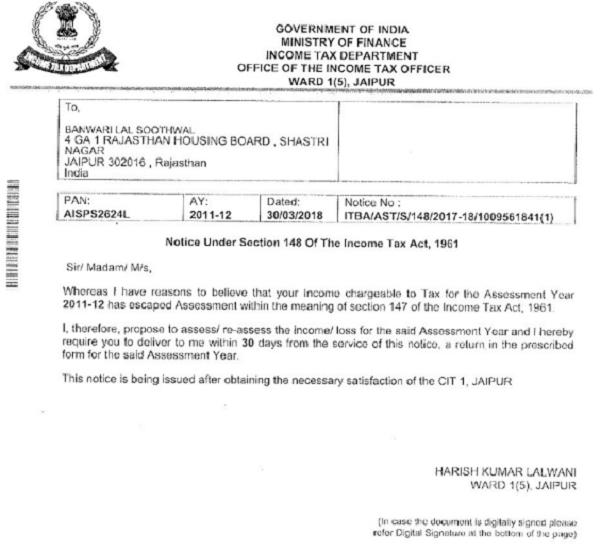
Section 148 of the Income Tax Act, 1961 (‘the Act’ for short) provides that before making the assessment, reassessment or recomputation under section 147, the Assessing Officer shall serve on the assessee a notice requiring him to furnish within such period, as may be specified in the notice, a return of his income or the income of any other person in respect of which he is assessable under this Act during the previous year corresponding to the relevant assessment year, in the prescribed form and verified in the prescribed manner and setting forth such other particulars as may be prescribed and the provisions of this Act shall, so far as may be, apply accordingly as if such return were a return required to be furnished under section 139.
The issuance of valid notice is a foundation for the valid assessment or re-assessment proceedings. The notice prescribed under section 148 is not a mere procedural requirement, but is a condition precedent to the validity of assessment or reassessment proceedings. If no notice is issued or if the notice issued is shown to be invalid, the proceedings initiated by the Assessing Officer would be invalid and void.
As a dead individual is not a person in the eyes of law, assessment or reassessment proceedings or subsequent proceedings taken in his name will be invalid. The Department must bring all the legal legal representatives on record and continue proceedings against them as required under and in accordance with section 159 of the Act. No assessment or reassessment proceedings or subsequent proceedings can be undertaken against a dead person. Framing assessment or reassessment proceedings on a non-existent person is a jurisdictional defect and cannot cured under section 292B or under section 292BB. For taking refuge under section 292BB the legal representatives or the assessee has to point out the defect in the notice or in its service during the course of assessment or reassessment proceedings.
Once the assessee is dead, no valid assessment or reassessment can be made on him by issuing notice under section 148 in the name of the deceased or framing assessment in his name. It is because on death of a person his legal personality ceases to exist and thereafter no order can be passed against such dead person. Thus, the assessment or reassessment in the hands of dead person is void. Therefore, for a valid reassessment of escaped income of the deceased, the Assessing Officer has to bring all the legal representatives on record and issue notices under section 148 to all.
Section 159 provides that any re- assessment proceeding taken against the deceased before his death may be continued against the legal representative from the stage at which it stood on the date of the death of the deceased and accordingly, all the provisions of this Act shall apply to that legal representative.
Section 292B also cannot cure jurisdictional defects:
Section 292B provides that no return of income, assessment, notice, summons or other proceedings shall not be invalid merely by reason of ‘any mistake, defect, or omission. Section 292B of the Act was enacted to save purely technical obligations without substantially coming in the way of the validity of the assessment proceedings. Issue of a valid notice is a condition precedent for initiating proceedings under section 148 of the Income-tax Act. If it is issued on a dead person it will be illegal and without jurisdiction which cannot be saved by section 292B of the Act.
Operation of Section 292BB in cases of issue of notice under section 148(1)/making assessment or reassessment on a dead person
Section 292BB prohibits an assessee in any enquiry or proceedings, to raise the plea of non-service, untimely service or improper service of a notice, if he has participated in the assessment or reassessment proceedings and such objection has not been raised before completion such assessment or reassessment proceedings. This Section was inserted by Finance Act 2018 w.e.f. 01.04.2008 and, thus, will not be applicable for earlier assessment years. Also, where the LR raises the plea of non-service of the notice before completion of reassessment, main provision cannot be invoked to correct the error. Further, the issuance and service of the notice under section 148(1) is jurisdictional aspect and therefore, a defect in the notice cannot be cured under section 292BB.
Assessing Officer issued notice under section 148 to assessee to file return on 31.03.2021 and writ applicant, legal representative of assessee, had informed about death of assessee on 22.11.2020, since writ applicant had not surrendered to jurisdiction of Assessing Officer by submitting return in response to impugned notice and Assessing Officer had not issued notice to him as legal representative representing estate of deceased assessee, impugned notice issued by Assessing Officer was invalid and should be quashed
The High Court has drawn distinction between clause (a) of sub-section (2) of section 159 and clause (b) of sub-section (2) of section 159. Clause (b) of sub-section (2) of section 159 permits initiation of any proceedings, which could have been taken against the deceased through legal representative. However, in the instant case, the impugned notice dated 31.03.2021 under section 148hasbeenissued upon the deceased assessee, who had expired prior to the issuance of such notice. The instant case does not fall under clause (a) of sub-section (2) of section 159 and in such circumstances, even the proceedings pursuant to such notices as sought to be initiated by the Assessing Officer cannot be continued upon the deceased assessee.
Assessing Officer issued a notice under section 148 on 31.03.2021 to assessee calling upon to him file return of income. Writ-applicant, son of assessee, responded to said notice by submitting that assessee had died on 22.11.2020 and prayed for quashing of said notice and, further, requested to drop proceeding. However, Assessing Officer issued notice under section 142(1) again in name of deceased assessee.
In the peculiar facts and circumstances as emerged from the records, more particularly upon perusal of the contents of the objections-cum-reply filed by the writ-applicant dated 10.04.2021 and 15.12.2021, it transpires that he has not surrendered to the jurisdiction of the Assessing Officer by submitting return in response to the impugned notices neither the jurisdictional Assessing Officer has issued notice upon writ-applicant as legal representative representing estate of deceased assessee. Thus, it is to be held that the proceeding initiated by the Assessing Officer against the deceased assessee was not tenable in the eye of law and was required to be quashed and set aside. In the result, the impugned notice was invalid and does not confer jurisdiction upon the Assessing Officer to proceed against the writ applicant. [In favour of assessee] (Related Assessment year : 2015-16) – [Kanubhai Dhirubhai Patel v. ITO (2022) 444 ITR 405 : 139 taxmann.com 580 (Guj.)]
Assessing Officer issued notice under section 148 against a dead person, impugned notice was null and void and required to be set aside
Petitioner herein is the son of Late Mr. Amrit SinghThapar, the deceased assessee, who expired on 2-8-2020. It is the case of the Petitioner that impugned notice dated 6-4-2021 was issued by Respondent No. 1 stating therein that income chargeable to tax for the assessment year 2013-14 had escaped assessment within the meaning of section 147 of the Act and 30 days were granted to file a return in the prescribed form. Soon thereafter vide an email dated 30-4-2021, Petitioner’s mother, i.e., the wife of the deceased assessee informed Respondent No. 1 of the demise of her husband and also sent the Death Certificate. Despite the said intimation, the revenue authorities issued further notices to the deceased assessee, including one under Section 148A(b) of the Income Tax Act, pursuant to an order passed by the Supreme Court. Against the notices issued by the revenue authorities, the petitioner Davinder Singh Thapar, i.e., the son of the deceased assessee, filed a writ petition before the Delhi High Court.
The petitioner Davinder Singh Thapar submitted before the High Court that the notices issued by the revenue department against the assessee were invalid in law since they were issued against a dead person. The petitioner averred that under Section 148 of the Income Tax Act, there is a statutory requirement that the Assessing Officer shall serve a notice on the assessee. The petitioner contended that since the assessee had expired prior to the issuance of the first notice, the said statutory requirement was not fulfilled.
The petitioner submitted that the Delhi High Court in the case of Savita Kapila versus ACIT, (2020) had held that a notice under Section 148 of the Income Tax Act against a dead person is null and void and, therefore, all consequential proceedings and orders are invalid.
The revenue department averred that notices were issued against the deceased assessee pursuant to an order passed by the Supreme Court in the case of Union of India v. Ashish Agarwal (2022) 286 Taxman 183 : 138 taxmann.com 64 (SC).
The Court observed that the judgment of the Supreme Court in Union of India & Ors. v. Ashish Agarwal (2022) did not deal with the issue of whether the notices could be issued against the assesses who had expired. However, on a pointed query by the Court as to whether the judgment deals with the issue if notices can be issued in cases where the assessees have expired, the answer was in the negative.
The Court noted that the Division Bench of the Delhi High Court in the case of Sangeeta Vig versus ITO, Delhi (2022), after referring to the decision rendered in Savita Kapila v. ACIT (2020) 426 ITR 502 : 273 Taxman 148 : 118 taxmann.com 46 (Del.) had set aside an order passed under Section 148A(d) and the consequential notice issued under Section 148 of the Income Tax Act against a deceased assessee.
The Court observed that the case of the assessee was covered by the judgments of the Delhi High Court. Accordingly, the impugned notices are hereby quashed and set aside. Needless to state that it is open to the Respondents to take such steps as may be permitted in law and if and when such steps are taken, with which the Petitioner is aggrieved, it would be open to the Petitioner to resort to the remedies in accordance with law. [In favour of assessee] (Related Assessment year : 2013-14) – [ACIT v. Davinder Singh Thapar (2022) 141 taxmann.com 4 (ITAT Delhi)]
Petitioner, legal representative, challenged impugned notice issued under section 148 on ground that notice had been issued in name of his deceased father, revenue was to be directed to issue appropriate notice to petitioner under section 148 as a legal representative of deceased assessee
I am inclined to allow this writ petition at the stage of admission by giving liberty to the respondent to issue appropriate notice to the petitioner under section 148 as a legal representative of the deceased assessee, namely, Jeyachandran. The time spent in the impugned proceeding till the date of receipt of this order shall be excluded. Considering the fact that the time for completing the assessment would expire on 31.03.2022, the respondent is given liberty to issue a fresh notice to the petitioner within a period of two weeks from the date of receipt of copy of this order. The respondent shall thereafter proceed to pass appropriate orders on merits and in accordance with law within a period of 75 days. The entire exercise shall be completed by the respondent within a period of 90 days from the date of receipt of copy of this order. Therefore, where petitioner, legal representative challenged impugned notice dated 29.03.2021 issued under section 148 on ground that notice had been issued in name of his father who died on 17.01.2014, revenue was to be directed to issue appropriate notice to petitioner under section 148 as a legal representative of deceased assessee. Consequently, the connected Miscellaneous Petitions are closed. [In favour of assessee] (Related Assessment year : 2015-16) – [J. Kishorekumar v. ITO (2022) 139 taxmann.com 47 (Mad.)]
Legal representatives of deceased not obliged to intimate death to Income tax department & get PAN cancelled
It is the case of the petitioner, that Late Shri Gupta had, however, expired on 17.06.2014 and in support of this submission, the petitioner has placed on record the Death Certificate of Late Shri Gupta issued by the Department of Public Health, Corporation of Chennai.
Delhi High Court quashed reopening notice as well as reassessment order & all consequential proceedings initiated in the name of deceased & also held, interalia, that the Legal representatives of deceased are not obliged to intimate death to Income tax department & get PAN cancelled & that reassessment order can be challenged in such cases in writ petition. (Related Assessment year : 2012-13) – [Sripathi Subbaraya Manohara L/H Late Sripathi Subbaraya Gupta v. PCIT – Date of Judgement : 14.07.2021 (Del.)]
Reassessment of deceased assessee’s legal heirs, invalid sans procedure under section 159, incurable u/nder section 292B
Karnataka High Court allows writ petition challenging initiation of reassessment against legal heirs where notice under section 148 was issued in the name of deceased Assessee; Assessee, late Mr. Kurkal Gopal Shetty passed away 2014 whereas a notice under section 148 for Assessment year 2011-12 dated 23.03.2018 was issued to him; During the course of assessment proceedings, Revenue was informed of the Assessee’s demise whereafter Revenue issued notices under section 142(1) to the legal heirs and passed an ex parte reassessment order; Legal heirs challenged the validity of reassessment notice, reassessment order and consequential recovery and penalty notices; High Court observes that legal heirs received the notice under section 142(1) but no fresh notice under section 148 was issued to them; High Court further observes that the notice to the deceased Assessee is invalid from its inception as the the only remedy available to the Revenue against a dead person is to issue notice to the legal representatives under section 159, and except this procedure no other procedure has been envisaged in law; High Court relies on the Madras High Court ruling in Alamelu Veerappan v. ITO (2018) 257 Taxman 72 : 95 taxmann.com 155 (Mad.) wherein it was held that “notice issued to the legal representatives beyond the period of limitation prescribed is without jurisdiction and unenforceable in law” and notes that Delhi High Court ruling in Rajender Kumar Sehgal v. ITO (2019) 414 ITR 286 : 260 Taxman 412 : 101 taxmann.com 233 (Del.) is also on the similar lines; Refers to Section 292B and holds that the notice issued against a dead person ought to have been issued under Section 159(2)(b) to the legal representatives and such notice cannot be saved by recourse to Section 292B; Relying on the Supreme Court ruling in CIT v. Kurban Hussain Ibrahimji Mithiborwala (1971) 82 ITR 821 (SC), High Court remarks that the position of law on validity of the notice vitiating the pursuant proceedings is well-settled and thus, sets aside the reassessment order and consequential demand and penalty notices. [In favour of assessee] – [Vanitha Gopal Shetty v. ACIT [TS-646-HC-2021(KAR)] – Date of Judgement : 05.07.2021 (Karn.)]
In absence of a statutory provision, a duty cannot be cast upon legal representatives to intimate factum of death of assessee to department and, thus, where Assessing Officer issued a notice to assessee under section 148 after his death and, in such a case, it could not have been validly served upon assessee, said notice being invalid, was to be quashed
An information was received by Assessing Officer that assessee had deposited certain amount in his bank account source of which was not explained. Assessing Officer thus issued a notice to asseessee under section 148 seeking to reopen assessment – Petitioner i.e. legal representative of assessee filed instant petition challenging validity of said notice by contending that it was issued subsequent to death of assessee and, thus, statutory requirement of service of notice had not been fulfilled. In absence of a statutory provision, a duty cannot be cast upon legal representatives to intimate factum of death of assessee to department. Therefore, question as to whether PAN record was updated or not or whether department was made aware by legal representatives or not is irrelevant. In view of aforesaid legal position and, having regard to fact that impugned notice could not have been served upon assessee, same deserved to be quashed. [In favour of assessee] (Related Assessment year : 2012-13) – [Savita Kapila v. ACIT (2020) 426 ITR 502 : 273 Taxman 148 : 118 taxmann.com 46 (Del.)]
Petitioner, a widow of original assessee, produced death certificate of her deceased husband, which indicated that notice under section 148 was issued against a dead person, impugned notice was invalid and was to be set aside
This Petition is filed by the widow of Late Shri Shyamsundar Pundalik Dhumatkar. Late Shri Shyamsundar Dhumatkar was engaged in his individual business. He filed return of his income till the year 2007-08. According to Petitioner, however, since thereafter he had no taxable income, he had stopped filing returns of income. The Assessing Officer issued a notice dated 27.03.2018 in the name of Late Shri Shyamsundar Dhumatkar under section 148 of the Income-tax Act, 1961 (for short ‘the Act’) reopening the assessment for the assessment year 2011-12. Shri Shyamsundar Pundalik Dhumatkar expired on 14.10.2016. Thus, the notice dated 27.03.2018 was issued on a dead person. The Petitioner as a widow and legal heir of the deceased Shri Shyamsundar Dhumatkar brought these facts to the notice of the income tax department. Despite this, the Assessing Officer issued a notice under section 142(1) of the Act on 29.08.2018 and therefore the Petitioner has filed this Petition challenging the said notice dated 27.03.2018.
The facts are not seriously in dispute. The Petitioner had produced the death certificate of Shri Shyamsundar Dhumatkar before the Income-tax authorities, indicating that he died on 14/10/2016. Thus, the impugned notice of reopening of assessment was issued on a dead person. There are several judgments of different High Courts holding that the notice or reopening of assessment is invalid in law. A reference in this respect can be made to a decision of Gujarat High Court in the case of Chandreshbhai Jayantibhai Patel v. ITO (2019) 413 ITR 276 : 261 Taxman 137 : 101 taxmann.com 362 (Guj.). As also the decision of Madras High Court in the case of Alamelu Veerappan v. ITO (2018) 257 Taxman 72 : 95 taxmann.com 155 (Mad.). It is not necessary to refer to all the judgments on the point. Suffice it to say, as per the settled law, notice for reopening of assessment against a dead person is invalid. In the result, the impugned notice is set aside. Petition is disposed of accordingly. Consequentially, the order of assessment dated 31.12.2018 also stands annulled. [In favour of assessee] (Related Assessment year : 2011-12) – [Rupa Shyamsundar Dhumatkar (2020) 420 ITR 256 : 275 Taxman 453 : 120 taxmann.com 323 (Bom.)]
Notice seeking to reopen assessment was issued in name of deceased assessee, since she could not have participated in reassessment proceedings, provisions of section 292BB were not applicable to assessee’s case and as a consequence, impugned reassessment proceedings deserved to be quashed
For relevant year, assessee filed her return declaring certain taxable income. Return was processed in a routine manner and assessee was intimated about it. After death of assessee, Assessing Officer issued a notice under section 148 in her name seeking to reopen assessment. Legal representative of assessee filed instant petition contending that Act did not provide any mechanism for issuing and carrying on reassessment in respect of a dead person, if reassessment notice was issued against a deceased. Revenue, on other hand, raised a plea that error in issuing notice to a non-existent person or entity was capable of correction by reason of section 292BB. On facts, if original assessee had lived and later participated in proceedings, then, by reason of section 292BB, she would have been precluded from saying that no notice was factually served upon her. However, in instant case, since notice was issued in name of assessee when she was no longer alive, it was inconceivable that she could have participated in reassessment proceedings to be estopped from contending that she did not receive it. Therefore, provisions of section 292BB were not applicable to assessee’s case and as a consequence, impugned reassessment proceedings deserved to be quashed. [In favour of assessee] (Related Assessment year : 2010-11) – [Rajender Kumar Sehgal v. ITO (2019) 414 ITR 286 : 260 Taxman 412 : 101 taxmann.com 233 (Del.)]
Assessing Officer had issued notice under section 148 in name of deceased assessee to reopen his assessment, for acquiring jurisdiction to reopen an assessment, notice should be issued in name of living person, i.e., legal heir of deceased assessee and section 292B could not be invoked to correct a fundamental/substantial error
The Assessing Officer issued a notice dated 29.03.2018 under section 148 in the name of the dead person, i.e., the deceased assessee [B] to reopen his assessment for the assessment year 2011-12. The petitioner, who was the registered legal heir of ‘B’, challenged the impugned notice on the ground that it was without jurisdiction. The Assessing Officer by order dated 13.11.2018 rejected the petitioner’s preliminary objection inter alia on the ground that the defect in the notice would stand rectified by virtue of section 292B. On writ:
The issue of a notice under section 148 is a foundation for reopening of assessment. The sine qua non for acquiring jurisdiction to reopen an assessment is that such notice should be issued in the name of the correct person. This requirement of issuing notice to a correct person and not to a dead person is not merely a procedural requirement but is a condition precedent to the impugned notice being valid in law. Thus a notice which has been issued in the name of the dead person is also not protected either by provisions of section 292B or section 292BB. This is so as the requirement of issuing a notice in the name of correct person is the foundational requirement to acquire jurisdiction to reopen the assessment. This is evident from section 148, which requires that before a proceeding can be taken up for reassessment, a notice must be served upon the assessee. The assessee on whom the notice must be sent must be a living person, i.e., legal heir of the deceased assessee, for the same to be responded. This in fact is the intent and purpose of the Act. Therefore, section 292B cannot be invoked to correct a foundational/substantial error as it is meant so as to meet the jurisdictional requirement. Therefore, both the impugned notice dated 29.03.2018 and the impugned order dated 13.11.2018 required to be quashed and set aside. [In favour of assessee] (Related Assessment year : 2011-12) – [Sumit Balkrishna Gupta v. ACIT (2019) 414 ITR 292 : 262 Taxman 61 : 103 taxmann.com 188 (Bom.)]
Proceedings were initiated against deceased assessee, notice issued on deceased person could not make legal heirs binding unless proper notice was issued on legal heirs – Any notice issued in name of deceased person was invalid and could not be enforced in law
The Assessing Officer issued notice under section 148 in the name of a dead person who had expired in 2009. Notice was received by the legal heir/wife of the assessee. The legal heir replied to the Assessing Officer stating that her husband expired in 2009 and did not furnish the return of income. On the ground that there was no compliance for the notice under section 148, the Assessing Officer completed the assessment under section 144, read with section 147, in the name of the legal heir. On appeal, the Commissioner (Appeals) confirmed order of the Assessing Officer.
In the instant case before the Tribunal, the legal heir contended that issuance of notice on dead person and the consequent assessment order made in her name was invalid as the Assessing Officer proceeded to complete the assessment in the name of the legal heir without issuing notice under section 148.
The assessee expired on 03.11.2009. In support, death certificate was also enclosed in the paper book. Subsequent to the death of the assessee, reassessment proceedings were initiated and the notice under section 148 was issued in the name of the dead person. In response to the notice issued by the Assessing Officer, the wife of the deceased had intimated the death of the assessee. However, no effort was made by the Assessing Officer to bring the legal heir on record; instead, the Assessing Officer proceeded to complete the assessment in the name of the legal heir without issuing notice under section 148.
In the instant case, the proceedings were initiated against the dead person after the death of the assessee; hence the notice issued on the dead person could not make the legal heirs binding unless a proper notice was issued on the legal heirs. After the death of the assessee, proceedings must be initiated against the legal heirs to treat the legal heirs as deemed assessees. As per section 159 (2)(b), the Assessing Officer is free to initiate proceedings against the legal representatives which could have been initiated against the deceased and determine the tax liability of the deceased person and the same is binding on the Legal representatives. Any notice issued in the name of a deceased person is invalid and cannot be enforced in the law. The Madras High Court in the case of Alamelu Veerappan v. ITO (2018) 257 Taxman 72 : 95 taxmann.com 155 (Mad.) has held that the notice issued on a dead person is invalid and cannot be enforced.
It was further held that the date when the notice was issued, the assessee was already dead and if the Department intended to proceed under section 147, it could have done so prior to expiry of period of limitation by issuing the notice to the legal heirs of the deceased and beyond that date, it could not have proceeded in the matter even by issuing notice to the legal representatives of the assessee. It was further held that even if the provisions of section 159 are attracted, in that case also, the notice was required to be issued against and in the name of the heirs of the deceased assessee and under the said circumstances, section 159 shall not be of any assistance to the revenue.
The Bombay High Court in the case of Sumit Balkrishna Gupta v. ACIT (2019) 262 Taxman 61 : 103 taxmann.com 188 (Bom.) held that the notice issued on a dead person is invalid unenforceable in law. It was further held that a notice which has been issued in the name of the person is also not protected either by provisions of section 292B or 292BB the requirement of issuing a notice in the name of correct person is the foundational requirement to acquire jurisdiction to reopen the assessment. This is evident from section 148, which requires that before a proceeding can be taken up for reassessment, a notice must be served upon the assessee. The assessee on whom the notice must be sent must be a living person i.e, legal heir of the deceased assessee, for the same to be responded. Thus, the notice under section 148 on a dead person was invalid and accordingly, quashed. Consequent assessments made under section 144, read with section 147, is to be annulled. [In favour of assessee] (Related Assessment year : 2007-08) – [Aemala Venkateswara Rao v. ITO, Guntur (2019) 176 ITD 431 : 105 taxmann.com 14 (ITAT Visakhapatnam)]
Assessee did not inherit anything from his father and, moreover, he had nothing to do with his father’s bank account, having regard to provisions of section 159, impugned assessment order passed under section 144, read with section 147 on ground that there were huge deposits in said account in relevant year prior to death of his father, was not sustainable
Liability of a legal representative under Act is limited to extent to which estate is capable of meeting said liability. Therefore, where assessee did not inherit anything from his father and, moreover, he had nothing to do with his father’s bank account, impugned assessment order passed under section 144, read with section 147, on ground that there were huge deposits in said account in relevant year prior to death of his father, was not sustainable and, thus, same deserved to be set aside. [In favour of assessee] – [C. Naveen Kumar v. ITO (2019) 266 Taxman 74 : 108 taxmann.com 219 (Mad.)]
Initiation of reassessment proceedings, in absence of service of notices under section 148 on all LRs of deceased assessee was bad in law, being void ab initio
Deceased assessee was survived by two sons and one daughter as her Legal Representatives (LRs) – After expiry of assessee, proceedings were initiated under section 148. Assessing Officer, however, issued notice to only one son ‘P’ who participated in reassessment proceedings. Subsequently, ‘P’ raised an objection before Commissioner (Appeals) that since notice was not served on all legal representatives, reassessment proceedings were invalid. Commissioner (Appeals) rejected said objection holding that once ‘P’ voluntarily participated in reassessment proceedings, he could not take a stand at appellate stage that notice was not served upon all legal heirs.
It would also be pertinent to notice here the provisions of section 159(4) of the Act, as per which, the personal liability of every LR for any tax payable by him in his capacity as such LR, if he creates a charge on or disposes of or parts with any asset of the estate of the deceased, shall be limited to the value of the asset so charged, dispose of or parted with. This is entirely in consonance with the requirement of serving reassessment notices on all the LRs of a deceased assessee, so as to enable a complete representation of the estate of the deceased in order to make the recovery of the liability fruitful and to enable the passing of an order effective to realize the entire sum due from the deceased assessee. The rights and interest of the LRs in the estate of the deceased cannot be taken away from them without giving them a proper opportunity of defending their rights and interest, in accordance with the natural justice principle of audi alterem partem, as held in ITO v. Umedram (1995) 54 ITD 191 (ITAT Jaipur). Therefore, initiation of reassessment proceedings, in absence of service of notices under section 148 on all LRs of deceased assessee was bad in law, being void ab initio. [In favour of assessee] (Related Assessment year : 2008-09) – [Shanta Kapoor v. ACIT, Agra (2018) 93 taxmann.com 226 (ITAT Agra)]
Revenue can not compel legal-heir to participate in deceased’s re-assessment; Death non-intimation irrelevant
Madras High Court allows petitioner’s (deceased assessee’s spouse) writ, quashes re-assessment notice issued under section 148 in the name of deceased-assessee, holds that petitioner cannot be compelled to participate in the proceedings and respond to Section 148 notice; In response to Section 148 notice issued in the name of assessee (within prescribed time-limit), petitioner intimated about assessee’s death and the subsequent notice was issued by Revenue beyond the limitation period; High Court remarks that merely because the Department was not intimated about the death of the assessee, that cannot, by itself, extend the period of limitation prescribed under the Statute.”, also clarifies that the issue relating to limitation is not a curable defect for the Revenue to invoke Section 292B; Further notes that Revenue could not show that there is a statutory obligation on the part of the legal representatives to immediately intimate the death of the assessee or take steps to cancel the PAN registration; Moreover, rules that proceedings under section 159 can be invoked only if the proceedings have already been initiated when assessee was alive and was permitted for the proceedings to be continued as against the legal heirs, however, observes that in present facts, Section 159 is not applicable, relies on Delhi High Court rulings in Vipin Walia v. ITO (2016) 382 ITR 19 : 238 Taxman 1 : 67 taxmann.com 56 : (2017) 295 CTR 505 (Del.) and Spice Entertainment Ltd., distinguishes Revenue’s reliance on Delhi High Court ruling in Sky Light Hospitality LLP on facts. [In favour of assesse] (Related Assessment year : 2010-11) – [Alamelu Veerappan v. ITO [TS-315-HC-2018(MAD)] – Date of Judgement : 07.06.2018 (Mad.)]
Department intended to proceed under section 147 against assessee when he was already dead, it could have been done so by issuing a notice to legal representative of assessee within period of limitation for issuance of notice
Notice under section 148 for relevant assessment year was issued upon original assessee when he was already dead. However, department continued with proceedings under section 147 in name of petitioner, as a legal heir of original assessee. Petitioner contended that proceedings initiated were barred by limitation. If department intended to proceed under section 147, it could have been done so prior to period of limitation by issuing a notice to legal representative of deceased assessee and beyond that date it could not have proceeded in matter even by issuing notice to Legal Representatives of assessee, therefore, subsequent proceedings under section 147 against petitioner were wholly misconceived and were to be quashed. [In favour of assessee] (Related Assessment year :2008-09) – [Vipin Walia v. ITO (2016) 382 ITR 19 : 238 Taxman 1 : 67 taxmann.com 56 : (2017) 295 CTR 505 (Del.)]
Original assessee, namely, ‘B’ died on 02.12.2009 and after a period of six years Assessing Officer issued notice under section 148 in her name to reopen assessment for assessment year 2009-10 and further despite pointing out by heir of ‘B’ that ‘B’ had expired long back, he relying upon section 159 continued with reassessment proceedings against ‘B’, section 159 would not applicable to instant case and, therefore impugned notice was liable to be set aside
Original assessee, namely, ‘B’ died on 02.12.2009. After a period of six years, Assessing Officer issued a notice under section 148 in name of ‘B’ to reopen assessment for assessment year 2009-10. Thereupon petitioner-heir and legal representative of ‘B’ informed Assessing Officer that ‘B’ had already expired on 02.12.2009 and, therefore, notice in her name was not valid. Despite it, Assessing Officer relying upon section 159 informed petitioner to file return of income for assessment year 2009-10 and continued with reassessment proceedings against ‘B’. Even if section 159 relied upon by Assessing Officer was attracted in instant case, in that case also, notice under section 148 was required to be issued against and in name of heir of ‘B’. Under circumstances section 159 shall not be any assistance to Assessing Officer. Therefore, impugned notice issued under section 148 was liable to be set aside. [In favour of assessee] (Related Assessment year : 2009-10) – [Rasid Lala v. ITO (2017) 77 taxmann.com 39 (Guj.)]
Notice under section 148 was addressed to an assessee who was already dead even on date of issue of notice and notice was not served upon legal representatives of deceased but it was served on munim, defect in such notice was not cured by section 292B and as such notice was not valid
In the case of CIT v. Shital Prasad Kharag Prasad (2006) 280 ITR 541, a Division Bench of this court has held that the notice contemplated under section 148 of the Income-tax Act, 1961, is a jurisdictional notice and is not curable under section 292B of the Act, if it was not served in accordance with the provisions of the Act.
In the present case, the notice under section 148 was addressed to an assessee who was already dead even on the date of issue of notice. The notice was issued on 28.03.1985, while the assessee, Ganga Prasad Jaiswal had died on 20.03.1985. The notice was not served upon the legal representatives of Ganga Prasad Jaiswal but it was served on one Keshav Ram, munim. Even the name of the deceased assessee was not correctly mentioned in the notice. The notice was addressed to Ganga Prasad Jaiswal while the correct name of the assessee was Ganga Ram Jaiswal.
Where the notice under section 148 was addressed to an assessee who was already dead even on the date of issue of notice and the notice was not served upon the legal representatives of the deceased but it was served on munim, the defect in such notice was not cured by section 292B and as such the notice was not valid. [In favour of assessee] – [CIT v. Suresh Chandra Jaiswal (2010) 325 ITR 563 (All.)]
Non-service of notice upon all legal representatives of deceased-assessee, is an irregularity which is curable and not an illegality sufficient for annulling assessment or reassessment proceedings
The assessee filed return for the assessment year 1992-93, declaring an income. The returns were processed under section 143(1A). Thereafter, the assessee passed away. A notice under section 148 was issued to the appellant, the legal representative of the deceased-assessee which was served upon him proposing to reopen assessment for relevant assessment years. The appellant appeared before the Assessing Officer through his chartered accountant and furnished the requisite explanations. There-after, reassessment orders were passed by the Assessing Officer for the relevant assessment years determining the income of the deceased- assessee. On appeals before the Commissioner (Appeals), the appellant, inter alia, contended that since a notice had not been issued to the other legal heirs left behind by the deceased-assessee, namely, his widow, sons and daughter, the orders of reassessment made by the Assessing Officer were illegal and unsustainable. The Commissioner (Appeals) upheld the contention of the appellant and annulled the reassessment orders. On revenue’s appeal, the Tribunal held that non-service of notice upon all the legal representatives of the deceased-assessee was an irregularity which was curable and not an illegality sufficient for annulling the assessment or reassessment proceedings. On appeals :
Held : The Tribunal had correctly held that the matter stood authoritatively concluded by the judgment of the Supreme Court in CIT v. Jai Prakash Singh (1996) 219 ITR 737 : 85 Taxman 407 (SC). The Apex Court in the said case held that non-issue of notices to other legal representatives of the deceased-assessee was not sufficient to avoid the assessment or reassessment orders made by the Assessing Officer. In the light of the said decision, the Commissioner was indeed in error in upsetting the reassessment orders passed by the Assessing Officer.
In the light of what had been stated above, no substantial question of law arose for consideration. The appeal failed and was, accordingly, dismissed. (Related Assessment years : 1992-93 and 1993-94) -[Shahid Atiq v. CIT (2006) 200 CTR 451 : 152 Taxman 71 (Del.)]
Notice of reassessment proceedings was served on four sons of deceased assessee – One of sons filed returns and pursued matter till passing of reassessment orders – At no stage, he objected to reassessment proceedings on ground that two of legal representatives of deceased had not been given notice – On facts, respondent – Legal representatives did not have locus standi to question orders of reassessment on ground of lack of notice to other legal representatives and appellate authority gravely erred in quashing reassessment orders only on ground that notice had not been given to remaining legal representatives – Further non-issuance of notice to some of legal heirs of deceased was merely an irregularity which did not affect validity of reassessment orders
For the assessment years 1979-80, 1985-86 and 1986-87, the Assessing Officer completed the assessment under section 143(1). Later on, he received information that the deceased had large deposits in banks which had not been properly explained. He then initiated reassessment proceedings for all these years and issued notices under section 148. The notices were duly served on all the legal heirs of the deceased. One of his sons, ‘H’ contested the notices. The Assessing Officer reassessed the income on deceased. The appeals filed by ‘H’ and three others were allowed by the Commissioner (Appeals) on the ground that notices of reassessment proceedings had not been given to two of the legal heirs of the deceased. Further appeals filed by the revenue were dismissed by the Tribunal. On reference :
Held : The notice of reassessment proceedings was served on four sons of the deceased. One of them, namely ‘H’, filed the returns without raising any objection. He pursued the matter till the passing of the orders. At no stage, he objected to reassessment proceedings on the ground that two of the legal representatives of the deceased had not been given notice. In this view of the matter, the legal representatives did not have the locus standi to question the orders of reassessment on the ground of lack of notice to other legal representatives and the appellate authority gravely erred in quashing the reassessment orders only on the ground that the notice had not been given to the remaining legal representatives. For the same reason, the order passed by the Tribunal was liable to be declared as vitiated by an error of law.
Further, non-issuance of notice to some of the legal heirs of the deceased was merely an irregularity and the same did not affect the validity of the reassessment orders. [In favour of the revenue] (Related Assessment years : 1979-80, 1985-86 and 1986-87) – [CIT v. Hukam Singh (2005) 276 ITR 347 : 198 CTR 92 (P&H)]
A notice under section 148 was issued upon original assessee when he was no more – Thereafter, department issued notice of demand under section 221(1) calling upon him to show cause as to why penalty should not be imposed for non-payment of dues – Notice under section 148 could not have been served upon deceased – Since department had not placed any material to show that notice under section 148 was served on petitioner, it could be said that notice was not served on him – Therefore, subsequent proceedings were bad in law as there was breach of principles of natural justice as well as mandatory provisions contained under section 148 – Therefore, notice of demand, notice under section 221(1) as also order of assessment and order of penalty were to be quashed
A notice under section 148 was issued in the name of the original assessee when he was no more. Thereafter, a notice of demand under section 156 was issued in the name of the petitioner, as a legal heir of original assessee, for the assessment year 1996-97. A notice under section 221(1), was also issued calling upon the petitioner to show cause as to why a penalty should not be imposed for non-payment of the dues. On writ :
Held : Obviously, the notice could not have been served upon the deceased. Moreover, there was nothing on record to show that the notice under section 148 was served on the petitioner either. The revenue had submitted that section 148 mandated service of the notice on the assessee, however, in view of section 2(7) read with section 159(2)(b), the petitioner, being a legal representative of the deceased, would be deemed to be an assessee. However, nothing was placed before the High Court to show that any notice was served even on the deemed assessee. As such, it was clear that notice under section 148 was neither served on the original assessee nor on the deemed assessee. Therefore, the subsequent proceedings were bad in law as there was breach of the principles of natural justice as well as the mandatory provisions contained in section 148. The principle of audi alteram ought to have been followed by the revenue. Therefore, the notice of demand, the notice under section 221(1) as also the order of assessment and the order of penalty were to be quashed. In other words, all proceedings, notices, orders pursuant to the said notice under section 148 were quashed and set aside. The writ petitions were accordingly, allowed. [In favour of the assessee] (Related Assessment year : 1996-97) –
Notice under section 148 was served on one of seven legal heirs of deceased assessee, assumption of jurisdiction under section 147/148 by Assessing Officer was bad in law and assessment completed on basis of such a notice was ab initio void
As a consequence of search operations, a notice under section 148 was served on ‘BP’, one of the legal heirs of deceased assessee. Certain other letters in regard to certain enquiries as also certain notices were issued subsequently in the names of legal heirs which included BP, LN and LD. After the notices were sent under section 148, various additions were made by the Assessing Officer. On appeal, the appellant contended that initiation of proceedings under section 148 was bad in law inasmuch as the notice was issued in the name of one legal heir only and was not issued to all the legal heirs as required under the provisions of law and, consequently, the assessment so completed on the basis of certain notices issued under section 148 was void ab initio. The Commissioner (Appeals) upheld the contention of the assessee and held that the assessment being void ab initio stood annulled. On revenue’s appeal :
Held : If the said irregularity was cured, as on the date of the judgment, the Assessing Officer was not competent to issue notice under section 148 to other legal heirs because of the provisions of section 149, and as such, by no means estate could be represented on the basis of notice issued under section 148 to ‘BP’, who was also stated to have expired long back. In these circumstances, the assumption of jurisdiction by the Assessing Officer under section 147/148 was bad in law. The defect of not sending notices to all the legal representatives was not curable under the Act. The issue of notices under sections 142(1) and 142(2) is entirely on the different footing. The processing of the returns under section 143(3) simpliciter and the one processed under section 148 after assuming jurisdiction to initiate reassessment proceedings are totally different. The assumption of jurisdiction is a very important step under the Act, which is based on certain happenings; whereas the proceedings under section 142(1)/142(2) are quite procedural and ordinary. The proceedings under section 147/148 affect the rights of the assessee. There was no infirmity in the findings of the Commissioner (Appeals). [In favour of assessee] (Related Assessment year : 1988-89) – [ACIT v. Mangi Lal (2004) 83 TTJ 590 : 4 SOT 130 (ITAT Jodhpur)]
As against seven legal heirs of deceased assessee assessment proceedings were initiated only against ‘A’, who attended same and never objected to proceedings before Assessing Officer and never took plea for impleading all legal heirs, it would be wrong to hold proceedings to be void ab initio on ground that notice was issued to one legal heir only – Assessing Officer was rightly directed in such a case to re-process matter but after bringing other legal heirs on record
For the assessment years 1983-84 to 1985-86, the interest income on FDRs was assessed under section 147 read with section 143. On appeal, the assessee took the plea, inter alia that notices having been served on only one out of seven legal heirs, assessments framed were invalid and required to be annulled. The appellate authority, however, without annulling the assessments, restored the matter back to the file of the Assessing Officer asking him to make enquiries for ascertaining the legal heirs so that notices could be issued to all of them.
On second appeal, the Accountant Member noted that out of seven legal heirs, only one ‘A’ was proceeded against, and ‘A’ having attended the proceedings never objected to the proceedings and raised a plea for impleading all the legal heirs before the Assessing Officer. In view of this, he held that the proceedings. Under section 148 had been validly initiated against ‘A’ as legal heir of the deceased and the assessments consequent to assuming jurisdiction by issue of notices under section 148 were valid. On the merits of the case vis-a-vis the addition itself the Accountant Member confirmed the view taken by the Dy. Commissioner (Appeals) to direct the Assessing Officer to make necessary enquiries and redecide the matter. The Judicial Member, however, held that the notices under section 148 read with section 147(a) issued to one of the legal heirs only were void ab initio and the assessments which followed did not suffer from curable infirmity but were non est in law.
HELD (PER THIRD MEMBER)
The Accountant Member in his order had approved the action of the first appellate authority in restoring the matter back to the file of the Assessing Officer asking him to re-process the same de novo but after bringing the other legal heirs on record. This direction was in conformity with the judgment of the Supreme Court in CIT v. Jai Prakash Singh (1996) 219 ITR 737 : 85 Taxman 40 (SC). Therefore, on the facts and the legal position, the view expressed by the Accountant Member had to be confirmed. (Related Assessment years : 1979-80 to 1981-82 and 1983-84 to 1985-86) –[Ashok Kumar v. ITO (2002) 80 ITD 33 : 74 TTJ 702 (ITAT Amritsar) (TM)]
Deceased derived income through his son (i.e. assessee herein). As returns for assessment years in question were not filed, ITO issued notices under sections 148 and 142(1) and made assessments in name of said son of deceased. Neither son in whose name assessments were made nor any other legal representative and heir of deceased had ever raised any objection about non-impleadment of all heirs and legal representatives before ITO during course of assessment proceedings nor before AAC on appeal. Assessee, on other hand, co-operated with ITO in making assessments. However, before Tribunal assessee submitted that despite giving names of all heirs of deceased ITO continued to treat him as sole heir of deceased and, hence, in these circumstances, assumption of jurisdiction by ITO was wrong. Tribunal quashed all assessment orders. For all practical purposes assessee represented estate of deceased and all other heirs and legal representatives of deceased wilfully abandoned plea of abatement and chose to be governed by assessment orders passed by ITO and, therefore, assessment proceedings were not nullity – Therefore, Tribunal erred in quashing assessment made on assessee
For the assessment years 1971-72, 1973-74, 1975-76 and 1976-77, the deceased derived income through his son (assessee) from hire charges of a cinema. As the returns were not filed, the ITO issuednotices under section 148, which was followed, by notice under section 142(1). The notices were again issued on 27.09.1977. Returns were ultimately filed for each of the four assessment years in question on 17.11.1977, for each of these years. The ITO after making certain disallowances and additions completed the assessment for these four years. The appeal before the AAC failed.
On second appeal the assessee raised a preliminary objection before the Tribunal that though in reply to the notices issued under section 143(3) he had given the names of all the heirs of the deceased but even then the ITO continued to treat the assessee as the sole heir of the deceased. In these circumstances, it was argued before the Tribunal that the assumption of jurisdiction by the ITO was wrong. The Tribunal accepted the preliminary objection raised by the assessee and quashed the assessment orders for all the assessment years in question. On reference :
Held : From a perusal of section 159, it will be seen that a legal representative has been made liable to pay any sum which the deceased would have been liable to pay, if he had not died, in the like manner and to the same extent as the deceased and all the provisions of the Act, have been made applicable in such a case. Further, the legal representative of the deceased has been treated as a deemed assessee and hasbeen made personally liable for any tax liability of the deceased to the extent to which the estate of the deceased is capable of meeting the liability.
It was found that neither the assessee in whose name the assessments were made nor any other legal representative and the heirs of the deceased had ever raised any objection about non-impleadment of all the heirs and the legal representatives before the ITO during the course of the assessment proceedings. On the other hand, the assessee co-operated with the Assessing Officer in making the assessments. Thus, for all practical purposes he represented the estate of the deceased before the Assessing Officer. All other heirs and legal representatives of the deceased wilfully abandoned the plea of abatement and chose to be governed by the assessment orders passed by the ITO and the assessment proceedings were not a nullity.
The estate of the deceased, was sufficiently represented by the assessee and the assessments for the aforementioned assessment years had rightly been made in the name of the assessee. The Tribunal had erred in quashing the said assessments. [In favour of revenue] (Related Assessment years : 1971-72, 1973-74, 1975-76 and 1976-77) – [CIT v. Chandra Mohan Verma (2000) 244 ITR 430 : (1999) 155 CTR 328 (All.)]
Notice under section 148 was issued in name of deceased assessee – Assessee’s widow filed return under protest – Since widow of assessee had participated in proceedings, defect, if any, in issuing notice was automatically cured
The assessee gifted a sum to his wife which was invested by her in firm. The ITO noticing that the share income of the wife of the assessee from said firm which was includible in the assessee’s hands under section 64 had escaped assessment initiated proceedings under section 147. The assessee subsequently expired. The ITO issuednotices under section 148 for all the assessment years in the name of the assessee. The widow of the deceased, filed returns under protest. The notices under section 143(2) were not responded to and the ITO completed the assessment for all the six years under section 144, read with section 147. Thereafter the widow of the assessee, as a legal heir of the assessee filed an appeal ,contending that the reassessment proceedings were initiated on the dead person and the entire proceedings should be held to be void. The AAC rejected the contention. The Tribunal also negatived the widow’s contention. On reference:
Held : In the instant case whether the issue of notice on a dead person under section 292B should be treated to be a procedural irregularity or whether it was a nullity, was academic since the widow of the deceased had already participated in the proceedings, this legal issue needed not be decided in the instant case. However, the very fact that the widow of the assessee had participated in the proceedings, the defect, if any, stood automatically cured. Hence, the Tribunal was justified in holding that the reassessment proceedings were valid when the notice under section 148 was issued in the name of a dead person and was served upon a person not shown to be authorized on behalf of the legal representatives of the assessee.
With regard to the second question as to whether the income of the widow, should be includible in the income of the deceased or not, on the basis of the material placed on record, the Tribunal had found the income of the widow was includible in the income of the assessee. There was no reason to take a different view from the one taken by the Tribunal. [In favour of revenue] (Related Assessment years : 1975-76 to 1980-81) – [Smt. Kaushalyabai v. CIT (1999) 238 ITR 1008 : 149 CTR 205 (MP)]