India has achieved a historic milestone in the realm of social protection coverage, recording one of the most significant expansions globally. According to the latest data from the International Labour Organization (ILO), India’s social security coverage has increased from 19% in 2015 to 64.3% in 2025.
To ensure social security coverage of organized sector workers, the following schemes are being implemented by the Employees’ Provident Fund Organization (EPFO).
The Employees’ Provident Funds Scheme, 1952 (EPF);
The Employees’ Pension Scheme, 1995 (EPS);
The Employees’ Deposit Linked Insurance Scheme, 1976 (EDLI).
These schemes are aimed at providing comprehensive social security to organized sector workers by ensuring retirement savings, monthly pension on superannuation/disability, and insurance benefits to dependents in case of death during service.
This Ministry has launched Pradhan Mantri Shram Yogi Maan-dhan (PM-SYM) scheme in February 2019 in order to provide old age protection to the workers of unorganized sector. This is a voluntary and contributory pension scheme. Under the scheme, a monthly assured pension of Rs. 3000/- is provided to the unorganized workers after attaining the age of 60 years. The workers in the age group of 18 to 40 years whose monthly income is Rs. 15,000/- or less and not a member of EPFO/ESIC/NPS (government funded) are eligible to join the scheme.
For the first time, the definition of ‘gig workers’ and ‘platform workers’ and provisions related to the same have been made in the Code on Social Security, 2020 which has come into force w.e.f. 21.11.2025.
The Code provides for framing of suitable social security measures for gig workers and platform workers on matters relating to life and disability cover, accident insurance, health and maternity benefits, old age protection, etc. The Code provides for setting up a Social Security Fund to finance welfare schemes. The Code also has provisions to constitute a National Social Security Board for the purposes of the welfare of gig workers and platform workers.
Further, the Ministry of Labour and Employment had launched e-Shram portal on 26.08.2021 for creation of a Comprehensive Centralized National Database of Unorganized Workers including gig workers, platform workers, etc. The e-Shram portal is meant to register and support the unorganized workers by providing them a Universal Account Number (UAN) on a self-declaration basis. The Ministry of Labour and Employment has also launched the e-Shram- “One-Stop-Solution’’ that entails integration of different social security/welfare schemes at single portal i.e., e-Shram. This is envisaged to enable unorganized workers registered on e-Shram to access social security schemes and see benefits availed by them.
So far, fourteen (14) schemes of different Central Ministries/Departments have already been integrated/ mapped with the e-Shram to enhance social security coverage to unorganized workers, such as Pradhan Mantri Street Vendors Atmanirbhar Nidhi (PMSVANidhi),Pradhan Mantri Suraksha Bima Yojana (PMSBY), Pradhan Mantri Jeevan Jyoti Bima Yojana (PMJJBY), Mahatma Gandhi National Rural Employment Guarantee scheme (MGNREGS), Pradhan Mantri Awas Yojana – Gramin (PMAY-G), Ayushman Bharat – Pradhan Mantri Jan Arogya Yojana (AB-PMJAY), Pradhan Mantri Awas Yojana – Urban (PMAY-U), Pradhan Mantri Matsya Sampada Yojana (PMMSY), Pradhan Mantri Kisan Samman Nidhi (PM-KISAN), One Nation One Ration Card (ONORC) and Pradhan Mantri Matru Vandana Yojana (PMMVY), etc.
This information was given by the Minister of State for Labour and Employment Sushri Shobha Karandlaje in written reply to a question in Rajya Sabha today.
PDUNASS Conducts Half-Day Workshop on Corporate Insolvency Resolution Process under the Insolvency and Bankruptcy Code, 2016
The Pandit Deendayal Upadhyaya National Academy of Social Security (PDUNASS), New Delhi, today conducted a half-day workshop on the Corporate Insolvency Resolution Process (CIRP) under the Insolvency and Bankruptcy Code (IBC), 2016 for Members of the Central Board of Trustees (CBT), Members of the Investment Committee of CBT, and other officers of EPFO. The workshop was organised with the objective of enhancing institutional understanding of insolvency resolution processes and related legal and administrative issues relevant to EPFO.
The workshop was graced by Shri Ramesh Krishnamurthi, Central Provident Fund Commissioner (CPFC) virtually. Ms. Roli Shukla Malge, Financial Adviser & Chief Accounts Officer (FA & CAO), EPFO, also attended the program virtually. Shri Kumar Rohit, Director PDUNASS and Shri M.M. Ashraf, Additional Central P.F. Commissioner were also present. Members of the Central Board of Trustees, members of the Investment Committee, officers from EPFO Head Office and PDUNASS participated in the programme.
Addressing the participants, Shri. Ramesh Krishnamurthi highlighted the significance of a clear and informed understanding of the insolvency resolution framework under the IBC for statutory bodies such as EPFO. He emphasised that timely and well-informed decisions in insolvency-related matters are essential for safeguarding the interests of subscribers while ensuring compliance with the evolving legal framework.
Shri Kumar Rohit elaborated upon the usefulness of such workshop in equipping EPFO’s leadership and decision-makers with clarity, confidence, and contextual understanding in dealing with complex legal and financial frameworks.
The workshop comprised focused sessions on the insolvency resolution framework and legal finality under the IBC, as well as post-resolution recovery, exceptions and administrative closure. The sessions facilitated meaningful deliberations and knowledge exchange among trustees and senior officers on complex and sensitive insolvency-related issues.
The initiative reflects PDUNASS’s continued commitment to capacity building and strengthening the institutional preparedness of EPFO in addressing legal and financial challenges arising under the Insolvency and Bankruptcy Code, 2016.
About PDUNASS
The Pandit Deendayal Upadhyaya National Academy of Social Security (PDUNASS) is the apex training institute of the Employees’ Provident Fund Organisation (EPFO) under the Ministry of Labour & Employment, Government of India. Established in 1990, PDUNASS undertakes training, research and consultancy in the field of social security.
“Governance Is a Moral Contract”: Shashi Tharoor Calls for Humane, Tech-Smart Reform at EPFO’s RGDE Anniversary Session
In a thought-provoking keynote at the 24th edition of Reimagining Governance: Discourse for Excellence (RGDE), Dr Shashi Tharoor urged public institutions to rethink governance as a moral responsibility anchored in dignity, trust and courage.
The session marked the second anniversary and conclusion of Season One of RGDE, an institutional dialogue platform of the Employees’ Provident Fund Organisation (EPFO), hosted under the aegis of the Pandit Deendayal Upadhyaya National Academy of Social Security (PDUNASS). Central Board of Trustees members, officers from EPFO’s field and zonal offices across India, and officials from the Ministry of Labour and Employment joined the commemorative session.
Governance Beyond Compliance
Dr Tharoor described governance as “a moral contract between the State and its people,” stressing that transparency, accountability, participation and rule of law must operate alongside efficiency and empathy.
He cautioned against confusing digitisation with reform. “We must not merely digitise inefficiency; we must redesign it,” he said, advocating sustained Government Process Re-engineering and simplification of procedures.
Highlighting a paradox of modern administration, he observed that even in an age of vast digital capability, citizens are often repeatedly asked to prove identity and eligibility. Governance, he suggested, must move toward integration and seamless service delivery that spares citizens avoidable procedural hardship.
Grievance redressal systems, he said, are not favour-granting platforms but instruments of democratic respect. Public service delivery must be rooted in dignity, empathy and institutional trust.
He also emphasised the need for scientific temperament in governance, evidence-based policy, data-driven review and reasoned judgment while cautioning that knowledge without ethics risks distancing institutions from the people they serve.
His concluding line resonated strongly: “When governance becomes truly just, citizens cease to feel governed; they begin to feel cared for.”
Ideas to Action
Launched on Good Governance Day in December 2024, RGDE was conceived as a reflective forum to examine governance beyond routine compliance. Over two years, its conversations have translated into institutional outcomes within EPFO, including the “Compassion in Governance” module inspired by Nobel Laureate Kailash Satyarthi, process simplification exercises drawing from public policy discussions, strengthened ethics training, and a forthcoming joint diploma programme in Labour Law and Social Security in collaboration with Gujarat National Law University.
Central Provident Fund Commissioner Ramesh Krishnamurthy reaffirmed EPFO’s commitment to citizen-centric and technology-enabled service delivery. Kumar Rohit, Director PDUNASS, highlighted how RGDE has strengthened ethical capacity and reflective leadership within the organisation.
The session concluded with an interactive exchange moderated by Uttam Prakash, Regional PF Commissioner and curator of RGDE. In a lighter moment, when asked whether Artificial Intelligence might one day replace politicians, Dr Tharoor quipped that while AI can process data and analyse trends, it cannot replicate human judgment, moral choice or democratic accountability.
With this anniversary session, RGDE formally concludes Season One. Season Two is expected to return with renewed design and deeper engagement, continuing the effort to strengthen governance that is accountable, technologically capable and fundamentally humane.
Secretary, DFS Chairs Meeting to Prepare Roadmap for Financial Inclusion 2.0
The meeting deliberated on universal banking access, digital payment adoption, and wider insurance and pension coverage, among others
Shri M. Nagaraju, Secretary, Department of Financial Services (DFS), Ministry of Finance, chaired a meeting at New Delhi today to deliberate on the preparation of the roadmap for Financial Inclusion 2.0. The meeting was attended by senior officials from various Ministries/Departments and institutions, such as Reserve Bank of India (RBI), Department of Economic Affairs (DEA), Department of Secondary Education and Training, Ministry of Electronics and Information Technology (MeiTY), Ministry of Health and Family Welfare (MoHUA), Ministry of Rural Development (MoRD), Ministry of Housing and Urban Affairs (MoHUA), Ministry of Labour & Employment (MoLE), Insurance Regulatory and Development Authority of India (IRDAI), Pension Fund Regulatory and Development Authority (PFRDA), Securities and Exchange Board of India (SEBI), Indian Banks Association (IBA), Indian Cybercrime Coordination Centre (I4C), National Payments Corporation of India (NPCI) etc.
The discussions focused on preparation of plan document for furtherance of Financial inclusion covering the following key areas:
Access of Banking services for all citizens
Augmentation of Banking infrastructure in villages
Availability of formal credit specially for women and vulnerable sections of society
Achieving goal of Insurance & Pension for all citizens by 2047
Development of innovative digital and financial products
Increasing penetration of digital transactions specially in rural / semi-urban areas
Increasing awareness on financial frauds including digital frauds
Imparting financial and digital literacy to adults as well as to students in secondary and senior secondary levels
Detailed deliberations were held on all aspects, with active participation from all stakeholders present in the meeting. Shri Nagaraju emphasized the need for further strengthening measures, such as presence of at least one bank branch in each subdivision in the North Eastern region, enhancing insurance and pension coverage for all citizens and formulating strategies to bring individuals currently outside the formal credit system into the mainstream credit framework.
Based on the discussions and further deliberation final report for furtherance of financial inclusion in the country will be issued in due course.
NITI Aayog Releases Study Reports on Scenarios Towards Viksit Bharat and Net Zero
Viksit Bharat @ 2047 is achievable in all scenarios
Electrification of energy, greening the energy, Mission LiFE and behaviour change and circularity are critical for Net Zero
Energy Demand: Electrification, circularity and energy efficiency can lower final energy demand by 20% in 2070; India’s coal consumption will continue to rise till 2047 even as it fulfils Net Zero goals.
Power: Electricity’s share of final energy can rise as high as 60% in 2070 from 21% in 2025; share of non-fossil generation increases from 23% to 80-85%
Transport: Electricity, biofuels and hydrogen can meet nearly 90% of transport energy demand by 2070
Industry: Demand for steel, cement and aluminium set to increase 4-6 times by 2070; electricity and green hydrogen emerge as the backbone of industrial energy
Critical Minerals: 20-25% of copper and graphite demand could be met through recycling by mid-century
NITI Aayog is releasing eleven study reports on Scenarios towards Viksit Bharat and Net Zero on the 9th and 10th of February 2026. The second set of four reports were released on the morning of 10th February 2026 at an event held at the Ambedkar International Centre, New Delhi.
The reports were released in the presence of Dr. V. K. Saraswat, Member, NITI Aayog; Sh. B.V.R. Subrahmanyam, CEO, NITI Aayog; Dr. Anil Jain, Chairperson, Petroleum and Natural Gas Regulatory Board; Sh. Alok Kumar, former Secretary, Ministry of Power; Sh. Pankaj Agarwal, Secretary, Ministry of Power; and Sh. Santosh Sarangi, Secretary, Ministry of New And Renewable Energy.
The following reports were released at today’s event:
Scenarios Towards Viksit Bharat and Net Zero – Sectoral Insights: Transport (Vol. 3)
This report assesses the current state and long-term evolution of India’s mobility ecosystem, covering passenger and freight demand, modal composition, technological maturity, and energy use. With passenger and freight transport projected to rise, modal shift, zero-emission vehicles, clean fuels and technologies, and structural shifts toward public and shared mobility solutions and rail and waterway transport are identified as essential components of the transition.
Scenarios Towards Viksit Bharat and Net Zero – Sectoral Insights: Industry (Vol. 4)
This report examines the various facets of industrial energy transition including industrial output, energy demand, and emissions across major subsectors including steel, cement, aluminium, textiles, and petrochemicals. Increasing electrification, material efficiency and recycling, share of non-fossil energy, and leveraging emerging technologies emerge as the way forward.
Scenarios Towards Viksit Bharat and Net Zero – Sectoral Insights: Power (Vol. 7)
This report examines the central role of electricity in India’s development and Net Zero agenda, assessing future electricity demand, low-carbon supply options, system reliability, and investment requirements. Demand is projected to rise sharply due to increasing urbanisation, cooling needs, digitalisation, electric mobility, and green hydrogen production. The report evaluates pathways for rapid electrification, large-scale renewable deployment, and storage and transmission expansion for a reliable, affordable, and progressively clean power system.
Scenarios Towards Viksit Bharat and Net Zero – Critical Mineral Assessment: Demand and Supply (Vol. 10)
This report estimates mineral requirements arising from India’s deployment of clean technologies across key segments such as solar, wind, battery energy storage systems, EVs, and electrolysers. Avenues to de-risk the critical mineral supply chain and meet India’s future requirements through coordinated action across development of domestic resources, international sourcing, institutional reforms, and circularity are discussed.
The launch of the four reports was followed by a panel discussion titled “Technology, Infrastructure, and Minerals: Building Blocks of Net Zero” moderated by Sh. O. P. Agarwal, Distinguished Fellow, NITI Aayog. The panel featured Sh. Suman Bery, Vice Chairperson, NITI Aayog; Sh. Ghanshyam Prasad, Chairperson, Central Electricity Authority; Sh. Sumant Sinha, CEO, ReNew; Sh. Rajat Gupta, Senior Partner, McKinsey & Company; and Sh. Deepak Arora, Head Government Relations, ArcelorMittal Nippon Steel India.
In his address, Dr. V. K. Saraswat, Member, NITI Aayog, shared “Energy, industry and transport are the engine of India’s economy. Along with the challenge of Viksit Bharat 2047 and achieving Net Zero by 2070, lies the opportunity to shift to clean energy, to new fuels like green hydrogen and lock in efficiency gains. India needs to move forward rapidly on implementation; a huge effort is required to bring in the technologies that are needed and to reduce their costs.”
Sh. B.V.R Subrahmanyam, CEO, NITI Aayog, observed “Power, transport and industry, these sectors cover 80% of the energy transition. The composition of India’s future power supply will be largely built from new sources like renewables, nuclear, and green hydrogen. Demand for materials like steel, cement, and aluminium will go up rapidly, even with demand management. The hard-to-abate sectors in industry are the toughest challenge. We will have to electrify to the extent possible, enhance circularity, rely on substitution of industrial process, and increase efficiency. Indian private companies in these sectors are world leaders – the capabilities needed to undertake this transition exists in the country. While critical minerals imports will increase, the decrease in fuels imports will be far greater, so overall India will be in a stronger position. Nonetheless, this will be a path breaking endeavour.”
Dr. Anil Jain, Chairperson, Petroleum and Natural Gas Regulatory Board; stated “The eleven reports being released by NITI fill a big vacuum. The last comprehensive energy assessment was the 2008 Integrate Energy policy, which became a bible of sorts. To make the scenarios possible numerous policy interventions are required on which detailed work will be needed, and the implementation challenge needs to be met. The Ministries should take this work forward.”
Sh. Alok Kumar, former Secretary, Ministry of Power, acknowledged “Renewables are the least cost path for India, whichever model one runs. Trends in technology costs are also favouring renewables – solar and batteries – that’s the destiny for India’s power sector going forward. The power sector needs to better anticipate and plan – generation, transmission, storage, and demand response are important and all need to be taken forward.”
Sh. Pankaj Agarwal, Secretary, Ministry of Power, observed “India needs affordable energy. Electricity is 22% of the current basket and we aspire to reach 40% by 2047. In this transition our Discoms need to remain strong. We’ll surely try to work on the pathways – right now we have the 2030 and 2032 roadmaps, that includes a 500 GW renewables target – but we will keep the longer term pathways in mind.”
Sh. Santosh Sarangi, Secretary, Ministry of New And Renewable Energy said “ I complement NITI Aayog for coming out with such a comprehensive report. It provides us with a roadmap till 2070 that the ministry will work on. It also highlights the implications of how India carries out the green transition; development and green transition are not mutually exclusive, rather mutually inclusive. Grid integration of renewables is a challenge, but no country in the world is backing down from it. There are technological innovations available and anticipating and responding on future changes in technology will be extremely crucial.”
The eleven reports being released by NITI Aayog detail the findings of India’s first government-led, multi-sectoral, integrated study to assess development scenarios that deliver on the Hon’ble Prime Minister’s vision Viksit Bharat 2047 while simultaneously reducing net green-house gas (GHG) emissions to zero by 2070.
NITI Aayog’s study entails a scenario-based analytic modelling exercise that integrates economic growth, India’s development priorities, and climate commitments. The study has been informed by ten inter-ministerial working groups that examined long-term transition scenarios across key domains like macroeconomic aspects of the transition; sectoral low carbon transition in power, transport, industry, buildings, and agriculture; financing for climate action; critical minerals; R&D and manufacturing; and the social implications of the transition. NITI Aayog undertook this comprehensive assessment to inform long-term policy planning.
PFMS ensuring timely release of funds, Transparency significantly enhanced by PFMS
PFMS has updated its system to streamline operations and introduced new protocols for strengthen DBT module
Customer Relationship Management (CRM) introduced for further improvement in User experience
Public Financial Management System (PFMS) is a web-based online transaction system for fund management and e-payment to implementing agencies and other beneficiaries.
Government has mandated PFMS as a single platform for payment, accounting & reconciliation of government transactions and DBT, while integrating various existing standalone systems. Several cash management modules have been introduced on PFMS for better fund management, including Single Nodal Agency (SNA), Treasury Single Account (TSA), Central Nodal Agency (CNA) and Single Nodal Agency Samyochit Pranali Ekikrit Shighra Hastantaran (SNA SPARSH).
The SNA SPARSH and SPARSH – Direct Benefit Transfer (DBT) for Centrally Sponsored schemes are ensuring Just in Time release of funds. These measures have significantly enhanced transparency by enabling tracking of funds through real-time reports and just-in-time payments across schemes. Delays in fund disbursement have been further reduced as payment is directly credited to beneficiary’s bank account through Reserve Bank of India.
To strengthen DBT module, PFMS has updated its system to streamline operations and introduced new protocols. These include transitioning from bulk rejection to partial acceptance of claim files, and advance sharing of de-seeded and seeded Aadhaar data with external systems. The technological and procedural improvements in PFMS are taken regularly based on user feedback and requirements. The Customer Relationship Management (CRM) has been introduced for further improvement in User experience.
PFMS has introduced a Grievance Redressal System, namely, the Customer Relationship
Management (CRM) system, to strengthen the grievance redressal mechanism for PFMS users/ beneficiaries.
The key features of the CRM system are as follows:
• Automatic generation of a ticket for each grievance raised.
• An automated acknowledgement to the user along with the ticket number.
• Tracking of the status of the grievances by the user
• FAQs on the PFMS Helpdesk Portal.
PFMS conducts Open House sessions on every Monday and Wednesday. This is a platform for CRM Users to get their doubts cleared and issues resolved. In addition, DBT Open House is conducted from 12 noon to 1 pm on all working days (through VC). This is a platform for users of PFMS (including citizens) to get their doubts clarified and resolve issues.
This information was given by the Minister of State for finance Shri Pankaj Chaudhary in a written reply in the Rajya Sabha today.
Fiji Finance Minister Mr. Esrom Immanuel visits Mahalekha Niyantrak Bhawan in New Delhi; meets Controller General of Accounts Ms. T.C.A. Kalyani
The Controller General of Accounts of India (CGA), Ms. T.C.A. Kalyani, hosted a delegation led by the Finance Minister of the Republic of Fiji, Mr. Esrom Immanuel, at Mahalekha Niyantrak Bhawan, in New Delhi, today.
A detailed discussion took place about the Public Finance practices in both the nations, including the digital transformation made by India in its Public Financial Management processes. The discussion also included the role played by the Public Financial Management System (PFMS) in helping transfer the benefits directly into the Bank accounts of the beneficiaries.
Mr. Esrom Immanuel appreciated the advances made by India in the field of Public Finance and discussed ways to further deepen the cooperation in this field, including inter-alia, asset management, capacity building, budget ecosystem and internal audit.
NBA Disburses Rs 45.05 lakh to Biodiversity Management Committees across 10 States and Two UTs
As part of its continued efforts to conserve biodiversity and ensure fair and equitable sharing of benefits from the use of biological resources, the National Biodiversity Authority (NBA) has disbursed Rs 45.05 lakh to benefit claimers through State Biodiversity Boards and Union Territory Biodiversity Councils.
The pay-outs will benefit more than 90 Biodiversity Management Committees (BMCs) across 10 States and two Union Territories, including Telangana, Karnataka, Andhra Pradesh, Goa, Maharashtra, Assam, Uttar Pradesh, Uttarakhand, Haryana, Himachal Pradesh, the National Capital Territory of Delhi and the Union Territory of Ladakh, as well as to 15 farmers of Red Sanders from Andhra Pradesh. These BMCs represent a range of diverse ecological and institutional settings, including rural villages, urban local bodies, mangrove areas and industrial vicinities.
The benefit-sharing amount was generated from the use of various biological resources, including certain insects, microorganisms found in soil and water and cultivated Red Sanders. These resources were used to develop a range of products, showing how biodiversity supports scientific innovation and the bio-economy. Through the Access and Benefit-Sharing mechanism, a share of the commercial benefits gained by the companies is returned to the communities, helping improve livelihoods and encouraging communities to actively protect and conserve biodiversity.
In recent years, the NBA has put in place simplified regulations to improve transparency and promote ease of doing business, while continuing to safeguard communities’ interests and biodiversity. The NBA works closely with States, local bodies, researchers, industry and communities to spread awareness and build capacity for biodiversity conservation and its sustainable use. It supports the documentation of People’s Biodiversity Registers including traditional knowledge details and participatory approach in managing and protecting biodiversity at the grassroots level.
Collectively, these measures have resulted in cumulative ABS payments crossing Rs 145 crore (around USD 16 million). The NBA continues to play a key role in advancing India’s obligations under the Convention on Biological Diversity and the Nagoya Protocol on ABS at both national and international levels and also towards attaining the goals of the National Biodiversity Target’s and the Kunming-Montreal Global Biodiversity Framework.
INS SUDARSHINI CONCLUDES FIRST PORT CALL OF LOKAYAN 26, STRENGTHENING INDIA–OMAN MARITIME TIES
The Indian Navy’s Sail Training Ship INS Sudarshini successfully concluded her first port call at Salalah, Oman, on 05 Feb 2026. The visit marked a key milestone in the ship’s ambitious ten-month trans-oceanic voyage, Lokayan 26, aimed at showcasing India’s rich maritime heritage and the ethos of Vasudhaiva Kutumbakam (The World is One Family) across the globe.
During the visit, the Commanding Officer of INS Sudarshini interacted with Captain Mohammad Al Ghailani, Southern Naval Area Commander of the Royal Navy of Oman (RNO), and Captain Mohammad Al Mahari, Commanding Officer of Royal Navy of Oman Vessel Al Moazer. The interactions highlighted historic seafaring links between India and Oman and reinforced Bridges of Friendship between the two navies. Continuing the professional engagement, the ship also hosted officers from the Royal Navy of Oman for a guided tour of the ship.
In a vibrant display of people-to-people connect, the sail training ship was open to visitors. More than 600 visitors, including schoolchildren, were provided a firsthand glimpse of the three-masted barque and were familiarised with the nuances of ocean sailing.
INS Sudarshini now proceeds on her next leg of Lokayan 26, carrying forward India’s timeless seafaring legacy across the oceans. With sails set and spirits high, she continues to serve as a symbol of maritime excellence, friendship, and goodwill
Will Your EPF Returns Drop? EPFO to Decide on FY26 Interest Rates Soon
The Employees’ Provident Fund Organisation (EPFO) is poised to make a significant announcement regarding the Employees’ Provident Fund (EPF) interest rate for the financial year 2025-26. This pivotal decision will be made during the Central Board of Trustees (CBT) meeting in March 2026.
Current EPF Interest Rate
Last year, the EPF interest rate was held steady at 8.25%. However, recent reports suggest a potential reduction of 5 to 20 basis points, which could lower the interest rate to approximately 8% to 8.20%. Interestingly, some official sources hint that the rate may remain unchanged, particularly in light of upcoming elections in various states.
Upcoming Review by Financial Committees
Before the CBT convenes, the Finance, Investment and Audit Committee (FIAC) will evaluate investment returns and recommend the interest rates. Following their suggestions, the CBT will pass their recommendations to the Finance Ministry for final approval. This process typically extends over a few months.
Impact on EPF Subscribers
Once approved, the updated interest rates will be credited to EPF accounts, generally between June and July, much like the previous year. This final decision will affect over 7 crore EPF subscribers nationwide, making the March meeting highly anticipated by salaried employees.
Stay tuned for updates on this crucial decision that could influence your EPF returns!
When Workers Prosper, the Country Prospers”: Dr Mandaviya
Workers’ Welfare Central to Government’s Vision of National Development, says Dr. Mandaviya
Labour Reforms Focus on Dignity, Security and Empowerment of Workers, says the Union Minister
Union Minister Dr Mansukh Mandaviya Addresses Inaugural Session of 21st All India Triennial Conference of Bharatiya Mazdoor Sangh in Puri, Odisha
Union Minister for Labour and Employment, Dr Mansukh Mandaviya, today addressed the inaugural session of the All India Triennial Conference of Bharatiya Mazdoor Sangh (BMS) in Puri, Odisha, and reiterated that the welfare, dignity and security of workers remain central to the Government’s vision of national development.
“I have the privilege to work for Shram Shakti and Yuva Shakti. These two forces are the foundation of India’s progress and will play a decisive role in achieving the vision of Viksit Bharat,” Dr Mandaviya said.
The Minister said that BMS is not only the largest trade union in India, but also among the largest organisations in the world, and has played an important role in working for workers’ welfare, ensuring justice for the country’s workforce, and empowering them as partners in national development and economic growth.
Emphasising that both workers and industry are equally important for economic growth, the Minister said that harmony and cooperation between the two are essential for building a strong and resilient economy. He noted that the Government has brought the Labour Codes into effect to strengthen this balance, enhance welfare provisions and social security for workers, while simplifying compliances for industries.
“I congratulate BMS for welcoming the Labour Codes, spreading awareness among workers, and countering misinformation, along with 15 other central trade unions. This reflects responsible and constructive leadership, placing workers’ interests above organisational considerations” he said.
Highlighting the enabling provisions of the Labour Codes, the Minister referred to mandatory appointment letters, equal opportunities for men and women, annual health check-ups, and health security for workers engaged in hazardous industries.
Referring to social security initiatives, the Minister said that the Government has worked consistently to expand coverage and strengthen institutional support for workers. He informed that around 940 million people are now covered under social security, as announced by the International Labour Organization (ILO), and underlined the goal of expanding the social security net to cover 1,000 million by 2026.
He further highlighted that ESIC hospitals and medical colleges now provide reservation for children of workers for medical education, helping reduce financial burden while fulfilling their aspirations for higher studies.
Dr Mandaviya stated that BMS has submitted representations on enhancement of Employees’ Provident Fund Organisation (EPFO) and Employees’ State Insurance Corporation (ESIC) wage ceilings, decisions on floor wages, and increase in minimum pension under EPS-95. He assured that these matters will be examined carefully and decisions will be taken in the coming days in the interest of workers.
“The progress of the nation is inseparable from the welfare of its workers. When workers prosper, the country prospers,” he said.
Underscoring the role of workers in building ‘Naya Bharat’, the Minister said that the Government will continue to move forward with worker welfare as its core priority. He reaffirmed that the Government will continue to support organisations that work sincerely for the welfare, empowerment and protection of workers.
Dr. Mandaviya called upon all stakeholders to work together to translate the vision of Viksit Bharat into reality in the spirit of ‘Nation First’. “We must ensure equal opportunities for all, take every worker forward, and empower them to realise their full potential,” he said.
The conference provided a platform for dialogue on labour reforms, social security and worker empowerment, with participation from representatives of workers’ organisations from across the country.
The inaugural session was attended by several dignitaries, including Shri Hiranmay Pandya, National President, BMS, Shri Ravindra Himte, National General Secretary, BMS; Mr Sergei Chernogaev, Chairman, FNPR, Russia; Ma. Shri Bhagaiah, Akhil Bharatiya Karyakarini Sadasya, RSS; and Ms Yuki Otsuji, Worker Specialist, South Asia and Country Office, ILO, New Delhi.
How to Download Form 15G for PF Withdrawal: A Complete Guide
When withdrawing your Provident Fund (PF) balance Form 15H is crucial for avoiding unnecessary TDS (Tax Deducted at Source) deductions. These forms are essential for individuals whose income is below the taxable limit, and submitting them correctly can help you get your PF withdrawal processed without any tax deductions.
What is Form 15G for EPF Withdrawal?
Form 15G or EPF Form 15G is available for resident individuals (below 60 years of age) and HUFs, to submit a self-declaration form to prevent the deduction of TDS.
This form can also be submitted to prevent TDS deduction on withdrawal of EPF balance if the employees estimated income for the relevant financial year is less than the basic exemption limit (Rs. 2,50,000 under the Old Tax Regime and Rs. 4,00,000 for the New Tax Regime).
Recently, the EPFO Unified portal launched a facility to submit EPF Form 15G for PF, which allows EPF members to withdraw PF online.
Form 15G is commonly used to prevent TDS deduction on interest income from banks, withdrawal of NSE, dividends, insurance commission, maturity of insurance policy, etc.
Form 15G has to be submitted quarterly to the person or entity responsible for deducting TDS, either electronically or in physical paper form.
Where to Download Form 15G?
Form 15G is available for download on the following platforms:
EPFO Portal: A direct download link is available on the EPFO website.
Income Tax Department Website: Available for free download.
Major Banks: Most Indian banks offer the option to download the form on their websites.
Direct Download Links For Form 15G
Download Form 15G from EPFO
Here’s a sample Form 15G.
Is Form 15G Mandatory for PF Withdrawal?
Form 15G is not mandatory for PF withdrawal; however, it is required if you wish to avoid TDS deduction. As per Section 192A of the Finance Act, 2015, TDS at 10% is deducted if the PF withdrawal amount exceeds Rs.50,000 and your service is less than 5 years.
PF Withdrawal TDS Rules
10% TDS – If you submit your PAN but not Form 15G.
20% TDS – If you fail to submit both PAN and Form 15G.
No TDS – If you submit Form 15G. (subject to eligibility conditions).
Note: TDS is not applicable if:
Your total income (including PF withdrawal) is below the taxable limit, or
Withdrawal is made after 5 years of continuous service.
How to Submit Form 15G Online for PF Withdrawal?
You can easily submit Form 15G online through the EPFO portal. Here’s a step-by-step guide:
Step 1: Log in to the EPFO UAN Portal
Go to the EPFO UAN Portal.
Log in using your Universal Account Number (UAN) and password.
Step 2: Navigate to ‘Online Services’
From the dashboard, click on Online Services and select Claim.
Step 3: Verify Your Bank Details
Enter your bank account number and click Verify to ensure your details are correct.
Step 4: Upload Form 15G
Under the ‘I want to apply for’ section, click on Upload Form 15G.
Step-by-Step Guide to Fill Form 15G for PF Withdrawal
Now that you have an idea about the TDS rules applicable to EPF and also what Form 15G or 15H is, let’s move on and understand how to fill out Form 15G for online EPF withdrawal.
You are required to fill out only Part I of Form 15G for PF withdrawal. Follow these instructions to fill up the other fields in Form 15G:
Name of the Assessee (Declarant) – Name must be as per your PAN Card
PAN of the Assessee: Form 15G can be submitted only by an individual and not by any firm or company. Enter your valid PAN card number and make sure the fourth letter of the PAN card number is ‘P’ otherwise your declaration will be treated as invalid.
Status: Your applicable income tax status ,i.e Individual in this case.
Previous Year: You have to select the financial year in which you are claiming the non-deduction of TDS.
Residential Status: Mention ‘Resident’ as your residential status because NRI is not allowed to submit Form 15G.
Address: Mention your address, preferably the one mentioned in the Aadhaar card along with your PIN code.
Email ID and phone number: Provide a valid email ID and your contact number for further communications.
(a) Whether assessed to tax under the Income-tax Act, 1961: Place a tick in the ‘’Yes’’ box if you filed an ITR in any of the last few years. (b) If yes, latest assessment year for which assessed: Look at the assessment year from the latest ITR and mention the same.
Estimated income for which this declaration is made: In this field, mention the estimated withdrawal amount.
Estimated total income of the P.Y. in which income mentioned in column 16 to be included: Mention the total estimated income of the financial year in which you plan to withdraw the PF amount.
Details of Form No. 15G other than this form filed during the previous year, if any: If you have filed another Form 15G anytime during the financial year, then mention the total number of Form 15Gs filled and the total of income amount of all these forms, i.e. total up the amount in filed (16) of all the forms.
Details of income for which the declaration is filed: In the last part you need to provide the following income details:
Investment identification number
Nature of Income
Section under which tax is deductible
Amount of Income
After filling in all the fields, cross-check all the details to ensure there is no error.
How Much Amount of PF Interest is Tax-Free?
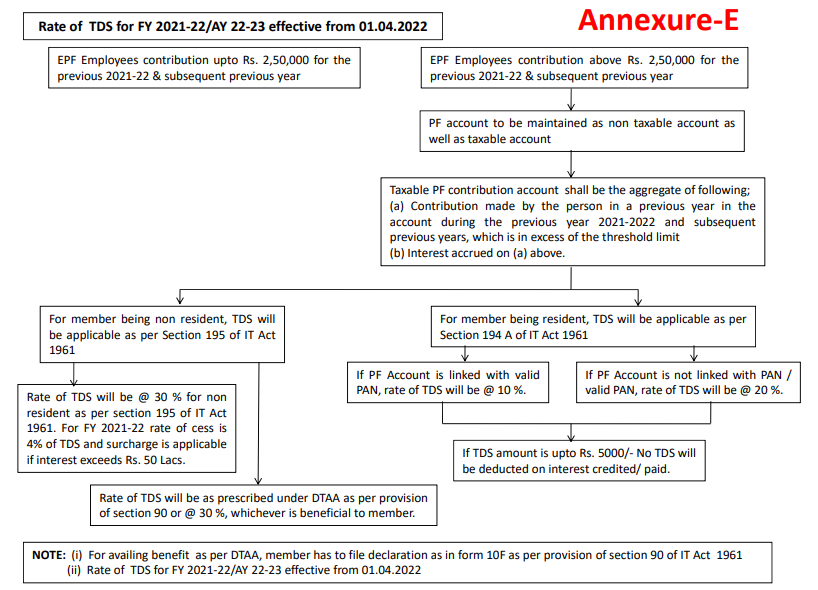
Interest on EPF contributions of up to Rs.2.5 lakh per year is tax-free. Any interest amount on contributions above this threshold will be taxed from the employee on a yearly basis.
Now that you know how to download and fill out Form 15G, you can save on TDS from your interest income. However, if individuals falsely declare Form 15G to avoid tax deduction at source, they are punishable by fines or imprisonment under the Income Tax Act’s Section 277.
When is TDS Not Applicable on EPF Withdrawal?
EPF Transfer: When transferring an EPF account to another account, TDS is not applicable.
Termination due to illness or other causes: TDS is not applicable in case of termination of service due to ill health, discontinuation of business by an employer, completion of a project, or other causes beyond the control of the employee.
Completion of 5 years of service: If an employee withdraws the EPF amount after completing a total of 5 years of service, TDS is not applicable.
EPF withdrawal of less than ₹50,000: TDS is not applicable if the EPF amount is less than Rs.50,000 and the employee has rendered service of less than 5 years.
If the employee withdraws Rs.50,000 or more with less than 5 years of service but submits Form 15G/15H along with PAN Card, TDS is not deducted.
Conclusion: How to Avoid TDS on EPF Withdrawal with Form 15G
Form 15G is a powerful tool for avoiding unnecessary TDS deductions on your PF withdrawal. By following this step-by-step guide, you can easily download, fill out, and submit the form to ensure a smooth and hassle-free PF withdrawal process. Be sure to verify your income and submit the correct form to avoid any penalties.
Nearly 79 Lakh Jobseekers Registered on NCS Portal in FY 2025–26
3.43 Crore Vacancies Mobilised on NCS Portal During FY 2025–26
The National Career Service (NCS) Portal is a one-stop solution for providing career related services including jobs from private and government sectors, information on online & offline job fairs, job search & matching, career counselling, vocational guidance, information on skill development courses, skill/training programmes etc. through a digital platform [www.ncs.gov.in] to all stakeholders across the country.
As on 20.01.2026, more than 78.86 lakh jobseekers and more than 12.36 lakh employers are registered on NCS portal during the FY 2025-26. Further, more than 3.43 crore vacancies have been mobilised on NCS Portal during the FY 2025-26.
The NCS project also inter alia, envisaged setting up of Model Career Centres (MCCs) in collaboration with States/Institutions to deliver employment services. Till date the Government has approved 407 Model Career Centres across the country.
Further, a module on NCS Portal facilitates the approved career counsellors to provide career counselling and guidance services. As on 20.01.2026, more than 1180 career counsellors have onboarded on NCS Portal and till date more than 55 Lakh online/ offline career guidance sessions have been conducted nationwide.
To enhance the employability, digital and career skills of jobseekers and empower & equip youth with an array of essential employable skills, NCS Portal inter-alia offers online employability enhancement programmes, digital skill enhancement programmes and self-placed career skill programme. NCS portal is integrated with Skill India Digital Hub (SIDH) that is specially designed and developed to skill, reskill and upskill individuals through an online training platform for jobs and entrepreneurial opportunities. The integration of NCS Portal with SIDH has paved the way for the skilled jobseekers on SIDH to avail the benefits of NCS Portal and the jobseekers to avail the skilling services offered by SIDH.
In order to increase awareness and enhance reach of NCS portal regular Social Media posts are released about the availability of services and vacancies on NCS portal. NCS monthly e-newsletters are released to create awareness about new development and activities of NCS. Besides, the Model Career Centres established at the States/UTs regularly conduct various outreach activities viz. workshops, awareness/ orientation programmes for the stakeholders.
This information was given by the Minister of State for Labour and Employment Sushri Shobha Karandlaje in written reply to a question in Rajya Sabha today.
The Central Government has implemented the four Labour Codes namely, the Code on Wages, 2019, the Industrial Relations Code, 2020, the Code on Social Security, 2020 and the Occupational Safety, Health and Working Conditions Code, 2020 which have come into effect from 21.11.2025. The new Labour Codes strengthen the protection available to workers including organised and unorganized workers. Important provisions under the four Labour Codes relating to wages, formalisation of employment and social security include-
A statutory right to all workers for minimum wages and timely payment of wages.
Universalization of social security by extending coverage to organized and unorganized workers including gig and platform workers;
Employees’ State Insurance Corporation (ESIC) coverage for establishments having more than 10 employees on mandatory basis and for establishments having less than 10 employees on voluntary basis and furthermore even for one employee if the establishment is involved in hazardous processes.
The provisions of EPFO shall now apply to all establishments employing 20 or more employees, universalizing its coverage;
Setting up of a Social Security Fund for formulating schemes for unorganised workers, gig and platform workers.
Safe and healthy working conditions for all workers.
Provision for annual health check-up and issuance of appointment letters to all employees;
Provision of Workers’ Re-Skilling Fund for retrenched workers;
Women are allowed to work in all types of work and establishments and at night subject to their consent and safety; and
Definition of Inter-State Migrant Worker expanded to include migrant workers employed by contractor, and also self-migrated. The migrant workers are now entitled for annual lump-sum travel allowance and portability of benefits.
This information was given by the Minister of State for Labour and Employment Sushri Shobha Karandlaje in written reply to a question in Rajya Sabha today.
EPFO Welcomes Rationalisation of Income Tax Regime for Provident Funds
Recognized Provident Funds are governed by Schedule XI of the Income Tax Act, 2025. At present, there is a divergence in eligibility for exemption under Income-tax provisions and Section 17 of the Employees’ Provident Funds and Miscellaneous Provisions Act,1952. Further, the pattern of investment notified under the Income Tax provisions and EPFO also varies. The limits of the employer’s contribution have not been aligned in the two enactments. These differences create confusion and give rise to avoidable litigation.
The Union Budget (2026-2027) has aligned the income-tax framework governing recognized provident funds with the statutory and administrative provisions of the Employees’ Provident Funds and Miscellaneous Provisions Act,1952 and the Employees’ Provident Funds Scheme, 1952.
Exemption
Recognition under the Income Tax Act,2025, shall be available only to provident funds that have obtained exemption under Section 17 of the Employees’ Provident Funds and Miscellaneous Provisions Act,1952.
Investment
Investment norms shall continue to be regulated under the applicable EPF framework and subordinate legislation. The rigid statutory ceiling restricting investment in Government securities to 50% has been removed.
Employer’s Contribution
The employer’s contribution shall be governed by the monetary ceiling of Rupees 7.5 Lakhs. Once this monetary ceiling is crossed, the contributions will be taxed as perquisites.
The rationalisation of the Income-tax regime in the Union Budget (2026-2027) will go a long way in serving the interests of its stakeholders by convergence and harmonisation with the Provident Fund enactment. Now, it clearly reflects that EPF exemption is governed by Employees’ Provident Funds and Miscellaneous Provisions Act, 1952. The investment norms have now been aligned with the EPF investment norms and the limits on employer’s contribution with the monetary ceiling under the Income-tax Act.
In 1995, the Government introduced a pension scheme under Section 6A of the EPF Act. The Employees Pension Scheme, 1995 (EPS-95) provided that the employer’s contribution of 8.33% should be towards the pension scheme. The EPS-95 capped the maximum monthly pension at Rs.5,000 or Rs.6,000. Thus, employers had to contribute 8.33% of Rs.5,000, which was later raised to Rs.6,500, towards the pension scheme.
In March 1996, a provision was added to para 11(3) of the EPS-95, giving the employer and employee an option to contribute 8.33% of actual salary (above the cap of Rs.5,000 or Rs.6,500) to the EPS. Such a higher salary would be considered a pensionable salary. However, the EPFO gave six months for the employees to file a joint option form for higher pension contributions to the EPS.
The government amended the EPS-95 scheme effective from 01/09/2014. It increased the maximum pensionable salary to Rs.15,000. It also omitted the provision to para 11(3), i.e. exercise of the option by the employer and employee to contribute EPS on a higher salary amount.
Thus, employers would make an EPS contribution of 8.33% on a maximum of Rs.15,000 for the employees joining the EPF scheme after 01/09/2014, even when they draw a higher salary.
However, the employees who were part of EPS-95 or joined before 01/09/2014 could contribute 8.33% to EPS on the actual salary as against the cap of Rs.15,000 if they filed a new joint option with the EPFOwithin six months, i.e. 28/02/2015.
There were issues after the 2014 amendment regarding pension contributions on higher salaries. Many employees stated that they did know about the exercise of the joint option for contributing pension on the higher salary amount. The EPFO rejected the joint option filed by many employees. Employers contributed 8.33% of pension on employees’ actual salaries without filing the joint option, but the pensionable salary was taken as Rs.15,000 for pension calculation.
Thus, many employees filed cases in High Courts for receiving higher pensions based on the contributions made on actual salary amounts. The Supreme Court took up this matter. The summary of the Supreme Court decision is as follows:
Status of Employee
Exercise of joint option
Eligibility to claim 8.33% pension contribution on a higher salary
Mode of higher pension claim
Employees in service as on 01/09/2014
Exercised joint option and rejected by the EPFO
Yes
By filing a higher pension claim application
Employees in service as on 01/09/2014
Not exercised joint option but contributing to EPS above the cap of Rs.5,000/Rs,6,500
Yes
By exercising the joint option
Employees retired before 01/09/2014
Exercised joint option and rejected by the EPFO
Yes
By filing a higher pension claim application
Employees retired before 01/09/2014
Not exercised joint option
No
Not applicable
The Supreme Court provided that employees who were part of the EPF before 01/09/2014 but have not exercised the joint option can exercise it within 03/05/2023. The EPFO further extended the due date to 11/07/2023. For such employees, a higher EPS contribution will be calculated from the date of their joining.
For example:
Mr. ‘X’ became a member of the EPF in 1998.
He has not exercised the joint option.
His salary increased to Rs.50,000 in 2015.
His employer contributes Rs.6,000 (i.e. 12% of his basic wage) towards EPF.
Of the employer’s contribution, Rs.1,250 (i.e. 8.33% of Rs.15,000; the statutory wage cap) will go to the EPS.
The remaining Rs.4,750 (i.e. Rs.6,000 – Rs.1,250) will go to the EPF.
He exercises the joint option within 11/07/2023 as per the Supreme Court judgement since the EPS contribution is above the statutory wage cap of Rs.6,500.
After submitting the joint option, his employer will contribute Rs.4,165 (i.e. 8.33% of Rs.50,000; his actual salary) and Rs.1,835 (Rs.6,000 – Rs.4,165) towards EPF.
The EPFO will calculate the monthly EPS amount of 8.33% of the actual salary and transfer the difference amount from the EPF to the EPS.
In such cases, the EPFO will return to the joining date or 01/11/1995, whichever is later, and transfer the difference from the PF account to the EPS account. But, the higher pension contribution will reduce the EPF lumpsum corpus that the employee gets upon retirement.
How to track EPFO higher pension application status?
You can check the status of the EPFO higher pension application by following the below steps:
Step 2: Click on the ‘Track Application Status for Pension on Higher Wages’.
Step 3: On the next page, click on ‘Click Here’ under the ‘Track application status for Pension on Higher Wages’ tab.
Step 4: Select and enter the application acknowledgement number, UAN number or PPO number.
Step 5: Enter the Captcha code, tick the consent and click on the ‘Get OTP’ button.
Step 6: Enter the OTP and click on ‘Get Status’. The application status will be displayed on the screen.
EPF higher pension eligibility
EPFO issued a circular in December 2022 providing the eligibility criteria and application process for claiming a higher pension. Below are the eligibility criteria for a higher pension:
The employees retired before 01/09/2014.
The employees exercised the joint option under para 11(3) of EPS-95 while being a member of EPS-95.
The employees and employers contributed EPS on salaries exceeding the wage ceiling of Rs.5,000 or Rs.6,500.
The EPFO declined the exercise of such an option.
However, the EPFO circular did not provide a higher pension option for employees who were part of the EPF before 01/09/2014 but still working/retired after 2014. As per the Supreme Court judgement, such employees were also eligible to claim a higher pension.
Thus, the EPFO issued another circular in February mentioning higher pension eligibility criteria for employees in service/retired after 2014. Below are the eligibility criteria to file a joint option for getting a higher pension:
The employees who were members before 01/09/2014 continued to be members after that date.
The employees and employers contributed to EPS on salaries exceeding the wage ceiling of Rs.5,000 or Rs.6,500.
The employees and employers were members of EPS-95 and did not exercise the joint option provided under the deleted para 11(3) of the EPS and amendment of 2014.
However, employees who were members of EPS-95 and exercised the joint options under the deleted para 11(3) of the EPS but did not file new joint options after the amendment of 2014 are not eligible to claim a higher pension. The EPS contributions of such employees will be 8.33% on the maximum amount of Rs.15,000, irrespective of their actual salaries.
EPF higher pension option form
The eligible employees who retired before 2014 can apply for a higher pension claim with the EPFO. They can apply for the higher pension claim online (as shown below) or with the regional EPF offices.
The eligible employees who joined EPS-95 but are retired/working after 2014 can apply the joint option form online(as shown below) or with the concerned regional EPF offices within 11/07/2023 to receive higher pensions.
How to apply for a higher pension in EPF?
Below is the step to claim a higher pension amount for employees retired before 2014:
Step 2: Click on the ‘Pension on Higher Salary: Online application for validation of Joint Option’ option.
Step 3: Fill in the details and submit the form.
The EPFO will digitally register each application and provide the receipt number to the applicant. It will forward the applications to the respective employers, who will verify them through e-sign/digital signature for further processing. The APFC/RPFC-II will examine the case and send the higher pension decision to the applicants via email, post, phone or SMS.
The field officers will examine the application form. If the form is complete, the wage details submitted by the employers will be verified with the the field offices data. Where the field officers data and employers’ details match, the dues will be calculated and an order will be passed by RPFC-II/RPFC-I/APFC for depositing/transferring the dues. The cases where there is a mismatch, it will informed to the employer and the pensioner by the APFC/RPFC-II and one month time will be given to rectify the same.
In case the application form is not approved by the employer, an opportunity will be given to the employer to provide additional proof/evidence or correct any mistakes/errors before rejection of the form. Such opportunity will be given for a period of one month and under intimation to the pensioners.
How to apply for a joint option online pension form in EPF?
Below is the step to exercise/apply for joint option under para 11(3) and para 11(4) of EPS-95 to claim for higher pension for employees who are part of EPS-95 but are working or retired after 2014:
Step 2: Click on the ‘Pension on Higher Salary: Exercise of Joint Option under para 11(3) and para 11(4) of EPS-1995 on or before 3rd May 2023’ option.
Step 3: Fill in the details and submit the form.
The field officers will examine the joint option forms. If the form is complete, the wage details submitted by the employers will be verified with the the field offices data. Where the field officers data and employers’ details match, the dues will be calculated and an order will be passed by RPFC-II/RPFC-I/APFC for depositing/transferring the dues. The cases where there is a mismatch, it will informed to the employer and the employee by the APFC/RPFC-II and one month time will be given to rectify the same.
In case the join option is not approved by the employer, an opportunity will be given to the employer to provide additional proof/evidence or correct any mistakes/errors before rejection of the form. Such opportunity will be given for a period of one month and under intimation to the employees.
EPFO guidelines for higher pension
The joint option/higher pension claim application should contain a disclaimer or declaration.
An employee should give explicit consent in the joint option/application form for a share adjustment from PF to EPS and a re-deposit of the amount.
An employee should give an undertaking of the trustee for a share transfer of funds from exempted PF trust to the EPFO pension fund. The undertaking will be effective for the deposit of due contribution and interest up to the payment date within the specified time.
The employer’s contribution share refund will be deposited with the interest rate declared under para 60 of the EPF Scheme, 1952, for employees of unexempted establishments.
The following documents should be submitted with the higher pension claim application:
Proof of joint option verified by the employer filed under para 26(6) of the EPF scheme.
Proof of joint option verified by the employer filed under para 11(3) provision.
Proof of remittance of EPS contribution in the PF account exceeding the current wage limit of Rs.6,500 or Rs.5,000.
Written refusal of APFC or EPFO to such remittance or request.
The following documents should be submitted with the joint option application:
Proof of remittance of EPS contribution in the PF account exceeding the current wage limit of Rs.6,500 or Rs.5,000.
Proof of joint option verified by the employer filed under para 26(6) of the EPF scheme.
The EPFO will issue further circulars regarding the deposit method and pension computation.
An employee can raise a complaint on EPFiGMS when they face a grievance to get a higher pension after submitting the application and payment of the due contribution if any.
EPF higher pension calculation formula
Calculation of higher pension for employees retired before 2014:
The average monthly pay earned during the contributory period of service in the 12 months before leaving EPFO is considered to determine the pension amount.
Calculation of higher pension for employees retired after 2014:
The average monthly pay earned during the contributory period of service in the 60 months before leaving EPFO is taken into account to determine the pension amount.
Current formula for calculating pension under the EPS scheme is as follows:
Employees Pension Scheme 1995 amended to provide withdrawal benefit to members having less than 6 months service; Amendment to benefit more than 7 lakh EPS members every year
Government of India has amended the Employees’ Pension Scheme (EPS), 1995 to ensure that EPS members with less than 6 months of contributory service also receive withdrawal benefit. This amendment will benefit more than 7 lakh EPS members every year who leave the scheme with less than 6 months of contributory service.
Further, the Central Government has modified the Table D and has ensured that every completed month of service rendered is taken into account to give proportionate withdrawal benefit to the members. The amount of withdrawal benefit will henceforth depend upon the number of completed months of service rendered by the member and the wages on which EPS contribution was received. The above measure has rationalized the payment of withdrawal benefit to members. It is estimated that every year more than 23 lakh members will benefit from this modification of the Table D.
Every year, lakhs of EPS 95 members leave the scheme prior to rendering the requisite 10 years of contributory service for pension. Such members are given withdrawal benefit as per the provisions of the Scheme.
More than 30 lakh withdrawal benefit claims were settled in the financial year 2023-24.
Till now, the withdrawal benefit was being calculated on the basis of the period of contributory service in completed years and the wages on which EPS contribution has been paid.
Therefore, only after completing 6 months and above of contributory service, the members were entitled for such withdrawal benefit. Consequently, the members leaving scheme, before contributing for 6 months or more, used to get no withdrawal benefit. This was a cause of many claim rejections and grievances as many members were exiting without having less than 6 months of contributory service. During the financial year 2023-24, approximately 7 lakh claims for withdrawal benefits were rejected due to contributory service being less than 6 months. Henceforth, all such EPS members who have not attained the age of 58 years as on 14.06.2024 will become entitled for withdrawal benefit.
Earlier, the calculation under erstwhile Table D ignored the fractional period of service rendered for less than 6 months after each completed year. This resulted in lesser amount of withdrawal benefit in many cases. With the modification of Table D, the Contributory service for calculating the withdrawal benefit will be now considered in completed months. This will ensure fair payment of withdrawal benefit. E.g. a member taking withdrawal benefit after 2 years and 5 months of contributory service & wages of 15,000/- per months was earlier entitled to Rs. 29,850/- withdrawal benefit. Now he will receive Rs. 36,000/- withdrawal benefit.
Petition to Government for Revision of EPFO Wage Ceiling
In a landmark ruling, the High Court, led by Justice J.K. Maheshwari, has allowed Naveen Prakash Nautiyal, an academician and activist, to petition the government regarding the urgent need to revise the Employee Provident Fund Organization (EPFO) wage ceiling. The court has directed the petitioner to submit a representation within two weeks, accompanied by a copy of the recent court order, with the government expected to make a decision within four months.
The Need for Change in EPFO Wage Ceiling
The crux of the petition is centered on the outdated EPFO wage ceiling of ₹15,000 per month, which has not been updated in accordance with the increasing minimum wages set by the Central Government and various States. This stagnation has led to a significant exclusion of countless workers from the EPFO benefits, undermining the intended social security provisions of the scheme.
The petition highlights the following key issues:
Exclusion of Workers: Workers earning above ₹15,000 are currently excluded from EPFO coverage, limiting their access to essential social security benefits. As minimum wages continue to rise, the gap between current regulations and economic reality widens, necessitating immediate action.
Inconsistent Revisions: The petition notes that revisions to the wage ceiling have been inconsistent, occurring sporadically every 13-14 years without a fixed schedule. A lack of linkage to critical economic indicators like inflation and the consumer price index exacerbates this problem, leading to further disenfranchisement of the workforce.
Recommendations Ignored: Despite recommendations for more regular and rational revisions from the Public Accounts Committee of the 16th Lok Sabha and the EPFO’s Sub-Committee in 2022, the Central Government has yet to implement these necessary changes.
Call for Action
The petition has raised crucial concerns regarding the absence of a set timeline for regular revisions of the wage ceiling and the arbitrary nature of adjustments made over the years. This erratic approach has transformed the EPFO from an inclusive safety net into a scheme that often excludes those who need it most.
Conclusion
As the discourse surrounding workers’ rights and social security continues to gain momentum, the legal action taken by Naveen Prakash Nautiyal emphasizes the urgent need for the government to address the disparities within the EPFO scheme. By revising the wage ceiling to reflect current economic conditions, we can move towards ensuring that all segments of the workforce receive the benefits and protection they deserve under the EPFO.
Employees’ Provident Fund (EPF) is a crucial retirement savings scheme, but withdrawals are subject to specific rules. Depending on retirement, unemployment, or emergencies like medical needs, marriage, or housing, employees can withdraw fully or partially. Tax implications vary based on service period, withdrawal reason, and fund type. Understanding EPF withdrawal rules helps avoid unnecessary TDS and plan finances effectively.
Tax Exempt Withdrawals
Withdrawal after 5 years.
For medical and other specified grounds (or).
Transfer of PF amount to NPS account.
No TDS if the amount withdrawn is less than Rs.50,000
Eligibility for EPF Withdrawal
An employee must fulfil the following conditions to withdraw the entire EPF funds:
The entire EPF amount can be withdrawn upon retirement. The retirement age fixed by the EPFO is 55 years.
An employee can withdraw 90% of the EPF funds one year before retirement after attaining 54 years.
An employee can withdraw 75% of the EPF amount after one month of unemployment. The remaining money will be transferred to the PF account of the new job.
An employee can withdraw the entire EPF amount after two months of unemployment.
EPF amount can be withdrawn without the employer’s consent by obtaining approval online when the Aadhar is linked with the UAN, and the employer has approved it.
Reasons for Partial Withdrawal of EPF
An employee can withdraw EPF partially for the following reasons upon fulfilment of certain conditions:
Medical purposes
Marriage
Education
Purchase of land or purchase/construction of house
Home loan repayment
House renovation
Tax on EPF Withdrawal
Your EPF payout has 3 components:
Your contribution/employee’s contribution
Interest on your/employee’s contribution
Employers contribution and interest on employer’s contribution
Your contribution/employee’s contribution – This is the amount contributed by you to your EPF. This portion of your withdrawal is not taxable.
Interest on your/employee’s contribution- This portion is taxed as income from other sources.
Employer’s contribution and interest on employer’s contribution – Employer’s contribution and interest on it is fully taxable. It is taxed under the head salary in your tax return. When TDS is deducted on it, you are likely to see an entry under salary TDS in your Form 26AS for it.
TDS on EPF withdrawal before 5 years
If you withdraw from EPF before completing 5 years of continuous service,the withdrawal amount is taxable. However, no TDS will be deducted when the amount is less than Rs.50,000. In calculating 5 years of service, your tenure with the previous employer is also included. If you transfer your EPF balance from the old employer to a new employer and your total employment is 5 years or more, no TDS is deducted. Do remember that you must calculate the exact 5 years, there is no grace if you are short by a few days.
Tax on EPF withdrawal by temporary employee
When you are hired for a temporary position or on contract for a certain period, you are not in the permanent rolls of the employer. Thus, the employer is not liable to contribute towards your EPF. However, you are brought on rolls by the employer after some time of your employment, and your employer begins your EPF contribution, but you resign after completing 5 years. In such a case, the period for calculating 5 years should be done from the date of joining as a permanent employee not from the date of hiring to the temporary position.
Tax on EPF withdrawal from an unrecognised EPF
A fund which is not approved by the Commissioner of Income Tax is considered an unrecognised provident fund. It may have been recognised by the commissioner of the provident fund or any other formal authority. But for a fund to enjoy the income tax benefits (where withdrawals are exempt from tax after 5 years), it must be approved by a Commissioner of Income Tax. If you are a member of the Unrecognised Provident Fund (URPF), your withdrawals are taxed whether or not you have completed 5 years of service.
Tax on EPF withdrawal after 5 years
The EPF withdrawal is exempt from tax when an employee withdraws the amount after 5 years of continuous service.
Rates of TDS
TDS is deducted @ 10% on EPF balance if withdrawn before 5 years of service, and the amount is above Rs.50,000. Remember to mention your PAN at the time of withdrawal. If PAN is not provided, TDS shall be deducted at the rate of 20%. You can submit Form 15G/Form 15H if the tax on your total income, including EPF withdrawal, is nil. TDS is not deducted if Form 15G/Form 15H is submitted.
Table on Taxability on Withdrawal of EPF
The following table will help you easily understand the taxability on withdrawal of EPF:
Sl No
Scenario
Taxability
1
Amount withdrawn is < Rs 50,000 before completion of 5 continuous years of service
No TDS. However, If the individual falls under the taxable bracket, the withdrawal amount is taxable
2
Amount withdrawn is > Rs 50,000 before completion of 5 years of continuous service
TDS @ 10% if PAN is furnished; No TDS in case Form 15G/15H is furnished
3
Withdrawal of EPF after 5 years of continuous service
No TDS. Further, the individual need not offer the same in the return of income as such withdrawal is exempt from tax.
4
Transfer of PF from one account to another upon a change of job
No TDS. Further, the individual need not offer the same in return of income as it is not taxable.
5
Before completion of 5 continuous years of service\if employment is terminated due to employee’s ill health\The business of the employer is discontinued\the reasons for withdrawal are beyond the employee’s control
No TDS. Further, the individual need not offer the same in the return of income as such withdrawal is exempt from tax
How to Avoid TDS on EPF Withdrawal?
Here are a few ways of avoiding TDS on EPF withdrawal:
When you change jobs, try not to withdraw the EPF amount and transfer it to the new account at your new company.
If you can defer withdrawing funds from your account for five years (continuous service with all employers), withdrawals thereafter will not attract any TDS.
If withdrawal amount is less than Rs 50,000, no TDS is deducted.
Frequently Asked Questions
1. What is the Employees’ Provident Fund (EPF)?
The Employees’ Provident Fund (EPF) is a retirement savings scheme designed to provide financial security to employees after retirement, funded by contributions from both the employer and the employee.
2. Who can withdraw from the EPF?
Any employee who has contributed to the EPF can withdraw their funds upon meeting specific eligibility criteria, such as retirement, unemployment, or medical emergencies.
3. What are the conditions for full EPF withdrawal?
Employees can withdraw the entire EPF amount upon retirement at the age of 55, after two months of unemployment, or under certain conditions for premature withdrawals.
4. Can I withdraw EPF for medical emergencies?
Yes, you can withdraw EPF partially for medical purposes, provided you fulfill the specified conditions.
5. What are the tax implications on EPF withdrawal?
The tax on EPF withdrawal depends on various factors such as the duration of service, the reason for withdrawal, and the amount withdrawn. Generally, withdrawals after 5 years of continuous service are tax-exempt, whereas withdrawals before 5 years may attract TDS.
6. How is TDS calculated on EPF withdrawals?
TDS is deducted at a rate of 10% if the amount withdrawn is greater than Rs. 50,000 and the employee’s PAN is furnished. If PAN is not provided, the TDS rate is 20%. Withdrawals below Rs. 50,000 do not attract TDS.
7. What if I withdraw my EPF after 5 years of service?
If you withdraw your EPF after completing 5 years of continuous service, you will not be subject to TDS, and the withdrawal is exempt from tax.
8. How can I avoid TDS on EPF withdrawal?
To avoid TDS, you can transfer your EPF balance to the new employer instead of withdrawing it, or ensure that your withdrawal amount is less than Rs. 50,000. Additionally, if you have not had any TDS liability, you can submit Form 15G/Form 15H.
The Employees Provident Fund Organisation (EPFO) has taken several steps in the last 1-2 years to simplify the claims settlement process for PF account holders. The Union Minister of State for Labour and Employment, Shobha Karandlaje, recently highlighted these steps in a written reply to various queries in the Rajya Sabha.
You should know about these changes going into the new financial year 2025-26, starting from April 1, 2025:
1. Enhanced auto claim settlement: For auto mode processing of advance claims, the amount limit has been increased to ₹1 lakh. Moreover, in addition to illness/hospitalisation advances, the advances for housing, education, and marriage have also been enabled through auto mode processing.
2. Simplified correction process: The minister said that the member details correction process has been simplified. Now, members having Aadhaar-verified UANs can make corrections in their IDs themselves, without any EPFO interventions.
Currently, around 96% of corrections are being done without any EPF office intervention, she said.
3. Simplified PF transfer: Now, there is no need for the employer’s attestation of Aadhaar-verified UANs in PF transfer claim requests. The minister said that currently, only 10% of transfer claims require member and employer’s attestation.
4. No need to submit cheque leaf: There is no need to submit a cheque leaf with the claim form now. The requirement for submitting a cheque-leaf with the claim form has also been relaxed for KYC-compliant UANs meeting prescribed criteria,” the minister said.
5. Guidance on ineligible claims: The minister said that certain upfront validations have been developed by EPFO to guide members about eligibility/admissibility of claims. This has been done to ensure that members do not file ineligible claims
The EPFO is now receiving over 99.31% claims in online mode, without any requirement to visit the field office. In FY 2024-25 as on March 6, 2025, 7.14 crore claims were filed in online mode.
Apart from the above, the EPFO is further simplifying the claim settlement process with centralisation of member databases under CITES 2.01. Additionally, as part of EPFO 3.0, stakeholder consultations have been held for transforming EPFO into a “future-ready, member-centric, and a technology-driven organisation,” the minister said.
In 1995, the Government introduced a pension scheme under Section 6A of the EPF Act. The Employees Pension Scheme, 1995 (EPS-95) provided that the employer’s contribution of 8.33% should be towards the pension scheme. The EPS-95 capped the maximum monthly pension at Rs.5,000 or Rs.6,000. Thus, employers had to contribute 8.33% of Rs.5,000, which was later raised to Rs.6,500, towards the pension scheme.
In March 1996, a provision was added to para 11(3) of the EPS-95, giving the employer and employee an option to contribute 8.33% of actual salary (above the cap of Rs.5,000 or Rs.6,500) to the EPS. Such a higher salary would be considered a pensionable salary. However, the EPFO gave six months for the employees to file a joint option form for higher pension contributions to the EPS.
The government amended the EPS-95 scheme effective from 01/09/2014. It increased the maximum pensionable salary to Rs.15,000. It also omitted the provision to para 11(3), i.e. exercise of the option by the employer and employee to contribute EPS on a higher salary amount.
Thus, employers would make an EPS contribution of 8.33% on a maximum of Rs.15,000 for the employees joining the EPF scheme after 01/09/2014, even when they draw a higher salary.
However, the employees who were part of EPS-95 or joined before 01/09/2014 could contribute 8.33% to EPS on the actual salary as against the cap of Rs.15,000 if they filed a new joint option with the EPFOwithin six months, i.e. 28/02/2015.
There were issues after the 2014 amendment regarding pension contributions on higher salaries. Many employees stated that they did know about the exercise of the joint option for contributing pension on the higher salary amount. The EPFO rejected the joint option filed by many employees. Employers contributed 8.33% of pension on employees’ actual salaries without filing the joint option, but the pensionable salary was taken as Rs.15,000 for pension calculation.
Thus, many employees filed cases in High Courts for receiving higher pensions based on the contributions made on actual salary amounts. The Supreme Court took up this matter. The summary of the Supreme Court decision is as follows:
The Supreme Court provided that employees who were part of the EPF before 01/09/2014 but have not exercised the joint option can exercise it within 03/05/2023. The EPFO further extended the due date to 11/07/2023. For such employees, a higher EPS contribution will be calculated from the date of their joining.
For example:
Mr. ‘X’ became a member of the EPF in 1998.
He has not exercised the joint option.
His salary increased to Rs.50,000 in 2015.
His employer contributes Rs.6,000 (i.e. 12% of his basic wage) towards EPF.
Of the employer’s contribution, Rs.1,250 (i.e. 8.33% of Rs.15,000; the statutory wage cap) will go to the EPS.
The remaining Rs.4,750 (i.e. Rs.6,000 – Rs.1,250) will go to the EPF.
He exercises the joint option within 11/07/2023 as per the Supreme Court judgement since the EPS contribution is above the statutory wage cap of Rs.6,500.
After submitting the joint option, his employer will contribute Rs.4,165 (i.e. 8.33% of Rs.50,000; his actual salary) and Rs.1,835 (Rs.6,000 – Rs.4,165) towards EPF.
The EPFO will calculate the monthly EPS amount of 8.33% of the actual salary and transfer the difference amount from the EPF to the EPS.
In such cases, the EPFO will return to the joining date or 01/11/1995, whichever is later, and transfer the difference from the PF account to the EPS account. But, the higher pension contribution will reduce the EPF lumpsum corpus that the employee gets upon retirement.
How to track EPFO higher pension application status?
You can check the status of the EPFO higher pension application by following the below steps:
Step 4: Select and enter the application acknowledgement number, UAN number or PPO number.
Step 5: Enter the Captcha code, tick the consent and click on the ‘Get OTP’ button.
Step 6: Enter the OTP and click on ‘Get Status’. The application status will be displayed on the screen.
EPF higher pension eligibility
EPFO issued a circular in December 2022 providing the eligibility criteria and application process for claiming a higher pension. Below are the eligibility criteria for a higher pension:
The employees retired before 01/09/2014.
The employees exercised the joint option under para 11(3) of EPS-95 while being a member of EPS-95.
The employees and employers contributed EPS on salaries exceeding the wage ceiling of Rs.5,000 or Rs.6,500.
The EPFO declined the exercise of such an option.
However, the EPFO circular did not provide a higher pension option for employees who were part of the EPF before 01/09/2014 but still working/retired after 2014. As per the Supreme Court judgement, such employees were also eligible to claim a higher pension.
Thus, the EPFO issued another circular in February mentioning higher pension eligibility criteria for employees in service/retired after 2014. Below are the eligibility criteria to file a joint option for getting a higher pension:
The employees and employers contributed to EPS on salaries exceeding the wage ceiling of Rs.5,000 or Rs.6,500.
The employees and employers were members of EPS-95 and did not exercise the joint option provided under the deleted para 11(3) of the EPS and amendment of 2014.
However, employees who were members of EPS-95 and exercised the joint options under the deleted para 11(3) of the EPS but did not file new joint options after the amendment of 2014 are not eligible to claim a higher pension. The EPS contributions of such employees will be 8.33% on the maximum amount of Rs.15,000, irrespective of their actual salaries.
EPF higher pension option form
The eligible employees who retired before 2014 can apply for a higher pension claim with the EPFO. They can apply for the higher pension claim online (as shown below) or with the regional EPF offices.
The eligible employees who joined EPS-95 but are retired/working after 2014 can apply the joint option form online(as shown below) or with the concerned regional EPF offices within 11/07/2023 to receive higher pensions.
How to apply for a higher pension in EPF?
Below is the step to claim a higher pension amount for employees retired before 2014:
Step 2: Click on the ‘Pension on Higher Salary: Online application for validation of Joint Option’ option.
Step 3: Fill in the details and submit the form.
The EPFO will digitally register each application and provide the receipt number to the applicant. It will forward the applications to the respective employers, who will verify them through e-sign/digital signature for further processing. The APFC/RPFC-II will examine the case and send the higher pension decision to the applicants via email, post, phone or SMS.
The field officers will examine the application form. If the form is complete, the wage details submitted by the employers will be verified with the the field offices data. Where the field officers data and employers’ details match, the dues will be calculated and an order will be passed by RPFC-II/RPFC-I/APFC for depositing/transferring the dues. The cases where there is a mismatch, it will informed to the employer and the pensioner by the APFC/RPFC-II and one month time will be given to rectify the same.
In case the application form is not approved by the employer, an opportunity will be given to the employer to provide additional proof/evidence or correct any mistakes/errors before rejection of the form. Such opportunity will be given for a period of one month and under intimation to the pensioners.
How to apply for a joint option online pension form in EPF?
Below is the step to exercise/apply for joint option under para 11(3) and para 11(4) of EPS-95 to claim for higher pension for employees who are part of EPS-95 but are working or retired after 2014:
Step 2: Click on the ‘Pension on Higher Salary: Exercise of Joint Option under para 11(3) and para 11(4) of EPS-1995 on or before 3rd May 2023’ option.
Step 3: Fill in the details and submit the form.
The field officers will examine the joint option forms. If the form is complete, the wage details submitted by the employers will be verified with the the field offices data. Where the field officers data and employers’ details match, the dues will be calculated and an order will be passed by RPFC-II/RPFC-I/APFC for depositing/transferring the dues. The cases where there is a mismatch, it will informed to the employer and the employee by the APFC/RPFC-II and one month time will be given to rectify the same.
In case the join option is not approved by the employer, an opportunity will be given to the employer to provide additional proof/evidence or correct any mistakes/errors before rejection of the form. Such opportunity will be given for a period of one month and under intimation to the employees.
An employee should give explicit consent in the joint option/application form for a share adjustment from PF to EPS and a re-deposit of the amount.
An employee should give an undertaking of the trustee for a share transfer of funds from exempted PF trust to the EPFO pension fund. The undertaking will be effective for the deposit of due contribution and interest up to the payment date within the specified time.
The employer’s contribution share refund will be deposited with the interest rate declared under para 60 of the EPF Scheme, 1952, for employees of unexempted establishments.
Proof of remittance of EPS contribution in the PF account exceeding the current wage limit of Rs.6,500 or Rs.5,000.
Proof of joint option verified by the employer filed under para 26(6) of the EPF scheme.
The EPFO will issue further circulars regarding the deposit method and pension computation.
An employee can raise a complaint on EPFiGMS when they face a grievance to get a higher pension after submitting the application and payment of the due contribution if any.
The average monthly pay earned during the contributory period of service in the 12 months before leaving EPFO is considered to determine the pension amount.
Calculation of higher pension for employees retired after 2014:
The average monthly pay earned during the contributory period of service in the 60 months before leaving EPFO is taken into account to determine the pension amount.
Current formula for calculating pension under the EPS scheme is as follows:
Employees Pension Scheme 1995 amended to provide withdrawal benefit to members having less than 6 months service; Amendment to benefit more than 7 lakh EPS members every year
Government of India has amended the Employees’ Pension Scheme (EPS), 1995 to ensure that EPS members with less than 6 months of contributory service also receive withdrawal benefit. This amendment will benefit more than 7 lakh EPS members every year who leave the scheme with less than 6 months of contributory service.
Further, the Central Government has modified the Table D and has ensured that every completed month of service rendered is taken into account to give proportionate withdrawal benefit to the members. The amount of withdrawal benefit will henceforth depend upon the number of completed months of service rendered by the member and the wages on which EPS contribution was received. The above measure has rationalized the payment of withdrawal benefit to members. It is estimated that every year more than 23 lakh members will benefit from this modification of the Table D.
Every year, lakhs of EPS 95 members leave the scheme prior to rendering the requisite 10 years of contributory service for pension. Such members are given withdrawal benefit as per the provisions of the Scheme.
Till now, the withdrawal benefit was being calculated on the basis of the period of contributory service in completed years and the wages on which EPS contribution has been paid.
Therefore, only after completing 6 months and above of contributory service, the members were entitled for such withdrawal benefit. Consequently, the members leaving scheme, before contributing for 6 months or more, used to get no withdrawal benefit. This was a cause of many claim rejections and grievances as many members were exiting without having less than 6 months of contributory service. During the financial year 2023-24, approximately 7 lakh claims for withdrawal benefits were rejected due to contributory service being less than 6 months. Henceforth, all such EPS members who have not attained the age of 58 years as on 14.06.2024 will become entitled for withdrawal benefit.
Earlier, the calculation under erstwhile Table D ignored the fractional period of service rendered for less than 6 months after each completed year. This resulted in lesser amount of withdrawal benefit in many cases. With the modification of Table D, the Contributory service for calculating the withdrawal benefit will be now considered in completed months. This will ensure fair payment of withdrawal benefit. E.g. a member taking withdrawal benefit after 2 years and 5 months of contributory service & wages of 15,000/- per months was earlier entitled to Rs. 29,850/- withdrawal benefit. Now he will receive Rs. 36,000/- withdrawal benefit.
The Employees Provident Fund Organisation (EPFO) has taken several steps in the last 1-2 years to simplify the claims settlement process for PF account holders. The Union Minister of State for Labour and Employment, Shobha Karandlaje, recently highlighted these steps in a written reply to various queries in the Rajya Sabha.
You should know about these changes going into the new financial year 2025-26, starting from April 1, 2025:
1. Enhanced auto claim settlement: For auto mode processing of advance claims, the amount limit has been increased to ₹1 lakh. Moreover, in addition to illness/hospitalisation advances, the advances for housing, education, and marriage have also been enabled through auto mode processing.
2. Simplified correction process: The minister said that the member details correction process has been simplified. Now, members having Aadhaar-verified UANs can make corrections in their IDs themselves, without any EPFO interventions.
Currently, around 96% of corrections are being done without any EPF office intervention, she said.
3. Simplified PF transfer: Now, there is no need for the employer’s attestation of Aadhaar-verified UANs in PF transfer claim requests. The minister said that currently, only 10% of transfer claims require member and employer’s attestation.
4. No need to submit cheque leaf: There is no need to submit a cheque leaf with the claim form now. The requirement for submitting a cheque-leaf with the claim form has also been relaxed for KYC-compliant UANs meeting prescribed criteria,” the minister said.
5. Guidance on ineligible claims: The minister said that certain upfront validations have been developed by EPFO to guide members about eligibility/admissibility of claims. This has been done to ensure that members do not file ineligible claims
The EPFO is now receiving over 99.31% claims in online mode, without any requirement to visit the field office. In FY 2024-25 as on March 6, 2025, 7.14 crore claims were filed in online mode.
Apart from the above, the EPFO is further simplifying the claim settlement process with centralisation of member databases under CITES 2.01. Additionally, as part of EPFO 3.0, stakeholder consultations have been held for transforming EPFO into a “future-ready, member-centric, and a technology-driven organisation,” the minister said.
EPFO Enhances Operational Efficiency for Subscribers
New Delhi: In a strategic move aimed at enhancing operational efficiency and improving the quality of life for over 75 million subscribers, the Employees’ Provident Fund Organisation (EPFO) has introduced a consolidated access system for all key services and provident fund account details through a single login on its member portal.
To expedite the claim settlement process, the retirement fund body has also rationalized the approval hierarchy. This change is designed to fast-track claims, thus providing timely support to the members.
As part of these improvements, the EPFO has launched a new feature called ‘Passbook Lite’ within its member portal. This facility allows members to easily check their passbook, offering a summarized view of contributions, withdrawals, and balance in a user-friendly format. This means members can access their passbook directly through the member portal without needing to visit the traditional passbook portal.
This initiative is expected to reduce grievances, improve transparency, and enhance member satisfaction,” stated a representative from the EPFO. They further explained that this approach ensures greater ease of access for members while simultaneously enhancing operational efficiency by diminishing the load on the existing passbook portal and simplifying the architecture through the integration of existing APIs within the member portal.
The minister noted that the previous multi-layered approval process often resulted in delays and prolonged processing times for members’ claims. To address these issues, the EPFO has streamlined the approval hierarchy. Powers that were once held by regional provident fund commissioners or officers in charge have now been delegated to assistant PF commissioners and subordinate levels in a structured and tiered manner.
These initiatives are part of the EPFO’s ongoing efforts to create a more accessible and efficient service for its members, ensuring that their retirement savings are managed with the utmost care and efficiency.
The Employees Provident Fund Organisation (EPFO) has taken several steps in the last 1-2 years to simplify the claims settlement process for PF account holders. The Union Minister of State for Labour and Employment, Shobha Karandlaje, recently highlighted these steps in a written reply to various queries in the Rajya Sabha.
You should know about these changes going into the new financial year 2025-26, starting from April 1, 2025:
1. Enhanced auto claim settlement: For auto mode processing of advance claims, the amount limit has been increased to ₹1 lakh. Moreover, in addition to illness/hospitalisation advances, the advances for housing, education, and marriage have also been enabled through auto mode processing.
2. Simplified correction process: The minister said that the member details correction process has been simplified. Now, members having Aadhaar-verified UANs can make corrections in their IDs themselves, without any EPFO interventions.
Currently, around 96% of corrections are being done without any EPF office intervention, she said.
3. Simplified PF transfer: Now, there is no need for the employer’s attestation of Aadhaar-verified UANs in PF transfer claim requests. The minister said that currently, only 10% of transfer claims require member and employer’s attestation.
4. No need to submit cheque leaf: There is no need to submit a cheque leaf with the claim form now. The requirement for submitting a cheque-leaf with the claim form has also been relaxed for KYC-compliant UANs meeting prescribed criteria,” the minister said.
5. Guidance on ineligible claims: The minister said that certain upfront validations have been developed by EPFO to guide members about eligibility/admissibility of claims. This has been done to ensure that members do not file ineligible claims
The EPFO is now receiving over 99.31% claims in online mode, without any requirement to visit the field office. In FY 2024-25 as on March 6, 2025, 7.14 crore claims were filed in online mode.
Apart from the above, the EPFO is further simplifying the claim settlement process with centralisation of member databases under CITES 2.01. Additionally, as part of EPFO 3.0, stakeholder consultations have been held for transforming EPFO into a “future-ready, member-centric, and a technology-driven organisation,” the minister said.
Supreme Court Directs Karnataka High Court to Determine Priority of Claims Between EPFO and Secured Creditors
New Delhi: In a significant ruling, the Supreme Court has directed the Karnataka High Court to resolve the priority of first charge among the Employees’ Provident Fund Organisation (EPFO) and secured creditors, including Axis Bank and two other banks, concerning funds obtained from the sale of properties belonging to a defaulting establishment.
A bench comprising Justices Vikram Nath, Sanjay Karol, and Sandeep Mehta nullified a previous order from the High Court dated February 1, 2024, which had dismissed the plea by Edelweiss Asset Reconstruction Limited (EARC). Senior advocate Krishnan Venugopal, representing EARC, conceded that EPFO holds the first charge on the dues. However, EARC argued that while Axis Bank sold one property for approximately ₹12 crores, they had disposed of two properties for a total of ₹7 crores. EARC stated that the remaining amount owed to EPFO could be recovered from Axis Bank, as they have already remitted ₹75 lakhs, corresponding to the sale proceeds received.
The appellant further claimed that the outstanding dues owed to EPFO, which had been stayed by the High Court under Section 14(B) of the PF Act, amounting to around ₹1.3 crores, should come from the proportionate share of Axis Bank. If EPFO is successful in its claims before the High Court regarding the Section 14(B) demand, recovery should be pursued from Axis Bank, not EARC.
Representing EPFO, advocate Dushyant Parashar argued that the High Court’s dismissal of the appellant’s petition was justified, allowing EPFO to collect the remaining amount of ₹3,43,629 along with the approximate ₹1.3 crores quantified under Section 14(B) of the PF Act, contingent upon its success in the High Court.
Parashar emphasized that EARC did not include Axis Bank in the proceedings before the High Court. Hence, their claim regarding recovery from Axis Bank for the Section 14(B) quantified amount lacked foundation. Axis Bank’s senior advocate Gopal Jain contended that according to Section 35 of the SARFAESI Act, the bank’s secured dues take precedence over any sales taxes and other dues owed to governmental authorities, preventing recovery until their full dues are settled.
After hearing the arguments, the bench remarked, “In our considered opinion, it would be appropriate that the High Court first deals with the issues raised by Axis Bank concerning its first charge and priority over EPFO for recovering dues from the secured property as per Section 35 of the SARFAESI Act.
The Court instructed the High Court to examine the priority of claims between EPFO and the secured creditors, which include Axis Bank, the State Bank of India, and the State Bank of Travancore (now part of SBI), under Section 11(2) of the PF Act. The bench noted the necessity for the High Court to consider any relevant facts related to the charge created by EPFO over the properties that Axis Bank intends to auction.
While the Supreme Court acknowledged that pertinent material was presented, it refrained from addressing the merits of the first charge and priority issue in detail. All parties involved in the writ petition, post-remand, will be at liberty to present their contentions before the High Court,” the bench concluded.
This dispute arose following M/s Acropetal Technologies Pvt Ltd, which falls under the Employees Provident Fund and Miscellaneous Provisions Act, 1952, defaulting on provident fund payments since July 2013.
The interest earned on the EPF contribution by the employees is generally exempt from tax. However, in Budget 2021 it was proposed to make the interest earned on the PF contributions exceeding Rs. 2,50,000 in a financial year taxable. However, for government employees this limit is Rs. 5 lakh.
Read this article to understand more about the taxability of interest on EPF contributions.
What is EPF?
Employee Provident Fund (EPF) is a retirement benefits scheme for salaried employees. The Employees Provident Fund Organisation (EPFO) manages this scheme. Every factory/organisation having 20 or more employees must register under the EPFO. Some organisations with fewer than 20 employees can obtain EPF registration voluntarily.
All employees, including regular and contractual workers, whose wages are up to Rs 15,000 should be enrolled in the EPF by the organization.
After registration, the employee needs to contribute to the fund and the employer will also make a matching contribution. The employees cannot register for EPF on their own. So if the employee who is drawing a salary more than Rs 15,000 wishes to contribute to EPF account, they can do so with the consent of their employer.
Latest Update on Withdrawal Limit
To ensure quicker access of funds to its members, the EPFO has announced that the threshold limit for auto-settlement for advance claims has been increased from Rs. 1 lakh to Rs. 5 lakh.
Some Important Features of the EPF Scheme
The following are some of the important features of the EPF Scheme:
The employee should make EPF contributions of Rs 1,800 or 12% on the basic salary and the dearness allowance, whichever is lower. Most companies deduct 12% of salary + DA.
The employer must also make an equal contribution to the EPF account.
However, the EPF contributions are payable at a maximum wage ceiling of Rs 15,000 per month. Therefore, some employers make the minimum contribution of Rs 1,800 per month(12% of Rs 15,000) to increase the in-hand salary of the employee. However, most employers choose to contribute 12% of basic salary + DA.
The employee can contribute at a higher rate via VPF (voluntary provident fund), but the employer is not under any obligation to match contributions above 12% of basic salary + DA.
Usually, interest is credited to the EPF account after the financial year has ended.
As per the EPFO guidelines, an organisation with less than 20 employees has to make an EPF contribution of 10% instead of 12%.
After retirement, the employee will get a lump-sum retirement amount, which includes the contributions of both the employee and the employer with interest accrued.
What is VPF?
An employee can voluntarily enhance the monthly PF contribution up to 100% of the basic salary as a Voluntary Provident Fund (VPF). The employer is under no obligation to match this excess contribution (beyond 12% of the basic salary + DA). This amount would be credited to the same EPF account as there is no separate account for VPF, and the interest offered would be the same as EPF.
What are the Taxation Rules for Income from EPF Contributions?
Tax on interest credited to EPF account
After Budget 2021, interest on an employee’s contribution to an EPF account above Rs 2.5 lakh during the financial year is taxable in the hands of the employee. This interest is also subject to TDS.
This rule will only apply to the contributions made by the employee, while contributions made by the employer will not be taxed. The calculation of interest on the threshold limit of Rs 2.5 lakh shall also include VPF contributions.
For example, an employee’s basic salary (no dearness allowance) is Rs 50,000 per month. The employer deducts 12% of the employee’s basic salary, i.e., Rs 6,000 towards EPF contribution. However, the employee voluntarily contributes Rs 3.28 lakh in VPF during the financial year. Hence, the employee’s total EPF contribution during the financial year will be Rs 4 lakh (Rs 6,000 x 12 + Rs 3.28 lakh).
The employee will be required to pay tax on interest accrued/earned on the excess contribution of Rs 2.5 lakh [Rs 72,000(EPF) + Rs 3.28 lakh(VPF) – Rs 2.5 lakh].
In the case of government employees who contribute to GPF, the threshold of Rs 2.5 lakh has been raised to Rs 5 lakh. That is to say interest on GPF contribution in excess of Rs 5 lakh will be taxable for the employee.
Before FY 2021-22, the interest credited to the EPF account on any amount of contribution was tax-free. Now a cap of Rs 2.5 lakh has been introduced, interest on contributions beyond this shall be taxable.
Tax Deduction on Contribution to EPF Account
An employee’s contribution to the EPF account is allowed as a deduction up to Rs 1.5 lakh under Section 80C of the IT Act.
This amendment has got applicable from 1st April 2021. It means the interest on the employee’s EPF contributions above Rs 2.5 lakh shall be taxable for the FY 2024-25 also.
How to Calculate the Taxable Portion of EPF interest?
As per notification No. 95/2021 dated 31st August 2021, for calculating taxable interest, the PF department shall maintain separate accounts, one with taxable contribution and another with non-taxable contribution, for all the subscribers starting from the financial year 2021-22 and onwards.
The taxpayer shall be liable to pay tax on the interest accrued in the taxable contribution account. The EPFO shall deduct TDS on such interest.
Under what Circumstances will TDS on interest be deducted?
TDS will be deducted at 10% on taxable interest income accrued above the threshold limit during the year as per Section 194A of the IT Act.
What is the Threshold Limit on Interest income above which TDS will be deducted?
For resident Indians, TDS is deductible if the interest accrued in the PF account for the financial year exceeds Rs 5,000.
The employee shall pay tax on the interest accrued on the taxable portion of the PF contribution. The amount of taxable PF interest should be added as income under the head ‘income from other sources’ on which tax shall be calculated as per the applicable income tax slab rates. The employee can claim a tax credit for the TDS deducted from the interest income.
In any other case such as final settlement, transfer claims, on transfer from EPFO to exempted establishments, and vice versa, the TDS shall be deducted either on 1st April 2024 or on final settlement or on the transfer date, whichever is later.
What is the Rate of TDS deduction on Taxable interest on EPF Contributions?
How will non-resident members claim to benefit from double taxation on taxable interest?
To avail of DTAA benefits, the member must obtain a Tax Residency Certificate (TRC) by filing Form 10F to the income tax department. On receipt application in Form 10F, the Assessing Officer may issue a TRC in Form 10FB on being satisfied on this behalf. Based on such TRC, the non-resident member can claim the benefit from double taxation.
What if there is interest-on-interest from the excess PF contribution? Will it be taxed in future years too?
As per the current accounting system followed by EPFO, interest is credited on an annual basis. The government notifies the EPF interest rates at the end of the relevant financial year. If the EPF and VPF contribution is more than Rs 2.5 lakh during the financial year, the TDS needs to be deducted from the interest accrued on the taxable portion of the PF contribution.
In the subsequent years, the previous years’ accumulations of the taxable account will be brought forward, and the interest accrued on the opening balance and current years’ contribution (contribution above the threshold limit of Rs 2.5 lakh) of the taxable account shall be taxable.
Mr Q is a salaried employee who contributes Rs 30,000 monthly to the EPF account. The closing balance of his PF account as of 31st March 2023 is Rs 50,00,000.
The calculation of taxable and non-taxable PF interest will be as under:
Illustration 2- If funds withdrawn from the PF account
When the member withdraws any amount from the EPF account, firstly, the funds will be withdrawn from the taxable account and thereafter from the non-taxable account.
Let’s calculate the taxable and non-taxable portion of the PF account interest, and TDS calculation.
FY 2023-24
Period(FY 2023-24)
Monthly contribution (Rs)
Cumulative balance at the end of the month
Interest accrued at 8.25% in
Non-taxable account (Rs)
Taxable account (Rs)
Non-taxable account (Rs)
Taxable account (Rs)
April
40,000
40,000
0
275
0
May
40,000
80,000
0
550
0
June
40,000
1,20,000
0
825
0
July
40,000
1,60,000
0
1,100
0
August
40,000
2,00,000
0
1,375
0
September
40,000
2,40,000
0
1,650
0
October
40,000
2,50,000
30,000
1,719
206
November
40,000
2,50,000
70,000
1,719
481
December
40,000
2,50,000
1,10,000
1,719
756
January
40,000
2,50,000
1,50,000
1,719
1,031
Withdrawal
-1,10,000
-1,50,000
February
40,000
1,80,000
0
1,238
0
March
40,000
2,20,000
0
1,513
0
Balance as on 31.03.24
2,20,000
0
15,400
2,475
We can see that the withdrawals from the PF account was first fully adjusted from the taxable account and then from the non-taxable account.
TDS would be deducted as per the below working:
Particulars
Non-taxable account (Amount in Rs)
Taxable account (Amount in Rs)
Carried forward balance as on 31.03.2024
50,00,000
0
Interest accrued on opening balance
4,12,500
0
Total contribution during the FY 2024-25
3,30,000
1,50,000
Withdrawals during the FY 2024-25
-1,10,000
-1,50,000
Interest accrued during the FY 2024-25
15,400
2,475
Total funds in the accounts to carry forward next year
In the next financial year, if the employee continues to contribute Rs 40,000 monthly to the PF account, i.e. FY 2024-25, and withdraws Rs 4 lakh in June 24, the taxable interest would be calculated in the following manner:
Total funds in the accounts to carry forward next year (A+B+C+D)
60,81,475
1,11,834
TDS @10% ((1,788 + 46)x 10%)
0
184
Balance carried forward to next year
60,81,475
1,11,834-184 = 1,11,650
Flow chart
Tax on EPF withdrawals
If EPF is withdrawn after five years of continuous service, then no tax is required to be paid on the contribution amount and interest received on the same. However, If you withdraw money in case of emergencies (we’ll talk about it) before a specified period of 5 years, then in that case, you won’t be exempted from tax. And the PF department will deduct TDS on EPF withdrawn before five years of continuous service at 10%.
Illustration
Mr. Ram’s total PF contribution (including interest) is Rs.5,50,000 as on 31st March 2023. Ram works in a company registered under EPFO and contributed Rs.3,50,000 to his EPF account in FY 2023-24. He received an interest of 8.25% on his contribution.
Now calculate his taxable and non-taxable contributions for FY 2023-24
Particulars
Taxable contribution
Non-Taxable contribution
Closing balance, including interest, as on 31st March
Pension Commutation: The Long-Standing Demand Ahead of the 8th Pay Commission
As the Terms of Reference (ToR) for the 8th Pay Commission move toward finalisation, the issue of pension commutation has resurfaced, reigniting an age-old demand from employee unions. They have long argued that the duration for the restoration of the commuted portion of the pension should be shortened from 15 years to 12 years. The pressing question now is whether the 8th Pay Commission will heed this demand and if the government will endorse such a recommendation this time around.
What is Pension Commutation?
Upon retirement, central employees have the option to receive up to 40% of their pension in a lump sum, a process known as ‘pension commutation.’ In exchange for this upfront payment, the employee’s monthly pension is reduced by that same percentage. Presently, the commuted pension is restored after a period of 15 years.
History: Recommendations of the 5th Pay Commission and Unfulfilled Demands
The 5th Pay Commission allowed employees to commute their pension from one-third to a maximum of 40% and recommended restoring the commuted pension earlier, after 12 years. However, the government did not accept this suggestion and maintained the 15-year period. The subsequent 6th and 7th Pay Commissions did not see the necessity to propose any amendments to this rule either.
Judicial Standpoint on the Pension Commutation Period
In 1986, the Supreme Court, during the “Common Cause vs Union of India” case, justified the 15-year restoration period. The court noted that while the government could recover the commuted amount within 12 years, the 15-year timeline was established to account for the ‘risk factor’—the chance that an employee could pass away before the full recovery of the commuted amount. This rationale was echoed in a 2019 decision by the Delhi High Court, which upheld the 15-year duration based on similar reasoning. The courts have determined that this matter falls under policy decision-making, a domain in which judiciary intervention is limited.
Current Demands and Expectations from the 8th Pay Commission
The representative bodies of central employees, notably the NC-JCM (National Council of Joint Consultative Machinery), have consistently demanded a reduction of the restoration period from 15 years to 12 years. Their argument hinges on the significant rise in average life expectancy and the acceleration in the government’s recovery of the commuted amount due to changes in the commutation table and interest rates.
For these reasons, employee unions are advocating for this adjustment to be included in the discussions surrounding the 8th Pay Commission.
The Government’s Position on the Pension Commutation Period
The demand from pensioners for a reduced restoration period is a long-standing issue that has yet to be addressed satisfactorily. The recommendation for a 12-year restoration period made by the 5th Pay Commission remains unfulfilled. The critical question now is whether the 8th Pay Commission will revisit this concern and if the government will reconsider its stance. Should this change occur, it would provide significant relief for countless pensioners, enabling them to reclaim their full pension three years sooner. However, as it stands, the legal and governmental positions maintain that the restoration of pension commutation will continue to be restricted to a 15-year timeframe.
The Employees’ Provident Fund Organisation (EPFO) has implemented new regulations to make it easier for its over 27 crore members to link their Aadhaar with their Universal Account Number (UAN) and correct any personal details. This initiative aims to cut down on bureaucratic red tape, reduce the dependency on employers, and expedite the settlement of benefits.
Direct Aadhaar-UAN Linking for Matching Details
Members whose name, gender, and date of birth match in both Aadhaar and UAN records can now directly approach their employers for Aadhaar seeding through the KYC function available on the employer portal. In these instances, no additional approval from the EPFO will be required. Previously, even simple matches faced delays due to multiple verification layers.
Simplified Joint Declaration (JD) Process
EPFO has revamped its Joint Declaration (JD) mechanism for scenarios where the Aadhaar and UAN details do not align, or if an incorrect Aadhaar has been linked.
Employer-led Corrections
Employers are now able to submit JD requests online to correct any mismatches related to name, gender, or date of birth, or to update an incorrect Aadhaar.
In a significant policy shift concerning claim settlements after a member’s death, guardianship certificates will no longer be necessary for minors if benefits are credited directly to the child’s bank account. Officials have been instructed to assist claimants in opening accounts in the minor’s name, facilitating the prompt crediting of both lump sum settlements and pension amounts.
Linking via UMANG App
The EPFO has also reminded members that they can link their Aadhaar to UAN using the UMANG mobile app by following these steps:
Enter UAN and verify the OTP sent to the registered mobile number.
Upon successful verification, the Aadhaar will be linked to the UAN.
Why It Matters
These updated rules aim to hasten access to provident fund services, reduce paperwork, and ensure timely payouts, especially in sensitive cases involving minors, while minimizing unnecessary procedural obstacles.
The interest earned on the EPF contribution by the employees is generally exempt from tax. However, in Budget 2021 it was proposed to make the interest earned on the PF contributions exceeding Rs. 2,50,000 in a financial year taxable. However, for government employees this limit is Rs. 5 lakh.
Read this article to understand more about the taxability of interest on EPF contributions.
What is EPF?
Employee Provident Fund (EPF) is a retirement benefits scheme for salaried employees. The Employees Provident Fund Organisation (EPFO) manages this scheme. Every factory/organisation having 20 or more employees must register under the EPFO. Some organisations with fewer than 20 employees can obtain EPF registration voluntarily.
All employees, including regular and contractual workers, whose wages are up to Rs 15,000 should be enrolled in the EPF by the organization.
After registration, the employee needs to contribute to the fund and the employer will also make a matching contribution. The employees cannot register for EPF on their own. So if the employee who is drawing a salary more than Rs 15,000 wishes to contribute to EPF account, they can do so with the consent of their employer.
Latest Update on Withdrawal Limit
To ensure quicker access of funds to its members, the EPFO has announced that the threshold limit for auto-settlement for advance claims has been increased from Rs. 1 lakh to Rs. 5 lakh.
Some Important Features of the EPF Scheme
The following are some of the important features of the EPF Scheme:
The employee should make EPF contributions of Rs 1,800 or 12% on the basic salary and the dearness allowance, whichever is lower. Most companies deduct 12% of salary + DA.
The employer must also make an equal contribution to the EPF account.
However, the EPF contributions are payable at a maximum wage ceiling of Rs 15,000 per month. Therefore, some employers make the minimum contribution of Rs 1,800 per month(12% of Rs 15,000) to increase the in-hand salary of the employee. However, most employers choose to contribute 12% of basic salary + DA.
The employee can contribute at a higher rate via VPF (voluntary provident fund), but the employer is not under any obligation to match contributions above 12% of basic salary + DA.
Usually, interest is credited to the EPF account after the financial year has ended.
As per the EPFO guidelines, an organisation with less than 20 employees has to make an EPF contribution of 10% instead of 12%.
After retirement, the employee will get a lump-sum retirement amount, which includes the contributions of both the employee and the employer with interest accrued.
What is VPF?
An employee can voluntarily enhance the monthly PF contribution up to 100% of the basic salary as a Voluntary Provident Fund (VPF). The employer is under no obligation to match this excess contribution (beyond 12% of the basic salary + DA). This amount would be credited to the same EPF account as there is no separate account for VPF, and the interest offered would be the same as EPF.
What are the Taxation Rules for Income from EPF Contributions?
Tax on interest credited to EPF account
After Budget 2021, interest on an employee’s contribution to an EPF account above Rs 2.5 lakh during the financial year is taxable in the hands of the employee. This interest is also subject to TDS.
This rule will only apply to the contributions made by the employee, while contributions made by the employer will not be taxed. The calculation of interest on the threshold limit of Rs 2.5 lakh shall also include VPF contributions.
For example, an employee’s basic salary (no dearness allowance) is Rs 50,000 per month. The employer deducts 12% of the employee’s basic salary, i.e., Rs 6,000 towards EPF contribution. However, the employee voluntarily contributes Rs 3.28 lakh in VPF during the financial year. Hence, the employee’s total EPF contribution during the financial year will be Rs 4 lakh (Rs 6,000 x 12 + Rs 3.28 lakh).
The employee will be required to pay tax on interest accrued/earned on the excess contribution of Rs 2.5 lakh [Rs 72,000(EPF) + Rs 3.28 lakh(VPF) – Rs 2.5 lakh].
In the case of government employees who contribute to GPF, the threshold of Rs 2.5 lakh has been raised to Rs 5 lakh. That is to say interest on GPF contribution in excess of Rs 5 lakh will be taxable for the employee.
Before FY 2021-22, the interest credited to the EPF account on any amount of contribution was tax-free. Now a cap of Rs 2.5 lakh has been introduced, interest on contributions beyond this shall be taxable.
Tax Deduction on Contribution to EPF Account
An employee’s contribution to the EPF account is allowed as a deduction up to Rs 1.5 lakh under Section 80C of the IT Act.
This amendment has got applicable from 1st April 2021. It means the interest on the employee’s EPF contributions above Rs 2.5 lakh shall be taxable for the FY 2024-25 also.
How to Calculate the Taxable Portion of EPF interest?
As per notification No. 95/2021 dated 31st August 2021, for calculating taxable interest, the PF department shall maintain separate accounts, one with taxable contribution and another with non-taxable contribution, for all the subscribers starting from the financial year 2021-22 and onwards.
The taxpayer shall be liable to pay tax on the interest accrued in the taxable contribution account. The EPFO shall deduct TDS on such interest.
Under what Circumstances will TDS on interest be deducted?
TDS will be deducted at 10% on taxable interest income accrued above the threshold limit during the year as per Section 194A of the IT Act.
What is the Threshold Limit on Interest income above which TDS will be deducted?
For resident Indians, TDS is deductible if the interest accrued in the PF account for the financial year exceeds Rs 5,000.
The employee shall pay tax on the interest accrued on the taxable portion of the PF contribution. The amount of taxable PF interest should be added as income under the head ‘income from other sources’ on which tax shall be calculated as per the applicable income tax slab rates. The employee can claim a tax credit for the TDS deducted from the interest income.
In any other case such as final settlement, transfer claims, on transfer from EPFO to exempted establishments, and vice versa, the TDS shall be deducted either on 1st April 2024 or on final settlement or on the transfer date, whichever is later.
What is the Rate of TDS deduction on Taxable interest on EPF Contributions?
How will non-resident members claim to benefit from double taxation on taxable interest?
To avail of DTAA benefits, the member must obtain a Tax Residency Certificate (TRC) by filing Form 10F to the income tax department. On receipt application in Form 10F, the Assessing Officer may issue a TRC in Form 10FB on being satisfied on this behalf. Based on such TRC, the non-resident member can claim the benefit from double taxation.
What if there is interest-on-interest from the excess PF contribution? Will it be taxed in future years too?
As per the current accounting system followed by EPFO, interest is credited on an annual basis. The government notifies the EPF interest rates at the end of the relevant financial year. If the EPF and VPF contribution is more than Rs 2.5 lakh during the financial year, the TDS needs to be deducted from the interest accrued on the taxable portion of the PF contribution.
In the subsequent years, the previous years’ accumulations of the taxable account will be brought forward, and the interest accrued on the opening balance and current years’ contribution (contribution above the threshold limit of Rs 2.5 lakh) of the taxable account shall be taxable.
Mr Q is a salaried employee who contributes Rs 30,000 monthly to the EPF account. The closing balance of his PF account as of 31st March 2023 is Rs 50,00,000.
The calculation of taxable and non-taxable PF interest will be as under:
Illustration 2- If funds withdrawn from the PF account
When the member withdraws any amount from the EPF account, firstly, the funds will be withdrawn from the taxable account and thereafter from the non-taxable account.
Let’s calculate the taxable and non-taxable portion of the PF account interest, and TDS calculation.
FY 2023-24
Period(FY 2023-24)
Monthly contribution (Rs)
Cumulative balance at the end of the month
Interest accrued at 8.25% in
Non-taxable account (Rs)
Taxable account (Rs)
Non-taxable account (Rs)
Taxable account (Rs)
April
40,000
40,000
0
275
0
May
40,000
80,000
0
550
0
June
40,000
1,20,000
0
825
0
July
40,000
1,60,000
0
1,100
0
August
40,000
2,00,000
0
1,375
0
September
40,000
2,40,000
0
1,650
0
October
40,000
2,50,000
30,000
1,719
206
November
40,000
2,50,000
70,000
1,719
481
December
40,000
2,50,000
1,10,000
1,719
756
January
40,000
2,50,000
1,50,000
1,719
1,031
Withdrawal
-1,10,000
-1,50,000
February
40,000
1,80,000
0
1,238
0
March
40,000
2,20,000
0
1,513
0
Balance as on 31.03.24
2,20,000
0
15,400
2,475
We can see that the withdrawals from the PF account was first fully adjusted from the taxable account and then from the non-taxable account.
TDS would be deducted as per the below working:
Particulars
Non-taxable account (Amount in Rs)
Taxable account (Amount in Rs)
Carried forward balance as on 31.03.2024
50,00,000
0
Interest accrued on opening balance
4,12,500
0
Total contribution during the FY 2024-25
3,30,000
1,50,000
Withdrawals during the FY 2024-25
-1,10,000
-1,50,000
Interest accrued during the FY 2024-25
15,400
2,475
Total funds in the accounts to carry forward next year
In the next financial year, if the employee continues to contribute Rs 40,000 monthly to the PF account, i.e. FY 2024-25, and withdraws Rs 4 lakh in June 24, the taxable interest would be calculated in the following manner:
Total funds in the accounts to carry forward next year (A+B+C+D)
60,81,475
1,11,834
TDS @10% ((1,788 + 46)x 10%)
0
184
Balance carried forward to next year
60,81,475
1,11,834-184 = 1,11,650
Flow chart
Tax on EPF withdrawals
If EPF is withdrawn after five years of continuous service, then no tax is required to be paid on the contribution amount and interest received on the same. However, If you withdraw money in case of emergencies (we’ll talk about it) before a specified period of 5 years, then in that case, you won’t be exempted from tax. And the PF department will deduct TDS on EPF withdrawn before five years of continuous service at 10%.
Illustration
Mr. Ram’s total PF contribution (including interest) is Rs.5,50,000 as on 31st March 2023. Ram works in a company registered under EPFO and contributed Rs.3,50,000 to his EPF account in FY 2023-24. He received an interest of 8.25% on his contribution.
Now calculate his taxable and non-taxable contributions for FY 2023-24
Particulars
Taxable contribution
Non-Taxable contribution
Closing balance, including interest, as on 31st March
In 1995, the Government introduced a pension scheme under Section 6A of the EPF Act. The Employees Pension Scheme, 1995 (EPS-95) provided that the employer’s contribution of 8.33% should be towards the pension scheme. The EPS-95 capped the maximum monthly pension at Rs.5,000 or Rs.6,000. Thus, employers had to contribute 8.33% of Rs.5,000, which was later raised to Rs.6,500, towards the pension scheme.
In March 1996, a provision was added to para 11(3) of the EPS-95, giving the employer and employee an option to contribute 8.33% of actual salary (above the cap of Rs.5,000 or Rs.6,500) to the EPS. Such a higher salary would be considered a pensionable salary. However, the EPFO gave six months for the employees to file a joint option form for higher pension contributions to the EPS.
The government amended the EPS-95 scheme effective from 01/09/2014. It increased the maximum pensionable salary to Rs.15,000. It also omitted the provision to para 11(3), i.e. exercise of the option by the employer and employee to contribute EPS on a higher salary amount.
Thus, employers would make an EPS contribution of 8.33% on a maximum of Rs.15,000 for the employees joining the EPF scheme after 01/09/2014, even when they draw a higher salary.
However, the employees who were part of EPS-95 or joined before 01/09/2014 could contribute 8.33% to EPS on the actual salary as against the cap of Rs.15,000 if they filed a new joint option with the EPFOwithin six months, i.e. 28/02/2015.
There were issues after the 2014 amendment regarding pension contributions on higher salaries. Many employees stated that they did know about the exercise of the joint option for contributing pension on the higher salary amount. The EPFO rejected the joint option filed by many employees. Employers contributed 8.33% of pension on employees’ actual salaries without filing the joint option, but the pensionable salary was taken as Rs.15,000 for pension calculation.
Thus, many employees filed cases in High Courts for receiving higher pensions based on the contributions made on actual salary amounts. The Supreme Court took up this matter. The summary of the Supreme Court decision is as follows:
The Supreme Court provided that employees who were part of the EPF before 01/09/2014 but have not exercised the joint option can exercise it within 03/05/2023. The EPFO further extended the due date to 11/07/2023. For such employees, a higher EPS contribution will be calculated from the date of their joining.
His employer contributes Rs.6,000 (i.e. 12% of his basic wage) towards EPF.
Of the employer’s contribution, Rs.1,250 (i.e. 8.33% of Rs.15,000; the statutory wage cap) will go to the EPS.
The remaining Rs.4,750 (i.e. Rs.6,000 – Rs.1,250) will go to the EPF.
He exercises the joint option within 11/07/2023 as per the Supreme Court judgement since the EPS contribution is above the statutory wage cap of Rs.6,500.
After submitting the joint option, his employer will contribute Rs.4,165 (i.e. 8.33% of Rs.50,000; his actual salary) and Rs.1,835 (Rs.6,000 – Rs.4,165) towards EPF.
The EPFO will calculate the monthly EPS amount of 8.33% of the actual salary and transfer the difference amount from the EPF to the EPS.
In such cases, the EPFO will return to the joining date or 01/11/1995, whichever is later, and transfer the difference from the PF account to the EPS account. But, the higher pension contribution will reduce the EPF lumpsum corpus that the employee gets upon retirement.
How to track EPFO higher pension application status?
You can check the status of the EPFO higher pension application by following the below steps:
Step 4: Select and enter the application acknowledgement number, UAN number or PPO number.
Step 5: Enter the Captcha code, tick the consent and click on the ‘Get OTP’ button.
Step 6: Enter the OTP and click on ‘Get Status’. The application status will be displayed on the screen.
EPF higher pension eligibility
EPFO issued a circular in December 2022 providing the eligibility criteria and application process for claiming a higher pension. Below are the eligibility criteria for a higher pension:
The employees retired before 01/09/2014.
The employees exercised the joint option under para 11(3) of EPS-95 while being a member of EPS-95.
The employees and employers contributed EPS on salaries exceeding the wage ceiling of Rs.5,000 or Rs.6,500.
The EPFO declined the exercise of such an option.
However, the EPFO circular did not provide a higher pension option for employees who were part of the EPF before 01/09/2014 but still working/retired after 2014. As per the Supreme Court judgement, such employees were also eligible to claim a higher pension.
Thus, the EPFO issued another circular in February mentioning higher pension eligibility criteria for employees in service/retired after 2014. Below are the eligibility criteria to file a joint option for getting a higher pension:
The employees and employers contributed to EPS on salaries exceeding the wage ceiling of Rs.5,000 or Rs.6,500.
The employees and employers were members of EPS-95 and did not exercise the joint option provided under the deleted para 11(3) of the EPS and amendment of 2014.
However, employees who were members of EPS-95 and exercised the joint options under the deleted para 11(3) of the EPS but did not file new joint options after the amendment of 2014 are not eligible to claim a higher pension. The EPS contributions of such employees will be 8.33% on the maximum amount of Rs.15,000, irrespective of their actual salaries.
EPF higher pension option form
The eligible employees who retired before 2014 can apply for a higher pension claim with the EPFO. They can apply for the higher pension claim online (as shown below) or with the regional EPF offices.
The eligible employees who joined EPS-95 but are retired/working after 2014 can apply the joint option form online(as shown below) or with the concerned regional EPF offices within 11/07/2023 to receive higher pensions.
How to apply for a higher pension in EPF?
Below is the step to claim a higher pension amount for employees retired before 2014:
Step 2: Click on the ‘Pension on Higher Salary: Online application for validation of Joint Option’ option.
Step 3: Fill in the details and submit the form.
The EPFO will digitally register each application and provide the receipt number to the applicant. It will forward the applications to the respective employers, who will verify them through e-sign/digital signature for further processing. The APFC/RPFC-II will examine the case and send the higher pension decision to the applicants via email, post, phone or SMS.
The field officers will examine the application form. If the form is complete, the wage details submitted by the employers will be verified with the the field offices data. Where the field officers data and employers’ details match, the dues will be calculated and an order will be passed by RPFC-II/RPFC-I/APFC for depositing/transferring the dues. The cases where there is a mismatch, it will informed to the employer and the pensioner by the APFC/RPFC-II and one month time will be given to rectify the same.
In case the application form is not approved by the employer, an opportunity will be given to the employer to provide additional proof/evidence or correct any mistakes/errors before rejection of the form. Such opportunity will be given for a period of one month and under intimation to the pensioners.
How to apply for a joint option online pension form in EPF?
Below is the step to exercise/apply for joint option under para 11(3) and para 11(4) of EPS-95 to claim for higher pension for employees who are part of EPS-95 but are working or retired after 2014:
Step 2: Click on the ‘Pension on Higher Salary: Exercise of Joint Option under para 11(3) and para 11(4) of EPS-1995 on or before 3rd May 2023’ option.
Step 3: Fill in the details and submit the form.
The field officers will examine the joint option forms. If the form is complete, the wage details submitted by the employers will be verified with the the field offices data. Where the field officers data and employers’ details match, the dues will be calculated and an order will be passed by RPFC-II/RPFC-I/APFC for depositing/transferring the dues. The cases where there is a mismatch, it will informed to the employer and the employee by the APFC/RPFC-II and one month time will be given to rectify the same.
In case the join option is not approved by the employer, an opportunity will be given to the employer to provide additional proof/evidence or correct any mistakes/errors before rejection of the form. Such opportunity will be given for a period of one month and under intimation to the employees.
An employee should give explicit consent in the joint option/application form for a share adjustment from PF to EPS and a re-deposit of the amount.
An employee should give an undertaking of the trustee for a share transfer of funds from exempted PF trust to the EPFO pension fund. The undertaking will be effective for the deposit of due contribution and interest up to the payment date within the specified time.
The employer’s contribution share refund will be deposited with the interest rate declared under para 60 of the EPF Scheme, 1952, for employees of unexempted establishments.
Proof of remittance of EPS contribution in the PF account exceeding the current wage limit of Rs.6,500 or Rs.5,000.
Proof of joint option verified by the employer filed under para 26(6) of the EPF scheme.
The EPFO will issue further circulars regarding the deposit method and pension computation.
An employee can raise a complaint on EPFiGMS when they face a grievance to get a higher pension after submitting the application and payment of the due contribution if any.
The average monthly pay earned during the contributory period of service in the 12 months before leaving EPFO is considered to determine the pension amount.
Calculation of higher pension for employees retired after 2014:
The average monthly pay earned during the contributory period of service in the 60 months before leaving EPFO is taken into account to determine the pension amount.
Current formula for calculating pension under the EPS scheme is as follows:
Employees Pension Scheme 1995 amended to provide withdrawal benefit to members having less than 6 months service; Amendment to benefit more than 7 lakh EPS members every year
Government of India has amended the Employees’ Pension Scheme (EPS), 1995 to ensure that EPS members with less than 6 months of contributory service also receive withdrawal benefit. This amendment will benefit more than 7 lakh EPS members every year who leave the scheme with less than 6 months of contributory service.
Further, the Central Government has modified the Table D and has ensured that every completed month of service rendered is taken into account to give proportionate withdrawal benefit to the members. The amount of withdrawal benefit will henceforth depend upon the number of completed months of service rendered by the member and the wages on which EPS contribution was received. The above measure has rationalized the payment of withdrawal benefit to members. It is estimated that every year more than 23 lakh members will benefit from this modification of the Table D.
Every year, lakhs of EPS 95 members leave the scheme prior to rendering the requisite 10 years of contributory service for pension. Such members are given withdrawal benefit as per the provisions of the Scheme.
Till now, the withdrawal benefit was being calculated on the basis of the period of contributory service in completed years and the wages on which EPS contribution has been paid.
Therefore, only after completing 6 months and above of contributory service, the members were entitled for such withdrawal benefit. Consequently, the members leaving scheme, before contributing for 6 months or more, used to get no withdrawal benefit. This was a cause of many claim rejections and grievances as many members were exiting without having less than 6 months of contributory service. During the financial year 2023-24, approximately 7 lakh claims for withdrawal benefits were rejected due to contributory service being less than 6 months. Henceforth, all such EPS members who have not attained the age of 58 years as on 14.06.2024 will become entitled for withdrawal benefit.
Earlier, the calculation under erstwhile Table D ignored the fractional period of service rendered for less than 6 months after each completed year. This resulted in lesser amount of withdrawal benefit in many cases. With the modification of Table D, the Contributory service for calculating the withdrawal benefit will be now considered in completed months. This will ensure fair payment of withdrawal benefit. E.g. a member taking withdrawal benefit after 2 years and 5 months of contributory service & wages of 15,000/- per months was earlier entitled to Rs. 29,850/- withdrawal benefit. Now he will receive Rs. 36,000/- withdrawal benefit.
The Employees Provident Fund Organisation (EPFO) has taken several steps in the last 1-2 years to simplify the claims settlement process for PF account holders. The Union Minister of State for Labour and Employment, Shobha Karandlaje, recently highlighted these steps in a written reply to various queries in the Rajya Sabha.
You should know about these changes going into the new financial year 2025-26, starting from April 1, 2025:
1. Enhanced auto claim settlement: For auto mode processing of advance claims, the amount limit has been increased to ₹1 lakh. Moreover, in addition to illness/hospitalisation advances, the advances for housing, education, and marriage have also been enabled through auto mode processing.
2. Simplified correction process: The minister said that the member details correction process has been simplified. Now, members having Aadhaar-verified UANs can make corrections in their IDs themselves, without any EPFO interventions.
Currently, around 96% of corrections are being done without any EPF office intervention, she said.
3. Simplified PF transfer: Now, there is no need for the employer’s attestation of Aadhaar-verified UANs in PF transfer claim requests. The minister said that currently, only 10% of transfer claims require member and employer’s attestation.
4. No need to submit cheque leaf: There is no need to submit a cheque leaf with the claim form now. The requirement for submitting a cheque-leaf with the claim form has also been relaxed for KYC-compliant UANs meeting prescribed criteria,” the minister said.
5. Guidance on ineligible claims: The minister said that certain upfront validations have been developed by EPFO to guide members about eligibility/admissibility of claims. This has been done to ensure that members do not file ineligible claims
The EPFO is now receiving over 99.31% claims in online mode, without any requirement to visit the field office. In FY 2024-25 as on March 6, 2025, 7.14 crore claims were filed in online mode.
Apart from the above, the EPFO is further simplifying the claim settlement process with centralisation of member databases under CITES 2.01. Additionally, as part of EPFO 3.0, stakeholder consultations have been held for transforming EPFO into a “future-ready, member-centric, and a technology-driven organisation,” the minister said.