Employees’ Provident Fund (EPF) is a crucial retirement savings scheme, but withdrawals are subject to specific rules. Depending on retirement, unemployment, or emergencies like medical needs, marriage, or housing, employees can withdraw fully or partially. Tax implications vary based on service period, withdrawal reason, and fund type. Understanding EPF withdrawal rules helps avoid unnecessary TDS and plan finances effectively.
Tax Exempt Withdrawals
Withdrawal after 5 years.
For medical and other specified grounds (or).
Transfer of PF amount to NPS account.
No TDS if the amount withdrawn is less than Rs.50,000
Eligibility for EPF Withdrawal
An employee must fulfil the following conditions to withdraw the entire EPF funds:
The entire EPF amount can be withdrawn upon retirement. The retirement age fixed by the EPFO is 55 years.
An employee can withdraw 90% of the EPF funds one year before retirement after attaining 54 years.
An employee can withdraw 75% of the EPF amount after one month of unemployment. The remaining money will be transferred to the PF account of the new job.
An employee can withdraw the entire EPF amount after two months of unemployment.
EPF amount can be withdrawn without the employer’s consent by obtaining approval online when the Aadhar is linked with the UAN, and the employer has approved it.
Reasons for Partial Withdrawal of EPF
An employee can withdraw EPF partially for the following reasons upon fulfilment of certain conditions:
Medical purposes
Marriage
Education
Purchase of land or purchase/construction of house
Home loan repayment
House renovation
Tax on EPF Withdrawal
Your EPF payout has 3 components:
Your contribution/employee’s contribution
Interest on your/employee’s contribution
Employers contribution and interest on employer’s contribution
Your contribution/employee’s contribution – This is the amount contributed by you to your EPF. This portion of your withdrawal is not taxable.
Interest on your/employee’s contribution- This portion is taxed as income from other sources.
Employer’s contribution and interest on employer’s contribution – Employer’s contribution and interest on it is fully taxable. It is taxed under the head salary in your tax return. When TDS is deducted on it, you are likely to see an entry under salary TDS in your Form 26AS for it.
TDS on EPF withdrawal before 5 years
If you withdraw from EPF before completing 5 years of continuous service,the withdrawal amount is taxable. However, no TDS will be deducted when the amount is less than Rs.50,000. In calculating 5 years of service, your tenure with the previous employer is also included. If you transfer your EPF balance from the old employer to a new employer and your total employment is 5 years or more, no TDS is deducted. Do remember that you must calculate the exact 5 years, there is no grace if you are short by a few days.
Tax on EPF withdrawal by temporary employee
When you are hired for a temporary position or on contract for a certain period, you are not in the permanent rolls of the employer. Thus, the employer is not liable to contribute towards your EPF. However, you are brought on rolls by the employer after some time of your employment, and your employer begins your EPF contribution, but you resign after completing 5 years. In such a case, the period for calculating 5 years should be done from the date of joining as a permanent employee not from the date of hiring to the temporary position.
Tax on EPF withdrawal from an unrecognised EPF
A fund which is not approved by the Commissioner of Income Tax is considered an unrecognised provident fund. It may have been recognised by the commissioner of the provident fund or any other formal authority. But for a fund to enjoy the income tax benefits (where withdrawals are exempt from tax after 5 years), it must be approved by a Commissioner of Income Tax. If you are a member of the Unrecognised Provident Fund (URPF), your withdrawals are taxed whether or not you have completed 5 years of service.
Tax on EPF withdrawal after 5 years
The EPF withdrawal is exempt from tax when an employee withdraws the amount after 5 years of continuous service.
Rates of TDS
TDS is deducted @ 10% on EPF balance if withdrawn before 5 years of service, and the amount is above Rs.50,000. Remember to mention your PAN at the time of withdrawal. If PAN is not provided, TDS shall be deducted at the rate of 20%. You can submit Form 15G/Form 15H if the tax on your total income, including EPF withdrawal, is nil. TDS is not deducted if Form 15G/Form 15H is submitted.
Table on Taxability on Withdrawal of EPF
The following table will help you easily understand the taxability on withdrawal of EPF:
Sl No
Scenario
Taxability
1
Amount withdrawn is < Rs 50,000 before completion of 5 continuous years of service
No TDS. However, If the individual falls under the taxable bracket, the withdrawal amount is taxable
2
Amount withdrawn is > Rs 50,000 before completion of 5 years of continuous service
TDS @ 10% if PAN is furnished; No TDS in case Form 15G/15H is furnished
3
Withdrawal of EPF after 5 years of continuous service
No TDS. Further, the individual need not offer the same in the return of income as such withdrawal is exempt from tax.
4
Transfer of PF from one account to another upon a change of job
No TDS. Further, the individual need not offer the same in return of income as it is not taxable.
5
Before completion of 5 continuous years of service\if employment is terminated due to employee’s ill health\The business of the employer is discontinued\the reasons for withdrawal are beyond the employee’s control
No TDS. Further, the individual need not offer the same in the return of income as such withdrawal is exempt from tax
How to Avoid TDS on EPF Withdrawal?
Here are a few ways of avoiding TDS on EPF withdrawal:
When you change jobs, try not to withdraw the EPF amount and transfer it to the new account at your new company.
If you can defer withdrawing funds from your account for five years (continuous service with all employers), withdrawals thereafter will not attract any TDS.
If withdrawal amount is less than Rs 50,000, no TDS is deducted.
Frequently Asked Questions
1. What is the Employees’ Provident Fund (EPF)?
The Employees’ Provident Fund (EPF) is a retirement savings scheme designed to provide financial security to employees after retirement, funded by contributions from both the employer and the employee.
2. Who can withdraw from the EPF?
Any employee who has contributed to the EPF can withdraw their funds upon meeting specific eligibility criteria, such as retirement, unemployment, or medical emergencies.
3. What are the conditions for full EPF withdrawal?
Employees can withdraw the entire EPF amount upon retirement at the age of 55, after two months of unemployment, or under certain conditions for premature withdrawals.
4. Can I withdraw EPF for medical emergencies?
Yes, you can withdraw EPF partially for medical purposes, provided you fulfill the specified conditions.
5. What are the tax implications on EPF withdrawal?
The tax on EPF withdrawal depends on various factors such as the duration of service, the reason for withdrawal, and the amount withdrawn. Generally, withdrawals after 5 years of continuous service are tax-exempt, whereas withdrawals before 5 years may attract TDS.
6. How is TDS calculated on EPF withdrawals?
TDS is deducted at a rate of 10% if the amount withdrawn is greater than Rs. 50,000 and the employee’s PAN is furnished. If PAN is not provided, the TDS rate is 20%. Withdrawals below Rs. 50,000 do not attract TDS.
7. What if I withdraw my EPF after 5 years of service?
If you withdraw your EPF after completing 5 years of continuous service, you will not be subject to TDS, and the withdrawal is exempt from tax.
8. How can I avoid TDS on EPF withdrawal?
To avoid TDS, you can transfer your EPF balance to the new employer instead of withdrawing it, or ensure that your withdrawal amount is less than Rs. 50,000. Additionally, if you have not had any TDS liability, you can submit Form 15G/Form 15H.
The interest earned on Employee Provident Fund (EPF) contributions is generally tax-exempt. However, the Budget 2021 proposed taxing interest on PF contributions exceeding Rs. 2,50,000 per financial year, with a higher limit of Rs. 5 lakh for government employees. EPF is a retirement benefits scheme for salaried employees, managed by the Employees Provident Fund Organisation (EPFO). It is mandatory for organizations with 20 or more employees to register, while some smaller organizations can do so voluntarily. Employees earning up to Rs. 15,000 must be enrolled, and both employees and employers make contributions to the fund. Employees earning more can also contribute to EPF with employer consent.
All employees, including regular and contractual workers, whose wages are up to Rs 15,000 should be enrolled in the EPF by the organization.
After registration, the employee needs to contribute to the fund and the employer will also make a matching contribution. The employees cannot register for EPF on their own. So if the employee who is drawing a salary more than Rs 15,000 wishes to contribute to EPF account, they can do so with the consent of their employer.
Latest Update on Withdrawal Limit
To ensure quicker access of funds to its members, the EPFO has announced that the threshold limit for auto-settlement for advance claims has been increased from Rs. 1 lakh to Rs. 5 lakh.
Some Important Features of the EPF Scheme
The following are some of the important features of the EPF Scheme:
The employee should make EPF contributions of Rs 1,800 or 12% on the basic salary and the dearness allowance, whichever is lower. Most companies deduct 12% of salary + DA.
The employer must also make an equal contribution to the EPF account.
The employee can contribute at a higher rate via VPF (voluntary provident fund), but the employer is not under any obligation to match contributions above 12% of basic salary + DA.
The interest on the PF contribution is credited to the PF account at the end of the financial year. The EPF interest rates are fixed by the government each year.
Usually, interest is credited to the EPF account after the financial year has ended.
As per the EPFO guidelines, an organisation with less than 20 employees has to make an EPF contribution of 10% instead of 12%.
After retirement, the employee will get a lump-sum retirement amount, which includes the contributions of both the employee and the employer with interest accrued.
What is VPF?
An employee can voluntarily enhance the monthly PF contribution up to 100% of the basic salary as a Voluntary Provident Fund (VPF). The employer is under no obligation to match this excess contribution (beyond 12% of the basic salary + DA). This amount would be credited to the same EPF account as there is no separate account for VPF, and the interest offered would be the same as EPF.
What are the Taxation Rules for Income from EPF Contributions?
Tax on interest credited to EPF account
After Budget 2021, interest on an employee’s contribution to an EPF account above Rs 2.5 lakh during the financial year is taxable in the hands of the employee. This interest is also subject to TDS.
For example, an employee’s basic salary (no dearness allowance) is Rs 50,000 per month. The employer deducts 12% of the employee’s basic salary, i.e., Rs 6,000 towards EPF contribution. However, the employee voluntarily contributes Rs 3.28 lakh in VPF during the financial year. Hence, the employee’s total EPF contribution during the financial year will be Rs 4 lakh (Rs 6,000 x 12 + Rs 3.28 lakh).
The employee will be required to pay tax on interest accrued/earned on the excess contribution of Rs 2.5 lakh [Rs 72,000(EPF) + Rs 3.28 lakh(VPF) – Rs 2.5 lakh].
In the case of government employees who contribute to GPF, the threshold of Rs 2.5 lakh has been raised to Rs 5 lakh. That is to say interest on GPF contribution in excess of Rs 5 lakh will be taxable for the employee.
Before FY 2021-22, the interest credited to the EPF account on any amount of contribution was tax-free. Now a cap of Rs 2.5 lakh has been introduced, interest on contributions beyond this shall be taxable.
From FY 2020-21 onwards, the employer’s contribution to the EPF account shall become taxable if the contribution to EPF, NPS and/or superannuation fund exceeds Rs 7.5 lakh in a financial year. The excess contribution will become taxable. The employer needs to calculate the amount that will be taxed as a prerequisite, and this will be reflected in the employee’s Form 16.
How to Calculate the Taxable Portion of EPF interest?
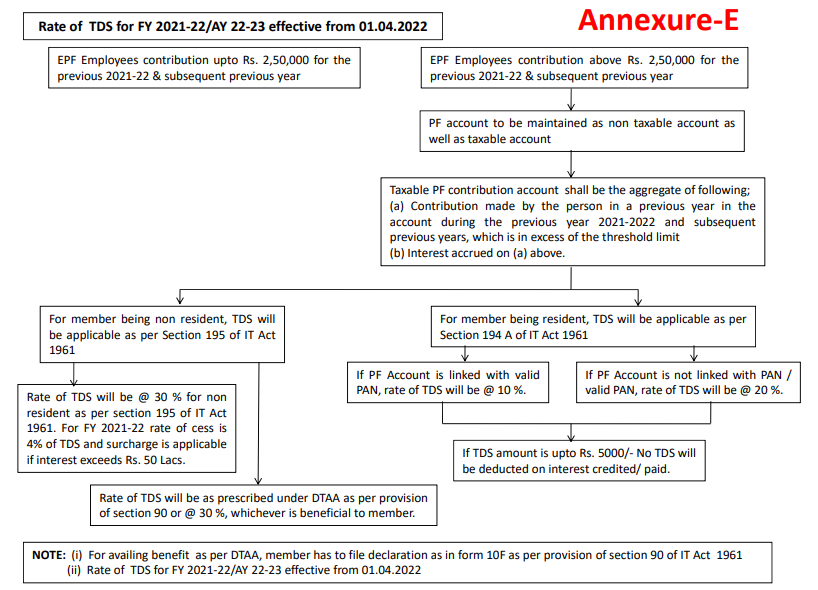
As per notification No. 95/2021 dated 31st August 2021, for calculating taxable interest, the PF department shall maintain separate accounts, one with taxable contribution and another with non-taxable contribution, for all the subscribers starting from the financial year 2021-22 and onwards.
The taxpayer shall be liable to pay tax on the interest accrued in the taxable contribution account. The EPFO shall deduct TDS on such interest.
Under what Circumstances will TDS on interest be deducted?
TDS will be deducted at 10% on taxable interest income accrued above the threshold limit during the year as per Section 194A of the IT Act.
What is the Threshold Limit on Interest income above which TDS will be deducted?
For resident Indians, TDS is deductible if the interest accrued in the PF account for the financial year exceeds Rs 5,000.
The employee shall pay tax on the interest accrued on the taxable portion of the PF contribution. The amount of taxable PF interest should be added as income under the head ‘income from other sources’ on which tax shall be calculated as per the applicable income tax slab rates. The employee can claim a tax credit for the TDS deducted from the interest income.
To know the amount of taxable PF interest, the employee can view the PF account statement. To know how to view the PF account statement, click here.
What is the Date of TDS Deduction on Taxable PF interest?
The new TDS rule will apply to the government and private sector employees on contributions from the financial year 2021-22 and subsequent years. No TDS will be applicable on past accumulation till 31st March 2021. It will be applicable to contributions made from 1st April 2021, which exceed the threshold limit of Rs 2.5 lakh.
In any other case such as final settlement, transfer claims, on transfer from EPFO to exempted establishments, and vice versa, the TDS shall be deducted either on 1st April 2024 or on final settlement or on the transfer date, whichever is later.
What is the Rate of TDS deduction on Taxable interest on EPF Contributions?
For resident Indians-
If PF account is linked with a valid PAN, then TDS rate will be 10%.
There is a 4% cess of TDS amount and surcharge applicable to non-residents. However, a cess of 4% and a surcharge will not be applicable if the TDS is deducted as per DTAA provisions.
How will non-resident members claim to benefit from double taxation on taxable interest?
To avail of DTAA benefits, the member must obtain a Tax Residency Certificate (TRC) by filing Form 10F to the income tax department. On receipt application in Form 10F, the Assessing Officer may issue a TRC in Form 10FB on being satisfied on this behalf. Based on such TRC, the non-resident member can claim the benefit from double taxation.
What if there is interest-on-interest from the excess PF contribution? Will it be taxed in future years too?
As per the current accounting system followed by EPFO, interest is credited on an annual basis. The government notifies the EPF interest rates at the end of the relevant financial year. If the EPF and VPF contribution is more than Rs 2.5 lakh during the financial year, the TDS needs to be deducted from the interest accrued on the taxable portion of the PF contribution.
In the subsequent years, the previous years’ accumulations of the taxable account will be brought forward, and the interest accrued on the opening balance and current years’ contribution (contribution above the threshold limit of Rs 2.5 lakh) of the taxable account shall be taxable.
Mr Q is a salaried employee who contributes Rs 30,000 monthly to the EPF account. The closing balance of his PF account as of 31st March 2023 is Rs 50,00,000.
The calculation of taxable and non-taxable PF interest will be as under:
Illustration 2- If funds withdrawn from the PF account
When the member withdraws any amount from the EPF account, firstly, the funds will be withdrawn from the taxable account and thereafter from the non-taxable account.
Let’s calculate the taxable and non-taxable portion of the PF account interest, and TDS calculation.
FY 2023-24
Period(FY 2023-24)
Monthly contribution (Rs)
Cumulative balance at the end of the month
Interest accrued at 8.25% in
Non-taxable account (Rs)
Taxable account (Rs)
Non-taxable account (Rs)
Taxable account (Rs)
April
40,000
40,000
0
275
0
May
40,000
80,000
0
550
0
June
40,000
1,20,000
0
825
0
July
40,000
1,60,000
0
1,100
0
August
40,000
2,00,000
0
1,375
0
September
40,000
2,40,000
0
1,650
0
October
40,000
2,50,000
30,000
1,719
206
November
40,000
2,50,000
70,000
1,719
481
December
40,000
2,50,000
1,10,000
1,719
756
January
40,000
2,50,000
1,50,000
1,719
1,031
Withdrawal
-1,10,000
-1,50,000
February
40,000
1,80,000
0
1,238
0
March
40,000
2,20,000
0
1,513
0
Balance as on 31.03.24
2,20,000
0
15,400
2,475
We can see that the withdrawals from the PF account was first fully adjusted from the taxable account and then from the non-taxable account.
TDS would be deducted as per the below working:
Particulars
Non-taxable account (Amount in Rs)
Taxable account (Amount in Rs)
Carried forward balance as on 31.03.2024
50,00,000
0
Interest accrued on opening balance
4,12,500
0
Total contribution during the FY 2024-25
3,30,000
1,50,000
Withdrawals during the FY 2024-25
-1,10,000
-1,50,000
Interest accrued during the FY 2024-25
15,400
2,475
Total funds in the accounts to carry forward next year
In the next financial year, if the employee continues to contribute Rs 40,000 monthly to the PF account, i.e. FY 2024-25, and withdraws Rs 4 lakh in June 24, the taxable interest would be calculated in the following manner:
Total funds in the accounts to carry forward next year (A+B+C+D)
60,81,475
1,11,834
TDS @10% ((1,788 + 46)x 10%)
0
184
Balance carried forward to next year
60,81,475
1,11,834-184 = 1,11,650
Flow chart
Tax on EPF withdrawals
If EPF is withdrawn after five years of continuous service, then no tax is required to be paid on the contribution amount and interest received on the same. However, If you withdraw money in case of emergencies (we’ll talk about it) before a specified period of 5 years, then in that case, you won’t be exempted from tax. And the PF department will deduct TDS on EPF withdrawn before five years of continuous service at 10%.
Illustration
Mr. Ram’s total PF contribution (including interest) is Rs.5,50,000 as on 31st March 2023. Ram works in a company registered under EPFO and contributed Rs.3,50,000 to his EPF account in FY 2023-24. He received an interest of 8.25% on his contribution.
Now calculate his taxable and non-taxable contributions for FY 2023-24
Particulars
Taxable contribution
Non-Taxable contribution
Closing balance, including interest, as on 31st March
5,50,000
The contribution made in FY 2023-24
1,00,000
2,50,000
Interest accrued for FY 2023-24
8,250
20,625
Total
1,08,250
8,20,625
FAQs
What is the interest rate of EPF for the FY 2023-24?
8.25% is the interest rate of EPF for the FY 2023-24.
If PF account is linked with a valid PAN, then TDS rate will be 10%.
If PF account is not linked with PAN, then the TDS rate will double to 20%.
However, for resident Indians, the TDS will be deducted only if the interest amount exceeds Rs 5,000.
For non-residents
The TDS will be deducted at 30%, and it shall be deducted under Section 195 of the Income Tax Act. However, if the rate of TDS specified under the Double Taxation Avoidance Agreement (DTAA) is beneficial to PF members, then such a rate will be applicable. The TDS rate is also 30% if the PF account is not linked with PAN.
What is VPF?
An employee can voluntarily enhance the monthly PF contribution up to 100% of the basic salary as a Voluntary Provident Fund (VPF). The employer is under no obligation to match this excess contribution (beyond 12% of the basic salary+DA). This amount would be credited to the same EPF account as there is no separate account for VPF, and the interest offered would be the same as EPF.
For government employees tax exemption limit is 5 lakh (1-year EPF contribution), Interest earned on EPF above 5 lakh is taxable from FY 2021-22.
Other than government employees tax exemption limit is 2.5 lakh for one year; if EPF contribution exceeds the limit of 2.5 lakh, interest earned on EPF contribution above 2.5 lakh is taxable from FY 2021-22.
Is contribution made to EPF taxable?
Employee’s contribution made to EPF is not taxable.
How can i avoid on pf interest earned?
Under income tax act, if you have earned pf interest below Rs 2.5 lakh is exempt.