Ministry of Corporate Affairs (MCA) vide General Circular No. 01/2025 dated June 16, 2025, has announced a relaxation on additional fees for filing 13 specified e-forms during the transition from MCA21 Version 2 to Version 3. Due to a system migration, these forms will be unavailable from June 18 to July 13, 2025. Filings with due or resubmission dates between June 18 and July 31, 2025, can be submitted without extra fees until August 15, 2025. This one-time fee waiver aims to ease the filing process amid technical constraints during the upgrade. Stakeholders are encouraged to file promptly once the new system goes live.
This is to inform that in view of the transition of the MCA21 portal from Version 2 (V2) to Version 3 (V3) and to facilitate a smooth roll out of Annual filing and related e-forms in MCA-21 V3, the Ministry has scheduled a system migration phase during which e-Forms (as per Annexure) will be temporarily unavailable for filing from 18.06.2025 and 13.07.2025 (both dates inclusive).
Accordingly, to facilitate smooth filing experience for stakeholders, the competent authority has decided that, in cases where the due date (i.e., the last date for filing without additional fees) or resubmission date falls between 18.06.2025 and 31.07.2025 (both dates inclusive), filing of the said e-Forms shall be allowed without levying any additional fees up to 15.08.2025.
According to the recent announcement from the Ministry of MSME, all companies with a turnover exceeding Rs 250 crore, along with all Central Public Sector Enterprises (CPSEs), must register on the Trade Receivable Discounting System (TReDS) by March 31, 2025.
NGOs (Non-Government Organizations) are entities established for non-profit or charitable purposes. An NGO set up as a Section 8 company under the Companies Act, 2013 (‘Act’) is regulated by the Ministry of Corporate Affairs (‘MCA’), whereas an NGO registered as a trust or society falls under the governance of the registrar of the respective state.
Registering as a Section 8 company provides more advantages compared to being a trust or society. This type of company generally holds more credibility among government bodies, donors, and other stakeholders. This article outlines the procedure for registering an NGO as a Section 8 Company under the Companies Act, 2013.
Applicable Laws in India for NGOs
In India, NGOs can be registered under the following legal frameworks:
Upon determining that an individual or collective intends to establish a limited company with these aims, the Central Government will issue a license for registration as a Section 8 company under the relevant Act.
Registering an NGO under Section 8 of the Companies Act, 2013 offers numerous benefits, including:
No Minimum Capital: There is no statutory minimum capital requirement for a Section 8 company, and its capital structure can be modified to align with the company’s growth needs. Fundraising can occur later through donations and member subscriptions.
No Stamp Duty: Section 8 company registration incurs no stamp duty fees in India, including those for the Memorandum of Association (MOA) or Articles of Association (AOA).
Separate Legal Identity: A Section 8 company is legally distinct from its members, allowing registered partnership firms to participate as individual members and take directorship positions. It boasts perpetual existence, meaning membership changes do not affect operational continuity.
Limited Liability: Members of a Section 8 company face limited liability corresponding to their shareholding. They are not personally liable for corporate losses.
Increased Credibility: Section 8 companies often command greater trust than other charitable organizations due to their regulatory framework, mandatory annual audits, and immutable MOA concerning non-profit objectives.
The objectives must align with one or more of the following: promotion of sports, social welfare, advancements in science and art, education, and financial support for low-income groups.
Founders, directors, and members cannot receive any form of remuneration.
No profits should be shared among members or directors, directly or indirectly.
Requirements for Incorporating a Section 8 Company
Directors
A minimum of two directors is necessary if the Section 8 company operates as a private entity, while a public entity requires at least three directors. Private companies are capped at 200 members, whereas public companies can have an unlimited membership.
Capital Requirement and Name
No minimum paid-up capital is required for a Section 8 company. Notably, these companies do not need to include the terms ‘Limited’ or ‘Private Limited’ in their name.
Charitable Objectives
Section 8 companies may only be formed for non-profit purposes. The MOA and AOA must explicitly state the non-profit goals, with any profits being reinvested or utilized for further charitable endeavors.
Management
A Section 8 company is governed by its Board of Directors according to its MOA and AOA, contrasting with trusts managed by trustees.
Compliance with Various Acts
A Section 8 company must adhere to the Companies Act, 2013, maintain proper accounting records, and submit returns to the Registrar of Companies. Alterations to the MOA and AOA provisions require Central Government approval, and the company must comply with the Income Tax Act and GST Law.
Obtaining a Digital Signature Certificate (DSC)
Digital signatures from the proposed company directors are essential, as registration forms must be filed online with digital signatures. Accredited government certifying agencies issue DSCs, and you need to obtain a Class 3 category DSC.
Application for Director Identification Number (DIN)
A DIN must be applied for the proposed company directors, using Form DIR-3 or alongside the SPICe+ registration form. Necessary documents, such as a self-attested PAN and identity and address proofs, should be scanned and submitted through the MCA Portal. The application should be certified by a practicing professional, such as a chartered accountant or company secretary.
Form INC-12 is filed for the grant of the license to operate as a Section 8 company. Along with this form, applicants are required to attach a draft copy of the Memorandum of Association (MOA) and Articles of Association (AOA).
There is a prescribed format for Memorandum of Association of a Section 8 company in Form INC 13. The subscription pages of the MOA and AOA shall be signed by each subscriber along with their name, address, description, and occupation, in the presence of at least one witness.
Form INC 12 is to be submitted along with the following attachments :
The SPICe+ form is the application for the incorporation of the company. The company can be reserved in the first part of the SPICe+ plus form. However, only one name can be declared for approval in this form. Thus, it is recommended that applicants access the free name search facility of existing companies available on the MCA portal before choosing the name. The system will provide a list of closely resembling names of the existing companies based on the search criteria. This will help you avoid choosing a name similar to that of an existing company.
The following documents must be attached along with SPICe+ Form:
Address of correspondence till the registered office is official
Address and Identity proofs of all the subscribers to MOA and first directors of the company
Passport size photograph of all the directors and shareholders
Copy of the rental agreement, in case the company registered office, is on a rented property
Form INC 22
Form INC 22 is filed for providing notice of the address of the company’s registered office. It needs to be filed within 30 days of the incorporation of the company.
Procedure for incorporation of a Section 8 company
Step 1 – Obtain a DSC of the proposed Directors of the Section 8 Company. Once a DSC is received, file Form DIR-3 with the ROC for getting a DIN. TheProof of Identity and Address Proof needs to be attached for obtaining DSC.
Step 2 – Once the DIR-3 is approved, the ROC will allot a DIN to the proposed directors.
Step 4 – Once the form is approved, a license under section 8 will be issued in Form INC-16.
Step 5 – After obtaining the license, file the SPICe+ Form with the ROC for incorporation along with the required attachments as mentioned above.
If the ROC is satisfied with the forms submitted, he issues a Certificate of Incorporation along with a unique Company Identification Number (CIN).
Penalty for Non-Compliance under Companies Act
The Central Government will revoke the Section 8 company license if it fails to comply with the legal provisions of the Act. If the objectives of the company are conducted fraudulently or in violation of the objectives for which it is established, the license can be revoked.
If a company defaults in complying with the provisions of the Act, the company will be punishable with a fine not less than Rs.10 lakh and may extend to Rs.1 crore. The Directors and the officers of the company in default of the provisions of the Act will be punishable with a fine not less than Rs.25,000 which may extend to Rs.25 lakh or both.
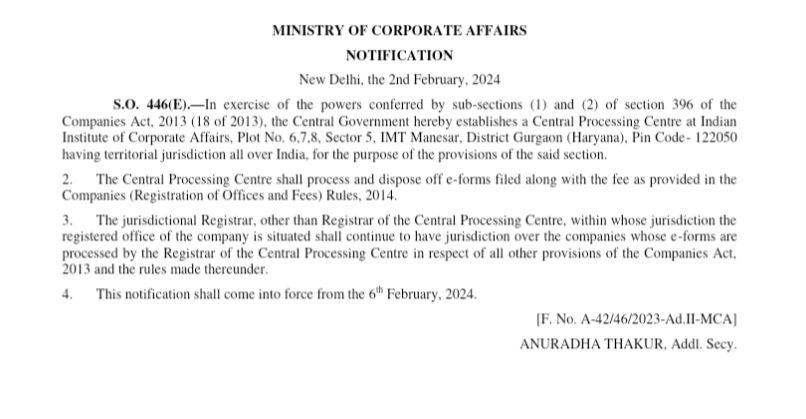
The Ministry of Corporate Affairs (MCA) has announced that starting from February 6th, 2024, the Central Processing Centre (CPC) will be responsible for handling and resolving e-forms submitted by companies. This change is intended to alleviate the workload of Regional Directors and Registrars of Companies, allowing them to focus on enforcement matters. Additionally, it has been clarified that the jurisdictional Registrars will retain authority over companies whose e-forms are processed by the CPC for all other aspects of the Companies Act, 2013. Link to Image
Ministry of Corporate Affairs Year Ender 2023: In the framework of corporate governance, the Ministry of Corporate Affairs (MCA) continues to focus on bolstering ‘ease of compliance’ and ‘ease of doing business’ in the year 2023.
The establishment of Central Processing for Accelerated Corporate Exit (C-PACE) signifies a proactive approach to facilitate swift approvals for companies opting for voluntary closures. Notably, during the year 2023, 1,96,028 companies and LLPs were incorporated, showcasing a robust growth compared to the corresponding period in the previous fiscal year.
In an important development, the amendment to the Companies (Compromises, Arrangements and Amalgamations) Rules, 2016 empowers Regional Directors (RDs) to expedite merger approvals. The groundbreaking Competition (Amendment) Bill, 2023, passed by both Houses of Parliament and received Presidential assent, introduces pivotal changes, including CCI’s approval for transactions over Rs 2,000 crore and a reduced timeline for final orders to 150 days.
The MCA also introduced amendments in key accounting standards with the Companies (Indian Accounting Standards) Amendment Rules, 2023, enhancing disclosure requirements. Additionally, strategic amendments in Companies (Incorporation) Rules, 2014, signify a commitment to minimising bureaucratic hurdles.
Promoting flexibility in corporate procedures through General Circular no. 09/2023, MCA extended timelines for conducting Annual and Extraordinary General Meetings through virtual means. The removal of processing costs in shifting registered offices and enabling such shifts after resolution plan approval under the Insolvency and Bankruptcy Code highlights a pragmatic regulatory environment.
The adoption of Straight Through Process (STP) for additional e-forms eliminates manual intervention, expediting electronic approvals and streamlining operations.
Lastly, the Companies (Prospectus and Allotment of Securities) Second Amendment Rules, 2023, introduce mandatory dematerialisation of shares for larger private companies, aligning regulations with contemporary market trends. These achievements collectively underscore the MCA’s commitment to fostering a dynamic, efficient, and responsive corporate ecosystem in India.
The processing type of additional e-forms have been changed to STP (Straight through Process) from Non-STP i.e, these forms can be approved electronically without human intervention and hence would lead to ‘ease of compliance’ and ‘ease of doing business’.
Central Processing for Accelerated Corporate Exit (C-PACE) has been operationalised w.e.f. 01.05.23 pursuant to Union Budget announcement in 2022, as a measure to provide expeditious approval of applications filed by the companies with intention to close operations voluntarily.
During Calander Year 2023, 1,96,028 companies and LLPs got incorporated as on 30th November 2023 as against 1,88,364 companies and LLPs for the corresponding period during Calander Year 2022.
The Companies (Compromises, Arrangements and Amalgamations) Rules, 2016 have been amended in May, 2023 pursuant to which, in case a Regional Director (RD) does not file an application before NCLT for considering the scheme of merger under section 232 or does not issue confirmation order for approval of merger u/s 233 within the time limit provided, it shall be deemed that RD has no objection and the confirmation order shall be issued accordingly.
The Competition (Amendment) Bill, 2023 had been passed by both the Houses of the Parliament (Lok Sabha on 29th March, 2023 and Rajya Sabha 3rd April, 2023) and received the Presidential assent (on 11th April, 2023).
Some highlights of the Amendment Act, 2023 are as under: –
Deals with transaction value of more than Rs 2,000 crore will require CCI’s approval. The timeline for the CCI to pass a final order on combination transactions has been reduced to 150 days from 210 days.
The Act expands the scope of entities that can be adjudged to be a part of anti-competitive agreements. Currently, enterprises or persons engaged in similar businesses can be held to be a part of anti-competitive agreements. The Act expands this to also include enterprises or persons who are not engaged in similar businesses.
The Act provides a framework for settlement and commitment for faster resolution of investigations of anti-competitive agreements (except cartels) and abuse of dominant position.
For the purpose of regulation of combinations, the Act modifies the definition of control as the ability to exercise material influence over the management, affairs, or strategic commercial decisions.
The MCA had notified the Companies (Indian Accounting Standards) Amendment Rules, 2023 vide G.S.R. No.242(E), dated 31.03.2023 effective from 01.04.2023. The said rule inter-alia brings amendments to IndAS 1, IndAS 8 and IndAS 12 relating to disclosures of material accounting policies, definition of Accounting estimates and deferred Tax related to Assets and Liabilities arising from a Single Transaction respectively along with other consequential amendment in IndAS 107, IndAS 34 and IndAS 101. Further, some editorial corrections have also been carried out in IndAS 101, IndAS 102, IndAS 103, IndAS 109 and IndAS 115.
The MCA vide General Circular no. 09/2023 dated 25.09.2023 has extended the time line to conduct Annual General Meeting (AGM) and Extra- ordinary General meeting (EGM) through Video Conference (VC) or other Audio visual (OVAM) or transact items through postal ballot for the year 2023 or 2024 on or before 30th September, 2024.
The MCA vide notification number G.S.R. 790 (E) dated 20.10.2023 has amended the Companies (Incorporation) Rules, 2014 through which imposition of cost at the time of processing of application filed for shifting of registered office has been removed.
When the management of the company has been taken over by new management under a resolution plan approved under section 31 of the Insolvency Bankruptcy Code, 2016 (31 of 2016) and no appeal against the resolution plan is pending in any Court or Tribunal and no inquiry, inspection, investigation is pending or initiated after the approval of the said resolution plan, the shifting of the registered office has been allowed.
India has taken another giant stride in enhancing the integrity of its financial markets with the Corporate Affairs Ministry (MCA) now mandating private companies to go in for dematerialisation of their securities.
All private companies, except small and government companies, can henceforth issue new securities only in dematerialised form, the MCA has said in its latest amendment to a Rule concerning issuance of securities.
Private companies have to facilitate dematerialisation of existing securities and the time period allowed to conform to the latest directives is until the end of September 2024.
MCA has also specifically said that no private company can issue securities or buyback its securities after September 30, 2024, until the entire holding of securities of its promoters, directors, and key managerial personnel has been dematerialised.
Also, every holder of securities in a private company who intends to transfer such securities on or after September 30, 2024 shall get them dematerialised before the transfer.
All subscription to any securities of a private company, whether by way of private placement or bonus shares or rights offer on or after September 30, 2024, can be done only in respect of securities held in dematerialised form before such subscription, MCA has said.
Commenting on the MCA move, Makarand M Joshi, Founder, MMJC & Associates, a corporate compliance firm, said that the move to facilitate dematerialisation of shares by certain category of private companies is a significant step towards ensuring the integrity of financial markets. “Apart from enhancing ease of doing business in India, this move will reduce unscrupulous activities while dealing in physical shares”, Joshi said.
Small private companies with a capital of less than ₹4 crore and turnover of less than ₹40 crore, and those that are neither holding nor subsidiary companies will be spared from the burden of dematerialisation.
The dematerialisation of shares of public companies (listed in bourses) took off in 1996 with the establishment of National Securities Depository Limited (NSDL).
The dematerialisation of shares in Indian equity markets revolutionised the way shares were held and traded, leading to increased efficiency, transparency, and investor participation while reducing the risks and costs associated with physical certificates. It was a pivotal development in the evolution of India’s capital markets.
This dematerialisation move, which was seen as a game-changer, brought in several benefits including elimination of physical certificates, improved transparency, faster and cheaper transactions, reduction in paperwork, integration with electronic trading, financial inclusion, better retail investor access, and reduced frauds and forgeries besides easier ownership transfer.
Varun Vaish, Partner, Luthra and Luthra Law Offices India, said this amendment is a landmark move aimed at bringing about a transformative change in the corporate governance landscape of India.
The dematerialisation of securities, while exempting small companies and government companies, signifies a progressive shift towards transparency and efficiency, aligning India’s corporate sector more closely with international practices., he said.
This amendment is expected to reduce the risks associated with physical certificates, such as loss, theft, and forgery, and improve the overall governance in private sector companies by facilitating better tracking and trading of securities, he added.
Abhishek Guha, Partner, Shardul Amarchand Mangaldas & Co., said this amendment will bring about further transparency and improve overall investor protection. It will curb risks like fake certificates and fraudulent share transfers resulting in unwarranted disputes and litigation.
“There will be operational and compliance costs associated with maintaining demat accounts but the associated costs should be acceptable given the substantial benefits”, Guha added.