Ministry of Corporate Affairs: BIG ROC COMPLIANCE UPDATE FY 2025-26

MCA Grants Major Relief to Companies – But LLPs Remain Outside the Extension!

The Ministry of Corporate Affairs (MCA), vide General Circular No. 05/2026 dated 24 October 2026, has announced significant relief for companies regarding the filing of financial statements and annual returns for FY 2025-26.

Revised Filing Deadlines for Companies

31 December 2026 – Financial Statements

  • AOC-4
  • AOC-4 (CFS)
  • AOC-4 (XBRL)
  • AOC-4 NBFC (Ind AS)

AOC-4 CFS NBFC (Ind AS)

31 January 2027 – Annual Returns

MGT-7

MGT-7A

Key Benefit: Companies can submit the specified forms within these extended timelines without payment of additional filing fees. Normal statutory filing fees remain applicable.

! IMPORTANT: NO RELIEF FOR LLPS!

The above relaxation applies to companies and does not extend the statutory filing deadlines prescribed under the Limited Liability Partnership Act, 2008.

17 LLP Filing Deadlines for FY 2025-26:

Form 11 – Annual Return: 30 May 2026 (already overdue if not filed)

Form 8 – Statement of Account & Solvency: 30 October 2026

Delayed LLP filings attract additional fees based on the period of delay and whether the entity qualifies as a Small LLP.

LLP Late Filing Fee Structure:

  • Up to 15 days: 1x normal filing fee
  • 16-30 days: 2x to 4x
  • 31-60 days: 4x to 8x
  • 61-90 days: 6x to 12x
  • 91-180 days: 10x to 20x
  • 181-360 days: 15x to 30x

Beyond 360 days, further daily additional fees apply.

Other Important Clarifications:

The MCA relaxation does not extend the statutory timeline for holding Annual General Meetings (AGMs).

Filing after the respective extended deadlines will attract applicable additional fees.

LLPs should complete Form 8 filing by 30 October 2026 to avoid additional filing fees.

Professional Insight:

While the extension provides welcome compliance relief to companies, businesses and professionals must distinguish between the filing requirements applicable to companies and LLPs.

Timely statutory compliance is essential to avoid unnecessary financial penalties and regulatory complications.

Share this update with business owners, directors, designated partners, finance professionals and compliance teams.

Important Clarification MCA Form ADT-1

Avoid the “Enter valid SRN associated with CIN” error while filing Form ADT-1.

Where “Casual Vacancy” is selected as the purpose of filing, Field (7b) – “Specify the SRN of relevant form” requires the SRN of original Form ADT-1, Form 23B or Form GNL-2, as applicable.

⚠️ Note: Do not enter the SRN of Form ADT-3.

📌 Stakeholders are advised to refer to the FAQs on Annual Filing available on the official MCA website under Help & FAQs section.

Deadline Approaching: Important Update on Form ADT-1 Filing Requirements

Important Update: Form ADT-1 Filing

Companies that have held their Annual General Meeting (AGM) on 30 September 2026, wherein the auditor was appointed or re-appointed, are required to file Form ADT-1 within the prescribed statutory timeline.

Last date for filing: 14 October 2026

2026 Amendment to Indian Accounting Standards Overview

Important Update for Stakeholders!

The Ministry of Corporate Affairs has notified the Companies (Indian Accounting Standards) Amendment Rules, 2026 vide G.S.R. 725(E) dated 12th August, 2026.

The amended Rules shall come into force on the date of their publication in the Official Gazette. 

For the detailed notification, please refer to the official notification issued by MCA:

G.S.R. 725(E).—In exercise of the powers conferred by section 133 read with section 469 of the Companies Act, 2013 (18 of 2013), the Central Government, in consultation with the National Financial Reporting Authority, hereby makes the following rules further to amend the Companies (Indian Accounting Standards) Rules, 2015, namely:-

1. Short title and commencement.— (1) These rules may be called the Companies (Indian Accounting Standards) Amendment Rules, 2026.

(2) They shall come into force on the date of their publication in the Official Gazette.

2. In the Companies (Indian Accounting Standards) Rules, 2015, in the “Annexure”, under the heading “B. Indian Accounting Standards (Ind AS)”,

(A) in “Indian Accounting Standard (Ind AS) 101”; —

(i) after paragraph 39AI, the following paragraphs shall be inserted, namely:-

“39AJ [Refer Appendix 1]
39AK Annual Improvements to Ind AS (2024), amended paragraphs B5-B6. An entity shall apply those amendments for annual reporting periods beginning on or after 1 April 2026.”

(ii) in Appendix B, for paragraphs B5 and B6, the following paragraphs shall be substituted, namely:-

“B5 An entity shall not reflect in its opening Ind AS Balance Sheet a hedging relationship of a type that does not qualify for hedge accounting in accordance with Ind AS 109 (for example, many hedging relationships where the hedging instrument is a stand-alone written option or a net written option; or where the hedged item is a net position in a cash flow hedge for another risk than foreign currency risk) [see paragraph 6.4.1(a) of Ind AS 109]. However, if an entity designated a net position as a hedged item in accordance with previous GAAP, it may designate as a hedged item in accordance with Ind ASs an individual item within that net position, or a net position if that meets the requirements in paragraph 6.6.1 of Ind AS 109, provided that it does so no later than the date of transition to Ind ASs.
B6 If, before the date of transition to Ind ASs, an entity had designated a transaction as a hedge but the hedge does not meet the qualifying criteria for hedge accounting in paragraph 6.4.1(b)-(c) of Ind AS 109, the entity shall apply paragraphs 6.5.6 and 6.5.7 of Ind AS 109 to discontinue hedge accounting. Transactions entered into before the date of transition to Ind ASs shall not be retrospectively designated as hedges.”;

(B) in “Indian Accounting Standard (Ind AS) 107”;

(i) after paragraph 5A, the following paragraphs shall be inserted, namely:- “5B Paragraph 30A applies only to contracts to buy nature-dependent electricity that satisfy the requirements in paragraph 2.3A of Ind AS 109 and are outside the scope of that Standard in accordance with paragraphs B2.7-B2.8 of Ind AS 109.
5C Paragraph 30B applies only to contracts that satisfy the requirements in paragraph 2.3A of Ind AS 109 and have been designated in a cash flow hedging relationship in accordance with paragraph 6.10.1 of Ind AS 109.
5D Paragraph 30C applies only to contracts that satisfy the requirements in paragraph 2.3A of Ind AS 109 and have been entered into with regards to an entity’s electricity purchases. These contracts comprise those:
(a) within the scope of Ind AS 109; and
(b) outside the scope of Ind AS 109 in accordance with paragraph 2.4 of that Standard, including those excluded in accordance with paragraphs B2.7-B2.8 of that Standard.”;

Table: Instrument EA

Instrument EAAnalysis
Instrument EA is a loan with an interest rate that is adjusted every reporting period by a fixed number of basis points if the debtor achieves a contractually specified reduction in carbon emissions during the preceding reporting period.

The maximum possible cumulative adjustments would not significantly change the interest rate on the loan.
The contractual cash flows are solely payments of principal and interest on the principal amount outstanding.

The entity considers whether the contractual cash flows that could arise both before and after each change in contractual cash flows are solely payments of principal and interest (see paragraph B4.1.10).

If the contingent event of achieving the carbon emissions target occurs, the interest rate is adjusted by a fixed number of basis points, resulting in contractual cash flows that are consistent with a basic lending arrangement. It is only because the nature of the contingent event itself does not relate directly to changes in basic lending risks and costs that the entity cannot conclude without further assessment whether the cash flows on the financial asset are solely payments of principal and interest.

The entity therefore assesses whether, in all contractually possible scenarios, the contractual cash flows would not be significantly different from the contractual cash flows on a financial instrument with identical contractual terms, but without the contingent feature linked to carbon emissions (see paragraph B4.1.10A).

Because any adjustments over the life of the instrument would not result in contractual cash flows that are significantly different, the entity concludes that the loan has contractual cash flows that are solely payments of principal and interest on the principal amount outstanding.

Table: Instrument I

Instrument IAnalysis
Instrument I is a loan with an interest rate that is adjusted every reporting period to track the movements in a market-determined carbon price index during the preceding reporting period.The contractual cash flows are not solely payments of principal and interest on the principal amount outstanding.

The contractual cash flows are indexed to a variable (the carbon price index), which is not a basic lending risk or cost. The contractual cash flows are therefore inconsistent with a basic lending arrangement (see paragraph B4.1.8A).

Note: The principal rules were published in the Gazette of India, Extraordinary, Part II, Section 3, Sub-section (i), vide number G.S.R. 111(E), dated the 16th February, 2015 and last amended vide notification number G.S.R. 549(E), dated the 13th August, 2025.

Union Minister of Commerce & Industry Shri Piyush Goyal in Singapore for 4th India-Singapore

Union Minister of Commerce and Industry, Shri Piyush Goyal, is visiting Singapore from 19-21 August 2026 as part of continued high-level engagement under the India-Singapore Ministerial Roundtable (ISMR) framework.

An Indian business delegation comprising around 70 senior business leaders from diverse sectors is visiting Singapore alongside Shri Piyush Goyal to strengthen India-Singapore economic and commercial ties. The delegation includes representatives from technology, software and AI, manufacturing and engineering, infrastructure and sustainability, financial services and FinTech, healthcare and life sciences, food and agriculture, logistics, maritime and trade, and professional services.

The delegation will undertake B2B, G2B and institutional engagements, including interactions with leading Centres of Excellence (COEs) and visits to skilling institutions in Singapore. The engagements will focus on partnerships, investment, market access, technology collaboration and talent development. The visit is being organised on the sidelines of the India-Singapore Ministerial Roundtable and India-Singapore Business Roundtable meetings.

During the visit, Shri Piyush Goyal will participate in the 4th India-Singapore Ministerial Roundtable (ISMR) on 20 August 2026. The ISMR serves as the apex ministerial mechanism for advancing the India-Singapore Comprehensive Strategic Partnership (CSP). The Roundtable will be held alongside the 4th India-Singapore Business Roundtable (ISBR), followed by an MoU signing ceremony and a lunch hosted by the Deputy Prime Minister of Singapore for all ISMR and ISBR delegates.

The Minister will participate in the Roundtable alongside Smt. Nirmala Sitharaman, Union Minister for Finance and Corporate Affairs; Dr. Subrahmanyam Jaishankar, Union Minister for External Affairs; and Shri Ashwini Vaishnaw, Union Minister for Railways, Information and Broadcasting, and Electronics and Information Technology. The Ministers will engage with their Singaporean counterparts and other senior Singaporean leadership during the visit.

Shri Piyush Goyal will also call on Mr Lawrence Wong, Prime Minister of Singapore, at the Istana.

On the sidelines, Shri Goyal will hold a series of Government-to-Business (G2B) engagements with senior representatives from the Global Finance & Technology Network, YPO Global, Milken Institute, Keppel Infrastructure, Temasek Holdings and IHH Healthcare, as well as the Singapore Business Federation (SBF) Chairman-led delegation, Turner & Townsend and STT GDC. These engagements will be followed by a Family Office Roundtable.

The Minister will jointly visit an APEDA–FairPrice initiative at City Square Mall along with Singapore’s Minister of State for Foreign Affairs and Trade & Industry, Ms Gan Siow Huang. The initiative aims to promote Indian agri-food exports and strengthen their presence in Singapore’s retail market, reflecting deepening agri-trade linkages between the two countries.

Shri Piyush Goyal will also participate in the India-Singapore Business Forum organised by FICCI at the INSEAD Asia Campus, where he will take part in a fireside chat on “India in the New Global Growth Equation: Growth and Opportunity for Businesses in Asia and the World,” followed by a networking dinner with the Indian and Singaporean business community.

The visit will conclude with a keynote address by the Minister at the ICAI ASEAN Conference 2026 at the Marina Bay Sands Expo and Convention Centre.

Singapore remains a key economic partner and a major source of investment for India. In FY 2025-26, Singapore was the largest source of FDI into India, with FDI inflows of USD 19.8 billion. Cumulative FDI inflows from Singapore stood at USD 194.68 billion during April 2000-March 2026, accounting for 24.72% of India’s total FDI inflows.

Singapore is also India’s largest trading partner within ASEAN and remains a significant source of External Commercial Borrowings and Foreign Portfolio Investment. Bilateral trade has expanded substantially following the conclusion of the India-Singapore Comprehensive Economic Cooperation Agreement (CECA), increasing from USD 6.7 billion in FY 2004-05 to USD 36.1 billion in FY 2025-26.

The visit reaffirms India’s commitment to strengthening trade, investment and people-to-people ties with Singapore, one of India’s largest sources of FDI and a key partner in advanced manufacturing, digitalisation, skills development and the green economy.

PSB Confluence 2026: Strategies for Public Sector Banks’ Future

The two-day PSB Confluence 2026, organised by the Department of Financial Services (DFS), Ministry of Finance, concluded today after extensive deliberations among the leadership of Public Sector Banks (PSBs) and Public Financial Institutions (PFIs), senior Government officials and domain experts across seven themes relevant to the next phase of growth of the banking and financial sector.

On Day 2, deliberations focused on Agriculture and Horticulture Value Chain Infrastructure, Priority Sector Lending and Reimagining the Credit Card Business. This was followed by debriefing sessions, where the thematic groups presented actionable strategies and innovative solutions emerging from discussions across all seven themes.

Addressing the concluding session, Union Minister for Finance and Corporate Affairs Smt. Nirmala Sitharaman emphasised the need to translate the deliberations into tangible outcomes. She called upon PSBs and PFIs to build on their institutional strength, anticipate emerging opportunities and develop capabilities to support India’s evolving economic requirements.

On Banking for Youth, the Finance Minister called upon PSBs to undertake a focused, month-long campaign commencing from 2nd October 2026 for youth above 16 years, coordinated through the Indian Banks’ Association (IBA), to strengthen engagement with young citizens entering the formal financial system. The initiative would seek to establish a sustained relationship with young customers and enable banks to support their evolving financial needs as they progress through education, employment, entrepreneurship, investment and wealth creation.

As part of the initiative, a common online portal/application for youth is envisaged to provide a single point for accessing simple and relevant information on banking services and opportunities relating to education, skilling and entrepreneurship. The initiative would be complemented by physical outreach through colleges, universities, skill institutions and other campuses, as well as youth-focused engagement spaces.

The Finance Minister also emphasised the importance of Priority Sector Lending (PSL) and the need to pay close attention to shortfalls against individual targets and sub-targets. PSBs were encouraged to maintain their strong focus on PSL through granular monitoring, early identification of emerging gaps and appropriate business strategies, with the objective of minimising shortfalls through genuine and productive credit flow to intended beneficiaries.

The Day 2 deliberations also identified opportunities to strengthen financing across agriculture and horticulture value chains, including FPOs, storage, processing, logistics and market linkages. Discussions on Reimagining the Credit Card Business explored strategies around digital onboarding, greater cross-sell to the existing customer base and leveraging opportunities arising from RuPay-UPI integration. The deliberations were also enriched by real-world experiences shared by CA Arvind Agarwal, Director, VNR Group, on Agriculture and Horticulture Value Chain Infrastructure, and Shri Sanjay Mehndiratta, Director, Toy Zone, on Priority Sector Lending, bringing practical perspectives from their respective entrepreneurial journeys.

Secretary, DFS, emphasised that the Confluence has enabled sharper identification of priorities and clearer actionable across the seven themes. PSBs and PFIs would now need to translate these into implementation with clear ownership and realistic timelines, while successful institutional models could be examined for wider adoption.

PSB Confluence 2026 brought together the collective experience and capabilities of PSBs, PFIs, Government and domain experts across areas critical to the future of banking. The actionable strategies emerging from the Confluence will now be taken forward by the concerned institutions through appropriate follow-up and implementation. As India advances towards Viksit Bharat 2047, PSBs and PFIs will continue to play an important role in deepening financial inclusion, financing emerging opportunities and supporting the country’s next phase of growth.

Union Minister of Commerce & Industry Shri Piyush Goyal Invites Japanese Businesses to Deepen Invest

Union Minister for Commerce and Industry Shri Piyush Goyal highlighted the growing depth and strategic importance of the India-Japan partnership and invited Japanese businesses to deepen their investments and partnerships in India. Shri Goyal was addressing a dinner hosted by the Government of Uttar Pradesh for a Japanese delegation, in the presence of Uttar Pradesh Chief Minister Shri Yogi Adityanath in New Delhi today.

Addressing the gathering, Shri Goyal said that India and Japan share a close and enduring partnership rooted in common aspirations for peace, progress and prosperity in the Indo-Pacific. He noted that the presence of the delegation from Yamanashi Prefecture reflects the growing reach of the bilateral partnership into India’s States and regions.

Shri Goyal said that the seven streams of national transformation outlined by Prime Minister Shri Narendra Modi—manufacturing, agriculture, technology, infrastructure, energy and defence, green and blue economy, and India’s civilisational soft power—represent areas where the strengths of India and Japan complement each other. He said the partnership goes beyond economic growth and reflects a shared commitment to becoming trusted partners in global progress.

Highlighting Uttar Pradesh’s growing economic potential, Shri Goyal said the State, under the leadership of Chief Minister Shri Yogi Adityanath, is working towards its ambition of becoming a USD 1 trillion economy. He said Uttar Pradesh’s large and aspirational population, improving connectivity, industrial momentum and skilled workforce provide a strong platform for Japanese technology and expertise to complement India’s young workforce and expanding market.

Referring to the 16th India-Japan Annual Summit held in Delhi in July 2026, Shri Goyal highlighted the strategic ambition underpinning the relationship, including Japan’s target of investing 10 trillion yen in India over the next decade. He said investments in areas such as artificial intelligence, semiconductors, critical minerals, batteries, energy and next-generation mobility would play an important role in shaping the future of both economies.

Shri Goyal said the growing India-Japan partnership is already visible on the ground, citing the Mumbai-Ahmedabad High-Speed Rail project, Japanese-assisted metro systems in Delhi, Ahmedabad, Bengaluru and Chennai, and 11 Japanese industrial townships across eight States. He noted that more than 1,400 Japanese companies are today operating in India, with household names such as Suzuki, Toyota and Honda in mobility, Sony in electronics, and Hitachi and Mitsubishi in engineering. He said bilateral trade stood at around USD 27.5 billion in FY 2025-26, while Japan is now India’s fifth-largest source of FDI, reflecting the strong foundation for further expansion of economic ties.

Drawing on the Japanese philosophy of ‘Kaizen’, Shri Goyal said India’s reform journey reflects a similar spirit of continuous improvement. He highlighted reforms in ease of doing business, infrastructure, digital public infrastructure, multimodal logistics and expanding Japanese language capabilities as part of India’s efforts to create a more enabling environment for investment and growth.

Shri Goyal said Uttar Pradesh, India’s third-largest State economy, has more than 9 million MSMEs and is the fifth-largest State exporter. He noted that enterprises such as Escorts Kubota and Seiko Advance are already contributing to the State’s manufacturing ecosystem.

He further highlighted the Jewar International Airport, Yamuna Expressway and the JICA-supported Western Dedicated Freight Corridor, along with 27 industrial clusters and ecosystems in sectors including defence, semiconductors and electronics, as key strengths that position Uttar Pradesh as a promising destination for deeper Japanese partnerships.

Shri Goyal said he would be visiting Japan from 24 to 27 August 2026 to take forward these conversations at the highest levels of government and industry and further strengthen the Special Strategic and Global Partnership between India and Japan.

Emphasising the civilisational ties between the two countries, Shri Goyal recalled the historical connection between India and Japan through the teachings of Buddha. He invited Japanese businesses to make India, and Uttar Pradesh in particular, a centre of their growth and a hub for Japanese innovation serving the Indo-Pacific and the world.

Department of Commerce Organises Awareness Session on EU CBAM Regulations for Exporters

The Department of Commerce, Ministry of Commerce & Industry, in collaboration with the National Accreditation Board for Certification Bodies (NABCB) and the Engineering Export Promotion Council (EEPC), organised an Awareness Session on European Union Carbon Border Adjustment Mechanism (EU CBAM) Regulations for Exporters at Vanijya Bhawan, New Delhi, today. The session was attended by around 100 participants, including exporters and industry stakeholders, and aimed at enhancing awareness and preparedness among Indian exporters regarding the evolving regulatory requirements under CBAM.

The technical sessions provided participants with an overview of the EU CBAM framework, its applicability and covered products, obligations for exporters, calculation of embedded emissions, data collection and reporting requirements, and accreditation and verification mechanisms. Practical case studies relating to the iron and steel and aluminium sectors were also discussed to provide exporters with a better understanding of the application of the requirements in practice.

The session provided an interactive platform for exporters and industry representatives to understand the regulatory and technical aspects of CBAM and seek clarifications on issues relating to compliance and reporting. The discussions highlighted the importance of timely awareness and preparedness as sustainability-related regulatory requirements increasingly become relevant to international trade.

Addressing the session, Joint Secretary, Department of Commerce, Shri Amit Verma, emphasised the importance of ensuring that Indian exporters are adequately informed and prepared to meet emerging sustainability-related requirements in international markets. He highlighted the Department’s efforts to create awareness among exporters and facilitate a better understanding of emerging regulatory requirements. He reiterated that the Department remains engaged with industry and relevant stakeholders and is working towards addressing concerns and facilitating practical and workable solutions for Indian exporters.

Providing the context for the session, CEO, NABCB, Shri N. Venkateswaran, highlighted the importance of a credible accreditation and verification ecosystem in building confidence in emissions-related data and supporting compliance with CBAM requirements.

Chairman, EEPC, Shri Pankaj Chadha, highlighted the importance of awareness and preparedness across the export value chain, including the availability of appropriate emissions-related data from suppliers and other stakeholders. He also emphasised the need for effective verification mechanisms to facilitate compliance by Indian exporters.

The Department of Commerce reaffirmed its continued engagement with exporters, industry associations and relevant institutions to build awareness and capacity on emerging sustainability-related trade regulations and facilitate Indian industry’s preparedness for evolving global market requirements.

The session concluded with a Question and Answer session and interaction with industry and exporters, providing participants an opportunity to seek clarifications on various aspects of EU CBAM and its implementation.

Regional Rural Banks (RRBs) Record Strong Growth in Credit Delivery FY 2025–26

During FY 2025–26, Regional Rural Banks (RRBs) have continued to strengthen their role in promoting rural economic development and financial inclusion by expanding credit delivery and maintaining a strong focus on Priority Sector Lending (PSL).

While gross loans outstanding of RRBs increased by 10.3%, from ₹5,24,163 crore in FY 2024–25 to ₹5,78,349 crore in FY 2025–26, the performance of RRBs under the Reserve Bank of India’s Priority Sector Lending framework remained strong during the year. The average achievement against the overall PSL prescribed target of 75% reached 91.7% of Adjusted Net Bank Credit (ANBC). Almost all RRBs achieved the overall PSL target, reflecting the RRBs’ robust focus on supporting priority sectors and advancing financial inclusion.

Agriculture and allied activities remained the largest component of the RRB credit portfolio, with outstanding credit of ₹3.78 lakh crore, constituting 77% of total Priority Sector Lending. Farm credit accounted for nearly 98% of agricultural lending, thereby supporting crop cultivation, allied agricultural activities and investment in the rural economy

Credit to the MSME sector stood at ₹66,978 crore (13.6% of total PSL), reaffirming the pivotal role of RRBs in supporting rural entrepreneurship and employment generation. Over 95% of MSME lending was directed towards micro enterprises, reflecting the RRBs’ focus on financing first-generation entrepreneurs, self-employed individuals, artisans, and small business units in rural and semi-urban areas. Within MSME lending, the services sector accounted for the largest share, followed by manufacturing enterprises and Khadi & Village Industries.

RRBs extended credit of ₹3.49 lakh crore to weaker sections, reaffirming their commitment to financial inclusion and equitable access to institutional credit. In addition, lending for housing, education, renewable energy and social infrastructure continue to support inclusive and sustainable development by promoting human capital formation, household asset creation, clean energy adoption and the creation of local infrastructure.

Overall, the financial performance of RRBs during FY 2025–26 highlights sustained expansion in rural credit, strong alignment with national development priorities and continued support to farmers, micro-enterprises and other underserved segments. RRBs thus remain key pillars in advancing financial inclusion, strengthening rural livelihoods and supporting the Government of India’s vision of inclusive and balanced economic growth.

MCA to Examine Litigation Funding for PUFE Transactions Under Insolvency

The Ministry of Corporate Affairs (MCA) will examine litigation funding for preferential, undervalued, fraudulent, and extortionate (PUFE) transactions under the insolvency regime to improve recoveries, the ministry told a parliamentary standing committee in a written reply.

“Litigation funding for PUFE transactions will be examined in light of global best practices and refined through detailed consultation with all relevant stakeholders,” the MCA said.  

The ministry in its comments highlighted that the market for litigation funding remains nascent in India.  

Funds worth over ₹4.38 trillion across 1,878 applications are locked in avoidance proceedings until March 31, 2026, according to Insolvency and Bankruptcy Board of India (IBBI) data.  Till June 2025, only 379 cases involving ₹66,919 crore had been disposed of, and ₹7,931 crore had been ordered to be clawed back.

Litigation funding, or third-party litigation finance, is an arrangement where an outside investor pays a claimant’s legal costs. In return, the funder gets an agreed-upon share of the financial recovery if the case wins.

Insolvency law practitioners said PUFE claims are often not pursued due to funding constraints, and litigation funding could make this process effective.  

“Third-party funding, if allowed in PUFE claims, could easily cover legal, investigation, and expert costs, with returns tied to success. This would ease the burden on creditors and shall support recovery from promoters or related parties who diverted the funds of the corporate debtor,” said Daizy Chawla, senior partner, S&A Law Offices. 

The house panel in its report on action taken by the MCA noted that avoidance transactions directly erode the value available to creditors and corporate debtors undertake such transactions before the commencement of insolvency proceedings that unfairly favour certain creditors or divert the company’s assets, thereby reducing the value available for resolution. 

The Insolvency Amendment Act, 2026, has expanded the look-back period for avoidance transactions, which are now counted from the initiation date (date of filing of application) rather than the insolvency commencement date. This was done to capture transactions undertaken in the interim period before admission, which may have been used to siphon value. The Act also clarified that proceedings relating to avoidance transactions will continue even after the completion of resolution proceedings or liquidation. 

Making a case for third-party litigation funding, the panel said it can enable pursuing complex and high-value claims such as tracing diverted assets, undertaking forensic investigations, and initiating recovery actions without imposing additional financial burden on the already depleted insolvency estate. 

“Such a framework should incorporate appropriate safeguards, including mandatory disclosure of funding arrangements before the adjudicating authority and the Committee of Creditors, prohibition of funder control over litigation strategy, transparent and reasonable return structures, and regulatory oversight by the IBBI,” the committee recommended. 

The Ministry of Corporate Affairs (MCA) will examine litigation funding for preferential, undervalued, fraudulent, and extortionate (PUFE) transactions under the insolvency regime to improve recoveries, the ministry told a parliamentary standing committee in a written reply.

Major Settlement Benefitting 423 Contract Workers at Ordnance Factory, Kanpur

A significant wage-related dispute concerning 423 contract workers engaged at Ordnance Factory, Kanpur, under Advanced Weapons and Equipment India Limited (AWEIL) has been successfully resolved through the timely intervention and sustained conciliation efforts of the Regional Labour Commissioner (Central), Kanpur, under the aegis of the Office of the Chief Labour Commissioner (Central), Ministry of Labour & Employment, Government of India.

Pursuant to the conciliation efforts, M/s Immense Manpower Pvt. Ltd., the contractor, disbursed approximately ₹50,00,000/- (Rupees Fifty Lakh only) on 13.08.2026 towards outstanding wages for the months of June and July, 2026 to 423 workmen.

Further, following the intervention of the Regional Labour Commissioner (Central), Kanpur, the pending bill of the contractor for the month of May, 2026 was also released by the Principal Employer, facilitating the settlement of the wage-related issues and ensuring timely payment to the concerned workforce.

As a result of the timely intervention and effective conciliation efforts, the proposed strike/demonstration by a group of workers at Ordnance Factory, Kanpur, was successfully averted, thereby preventing disruption of industrial operations and promoting industrial peace and harmony at the establishment.

During the conciliation proceedings, the management was sensitized about its statutory obligations relating to workers’ welfare, fair service conditions, and compliance with labour laws. The importance of maintaining harmonious industrial relations through constructive dialogue and ensuring timely implementation of welfare measures was emphasized. The management assured that it would continue to uphold its commitment towards the welfare of the workforce and adherence to statutory provisions.

This successful conciliation reflects the continued commitment of the Ministry of Labour and Employment towards protecting workers’ rights, ensuring timely realization of statutory benefits, promoting fair labour practices, and fostering harmonious industrial relations through effective conciliation and constructive dialogue.

DFS Hosts PSB Confluence 2026: Day 1 Deliberations on Deposit Mobilisation

The first day of the two-day PSB Confluence 2026, organised by the Department of Financial Services (DFS), Ministry of Finance, brought together senior leadership of Public Sector Banks (PSBs) and Public Financial Institutions (PFIs), senior officials from the Government and domain experts to deliberate on emerging opportunities and strategic priorities for the banking and financial sector.

The Confluence is structured around seven themes covering key areas of opportunity for PSBs and PFIs, with the deliberations aimed at identifying practical strategies and solutions that can be taken forward and scaled across institutions.

On Day 1, the Confluence was addressed by Union Minister for Finance and Corporate Affairs Smt. Nirmala Sitharaman and Secretary, Department of Financial Services.

The Union Finance Minister highlighted the critical importance of the seven themes identified for deliberations during the two-day Confluence in taking forward the banking sector, financial inclusion and credit. She emphasised that the historically low level of Non-Performing Assets (NPAs) places the banking sector in a position of strength to take forward the next phase of reforms.

On Banking for Youth, the Finance Minister emphasised that the future of banking must reflect the aspirations of India’s youth, with 29% of India’s population between 15 and 29 years of age.

Secretary, DFS, outlined the objectives of the Confluence and the importance of translating the deliberations into concrete and implementable outcomes. He spoke about the need for PSBs and PFIs to anticipate emerging opportunities, strengthen institutional capabilities, draw upon successful approaches across institutions and leverage their collective experience to support the next phase of economic growth.

Four of the seven themes were taken up for detailed deliberations on Day 1: Deposit Mobilisation, Banking for Youth, Supporting the Investment Cycle and Global Capability Centres (GCCs). The discussions highlighted approaches to strengthen the deposit base through deeper customer engagement; develop banking propositions responsive to the aspirations and financial needs of India’s youth; enhance institutional capabilities and financing solutions to support the evolving investment cycle; and position PSBs and PFIs to capture emerging opportunities across the expanding GCC ecosystem. The deliberations were also enriched by perspectives from expert speakers, including Mr. Seshagiri Rao MVS, Group CFO, JSW, on Supporting the Investment Cycle, and Mr. Tanay Kediyal, GCC Enterprise Transformation Expert, on the evolving GCC ecosystem.

As part of the discussions on Banking for Youth, the potential of leveraging Mera Yuva Bharat (MY Bharat), a national platform of the Department of Youth Affairs, Ministry of Youth Affairs and Sports, for wider youth engagement was explored. Dr. Priyanka Shukla, CEO, MY Bharat, participated as an expert speaker and shared perspectives on youth outreach. With over 2.60 crore registered users and an extensive outreach network, MY Bharat can help strengthen young people’s connect with the formal financial system and enhance their awareness of opportunities relating to education finance, entrepreneurship, internships and careers in the financial sector.

On Day 2, discussions will cover the remaining three themes: Agriculture and Horticulture Value Chain Infrastructure, Priority Sector Lending and Reimagining the Credit Card Business, followed by presentations on actionable strategies and innovative solutions emerging from all seven thematic groups.

The Confluence reflects the collective endeavour of the Government, PSBs and PFIs to build on the progress achieved by the banking sector and prepare for emerging opportunities. The deliberations seek to strengthen institutional capabilities and competitiveness and position PSBs and PFIs to effectively support India’s evolving growth aspirations and its journey towards Viksit Bharat 2047.

Union Minister for Finance and Corporate Affairs Smt. Nirmala Sitharaman Chairs 3rd Meeting

Union Minister for Finance and Corporate Affairs, Smt. Nirmala Sitharaman, chaired the 3rd Meeting of the Apex Monitoring Authority of the National Industrial Corridor Development and Implementation Trust (NICDIT) in New Delhi today. The meeting reviewed the progress of projects under the National Industrial Corridor Development Programme (NICDP) and deliberated on priorities for the next phase of industrial corridor development.

The meeting was attended by Union Minister for Commerce and Industry, Shri Piyush Goyal; Chief Minister of Madhya Pradesh, Dr. Mohan Yadav; and Vice-Chairman, NITI Aayog, Shri Ashok Kumar Lahiri.

Chairing the meeting, Smt. Nirmala Sitharaman appreciated the progress made under NICDP and said that the encouraging results on the ground indicate growing investor demand. She emphasised that the next pipeline of industrial land and infrastructure should be prepared well before the existing inventory is exhausted.

Smt. Sitharaman stated that Industrial Corridors are an important pillar of the Government of India’s strategy to expand manufacturing, strengthen logistics competitiveness and create globally competitive industrial ecosystems.

Recalling the emphasis placed at the previous Apex meeting, she said that Industrial Corridor development should be taken forward in the spirit of ‘Team India’. She also underlined the importance of convergence of Freight, Industrial Development, Railways and Expressways, the FIRE Corridors, for the success of the programme.

The Finance Minister stressed that the focus must now move beyond project approvals towards timely completion of infrastructure, land allotment, investment and commencement of production. She urged States to resolve bottlenecks relating to land, connectivity, utilities, statutory clearances and the powers of project Special Purpose Vehicles (SPVs).

She further stressed the need for integrated planning through PM GatiShakti and continued use of investor-friendly land allotment mechanisms. Worker housing, healthcare, skilling, public transport and other social amenities, she said, should form an integral part of industrial development.

Smt. Sitharaman also highlighted the Government of India’s support for infrastructure and manufacturing through enhanced public capital expenditure, support to States under SASCI, improved credit support for manufacturing MSMEs, and tax and customs measures aimed at strengthening domestic manufacturing and supply chains.

Union Minister for Commerce and Industry, Shri Piyush Goyal, called for faster and outcome-oriented implementation of Industrial Corridor projects, with greater focus on timely investment and operationalisation.

Shri Goyal stated that BHAVYA and future industrial developments should be aligned with PM GatiShakti and planned through an integrated area-development approach.

He called for focused investor outreach and stronger marketing of industrial nodes, including leveraging opportunities arising from India’s Free Trade Agreements and exploring country- and sector-specific industrial enclaves.

The Minister emphasised the need to match investor requirements with suitable locations and develop ready-to-use industrial ecosystems with plug-and-play infrastructure, flatted factories, worker housing and supporting economic and social infrastructure. Such an approach, he said, would facilitate faster investment and commencement of operations.

The National Industrial Corridor Development Programme now covers 20 approved projects across 13 States and 7 Industrial Corridors.

Four industrial smart cities — Dholera, Shendra-Bidkin, Greater Noida and Vikram Udyogpuri — have entered the production stage.

The 12 projects approved in August 2024 are also progressing, with infrastructure development, land allotment and investor engagement increasingly being undertaken in parallel.

So far, 469 plots covering approximately 5,348 acres have been allotted, with an estimated investment potential of around ₹2.21 lakh crore and employment potential of approximately 1.29 lakh persons. 134 units are already in production, while another 95 units are under construction.

Union Minister for Ports, Shipping and Waterways, Shri Sarbananda Sonowal, emphasised the integration of national waterways with Industrial Corridors and suggested examining waterways as a potential spine for corridor development.

He also stressed the need to develop industrial infrastructure in the North-Eastern States to broaden the country’s industrial base, particularly at locations offering strong connectivity, land availability, local resource advantages and market potential.

Vice-Chairman, NITI Aayog, Shri Ashok Kumar Lahiri, urged State Governments to give greater priority to empowering project SPVs with adequate planning, development and municipal powers, in line with the approved institutional and legal framework of the Industrial Corridor Programme.

He emphasised that effective delegation of these powers would enable SPVs to take timely decisions, reduce dependence on multiple State agencies and facilitate more coordinated, efficient and investor-friendly development.

The meeting commenced with the welcome address by Secretary, DPIIT and Chairman, NICDIT, Shri Amardeep Singh Bhatia, who outlined the progress since the previous Apex meeting and key implementation issues before the Authority.

This was followed by a presentation by CEO, NICDIT, Shri Rajat Kumar Saini, on the current status of Industrial Corridor projects, including progress in implementation, land allotment and investor mobilisation, as well as project-specific issues requiring coordination with States.

Representatives from participating States shared project-wise progress, key implementation challenges and areas requiring coordinated support. The discussions provided a platform for focused Centre-State engagement to resolve project-specific issues and accelerate implementation.

The Apex Authority underlined that the next measure of progress would be the speed at which completed and ongoing projects translate into active manufacturing centres, investment and employment.

The Apex Authority also reviewed the rollout of the Bharat Audyogik Vikas Yojana (BHAVYA), which envisages the development of 100 investment-ready, plug-and-play industrial parks across the country.

Against up to 20 projects proposed for approval in the first round, 87 applications have been received from States, reflecting strong interest in the scheme across the country.

It was emphasised that the planning and appraisal of BHAVYA projects should be fully aligned with PM GatiShakti, with infrastructure in and around industrial areas being planned as an integral part of industrial development.

BHAVYA will build on the experience gained from Industrial Corridor projects. The appraisal of proposals will focus on factors including availability of ready land, credible industrial demand, strong connectivity, assured utilities, realistic phasing and the ability to attract investors at an early stage.

The discussions at the meeting underlined a clear direction for the next phase of industrial infrastructure development: progress will be measured not only by the infrastructure created, but also by how quickly projects attract investment, commence production and generate economic activity and employment.

The meeting was also attended virtually by Union Minister for Ports, Shipping and Waterways, Shri Sarbananda Sonowal; Chief Minister of Maharashtra, Shri Devendra Fadnavis; Chief Minister of Bihar, Shri Samrat Choudhary; Chief Minister of Haryana, Shri Nayab Singh Saini; Chief Minister of Kerala, Shri V. D. Satheesan; Chief Minister of Uttarakhand, Shri Pushkar Singh Dhami; Ministers from participating States; senior officials of the Government of India and State Governments; and other stakeholders.

About NICDIT

The National Industrial Corridor Development and Implementation Trust (NICDIT) is a Trust constituted by the Government of India for the coordinated and unified development of Industrial Corridors across the country. It functions under the administrative control of the Department for Promotion of Industry and Internal Trade (DPIIT), Ministry of Commerce & Industry, and supports the development of trunk infrastructure in industrial nodes under the approved framework of the National Industrial Corridor Development Programme. Under BHAVYA, Government of India participation in project SPVs and equity support is routed through NICDIT.

About NICDC

National Industrial Corridor Development Corporation Limited (NICDC) is a Special Purpose Vehicle under the administrative control of DPIIT, Ministry of Commerce & Industry. NICDC undertakes project development activities and coordinates implementation of Industrial Corridor projects under the National Industrial Corridor Development Programme, working with State Governments and project SPVs to develop investment-ready industrial areas and smart industrial cities. Under BHAVYA, NICDC has been designated as the Project Management Agency for implementation and monitoring of the Scheme.

DRI uncovers large-scale illegal use of SAFTA agreement in areca imports

The Directorate of Revenue Intelligence (DRI), in a month-long intelligence-led operation, has dismantled a major network involved in importing South-East Asian areca nuts into India by falsely declaring them as Bangladeshi origin and fraudulently availing concessional duty benefits under the South Asian Free Trade Area (SAFTA). The investigation has so far revealed a potential revenue loss of more than Rs. 2,500 crore. Nine persons have been arrested in connection with the case.

The import of areca nuts into India attracts a Basic Customs Duty (BCD) of 100%. However, eligible imports of areca nuts made under SAFTA agreement are fully exempt from customs duty.  The areca nuts originating from Bangladesh are entitled to exemption under SAFTA if imports meet the prescribed Rules of Origin criterion.

Intelligence gathered and developed by DRI indicated that certain syndicates were fraudulently claiming the SAFTA benefits on a very large scale on imports of areca nuts.  While they were importing areca nuts originating and sourced from Indonesia, Thailand, Malaysia and other South-East Asian countries, they were mis-declaring the country of origin of areca nuts imported into India as Bangladesh.

Thereafter, simultaneous searches were conducted at multiple premises linked to importers, Customs Brokers and IEC holders in Kolkata and Visakhapatnam. Several incriminating documents and substantial evidences establishing the South-East Asian origin of Areca nuts were recovered. DRI officers also recovered and seized around Rs. 75 lakh in cash, believed to be sale proceeds of the illegally imported goods.  A live consignment of around 160 MT of areca nuts.

The investigations so far have revealed huge scale of fraudulent imports of areca nuts in which exchequer has been duped of customs duty in excess of Rs 2,500 crore in recent years. The masterminds were facilitating the import of areca nuts from South-East Asian countries into one of the EPZ in Bangladesh and thereafter routing the goods to India merely changing containers and bags and passing them off as Bangladeshi-origin areca nuts. They had fraudulently obtained SAFTA Certificates of Origin from Bangladeshi authorities. The masterminds were charging substantial commissions from Indian importers for arranging the routing, documentation, clearance and transportation of the consignments and massive collection of payments in cash… The investigation has also brought to light the use of hawala channels and dummy entities for movement and layering of the financial proceeds.

Investigation has further revealed that one Customs Broker firm was particularly responsible for clearance of most of the fraudulent imports of areca nuts identified in the case. Consequent to the ongoing investigation by DRI, the Customs Broker’s licence has been suspended by the competent authority. Nine persons have been arrested so far in connection with the case.

Such illegal imports adversely impact domestic areca nut growers and legitimate trade by creating unfair price distortion, and disrupting the level playing field for legitimate businesses. Besides causing huge loss to the Government revenue, these illegal activities also undermine regulated trade practices and economic security in the border regions.

With this operation, DRI has effectively disrupted a well-organised network involved in systematic mis-declaration of country of origin, fraudulent availment of SAFTA benefits and large-scale evasion of customs revenue.

Navigating IRDAI’s Grievance Redressal for Insurance in India

As insurance adoption accelerates across India, navigating the customer Grievance Redressal Mechanism has become a vital skill for policyholders. To ensure financial security, a clear understanding of the established regulatory grievance channels and recent customer statistics is critical for every policyholder.

The Insurance Regulatory and Development Authority of India (IRDAI) mandates a strict, time-bound process for resolving policyholder issues. Customers facing unfair claim rejections, delays, mis-selling or other service-related issues are advised to follow this defined escalation path:

a.) Insurer level: The Grievance Redressal Officer (GRO) of the insurer is the nodal officer for dealing with grievances. Every office of the insurer is mandated to designate one of its officials as Grievance Redressal Officer. Policyholder Protection, Grievance Redressal and Claims Monitoring Committee (PPGR & CM Committee), constituted by every insurer is the Board-level Committee for ensuring efficient and effective redressal of grievances.

Every grievance received either through a digital interface, direct correspondence or the call centre of the insurer is registered in the Complaints Management System (CMS) of the insurer. The Complaints Management Systems of insurers and the Bima Bharosa Portal are integrated. Insurers must acknowledge the complaint immediately and provide a resolution within 14 days.

b.) IRDAI’s Bhima Bharosa portal: Complainants can register and monitor the redressal of grievances by logging into the Bima Bharosa Portal, which is an integrated portal for monitoring policyholder grievances across the insurance industry by the IRDAI. Policyholders who have complaints against insurers are required to first approach the Complaints/Grievance Redressal Cell of the insurer concerned.

If they do not receive a response from the insurer within a reasonable period of time or are dissatisfied with the response of the company, they may approach the Grievance Redressal Cell in the Policyholders’ Protection & Grievance Redressal Department of the IRDAI. Policyholders can log in to the official IRDAI Bima Bharosa Portal at https://bimabharosa.irdai.gov.in/.

Alternatively, citizens can lodge complaints via the toll-free helpline numbers 155255 or 1800-4254-732, or via email at complaints@irdai.gov.in. Complaints sent through physical letters or emails are also registered in Bima Bharosa Portal. The call centre run by the authority offers multi-lingual support and operates in 12 languages.

Provisional Estimates of Wholesale Price Index for July 2026

  1. Key highlights of WPI (Base Year 2022-23) for July 2026
  1. All India Wholesale Price Index (WPI) inflation for July 2026 is 9.78 per cent on year-on-year (YoY) basis, compared to 9.87 per cent in June 2026. The index for All Commodities for July 2026 stands at 110.0, whereas it was 110.2 in June 2026.
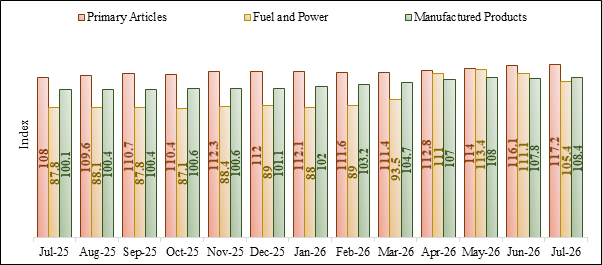
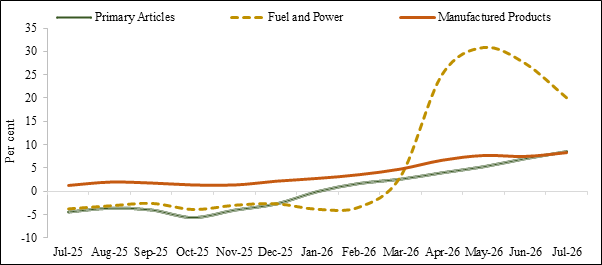
  2. YoY inflation rates for major groups, namely, Primary Articles, Fuel and Power, and Manufactured Products are 8.52 per cent, 20.05 per cent, and 8.29 per cent, respectively in July 2026, compared to 7.0 per cent, 27.41 per cent, and 7.48 per cent, respectively in June 2026. The indices for Primary Articles, Fuel and Power, and Manufactured Products are 117.2, 105.4, and 108.4, respectively, in July 2026, whereas they were 116.1, 111.1, and 107.8, respectively, in June 2026.
  3. Across groups, ‘Mineral Oils (containing Petroleum Products)’, ‘Food Articles’, ‘Manufacture of Basic Metals’, ‘Non-Food Articles’, ‘Manufacture of Food Products’, and ‘Manufacture of Chemicals and Chemical Products’ have been major drivers of WPI inflation in July 2026.
  4. WPI Food Index (weight=24.99 per cent): The Food Index consists of ‘Food Articles’ from Primary Articles major group, and ‘Manufacture of Food Products’ from Manufactured Products major group. It observed a YoY inflation of 6.65 per cent in July 2026, compared to 6.14 per cent in June 2026.
  5. Monthly indices and Inflation Rate (in per cent) for All commodities and Major Groups, along with major group-wise contribution for the past months are presented in the charts below.

Chart 1: WPI Index and Inflation Rate for All Commodities

1

Chart 2: WPI Index of Major Groups

2

Chart 3: Inflation Rate across Major Groups

3

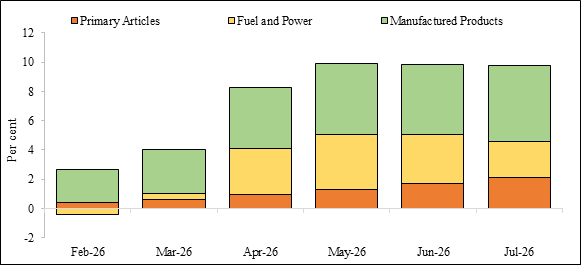
Chart 4: Major Group-Wise contribution to Inflation

4
  1. The final index for the month of May 2026 has been revised from 109.9 (Provisional estimate) to 110.1. Accordingly, WPI inflation has been revised from 9.68 per cent, as per provisional estimate to 9.88 per cent as per the final estimate.
  2. The Final Estimate of WPI (Base Year 2022-23) for the month of May 2026 has been compiled with a weighted response rate of 98.14 per cent.
  3. The Provisional Estimate of WPI (Base Year 2022-23) for the month of July 2026 has been compiled with a weighted response rate of 78.55 per cent.
  4. Wholesale Price Index and Year-on-Year (YoY) Inflation Rate for All Commodities, Major Groups, and Groups for the last six months is given at Annexure-I and II respectively.
  5. Cumulative WPI for All Commodities, Major Groups, and Groups from April to July for FY 2023-24, FY 2024-25, FY 2025-26, and FY 2026-27 is given at Annexure-III.
  6. Cumulative YoY Inflation Rate for All Commodities, Major Groups, and Groups from April to July for FY 2024-25, FY 2025-26, and FY 2026-27 is given at Annexure- IV.
  7. Item-wise data pertaining to WPI (Base Year 2022-23) series from April 2023 to July 2026 is available at (https://eaindustry.nic.in/download_data_2223.asp).
  8. Provisional indices of WPI, OPPI, and trial IPPI for a reference month are released on the 14th of the following month (if it is a working day, else on next working day). Accordingly, release of WPI, Output PPI, and trial Input PPI for the month of August 2026 will be on Monday, 14th September 2026.

      Annexure-I

 WPI for All Commodities, Major Groups and Groups for last six months

Groups/Major GroupsCommodity WeightFeb-26
(F)
Mar-26
(F)
Apr-26
(F)
May-26
(F)
Jun-26
(P)
Jul-26
(P)
ALL COMMODITIES100.00000103.1104.6108.9110.1110.2110
I. PRIMARY ARTICLES22.75730111.6111.4112.8114116.1117.2
(A). Food Articles15.97835113.1112.8114.2115.1117.3118.2
(B). Non-Food Articles5.52841107.3107.4107.6109.1110.4112.6
(C). Minerals1.25054112110.8118.8121125.1125.4
II. FUEL AND POWER14.1143389.093.5111.0113.4111.1105.4
(A). Coal and Lignite0.7413686.587.887.786.687.988.4
(B). Mineral Oils8.1920885.892.9121.6125.7122.9113.2
(C). Electricity4.4634994.791.290.891.591.992.4
(D). Crude Petroleum & Natural Gas0.7174092.4119.7138.8136.8120.2114.8
III. MANUFACTURED PRODUCTS63.12837103.2104.7107.0108.0107.8108.4
(A). Manufacture of Food Products9.02016108109.1111112.4113.1115.1
(B). Manufacture of Beverages0.90483102.6102.7104.4104.9105.4105.1
(C). Manufacture of Tobacco Products0.27645122.7122.6122.5122.8124.3124.7
(D). Manufacture of Textiles4.0899394.496.499.1102.1102.2104
(E). Manufacture of Wearing Apparel1.32948109.8109.9111111.6111.9111.6
(F). Manufacture of Leather and Related Products0.54137104.9105.5107.3108.4108.6109.4
(G). Manufacture Of Wood and Products of Wood and Cork, except Furniture; Manufacture of Articles of Straw and Plaiting Materials1.07718110112.1115.2115116.9116.3
(H). Manufacture of Paper and Paper Products1.1532890.691.493.794.193.894.2
(I). Printing and Reproduction of Recorded Media0.42618105.1105.8107108.1107108.5
(J). Manufacture of Chemicals and Chemical Products6.1256791.896.5102.6103.6102.4102.6
(K). Manufacture of Basic Pharmaceutical Products and Pharmaceutical Preparations 2.2010299.6100.8102.3102.9102.2103.6
(L). Manufacture of Rubber and Plastic Products2.7146796.3101.9106106.3106.2106.3
(M). Manufacture of Other Non-Metallic Mineral Products2.8407496.196.89999.299.699.9
(N). Manufacture of Basic Metals8.4113398100.1103.5104.9103.1102.2
(O). Manufacture of Fabricated Metal Products, except Machinery and Equipment4.13294102102.7104.4105.9105.7106.6
(P). Manufacture of Computer, Electronic and Optical Products2.07628101.5102101.7102.7102.7104.1
(Q). Manufacture of Electrical Equipment2.64318110.2111112.7114.2114.8116.5
(R). Manufacture of Machinery and Equipment n.e.c.3.46796104.3104.3105.1105.3105.4106
(S). Manufacture of Motor Vehicles, Trailers and Semi-Trailers5.43645106.4105.9106.7107107.1107.5
(T). Manufacture of Other Transport Equipment1.39511105.2105.4106106.4106.5107.7
(U). Manufacture of Furniture0.82618102.6102.8105.6105.6106.4105.5
(V). Other Manufacturing2.03798156.4158.8157158.2156.6157
FOOD INDEX24.99851111.3111.5113114.1115.8117.1

 (P)-Provisional, (F)-Final

  Annexure-II

      WPI Inflation Rate (YoY) for All Commodities, Major Groups, and Groups for last six months

Groups/Major GroupsCommodity WeightFeb-26
(F)
Mar-26
(F)
Apr-26
(F)
May-26
(F)
Jun-26
(P)
Jul-26
(P)
ALL COMMODITIES100.000002.183.988.369.889.879.78
I. PRIMARY ARTICLES22.757301.642.583.965.2678.52
(A). Food Articles15.978350.81.532.613.695.495.44
(B). Non-Food Articles5.528414.686.657.610.211.0717.66
(C). Minerals1.250541.360.0986.059.4513.28
II. FUEL AND POWER14.11433-3.373.2025.0030.8027.4120.05
(A). Coal and Lignite0.74136-2.37-0.79-1.57-2.26-1.57-0.56
(B). Mineral Oils8.19208-4.354.2640.7449.8246.4832.4
(C). Electricity4.46349-1.56-2.04-2.58-0.54-0.761.09
(D). Crude Petroleum & Natural Gas0.71740-5.3326.1356.3161.5134.7526.99
III. MANUFACTURED PRODUCTS63.128373.614.806.687.687.488.29
(A). Manufacture of Food Products9.020162.082.544.726.247.28.89
(B). Manufacture of Beverages0.90483-0.68-0.680.381.251.440.96
(C). Manufacture of Tobacco Products0.2764512.5711.8612.0812.7614.1413.36
(D). Manufacture of Textiles4.089931.944.97.2510.9810.8512.8
(E). Manufacture of Wearing Apparel1.329483.392.93.063.722.573.33
(F). Manufacture of Leather and Related Products0.541372.643.233.874.233.634.59
(G). Manufacture Of Wood and Products of Wood and Cork, except Furniture; Manufacture of Articles of Straw and Plaiting Materials1.0771835.068.076.589.057.78
(H). Manufacture of Paper and Paper Products1.15328-0.660.112.182.953.193.18
(I). Printing and Reproduction of Recorded Media0.426181.552.123.083.942.493.73
(J). Manufacture of Chemicals and Chemical Products6.125670.225.71314.7312.7813.12
(K). Manufacture of Basic Pharmaceutical Products and Pharmaceutical Preparations 2.201020.31.12.613.942.824.75
(L). Manufacture of Rubber and Plastic Products2.71467-0.725.3810.0710.849.9410.38
(M). Manufacture of Other Non-Metallic Mineral Products2.84074-0.93-0.11.751.331.842.67
(N). Manufacture of Basic Metals8.411337.348.5710.713.1612.3112.56
(O). Manufacture of Fabricated Metal Products, except Machinery and Equipment4.132942.823.425.036.336.127.24
(P). Manufacture of Computer, Electronic and Optical Products2.076280.89-0.58-1.17-0.87-1.53-0.95
(Q). Manufacture of Electrical Equipment2.643187.627.989.2111.4111.0312.34
(R). Manufacture of Machinery and Equipment n.e.c.3.467961.261.071.842.232.132.61
(S). Manufacture of Motor Vehicles, Trailers and Semi-Trailers5.436451.820.950.850.751.711.8
(T). Manufacture of Other Transport Equipment1.395111.741.933.214.1144.46
(U). Manufacture of Furniture0.82618-0.10.193.835.185.034.04
(V). Other Manufacturing2.0379831.5432.8926.2121.4120.5522.46
FOOD INDEX24.998511.271.923.294.586.146.65

 (P)-Provisional, (F)-Final

Annexure-III

 Cumulative WPI for All Commodities, Major Groups, and Groups

Groups/Major GroupsCommodity WeightApr-JulFY 2023-24Apr-JulFY 2024-25Apr-JulFY 2025-26Apr-Jul FY 2026-27
ALL COMMODITIES100.0000098.8100.5100.3109.8
I. PRIMARY ARTICLES22.75730103.9111108.3115
(A). Food Articles15.97835105.8115.2111.4116.2
(B). Non-Food Articles5.52841999898.5109.9
(C). Minerals1.25054101.1114.2112.3122.6
II. FUEL AND POWER14.1143391.691.287.6110.2
(A). Coal and Lignite0.7413692.189.58987.7
(B). Mineral Oils8.1920889.489.984.9120.9
(C). Electricity4.4634995.392.392.391.7
(D). Crude Petroleum & Natural Gas0.7174094.2101.788.3127.7
III. MANUFACTURED PRODUCTS63.1283798.598.8100.3107.8
(A). Manufacture of Food Products9.0201698.3100.6105.8112.9
(B). Manufacture of Beverages0.90483102.4103.8103.9105
(C). Manufacture of Tobacco Products0.27645104.1106.8109.3123.6
(D). Manufacture of Textiles4.0899393.192.692.2101.9
(E). Manufacture of Wearing Apparel1.32948102.4104.4108.1111.5
(F). Manufacture of Leather and Related Products0.54137101.5101.6104.2108.4
(G). Manufacture Of Wood and Products of Wood and Cork, except Furniture; Manufacture of Articles of Straw and Plaiting Materials1.07718102103.2107.4115.9
(H). Manufacture of Paper and Paper Products1.1532891.589.491.394
(I). Printing and Reproduction of Recorded Media0.42618103.2104.3104.2107.7
(J). Manufacture of Chemicals and Chemical Products6.1256793.491.390.7102.8
(K). Manufacture of Basic Pharmaceutical Products and Pharmaceutical Preparations 2.2010210199.699.3102.8
(L). Manufacture of Rubber and Plastic Products2.7146795.795.996.3106.2
(M). Manufacture of Other Non-Metallic Mineral Products2.8407499.296.197.699.4
(N). Manufacture of Basic Metals8.4113395.694.392.2103.4
(O). Manufacture of Fabricated Metal Products, except Machinery and Equipment4.13294100.3100.199.5105.7
(P). Manufacture of Computer, Electronic and Optical Products2.0762898.697104102.8
(Q). Manufacture of Electrical Equipment2.64318100.9102103.2114.6
(R). Manufacture of Machinery and Equipment n.e.c.3.46796102102.2103.2105.5
(S). Manufacture of Motor Vehicles, Trailers and Semi-Trailers5.43645103.4106.3105.7107.1
(T). Manufacture of Other Transport Equipment1.39511101.2101.2102.6106.7
(U). Manufacture of Furniture0.82618101.6101.6101.2105.8
(V). Other Manufacturing2.03798104.5112.3128.2157.2
FOOD INDEX24.99851103.1109.9109.4115

Note: Cumulative Index has been calculated by taking Arithmetic Mean of 4 months indices

Annexure-IV

 Cumulative WPI Inflation Rate (YoY) for All Commodities, Major Groups, and Groups

Groups/Major GroupsCommodity WeightApr-JulFY 2024-25Apr-JulFY 2025-26Apr-Jul FY 2026-27
ALL COMMODITIES100.000001.72-0.29.47
I. PRIMARY ARTICLES22.757306.83-2.436.19
(A). Food Articles15.978358.88-3.34.31
(B). Non-Food Articles5.52841-1.010.5111.57
(C). Minerals1.2505412.96-1.669.17
II. FUEL AND POWER14.11433-0.44-3.9525.8
(A). Coal and Lignite0.74136-2.82-0.56-1.46
(B). Mineral Oils8.192080.56-5.5642.4
(C). Electricity4.46349-3.150-0.65
(D). Crude Petroleum & Natural Gas0.717407.96-13.1844.62
III. MANUFACTURED PRODUCTS63.128370.31.527.48
(A). Manufacture of Food Products9.020162.345.176.71
(B). Manufacture of Beverages0.904831.370.11.06
(C). Manufacture of Tobacco Products0.276452.592.3413.08
(D). Manufacture of Textiles4.08993-0.54-0.4310.52
(E). Manufacture of Wearing Apparel1.329481.953.543.15
(F). Manufacture of Leather and Related Products0.541370.12.564.03
(G). Manufacture Of Wood and Products of Wood and Cork, except Furniture; Manufacture of Articles of Straw and Plaiting Materials1.077181.184.077.91
(H). Manufacture of Paper and Paper Products1.15328-2.32.132.96
(I). Printing and Reproduction of Recorded Media0.426181.07-0.13.36
(J). Manufacture of Chemicals and Chemical Products6.12567-2.25-0.6613.34
(K). Manufacture of Basic Pharmaceutical Products and Pharmaceutical Preparations 2.20102-1.39-0.33.52
(L). Manufacture of Rubber and Plastic Products2.714670.210.4210.28
(M). Manufacture of Other Non-Metallic Mineral Products2.84074-3.131.561.84
(N). Manufacture of Basic Metals8.41133-1.36-2.2312.15
(O). Manufacture of Fabricated Metal Products, except Machinery and Equipment4.13294-0.2-0.66.23
(P). Manufacture of Computer, Electronic and Optical Products2.07628-1.627.22-1.15
(Q). Manufacture of Electrical Equipment2.643181.091.1811.05
(R). Manufacture of Machinery and Equipment n.e.c.3.467960.20.982.23
(S). Manufacture of Motor Vehicles, Trailers and Semi-Trailers5.436452.8-0.561.32
(T). Manufacture of Other Transport Equipment1.3951101.384
(U). Manufacture of Furniture0.826180-0.394.55
(V). Other Manufacturing2.037987.4614.1622.62
FOOD INDEX24.998516.6-0.455.12

Provisional Estimates of Output Producer Price Index (Base Year 2022-23) for the month of July 2026

  1. Key highlights of Output PPI (Base Year 2022-23) for July 2026
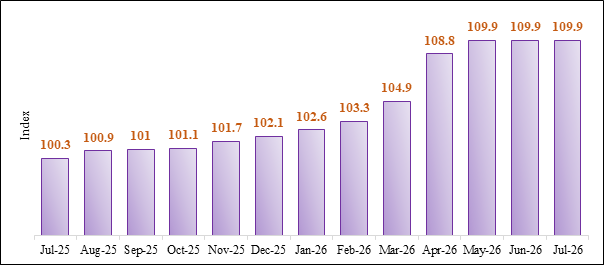
  1. All India Output PPI for All Commodities for July 2026 stands at 109.9, same as it was in June 2026.
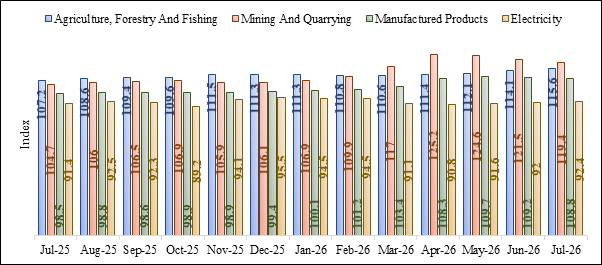
  2. Output PPIs for Agriculture, Forestry and Fishing; Mining and Quarrying; Manufactured Products; and Electricity are 115.6, 119.4, 108.8, and 92.4, respectively, in July 2026, whereas those were 114.1, 121.5, 109.2, and 92.0, respectively, in June 2026.
  3. Monthly indices for All Commodities and Major Groups, for the past 13 months are presented in the charts below.

Chart 5: Output PPI for All Commodities

5

Chart 6: Output PPI across Major Groups

6
  1. The final index of Output PPI for the month of May 2026 has been revised from 109.6 (Provisional estimate) to 109.9.
  2. Output PPI for All Commodities, Major Groups, and Groups for the last six months is given at Annexure-V.
  3. Cumulative Output PPI for All Commodities, Major Groups, and Groups from April to July for FY 2023-24, FY 2024-25, FY 2025-26, and FY 2026-27 is given at Annexure-VI.
  4. SUT category-wise index pertaining to Output PPI (Base Year 2022-23) series from April 2023 to July 2026 is available at (https://eaindustry.nic.in/download_data_2223.asp).

Annexure-V

Output PPI for All Commodities, Major Groups and Groups for last six months

Groups/Major GroupsWeightFeb-26
(F)
Mar-26
(F)
Apr-26
(F)
May-26
(F)
Jun-26
(P)
Jul-26
(P)
ALL COMMODITIES100103.3104.9108.8109.9109.9109.9
AGRICULTURE, FORESTRY AND FISHING22.15648110.8110.6111.4112.1114.1115.6
Crop and Animal Production, Hunting and Related Service Activities 19.03219111.3111.0111.5111.9114.3116.1
Forestry and Logging1.67481115.0115.4116.7118.8118.0119.9
Fishing and Aquaculture1.4494899.3100.1103.2106.9106.6103.7
MINING AND QUARRYING3.42065109.9117.0125.2124.6121.5119.4
Mining of Metal Ores0.70792168.0171.5174.7180.1178.7177.7
Mining of Coal and Lignite0.739886.587.887.786.687.988.4
Other Mining and Quarrying1.23208103.2100.5109.9108.5113.1110.9
Extraction of Crude Petroleum and Natural Gas0.7408588.9121.7141.0136.2114.2108.9
MANUFACTURED PRODUCTS69.93568101.2103.4108.3109.7109.2108.8
(A). Manufacture of Food Products8.47196108.3109.2111.0112.5113.2115.5
(B). Manufacture of Beverages0.8417102.7102.8104.6105.0105.5105.2
(C). Manufacture of Tobacco Products0.25705125.9125.9125.4125.6127.4128.2
(D). Manufacture of Textiles4.3877495.097.8100.9103.9104.3105.7
(E). Manufacture of Wearing Apparel1.20494108.7108.7109.9110.8110.8110.9
(F). Manufacture of Leather and Related Products0.49989103.6104.2105.9107.1107.3108.1
(G). Manufacture of Wood and Products of Wood and Cork, except Furniture; Manufacture of Articles of Straw and Plaiting Materials1.08949108.3110.3113.3113.2114.8114.1
(H). Manufacture of Paper and Paper Products1.0312890.791.693.994.594.194.5
(I). Printing and Reproduction of Recorded Media0.30931106.1107.1109.3109.5109.6110.1
(J). Manufacture of Coke and Refined Petroleum Products7.1481885.792.7121.1125.2122.3112.7
(K). Manufacture of Chemicals and Chemical Products5.7479392.297.3103.3104.1103.0102.9
(L). Manufacture of Basic Pharmaceuticals, Medicinal Chemical and Botanical Products1.92807100.6101.8103.2103.6103.0104.5
(M). Manufacture of Rubber and Plastic Products2.5725296.9102.5106.7107.0106.8107.0
(N). Manufacture of Other Non-Metallic Mineral Products2.5043795.896.499.099.199.599.9
(O). Manufacture of Basic Metals7.46596.699.0102.7104.3102.7102.1
(P). Manufacture of Fabricated Metal Products, except Machinery and Equipment3.15198100.4101.1102.3103.3104.0104.0
(Q). Manufacture of Computer, Electronic and Optical Products1.7748104.6104.6104.3104.9104.7105.3
(R). Manufacture of Electrical Equipment3.81453104.0104.4105.7107.2107.9108.9
(S). Manufacture of Machinery and Equipment n.e.c.2.46158104.7104.8105.7105.7105.6106.2
(T). Manufacture of Motor Vehicles, Trailers and Semi-Trailers4.39321106.9106.6107.4107.2107.6107.8
(U). Manufacture of Other Transport Equipment1.34392106.1106.4107.2107.6107.6108.9
(V). Manufacture of Furniture0.73566103.2103.7105.3104.9105.4104.7
(W). Other Manufacturing6.80057118.3119.9120.9122.2121.0122.1
ELECTRICITY4.4871994.591.190.891.692.092.4
Electricity4.4871994.591.190.891.692.092.4

  (P)-Provisional, (F)-Final

Annexure-VI

Cumulative Output PPI for All Commodities, Major Groups and Groups

ALL COMMODITIES10098.8100.3100.3109.6
AGRICULTURE, FORESTRY AND FISHING22.15648103.9109.3107.2113.3
Crop and Animal Production, Hunting and Related Service Activities 19.03219104109.6107.3113.5
Forestry and Logging1.67481102.5113111.6118.4
Fishing and Aquaculture1.44948104.9100.9101.3105.1
MINING AND QUARRYING3.4206597.6106.1103.8122.7
Mining of Metal Ores0.70792105.6126.1140.7177.8
Mining of Coal and Lignite0.739892.189.58987.7
Other Mining and Quarrying1.23208100.9109.2103.9110.6
Extraction of Crude Petroleum and Natural Gas0.7408590.198.483.4125.1
MANUFACTURED PRODUCTS69.9356897.497.698.5109
(A). Manufacture of Food Products8.4719697.299.8105.7113.1
(B). Manufacture of Beverages0.8417102.5104104.1105.1
(C). Manufacture of Tobacco Products0.25705104106.8109.5126.7
(D). Manufacture of Textiles4.3877493.29392.4103.7
(E). Manufacture of Wearing Apparel1.20494102103.5107.3110.6
(F). Manufacture of Leather and Related Products0.49989101.1100.6102.7107.1
(G). Manufacture of Wood and Products of Wood and Cork, except Furniture; Manufacture of Articles of Straw and Plaiting Materials1.08949101.9102.8106.4113.9
(H). Manufacture of Paper and Paper Products1.0312891.589.591.594.3
(I). Printing and Reproduction of Recorded Media0.30931103.9104.8105.4109.6
(J). Manufacture of Coke and Refined Petroleum Products7.1481889.489.884.9120.3
(K). Manufacture of Chemicals and Chemical Products5.7479393.591.591.1103.3
(L). Manufacture of Basic Pharmaceuticals, Medicinal Chemical and Botanical Products1.92807101.899.399.6103.6
(M). Manufacture of Rubber and Plastic Products2.5725295.89696.4106.9
(N). Manufacture of Other Non-Metallic Mineral Products2.504379995.89799.4
(O). Manufacture of Basic Metals7.46595.594.291.6103
(P). Manufacture of Fabricated Metal Products, except Machinery and Equipment3.1519899.299.598.4103.4
(Q). Manufacture of Computer, Electronic and Optical Products1.774898.596.3107.7104.8
(R). Manufacture of Electrical Equipment3.8145399.899.5100.7107.4
(S). Manufacture of Machinery and Equipment n.e.c.2.46158102102.7103.3105.8
(T). Manufacture of Motor Vehicles, Trailers and Semi-Trailers4.39321103.7106.5106107.5
(U). Manufacture of Other Transport Equipment1.34392101.5101.6103.6107.8
(V). Manufacture of Furniture0.73566101.6101.4101.6105.1
(W). Other Manufacturing6.80057101.6103108121.6
ELECTRICITY4.4871995.392.392.391.7
Electricity4.4871995.392.392.391.7

Note: Cumulative Index has been calculated by taking Arithmetic Mean of 4 months indices

Provisional Estimates of Trial Input Producer Price Index (IPPI) (Base Year 2022-23) for the month of July 2026

  1. All India trial Input PPI[1] for Manufacturing Sector for July 2026 stands at 105.9 (Provisional estimate).
  2. Trial Input PPI for Manufacturing Sector for the month of May 2026 has been revised from 104.9 (provisional estimate) to 106.5 (final index).
  3. Trial Input PPI for all Manufacturing Industries at NIC-2-digit, from March to July 2026 is given below.

Trial Input PPI for all Manufacturing Industries at NIC-2-digit

Manufacturing Sector100.000000100.9104.2106.5107.1105.9
(A). Manufacture of Food Products14.84638107.1108.3110.5112.2113.8
(B). Manufacture of Beverages1.03035106104.5105.4105.5107.4
(C). Manufacture of Tobacco Products0.26443128124.7122.5123.4130.8
(D). Manufacture of Textiles5.8891895.5100.8103.4107.8103.9
(E). Manufacture of Wearing Apparel1.57012105.6106.6107.4109.6108.1
(F). Manufacture of Leather and Related Products0.7763496.39697.99698.5
(G). Manufacture of Wood and Products of Wood and Cork, Except Furniture; Manufacture of Articles of Straw and Plaiting Materials1.8219499.7110.8113.4112.3112
(H). Manufacture of Paper and Paper Products0.8749495.196.897.29798
(I). Printing and Reproduction of Recorded Media0.4660696.498.398.998.598.4
(J). Manufacture of Coke and Refined Petroleum Products12.329198.2105.2111.8113.599.9
(K). Manufacture of Chemicals and Chemical Products7.98919100.9107.9110.5112.5109.4
(L). Manufacture of Basic Pharmaceutical Products and Pharmaceutical Preparations 2.4046398.2103.5105.3105.6104.3
(M). Manufacture of Rubber and Plastic Products3.40235105.9109.8111.1112.1111.6
(N). Manufacture of Other Non-Metallic Mineral Products3.2830692.396.498.492.693.3
(O). Manufacture of Basic Metals11.2522998.3100.6102.299.2101.5
(P). Manufacture of Fabricated Metal Products, except Machinery and Equipment5.5923999.7102.2104.7105.4105.8
(Q). Manufacture of Computer, Electronic and Optical Products2.22964108108.2107111.5108.5
(R). Manufacture of Electrical Equipment3.64437111.5113.4116.2117.7117.2
(S). Manufacture of Machinery and Equipment n.e.c.5.07784102.2105105.4105.3106.4
(T). Manufacture of Motor Vehicles, Trailers and Semi-Trailers, and Manufacture of Other Transport Equipment10.49446101.5102.8103.7104.9105.1
(U). Manufacture of Furniture0.9835397.6101.1100.798.6101.5
(V). Other Manufacturing3.7774188.988.489.58899.3

July 2026 Trade Analysis: India’s Export and Import Trends

India’s total exports (Merchandise and Services combined) for July 2026* is estimated at US$ 80.14 Billion, registering a positive growth of 13.31 percent vis-à-vis July 2025. Total imports (Merchandise and Services combined) for July 2026* is estimated at US$ 95.16 Billion, registering a positive growth of 15.83 percent vis-à-vis July 2025.

Table 1: Trade during July 2026*

  July 2026(US$ Billion)July 2025(US$ Billion)
MerchandiseExports44.2436.98
Imports76.2264.86
Services*Exports35.8933.74
Imports18.9417.30
Total Trade(Merchandise +Services) *Exports80.1470.72
Imports95.1682.16
Trade Balance-15.03-11.43

* Note: The latest data for services sector released by RBI is for June 2026. The data for July 2026 is an estimation. (ii) Data for April-July 2025-26 has been revised on pro-rata basis using quarterly balance of payments data.

Fig 1: Total Trade during July 2026*

India’s total exports during April-July 2026-27* is estimated at US$ 316.42 Billion registering a positive growth of 13.16 percent. Total imports during April-July 2026-27* is estimated at US$ 365.85 Billion registering a growth of 17.28 percent.

Table 2: Trade during April-July 2026-27*

  April-July 2026-27(US$ Billion)April-July 2025-26(US$ Billion)
MerchandiseExports173.78148.48
Imports292.38245.14
Services*Exports142.64131.15
Imports73.4766.81
Total Trade(Merchandise +Services) *Exports316.42279.63
Imports365.85311.94
Trade Balance-49.43-32.32

Fig 2: Total Trade during April-July 2026-27* 

MERCHANDISE TRADE

  • Merchandise exports during July 2026 were US$ 44.24 Billion as compared to US$ 36.98 Billion in July 2025.
  • Merchandise imports during July 2026 were US$ 76.22 Billion as compared to US$ 64.86 Billion in July 2025.

Fig 3: Merchandise Trade during July 2026

  • Merchandise exports during April-July 2026-27 were US$ 173.78 Billion as compared to US$ 148.48 Billion during April-July 2025-26.
  • Merchandise imports during April-July 2026-27 were US$ 292.38 Billion as compared to US$ 245.14 Billion during April-July 2025-26.
  • Merchandise trade deficit during April-July 2026-27 was US$ 118.60 Billion as compared to US$ 96.66 Billion during April-July 2025-26.

Fig 4: Merchandise Trade during April-July 2026-27

  • Non-petroleum and non-gems & jewellery exports in July 2026 were US$ 35.00 Billion compared to US$ 30.47 Billion in July 2025.
  • Non-petroleum, non-gems & jewellery (gold, silver & precious metals) imports in July 2026 were US$ 51.82 Billion compared to US$ 43.07 Billion in July 2025.

Table 3: Trade excluding Petroleum and Gems & Jewellery during July 2026

 July 2026(US$ Billion)July 2025 (US$ Billion)
Non- petroleum exports37.3232.86
Non- petroleum imports57.9149.30
Non-petroleum & Non-Gems & Jewellery exports35.0030.47
Non-petroleum & Non-Gems & Jewellery imports51.8243.07

Note: Gems & Jewellery Imports include Gold, Silver & Pearls, precious & Semi-precious stones

Fig 5: Trade excluding Petroleum and Gems & Jewellery during July 2026

  • Non-petroleum and non-gems & jewellery exports in April-July 2026-27 were US$ 134.02 Billion, compared to US$ 118.27 Billion in April-July 2025-26.
  • Non-petroleum, non-gems & jewellery (gold, silver & precious metals) imports in April-July 2026-27 were US$ 192.03 Billion, compared to US$ 160.95 Billion in April-July 2025-26.

Table 4: Trade excluding Petroleum and Gems & Jewellery during April-July 2026-27

 April-July 2026-27(US$ Billion)April-July 2025-26(US$ Billion)
Non- petroleum exports143.61127.32
Non- petroleum imports213.46180.33
Non-petroleum & Non Gems & Jewellery exports134.02118.27
Non-petroleum & Non Gems & Jewellery imports192.03160.95

Note: Gems & Jewellery Imports include Gold, Silver & Pearls, precious & Semi-precious stones

Fig 6: Trade excluding Petroleum and Gems & Jewellery during April-July 2026-27

SERVICES TRADE

  • The estimated value of services export for July 2026* is US$ 35.89 Billion as compared to US$ 33.74 Billion in July 2025.
  • The estimated value of services imports for July 2026* is US$ 18.94 Billion as compared to US$ 17.30 Billion in July 2025.

Fig 7: Services Trade during July 2026*

  • The estimated value of service exports during April-July 2026-27* is US$ 142.64 Billion as compared to US$ 131.15 Billion in April-July 2025-26.
  • The estimated value of service imports during April-July 2026-27* is US$ 73.47 Billion as compared to US$ 66.81 Billion in April-July 2025-26.
  • The services trade surplus for April-July 2026-27* is US$ 69.17 Billion as compared to US$ 64.35 Billion in April-July 2025-26.

Fig 8: Services Trade during April-July 2026-27*

  • Exports of  Iron Ore (78.35%), Petroleum Products (67.64%), Electronic Goods (57.4%), Meat, Dairy & Poultry Products (40.84%), Cashew (25.11%), Marine Products (17.83%), Engineering Goods (17.71%), Handicrafts Excl. Hand Made Carpet (15.55%), Organic & Inorganic Chemicals (14.39%), Plastic & Linoleum (11.01%), Cereal Preparations & Miscellaneous Processed Items (9.51%), Cotton Yarn/Fabs./Made-Ups, Handloom Products Etc. (8.4%), Mica, Coal & Other Ores, Minerals Including Processed Minerals (5.79%), Drugs & Pharmaceuticals (0.74%), and Man-Made Yarn/Fabs./Made-Ups Etc. (0.45%) recorded positive growth during July 2026 over the corresponding month of last year.
  • Imports of Silver (-66.1%), Sulphur & Unroasted Iron Pyrts (-47%), Newsprint (-26.31%), Pulp And Waste Paper (-22.61%), Medcnl. & Pharmaceutical Products (-3.96%), Wood &  Wood Products (-2.1%), and Iron & Steel (-1.84%) recorded negative growth during July 2026 over the corresponding month of last year.
  • Services exports is estimated to grow by 6.38 percent during April-July 2026-27* over April-July 2025-26.
  • Top 5 export destinations, in terms of change in value, exhibiting positive growth in July 2026 vis a vis July 2025 are U S A (12.85%), China P Rp (64.57%), Singapore (83.7%), Kenya (151.41%), and Malaysia (73.03%).
  • Top 5 export destinations, in terms of change in value, exhibiting positive growth in April-July 2026-27 vis a vis April-July 2025-26 are Singapore (97.11%), China P Rp (35.97%), Tanzania Rep (131.2%), South Africa (69.75%), and Sri Lanka Dsr (111.76%).
  • Top 5 import sources, in terms of change in value, exhibiting growth in July 2026 vis a vis July 2025 are Russia (83.85%), China P Rp (34.42%), Oman (150.36%), Taiwan (111.3%), and U S A (18.11%)
  • Top 5 import sources, in terms of change in value, exhibiting growth in April-July 2026-27 vis a vis April-July 2025-26 are Russia (59.65%), China P Rp (29.68%), Oman (200.68%), U S A (22.42%), and Brazil (166.84%).

District Legal Service Authority Notification for Tax Year 2026-27

MINISTRY OF FINANCE

(Department of Revenue)

(CENTRAL BOARD OF DIRECT TAXES)

NOTIFICATION

S.O. 4459(E).— In exercise of the powers conferred by Schedule III [Table: Sl. No. 36] read with section 11 of the Income-tax Act, 2025 (30 of 2025), (hereinafter referred to as the said Act), the Central Government hereby notifies for the purposes of the said clause, ‘District Legal Service Authority, Panchkula’ (PAN: AAAGC0054R), an Authority constituted by the ‘Legal Services Authorities Act, 1987’ (39 of 1987), in respect of the following specified income arising to the said body namely: –

(a) grants received from the Punjab and Haryana High Court, the Central Authority i.e. the National Legal Services Authority and the State Authority i.e., Haryana State Legal Services Authority for the purpose of the Legal Services Authorities Act, 1987(39 of 1987);

(b) grants or donation received from the Central Government or the State Government of Haryana for the purposes of the Legal Services Authorities Act, 1987(39 of 1987);

(c) amount received under the order of the Court;

(d) fees received as recruitment application fee; and

(e) interest earned on bank deposits.

2. This notification shall be effective subject to the conditions that ‘District Legal Service Authority, Panchkula’ (PAN: AAAGC0054R), –

(a) shall not engage in any commercial activity;

(b) shall file return of income in accordance with the provisions of section 263(9)(c)(xiii) of the said Act; and

(c) activities and the nature of the specified income shall remain unchanged throughout the tax year.

3. Failure to comply with the conditions specified in paragraph 2 shall result in withdrawal of exemption under Schedule III [Table: Sl. No. 36] read with section 11 and initiation of proceedings under the said Act.

4. This notification shall be applicable for the tax year 2026-27.

[Notification No. 113/2026/F. No. 300196/6/2026-ITA-I]

Income Tax Exemption Notification for District Legal Service Authority

MINISTRY OF FINANCE

(Department of Revenue)

(CENTRAL BOARD OF DIRECT TAXES)

NOTIFICATION

New Delhi, the 11th August, 2026

S.O. 4458(E).—Whereas, section 10 (46) of the Income-tax Act, 1961 (43 of 1961) provided for exemption of specified income of certain bodies or authorities or Boards or Trusts or Commissions as may be notified by the Central Government in the Official Gazette for the purposes of that section;

And whereas, the Income-tax Act, 1961 (43 of 1961) was repealed by section 536 (1) of the Income-tax Act, 2025 (30 of 2025);

And whereas, section 536(2)(a) and (b) of the Income-tax Act, 2025 (30 of 2025), inter alia, provides that irrespective of the repeal of the Income-tax Act, 1961 (43 of 1961) (hereinafter referred to as the Act of 1961) and subject to sub-section (4) thereof, nothing shall affect—

(i) the previous operation of the provisions of the Act of 1961 and any order or anything duly done or suffered thereunder; or

(ii) any right, privilege, obligation or liability acquired, accrued or incurred under the Act of 1961 or orders under that Act;

And whereas, section 536(2)(c) of the Income-tax Act, 2025 (30 of 2025) provides that the provisions of the Act of 1961 shall continue to apply to any proceeding pending on the date of commencement of the Income-tax Act, 2025 (30 of 2025) and to any proceedings initiated on after the 1st April, 2026 (including notices, assessment, reassessment, recomputation, rectification, penalty, reference, revision and appeals) in respect of any tax year beginning before the 1st April, 2026 and such proceedings shall be carried out as per the procedure specified in the Act of 1961;

And whereas, section 536(2)(e) of the Income-tax Act, 2025 (30 of 2025) provides that any proceeding pending on the date of its commencement before any income-tax authority or any other authority constituted under the repealed Income-tax Act, Appellate Tribunal, or any court, by way of application, appeal, reference or revision or by any other means, shall be continued and disposed of as if this Act had not been enacted;

Now, therefore, in pursuance of the provisions of section 536(2)(a) to (c) and (e) of the Income-tax Act, 2025 (30 of 2025), the Central Government hereby notifies, for the purposes of section 10 (46) of the Act of 1961, ‘District Legal Service Authority, Panchkula (PAN: AAAGC0054R), an Authority constituted by the ‘Legal Services Authorities Act, 1987′(39 of 1987), in respect of the following specified income arising to the said body namely :-

grants received from the Punjab and Haryana High Court, the Central Authority i.e. the National Legal Services Authority and the State Authority i.e., Haryana State Legal Servies Authority for the purpose of the Legal Services Authorities Act, 1987(39 of 1987);

(a) grants or donation received from the Central Government or the State Government of Haryana for the purposes of the Legal Services Authorities Act, 1987(39 of 1987);

(b) amount received under the order of the Court;

(c) fees received as recruitment application fee; and

(d) interest earned on bank deposits.

2. This notification shall be effective subject to the conditions that the District Legal Service Authority, Panchkula –

(a) shall not engage in any commercial activity;

(b) its activities and the nature of the specified income shall remain unchanged throughout the financial years; and

(c) shall file return of income in accordance with the provisions of section 139(4C) (g) of the Act of 1961.

3. Failure to comply with these conditions shall result in the initiation of penal actions under the provisions of the Act of 1961, and withdrawal of exemption granted under section 10(46) of the Act of 1961.

4. This notification shall be deemed to have been applied for assessment years 2023-24, 2024-25, 2025-26 and 2026-27 relevant for the financial years 2022-23, 2023-24, 2024-25 and 2025-26.

Explanatory Memorandum

It is certified that the interests of no person are being adversely affected by giving retrospective effect [with effect from the year of application filed before the Board or Income-tax Department] to this notification.Uploaded by Dte. of Printing at Government of India Press, Ring Road, Mayapuri, New Delhi-110064 and Published by the Controller of Publications, Delhi-

PM GatiShakti: Transforming Infrastructure Planning in India

PM GatiShakti National Master Plan (PMGS NMP), launched in October 2021, is a transformative “Whole of Government” approach to bring together various Central Ministries/Departments and States/UTs to ensure integrated planning and coordinated execution of infrastructure projects. PMGS NMP aims to facilitate Ministries/States in data driven decision making by utilizing geospatial data, satellite imagery and API integration to monitor, plan, and optimize infrastructure development. The PMGS NMP is facilitating Ministries/States in planning of their respective infrastructure projects, including social infrastructure projects, in integrated, synchronized and coordinated manner to provide seamless and efficient connectivity for the movement of people, goods, and services across various modes of transport, thereby enhancing last-mile connectivity and reducing travel time.

PM GatiShakti provides an integrated planning framework; the approval and implementation of the projects are undertaken by the respective central Ministries/Departments and States/UTs under their plans, schemes, procedures and budgetary/funding provisions. Hence, no quantified targets or expenditure requirements have been set under PM GatiShakti initiative.

The Network Planning Group (NPG), constituted under the PM GatiShakti framework, evaluates the critical infrastructure projects of the central Government to ensure integrated planning, multimodality, inter-modality, synchronization of efforts, last mile connectivity, comprehensive development in and around the project location, data driven decision makings, etc at the planning stage. As on date, 396 infrastructure projects with total estimated cost of about ₹ 18.66 Lakh Crore have been evaluated through the NPG mechanism. Out of these 396 projects, 256 projects have been sanctioned – out of which, 198 projects are under implementation. Ministry-wise details are given at Annexure-A.

Government carries out assessment of its initiatives/schemes from time to time through various studies, surveys, etc. Apart from these, there are several studies by universities and research scholars in this respect. As per these assessments, the integrated planning initiatives like, PM GatiShakti, National Logistics Policy, PRAGATI, Sagarmala, development of connectivity infrastructure (expressways/ national highways/ dedicated rail freight corridors and rail tracks, industrial corridors/hubs), etc. have shaped the vision of connected and competitive India and have improved logistics efficiency, turn-around time, ease of doing business, industrial growth and reduced logistics cost in country. An assessment of logistic cost has been carried out by DPIIT in the year 2025 in collaboration with National Council of Applied Economic Research (NCAER). As per the assessment, the logistics cost in India is estimated at 7.9% of the GDP, which is at par with the advanced economies in the world. The Economic Survey 2023-24 highlighted that these measures have improved domestic manufacturing and export competitiveness. A study by Indian Institute of Management, Bangalore on impact of development of National Highway projects underlines that every-one rupee expenditure in National Highways development leads to a ₹3.2 increase in Gross Domestic Product (GDP).

So far 58 Central Ministries/Departments and all 36 States/UTs have been onboarded on the PMGS NMP, covering all infrastructure sectors like road, rail, ports & waterways, power, petroleum & natural gas, civil aviation, telecommunications, industrial corridors, etc. Further, PM GatiShakti public platform (url: ugi.pmgatishakti.gov.in) has been launched in September 2025, which provided access of PM GatiShakti data analytics to private entities and general public. Through this Query based mechanism, public and private entities are able to plan their projects by obtaining data analytic reports from the PMGS-NMP Portal through a simple query-based mechanism. The States have been encouraged to expand the use of PM GatiShakti for district level planning. About 1800 data layers have been integrated and over 65 software modules/tools and more than 100 mobile/web applications have been developed and integrated on the platform for the use of stakeholders. Further expansion of the PM GatiShakti initiative is a continuous process – mapping/integration of more data layers, development and integration of additional features, software modules/tools for planning and analysis modules/tools, mobile/ web applications, etc. to be continue further as per the requirements of the Ministries/Departments, States/UTs and other stakeholders.

This information was given by Minister of State for Ministry of Commerce and Industry, Shri Jitin Prasada in a written reply in Lok Sabha today.

Ministry-wise details of Projects evaluated through NPG Mechanism

Ministry/DepartmentNumber of ProjectsSanctionedYet to be SanctionedUnder ImplementationEstimated Cost (Rs. in Crore)
Ministry of Road Transport and Highways17110863539,01,668
Ministry of Railways162102601025,43,315
Ministry of Housing and Urban Affairs311714172,88,614
Ministry of Petroleum and Natural Gas4403#9,271
Ministry of Ports, Shipping and Waterways321249,759
Ministry of Civil Aviation642210,005
NICDC, Department for Promotion of Industry and Internal Trade121201228,693
Ministry of New and Renewable Energy0110120,774
Ministry  of   ElectronicsAnd               Information Technology011014,680
Ministry of Textiles05050059,760
Total39625614019818,66,539

PDUNASS Inaugurates Joint EPFO–ITC-ILO Training on Actuarial Practices in Social Security

The Pandit Deendayal Upadhyaya National Academy of Social Security (PDUNASS) inaugurated the residential phase of a specialized training programme titled “Actuarial Practices in Social Security: Strengthening Actuarial Governance at EPFO India” on 10th August in New Delhi.

Organized jointly by the Employees’ Provident Fund Organisation (EPFO) and the International Training Centre of the International Labour Organization (ITC-ILO), the three-day residential phase (10–12 August 2026) follows a comprehensive online module conducted via the ITC-ILO e-Campus from 25 May to 9 August 2026.

Welcoming the Chief Guest and the ILO/ITC-ILO delegation, Shri Kumar Rohit, Director, PDUNASS, noted that the initiative aligns with PDUNASS’s mandate as EPFO’s apex training institute to bring internationally benchmarked learning to its officers. Expressing gratitude for the strategic partnership, he remarked:”With the EPF, EPS, and EDLI schemes aligning with the Code on Social Security, 2020, strengthening in-house actuarial capacity is both timely and essential.”

Mr. Oktavianto Pasaribu, Deputy Director and Senior Advisor for Regional Partnership and Resource Mobilization, ILO, highlighted that the collaboration reflects the ILO’s commitment to strengthening social protection systems across South Asia. He emphasized that sound actuarial governance is central to the financial sustainability of social security institutions and commended EPFO’s proactive approach to building in-house capacity.

Presenting an overview of the curriculum, Mr. Charles Crevier, ITC-ILO Faculty, outlined the blended structure of the programme and the key residential themes, which include:

  • Actuarial valuation methods
  • Asset-Liability Management (ALM)
  • Global best governance practices in social security institutions

Delivering the keynote address and formally declaring the programme inaugurated, Shri Ramesh Krishnamurthi, Central Provident Fund Commissioner (CPFC), observed that as custodian of retirement savings, pensions, and insurance for crores of workers, every actuarial decision at EPFO impacts the financial security of millions. He urged officers to elevate actuarial work into a strategic governance function and foster an evidence-based culture across EPFO.”As EPFO continues to grow in size and responsibility, strengthening our actuarial capacity becomes increasingly important to strengthen governance and prepare better for future challenges.” Said Shri Ramesh Krishnamurthi, CPFC.

The inaugural session and residential phase were attended by senior leadership and operational officers, including:

  • Financial Adviser & Chief Accounts Officer (FA & CAO), ACCs, RPFC-Is, RPFC-IIs, SOs, and ASOs from EPFO
  • Representatives and officials from ESIC
  • Other prominent experts present included Mr. Amjad Rabi (ITC-ILO Faculty), Ms. Divya Verma (Senior Programme Officer, ILO), and Mr. Karun Gopinath (National Project Coordinator, ILO).

About PDUNASS

The Pandit Deendayal Upadhyaya National Academy of Social Security (PDUNASS) is the apex training and research institute of the Employees’ Provident Fund Organisation (EPFO), functioning under the Ministry of Labour & Employment, Government of India. Established in 1990, PDUNASS is dedicated to training, research, and consultancy in social security administration.

About ITC-ILO

The International Training Centre of the International Labour Organization (ITC-ILO), based in Turin, Italy, is the training arm of the ILO. It designs and delivers capacity-building programmes for ILO constituents worldwide—including governments, employers’ and workers’ organisations—in areas central to promoting decent work, social protection, and social security governance.

Essential TDS and TCS Rates for Individuals and Companies

TDS RATES

Commonly applicable TDS sections to Individual, HUF, LLP, Partnership Firms, Company

With cross-mapping of Section & codes under Old Act and New Act and also with

Threshold limits & Rates applicable for AY 2026-2027 (OLD Act) & TY 2026-2027 (New Act)A COMPILIATION BY CA HARSHIL SHETH

Section in
OLD
ACT 1961
Section in
NEW ACT
2025
Section
Code
in
NEW
ACT
Nature of PaymentApplicable toLimitRate
1923921002Salary Payment to employees other than Government employeesALLIf Taxable Income more than ₹ 4 lakhs [₹2.5 lakhs/ 3 lakhs / 5 lakhs (as the case may be) in case Employee has declared to opt old regime]
Note- considering Rebate u/s 87A
Slab rates as applicable
194H393(1)
[Table: Sl.
No. 1 (ii)]
1006Commission or brokerage (not being Insurance commission)COMPANY / LLP / FIRM and INDIVIDUAL/HUF having Turnover more than 1 Crore in case of Business or Gross receipts more than 50 lakhs in case of Profession in Previous FY₹ 20,0002%
194IB393(1)
Sl.No.2(i)
 Payment of rent by those Individual/ HUF who are not covered by 194I / 393(1) [Table: Sl. No. 2 (ii) ] ₹50,000 monthly rent2%
194I(a)393(1)
[Table: Sl.
No. 2
(ii).D(a)]
1008Rent for Plant, Machinery, equipmentCOMPANY / LLP / FIRM and INDIVIDUAL/HUF having Turnover more than 1 Crore in case of Business or Gross receipts more than 50 lakhs in case of Profession in Previous FY₹50,000 monthly rent2%
194I(b)393(1)
[Table: Sl.
No. 2
(ii).D(b)]
1009Rent for Land or building or Land appurtenant to Building or furniture or fittingCOMPANY / LLP / FIRM and INDIVIDUAL/HUF having Turnover more than 1 Crore in case of Business or Gross receipts more than 50 lakhs in case of Profession in Previous FY₹50,000 monthly rent10%
194IA393(1)
[Table: Sl.
No. 3(i)]
 Payment on transfer of certain immovable property other than Rural agricultural landIf Sales consideration or Stamp duty value (w.e. is higher) is higher than ₹ 50 lakhs, then each buyer needs to deduct TDS (even if their individual portion is lower than ₹ 50 lakhs )₹ 50 Lakhs1%
194K393(1)
[Table: Sl.
No. 4 (i)]
1013Dividend from Mutual Fund companyAll MF companies₹ 10,00010%
194A393(1)
[Table: Sl.
No. 5
(ii).D(a)]
1020Interest on Bank Deposit/Post Office Deposit/Banking Co-operative Society Deposit to senior CitizenBanks / Post-office/Banking Co-operative Society₹ 1,00,00010%
194A393(1)
[Table: Sl.
No. 5
(ii).D(b)]
1021Interest on Bank Deposit/Post Office Deposit/Banking Co-operative Society Deposit to Other than Senior CitizenBanks / Post-office/Banking Co-operative Society₹ 50,00010%
Section in OLD ACT 1961Section in NEW ACT 2025Section Code in NEW ACTNature of PaymentApplicable toLimitRate
194A393(1)
[Table: Sl. No. 5 (iii)]
1022Interest on Deposits/ Loans (Other than mentioned above)COMPANY / LLP / FIRM and
INDIVIDUAL/HUF having Turnover more than 1 Crore in case of Business or Gross receipts more than 50 lakhs in case of Profession in Previous FY
₹ 10,00010%
194C393(1)
[Table: Sl. No. 6 (i).D(a)]
1023Payment to contractor/sub-contractor:
a) HUF/ Individuals
COMPANY / LLP / FIRM and
INDIVIDUAL/HUF having Turnover more than 1 Crore in case of Business or Gross receipts more than 50 lakhs in case of Profession in Previous FY
Single Transaction: ₹ 30,000 & Aggregate of Transactions:₹ 1,00,0001%
194C393(1)
[Table: Sl. No. 6 (i).D(b)]
1024b) OthersCOMPANY / LLP / FIRM and
INDIVIDUAL/HUF having Turnover more than 1 Crore in case of Business or Gross receipts more than 50 lakhs in case of Profession in Previous FY
Single Transaction: ₹ 30,000 & Aggregate of Transactions:₹ 1,00,0002%
Examples of Contracts Are Job work / Repairing / Labour contract / Supply of labour / Advertisement / Ocean Freight / Shipping charges / Annual maintenance contract / Any Contract etc.
Note for Transporter – No TDS is required to deduct in case of Transporter involved in plying, hiring or leasing goods carriages, where such Transporter owns 10 or less goods carriages at any time during the previous year and furnishes a declaration
194M393(1)
[Table Sl. No. 6(ii)]
 (a) for carrying out any work (including supply of labour for carrying out any work) in pursuance of a contract;
or
(b) by way of fees for professional services; or
(c) by way of commission [not being insurance commission]
Individual or HUF (other than those required to deduct TDS in any other Sections in this table)₹ 50 lakhs2%
194J393(1)
[Table: Sl. No. 6 (iii).D(a)]
1026a. sum paid or payable towards fees for technical services or
c. fees paid to person for services for running a call centre
COMPANY / LLP / FIRM and
INDIVIDUAL/HUF having Turnover more than 1 Crore in case of Business or Gross receipts more than 50 lakhs in case of Profession in Previous FY
₹ 50,0002%
194J393(1)
[Table: Sl. No. 6 (iii).D(b)]
1027a. sum paid or payable towards Professional FeesCOMPANY / LLP / FIRM and
INDIVIDUAL/HUF having Turnover more than 1 Crore in case of Business or Gross receipts more than 50 lakhs in case of Profession in Previous FY
₹ 50,00010%
194J393(1)
[Table: Sl. No. 6 (iii).D(b)]
1028Any sum by way of remuneration or fees or commission by whatever name called, other than those on which tax is deductible under head salary, to a director of a companycompany–10%
194393(1)
[Table: Sl. No. 7]
1029DividendAll Companies₹ 10,000 (in case paid to shareholder being Individual)10%
194Q393(1)
[Table: Sl. No. 8 (ii)]
1031Purchase of goodsAll Assessee having Turnover > ₹ 10 crores in previous FY and if the purchase of goods by him from the seller is of the value or aggregate of such value exceeding ₹ 50 Lakhs in current FY. 0.1%
194T393(3)
[Table: Sl. No. 7]
1067Salary, remuneration, commission, bonus or interest to a partner of the firmPARTNERSHIP FIRM / LLP₹ 20,00010.00%

TCS RATES

All TCS sections With cross-mapping of Section & codes under Old Act and New Act and also with Threshold limits & Rates applicable for AY 2026-2027 (OLD Act) & TY 2026-2027 (New Act)

A COMPILIATION BY CA HARSHIL SHETH

Section in Old ActSection in New ActSection code in New ActNature of ReceiptPerson responsible for collectionRate up to 31-3-2026Rate after 1-4-2026
206C(1)394(1) [Table: Sl.No. 1]1068Sale of alcoholic liquor for human consumption.Seller1%2%
206C(1)394(1) [Table: Sl.No. 2]1069Sale of tendu leavesSeller5%2%
206C(1)394(1) [Table: Sl.No. 3]1070Sale of timber obtained under a forest leaseSeller2%2%
206C(1)394(1) [Table: Sl.No. 3]1071Sale of timber obtained by any mode other than a forest leaseSeller2%2%
206C(1)394(1) [Table: Sl.No. 3]1072Sale of any other forest produce (not being timber or tendu leaves) obtained under a forest lease.Seller2%2%
206C(1)394(1) [Table: Sl.No. 4]1073Sale of scrap.Seller1%2%
206C(1)394(1) [Table: Sl.No. 5]1074Sale of minerals, being coal or lignite or iron ore.Seller1%2%
206C(1F)394(1) [Table: Sl.No. 6.D(a)]1075Sale consideration exceeding Rs. 10 lakhs in case of sale of motor vehicleSeller1%1%
206C(1F)394(1) [Table: Sl.No. 6.D(b)]1076
1077
1078
1079
1080
1081
1082
1083
1084
1085
Sale consideration exceeding Rs. 10 lakhs in case of sale of

wrist watch
art piece such as antiques, painting, sculpture
collectibles such as coin, stamp
yacht, rowing boat, canoe, helicopter
pair of sunglasses
bag such as handbag, purse
pair of shoes
sportswear and equipment such as golf kit, ski-wear
home theatre system
horse for horse racing in race clubs and horse for polo
Seller1%1%
206C(1G)394(1) [Table: Sl.No. 7.D(a)]1086Remittance under LRS of an amount or aggregate of the amounts exceeding Rs. 10 lakhs for purposes of education or medical treatmentAuthorised dealer5%2%
206C(1G)394(1) [Table: Sl.No. 7.D(b)]1087Remittance under LRS of an amount or aggregate of the amounts exceeding Rs. 10 lakhs for purposes other than education or medical treatmentAuthorised dealer20%20%
206C(1G)394(1) [Table: Sl.No. 8.D(a)]1088Sale of “overseas tour programme package” with amount or aggregate of amounts up to Rs. 10 lakhs.Seller5%2%
206C(1G)394(1) [Table: Sl.No. 8.D(b)]1089Sale of “overseas tour programme package” with amount or aggregate of amounts above Rs. 10 lakhs.Seller20%2%
206C(1C)394(1) [Table: Sl.No. 9]1090Use of parking lotSeller2%2%
206C(1C)394(1) [Table: Sl.No. 9]1091Use of toll plazaSeller2%2%
206C(1C)394(1) [Table: Sl.No. 9]1092Use of mine or quarry for the purpose of business, excluding mining and quarrying of mineral oil (including petroleum and natural gas).Seller2%2%

FORMS FOR TDS TCS RETURN UNDER OLD ACT VS NEW ACT

For Section in Old ActCorresponding TDS TCS return under Old Act
For filing for period ending on 31-03-2026
Corresponding TDS TCS return under New Act from 01-04-2026
19224Q138
194IB26QC141
194IA26QB141
194M26QD141
194S (in case transfer of VDA by Individual/HUF)26QE141
All other TDS Sections in above table26Q140
TCS Sections27EQ143

ESOP Tax Ruling Benefits Startup Employees

Big relief for startup employees.
His own employer’s Form 16 taxed his ESOP payout as salary. The tribunal just ruled the employer got it wrong, and the tax difference is enormous.
1. Pramod Kumar Jain held 2,653 vested stock options under Flipkart’s 2012 ESOP plan, but he never exercised them.

Flipkart’s Singapore parent company bought the options back directly from him for Rs 2.33 crore instead.

2. He reported that Rs 2.33 crore as long term capital gains when he filed his return.

His employer saw it differently and had already deducted TDS on the amount as if it were salary, which is exactly how it showed up on his Form 16.

3. The Assessing Officer went with the employer’s Form 16 rather than the employee’s return, and reclassified the full amount as a salary perquisite under Section 17(2).

The Commissioner of Income Tax Appeals agreed, so Pramod Jain took the matter to the ITAT.

4. The Bangalore bench had to answer one specific question.

Can an ESOP be taxed as a salary perquisite before the employee has actually exercised it and received the shares?

4. The Bangalore bench had to answer one specific question.

Can an ESOP be taxed as a salary perquisite before the employee has actually exercised it and received the shares?

5. The tribunal said no.

An unexercised option is only a right to buy shares at some point in the future, not a security you already own. Section 17(2)(vi) taxes securities that have actually been allotted, and here no shares were ever allotted before the buyback.

6. So the tribunal reversed both the Assessing Officer and the Commissioner of Income Tax Appeals.

The Rs 2.33 crore stays classified as long term capital gains, not salary.

7. Why this matters:
Salary can be taxed at slab rates running into the high thirties once surcharge and cess are added.

LTCG is generally taxed at a flat 12.5%, without indexation.

Same rupee amount, very different tax bill, depending entirely on where in the ESOP lifecycle the payout happened.
8. Important caveat.

This ruling is fact specific, not a blanket rule.

It applies where options were vested, never exercised, and consideration was received for surrender or buyback.

Delhi, Karnataka, and Madras High Courts have given inconsistent answers on similar Flipkart payouts before, so this remains contested, not settled.

9. If you work at a startup and get offered an ESOP buyback, do not assume your employer’s Form 16 has classified the payout correctly.

This case shows that even Flipkart’s own TDS treatment did not survive scrutiny at the tribunal.

New Labour Codes: Principal Employer, Contractor, and Contract Labour Differences

PRINCIPAL EMPLOYER vs CONTRACTOR vs CONTRACT LABOUR

15 Key Differences under the New Labour Codes

Effective from 21 Nov 2025 | Key provisions from OSH Code 2020, Code on Wages 2019 & Social Security Code 2020

Aspect / SectionPrincipal EmployerContractorContract Labour
1  Legal identity
|
OSH ss.2(1)(m),(n),(u)
Establishment-side person with ultimate control; gets work done through contractor.Undertakes work or supplies manpower through contract labour; includes subcontractor.Worker hired by or through contractor for work connected with the establishment.
2  Who is contract labour?
|
OSH s.2(1)(m)
Direct employees of PE are not contract labour.Not every employee of contractor is contract labour.Permanent regular employees of contractor’s own establishment are excluded, except part-time employee.
3  Threshold
|
OSH s.45
Part I applies if 50+ contract labour were employed on any day in preceding 12 months.Manpower-supply contractor also covered at 50+ contract labour threshold.Coverage depends on worker count; intermittent test: over 120 days, or seasonal over 60 days.
4  Registration / Licence
|
OSH ss.3,47,48,119
Registers establishment electronically, where applicable.Must obtain contractor/common licence; usually valid for 5 years, subject to conditions.No personal registration or licence required.
5  Lawful engagement
|
OSH ss.50,54
Must ensure contractor holds valid licence; engagement through unlicensed contractor is a contravention.Must report work order / engagement to authority; failure may affect licence.Not responsible for licence or reporting failures.
6  Recruitment & documents
|
OSH ss.6(1)(f),49,56
Should ensure worker has appointment documentation and no prohibited recruitment charges are collected.Cannot charge fee/commission; issues appointment letter; gives experience certificate on demand.Entitled to appointment letter, no recruitment commission, and experience certificate.
7  Core activity deployment
|
OSH ss.2(1)(p),57
Generally cannot engage contract labour in core activity except statutory exceptions.Cannot supply workers for prohibited core activities.Can work in core activity only where section 57 exception applies.
8  Welfare & safety
|
OSH ss.6,23,24,53
Has express non-transferable duty to provide welfare facilities and safe workplace.Must cooperate with safety systems and licence conditions; provide training/PPE where applicable.Beneficiary of welfare, health and safety facilities at workplace.
9  Wages default
|
OSH s.55
If contractor defaults or short-pays, PE must pay full wage/unpaid balance and may recover from contractor.Primary wage-paying employer; normally pays electronically and informs PE.Entitled to full wages despite contractor default.
10  Minimum wages & OT
|
COW ss.5,14,16,17,43
Must monitor compliance; establishment-side liability can arise where statutory dues remain unpaid.Must pay minimum wages, fix wage period up to 1 month, pay OT at double rate, and follow timelines.Has right to minimum wages, timely wages, OT, and final wages within 2 working days in specified cases.
11  Records & wage slips
|
OSH s.33 / SSC s.31(7)
Maintains establishment-level records, returns, contractor details, wages and defaults.Maintains attendance, wages, deductions, OT and social-security contribution records.Must be shown in muster/wage/social-security records and receive wage slip.
12  Provident Fund
|
SSC s.17
If PE pays PF/EPS/insurance dues for contractor workers, amount can be recovered from contractor.Bears employer-side contribution and charges; can deduct only employee’s lawful contribution.Gets PF/EPS/insurance coverage subject to scheme conditions.
13  ESI
|
SSC ss.28,31,32
Must initially pay contributions for employees engaged directly or through contractor; may recover contractor-related amount.Reimburses/reconciles; keeps worker register; cannot recover employer share from worker.Eligible insured person gets sickness, maternity, disablement, dependant and medical benefits.
14  Gratuity
|
SSC ss.53,56
Usually not the gratuity-paying employer in a genuine contract labour arrangement, but should monitor compliance.Contractor is the employer liable to pay gratuity to contract labour, subject to legal conditions.Claims gratuity from contractor, not automatically from principal employer.
15  Employment injury compensation
|
SSC s.85
Can be liable as if worker were directly employed where work is ordinarily part of PE’s trade/business; may seek indemnity.May have to indemnify PE and remains answerable to worker.May recover compensation from PE or contractor, subject to section 85 limits.
QUICK NOTES.   Core activity generally excludes support functions like sanitation, security, canteen, housekeeping, transport and similar ancillary work.   Inter-State migrant contract labour: extra compliance applies where 10 or more such workers are employed (OSH ss.59–61).   Outsourcing does not eliminate statutory liability of the principal employer.

How to Calculate and Pay LLP Agreement Stamp Duty

How Much Stamp Duty Is Payable on an LLP Agreement?

There is no single national figure. Stamp duty on LLP agreement liability is fixed by the Stamp Act of the state of the registered office, and in most states it is worked out on the LLP capital contribution recorded in the deed. For instance, a contribution of ₹1 lakh would incur ₹1,000 in Maharashtra, ₹2,500 in Bihar and ₹500 in Telangana.

How Is the Duty Calculated?

The process of calculation involves two stages. Initially, the state schedule should be consulted to avoid possible violation of the law. Subsequently, the slab corresponding with the payment indicated in the contract has to be determined.

Worked Example: Maharashtra

Take an LLP in Mumbai with two partners contributing ₹3 lakh each in cash, so ₹6 lakh in total. Article 47(1)(b) of Schedule I to the Maharashtra Stamp Act charges 1% where cash contribution exceeds ₹50,000, capped at ₹15,000. The duty is ₹6,000. Therefore, in this case, the stamp duty payable is ₹6,000.

Worked Example: Karnataka

When you relocate the LLP to Bengaluru, the fee amounts to ₹ 1,000 in accordance with the Karnataka Stamp Act. This essentially means that everything remains the same – partners are unchanged, capital is unchanged, but you only pay one-sixth of the stamp duty that you would pay in Maharashtra.

What Is the Property-Contribution Trap?

A trap exists at the entry point of Maharashtra. Where contribution comes in as property rather than cash, Article 47(1)(c) charges conveyance duty on market value, which can turn a ₹6,000 bill into a six-figure one. Check what an LLP agreement must contain before fixing the contribution clause. Overall, it is better to find out what to check in the LLP agreement for contribution clause before making a decision about the clause.

State-Wise Stamp Duty on LLP Agreements

Rates verified July 2026. Four states name a limited liability partnership expressly: Maharashtra, Karnataka, Gujarat, and Rajasthan, which goes furthest and gives the LLP its own Article 35-B. Everywhere else the agreement is stamped under the ordinary instrument-of-partnership article. Where a row says the rate was not verified, that is deliberate: those figures circulate online with no traceable schedule entry behind them, and a wrong rupee figure is worse than a gap.

State or UTArticleStamp duty on the LLP agreement
Maharashtra47, names LLP₹500 where cash contribution is nil or up to ₹50,000; 1% above that, capped at ₹15,000
Karnataka40-A, names LLP₹1,000 up to ₹10 lakh capital; above that, ₹1,000 plus ₹500 per ₹5 lakh or part, capped at ₹10 lakh
Madhya PradeshPartnership entries 111 to 1132% of cash contribution above ₹50,000, minimum ₹2,000 and maximum ₹10,000; ₹5,000 where contribution is nil or under ₹50,000
Bihar46(A)2.5% of disclosed capital, minimum ₹1,000 and maximum ₹10,000; ₹10,000 where capital is not disclosed
ChhattisgarhPartnership₹1,000 where cash contribution is up to ₹50,000; 2% above that, capped at ₹5,000
Punjab46₹2,000 in any other case; the sub-₹500 capital slab could not be verified
Haryana46₹1,000 flat, on both capital slabs
Telangana41₹100 where capital is up to ₹5,000; ₹500 in any other case
Andhra Pradesh41₹100 where capital is up to ₹5,000; ₹500 in any other case
Uttar Pradesh46, Schedule I-BBond duty on capital, which computes to ₹700 once capital passes ₹10,000
Uttarakhand46-A₹700, shown in the department fee table as 7% on ₹10,000
Odisha46₹50 where capital is below ₹500; ₹200 in any other case
Assam46Bond duty where capital is up to ₹1,000; ₹100 in any other case
Tripura46₹100
Himachal Pradesh46, Schedule I-A₹200; the entry is dated, so confirm the current notification
Gujarat44, names LLP1% of the capital contribution, capped at ₹10,000; where contribution comes in as immovable property, 3.5% of its market value
Rajasthan35-B, a dedicated LLP article₹2,000 where cash contribution is nil or up to ₹50,000; ₹2,000 for every further ₹50,000 or part, capped at ₹10,000
Tamil Nadu46₹50 where capital does not exceed ₹500; ₹1,000 in any other case, raised from ₹300 in 2023
West Bengal46, Schedule I-A₹20 up to ₹500; ₹50 up to ₹10,000; ₹100 up to ₹50,000; ₹150 above that
Kerala43₹5,000; dissolution ₹1,000
Delhi46, Schedule I-ARate not verified at publication. Delhi applies Schedule I-A but does not publish it, so confirm with the Collector of Stamps
Goa, Jharkhand, Sikkim, the north-eastern states not listed above, Jammu and Kashmir, and the union territoriesVariesRate not verified at publication, confirm with the state stamp authority

What Pattern Should You Read in the Table?

Rather than just concentrating on one column of data, the general trend should be analyzed. The stamp duty imposed on an LLP agreement differs between the states. Some states have progressed to a capped % rate or a rising slab. The states that bear the colonial legacy such as Assam, Odisha, and Tripura impose nominal charges for the same.

When and How Do You Pay Stamp Duty on LLP Agreement Filings?

It is necessary to make payment either before or at the time contract is made. According to Section 17 of the Indian Stamp Act of 1899, documents which require stamp duty must be duly stamped before or at the time of execution. The payment cannot be delayed due to the absence of any grace period of thirty days.

What Does the 30-Day Rule Actually Cover?

It should be observed that “30 days” can be a bit confusing because it refers to some other obligation. As per Rule 21(1) read with Section 23(2) of the LLP Act of 2008, the agreement is to be submitted with the Registrar in Form 3 within 30 days of the incorporation of the LLP. This refers to an obligation to file with the MCA and does not necessitate any payment to the government.

Which Payment Routes Are Available?

Three payment routes are in use, and availability varies by state:

  • E-stamping. A certificate bought through the state e-stamping vendor or treasury portal, now the default in most large states.
  • Franking. An authorised bank impresses the duty on the first page of the unsigned agreement.
  • Physical stamp paper. Still valid in several states, though denominations are limited and stock is inconsistent.

Whose Name Must the Stamp Be In?

The stamp must be in the name of one of the parties to the agreement before the signing of the document. The LLP has to be incorporated before using the FiLLiP incorporation form and the partners are required to execute the document before two witnesses.

What If You Pay Late or Underpay?

In case of any mistake in the stamp attached on the LLP agreement, the stamp will not be invalidated but rendered unworkable. Section 35 forbids the officials from exercising any power in connection with the agreement until it is fully stamped.

How Expensive Is the Cure?

The method entails expenditure. Section 35 claims that the instrument will be accepted after there is a payment for unpaid duty and a fine of ₹5 or if the unpaid amount is more than ₹5, a fine of 10 times of the unpaid amount. The total duty amounts to ₹60,000 for ₹6,000 of unpaid stamp value, and so on. As stated in Section 33, any government official accepting the instrument needs to confiscate it, and the Collector applies charges as per Section 40.

Why Does the Defect Stay Hidden?

The form is accepted and registered by the MCA, regardless of stamping requirements, which means that the flaw remains undetected for years. Problems arise in partnership disputes or acquisition discussions preventing the agreement from being filed.

Does Additional Capital Contribution Need Fresh Stamp Duty?

Yes, the rise in contribution is documented through a supplementary LLP deed, which is a separate document that is chargeable in its own right. Duty is also charged on the increase in contribution according to the same article of the same state schedule.

How Is the Supplementary Deed Charged?

In Maharashtra, the supplemental deed worth ₹8 lakh incurs a tax of 1% which amounts to ₹8,000. Since this is less than the taxable limit of ₹15,000 specified in Article 47. The same rules in Article 40-A are applied by Karnataka while calculating taxes.

Does Form 3 Have to Be Filed Again?

The requirement to file documents arises at the same time. Rule 21(1) requires Form 3 again within 30 days of the change, and the MCA fee is banded by contribution, so a larger declared figure raises both the state duty and the central fee. Model that alongside the total cost of registering an LLP.

What Other Changes Trigger Duty?

Welcoming a new partner with money or adjusting the asset valuation will produce equivalent effects. However, if the contributions situation does not change, the issue will remain static and would be only mentioned as “change of the registration office” by the article author.

Is There a Minimum Capital Contribution for an LLP?

One important point in relation to any partnership has to do with the contributions that partners are expected to make at formation. According to the LLP Act 2008, there does not exist a minimum contribution requirement by partners at the time of the LLP formation nor is there a maximum limit imposed. Indeed, the contribution can be made in the form of cash, tangible assets, or intangible assets as recognized by the LLP structure.

Why Does the Duty Scale With Contribution?

This serves to explain the existence of the duty under consideration. Because there is no statutory benchmark, taxation in the state is dependent on the information that the partners include in their declarations.

Why Is the Declared Figure a Cost Decision?

Thus, it follows that the act of declaring contributions means that the individual has taken a decision regarding expenditures that should therefore be considered a substantive decision rather than a mere technicality. The cost involved in declaration of contributions of ₹50 lakh is ₹15,000 in Maharashtra and ₹5,000 in Karnataka even without payment being made to the bank.

Who Drafts and Stamps the Agreement?

It is the responsibility of the partners to prepare the deed and calculate the stamp-duty under the LLP agreement, though the deed may be drafted by a company secretary, lawyer, or registration service, while the partners buy the stamp. Vakilsearch does provide this service as part of LLP registration while considering contributions and unequal sharing of profits while preparing the deed.

Do You Need a Custom Draft?

It is not necessary to prepare different documents due to the absence of any requirement. A two-person LLP can simply utilize the provisions of the First Schedule as set out in Section 23(4) of the LLP Act. Drafting assistance comes into play only when there are no further documents that can provide the information.

What Should You Take Away?

When it comes to stamp duty outlined in LLP agreement, many believe that the sum which needs to be spent will be substantial enough. But in reality, there will not be a need for big amounts of money for this operation. The duty amount concerning LLP agreement will most probably cover small operations rather than well-organized large ones. To have everything done properly one should find out the state he/she is in, understand the contributions type, pay the duty before proceeding and file Form 3 within a month. Rates were checked against state official lists in July 2026 so it is important to clarify them with the local authorities prior to the purchase because the rates may differ from time to time due to notifications from the states.

Government signs strategic MoUs with key industry leaders and ecosystems to strengthen support to StartUps

The Department for Promotion of Industry and Internal Trade (DPIIT), Ministry of Commerce and Industry, has announced a series of strategic Memoranda of Understanding (MoUs) with key industry leaders and ecosystem enablers—Cashfree Payments, Darwin Dynamics, Vultr India, Cars24, and the Council for Startup India (CSI).

Enhancing Digital Payment Infrastructure and Fintech Capabilities with Cashfree Payments

DPIIT has signed a Memorandum of Understanding (MoU) with Cashfree Payments India Private Limited to strengthen support for DPIIT-recognised startups by enhancing access to digital payment infrastructure, financial technology solutions, and capacity-building initiatives. The collaboration seeks to combine DPIIT’s institutional reach with Cashfree Payments’ expertise in digital payments to enable startups to scale efficiently and contribute to India’s innovation-led growth.

Under the partnership, eligible startups will receive access to secure and scalable payment and payout solutions, identity verification and risk management services, along with preferential onboarding support and commercial benefits. The collaboration will also facilitate founder workshops, mentoring sessions, AI buildathons, hackathons, and knowledge-sharing programmes to build capabilities in areas such as digital payments, compliance, fraud prevention, KYC, cross-border transactions, and emerging technologies.

Expanding Inclusive Entrepreneurship and Deep-Tech Innovation with Darwin Dynamics

DPIIT has signed a Memorandum of Understanding (MoU) with Darwin Dynamics LLP to strengthen entrepreneurship development and foster a more inclusive, innovation-driven startup ecosystem in India. The partnership aims to expand the reach of the Startup India initiative by promoting entrepreneurship across Tier II, Tier III and rural regions, while enabling greater access to mentorship, institutional networks, market opportunities and capacity-building support for startups.

Under the collaboration, Darwin Dynamics will work to facilitate startup formalisation, strengthen entrepreneurship awareness, support capacity-building programmes, and promote innovation in strategic sectors including clean energy, green hydrogen, artificial intelligence, climate technologies and advanced manufacturing.

The organisation will also undertake structured initiatives including startup outreach and formalisation drives, entrepreneurship bootcamps, mentor network development, international market access programmes, investor connect initiatives, and policy research studies. The collaboration is expected to create new opportunities for startups, particularly youth, women entrepreneurs, first-generation founders and innovators from underserved regions, while contributing to India’s vision of becoming a globally competitive innovation-led economy.

Boosting Technology and Cloud Infrastructure Access with Vultr India

The collaboration with Vultr India Pvt Ltd focuses on  strengthening the technology infrastructure available to DPIIT-recognised startups. The collaboration aims to enhance startups’ access to cloud computing resources, technical capacity-building, and digital infrastructure, enabling them to build, scale and innovate more efficiently.

Under the partnership, eligible DPIIT-recognised startups will have access to cloud credits, preferential pricing, and technical support through Vultr’s startup programmes. The collaboration also includes structured training sessions and technical handholding on cloud infrastructure, covering areas such as cloud computing, storage, databases, Kubernetes, networking, and application deployment to strengthen startups’ technology capabilities.

The cloud computing company will also explore participation in Startup India and DPIIT-led events to further engage with the startup ecosystem and promote technology adoption. The partnership is expected to support startups in leveraging advanced cloud infrastructure, reducing technology adoption barriers, and accelerating the development of innovative, globally competitive digital solutions.


Driving Mobility, Auto-Tech, and AI Innovation with Cars24

DPIIT has partnered with Cars24 Services Private Limited to foster innovation, entrepreneurship and capacity building in India’s mobility and automotive technology ecosystem. The collaboration aims to strengthen the startup ecosystem by supporting AI-driven innovation, founder development, skilling, investment opportunities and road safety initiatives.

The auto-tech company aims to provide structured mentorship to startup founders, promote mobility and autotech skilling programmes, facilitate AI-focused technology enablement, and organise innovation challenges and hackathons to encourage startup-led solutions. The collaboration will also support promising startups through investment evaluation and ecosystem engagement, particularly in the areas of mobility and artificial intelligence.

The partnership is expected to strengthen India’s innovation ecosystem by enabling startups to develop cutting-edge mobility solutions, enhance execution capabilities, and contribute to the advancement of safe, sustainable and technology-driven transportation.

Accelerating Investment, Governance, and Global Scaling with Council for Startup India (CSI)

DPIIT has signed a Memorandum of Understanding (MoU) with the Council for Startup India (CSI) to strengthen support for DPIIT-recognised startups by facilitating access to investment, strategic partnerships, mentorship, leadership development and global markets. The collaboration aims to accelerate the growth of innovation-driven enterprises by enabling startups to scale sustainably and strengthen their global competitiveness.

As part of the MoU, CSI will support startups through dedicated programmes on investment readiness, corporate engagement, CFO matchmaking, global market access, and international innovation collaborations. It will also facilitate corporate partnerships, support founders in governance, financial readiness, compliance and international expansion, and strengthen linkages between startups, investors, industry and policy stakeholders.

The partnership is expected to enhance access to finance, mentorship and commercial opportunities for startups, while contributing to the growth of a robust, globally competitive and innovation-led startup ecosystem in India.

GeM Completes a Decade of Transforming Public Procurement with Cumulative GMV Exceeding ₹20 Lakh Crore

Delhi: The Government e Marketplace (GeM) will complete ten years of operations on 9 August 2026. Marking a decade of transforming public procurement through technology, transparency, efficiency and good governance, the platform has facilitated a cumulative Gross Merchandise Value (GMV) of over ₹20 lakh crore through more than 3.78 crore orders, underscoring its growing role in India’s public procurement ecosystem.

The platform’s annual GMV has grown from ₹422 crore in FY 2016–17 to over ₹5 lakh crore in each of FY 2024–25 and FY 2025–26. In the first four months of FY 2026–27 alone, GeM recorded a GMV of ₹1,47,888 crore. While the platform took more than eight years to achieve its first ₹10 lakh crore in cumulative GMV, the next ₹10 lakh crore milestone was reached in less than two years, reflecting accelerated adoption and increasing participation across the public procurement ecosystem.

Participation on the platform has expanded significantly over the past decade. The number of profile-completed sellers has increased from 3,339 to 25.45 lakh, while primary buyer organisations have grown from 1,707 to 1.37 lakh. The number of Micro and Small Enterprises (MSEs) registered on the platform has increased from 2,424 to 12.25 lakh.

GeM has also played a significant role in promoting inclusive public procurement. MSEs have fulfilled orders worth more than ₹9.07 lakh crore, accounting for 45.6 per cent of the cumulative GMV. More than 2.24 lakh women-led MSEs have fulfilled over 50 lakh orders valued at more than ₹99,147 crore, while 42,242 startups have secured orders worth over ₹65,633 crore through the platform.

An IIT Delhi study covering FY 2023–24 to FY 2025–26 estimated a monetised benefit of ₹86,571.69 crore through price and process efficiencies, resulting in a net social saving of ₹1,76,411.46 crore. The study also found that, in a comparison of 101 items with other e-marketplaces, GeM offered lower prices for 74.3 per cent of the items, with a spend-weighted saving of 13.6 per cent. Earlier assessments in the Economic Survey 2021–22 had also recorded consistent procurement savings through the platform.

To further improve ease of doing business, GeM has introduced several seller-friendly measures. Transaction charges have been reduced from 0.50 per cent to 0.30 per cent, while orders up to ₹10 lakh have been exempted from transaction charges. As a result, 97 per cent of all orders now attract no transaction fee. The maximum transaction fee has been capped at ₹3 lakh, and vendor assessment fees have been reduced by up to 92 per cent.

According to the interim findings of an Axis My India survey, 92 per cent of the buyers surveyed expressed satisfaction with their overall experience on the platform. Among sellers, 67 per cent reported higher business volumes, while 78 per cent indicated their intention to continue using the platform.

GeM now digitises the entire public procurement lifecycle and deploys Artificial Intelligence (AI) and Machine Learning (ML) tools to identify suspected cartelisation, collusion and order splitting. As a fully digital platform, it also generates a rich transactional data trail that enables policymakers to monitor public procurement spending, identify inefficiencies and design evidence-based policy interventions.

Chief Executive Officer, GeM, Shri Mihir Kumar, said, “GeM has moved public procurement from opaque, fragmented processes to a single, transparent marketplace where capability determines success. The next decade will be defined by deeper use of AI for better value for the public and equal opportunity for every enterprise.”

Building on a decade of transformation, GeM will continue to strengthen the use of data-driven technologies to promote fair competition, enhance value for public expenditure and build a procurement ecosystem that is simpler, faster, more transparent and value-driven for buyers and sellers alike, in line with the vision of Viksit Bharat.

87 Proposals Received under BHAVYA Scheme during First Round of Phase-I

Kolkata: 87 proposals are received from various State and UT governments under the Bharat Audyogik Vikas Yojana (BHAVYA) Scheme, in round 1 of Phase-I, which was open for receiving applications till 31st July 2026. The state-wise break-up of proposals received is placed at Annexure-I. No proposal has been received from the State of West Bengal in the first round.

Applications received would be taken up for evaluation and scoring in accordance with the prescribed eligibility and evaluation criteria as per the Scheme guidelines. The selection of projects is based on Challenge mode with evaluation on parameters such as connectivity and site suitability, quality of core, value-added and social infrastructure in DPR, industrial ecosystem and policy enablers. The criteria is detailed at Annexure I of the Scheme guidelines that are available at http://www.dpiit.gov.in. The guidelines provide that the selection process for first phase will be completed within one year from the date of notification of the Scheme.

This information was given by Minister of State for Ministry of Commerce and Industry, Shri Jitin Prasada in a written reply in Rajya Sabha today.

ANNEXURE- I

The state-wise break-up of proposals received in first round, is as under: –

S. No.State/UTNo. of proposals
1.Andhra Pradesh6
2.Assam2
3.Bihar2
4.Chhattisgarh4
5.Gujarat6
6.Haryana1
7.Himachal Pradesh2
8.Jammu & Kashmir2
9.Karnataka3
10.Kerala1
11.Ladakh1
12.Madhya Pradesh11
13.Maharashtra14
14.Manipur1
15.Meghalaya1
16.Mizoram1
17.Odisha2
18.Punjab2
19.Rajasthan4
20.Tamil Nadu7
21.Telangana4
22.Tripura2
23.Uttar Pradesh7
24.Uttarakhand1
 Total87

12th session of the India-Russia Working Group on Modernization and Industrial Cooperation was held in New Delhi

The 12th Session of the India-Russia Working Group on Modernization and Industrial Cooperation under the Intergovernmental Commission on Trade, Economic, Scientific, Technological and Cultural Cooperation was held on August 7, 2026, at Vanijya Bhawan, New Delhi.

Shri Amardeep Singh Bhatia, Secretary, DPIIT, Ministry of Commerce and Industry, co-chaired from the Indian side, while H.E. Mr. Alexey Gruzdev, Deputy Minister of Industry and Trade of Russia, co-chaired from the Russian side.

The meeting reviewed progress since the 11th session and discussed collaboration across the identified sub-groups on modernization, mining, fertilizers and railway transport. Key areas in the 12th Session included cooperation in the field of modern industrialisation, science and technology, aerospace, railway infrastructure, mineral fertilizers and chemicals, rare earths and critical minerals, exploration and  capacity building in REs,  power engineering, industrial infrastructure, mining equipments, aluminium sector and joint venture for urea production, etc.
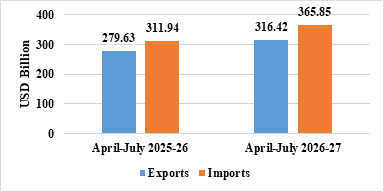
New areas of cooperation in railway transport such as infrastructure facilities, Vande Bharat train project, and signalling equipment were welcomed. Moreover, cooperation in Unmanned Aerial systems (UAVs), 3-D printing, production of Russian regional aircraft SJ-100, and aero-engine were also discussed. Further, cooperation in carbon-fibre technologies and propulsion systems, DAP/NPK fertilizer supplies, automation, critical minerals, lithium mining and titanium technologies, along with enhanced collaboration in aluminium, mining equipments and exploration of rare earth elements were discussed during the session.

The Protocol of the 12th Session of the Working Group was signed by both the co-chairs reaffirming the strategic India-Russia partnership with the aim to deepen industrial and economic cooperation. The session was attended by around 60 delegates from both sides.