2026 Amendment to Indian Accounting Standards Overview

Important Update for Stakeholders!

The Ministry of Corporate Affairs has notified the Companies (Indian Accounting Standards) Amendment Rules, 2026 vide G.S.R. 725(E) dated 12th August, 2026.

The amended Rules shall come into force on the date of their publication in the Official Gazette. 

For the detailed notification, please refer to the official notification issued by MCA:

G.S.R. 725(E).—In exercise of the powers conferred by section 133 read with section 469 of the Companies Act, 2013 (18 of 2013), the Central Government, in consultation with the National Financial Reporting Authority, hereby makes the following rules further to amend the Companies (Indian Accounting Standards) Rules, 2015, namely:-

1. Short title and commencement.— (1) These rules may be called the Companies (Indian Accounting Standards) Amendment Rules, 2026.

(2) They shall come into force on the date of their publication in the Official Gazette.

2. In the Companies (Indian Accounting Standards) Rules, 2015, in the “Annexure”, under the heading “B. Indian Accounting Standards (Ind AS)”,

(A) in “Indian Accounting Standard (Ind AS) 101”; —

(i) after paragraph 39AI, the following paragraphs shall be inserted, namely:-

“39AJ [Refer Appendix 1]
39AK Annual Improvements to Ind AS (2024), amended paragraphs B5-B6. An entity shall apply those amendments for annual reporting periods beginning on or after 1 April 2026.”

(ii) in Appendix B, for paragraphs B5 and B6, the following paragraphs shall be substituted, namely:-

“B5 An entity shall not reflect in its opening Ind AS Balance Sheet a hedging relationship of a type that does not qualify for hedge accounting in accordance with Ind AS 109 (for example, many hedging relationships where the hedging instrument is a stand-alone written option or a net written option; or where the hedged item is a net position in a cash flow hedge for another risk than foreign currency risk) [see paragraph 6.4.1(a) of Ind AS 109]. However, if an entity designated a net position as a hedged item in accordance with previous GAAP, it may designate as a hedged item in accordance with Ind ASs an individual item within that net position, or a net position if that meets the requirements in paragraph 6.6.1 of Ind AS 109, provided that it does so no later than the date of transition to Ind ASs.
B6 If, before the date of transition to Ind ASs, an entity had designated a transaction as a hedge but the hedge does not meet the qualifying criteria for hedge accounting in paragraph 6.4.1(b)-(c) of Ind AS 109, the entity shall apply paragraphs 6.5.6 and 6.5.7 of Ind AS 109 to discontinue hedge accounting. Transactions entered into before the date of transition to Ind ASs shall not be retrospectively designated as hedges.”;

(B) in “Indian Accounting Standard (Ind AS) 107”;

(i) after paragraph 5A, the following paragraphs shall be inserted, namely:- “5B Paragraph 30A applies only to contracts to buy nature-dependent electricity that satisfy the requirements in paragraph 2.3A of Ind AS 109 and are outside the scope of that Standard in accordance with paragraphs B2.7-B2.8 of Ind AS 109.
5C Paragraph 30B applies only to contracts that satisfy the requirements in paragraph 2.3A of Ind AS 109 and have been designated in a cash flow hedging relationship in accordance with paragraph 6.10.1 of Ind AS 109.
5D Paragraph 30C applies only to contracts that satisfy the requirements in paragraph 2.3A of Ind AS 109 and have been entered into with regards to an entity’s electricity purchases. These contracts comprise those:
(a) within the scope of Ind AS 109; and
(b) outside the scope of Ind AS 109 in accordance with paragraph 2.4 of that Standard, including those excluded in accordance with paragraphs B2.7-B2.8 of that Standard.”;

Table: Instrument EA

Instrument EAAnalysis
Instrument EA is a loan with an interest rate that is adjusted every reporting period by a fixed number of basis points if the debtor achieves a contractually specified reduction in carbon emissions during the preceding reporting period.

The maximum possible cumulative adjustments would not significantly change the interest rate on the loan.
The contractual cash flows are solely payments of principal and interest on the principal amount outstanding.

The entity considers whether the contractual cash flows that could arise both before and after each change in contractual cash flows are solely payments of principal and interest (see paragraph B4.1.10).

If the contingent event of achieving the carbon emissions target occurs, the interest rate is adjusted by a fixed number of basis points, resulting in contractual cash flows that are consistent with a basic lending arrangement. It is only because the nature of the contingent event itself does not relate directly to changes in basic lending risks and costs that the entity cannot conclude without further assessment whether the cash flows on the financial asset are solely payments of principal and interest.

The entity therefore assesses whether, in all contractually possible scenarios, the contractual cash flows would not be significantly different from the contractual cash flows on a financial instrument with identical contractual terms, but without the contingent feature linked to carbon emissions (see paragraph B4.1.10A).

Because any adjustments over the life of the instrument would not result in contractual cash flows that are significantly different, the entity concludes that the loan has contractual cash flows that are solely payments of principal and interest on the principal amount outstanding.

Table: Instrument I

Instrument IAnalysis
Instrument I is a loan with an interest rate that is adjusted every reporting period to track the movements in a market-determined carbon price index during the preceding reporting period.The contractual cash flows are not solely payments of principal and interest on the principal amount outstanding.

The contractual cash flows are indexed to a variable (the carbon price index), which is not a basic lending risk or cost. The contractual cash flows are therefore inconsistent with a basic lending arrangement (see paragraph B4.1.8A).

Note: The principal rules were published in the Gazette of India, Extraordinary, Part II, Section 3, Sub-section (i), vide number G.S.R. 111(E), dated the 16th February, 2015 and last amended vide notification number G.S.R. 549(E), dated the 13th August, 2025.

Union Minister of Commerce & Industry Shri Piyush Goyal in Singapore for 4th India-Singapore

Union Minister of Commerce and Industry, Shri Piyush Goyal, is visiting Singapore from 19-21 August 2026 as part of continued high-level engagement under the India-Singapore Ministerial Roundtable (ISMR) framework.

An Indian business delegation comprising around 70 senior business leaders from diverse sectors is visiting Singapore alongside Shri Piyush Goyal to strengthen India-Singapore economic and commercial ties. The delegation includes representatives from technology, software and AI, manufacturing and engineering, infrastructure and sustainability, financial services and FinTech, healthcare and life sciences, food and agriculture, logistics, maritime and trade, and professional services.

The delegation will undertake B2B, G2B and institutional engagements, including interactions with leading Centres of Excellence (COEs) and visits to skilling institutions in Singapore. The engagements will focus on partnerships, investment, market access, technology collaboration and talent development. The visit is being organised on the sidelines of the India-Singapore Ministerial Roundtable and India-Singapore Business Roundtable meetings.

During the visit, Shri Piyush Goyal will participate in the 4th India-Singapore Ministerial Roundtable (ISMR) on 20 August 2026. The ISMR serves as the apex ministerial mechanism for advancing the India-Singapore Comprehensive Strategic Partnership (CSP). The Roundtable will be held alongside the 4th India-Singapore Business Roundtable (ISBR), followed by an MoU signing ceremony and a lunch hosted by the Deputy Prime Minister of Singapore for all ISMR and ISBR delegates.

The Minister will participate in the Roundtable alongside Smt. Nirmala Sitharaman, Union Minister for Finance and Corporate Affairs; Dr. Subrahmanyam Jaishankar, Union Minister for External Affairs; and Shri Ashwini Vaishnaw, Union Minister for Railways, Information and Broadcasting, and Electronics and Information Technology. The Ministers will engage with their Singaporean counterparts and other senior Singaporean leadership during the visit.

Shri Piyush Goyal will also call on Mr Lawrence Wong, Prime Minister of Singapore, at the Istana.

On the sidelines, Shri Goyal will hold a series of Government-to-Business (G2B) engagements with senior representatives from the Global Finance & Technology Network, YPO Global, Milken Institute, Keppel Infrastructure, Temasek Holdings and IHH Healthcare, as well as the Singapore Business Federation (SBF) Chairman-led delegation, Turner & Townsend and STT GDC. These engagements will be followed by a Family Office Roundtable.

The Minister will jointly visit an APEDA–FairPrice initiative at City Square Mall along with Singapore’s Minister of State for Foreign Affairs and Trade & Industry, Ms Gan Siow Huang. The initiative aims to promote Indian agri-food exports and strengthen their presence in Singapore’s retail market, reflecting deepening agri-trade linkages between the two countries.

Shri Piyush Goyal will also participate in the India-Singapore Business Forum organised by FICCI at the INSEAD Asia Campus, where he will take part in a fireside chat on “India in the New Global Growth Equation: Growth and Opportunity for Businesses in Asia and the World,” followed by a networking dinner with the Indian and Singaporean business community.

The visit will conclude with a keynote address by the Minister at the ICAI ASEAN Conference 2026 at the Marina Bay Sands Expo and Convention Centre.

Singapore remains a key economic partner and a major source of investment for India. In FY 2025-26, Singapore was the largest source of FDI into India, with FDI inflows of USD 19.8 billion. Cumulative FDI inflows from Singapore stood at USD 194.68 billion during April 2000-March 2026, accounting for 24.72% of India’s total FDI inflows.

Singapore is also India’s largest trading partner within ASEAN and remains a significant source of External Commercial Borrowings and Foreign Portfolio Investment. Bilateral trade has expanded substantially following the conclusion of the India-Singapore Comprehensive Economic Cooperation Agreement (CECA), increasing from USD 6.7 billion in FY 2004-05 to USD 36.1 billion in FY 2025-26.

The visit reaffirms India’s commitment to strengthening trade, investment and people-to-people ties with Singapore, one of India’s largest sources of FDI and a key partner in advanced manufacturing, digitalisation, skills development and the green economy.

PSB Confluence 2026: Strategies for Public Sector Banks’ Future

The two-day PSB Confluence 2026, organised by the Department of Financial Services (DFS), Ministry of Finance, concluded today after extensive deliberations among the leadership of Public Sector Banks (PSBs) and Public Financial Institutions (PFIs), senior Government officials and domain experts across seven themes relevant to the next phase of growth of the banking and financial sector.

On Day 2, deliberations focused on Agriculture and Horticulture Value Chain Infrastructure, Priority Sector Lending and Reimagining the Credit Card Business. This was followed by debriefing sessions, where the thematic groups presented actionable strategies and innovative solutions emerging from discussions across all seven themes.

Addressing the concluding session, Union Minister for Finance and Corporate Affairs Smt. Nirmala Sitharaman emphasised the need to translate the deliberations into tangible outcomes. She called upon PSBs and PFIs to build on their institutional strength, anticipate emerging opportunities and develop capabilities to support India’s evolving economic requirements.

On Banking for Youth, the Finance Minister called upon PSBs to undertake a focused, month-long campaign commencing from 2nd October 2026 for youth above 16 years, coordinated through the Indian Banks’ Association (IBA), to strengthen engagement with young citizens entering the formal financial system. The initiative would seek to establish a sustained relationship with young customers and enable banks to support their evolving financial needs as they progress through education, employment, entrepreneurship, investment and wealth creation.

As part of the initiative, a common online portal/application for youth is envisaged to provide a single point for accessing simple and relevant information on banking services and opportunities relating to education, skilling and entrepreneurship. The initiative would be complemented by physical outreach through colleges, universities, skill institutions and other campuses, as well as youth-focused engagement spaces.

The Finance Minister also emphasised the importance of Priority Sector Lending (PSL) and the need to pay close attention to shortfalls against individual targets and sub-targets. PSBs were encouraged to maintain their strong focus on PSL through granular monitoring, early identification of emerging gaps and appropriate business strategies, with the objective of minimising shortfalls through genuine and productive credit flow to intended beneficiaries.

The Day 2 deliberations also identified opportunities to strengthen financing across agriculture and horticulture value chains, including FPOs, storage, processing, logistics and market linkages. Discussions on Reimagining the Credit Card Business explored strategies around digital onboarding, greater cross-sell to the existing customer base and leveraging opportunities arising from RuPay-UPI integration. The deliberations were also enriched by real-world experiences shared by CA Arvind Agarwal, Director, VNR Group, on Agriculture and Horticulture Value Chain Infrastructure, and Shri Sanjay Mehndiratta, Director, Toy Zone, on Priority Sector Lending, bringing practical perspectives from their respective entrepreneurial journeys.

Secretary, DFS, emphasised that the Confluence has enabled sharper identification of priorities and clearer actionable across the seven themes. PSBs and PFIs would now need to translate these into implementation with clear ownership and realistic timelines, while successful institutional models could be examined for wider adoption.

PSB Confluence 2026 brought together the collective experience and capabilities of PSBs, PFIs, Government and domain experts across areas critical to the future of banking. The actionable strategies emerging from the Confluence will now be taken forward by the concerned institutions through appropriate follow-up and implementation. As India advances towards Viksit Bharat 2047, PSBs and PFIs will continue to play an important role in deepening financial inclusion, financing emerging opportunities and supporting the country’s next phase of growth.

Union Minister of Commerce & Industry Shri Piyush Goyal Invites Japanese Businesses to Deepen Invest

Union Minister for Commerce and Industry Shri Piyush Goyal highlighted the growing depth and strategic importance of the India-Japan partnership and invited Japanese businesses to deepen their investments and partnerships in India. Shri Goyal was addressing a dinner hosted by the Government of Uttar Pradesh for a Japanese delegation, in the presence of Uttar Pradesh Chief Minister Shri Yogi Adityanath in New Delhi today.

Addressing the gathering, Shri Goyal said that India and Japan share a close and enduring partnership rooted in common aspirations for peace, progress and prosperity in the Indo-Pacific. He noted that the presence of the delegation from Yamanashi Prefecture reflects the growing reach of the bilateral partnership into India’s States and regions.

Shri Goyal said that the seven streams of national transformation outlined by Prime Minister Shri Narendra Modi—manufacturing, agriculture, technology, infrastructure, energy and defence, green and blue economy, and India’s civilisational soft power—represent areas where the strengths of India and Japan complement each other. He said the partnership goes beyond economic growth and reflects a shared commitment to becoming trusted partners in global progress.

Highlighting Uttar Pradesh’s growing economic potential, Shri Goyal said the State, under the leadership of Chief Minister Shri Yogi Adityanath, is working towards its ambition of becoming a USD 1 trillion economy. He said Uttar Pradesh’s large and aspirational population, improving connectivity, industrial momentum and skilled workforce provide a strong platform for Japanese technology and expertise to complement India’s young workforce and expanding market.

Referring to the 16th India-Japan Annual Summit held in Delhi in July 2026, Shri Goyal highlighted the strategic ambition underpinning the relationship, including Japan’s target of investing 10 trillion yen in India over the next decade. He said investments in areas such as artificial intelligence, semiconductors, critical minerals, batteries, energy and next-generation mobility would play an important role in shaping the future of both economies.

Shri Goyal said the growing India-Japan partnership is already visible on the ground, citing the Mumbai-Ahmedabad High-Speed Rail project, Japanese-assisted metro systems in Delhi, Ahmedabad, Bengaluru and Chennai, and 11 Japanese industrial townships across eight States. He noted that more than 1,400 Japanese companies are today operating in India, with household names such as Suzuki, Toyota and Honda in mobility, Sony in electronics, and Hitachi and Mitsubishi in engineering. He said bilateral trade stood at around USD 27.5 billion in FY 2025-26, while Japan is now India’s fifth-largest source of FDI, reflecting the strong foundation for further expansion of economic ties.

Drawing on the Japanese philosophy of ‘Kaizen’, Shri Goyal said India’s reform journey reflects a similar spirit of continuous improvement. He highlighted reforms in ease of doing business, infrastructure, digital public infrastructure, multimodal logistics and expanding Japanese language capabilities as part of India’s efforts to create a more enabling environment for investment and growth.

Shri Goyal said Uttar Pradesh, India’s third-largest State economy, has more than 9 million MSMEs and is the fifth-largest State exporter. He noted that enterprises such as Escorts Kubota and Seiko Advance are already contributing to the State’s manufacturing ecosystem.

He further highlighted the Jewar International Airport, Yamuna Expressway and the JICA-supported Western Dedicated Freight Corridor, along with 27 industrial clusters and ecosystems in sectors including defence, semiconductors and electronics, as key strengths that position Uttar Pradesh as a promising destination for deeper Japanese partnerships.

Shri Goyal said he would be visiting Japan from 24 to 27 August 2026 to take forward these conversations at the highest levels of government and industry and further strengthen the Special Strategic and Global Partnership between India and Japan.

Emphasising the civilisational ties between the two countries, Shri Goyal recalled the historical connection between India and Japan through the teachings of Buddha. He invited Japanese businesses to make India, and Uttar Pradesh in particular, a centre of their growth and a hub for Japanese innovation serving the Indo-Pacific and the world.

Department of Commerce Organises Awareness Session on EU CBAM Regulations for Exporters

The Department of Commerce, Ministry of Commerce & Industry, in collaboration with the National Accreditation Board for Certification Bodies (NABCB) and the Engineering Export Promotion Council (EEPC), organised an Awareness Session on European Union Carbon Border Adjustment Mechanism (EU CBAM) Regulations for Exporters at Vanijya Bhawan, New Delhi, today. The session was attended by around 100 participants, including exporters and industry stakeholders, and aimed at enhancing awareness and preparedness among Indian exporters regarding the evolving regulatory requirements under CBAM.

The technical sessions provided participants with an overview of the EU CBAM framework, its applicability and covered products, obligations for exporters, calculation of embedded emissions, data collection and reporting requirements, and accreditation and verification mechanisms. Practical case studies relating to the iron and steel and aluminium sectors were also discussed to provide exporters with a better understanding of the application of the requirements in practice.

The session provided an interactive platform for exporters and industry representatives to understand the regulatory and technical aspects of CBAM and seek clarifications on issues relating to compliance and reporting. The discussions highlighted the importance of timely awareness and preparedness as sustainability-related regulatory requirements increasingly become relevant to international trade.

Addressing the session, Joint Secretary, Department of Commerce, Shri Amit Verma, emphasised the importance of ensuring that Indian exporters are adequately informed and prepared to meet emerging sustainability-related requirements in international markets. He highlighted the Department’s efforts to create awareness among exporters and facilitate a better understanding of emerging regulatory requirements. He reiterated that the Department remains engaged with industry and relevant stakeholders and is working towards addressing concerns and facilitating practical and workable solutions for Indian exporters.

Providing the context for the session, CEO, NABCB, Shri N. Venkateswaran, highlighted the importance of a credible accreditation and verification ecosystem in building confidence in emissions-related data and supporting compliance with CBAM requirements.

Chairman, EEPC, Shri Pankaj Chadha, highlighted the importance of awareness and preparedness across the export value chain, including the availability of appropriate emissions-related data from suppliers and other stakeholders. He also emphasised the need for effective verification mechanisms to facilitate compliance by Indian exporters.

The Department of Commerce reaffirmed its continued engagement with exporters, industry associations and relevant institutions to build awareness and capacity on emerging sustainability-related trade regulations and facilitate Indian industry’s preparedness for evolving global market requirements.

The session concluded with a Question and Answer session and interaction with industry and exporters, providing participants an opportunity to seek clarifications on various aspects of EU CBAM and its implementation.

Regional Rural Banks (RRBs) Record Strong Growth in Credit Delivery FY 2025–26

During FY 2025–26, Regional Rural Banks (RRBs) have continued to strengthen their role in promoting rural economic development and financial inclusion by expanding credit delivery and maintaining a strong focus on Priority Sector Lending (PSL).

While gross loans outstanding of RRBs increased by 10.3%, from ₹5,24,163 crore in FY 2024–25 to ₹5,78,349 crore in FY 2025–26, the performance of RRBs under the Reserve Bank of India’s Priority Sector Lending framework remained strong during the year. The average achievement against the overall PSL prescribed target of 75% reached 91.7% of Adjusted Net Bank Credit (ANBC). Almost all RRBs achieved the overall PSL target, reflecting the RRBs’ robust focus on supporting priority sectors and advancing financial inclusion.

Agriculture and allied activities remained the largest component of the RRB credit portfolio, with outstanding credit of ₹3.78 lakh crore, constituting 77% of total Priority Sector Lending. Farm credit accounted for nearly 98% of agricultural lending, thereby supporting crop cultivation, allied agricultural activities and investment in the rural economy

Credit to the MSME sector stood at ₹66,978 crore (13.6% of total PSL), reaffirming the pivotal role of RRBs in supporting rural entrepreneurship and employment generation. Over 95% of MSME lending was directed towards micro enterprises, reflecting the RRBs’ focus on financing first-generation entrepreneurs, self-employed individuals, artisans, and small business units in rural and semi-urban areas. Within MSME lending, the services sector accounted for the largest share, followed by manufacturing enterprises and Khadi & Village Industries.

RRBs extended credit of ₹3.49 lakh crore to weaker sections, reaffirming their commitment to financial inclusion and equitable access to institutional credit. In addition, lending for housing, education, renewable energy and social infrastructure continue to support inclusive and sustainable development by promoting human capital formation, household asset creation, clean energy adoption and the creation of local infrastructure.

Overall, the financial performance of RRBs during FY 2025–26 highlights sustained expansion in rural credit, strong alignment with national development priorities and continued support to farmers, micro-enterprises and other underserved segments. RRBs thus remain key pillars in advancing financial inclusion, strengthening rural livelihoods and supporting the Government of India’s vision of inclusive and balanced economic growth.

MCA to Examine Litigation Funding for PUFE Transactions Under Insolvency

The Ministry of Corporate Affairs (MCA) will examine litigation funding for preferential, undervalued, fraudulent, and extortionate (PUFE) transactions under the insolvency regime to improve recoveries, the ministry told a parliamentary standing committee in a written reply.

“Litigation funding for PUFE transactions will be examined in light of global best practices and refined through detailed consultation with all relevant stakeholders,” the MCA said.  

The ministry in its comments highlighted that the market for litigation funding remains nascent in India.  

Funds worth over ₹4.38 trillion across 1,878 applications are locked in avoidance proceedings until March 31, 2026, according to Insolvency and Bankruptcy Board of India (IBBI) data.  Till June 2025, only 379 cases involving ₹66,919 crore had been disposed of, and ₹7,931 crore had been ordered to be clawed back.

Litigation funding, or third-party litigation finance, is an arrangement where an outside investor pays a claimant’s legal costs. In return, the funder gets an agreed-upon share of the financial recovery if the case wins.

Insolvency law practitioners said PUFE claims are often not pursued due to funding constraints, and litigation funding could make this process effective.  

“Third-party funding, if allowed in PUFE claims, could easily cover legal, investigation, and expert costs, with returns tied to success. This would ease the burden on creditors and shall support recovery from promoters or related parties who diverted the funds of the corporate debtor,” said Daizy Chawla, senior partner, S&A Law Offices. 

The house panel in its report on action taken by the MCA noted that avoidance transactions directly erode the value available to creditors and corporate debtors undertake such transactions before the commencement of insolvency proceedings that unfairly favour certain creditors or divert the company’s assets, thereby reducing the value available for resolution. 

The Insolvency Amendment Act, 2026, has expanded the look-back period for avoidance transactions, which are now counted from the initiation date (date of filing of application) rather than the insolvency commencement date. This was done to capture transactions undertaken in the interim period before admission, which may have been used to siphon value. The Act also clarified that proceedings relating to avoidance transactions will continue even after the completion of resolution proceedings or liquidation. 

Making a case for third-party litigation funding, the panel said it can enable pursuing complex and high-value claims such as tracing diverted assets, undertaking forensic investigations, and initiating recovery actions without imposing additional financial burden on the already depleted insolvency estate. 

“Such a framework should incorporate appropriate safeguards, including mandatory disclosure of funding arrangements before the adjudicating authority and the Committee of Creditors, prohibition of funder control over litigation strategy, transparent and reasonable return structures, and regulatory oversight by the IBBI,” the committee recommended. 

The Ministry of Corporate Affairs (MCA) will examine litigation funding for preferential, undervalued, fraudulent, and extortionate (PUFE) transactions under the insolvency regime to improve recoveries, the ministry told a parliamentary standing committee in a written reply.

Major Settlement Benefitting 423 Contract Workers at Ordnance Factory, Kanpur

A significant wage-related dispute concerning 423 contract workers engaged at Ordnance Factory, Kanpur, under Advanced Weapons and Equipment India Limited (AWEIL) has been successfully resolved through the timely intervention and sustained conciliation efforts of the Regional Labour Commissioner (Central), Kanpur, under the aegis of the Office of the Chief Labour Commissioner (Central), Ministry of Labour & Employment, Government of India.

Pursuant to the conciliation efforts, M/s Immense Manpower Pvt. Ltd., the contractor, disbursed approximately ₹50,00,000/- (Rupees Fifty Lakh only) on 13.08.2026 towards outstanding wages for the months of June and July, 2026 to 423 workmen.

Further, following the intervention of the Regional Labour Commissioner (Central), Kanpur, the pending bill of the contractor for the month of May, 2026 was also released by the Principal Employer, facilitating the settlement of the wage-related issues and ensuring timely payment to the concerned workforce.

As a result of the timely intervention and effective conciliation efforts, the proposed strike/demonstration by a group of workers at Ordnance Factory, Kanpur, was successfully averted, thereby preventing disruption of industrial operations and promoting industrial peace and harmony at the establishment.

During the conciliation proceedings, the management was sensitized about its statutory obligations relating to workers’ welfare, fair service conditions, and compliance with labour laws. The importance of maintaining harmonious industrial relations through constructive dialogue and ensuring timely implementation of welfare measures was emphasized. The management assured that it would continue to uphold its commitment towards the welfare of the workforce and adherence to statutory provisions.

This successful conciliation reflects the continued commitment of the Ministry of Labour and Employment towards protecting workers’ rights, ensuring timely realization of statutory benefits, promoting fair labour practices, and fostering harmonious industrial relations through effective conciliation and constructive dialogue.

DFS Hosts PSB Confluence 2026: Day 1 Deliberations on Deposit Mobilisation

The first day of the two-day PSB Confluence 2026, organised by the Department of Financial Services (DFS), Ministry of Finance, brought together senior leadership of Public Sector Banks (PSBs) and Public Financial Institutions (PFIs), senior officials from the Government and domain experts to deliberate on emerging opportunities and strategic priorities for the banking and financial sector.

The Confluence is structured around seven themes covering key areas of opportunity for PSBs and PFIs, with the deliberations aimed at identifying practical strategies and solutions that can be taken forward and scaled across institutions.

On Day 1, the Confluence was addressed by Union Minister for Finance and Corporate Affairs Smt. Nirmala Sitharaman and Secretary, Department of Financial Services.

The Union Finance Minister highlighted the critical importance of the seven themes identified for deliberations during the two-day Confluence in taking forward the banking sector, financial inclusion and credit. She emphasised that the historically low level of Non-Performing Assets (NPAs) places the banking sector in a position of strength to take forward the next phase of reforms.

On Banking for Youth, the Finance Minister emphasised that the future of banking must reflect the aspirations of India’s youth, with 29% of India’s population between 15 and 29 years of age.

Secretary, DFS, outlined the objectives of the Confluence and the importance of translating the deliberations into concrete and implementable outcomes. He spoke about the need for PSBs and PFIs to anticipate emerging opportunities, strengthen institutional capabilities, draw upon successful approaches across institutions and leverage their collective experience to support the next phase of economic growth.

Four of the seven themes were taken up for detailed deliberations on Day 1: Deposit Mobilisation, Banking for Youth, Supporting the Investment Cycle and Global Capability Centres (GCCs). The discussions highlighted approaches to strengthen the deposit base through deeper customer engagement; develop banking propositions responsive to the aspirations and financial needs of India’s youth; enhance institutional capabilities and financing solutions to support the evolving investment cycle; and position PSBs and PFIs to capture emerging opportunities across the expanding GCC ecosystem. The deliberations were also enriched by perspectives from expert speakers, including Mr. Seshagiri Rao MVS, Group CFO, JSW, on Supporting the Investment Cycle, and Mr. Tanay Kediyal, GCC Enterprise Transformation Expert, on the evolving GCC ecosystem.

As part of the discussions on Banking for Youth, the potential of leveraging Mera Yuva Bharat (MY Bharat), a national platform of the Department of Youth Affairs, Ministry of Youth Affairs and Sports, for wider youth engagement was explored. Dr. Priyanka Shukla, CEO, MY Bharat, participated as an expert speaker and shared perspectives on youth outreach. With over 2.60 crore registered users and an extensive outreach network, MY Bharat can help strengthen young people’s connect with the formal financial system and enhance their awareness of opportunities relating to education finance, entrepreneurship, internships and careers in the financial sector.

On Day 2, discussions will cover the remaining three themes: Agriculture and Horticulture Value Chain Infrastructure, Priority Sector Lending and Reimagining the Credit Card Business, followed by presentations on actionable strategies and innovative solutions emerging from all seven thematic groups.

The Confluence reflects the collective endeavour of the Government, PSBs and PFIs to build on the progress achieved by the banking sector and prepare for emerging opportunities. The deliberations seek to strengthen institutional capabilities and competitiveness and position PSBs and PFIs to effectively support India’s evolving growth aspirations and its journey towards Viksit Bharat 2047.

Union Minister for Finance and Corporate Affairs Smt. Nirmala Sitharaman Chairs 3rd Meeting

Union Minister for Finance and Corporate Affairs, Smt. Nirmala Sitharaman, chaired the 3rd Meeting of the Apex Monitoring Authority of the National Industrial Corridor Development and Implementation Trust (NICDIT) in New Delhi today. The meeting reviewed the progress of projects under the National Industrial Corridor Development Programme (NICDP) and deliberated on priorities for the next phase of industrial corridor development.

The meeting was attended by Union Minister for Commerce and Industry, Shri Piyush Goyal; Chief Minister of Madhya Pradesh, Dr. Mohan Yadav; and Vice-Chairman, NITI Aayog, Shri Ashok Kumar Lahiri.

Chairing the meeting, Smt. Nirmala Sitharaman appreciated the progress made under NICDP and said that the encouraging results on the ground indicate growing investor demand. She emphasised that the next pipeline of industrial land and infrastructure should be prepared well before the existing inventory is exhausted.

Smt. Sitharaman stated that Industrial Corridors are an important pillar of the Government of India’s strategy to expand manufacturing, strengthen logistics competitiveness and create globally competitive industrial ecosystems.

Recalling the emphasis placed at the previous Apex meeting, she said that Industrial Corridor development should be taken forward in the spirit of ‘Team India’. She also underlined the importance of convergence of Freight, Industrial Development, Railways and Expressways, the FIRE Corridors, for the success of the programme.

The Finance Minister stressed that the focus must now move beyond project approvals towards timely completion of infrastructure, land allotment, investment and commencement of production. She urged States to resolve bottlenecks relating to land, connectivity, utilities, statutory clearances and the powers of project Special Purpose Vehicles (SPVs).

She further stressed the need for integrated planning through PM GatiShakti and continued use of investor-friendly land allotment mechanisms. Worker housing, healthcare, skilling, public transport and other social amenities, she said, should form an integral part of industrial development.

Smt. Sitharaman also highlighted the Government of India’s support for infrastructure and manufacturing through enhanced public capital expenditure, support to States under SASCI, improved credit support for manufacturing MSMEs, and tax and customs measures aimed at strengthening domestic manufacturing and supply chains.

Union Minister for Commerce and Industry, Shri Piyush Goyal, called for faster and outcome-oriented implementation of Industrial Corridor projects, with greater focus on timely investment and operationalisation.

Shri Goyal stated that BHAVYA and future industrial developments should be aligned with PM GatiShakti and planned through an integrated area-development approach.

He called for focused investor outreach and stronger marketing of industrial nodes, including leveraging opportunities arising from India’s Free Trade Agreements and exploring country- and sector-specific industrial enclaves.

The Minister emphasised the need to match investor requirements with suitable locations and develop ready-to-use industrial ecosystems with plug-and-play infrastructure, flatted factories, worker housing and supporting economic and social infrastructure. Such an approach, he said, would facilitate faster investment and commencement of operations.

The National Industrial Corridor Development Programme now covers 20 approved projects across 13 States and 7 Industrial Corridors.

Four industrial smart cities — Dholera, Shendra-Bidkin, Greater Noida and Vikram Udyogpuri — have entered the production stage.

The 12 projects approved in August 2024 are also progressing, with infrastructure development, land allotment and investor engagement increasingly being undertaken in parallel.

So far, 469 plots covering approximately 5,348 acres have been allotted, with an estimated investment potential of around ₹2.21 lakh crore and employment potential of approximately 1.29 lakh persons. 134 units are already in production, while another 95 units are under construction.

Union Minister for Ports, Shipping and Waterways, Shri Sarbananda Sonowal, emphasised the integration of national waterways with Industrial Corridors and suggested examining waterways as a potential spine for corridor development.

He also stressed the need to develop industrial infrastructure in the North-Eastern States to broaden the country’s industrial base, particularly at locations offering strong connectivity, land availability, local resource advantages and market potential.

Vice-Chairman, NITI Aayog, Shri Ashok Kumar Lahiri, urged State Governments to give greater priority to empowering project SPVs with adequate planning, development and municipal powers, in line with the approved institutional and legal framework of the Industrial Corridor Programme.

He emphasised that effective delegation of these powers would enable SPVs to take timely decisions, reduce dependence on multiple State agencies and facilitate more coordinated, efficient and investor-friendly development.

The meeting commenced with the welcome address by Secretary, DPIIT and Chairman, NICDIT, Shri Amardeep Singh Bhatia, who outlined the progress since the previous Apex meeting and key implementation issues before the Authority.

This was followed by a presentation by CEO, NICDIT, Shri Rajat Kumar Saini, on the current status of Industrial Corridor projects, including progress in implementation, land allotment and investor mobilisation, as well as project-specific issues requiring coordination with States.

Representatives from participating States shared project-wise progress, key implementation challenges and areas requiring coordinated support. The discussions provided a platform for focused Centre-State engagement to resolve project-specific issues and accelerate implementation.

The Apex Authority underlined that the next measure of progress would be the speed at which completed and ongoing projects translate into active manufacturing centres, investment and employment.

The Apex Authority also reviewed the rollout of the Bharat Audyogik Vikas Yojana (BHAVYA), which envisages the development of 100 investment-ready, plug-and-play industrial parks across the country.

Against up to 20 projects proposed for approval in the first round, 87 applications have been received from States, reflecting strong interest in the scheme across the country.

It was emphasised that the planning and appraisal of BHAVYA projects should be fully aligned with PM GatiShakti, with infrastructure in and around industrial areas being planned as an integral part of industrial development.

BHAVYA will build on the experience gained from Industrial Corridor projects. The appraisal of proposals will focus on factors including availability of ready land, credible industrial demand, strong connectivity, assured utilities, realistic phasing and the ability to attract investors at an early stage.

The discussions at the meeting underlined a clear direction for the next phase of industrial infrastructure development: progress will be measured not only by the infrastructure created, but also by how quickly projects attract investment, commence production and generate economic activity and employment.

The meeting was also attended virtually by Union Minister for Ports, Shipping and Waterways, Shri Sarbananda Sonowal; Chief Minister of Maharashtra, Shri Devendra Fadnavis; Chief Minister of Bihar, Shri Samrat Choudhary; Chief Minister of Haryana, Shri Nayab Singh Saini; Chief Minister of Kerala, Shri V. D. Satheesan; Chief Minister of Uttarakhand, Shri Pushkar Singh Dhami; Ministers from participating States; senior officials of the Government of India and State Governments; and other stakeholders.

About NICDIT

The National Industrial Corridor Development and Implementation Trust (NICDIT) is a Trust constituted by the Government of India for the coordinated and unified development of Industrial Corridors across the country. It functions under the administrative control of the Department for Promotion of Industry and Internal Trade (DPIIT), Ministry of Commerce & Industry, and supports the development of trunk infrastructure in industrial nodes under the approved framework of the National Industrial Corridor Development Programme. Under BHAVYA, Government of India participation in project SPVs and equity support is routed through NICDIT.

About NICDC

National Industrial Corridor Development Corporation Limited (NICDC) is a Special Purpose Vehicle under the administrative control of DPIIT, Ministry of Commerce & Industry. NICDC undertakes project development activities and coordinates implementation of Industrial Corridor projects under the National Industrial Corridor Development Programme, working with State Governments and project SPVs to develop investment-ready industrial areas and smart industrial cities. Under BHAVYA, NICDC has been designated as the Project Management Agency for implementation and monitoring of the Scheme.

DRI uncovers large-scale illegal use of SAFTA agreement in areca imports

The Directorate of Revenue Intelligence (DRI), in a month-long intelligence-led operation, has dismantled a major network involved in importing South-East Asian areca nuts into India by falsely declaring them as Bangladeshi origin and fraudulently availing concessional duty benefits under the South Asian Free Trade Area (SAFTA). The investigation has so far revealed a potential revenue loss of more than Rs. 2,500 crore. Nine persons have been arrested in connection with the case.

The import of areca nuts into India attracts a Basic Customs Duty (BCD) of 100%. However, eligible imports of areca nuts made under SAFTA agreement are fully exempt from customs duty.  The areca nuts originating from Bangladesh are entitled to exemption under SAFTA if imports meet the prescribed Rules of Origin criterion.

Intelligence gathered and developed by DRI indicated that certain syndicates were fraudulently claiming the SAFTA benefits on a very large scale on imports of areca nuts.  While they were importing areca nuts originating and sourced from Indonesia, Thailand, Malaysia and other South-East Asian countries, they were mis-declaring the country of origin of areca nuts imported into India as Bangladesh.

Thereafter, simultaneous searches were conducted at multiple premises linked to importers, Customs Brokers and IEC holders in Kolkata and Visakhapatnam. Several incriminating documents and substantial evidences establishing the South-East Asian origin of Areca nuts were recovered. DRI officers also recovered and seized around Rs. 75 lakh in cash, believed to be sale proceeds of the illegally imported goods.  A live consignment of around 160 MT of areca nuts.

The investigations so far have revealed huge scale of fraudulent imports of areca nuts in which exchequer has been duped of customs duty in excess of Rs 2,500 crore in recent years. The masterminds were facilitating the import of areca nuts from South-East Asian countries into one of the EPZ in Bangladesh and thereafter routing the goods to India merely changing containers and bags and passing them off as Bangladeshi-origin areca nuts. They had fraudulently obtained SAFTA Certificates of Origin from Bangladeshi authorities. The masterminds were charging substantial commissions from Indian importers for arranging the routing, documentation, clearance and transportation of the consignments and massive collection of payments in cash… The investigation has also brought to light the use of hawala channels and dummy entities for movement and layering of the financial proceeds.

Investigation has further revealed that one Customs Broker firm was particularly responsible for clearance of most of the fraudulent imports of areca nuts identified in the case. Consequent to the ongoing investigation by DRI, the Customs Broker’s licence has been suspended by the competent authority. Nine persons have been arrested so far in connection with the case.

Such illegal imports adversely impact domestic areca nut growers and legitimate trade by creating unfair price distortion, and disrupting the level playing field for legitimate businesses. Besides causing huge loss to the Government revenue, these illegal activities also undermine regulated trade practices and economic security in the border regions.

With this operation, DRI has effectively disrupted a well-organised network involved in systematic mis-declaration of country of origin, fraudulent availment of SAFTA benefits and large-scale evasion of customs revenue.

Navigating IRDAI’s Grievance Redressal for Insurance in India

As insurance adoption accelerates across India, navigating the customer Grievance Redressal Mechanism has become a vital skill for policyholders. To ensure financial security, a clear understanding of the established regulatory grievance channels and recent customer statistics is critical for every policyholder.

The Insurance Regulatory and Development Authority of India (IRDAI) mandates a strict, time-bound process for resolving policyholder issues. Customers facing unfair claim rejections, delays, mis-selling or other service-related issues are advised to follow this defined escalation path:

a.) Insurer level: The Grievance Redressal Officer (GRO) of the insurer is the nodal officer for dealing with grievances. Every office of the insurer is mandated to designate one of its officials as Grievance Redressal Officer. Policyholder Protection, Grievance Redressal and Claims Monitoring Committee (PPGR & CM Committee), constituted by every insurer is the Board-level Committee for ensuring efficient and effective redressal of grievances.

Every grievance received either through a digital interface, direct correspondence or the call centre of the insurer is registered in the Complaints Management System (CMS) of the insurer. The Complaints Management Systems of insurers and the Bima Bharosa Portal are integrated. Insurers must acknowledge the complaint immediately and provide a resolution within 14 days.

b.) IRDAI’s Bhima Bharosa portal: Complainants can register and monitor the redressal of grievances by logging into the Bima Bharosa Portal, which is an integrated portal for monitoring policyholder grievances across the insurance industry by the IRDAI. Policyholders who have complaints against insurers are required to first approach the Complaints/Grievance Redressal Cell of the insurer concerned.

If they do not receive a response from the insurer within a reasonable period of time or are dissatisfied with the response of the company, they may approach the Grievance Redressal Cell in the Policyholders’ Protection & Grievance Redressal Department of the IRDAI. Policyholders can log in to the official IRDAI Bima Bharosa Portal at https://bimabharosa.irdai.gov.in/.

Alternatively, citizens can lodge complaints via the toll-free helpline numbers 155255 or 1800-4254-732, or via email at complaints@irdai.gov.in. Complaints sent through physical letters or emails are also registered in Bima Bharosa Portal. The call centre run by the authority offers multi-lingual support and operates in 12 languages.

Provisional Estimates of Wholesale Price Index for July 2026

  1. Key highlights of WPI (Base Year 2022-23) for July 2026
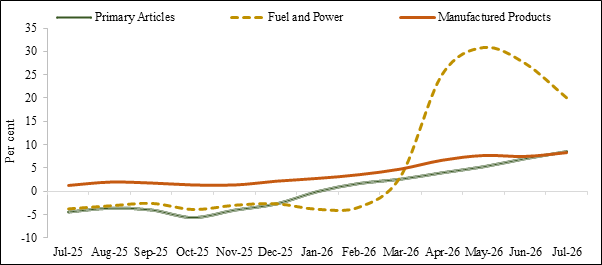
  1. All India Wholesale Price Index (WPI) inflation for July 2026 is 9.78 per cent on year-on-year (YoY) basis, compared to 9.87 per cent in June 2026. The index for All Commodities for July 2026 stands at 110.0, whereas it was 110.2 in June 2026.
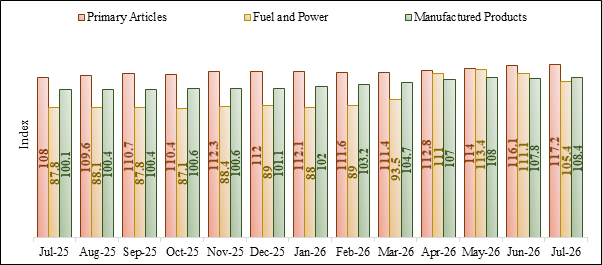
  2. YoY inflation rates for major groups, namely, Primary Articles, Fuel and Power, and Manufactured Products are 8.52 per cent, 20.05 per cent, and 8.29 per cent, respectively in July 2026, compared to 7.0 per cent, 27.41 per cent, and 7.48 per cent, respectively in June 2026. The indices for Primary Articles, Fuel and Power, and Manufactured Products are 117.2, 105.4, and 108.4, respectively, in July 2026, whereas they were 116.1, 111.1, and 107.8, respectively, in June 2026.
  3. Across groups, ‘Mineral Oils (containing Petroleum Products)’, ‘Food Articles’, ‘Manufacture of Basic Metals’, ‘Non-Food Articles’, ‘Manufacture of Food Products’, and ‘Manufacture of Chemicals and Chemical Products’ have been major drivers of WPI inflation in July 2026.
  4. WPI Food Index (weight=24.99 per cent): The Food Index consists of ‘Food Articles’ from Primary Articles major group, and ‘Manufacture of Food Products’ from Manufactured Products major group. It observed a YoY inflation of 6.65 per cent in July 2026, compared to 6.14 per cent in June 2026.
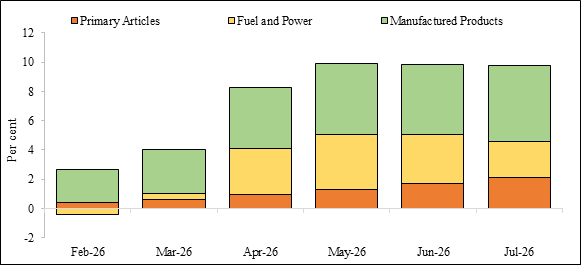
  5. Monthly indices and Inflation Rate (in per cent) for All commodities and Major Groups, along with major group-wise contribution for the past months are presented in the charts below.

Chart 1: WPI Index and Inflation Rate for All Commodities

1

Chart 2: WPI Index of Major Groups

2

Chart 3: Inflation Rate across Major Groups

3

Chart 4: Major Group-Wise contribution to Inflation

4
  1. The final index for the month of May 2026 has been revised from 109.9 (Provisional estimate) to 110.1. Accordingly, WPI inflation has been revised from 9.68 per cent, as per provisional estimate to 9.88 per cent as per the final estimate.
  2. The Final Estimate of WPI (Base Year 2022-23) for the month of May 2026 has been compiled with a weighted response rate of 98.14 per cent.
  3. The Provisional Estimate of WPI (Base Year 2022-23) for the month of July 2026 has been compiled with a weighted response rate of 78.55 per cent.
  4. Wholesale Price Index and Year-on-Year (YoY) Inflation Rate for All Commodities, Major Groups, and Groups for the last six months is given at Annexure-I and II respectively.
  5. Cumulative WPI for All Commodities, Major Groups, and Groups from April to July for FY 2023-24, FY 2024-25, FY 2025-26, and FY 2026-27 is given at Annexure-III.
  6. Cumulative YoY Inflation Rate for All Commodities, Major Groups, and Groups from April to July for FY 2024-25, FY 2025-26, and FY 2026-27 is given at Annexure- IV.
  7. Item-wise data pertaining to WPI (Base Year 2022-23) series from April 2023 to July 2026 is available at (https://eaindustry.nic.in/download_data_2223.asp).
  8. Provisional indices of WPI, OPPI, and trial IPPI for a reference month are released on the 14th of the following month (if it is a working day, else on next working day). Accordingly, release of WPI, Output PPI, and trial Input PPI for the month of August 2026 will be on Monday, 14th September 2026.

      Annexure-I

 WPI for All Commodities, Major Groups and Groups for last six months

Groups/Major GroupsCommodity WeightFeb-26
(F)
Mar-26
(F)
Apr-26
(F)
May-26
(F)
Jun-26
(P)
Jul-26
(P)
ALL COMMODITIES100.00000103.1104.6108.9110.1110.2110
I. PRIMARY ARTICLES22.75730111.6111.4112.8114116.1117.2
(A). Food Articles15.97835113.1112.8114.2115.1117.3118.2
(B). Non-Food Articles5.52841107.3107.4107.6109.1110.4112.6
(C). Minerals1.25054112110.8118.8121125.1125.4
II. FUEL AND POWER14.1143389.093.5111.0113.4111.1105.4
(A). Coal and Lignite0.7413686.587.887.786.687.988.4
(B). Mineral Oils8.1920885.892.9121.6125.7122.9113.2
(C). Electricity4.4634994.791.290.891.591.992.4
(D). Crude Petroleum & Natural Gas0.7174092.4119.7138.8136.8120.2114.8
III. MANUFACTURED PRODUCTS63.12837103.2104.7107.0108.0107.8108.4
(A). Manufacture of Food Products9.02016108109.1111112.4113.1115.1
(B). Manufacture of Beverages0.90483102.6102.7104.4104.9105.4105.1
(C). Manufacture of Tobacco Products0.27645122.7122.6122.5122.8124.3124.7
(D). Manufacture of Textiles4.0899394.496.499.1102.1102.2104
(E). Manufacture of Wearing Apparel1.32948109.8109.9111111.6111.9111.6
(F). Manufacture of Leather and Related Products0.54137104.9105.5107.3108.4108.6109.4
(G). Manufacture Of Wood and Products of Wood and Cork, except Furniture; Manufacture of Articles of Straw and Plaiting Materials1.07718110112.1115.2115116.9116.3
(H). Manufacture of Paper and Paper Products1.1532890.691.493.794.193.894.2
(I). Printing and Reproduction of Recorded Media0.42618105.1105.8107108.1107108.5
(J). Manufacture of Chemicals and Chemical Products6.1256791.896.5102.6103.6102.4102.6
(K). Manufacture of Basic Pharmaceutical Products and Pharmaceutical Preparations 2.2010299.6100.8102.3102.9102.2103.6
(L). Manufacture of Rubber and Plastic Products2.7146796.3101.9106106.3106.2106.3
(M). Manufacture of Other Non-Metallic Mineral Products2.8407496.196.89999.299.699.9
(N). Manufacture of Basic Metals8.4113398100.1103.5104.9103.1102.2
(O). Manufacture of Fabricated Metal Products, except Machinery and Equipment4.13294102102.7104.4105.9105.7106.6
(P). Manufacture of Computer, Electronic and Optical Products2.07628101.5102101.7102.7102.7104.1
(Q). Manufacture of Electrical Equipment2.64318110.2111112.7114.2114.8116.5
(R). Manufacture of Machinery and Equipment n.e.c.3.46796104.3104.3105.1105.3105.4106
(S). Manufacture of Motor Vehicles, Trailers and Semi-Trailers5.43645106.4105.9106.7107107.1107.5
(T). Manufacture of Other Transport Equipment1.39511105.2105.4106106.4106.5107.7
(U). Manufacture of Furniture0.82618102.6102.8105.6105.6106.4105.5
(V). Other Manufacturing2.03798156.4158.8157158.2156.6157
FOOD INDEX24.99851111.3111.5113114.1115.8117.1

 (P)-Provisional, (F)-Final

  Annexure-II

      WPI Inflation Rate (YoY) for All Commodities, Major Groups, and Groups for last six months

Groups/Major GroupsCommodity WeightFeb-26
(F)
Mar-26
(F)
Apr-26
(F)
May-26
(F)
Jun-26
(P)
Jul-26
(P)
ALL COMMODITIES100.000002.183.988.369.889.879.78
I. PRIMARY ARTICLES22.757301.642.583.965.2678.52
(A). Food Articles15.978350.81.532.613.695.495.44
(B). Non-Food Articles5.528414.686.657.610.211.0717.66
(C). Minerals1.250541.360.0986.059.4513.28
II. FUEL AND POWER14.11433-3.373.2025.0030.8027.4120.05
(A). Coal and Lignite0.74136-2.37-0.79-1.57-2.26-1.57-0.56
(B). Mineral Oils8.19208-4.354.2640.7449.8246.4832.4
(C). Electricity4.46349-1.56-2.04-2.58-0.54-0.761.09
(D). Crude Petroleum & Natural Gas0.71740-5.3326.1356.3161.5134.7526.99
III. MANUFACTURED PRODUCTS63.128373.614.806.687.687.488.29
(A). Manufacture of Food Products9.020162.082.544.726.247.28.89
(B). Manufacture of Beverages0.90483-0.68-0.680.381.251.440.96
(C). Manufacture of Tobacco Products0.2764512.5711.8612.0812.7614.1413.36
(D). Manufacture of Textiles4.089931.944.97.2510.9810.8512.8
(E). Manufacture of Wearing Apparel1.329483.392.93.063.722.573.33
(F). Manufacture of Leather and Related Products0.541372.643.233.874.233.634.59
(G). Manufacture Of Wood and Products of Wood and Cork, except Furniture; Manufacture of Articles of Straw and Plaiting Materials1.0771835.068.076.589.057.78
(H). Manufacture of Paper and Paper Products1.15328-0.660.112.182.953.193.18
(I). Printing and Reproduction of Recorded Media0.426181.552.123.083.942.493.73
(J). Manufacture of Chemicals and Chemical Products6.125670.225.71314.7312.7813.12
(K). Manufacture of Basic Pharmaceutical Products and Pharmaceutical Preparations 2.201020.31.12.613.942.824.75
(L). Manufacture of Rubber and Plastic Products2.71467-0.725.3810.0710.849.9410.38
(M). Manufacture of Other Non-Metallic Mineral Products2.84074-0.93-0.11.751.331.842.67
(N). Manufacture of Basic Metals8.411337.348.5710.713.1612.3112.56
(O). Manufacture of Fabricated Metal Products, except Machinery and Equipment4.132942.823.425.036.336.127.24
(P). Manufacture of Computer, Electronic and Optical Products2.076280.89-0.58-1.17-0.87-1.53-0.95
(Q). Manufacture of Electrical Equipment2.643187.627.989.2111.4111.0312.34
(R). Manufacture of Machinery and Equipment n.e.c.3.467961.261.071.842.232.132.61
(S). Manufacture of Motor Vehicles, Trailers and Semi-Trailers5.436451.820.950.850.751.711.8
(T). Manufacture of Other Transport Equipment1.395111.741.933.214.1144.46
(U). Manufacture of Furniture0.82618-0.10.193.835.185.034.04
(V). Other Manufacturing2.0379831.5432.8926.2121.4120.5522.46
FOOD INDEX24.998511.271.923.294.586.146.65

 (P)-Provisional, (F)-Final

Annexure-III

 Cumulative WPI for All Commodities, Major Groups, and Groups

Groups/Major GroupsCommodity WeightApr-JulFY 2023-24Apr-JulFY 2024-25Apr-JulFY 2025-26Apr-Jul FY 2026-27
ALL COMMODITIES100.0000098.8100.5100.3109.8
I. PRIMARY ARTICLES22.75730103.9111108.3115
(A). Food Articles15.97835105.8115.2111.4116.2
(B). Non-Food Articles5.52841999898.5109.9
(C). Minerals1.25054101.1114.2112.3122.6
II. FUEL AND POWER14.1143391.691.287.6110.2
(A). Coal and Lignite0.7413692.189.58987.7
(B). Mineral Oils8.1920889.489.984.9120.9
(C). Electricity4.4634995.392.392.391.7
(D). Crude Petroleum & Natural Gas0.7174094.2101.788.3127.7
III. MANUFACTURED PRODUCTS63.1283798.598.8100.3107.8
(A). Manufacture of Food Products9.0201698.3100.6105.8112.9
(B). Manufacture of Beverages0.90483102.4103.8103.9105
(C). Manufacture of Tobacco Products0.27645104.1106.8109.3123.6
(D). Manufacture of Textiles4.0899393.192.692.2101.9
(E). Manufacture of Wearing Apparel1.32948102.4104.4108.1111.5
(F). Manufacture of Leather and Related Products0.54137101.5101.6104.2108.4
(G). Manufacture Of Wood and Products of Wood and Cork, except Furniture; Manufacture of Articles of Straw and Plaiting Materials1.07718102103.2107.4115.9
(H). Manufacture of Paper and Paper Products1.1532891.589.491.394
(I). Printing and Reproduction of Recorded Media0.42618103.2104.3104.2107.7
(J). Manufacture of Chemicals and Chemical Products6.1256793.491.390.7102.8
(K). Manufacture of Basic Pharmaceutical Products and Pharmaceutical Preparations 2.2010210199.699.3102.8
(L). Manufacture of Rubber and Plastic Products2.7146795.795.996.3106.2
(M). Manufacture of Other Non-Metallic Mineral Products2.8407499.296.197.699.4
(N). Manufacture of Basic Metals8.4113395.694.392.2103.4
(O). Manufacture of Fabricated Metal Products, except Machinery and Equipment4.13294100.3100.199.5105.7
(P). Manufacture of Computer, Electronic and Optical Products2.0762898.697104102.8
(Q). Manufacture of Electrical Equipment2.64318100.9102103.2114.6
(R). Manufacture of Machinery and Equipment n.e.c.3.46796102102.2103.2105.5
(S). Manufacture of Motor Vehicles, Trailers and Semi-Trailers5.43645103.4106.3105.7107.1
(T). Manufacture of Other Transport Equipment1.39511101.2101.2102.6106.7
(U). Manufacture of Furniture0.82618101.6101.6101.2105.8
(V). Other Manufacturing2.03798104.5112.3128.2157.2
FOOD INDEX24.99851103.1109.9109.4115

Note: Cumulative Index has been calculated by taking Arithmetic Mean of 4 months indices

Annexure-IV

 Cumulative WPI Inflation Rate (YoY) for All Commodities, Major Groups, and Groups

Groups/Major GroupsCommodity WeightApr-JulFY 2024-25Apr-JulFY 2025-26Apr-Jul FY 2026-27
ALL COMMODITIES100.000001.72-0.29.47
I. PRIMARY ARTICLES22.757306.83-2.436.19
(A). Food Articles15.978358.88-3.34.31
(B). Non-Food Articles5.52841-1.010.5111.57
(C). Minerals1.2505412.96-1.669.17
II. FUEL AND POWER14.11433-0.44-3.9525.8
(A). Coal and Lignite0.74136-2.82-0.56-1.46
(B). Mineral Oils8.192080.56-5.5642.4
(C). Electricity4.46349-3.150-0.65
(D). Crude Petroleum & Natural Gas0.717407.96-13.1844.62
III. MANUFACTURED PRODUCTS63.128370.31.527.48
(A). Manufacture of Food Products9.020162.345.176.71
(B). Manufacture of Beverages0.904831.370.11.06
(C). Manufacture of Tobacco Products0.276452.592.3413.08
(D). Manufacture of Textiles4.08993-0.54-0.4310.52
(E). Manufacture of Wearing Apparel1.329481.953.543.15
(F). Manufacture of Leather and Related Products0.541370.12.564.03
(G). Manufacture Of Wood and Products of Wood and Cork, except Furniture; Manufacture of Articles of Straw and Plaiting Materials1.077181.184.077.91
(H). Manufacture of Paper and Paper Products1.15328-2.32.132.96
(I). Printing and Reproduction of Recorded Media0.426181.07-0.13.36
(J). Manufacture of Chemicals and Chemical Products6.12567-2.25-0.6613.34
(K). Manufacture of Basic Pharmaceutical Products and Pharmaceutical Preparations 2.20102-1.39-0.33.52
(L). Manufacture of Rubber and Plastic Products2.714670.210.4210.28
(M). Manufacture of Other Non-Metallic Mineral Products2.84074-3.131.561.84
(N). Manufacture of Basic Metals8.41133-1.36-2.2312.15
(O). Manufacture of Fabricated Metal Products, except Machinery and Equipment4.13294-0.2-0.66.23
(P). Manufacture of Computer, Electronic and Optical Products2.07628-1.627.22-1.15
(Q). Manufacture of Electrical Equipment2.643181.091.1811.05
(R). Manufacture of Machinery and Equipment n.e.c.3.467960.20.982.23
(S). Manufacture of Motor Vehicles, Trailers and Semi-Trailers5.436452.8-0.561.32
(T). Manufacture of Other Transport Equipment1.3951101.384
(U). Manufacture of Furniture0.826180-0.394.55
(V). Other Manufacturing2.037987.4614.1622.62
FOOD INDEX24.998516.6-0.455.12

Provisional Estimates of Output Producer Price Index (Base Year 2022-23) for the month of July 2026

  1. Key highlights of Output PPI (Base Year 2022-23) for July 2026
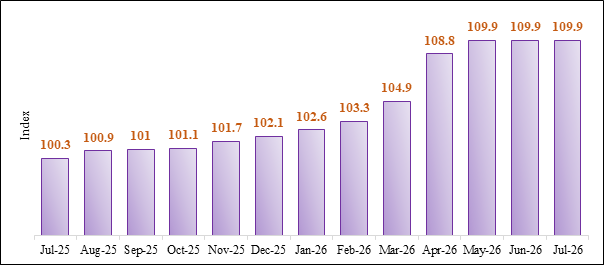
  1. All India Output PPI for All Commodities for July 2026 stands at 109.9, same as it was in June 2026.
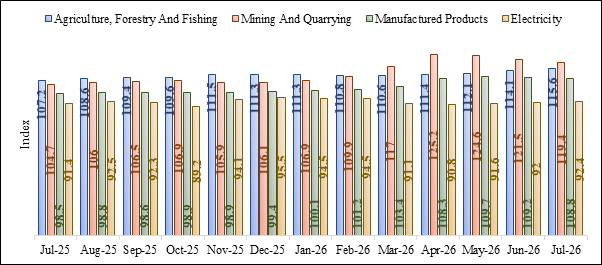
  2. Output PPIs for Agriculture, Forestry and Fishing; Mining and Quarrying; Manufactured Products; and Electricity are 115.6, 119.4, 108.8, and 92.4, respectively, in July 2026, whereas those were 114.1, 121.5, 109.2, and 92.0, respectively, in June 2026.
  3. Monthly indices for All Commodities and Major Groups, for the past 13 months are presented in the charts below.

Chart 5: Output PPI for All Commodities

5

Chart 6: Output PPI across Major Groups

6
  1. The final index of Output PPI for the month of May 2026 has been revised from 109.6 (Provisional estimate) to 109.9.
  2. Output PPI for All Commodities, Major Groups, and Groups for the last six months is given at Annexure-V.
  3. Cumulative Output PPI for All Commodities, Major Groups, and Groups from April to July for FY 2023-24, FY 2024-25, FY 2025-26, and FY 2026-27 is given at Annexure-VI.
  4. SUT category-wise index pertaining to Output PPI (Base Year 2022-23) series from April 2023 to July 2026 is available at (https://eaindustry.nic.in/download_data_2223.asp).

Annexure-V

Output PPI for All Commodities, Major Groups and Groups for last six months

Groups/Major GroupsWeightFeb-26
(F)
Mar-26
(F)
Apr-26
(F)
May-26
(F)
Jun-26
(P)
Jul-26
(P)
ALL COMMODITIES100103.3104.9108.8109.9109.9109.9
AGRICULTURE, FORESTRY AND FISHING22.15648110.8110.6111.4112.1114.1115.6
Crop and Animal Production, Hunting and Related Service Activities 19.03219111.3111.0111.5111.9114.3116.1
Forestry and Logging1.67481115.0115.4116.7118.8118.0119.9
Fishing and Aquaculture1.4494899.3100.1103.2106.9106.6103.7
MINING AND QUARRYING3.42065109.9117.0125.2124.6121.5119.4
Mining of Metal Ores0.70792168.0171.5174.7180.1178.7177.7
Mining of Coal and Lignite0.739886.587.887.786.687.988.4
Other Mining and Quarrying1.23208103.2100.5109.9108.5113.1110.9
Extraction of Crude Petroleum and Natural Gas0.7408588.9121.7141.0136.2114.2108.9
MANUFACTURED PRODUCTS69.93568101.2103.4108.3109.7109.2108.8
(A). Manufacture of Food Products8.47196108.3109.2111.0112.5113.2115.5
(B). Manufacture of Beverages0.8417102.7102.8104.6105.0105.5105.2
(C). Manufacture of Tobacco Products0.25705125.9125.9125.4125.6127.4128.2
(D). Manufacture of Textiles4.3877495.097.8100.9103.9104.3105.7
(E). Manufacture of Wearing Apparel1.20494108.7108.7109.9110.8110.8110.9
(F). Manufacture of Leather and Related Products0.49989103.6104.2105.9107.1107.3108.1
(G). Manufacture of Wood and Products of Wood and Cork, except Furniture; Manufacture of Articles of Straw and Plaiting Materials1.08949108.3110.3113.3113.2114.8114.1
(H). Manufacture of Paper and Paper Products1.0312890.791.693.994.594.194.5
(I). Printing and Reproduction of Recorded Media0.30931106.1107.1109.3109.5109.6110.1
(J). Manufacture of Coke and Refined Petroleum Products7.1481885.792.7121.1125.2122.3112.7
(K). Manufacture of Chemicals and Chemical Products5.7479392.297.3103.3104.1103.0102.9
(L). Manufacture of Basic Pharmaceuticals, Medicinal Chemical and Botanical Products1.92807100.6101.8103.2103.6103.0104.5
(M). Manufacture of Rubber and Plastic Products2.5725296.9102.5106.7107.0106.8107.0
(N). Manufacture of Other Non-Metallic Mineral Products2.5043795.896.499.099.199.599.9
(O). Manufacture of Basic Metals7.46596.699.0102.7104.3102.7102.1
(P). Manufacture of Fabricated Metal Products, except Machinery and Equipment3.15198100.4101.1102.3103.3104.0104.0
(Q). Manufacture of Computer, Electronic and Optical Products1.7748104.6104.6104.3104.9104.7105.3
(R). Manufacture of Electrical Equipment3.81453104.0104.4105.7107.2107.9108.9
(S). Manufacture of Machinery and Equipment n.e.c.2.46158104.7104.8105.7105.7105.6106.2
(T). Manufacture of Motor Vehicles, Trailers and Semi-Trailers4.39321106.9106.6107.4107.2107.6107.8
(U). Manufacture of Other Transport Equipment1.34392106.1106.4107.2107.6107.6108.9
(V). Manufacture of Furniture0.73566103.2103.7105.3104.9105.4104.7
(W). Other Manufacturing6.80057118.3119.9120.9122.2121.0122.1
ELECTRICITY4.4871994.591.190.891.692.092.4
Electricity4.4871994.591.190.891.692.092.4

  (P)-Provisional, (F)-Final

Annexure-VI

Cumulative Output PPI for All Commodities, Major Groups and Groups

ALL COMMODITIES10098.8100.3100.3109.6
AGRICULTURE, FORESTRY AND FISHING22.15648103.9109.3107.2113.3
Crop and Animal Production, Hunting and Related Service Activities 19.03219104109.6107.3113.5
Forestry and Logging1.67481102.5113111.6118.4
Fishing and Aquaculture1.44948104.9100.9101.3105.1
MINING AND QUARRYING3.4206597.6106.1103.8122.7
Mining of Metal Ores0.70792105.6126.1140.7177.8
Mining of Coal and Lignite0.739892.189.58987.7
Other Mining and Quarrying1.23208100.9109.2103.9110.6
Extraction of Crude Petroleum and Natural Gas0.7408590.198.483.4125.1
MANUFACTURED PRODUCTS69.9356897.497.698.5109
(A). Manufacture of Food Products8.4719697.299.8105.7113.1
(B). Manufacture of Beverages0.8417102.5104104.1105.1
(C). Manufacture of Tobacco Products0.25705104106.8109.5126.7
(D). Manufacture of Textiles4.3877493.29392.4103.7
(E). Manufacture of Wearing Apparel1.20494102103.5107.3110.6
(F). Manufacture of Leather and Related Products0.49989101.1100.6102.7107.1
(G). Manufacture of Wood and Products of Wood and Cork, except Furniture; Manufacture of Articles of Straw and Plaiting Materials1.08949101.9102.8106.4113.9
(H). Manufacture of Paper and Paper Products1.0312891.589.591.594.3
(I). Printing and Reproduction of Recorded Media0.30931103.9104.8105.4109.6
(J). Manufacture of Coke and Refined Petroleum Products7.1481889.489.884.9120.3
(K). Manufacture of Chemicals and Chemical Products5.7479393.591.591.1103.3
(L). Manufacture of Basic Pharmaceuticals, Medicinal Chemical and Botanical Products1.92807101.899.399.6103.6
(M). Manufacture of Rubber and Plastic Products2.5725295.89696.4106.9
(N). Manufacture of Other Non-Metallic Mineral Products2.504379995.89799.4
(O). Manufacture of Basic Metals7.46595.594.291.6103
(P). Manufacture of Fabricated Metal Products, except Machinery and Equipment3.1519899.299.598.4103.4
(Q). Manufacture of Computer, Electronic and Optical Products1.774898.596.3107.7104.8
(R). Manufacture of Electrical Equipment3.8145399.899.5100.7107.4
(S). Manufacture of Machinery and Equipment n.e.c.2.46158102102.7103.3105.8
(T). Manufacture of Motor Vehicles, Trailers and Semi-Trailers4.39321103.7106.5106107.5
(U). Manufacture of Other Transport Equipment1.34392101.5101.6103.6107.8
(V). Manufacture of Furniture0.73566101.6101.4101.6105.1
(W). Other Manufacturing6.80057101.6103108121.6
ELECTRICITY4.4871995.392.392.391.7
Electricity4.4871995.392.392.391.7

Note: Cumulative Index has been calculated by taking Arithmetic Mean of 4 months indices

Provisional Estimates of Trial Input Producer Price Index (IPPI) (Base Year 2022-23) for the month of July 2026

  1. All India trial Input PPI[1] for Manufacturing Sector for July 2026 stands at 105.9 (Provisional estimate).
  2. Trial Input PPI for Manufacturing Sector for the month of May 2026 has been revised from 104.9 (provisional estimate) to 106.5 (final index).
  3. Trial Input PPI for all Manufacturing Industries at NIC-2-digit, from March to July 2026 is given below.

Trial Input PPI for all Manufacturing Industries at NIC-2-digit

Manufacturing Sector100.000000100.9104.2106.5107.1105.9
(A). Manufacture of Food Products14.84638107.1108.3110.5112.2113.8
(B). Manufacture of Beverages1.03035106104.5105.4105.5107.4
(C). Manufacture of Tobacco Products0.26443128124.7122.5123.4130.8
(D). Manufacture of Textiles5.8891895.5100.8103.4107.8103.9
(E). Manufacture of Wearing Apparel1.57012105.6106.6107.4109.6108.1
(F). Manufacture of Leather and Related Products0.7763496.39697.99698.5
(G). Manufacture of Wood and Products of Wood and Cork, Except Furniture; Manufacture of Articles of Straw and Plaiting Materials1.8219499.7110.8113.4112.3112
(H). Manufacture of Paper and Paper Products0.8749495.196.897.29798
(I). Printing and Reproduction of Recorded Media0.4660696.498.398.998.598.4
(J). Manufacture of Coke and Refined Petroleum Products12.329198.2105.2111.8113.599.9
(K). Manufacture of Chemicals and Chemical Products7.98919100.9107.9110.5112.5109.4
(L). Manufacture of Basic Pharmaceutical Products and Pharmaceutical Preparations 2.4046398.2103.5105.3105.6104.3
(M). Manufacture of Rubber and Plastic Products3.40235105.9109.8111.1112.1111.6
(N). Manufacture of Other Non-Metallic Mineral Products3.2830692.396.498.492.693.3
(O). Manufacture of Basic Metals11.2522998.3100.6102.299.2101.5
(P). Manufacture of Fabricated Metal Products, except Machinery and Equipment5.5923999.7102.2104.7105.4105.8
(Q). Manufacture of Computer, Electronic and Optical Products2.22964108108.2107111.5108.5
(R). Manufacture of Electrical Equipment3.64437111.5113.4116.2117.7117.2
(S). Manufacture of Machinery and Equipment n.e.c.5.07784102.2105105.4105.3106.4
(T). Manufacture of Motor Vehicles, Trailers and Semi-Trailers, and Manufacture of Other Transport Equipment10.49446101.5102.8103.7104.9105.1
(U). Manufacture of Furniture0.9835397.6101.1100.798.6101.5
(V). Other Manufacturing3.7774188.988.489.58899.3

July 2026 Trade Analysis: India’s Export and Import Trends

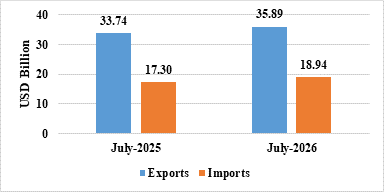
India’s total exports (Merchandise and Services combined) for July 2026* is estimated at US$ 80.14 Billion, registering a positive growth of 13.31 percent vis-à-vis July 2025. Total imports (Merchandise and Services combined) for July 2026* is estimated at US$ 95.16 Billion, registering a positive growth of 15.83 percent vis-à-vis July 2025.

Table 1: Trade during July 2026*

  July 2026(US$ Billion)July 2025(US$ Billion)
MerchandiseExports44.2436.98
Imports76.2264.86
Services*Exports35.8933.74
Imports18.9417.30
Total Trade(Merchandise +Services) *Exports80.1470.72
Imports95.1682.16
Trade Balance-15.03-11.43

* Note: The latest data for services sector released by RBI is for June 2026. The data for July 2026 is an estimation. (ii) Data for April-July 2025-26 has been revised on pro-rata basis using quarterly balance of payments data.

Fig 1: Total Trade during July 2026*

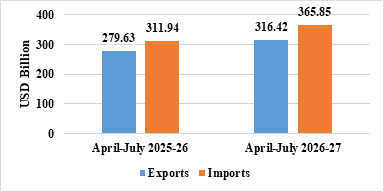
India’s total exports during April-July 2026-27* is estimated at US$ 316.42 Billion registering a positive growth of 13.16 percent. Total imports during April-July 2026-27* is estimated at US$ 365.85 Billion registering a growth of 17.28 percent.

Table 2: Trade during April-July 2026-27*

  April-July 2026-27(US$ Billion)April-July 2025-26(US$ Billion)
MerchandiseExports173.78148.48
Imports292.38245.14
Services*Exports142.64131.15
Imports73.4766.81
Total Trade(Merchandise +Services) *Exports316.42279.63
Imports365.85311.94
Trade Balance-49.43-32.32

Fig 2: Total Trade during April-July 2026-27* 

MERCHANDISE TRADE

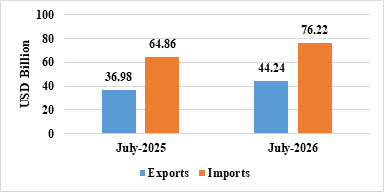
  • Merchandise exports during July 2026 were US$ 44.24 Billion as compared to US$ 36.98 Billion in July 2025.
  • Merchandise imports during July 2026 were US$ 76.22 Billion as compared to US$ 64.86 Billion in July 2025.

Fig 3: Merchandise Trade during July 2026

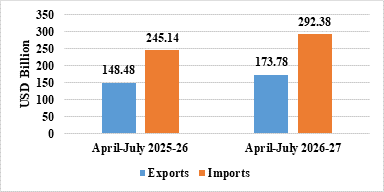
  • Merchandise exports during April-July 2026-27 were US$ 173.78 Billion as compared to US$ 148.48 Billion during April-July 2025-26.
  • Merchandise imports during April-July 2026-27 were US$ 292.38 Billion as compared to US$ 245.14 Billion during April-July 2025-26.
  • Merchandise trade deficit during April-July 2026-27 was US$ 118.60 Billion as compared to US$ 96.66 Billion during April-July 2025-26.

Fig 4: Merchandise Trade during April-July 2026-27

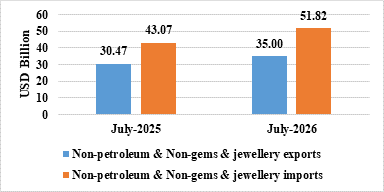
  • Non-petroleum and non-gems & jewellery exports in July 2026 were US$ 35.00 Billion compared to US$ 30.47 Billion in July 2025.
  • Non-petroleum, non-gems & jewellery (gold, silver & precious metals) imports in July 2026 were US$ 51.82 Billion compared to US$ 43.07 Billion in July 2025.

Table 3: Trade excluding Petroleum and Gems & Jewellery during July 2026

 July 2026(US$ Billion)July 2025 (US$ Billion)
Non- petroleum exports37.3232.86
Non- petroleum imports57.9149.30
Non-petroleum & Non-Gems & Jewellery exports35.0030.47
Non-petroleum & Non-Gems & Jewellery imports51.8243.07

Note: Gems & Jewellery Imports include Gold, Silver & Pearls, precious & Semi-precious stones

Fig 5: Trade excluding Petroleum and Gems & Jewellery during July 2026

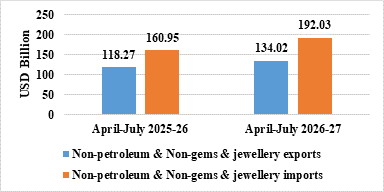
  • Non-petroleum and non-gems & jewellery exports in April-July 2026-27 were US$ 134.02 Billion, compared to US$ 118.27 Billion in April-July 2025-26.
  • Non-petroleum, non-gems & jewellery (gold, silver & precious metals) imports in April-July 2026-27 were US$ 192.03 Billion, compared to US$ 160.95 Billion in April-July 2025-26.

Table 4: Trade excluding Petroleum and Gems & Jewellery during April-July 2026-27

 April-July 2026-27(US$ Billion)April-July 2025-26(US$ Billion)
Non- petroleum exports143.61127.32
Non- petroleum imports213.46180.33
Non-petroleum & Non Gems & Jewellery exports134.02118.27
Non-petroleum & Non Gems & Jewellery imports192.03160.95

Note: Gems & Jewellery Imports include Gold, Silver & Pearls, precious & Semi-precious stones

Fig 6: Trade excluding Petroleum and Gems & Jewellery during April-July 2026-27

SERVICES TRADE

  • The estimated value of services export for July 2026* is US$ 35.89 Billion as compared to US$ 33.74 Billion in July 2025.
  • The estimated value of services imports for July 2026* is US$ 18.94 Billion as compared to US$ 17.30 Billion in July 2025.

Fig 7: Services Trade during July 2026*

  • The estimated value of service exports during April-July 2026-27* is US$ 142.64 Billion as compared to US$ 131.15 Billion in April-July 2025-26.
  • The estimated value of service imports during April-July 2026-27* is US$ 73.47 Billion as compared to US$ 66.81 Billion in April-July 2025-26.
  • The services trade surplus for April-July 2026-27* is US$ 69.17 Billion as compared to US$ 64.35 Billion in April-July 2025-26.

Fig 8: Services Trade during April-July 2026-27*

  • Exports of  Iron Ore (78.35%), Petroleum Products (67.64%), Electronic Goods (57.4%), Meat, Dairy & Poultry Products (40.84%), Cashew (25.11%), Marine Products (17.83%), Engineering Goods (17.71%), Handicrafts Excl. Hand Made Carpet (15.55%), Organic & Inorganic Chemicals (14.39%), Plastic & Linoleum (11.01%), Cereal Preparations & Miscellaneous Processed Items (9.51%), Cotton Yarn/Fabs./Made-Ups, Handloom Products Etc. (8.4%), Mica, Coal & Other Ores, Minerals Including Processed Minerals (5.79%), Drugs & Pharmaceuticals (0.74%), and Man-Made Yarn/Fabs./Made-Ups Etc. (0.45%) recorded positive growth during July 2026 over the corresponding month of last year.
  • Imports of Silver (-66.1%), Sulphur & Unroasted Iron Pyrts (-47%), Newsprint (-26.31%), Pulp And Waste Paper (-22.61%), Medcnl. & Pharmaceutical Products (-3.96%), Wood &  Wood Products (-2.1%), and Iron & Steel (-1.84%) recorded negative growth during July 2026 over the corresponding month of last year.
  • Services exports is estimated to grow by 6.38 percent during April-July 2026-27* over April-July 2025-26.
  • Top 5 export destinations, in terms of change in value, exhibiting positive growth in July 2026 vis a vis July 2025 are U S A (12.85%), China P Rp (64.57%), Singapore (83.7%), Kenya (151.41%), and Malaysia (73.03%).
  • Top 5 export destinations, in terms of change in value, exhibiting positive growth in April-July 2026-27 vis a vis April-July 2025-26 are Singapore (97.11%), China P Rp (35.97%), Tanzania Rep (131.2%), South Africa (69.75%), and Sri Lanka Dsr (111.76%).
  • Top 5 import sources, in terms of change in value, exhibiting growth in July 2026 vis a vis July 2025 are Russia (83.85%), China P Rp (34.42%), Oman (150.36%), Taiwan (111.3%), and U S A (18.11%)
  • Top 5 import sources, in terms of change in value, exhibiting growth in April-July 2026-27 vis a vis April-July 2025-26 are Russia (59.65%), China P Rp (29.68%), Oman (200.68%), U S A (22.42%), and Brazil (166.84%).

District Legal Service Authority Notification for Tax Year 2026-27

MINISTRY OF FINANCE

(Department of Revenue)

(CENTRAL BOARD OF DIRECT TAXES)

NOTIFICATION

S.O. 4459(E).— In exercise of the powers conferred by Schedule III [Table: Sl. No. 36] read with section 11 of the Income-tax Act, 2025 (30 of 2025), (hereinafter referred to as the said Act), the Central Government hereby notifies for the purposes of the said clause, ‘District Legal Service Authority, Panchkula’ (PAN: AAAGC0054R), an Authority constituted by the ‘Legal Services Authorities Act, 1987’ (39 of 1987), in respect of the following specified income arising to the said body namely: –

(a) grants received from the Punjab and Haryana High Court, the Central Authority i.e. the National Legal Services Authority and the State Authority i.e., Haryana State Legal Services Authority for the purpose of the Legal Services Authorities Act, 1987(39 of 1987);

(b) grants or donation received from the Central Government or the State Government of Haryana for the purposes of the Legal Services Authorities Act, 1987(39 of 1987);

(c) amount received under the order of the Court;

(d) fees received as recruitment application fee; and

(e) interest earned on bank deposits.

2. This notification shall be effective subject to the conditions that ‘District Legal Service Authority, Panchkula’ (PAN: AAAGC0054R), –

(a) shall not engage in any commercial activity;

(b) shall file return of income in accordance with the provisions of section 263(9)(c)(xiii) of the said Act; and

(c) activities and the nature of the specified income shall remain unchanged throughout the tax year.

3. Failure to comply with the conditions specified in paragraph 2 shall result in withdrawal of exemption under Schedule III [Table: Sl. No. 36] read with section 11 and initiation of proceedings under the said Act.

4. This notification shall be applicable for the tax year 2026-27.

[Notification No. 113/2026/F. No. 300196/6/2026-ITA-I]

Income Tax Exemption Notification for District Legal Service Authority

MINISTRY OF FINANCE

(Department of Revenue)

(CENTRAL BOARD OF DIRECT TAXES)

NOTIFICATION

New Delhi, the 11th August, 2026

S.O. 4458(E).—Whereas, section 10 (46) of the Income-tax Act, 1961 (43 of 1961) provided for exemption of specified income of certain bodies or authorities or Boards or Trusts or Commissions as may be notified by the Central Government in the Official Gazette for the purposes of that section;

And whereas, the Income-tax Act, 1961 (43 of 1961) was repealed by section 536 (1) of the Income-tax Act, 2025 (30 of 2025);

And whereas, section 536(2)(a) and (b) of the Income-tax Act, 2025 (30 of 2025), inter alia, provides that irrespective of the repeal of the Income-tax Act, 1961 (43 of 1961) (hereinafter referred to as the Act of 1961) and subject to sub-section (4) thereof, nothing shall affect—

(i) the previous operation of the provisions of the Act of 1961 and any order or anything duly done or suffered thereunder; or

(ii) any right, privilege, obligation or liability acquired, accrued or incurred under the Act of 1961 or orders under that Act;

And whereas, section 536(2)(c) of the Income-tax Act, 2025 (30 of 2025) provides that the provisions of the Act of 1961 shall continue to apply to any proceeding pending on the date of commencement of the Income-tax Act, 2025 (30 of 2025) and to any proceedings initiated on after the 1st April, 2026 (including notices, assessment, reassessment, recomputation, rectification, penalty, reference, revision and appeals) in respect of any tax year beginning before the 1st April, 2026 and such proceedings shall be carried out as per the procedure specified in the Act of 1961;

And whereas, section 536(2)(e) of the Income-tax Act, 2025 (30 of 2025) provides that any proceeding pending on the date of its commencement before any income-tax authority or any other authority constituted under the repealed Income-tax Act, Appellate Tribunal, or any court, by way of application, appeal, reference or revision or by any other means, shall be continued and disposed of as if this Act had not been enacted;

Now, therefore, in pursuance of the provisions of section 536(2)(a) to (c) and (e) of the Income-tax Act, 2025 (30 of 2025), the Central Government hereby notifies, for the purposes of section 10 (46) of the Act of 1961, ‘District Legal Service Authority, Panchkula (PAN: AAAGC0054R), an Authority constituted by the ‘Legal Services Authorities Act, 1987′(39 of 1987), in respect of the following specified income arising to the said body namely :-

grants received from the Punjab and Haryana High Court, the Central Authority i.e. the National Legal Services Authority and the State Authority i.e., Haryana State Legal Servies Authority for the purpose of the Legal Services Authorities Act, 1987(39 of 1987);

(a) grants or donation received from the Central Government or the State Government of Haryana for the purposes of the Legal Services Authorities Act, 1987(39 of 1987);

(b) amount received under the order of the Court;

(c) fees received as recruitment application fee; and

(d) interest earned on bank deposits.

2. This notification shall be effective subject to the conditions that the District Legal Service Authority, Panchkula –

(a) shall not engage in any commercial activity;

(b) its activities and the nature of the specified income shall remain unchanged throughout the financial years; and

(c) shall file return of income in accordance with the provisions of section 139(4C) (g) of the Act of 1961.

3. Failure to comply with these conditions shall result in the initiation of penal actions under the provisions of the Act of 1961, and withdrawal of exemption granted under section 10(46) of the Act of 1961.

4. This notification shall be deemed to have been applied for assessment years 2023-24, 2024-25, 2025-26 and 2026-27 relevant for the financial years 2022-23, 2023-24, 2024-25 and 2025-26.

Explanatory Memorandum

It is certified that the interests of no person are being adversely affected by giving retrospective effect [with effect from the year of application filed before the Board or Income-tax Department] to this notification.Uploaded by Dte. of Printing at Government of India Press, Ring Road, Mayapuri, New Delhi-110064 and Published by the Controller of Publications, Delhi-

PM GatiShakti: Transforming Infrastructure Planning in India

PM GatiShakti National Master Plan (PMGS NMP), launched in October 2021, is a transformative “Whole of Government” approach to bring together various Central Ministries/Departments and States/UTs to ensure integrated planning and coordinated execution of infrastructure projects. PMGS NMP aims to facilitate Ministries/States in data driven decision making by utilizing geospatial data, satellite imagery and API integration to monitor, plan, and optimize infrastructure development. The PMGS NMP is facilitating Ministries/States in planning of their respective infrastructure projects, including social infrastructure projects, in integrated, synchronized and coordinated manner to provide seamless and efficient connectivity for the movement of people, goods, and services across various modes of transport, thereby enhancing last-mile connectivity and reducing travel time.

PM GatiShakti provides an integrated planning framework; the approval and implementation of the projects are undertaken by the respective central Ministries/Departments and States/UTs under their plans, schemes, procedures and budgetary/funding provisions. Hence, no quantified targets or expenditure requirements have been set under PM GatiShakti initiative.

The Network Planning Group (NPG), constituted under the PM GatiShakti framework, evaluates the critical infrastructure projects of the central Government to ensure integrated planning, multimodality, inter-modality, synchronization of efforts, last mile connectivity, comprehensive development in and around the project location, data driven decision makings, etc at the planning stage. As on date, 396 infrastructure projects with total estimated cost of about ₹ 18.66 Lakh Crore have been evaluated through the NPG mechanism. Out of these 396 projects, 256 projects have been sanctioned – out of which, 198 projects are under implementation. Ministry-wise details are given at Annexure-A.

Government carries out assessment of its initiatives/schemes from time to time through various studies, surveys, etc. Apart from these, there are several studies by universities and research scholars in this respect. As per these assessments, the integrated planning initiatives like, PM GatiShakti, National Logistics Policy, PRAGATI, Sagarmala, development of connectivity infrastructure (expressways/ national highways/ dedicated rail freight corridors and rail tracks, industrial corridors/hubs), etc. have shaped the vision of connected and competitive India and have improved logistics efficiency, turn-around time, ease of doing business, industrial growth and reduced logistics cost in country. An assessment of logistic cost has been carried out by DPIIT in the year 2025 in collaboration with National Council of Applied Economic Research (NCAER). As per the assessment, the logistics cost in India is estimated at 7.9% of the GDP, which is at par with the advanced economies in the world. The Economic Survey 2023-24 highlighted that these measures have improved domestic manufacturing and export competitiveness. A study by Indian Institute of Management, Bangalore on impact of development of National Highway projects underlines that every-one rupee expenditure in National Highways development leads to a ₹3.2 increase in Gross Domestic Product (GDP).

So far 58 Central Ministries/Departments and all 36 States/UTs have been onboarded on the PMGS NMP, covering all infrastructure sectors like road, rail, ports & waterways, power, petroleum & natural gas, civil aviation, telecommunications, industrial corridors, etc. Further, PM GatiShakti public platform (url: ugi.pmgatishakti.gov.in) has been launched in September 2025, which provided access of PM GatiShakti data analytics to private entities and general public. Through this Query based mechanism, public and private entities are able to plan their projects by obtaining data analytic reports from the PMGS-NMP Portal through a simple query-based mechanism. The States have been encouraged to expand the use of PM GatiShakti for district level planning. About 1800 data layers have been integrated and over 65 software modules/tools and more than 100 mobile/web applications have been developed and integrated on the platform for the use of stakeholders. Further expansion of the PM GatiShakti initiative is a continuous process – mapping/integration of more data layers, development and integration of additional features, software modules/tools for planning and analysis modules/tools, mobile/ web applications, etc. to be continue further as per the requirements of the Ministries/Departments, States/UTs and other stakeholders.

This information was given by Minister of State for Ministry of Commerce and Industry, Shri Jitin Prasada in a written reply in Lok Sabha today.

Ministry-wise details of Projects evaluated through NPG Mechanism

Ministry/DepartmentNumber of ProjectsSanctionedYet to be SanctionedUnder ImplementationEstimated Cost (Rs. in Crore)
Ministry of Road Transport and Highways17110863539,01,668
Ministry of Railways162102601025,43,315
Ministry of Housing and Urban Affairs311714172,88,614
Ministry of Petroleum and Natural Gas4403#9,271
Ministry of Ports, Shipping and Waterways321249,759
Ministry of Civil Aviation642210,005
NICDC, Department for Promotion of Industry and Internal Trade121201228,693
Ministry of New and Renewable Energy0110120,774
Ministry  of   ElectronicsAnd               Information Technology011014,680
Ministry of Textiles05050059,760
Total39625614019818,66,539

PDUNASS Inaugurates Joint EPFO–ITC-ILO Training on Actuarial Practices in Social Security

The Pandit Deendayal Upadhyaya National Academy of Social Security (PDUNASS) inaugurated the residential phase of a specialized training programme titled “Actuarial Practices in Social Security: Strengthening Actuarial Governance at EPFO India” on 10th August in New Delhi.

Organized jointly by the Employees’ Provident Fund Organisation (EPFO) and the International Training Centre of the International Labour Organization (ITC-ILO), the three-day residential phase (10–12 August 2026) follows a comprehensive online module conducted via the ITC-ILO e-Campus from 25 May to 9 August 2026.

Welcoming the Chief Guest and the ILO/ITC-ILO delegation, Shri Kumar Rohit, Director, PDUNASS, noted that the initiative aligns with PDUNASS’s mandate as EPFO’s apex training institute to bring internationally benchmarked learning to its officers. Expressing gratitude for the strategic partnership, he remarked:”With the EPF, EPS, and EDLI schemes aligning with the Code on Social Security, 2020, strengthening in-house actuarial capacity is both timely and essential.”

Mr. Oktavianto Pasaribu, Deputy Director and Senior Advisor for Regional Partnership and Resource Mobilization, ILO, highlighted that the collaboration reflects the ILO’s commitment to strengthening social protection systems across South Asia. He emphasized that sound actuarial governance is central to the financial sustainability of social security institutions and commended EPFO’s proactive approach to building in-house capacity.

Presenting an overview of the curriculum, Mr. Charles Crevier, ITC-ILO Faculty, outlined the blended structure of the programme and the key residential themes, which include:

  • Actuarial valuation methods
  • Asset-Liability Management (ALM)
  • Global best governance practices in social security institutions

Delivering the keynote address and formally declaring the programme inaugurated, Shri Ramesh Krishnamurthi, Central Provident Fund Commissioner (CPFC), observed that as custodian of retirement savings, pensions, and insurance for crores of workers, every actuarial decision at EPFO impacts the financial security of millions. He urged officers to elevate actuarial work into a strategic governance function and foster an evidence-based culture across EPFO.”As EPFO continues to grow in size and responsibility, strengthening our actuarial capacity becomes increasingly important to strengthen governance and prepare better for future challenges.” Said Shri Ramesh Krishnamurthi, CPFC.

The inaugural session and residential phase were attended by senior leadership and operational officers, including:

  • Financial Adviser & Chief Accounts Officer (FA & CAO), ACCs, RPFC-Is, RPFC-IIs, SOs, and ASOs from EPFO
  • Representatives and officials from ESIC
  • Other prominent experts present included Mr. Amjad Rabi (ITC-ILO Faculty), Ms. Divya Verma (Senior Programme Officer, ILO), and Mr. Karun Gopinath (National Project Coordinator, ILO).

About PDUNASS

The Pandit Deendayal Upadhyaya National Academy of Social Security (PDUNASS) is the apex training and research institute of the Employees’ Provident Fund Organisation (EPFO), functioning under the Ministry of Labour & Employment, Government of India. Established in 1990, PDUNASS is dedicated to training, research, and consultancy in social security administration.

About ITC-ILO

The International Training Centre of the International Labour Organization (ITC-ILO), based in Turin, Italy, is the training arm of the ILO. It designs and delivers capacity-building programmes for ILO constituents worldwide—including governments, employers’ and workers’ organisations—in areas central to promoting decent work, social protection, and social security governance.

Urgent Reminder: Registration for Prime Minister Internship Scheme Closes on November 10

Last Call for Prime Minister Internship Scheme Applications

The registration window for young applicants on the dedicated portal under the Prime Minister Internship Scheme (PMIS)—a landmark initiative aimed at boosting employability among Indian youth—will close on November 10, as announced by the Ministry of Corporate Affairs (MCA) on Monday.

“Last Call! Don’t miss your chance to apply for the PM Internship Scheme! Applications close on November 10th—seize this opportunity to shape your future!” read a social media post by the MCA on platform X.

The response to the PMIS has been overwhelmingly positive, with a diverse array of industries eager to engage young talent and shape the future workforce. To date, 280 companies have onboarded to the dedicated portal www.pminternship.mca.gov.in and offered 1.28 lakh internship opportunities under this scheme. The corporate registration window closed on October 20, official sources confirmed.

Launched on October 3, the pilot scheme under PMIS allows corporates to onboard and register their internship opportunities. The youth registration window was opened on October 12. The MCA is administering the PMIS, which was announced in this year’s union budget, to address the growing need for employable skills and industry readiness among India’s youth.

The Government has allocated ₹800 crore for the pilot scheme, aimed at providing 1.25 lakh internships to youth aged between 21 and 24 in FY’25. The target date for providing these internships under the pilot project is set for December 2. Youth aged 21-24 who have completed their 10th, 12th, ITI, Polytechnic, Diploma, or are graduates are eligible to benefit from this scheme. Top 500 corporates by CSR spend (average of the last three financial years) have been permitted to participate and offer internship opportunities to youth.

Enhancing Employment

The PMIS aims to provide young Indians with practical industry experience while enhancing their employability. The scheme seeks to bridge the gap between academic learning and industry requirements by offering internship opportunities across diverse sectors, including technology, manufacturing, finance, retail, healthcare, and more.

The government’s focus on making India’s youth job-ready and aligning their skills with market demands resonates with companies eager to contribute to workforce development, according to economy watchers. Notable corporates offering internship opportunities include Mahindra & Mahindra, Tata Consultancy Services, Larsen & Toubro, Reliance Industries, HDFC Bank, Maruti Suzuki, Tech Mahindra, ONGC, Bajaj Finance, Eicher Motor, Max Life Insurance, Muthoot Finance, and Jubilant Foodworks.

Sectors witnessing the most internship opportunities include oil, gas & energy, automotive, travel and hospitality, banking and financial services, and metals and mining. Other key sectors include manufacturing & industrial, infrastructure and construction, IT and software development, FMCG, and telecom.

Presently, internship opportunities are available in 737 districts across 37 States and Union Territories, indicating a strong response from youth towards the pilot scheme.

The PMIS aligns directly with the Prime Minister’s vision of a “Viksit Bharat,” an India that is prosperous, advanced, and equipped to face future challenges. By recognizing that practical skills are as essential as theoretical knowledge, the scheme integrates real-world experience into academic learning, preparing students for the workforce and reducing the skills gap.

The PMIS is part of the government’s broader strategy to boost India’s human capital development and improve youth employability.

PMIS Benefits

Under the PMIS, interns will receive an allowance of ₹5000 per month, along with a ₹6000 one-time grant. However, the MCA has recently stipulated that internship aspirants looking to avail benefits under the PM Internship Scheme must possess an Aadhar number or undergo Aadhaar authentication.

This is a vital opportunity for youth to gain valuable experience and enhance their skills for a successful future. Don’t miss your chance—apply before the deadline!

Important Changes to CSR Filing in 2023-24 by MCA

MCA Tightens Oversight on CSR Compliance for Corporate India

The Ministry of Corporate Affairs (MCA) has tightened its oversight on corporate India’s Corporate Social Responsibility (CSR) compliance by shortening the window for filing the CSR return with the government. Corporates are now mandated to file their CSR return (CSR-2) for the financial year 2023-24 by December 31, 2024. This filing must be done independently, separate from AOC-4, which is the annual return form that companies must submit within 30 days of their Annual General Meeting (AGM).

For the previous fiscal year, 2022-23, corporates had the flexibility to file the CSR return (CSR-2) until March 31, 2024. However, the new timeline reflects a stricter approach by the MCA to enhance compliance.

Company law experts have pointed out inconsistencies where CSR numbers declared in financial statements (within AOC-4) do not align with the figures reported in the CSR return (CSR-2). Anjali Jain, Partner at Areness, a law firm, mentioned that this MCA notification will assist the regulator in analyzing and assessing such discrepancies, particularly benefiting from a reduced compliance window.

Manmeet Kaur, Partner at Karanjawala & Co, emphasized that the requirement for standalone CSR filing would enhance transparency and accuracy concerning CSR activities, as companies will need to maintain separate records for both AOC-4 and CSR-2 filings. Kaur also noted that amendments made to the Companies (Accounts) Rules in 2022 mandated CSR-2 to be filed as an addendum to AOC-4, a process that was revised in 2023. Now, a distinct CSR-2 filing must occur after the AOC-4 submission for FY22-23, no later than March 31, 2024.

The latest amendment introduces a separate filing requirement for form CSR-2 for FY23-24, which must occur after the AOC-4 filing and before December 31, 2024, Kaur added.

Vanita Bhargava, Partner at Khaitan & Co, explained that Form CSR-2 was initially introduced in 2022, requiring companies to report detailed information regarding their CSR initiatives, including project details, CSR committee structure, CSR spending, and any unspent CSR funds.

“The latest MCA notification ensures transparency and creates a mechanism to ascertain whether companies are meeting their regulatory obligations regarding CSR,” stated Bhargava. “This move by the MCA appears to align with the originally intended timeline for submitting Form CSR-2, which is to occur within 30 days of the company’s AGM, in conjunction with Form AOC-4.”

As corporate India adapts to these new regulations, the focus on CSR compliance is set to increase, promoting greater accountability and transparency in CSR activities across the board.

Report: Over 700 Chinese Companies Under Probe by MCA for Financial Fraud

India to Remove Chinese Companies Amid Growing Concerns

The Ministry of Corporate Affairs (MCA) is set to remove approximately 400 Chinese companies operating in 17 states over the next three months, as reported by Moneycontrol, citing an anonymous government official on Friday, August 2. This move comes as part of the ongoing investigation into the operations of these companies, with a reported 700 Chinese companies currently under scrutiny.

A government official stated, “There will be a substantial number of anywhere between 300 to 400 companies which will be struck off. These include loan apps, online job companies, etc.” This decisive action follows concerns over predatory lending practices, fraud, and violations of financial regulations associated with digital lending apps, some of which have ties to Chinese corporates. Allegations against these companies include aggressive tactics, excessively high interest rates, and unethical practices such as harassment.

The removal of these companies from the official Registrar of Companies (RoC) signifies that they will no longer be recognized as valid businesses. The official further elaborated, “In most cases, such companies are those that are not available at the registered offices. Some are those for which investment had come but are now into some other business. These are incorporation related fraud and financial frauds. Some companies have an Indian director, but the bank account is operated from China. There are companies which have had no transactions.”

According to Section 248 of the Companies Act, the companies in question will be issued notices, providing them with an opportunity to respond. Failure to address these notices within the stipulated timeframe will result in the companies being struck off. The affected companies are primarily based in 17 states, including Delhi, Bengaluru, Uttar Pradesh, Andhra Pradesh, Mumbai, and Chennai.

In addition to the aforementioned actions, the MCA has initiated further investigation into an additional 30 to 40 Chinese companies, including mobile components makers such as battery manufacturers and mobile screen makers. This heightened scrutiny underscores the Government of India’s commitment to ensuring transparency and accountability in dealings with Chinese companies across various sectors, including technology, infrastructure, and finance.

As India takes stringent measures to address concerns surrounding Chinese companies, this development reflects a wider global trend of heightened vigilance over foreign entities operating within national borders.

The situation continues to evolve, and it is essential to closely monitor further developments as the Indian government remains dedicated to safeguarding the integrity of its corporate landscape.

IICA and HP launch first batch of ‘HP Future Impact Leader – IICA Certified ESG Professional Programme’

The Indian Institute of Corporate Affairs (IICA) in collaboration with HP India, launched the inaugural batch of the “HP Future Impact Leader – IICA Certified Environmental-Social-Governance (ESG) Professional Programme” yesterday, in Manesar. The event marked a pivotal step towards cultivating leaders to drive sustainable and responsible business practices to benchmark the impact of leadership in India.

Dr. Ajay Bhushan Prasad Pandey, Director General & CEO of IICA and Chairperson of NFRA, and former Secretary of the Ministry of Finance, Government of India, delivered the event’s Keynote Address. In his speech, he emphasized the significant milestones achieved by IICA in the realm of ESG (Environmental, Social, and Governance) through capacity building of business stakeholders, highlighting its crucial role in shaping the future of our country.

Dr. Pandey began his address by referencing the 1972 United Nations Conference on the Human Environment in Stockholm and the 2030 Agenda for Sustainable Development, adopted by world leaders in 2015 at a historic UN Summit. He noted that this summit marked a global realization of the importance of sustainable development. He explained that businesses initially focused on profit, then on environmental responsibility, and eventually on corporate social responsibility. Today, the sustainability domain has emerged, encompassing all these aspects.

He pointed out that the significance of ESG has grown rapidly over the past two decades due to the evolving global landscape. Businesses are now required to be more responsible for their impact on the environment and society to attract investors and various stakeholders. ESG has become key to the sustained growth of businesses, aligning perfectly with the 4Ps of the G20 New Delhi Declaration Landmark Document 2023: Planet, People, Peace, and Prosperity.

Adopting ESG core principles in business operations helps identify cost-saving opportunities, lower energy consumption, reduce resource waste, and minimize operational costs. Dr. Pandey stressed the importance of mandatory ESG reporting practices to avoid reputational and compliance issues in the future. He also highlighted the call by the Hon’ble Prime Minister to redefine the PPP (Pro-Planet-People) in the G20 Delhi Declaration.

Dr. Pandey referred to new research co-authored by Wharton’s Aline Gatignon, which offers unprecedented insights into how various firms allocate Corporate Social Responsibility (CSR) funds across different dimensions. The study, titled “When Few Give to Many and Many Give to Few,” suggests that the USA can learn from India, which has become the first country in the world to mandate CSR for certain qualified corporate companies and has attributes which are already contributing in the ESG.

He also provided insights into the evolving role of ESG regulations in India’s growth and development, motivating delegates from various public and private companies to integrate ESG principles into their core strategies to keep pace with global trends. At the end of his address, Dr. Pandey thanked HP and UNICEF for supporting the program and urged the delegates to become real impact leaders, contributing to the development of India and the world.

Mr. Rajeev Nair, Head of Legal at HP India, provided a Special Address focusing on the legal aspects and compliance requirements of ESG initiatives. He highlighted in his address that sustainability has been at the core of HP’s Business Operations since its inception. He underscored the importance of integrating legal frameworks with sustainable business practices. He also emphasized HP’s unwavering commitment to sustainability and innovation, and how this programme aligns with HP’s vision of creating a positive impact on society and the environment.

Ms. Geetanjali Master, Public Private Partnership Specialist at UNICEF India, offered a compelling Special Address on the collaborative efforts required between public and private sectors to achieve sustainable development goals. Her address underscored the importance of partnerships in driving impactful ESG initiatives. UNICEF envisions with IICA how to fill the gap between theory and practice.

Dr Garima Dadhich, Associate Professor & Head of the School of Business Environment at IICA eloquently highlighted the critical role of shaping sustainable business practices and the importance of developing ESG professionals and impact leaders with the support of UNICEF and HP. The professionals will be equipped with 360-degree ESG expertise, which is crucial for the current corporate landscape. The event concluded with a Vote of Thanks by Dr. Ravi Raj Atrey, expressing deep gratitude to all speakers and participants, reiterating the programme’s goal to nurture leaders who will champion ESG expertise in their respective fields.

The scholarship-based HP Future Impact Leader – IICA Certified ESG Professional Programme aims to equip participants with the knowledge and skills necessary to lead sustainable initiatives within their organizations. This inaugural session marks the beginning of a transformative journey for the first batch of ESG professionals, who are now better equipped to lead their organizations toward a sustainable future. HP and IICA remain committed to fostering ESG leadership and look forward to the continued success of this programme. This collaboration between HP and IICA represents a significant stride towards building a more sustainable and responsible corporate ecosystem.

About IICA & SBE

The Indian Institute of Corporate Affairs (IICA), an autonomous institute, works under the aegis of the Ministry of Corporate Affairs and provides induction and training to the central civil servants of the Indian Corporate Law Service Cadre. A unique world-class institution functioning as a think tank, action research, policy advocacy, service delivery, and capacity-building support to the Ministry, corporate sector, professionals, and related stakeholders. It is a holistic think-tank and service delivery institute to help corporate growth, reforms, and regulation through synergized knowledge management, global partnerships, and real-time solutions.

School of Business Environment (SBE) is a specialised vertical within IICA promoting responsible business conduct focusing on the forward-looking areas of Environmental-Social-Governance (ESG), Corporate Social Responsibility (CSR), Sustainable Finance, Business & Biodiversity Conservation, Business and Human Rights, Responsible Trade, Non-Financial Reporting & auditing; Audit, and other aligned areas. The School has been providing technical expertise to various Ministries and Agencies of the Govt. of India, State Governments, Corporates, Board Members, professionals, and other stakeholders through research studies, policy inputs and advocacy, advisory services, academic programmes, customised capacity-building programmes, etc. A few of the important contributions of the School include developing the National Guidelines on Responsible Business Conduct (NGRBC), the Zero Draft of National Action Plan (NAP) on Business & Human Rights, and technical inputs to the High-Level Committees on Corporate Social Responsibility (CSR) for the Ministry of Corporate Affairs.

An Overview on Internal Audit

Definition of internal audit

As per the Companies Act 2013, internal audit is a systematic and independent examination of a company’s financial, operational, and compliance controls, processes, and systems. Its purpose is to provide assurance to the board of directors regarding the effectiveness of risk management, internal controls, and overall governance within the organization. Internal audit helps in improving and adding value to the company’s operations while ensuring compliance with relevant laws and regulations.

Meaning of Internal Audit

Internal audit is a systematic and independent examination of an organization’s activities, processes, and operations to ensure compliance with policies, laws, and industry standards. It aims to provide assurance to management by evaluating and improving the effectiveness of risk management, control, and governance processes.

To which companies internal audit is applicable ?

As per the Companies Act 2013 in India, internal audit is applicable to certain class of companies. Specifically, Section 138 of the Act mandates the requirement for internal audit. It applies to:

  1. Every listed company.
  2. Unlisted public companies having:
    a. Paid-up share capital of fifty crore rupees or more during the preceding financial year.
    b. Turnover of two hundred crore rupees or more during the preceding financial year.
    c. Outstanding loans or borrowings from banks or public financial institutions exceeding one hundred crore rupees or more at any point in time during the preceding financial year.

Private companies are generally not required to have mandatory internal audits under the Companies Act 2013, unless the articles of the company require it or it is deemed necessary by the board.

Who can be appointed as a internal auditor as per the companies act 2013

As per the Companies Act 2013 in India, a qualified chartered accountant, a cost accountant, or a company secretary can be appointed as an internal auditor. The individual must not be an employee of the company and should meet the criteria specified by the board of directors.

What are the responsibilities of an internal auditor

In detail, the responsibilities of an internal auditor include:

  1. Risk Assessment:
  • Identify and evaluate potential risks that could impact the organization.
  • Assess the effectiveness of existing risk management processes.
  1. Audit Planning:
  • Develop comprehensive audit plans based on identified risks.
  • Determine the scope, objectives, and resources required for audits.
  1. Financial Audits:
  • Examine financial records to ensure accuracy and compliance with accounting standards.
  • Verify the reliability of financial information for decision-making.
  1. Operational Audits:
  • Evaluate the efficiency and effectiveness of operational processes.
  • Recommend improvements to enhance productivity and achieve organizational goals.
  1. Compliance Audits:
  • Ensure adherence to laws, regulations, and internal policies.
  • Identify and address any instances of non-compliance.
  1. Internal Control Evaluation:
  • Assess the adequacy and effectiveness of internal controls.
  • Recommend enhancements to strengthen control mechanisms.
  1. Information Systems Audits:
  • Review and evaluate IT systems and data security.
  • Identify vulnerabilities and recommend measures to safeguard information.
  1. Documentation and Reporting:
  • Maintain detailed audit documentation for reference and future reviews.
  • Communicate findings and recommendations through comprehensive reports.
  1. Follow-up:
  • Monitor the implementation of audit recommendations.
  • Ensure corrective actions are taken to address identified issues.
  1. Communication and Collaboration:
    • Collaborate with management and relevant departments to gather information.
    • Communicate effectively with stakeholders and provide insights for improvement.
  2. Professional Development:
    • Stay updated on industry trends, regulations, and best practices.
    • Continuously enhance skills and knowledge relevant to the internal audit profession.
  3. Ethical Conduct:
    • Uphold high ethical standards in conducting audits.
    • Maintain independence and objectivity in the audit process.

These responsibilities collectively contribute to the internal auditor’s role in enhancing organizational governance, risk management, and control processes.

Why is it important to perform internal audit

Performing detailed internal audits is crucial for several reasons. It helps identify operational inefficiencies, ensures compliance with regulations, mitigates risks, detects fraud, and provides valuable insights for continuous improvement. Detailed audits enhance transparency, accountability, and overall organizational performance by uncovering areas that may require attention or optimization.

What are the key elements of the internal audit report

An internal audit report typically includes:

  1. Executive Summary: Provides a concise overview of the audit, key findings, and recommendations.
  2. Introduction: Briefly explains the purpose and scope of the audit, including the areas examined.
  3. Objective and Scope: Clearly defines the audit’s goals and the extent of the examination.
  4. Methodology: Describes the audit approach, techniques used, and data sources.
  5. Background Information: Offers context about the audited area, relevant policies, and procedures.
  6. Findings: Presents detailed information on issues identified during the audit, supported by evidence.
  7. Recommendations: Suggests actions to address identified issues and improve processes.
  8. Management Response: Includes the management’s feedback on the findings and their plans for corrective action.
  9. Appendices: Additional supporting documents, charts, or graphs that enhance understanding.
  10. Conclusion: Summarizes the overall audit results and reiterates the importance of implementing recommendations.

Each of these elements contributes to a comprehensive internal audit report that communicates findings, recommendations, and corrective actions effectively.

What are the key attributes to become an internal auditor

To become a successful internal auditor, key attributes include:

  1. Analytical Skills: Ability to analyze complex data and identify patterns or discrepancies.
  2. Attention to Detail: Thoroughness in reviewing and assessing information to ensure accuracy.
  3. Communication Skills: Clear communication is crucial for conveying findings and recommendations to various stakeholders.
  4. Ethical Judgment: Upholding ethical standards is essential when dealing with sensitive information.
  5. Problem-Solving: Capability to identify issues, propose solutions, and make informed decisions.
  6. Knowledge of Regulations: Understanding relevant laws and regulations impacting the industry.
  7. Risk Management: Assessing and managing risks within the organization effectively.
  8. Adaptability: Flexibility to navigate changing business environments and emerging risks.
  9. Technology Proficiency: Familiarity with audit tools and software to enhance efficiency.
  10. Teamwork: Collaborating with colleagues and departments to achieve audit objectives.
  11. Time Management: Efficiently managing time to meet deadlines and complete audits.
  12. Continuous Learning: Staying updated on industry trends, regulations, and audit methodologies.

Combining these attributes will contribute to a well-rounded skill set for a successful career in internal auditing.

Understanding Related Party Transactions under the Companies Act, 2013

Introduction:

The Companies Act, 2013, governs the corporate landscape in India, providing a comprehensive framework for the regulation and management of companies. One crucial aspect of corporate governance addressed by the Act is Related Party Transactions (RPTs). Related Party Transactions are transactions between a company and its related parties, which include directors, key managerial personnel, their relatives, and entities in which they have a significant influence.

Definition of Related Party Transactions:

As per Section 2(76) of the Companies Act, 2013, a Related Party Transaction is defined as a transaction entered into by a company with a related party. Related parties are classified into three categories:

  1. Related Parties under Section 2(76)(i):
    • Director or his relative
    • Key managerial personnel or his relative
    • Firm, in which a director, manager, or his relative is a partner
    • Private company in which a director or manager is a member or director
    • Public company in which a director or manager is a director or holds along with his relatives, more than 2% of its paid-up share capital
  2. Related Parties under Section 2(76)(ii):
    • Public companies where directors, along with their relatives, hold more than 10% of the paid-up share capital
  3. Related Parties under Section 2(76)(iii):
    • Any body corporate whose board of directors, managing director, or manager is accustomed to act in accordance with the advice, directions, or instructions of a director or manager

Regulatory Framework:

Section 188 of the Companies Act, 2013, lays down the provisions governing Related Party Transactions. Key elements of the regulatory framework include:

  1. Approval by the Board:
    • All RPTs require prior approval by the Board of Directors. Interested directors must abstain from voting.
  2. Shareholder Approval:
    • Certain RPTs may require approval from the shareholders through a special resolution.
  3. Disclosure Requirements:
    • Full disclosure of RPTs in the Board’s report, including details of the transaction, the nature of the relationship, and the material terms.
  4. Pricing and Commercial Terms:
    • Transactions must be conducted at arm’s length and on commercial terms. Any deviation requires justification.
  5. Audit Committee Scrutiny:
    • The Audit Committee plays a crucial role in scrutinizing and approving RPTs.

Penalties for Non-Compliance:

Non-compliance with the provisions related to RPTs can result in severe consequences. Section 188(3) outlines penalties, including fines and imprisonment for officers in default.

Challenges and Best Practices:

  1. Conflict of Interest:
    • Mitigating conflicts of interest is crucial. Companies should establish robust procedures for identification, disclosure, and resolution of potential conflicts.
  2. Transparent Reporting:
    • Transparent reporting in financial statements enhances accountability and builds investor confidence.
  3. Corporate Governance:
    • Strong corporate governance practices, including an independent board and effective audit committees, are essential.

Conclusion:

Related Party Transactions, though essential for business growth, pose challenges to corporate governance. The Companies Act, 2013, provides a comprehensive framework to ensure transparency, accountability, and fairness in such transactions. Companies must adhere to these regulations, fostering a culture of integrity and ethical conduct in their operations.

Exploring Recent Amendments in Schedule 3 of the Companies Act, 2013


Introduction:

Schedule 3, often referred to as the “Form and Content of Financial Statements,” is a crucial component of the Companies Act, 2013 in India. It plays a central role in shaping how companies present their financial information. This schedule provides a standardized format and structure for the preparation of financial statements, enhancing transparency and comparability.

Staying updated with recent amendments in corporate compliance is of paramount importance in today’s ever-evolving business landscape. With laws and regulations constantly changing, companies must remain vigilant and informed. Adhering to the latest compliance standards not only ensures a company’s legal and ethical standing but also safeguards against potential risks and liabilities. Furthermore, staying current with compliance requirements demonstrates a commitment to good governance and can enhance a company’s reputation in the eyes of investors, customers, and regulatory authorities. In an era where regulatory changes can have significant financial and operational implications, proactively keeping abreast of amendments is a strategic imperative for businesses seeking long-term success and sustainability.

Section 1: Overview of Schedule 3

Schedule 3, as outlined in the Companies Act, 2013, is a pivotal document that prescribes the format, content, and structure for the preparation of financial statements by companies in India. Its primary role is to provide a standardized framework for presenting financial information, ensuring consistency, transparency, and comparability in financial reporting.

Content of Schedule 3:
Schedule 3 specifies the presentation requirements for the three fundamental components of financial statements:

  1. Balance Sheet: It lays out the format for the balance sheet, including the classification of assets and liabilities. This includes current and non-current assets, current and non-current liabilities, and shareholders’ equity. The sequence of items ensures a standardized presentation, making it easier for users to interpret a company’s financial position.
  2. Statement of Profit and Loss: This section outlines the format for the statement of profit and loss (income statement). It provides a structured approach to reporting revenues, expenses, gains, and losses. The sequence ensures uniformity in the reporting of a company’s financial performance.
  3. Notes to Accounts: The schedule mandates the inclusion of specific information and disclosures in the notes to accounts. These notes provide additional details, explanations, and background information on items presented in the balance sheet and statement of profit and loss. It ensures that important information is not omitted and that users have a comprehensive understanding of the financial statements.

Role of Schedule 3 in Preparing Financial Statements:

  1. Standardization: One of the foremost roles of Schedule 3 is to standardize the presentation of financial information. By providing a set format and content requirements, it ensures that companies present their financial statements in a consistent and easily comparable manner. This is essential for stakeholders such as investors, creditors, and regulatory bodies who rely on these statements for decision-making.
  2. Transparency: Schedule 3 promotes transparency in financial reporting. The structured format reduces the likelihood of omissions or manipulations in financial statements, making it more challenging for companies to hide unfavorable information.
  3. Compliance: Compliance with Schedule 3 is a legal obligation under the Companies Act, making it a foundational aspect of corporate governance. Companies are required by law to prepare their financial statements in accordance with the format specified in the schedule. Non-compliance can result in penalties and legal consequences.
  4. Auditor’s Reference: Auditors use Schedule 3 as a guide to verify that financial statements comply with statutory requirements. The structured framework simplifies the audit process, ensuring that auditors can assess compliance efficiently and accurately.
  5. Investor and Creditor Trust: Standardized financial statements enhance trust among investors and creditors. They can rely on the consistent format to make informed investment and lending decisions. This, in turn, fosters confidence in the financial stability and reliability of a company.

Section 2: Historical Background of Schedule 3

Schedule 3, a key component of the Companies Act, 2013 in India, has a rich history of evolution and refinement. Over the years, it has undergone several transformations to adapt to changing regulatory requirements and accounting standards. Understanding its historical development and key changes before recent amendments provides insights into its significance and relevance.

Historical Background:

  • Companies Act, 1956: The predecessor of the Companies Act, 2013, was the Companies Act, 1956. The first version of Schedule 3 was introduced as part of the 1956 Act, laying down the format for preparing financial statements. It was a foundational step in standardizing financial reporting in India.
  • Companies Act, 2013: The enactment of the Companies Act, 2013, brought significant changes to corporate law in India. Schedule 3 was substantially revised and updated to align with international financial reporting standards. The new schedule aimed to enhance transparency, accountability, and uniformity in financial reporting.

Major Changes Prior to Recent Amendments:

  • Adoption of Indian Accounting Standards (Ind AS): A major transition occurred when India moved towards the adoption of Ind AS, which are converged with International Financial Reporting Standards (IFRS). This transition led to significant changes in the format and presentation of financial statements under Schedule 3. The introduction of Ind AS marked a paradigm shift in financial reporting, emphasizing fair value measurement and consistency with international accounting practices.
  • Enhanced Disclosure Requirements: Over the years, there was a noticeable expansion in disclosure requirements within Schedule 3. This was driven by the need to provide more information to stakeholders for a comprehensive understanding of a company’s financial position and performance. Additional disclosures related to related party transactions, segment reporting, and contingent liabilities were introduced to enhance transparency.
  • Revised Presentation of Financial Statements: The format of financial statements in Schedule 3 underwent refinements to ensure that the balance sheet, statement of profit and loss, and notes to accounts presented a clearer and more informative picture of a company’s financial health. The sequence of items was adjusted to align with international reporting standards.
  • Accounting for Amalgamations and Mergers: Changes were introduced in Schedule 3 to address the complexities of accounting for amalgamations and mergers. The revised schedule aimed to provide clearer guidance on how to present financial information in such scenarios.
  • Revised Definitions and Classifications: Changes were made to the definitions and classifications of various items in financial statements. This was done to bring them in line with the updated accounting standards and to ensure consistency in reporting.

Section 3: Recent Amendments in Schedule 3

  1. Adoption of Indian Accounting Standards (Ind AS): One of the most significant changes was the adoption of Ind AS, which brought India’s accounting standards in closer alignment with International Financial Reporting Standards (IFRS). Companies, especially listed companies and those meeting specific thresholds, were required to prepare their financial statements in accordance with Ind AS. This change had a substantial impact on the presentation and measurement of various items in financial statements.
  2. Classification of Current and Non-Current Liabilities: Amendments clarified the presentation of current and non-current liabilities in the balance sheet. Liabilities were to be classified based on their nature, instead of their maturity, providing a clearer picture of a company’s financial obligations.
  3. Revised Format for the Statement of Profit and Loss: The statement of profit and loss underwent changes to align with the requirements of Ind AS. This included modifications in the presentation of revenues, expenses, and exceptional items, ensuring greater consistency with international accounting standards.
  4. Notes to Accounts: Amendments introduced more comprehensive disclosure requirements in the notes to accounts. This included detailed information on various aspects such as related party transactions, fair value measurement, impairment of assets, and segment reporting. The goal was to enhance transparency and provide stakeholders with a deeper understanding of a company’s financial performance and position.
  5. Changes in Presentation of Reserves: The schedule was updated to reflect changes in the presentation of reserves in the balance sheet. This aimed to provide a clearer representation of the company’s accumulated profits and reserves.
  6. Additional Disclosures on CSR Activities: Companies that fell under the criteria for Corporate Social Responsibility (CSR) were required to disclose specific details about their CSR activities. This information was to be included in the notes to accounts.
  7. Amalgamation and Mergers: The schedule provided a more detailed framework for the presentation of financial statements in case of amalgamations and mergers, bringing greater clarity to these complex transactions.
  8. Employee Benefits: Amendments included changes in the accounting for employee benefits. This affected the presentation and disclosure of items related to employee remuneration, including post-employment benefits.
  9. Revised Formats for Financial Statements: The overall format of financial statements, including the balance sheet and statement of profit and loss, was updated to align with Ind AS requirements. These changes aimed to provide a more comprehensive and globally compatible presentation of financial information.

Section 4: Implications of the Amendments

The recent amendments to Schedule 3 of the Companies Act, 2013 have far-reaching implications for both companies and auditors. These changes are instrumental in improving the quality and transparency of financial reporting. Here’s an analysis of the practical implications:

For Companies:

  1. Enhanced Reporting Standards: Companies are now required to adhere to the Indian Accounting Standards (Ind AS), which are largely converged with International Financial Reporting Standards (IFRS). This alignment means companies must maintain a higher level of financial reporting quality. It necessitates more robust accounting practices and greater accuracy in financial statements.
  2. Increased Disclosure Requirements: The amendments have introduced additional disclosure requirements, particularly in the notes to accounts. This means that companies must provide more detailed information on various aspects of their financials, including related party transactions, fair value measurement, and employee benefits. These disclosures offer stakeholders a deeper understanding of a company’s financial performance and position.
  3. Impact on Business Operations: The changes may require companies to reevaluate certain accounting practices, leading to potential operational and procedural adjustments. For example, changes in the classification of current and non-current liabilities could impact how companies manage their financial obligations.
  4. Compliance and Legal Obligations: Companies must ensure compliance with the updated Schedule 3 to meet their legal obligations. Non-compliance can result in penalties and legal consequences, affecting the company’s reputation and financial health.

For Auditors:

  1. Increased Scrutiny: Auditors are tasked with ensuring that companies adhere to the new reporting standards. This means auditors must exercise greater scrutiny during their assessments, particularly in areas that have seen significant changes, such as the adoption of Ind AS.
  2. Complexity of Audit: The amendments have made the audit process more complex, as auditors must verify compliance with Ind AS, assess the accuracy of disclosures, and ensure that financial statements align with international norms. This can require auditors to have a deeper understanding of accounting standards and practices.
  3. Audit Quality: The changes are expected to enhance the quality of audits. With increased transparency and adherence to international accounting standards, the chances of identifying inaccuracies or irregularities in financial statements improve, ultimately benefitting the auditing process.

Impact on Financial Reporting Quality and Transparency:

The recent amendments to Schedule 3 have a positive impact on the quality and transparency of financial reporting:

  1. Standardization and Comparability: The alignment with Ind AS and IFRS promotes standardization, making it easier to compare the financial performance of different companies. This, in turn, enhances transparency in financial markets and investor confidence.
  2. Disclosure and Clarity: The amendments bring forth a wealth of detailed information in the notes to accounts. This additional disclosure ensures greater clarity about a company’s financial position, performance, and risk factors. Stakeholders can make more informed decisions based on this comprehensive information.
  3. Global Alignment: India’s adoption of international accounting standards, as reflected in Schedule 3, strengthens the country’s global alignment in financial reporting. It facilitates cross-border investments and improves India’s credibility in international financial markets.

Section 5: Challenges and Controversies

While the recent amendments to Schedule 3 of the Companies Act, 2013 aimed to enhance financial reporting quality and transparency, they also brought about some challenges and controversies. Here are some of the key issues that emerged:

1. Implementation Complexity:

  • Challenge: The transition to Indian Accounting Standards (Ind AS) and the increased disclosure requirements posed implementation challenges for companies. Adapting to the new standards and ensuring compliance required significant time and resources.
  • Example: Many companies, particularly those with complex financial structures, faced difficulties in adjusting to the new reporting standards. Smaller companies, in particular, found it challenging to cope with the enhanced disclosure requirements.

2. Interpretation Differences:

  • Challenge: The amendments led to differences in interpreting certain accounting standards and their applicability to specific transactions. These variations in interpretation created ambiguity in financial reporting.
  • Example: Controversies arose when companies had to determine the fair value of certain assets or assess the impact of mergers and amalgamations. Differences in interpretation led to debates about the accuracy of reported financials.

3. Increased Regulatory Scrutiny:

  • Challenge: With the introduction of stringent compliance requirements, regulatory authorities had to increase their scrutiny of financial statements. This imposed additional burdens on both regulators and companies.
  • Example: Regulatory bodies like the Ministry of Corporate Affairs and the Securities and Exchange Board of India (SEBI) had to invest more resources into ensuring that companies complied with the new standards. This led to an increased administrative workload.

4. Controversies on Fair Value Measurement:

  • Challenge: The use of fair value measurement under Ind AS, particularly for certain financial instruments and non-financial assets, led to debates about the reliability and accuracy of fair value estimates.
  • Example: Companies in sectors like real estate and financial services faced challenges in determining the fair value of assets, particularly during periods of market volatility. These discrepancies in fair value estimation raised questions about the credibility of reported figures.

5. Impact on Taxation:

  • Challenge: The amendments in Schedule 3 had tax implications for companies. Changes in accounting standards often affected how companies calculated their taxable income, which led to discussions about tax planning and optimization.
  • Example: The new standards sometimes led to tax controversies, especially when companies optimized their tax positions based on the reporting standards. This raised questions about the balance between tax planning and tax evasion.

6. Resource Constraints:

  • Challenge: Compliance with the amendments required companies to allocate additional resources, both in terms of financial investments and skilled personnel, which posed financial constraints for smaller enterprises.
  • Example: Small and medium-sized enterprises (SMEs) encountered difficulties in adapting to the changes due to budget constraints and the unavailability of expertise in complex accounting standards.

7. Adjustments to IT Systems:

  • Challenge: Implementing the amendments necessitated adjustments to IT systems to accommodate new reporting requirements and the adoption of Ind AS.
  • Example: Companies with outdated or incompatible IT systems had to invest in system upgrades, which came with costs and potential disruptions to operations.

Section 6: Compliance and Implementation

Compliance with the amended Schedule 3 of the Companies Act, 2013 is of paramount importance for several reasons:

  1. Legal Obligation: The Companies Act, 2013 mandates compliance with Schedule 3. Non-compliance can result in legal penalties, including fines and potential legal actions against the company and its officers.
  2. Enhanced Transparency: Compliance with the amendments promotes greater transparency in financial reporting. It ensures that companies provide accurate, comprehensive, and standardized financial information, fostering trust among stakeholders.
  3. Investor and Creditor Confidence: Adhering to the amended Schedule 3 enhances investor and creditor confidence. Reliable and transparent financial statements help attract investors and lenders, supporting capital raising and business growth.
  4. Good Governance: Compliance is a fundamental aspect of good corporate governance. It demonstrates a commitment to ethical business practices and accountability to shareholders and the public.
  5. Protection against Risk: Compliance reduces the risk of legal and financial repercussions that can arise from non-compliance. It safeguards a company’s reputation and financial stability.

Guidance on Implementing Changes Effectively:

To implement the changes effectively, companies should consider the following steps:

  1. Educate the Team: Ensure that finance and accounting teams are well-informed about the amended Schedule 3, its requirements, and the implications of the changes. Training and ongoing education are essential.
  2. Review Accounting Policies: Companies should review and update their accounting policies to align with the amended standards. Particular attention should be paid to areas where major changes have occurred, such as fair value measurement.
  3. Leverage Technology: Consider investing in accounting software or systems that can facilitate compliance with the new standards. These systems can help automate the preparation of financial statements and ensure accuracy.
  4. Engage Professionals: For complex issues, such as the determination of fair values or the accounting treatment of specific transactions, it may be beneficial to engage professional advisors or chartered accountants with expertise in the field.
  5. Develop Robust Internal Controls: Establish strong internal controls to ensure accurate financial reporting and compliance. These controls help prevent errors, irregularities, and fraud.
  6. Allocate Adequate Resources: Adequately allocate financial and human resources to ensure compliance. This may involve hiring additional staff, training, and budget adjustments.
  7. Regularly Monitor and Audit: Continuously monitor compliance with Schedule 3 and conduct internal audits to identify and rectify any deviations from the requirements.
  8. Document the Process: Maintain thorough documentation of accounting processes and decisions. This documentation is crucial in case of regulatory inquiries or audits.
  9. Disclose Relevant Information: Ensure that all required disclosures are made in the financial statements, including related party transactions, fair value measurements, and other significant details.
  10. Engage with Regulators: Establish open lines of communication with regulatory authorities, such as the Ministry of Corporate Affairs. Seek guidance and clarification when necessary to ensure accurate interpretation and compliance with the amendments.
  11. Stakeholder Communication: Transparently communicate changes to stakeholders, including shareholders and creditors. Timely and clear communication can foster understanding and trust.
  12. Regular Training and Updates: Schedule periodic training sessions and updates for your team to keep them abreast of further amendments and best practices in financial reporting.

Section 7: Comparison with International Reporting Standards

Parallels:

  1. Adoption of Ind AS: The most significant parallel is the adoption of Indian Accounting Standards (Ind AS) in Schedule 3. Ind AS is closely aligned with International Financial Reporting Standards (IFRS). This alignment ensures that financial reporting in India is on par with international standards.
  2. Structure of Financial Statements: Schedule 3 follows a structure similar to IFRS for financial statements. It includes the balance sheet, statement of profit and loss, and notes to accounts, which aligns with the structure commonly used in international reporting.
  3. Fair Value Measurement: Both Schedule 3 and IFRS emphasize fair value measurement for various financial instruments and non-financial assets. This is in line with the global trend towards fair value accounting.

Deviations:

  1. Specific Indian Requirements: Some deviations exist due to the unique economic and regulatory environment in India. For example, Schedule 3 includes specific requirements related to the presentation of items like reserves and dividend. These diverge from IFRS, which allows for more flexibility in presentation.
  2. Sector-Specific Differences: Certain industries or sectors in India may have specific reporting requirements or exemptions, which can lead to deviations from IFRS. For instance, companies in the Indian banking and insurance sectors may have specific reporting requirements that differ from IFRS.
  3. Amortization of Goodwill: India continues to amortize goodwill over a period of up to ten years, while under IFRS, goodwill is subject to an impairment test without mandatory annual amortization.

India’s Alignment with Global Accounting Practices:

India has taken significant steps to align its accounting and financial reporting practices with global standards. The adoption of Ind AS is a clear demonstration of this commitment to international best practices. Key points highlighting India’s alignment with global accounting practices include:

  1. Convergence with IFRS: The adoption of Ind AS is a deliberate move to converge with IFRS, bringing Indian accounting standards in line with international norms. This convergence enhances India’s credibility in global financial markets.
  2. Investor Confidence: By aligning with global standards, India aims to enhance investor confidence and attract foreign investment. International investors are more likely to invest in Indian companies when they can rely on financial statements prepared in a manner consistent with global standards.
  3. Cross-Border Trade and Capital Flows: Alignment with global accounting practices simplifies cross-border trade and investment. It streamlines financial reporting for multinational companies and facilitates international business transactions.
  4. Improving Comparability: Consistency in reporting standards improves the comparability of financial statements across countries. This is particularly important for investors and analysts who assess companies in a global context.
  5. Regulatory Harmonization: India’s alignment with global standards extends beyond accounting. Regulatory bodies, such as the Securities and Exchange Board of India (SEBI), aim to harmonize regulations with international best practices, enhancing the ease of doing business in India.

Section 8: Industry-Specific Impact

The impact of the amendments to Schedule 3 of the Companies Act, 2013 varies across different industries, and sector-specific considerations come into play. Here’s an examination of how various industries are affected:

1. Financial Services and Banking:

  • Impact: The financial services sector, including banks and non-banking financial companies (NBFCs), is significantly impacted by the amendments. These entities often deal with complex financial instruments and require adherence to strict accounting standards.
  • Sector-Specific Considerations: The sector must focus on rigorous compliance, particularly in the areas of asset classification, provisioning, and fair value measurement. Changes to the presentation of financial instruments can have a significant impact.

2. Real Estate:

  • Impact: Real estate companies are affected, primarily due to changes in the accounting for revenue recognition, fair value measurement, and accounting for leases.
  • Sector-Specific Considerations: The sector needs to reevaluate revenue recognition methods, particularly for long-term construction contracts, and adapt to the new fair value measurement requirements for property valuations. Accounting for leases is another significant area that requires attention.

3. Information Technology (IT) and Software Services:

  • Impact: IT companies, which often operate internationally, face significant changes due to global alignment with accounting standards.
  • Sector-Specific Considerations: These companies need to consider the impact of currency exchange rate fluctuations on financial statements, as well as the treatment of software development and revenue recognition in accordance with Ind AS.

4. Manufacturing and Heavy Industries:

  • Impact: The manufacturing sector is impacted by changes in the presentation of financial statements and the treatment of assets.
  • Sector-Specific Considerations: Manufacturers must consider how the reclassification of current and non-current assets affects their financial position. The treatment of property, plant, and equipment may also require adjustments.

5. Pharmaceuticals and Healthcare:

  • Impact: This sector must consider the new standards for the accounting of research and development (R&D) expenses, revenue recognition, and the measurement of biological assets.
  • Sector-Specific Considerations: The R&D expenses, often a significant part of pharmaceutical companies’ operations, need to be accounted for accurately. Revenue recognition may also change, particularly in cases involving long-term supply arrangements.

6. Telecommunications:

  • Impact: Telecommunication companies are affected, particularly due to changes in revenue recognition and the presentation of leases.
  • Sector-Specific Considerations: The sector must address how it recognizes revenue from long-term contracts and how it accounts for network infrastructure leases, which are a significant part of their operations.

7. Oil and Gas:

  • Impact: The sector faces challenges related to the measurement of exploration and evaluation assets, as well as fair value measurement for assets.
  • Sector-Specific Considerations: Companies in this sector must evaluate the impact of fair value measurement on their oil and gas reserves and exploration assets, which can significantly affect the balance sheet.

Section 9: Case Studies and Examples

Here are some hypothetical examples to illustrate the impact of the amendments:

Case 1: IT Services Company

A multinational IT services company, XYZ Inc., successfully adapted to the changes in Schedule 3:

Amendment Influence:

  • Transition to Ind AS required XYZ Inc. to reevaluate revenue recognition practices.
  • The new standards necessitated recognizing revenue over time for long-term software development projects, aligning with the project’s progress.

Impact on Financial Statements:

  • In the income statement, XYZ Inc. reported revenue more evenly over the project duration, reflecting the ongoing progress of long-term contracts.
  • In the balance sheet, the presentation of accounts receivable changed, as the revenue recognized over time led to an increase in unbilled revenue.

Case 2: Pharmaceutical Company

A pharmaceutical company, PharmaCo, effectively adapted to the changes in Schedule 3:

Amendment Influence:

  • Amendments required PharmaCo to change the treatment of research and development (R&D) expenses.
  • Previously, R&D expenses were expensed as incurred, but now, certain qualifying R&D costs were capitalized.

Impact on Financial Statements:

  • In the income statement, PharmaCo reported reduced R&D expenses, leading to improved profitability.
  • The balance sheet reflected capitalized R&D costs as intangible assets, impacting the company’s total assets and shareholders’ equity.

Case 3: Oil and Gas Exploration Company

An oil and gas exploration company, EnerCorp, effectively adapted to the changes:

Amendment Influence:

  • Changes in Schedule 3 required a different approach to the measurement of exploration and evaluation assets and fair value measurement.
  • EnerCorp had to assess its exploration assets under the new fair value measurement rules.

Impact on Financial Statements:

  • The balance sheet of EnerCorp showed a significant increase in the fair value of exploration assets, reflecting the revaluation.
  • In the income statement, EnerCorp reported gains from the remeasurement of exploration assets.

Section 10: Conclusion and Future Outlook

  1. Alignment with Ind AS: The recent amendments align Indian accounting standards with Indian Accounting Standards (Ind AS), bringing India closer to international financial reporting standards (IFRS).
  2. Enhanced Transparency: The amendments aim to enhance transparency and comparability in financial reporting through standardized formats and increased disclosure requirements.
  3. Impact on Various Sectors: Different industries are affected in unique ways by the amendments, with sector-specific considerations that require careful attention.
  4. Global Alignment: India’s alignment with global accounting practices and standards reflects the country’s commitment to international norms, boosting investor confidence and facilitating cross-border trade and investments.
  5. Implementation Challenges: The transition to the new standards poses challenges for companies, including complexities in compliance, changes in financial statements, and resource constraints.

Insights into the Future of Financial Reporting:

  1. Continued Convergence with IFRS: India is likely to continue converging its accounting standards with IFRS to further harmonize financial reporting and enhance its position in the global financial landscape.
  2. Technology Integration: Advancements in technology, such as the use of blockchain and artificial intelligence, may shape the future of financial reporting. These technologies can streamline data collection, improve accuracy, and enhance real-time reporting.
  3. Sustainability Reporting: There’s a growing global trend towards sustainability reporting, and India may also see increased requirements for environmental, social, and governance (ESG) disclosures in financial reports.
  4. Digital Reporting and Data Analytics: Digital reporting formats and data analytics will likely become more prominent, allowing for more interactive and informative financial statements.
  5. Regulatory Evolution: Regulatory bodies in India will likely continue to evolve to meet the changing needs of stakeholders and to adapt to the global regulatory environment.
  6. Increased Stakeholder Expectations: Shareholders, regulators, and other stakeholders will likely have higher expectations for transparency, accountability, and the ability to make data-driven decisions based on financial reports.

Section 11: References and Further Resources

References:

  1. The Companies Act, 2013 (Official Act)
  1. Official Notifications and Amendments:
  1. Indian Accounting Standards (Ind AS):

Additional Resources:

  1. Institute of Chartered Accountants of India (ICAI):
  • ICAI provides various resources and publications related to accounting standards and financial reporting in India. Visit the ICAI website.
  1. Securities and Exchange Board of India (SEBI):
  • SEBI regulates securities markets in India and plays a role in financial reporting requirements for listed companies. SEBI website.
  1. International Financial Reporting Standards (IFRS):
  1. Financial Reporting and Audit Guidelines:
  • Various guidelines, publications, and updates related to financial reporting and audit practices can be found on websites like Deloitte, PwC, and EY.
  1. Academic Journals and Research Papers:
  • Academic journals such as the “Indian Accounting Review” and research databases like JSTOR and Google Scholar are excellent sources for in-depth research on financial reporting and accounting standards in India.
  1. Professional Organizations:
  • Explore resources provided by professional accounting and finance organizations in India, such as the Association of Chartered Certified Accountants (ACCA) and the Institute of Company Secretaries of India (ICSI).

These resources, along with the Companies Act, official notifications, and guidelines, offer a comprehensive range of information and references for further exploration of the topic of financial reporting and Schedule 3 amendments in India.


Mandatory Filings for Listed Entities: Enhancing Transparency and Accountability

Introduction

In the intricate landscape of the stock market, where investors put their faith and capital into publicly traded companies, transparency is paramount. Listed entities, those publicly traded on stock exchanges, are mandated to disclose a plethora of information through various filings. These filings act as windows into the company’s financial health, operational performance, and strategic direction. This article presents a comprehensive exploration of the world of mandatory filings for listed entities, dissecting their diverse types, their significance, and the profound implications of non-compliance.

1. Types of Mandatory Filings

The regulatory framework enforces several types of mandatory filings, each serving a unique purpose:

a. Financial Statements: A cornerstone of transparency, financial statements encompass the balance sheet, income statement, and cash flow statement. These documents offer an in-depth look into a company’s financial position and performance over a specific period.

b. Annual Reports: Going beyond numbers, annual reports weave a narrative around a company’s achievements, challenges, and future prospects. Management’s discussion and analysis (MD&A), corporate governance practices, and risk assessments are integral components of these reports.

c. Quarterly Reports: Providing a more frequent update, quarterly reports give insights into a company’s performance over a three-month period. They are particularly valuable for assessing short-term trends and adjustments in strategy.

d. Insider Trading Reports: To ensure a level playing field, insiders like executives and directors are required to report their transactions involving the company’s stock. This discourages insider trading and maintains transparency around key personnel’s actions.

e. Proxy Statements: Distributed before shareholder meetings, proxy statements are gateways to crucial decisions. These documents detail proposals up for vote, executive compensation, and the structure of the company’s board.

f. Material Event Disclosures: Companies must promptly report significant occurrences that could impact their financial status or operations. This includes mergers, acquisitions, major contracts, leadership changes, and legal actions.

2. Importance of Mandatory Filings

The significance of mandatory filings extends far beyond regulatory compliance:

a. Transparency and Accountability: Mandatory filings serve as a conduit for transparency, fostering investor trust by providing accurate and timely information. Accountability is ingrained as companies are compelled to disclose their operations and financials.

b. Informed Decision-Making: These filings empower investors and stakeholders to make informed decisions. Analyzing financial statements, reports, and disclosures aids in understanding a company’s trajectory, risk profile, and overall health.

c. Regulatory Compliance: Compliance with mandatory filings is not a choice; it’s an obligation. Companies adhering to these regulations avoid legal ramifications, safeguard their reputation, and ensure market integrity.

d. Market Integrity: Timely and truthful filings preserve market integrity. They prevent the spread of misinformation that can skew market perceptions and contribute to undue volatility.

3. Implications of Inaccurate Filings

Inaccurate or fraudulent filings can lead to dire consequences:

a. Legal Consequences: Companies submitting false or misleading information can face legal actions from regulatory bodies and investors. Executives involved may be subject to fines, imprisonment, or both.

b. Investor Losses: Misleading filings can result in investor losses when decisions are based on inaccurate data. The eventual correction of such information can lead to rapid stock price declines.

c. Reputational Damage: Beyond financial losses, companies may suffer long-term reputational damage due to fraudulent filings. Investor trust and consumer confidence can plummet, affecting the company’s sustainability.

4. Navigating the Filings Landscape

Navigating the world of mandatory filings requires careful attention:

a. Regulatory Variability: Filings requirements vary across jurisdictions and exchanges. Companies must comprehend the specific regulations applicable to their operations and location.

b. Timeliness: Meeting filing deadlines is crucial. Delays can result in penalties, regulatory scrutiny, and adverse market reactions.

c. Accuracy and Detail: Filings must be precise, complete, and representative of the company’s situation. Incomplete or misleading disclosures can lead to skepticism and legal repercussions.

Conclusion

Mandatory filings form the bedrock of transparency, accountability, and trust in the world of publicly traded companies. These filings offer stakeholders a panoramic view of a company’s financial and operational dimensions. By prioritizing accurate and timely submissions, companies not only adhere to regulatory requirements but also cultivate investor confidence and credibility. As regulatory landscapes continue to evolve, it is paramount for listed entities to sustain their commitment to fulfilling mandatory filing obligations, thus maintaining the equilibrium between market integrity and investor protection.

Required documents for strike off company

The required documents for Strike Off Company vary depending on the jurisdiction, but some of the common documents include:

  • Strike off application form: A form that is submitted to the relevant government authority to initiate the strike off process.
  • Proof of cessation of business: Evidence that the company has ceased trading and is no longer in operation. This may include a statement from the directors or proof of disposal of assets.
  • Proof of no outstanding liabilities: Evidence that the company has no outstanding debts, taxes, or other liabilities. This may include a statement from the directors or a declaration that the company has no creditors.
  • Proof of no ongoing legal proceedings: Evidence that the company is not involved in any ongoing legal proceedings. This may include a statement from the directors or a letter from a solicitor.
  • Certificate of Incorporation: A document issued by the relevant government authority that confirms the formation of the company.
  • Memorandum and Articles of Association: The company’s constitution, which sets out the rules and regulations governing the company.
  • Annual returns: Completed and up-to-date annual returns for the company.

These are some of the common documents required for striking off a company. The exact requirements may vary depending on the jurisdiction, so it is important to check the specific requirements for your jurisdiction before submitting any documents. A professional strike off company service can assist you with the preparation of these documents and ensure that everything is completed correctly.

If you want to check strike off company status contact Microvista Technologies now.

MCA Amendments 2023: Upgradation of E-Forms in tune with V3 portal

MCA Notification dated 21.01.2022 contains a list of notifications issued by the Ministry of Corporate Affairs during 2023 for making amendments to the provision of the Companies Act 2013 and Rules made thereunder.

Amendment to Companies (Incorporation) Rule, 2014

The following forms are covered in the recent amendment

SPICe+ PART A, SPICe+ PART B, INC-4, INC-13, INC-31, INC-33, INC-34, INC-9, AGILE PRO-S, URC-1.SPICe PART-A: NIC code 2008 introduced with the option of selecting 3 business activities with a 5-digit code.SPICe PART-B:

  • FORM INC-3: The name of the person nominated shall be nominated in MOA and such nomination filed in E Form INC-32 (SPICe+) along with Consent, earlier given in Form INC-3 (Substituted).
  • FORM-INC-4: A person nominated by the subscriber of OPC may withdraw his consent by giving notice in writing to such sole member and to the OPC in the form of a declaration in Form INC-4. The Company in the form of declaration in Form INC-4 can file with the registrar notice of withdrawal and intimation of another person nominated by the sole member within 30 days.
  • E-MOA and E-AOA: E MOA (INC-13) and E-AOA(INC-31) were incorporated including in section 8 Company. E-MOA (INC-33) and E-MOA (INC-34). Auto-population of object clause, subscriber, and share capital details from SPICe+ Part A and Part B.
  • Capital: Bifurcation of Capital into different classes to be provided.
  • INC-14 and INC-15: The requirement of INC-14 and INC-15 as an attachment is omitted.
  • FORM No. INC-18: An intimation along with a copy of the appreciation with annexures as filed in Form no. INC.18 with the Regional Director shall also go to the registrar through the MCA system.
  • Attachments were removed and information was captured in a machine-readable format.

URC-1

The requirement of providing the attachment ‘Resolution of Unregistered Companies in case of Chapter XXI (Part I) companies’ in SPICe+ Part B is to be moved to the attachment section of URC-1.

Consent of Members, a declaration from all the members covered under 8(1)(b) and (c), a declaration from directors, and a Certificate from Professionals are removed as an attachment and moved in Form URC-1.

INC-9

Attachments ‘Consent of majority of members, ‘Consent of at least three -fourth of members agreeing for registration under this part’, ‘Declaration from all the members regarding complianceas per section 8(1)(b) and section 8(1)(c) of the Act and detailed objects of the company have been removed and added as declarations in Form INC-9.

AGILE PRO- S

Mandatory for all Companies.