


Keeping in view the pandemic and second wave of COVID, the ESIC has extended due date for filing and paying ESI contribution for April 2021 till 15 June 2021.
Press Note is attached below:
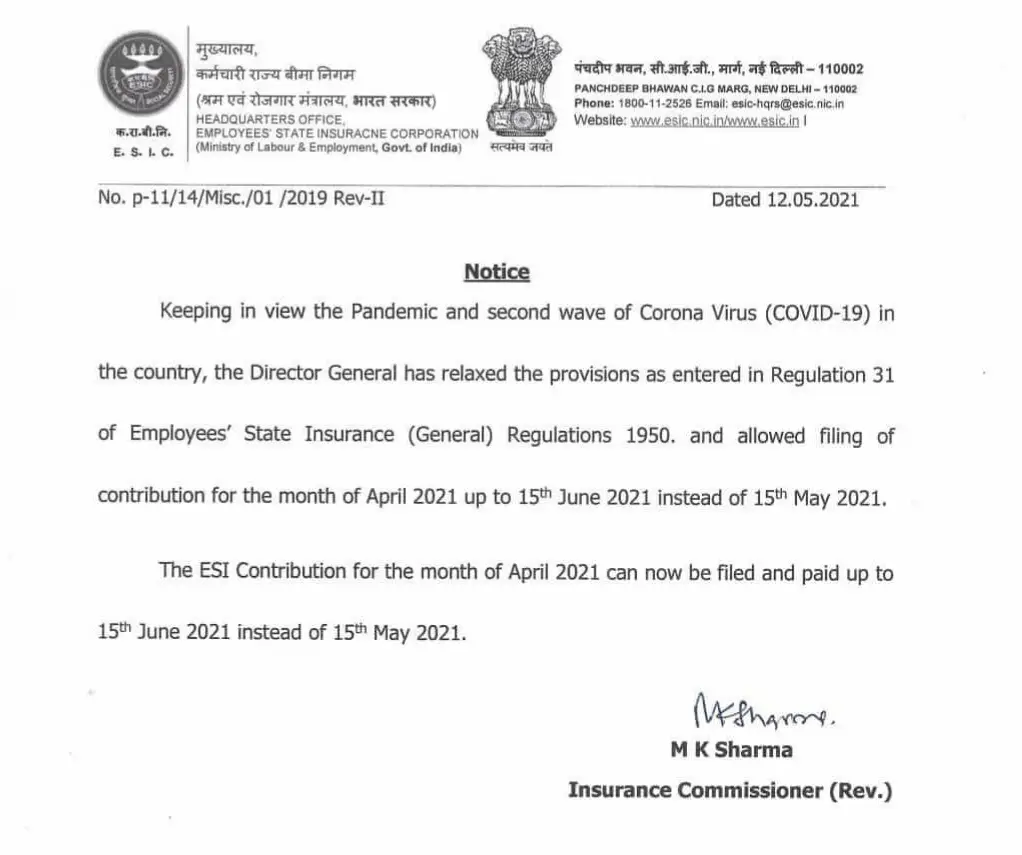
Keeping in view the pandemic and second wave of COVID, the ESIC has extended due date for filing and paying ESI contribution for April 2021 till 15 June 2021.
Press Note is attached below:
The government on Wednesday approved the Production Linked Incentive (PLI) scheme for promoting battery storage at an estimated outlay of Rs 18,100 crore With the objective to promote the ‘Make in India’ initiative, National Programme on Advanced Chemistry Cell (ACC) Battery Storage is expected to attract investment of Rs 45,000 crore, Information and Broadcasting Minister Prakash Javadekar told reporters after the Cabinet meeting.
The policy aims to make manufacturers globally competitive, boost exports, achieve economies of scale and produce cutting edge products.
ACCs are the new generation of advanced storage technologies that can store electric energy either as electrochemical or as chemical energy and convert it back to electric energy as and when required, an official statement said.
Major battery consuming sectors like consumer electronics, electric vehicles, advanced electricity grids, solar rooftop etc. are expected to achieve robust growth in the coming years, it said, adding it is likely that the dominant battery technologies will control some of the world”s largest growth sectors.
The power ministry is monitoring the supply to 73 major identified oxygen plants across the country, out of which 13 oxygen plants supply oxygen to the Delhi-NCR region. The ministry has said it is taking proactive measures amid the second wave of coronavirus.
The power supplies to all such plants is reviewed every day at the level of the secretary, ministry of power, along with the concerned energy secretaries of the states, CMD, POSOCO on a case by case basis. All issues related to 24×7 power supply to oxygen plants are discussed in real-time and interventions are planned and executed immediately by the state discoms aided by POSOCO and Central Electricity Authority.
also read

The PM CARES Fund has approved the procurement of 1,50,000 units of Oxycare System developed by the Defence Research Development Organisation at a cost of Rs 322.5 crore as informed by DRDO. It further informed that the Oxycare System is an SpO2 based Oxygen Supply System, that regulates oxygen being administered to patients based on sensed SpO2 levels. It further added,” Under this sanction, 1,00,000 manual and 50,000 automatic oxycare systems along with NRBM (Non- rebreather mask) masks are being procured. The Oxycare system delivers supplemental oxygen based on SpO2 levels and prevents the person from sinking into a state of Hypoxia, which can be fatal.”
The system was developed by the Defence Bio- Engineering and ElectroMedical Laboratory (DEBEL) in Bengaluru of the DRDO for soldiers posted at extreme high altitude areas. The system is indigenously developed for operations in field conditions and is robust. This comes amid the huge increase in demand for medical supplies as COVID-19 cases continue to rise across the country.
India’s recent move to allow 5G trials without Chinese companies Huawei and ZTE is a “sovereign” one, US State Department spokesperson Ned Price said. “We’re deeply concerned about…dangers of installing networks with equipment that can be…potentially controlled by the PRC (People’s Republic of China),” he added. In 2020, the US designated Huawei and ZTE as “national security threats”.
Several media reports have covered the news of World Health Organisation (WHO) classifying B.1.617 as variant of global concern. Some of these reports have termed the B.1.617 variant of the coronavirus as an “Indian Variant”.
These media reports are without any basis, and unfounded.
This is to clarify that WHO has not associated the term “Indian Variant” with the B.1.617 variant of the coronavirus in its 32 page document.
In fact, the word “Indian” has not been used in its report on the matter.
The Subject Expert Committee (SEC) has given a nod to Bharat Biotech’s Covaxin for Phase 2 and 3 human clinical trials on children aged between two to eighteen years old.The Committee after the detailed deliberation, recommended conducting the phase 2 and 3 clinical trial of the whole virion inactivated Coronavirus vaccine in the age group of 2 to 18 years subject to the condition that the firm must submit the interim safety data of phase 2 clinical trial along with DSMB recommendations to the CDSCO ( Central Drug Standard Control Organization ) before proceeding to the phase 3 clinical trial. Covaxin is one of the two vaccines being manufactured in India at present and has been developed by Bharat Biotech in association with the Indian Council of Medical Research and the National Institute of Virology.
The United Nations has raised India’s growth forecast to 7.5 percent for calendar year 2021, marking a 0.2 percent increase from its projection in January, but said the country’s outlook for the year remains highly fragile. As per the World Economic Situation and Prospects Report the surging Covid-19 infections and inadequate vaccination progress in many countries threaten a broad based recovery of the world economy. It also projected India’s GDP to grow by 10.1 percent in 2022.
The UN report said the country has expanded vaccine eligibility and is ramping up supply in every possible manner but access to vaccines is unequal and insufficient to meet the massive demand. The global economy is now projected to expand by 5.4 percent in 2021 following a sharp contraction of 3.6 percent in 2020, reflecting an upward revision from the UN forecasts released in January. Amid rapid vaccination and continued fiscal and monetary support measures, China and USA -the two largest economies are on the path of recovery. In contrast, the growth outlook in several countries in South Asia, sub- Saharan Africa, latin America and the Carribean remains fragile and uncertain.
For many countries, said the report, economic output is only projected to return to pre pandemic levels in 2022 or 2023. The report said,” Regional economic growth will return in 2021 at 6.9 percent against a 5.6 percent drop in 2020 but the recovery will be very uneven, and the scarring effects will run deep.”
Indiabulls Housing Finance on Tuesday decided to divest its mutual fund business to investment platform Groww for Rs 175 crore. Indiabulls Mutual Fund is one of India’s largest housing finance companies having a net worth of over Rs 16,500 crore. The company is engaged in providing home loans and loans to small business owners.
Indiabulls Housing said it plans to focus management bandwidth and consolidate capital towards real estate asset management business in line with its asset light strategy. The company expects the transactions with Groww to conclude by June 30, 2022. Groww started its financial services business in May 2016 and is one of the leading tech platforms for investing in stocks and mutual funds.
World Health Organisation informed, the coronavirus variant B1617 first identified in India last year has been classified as a variant of global concern, with some preliminary studies showing that it spreads more easily. Dr. Maria Van Kerkhove, Technical lead COVID-19 at WHO said, “ The B1617 virus variant that was first identified in India has been classified as a variant of interest by WHO. She added that WHO needs much more information about this variant and all of the sub lineages. She said, “ Our Epi teams and our lab teams internally, there is some available information to suggest increased transmissibility of B1617, as such we are classifying this as a variant of concern at the global level.”
Ola Foundation announced a partnership with GiveIndia to provide consumers with oxygen concentrators for free through the Ola App. The service will start rolling out in Bengaluru from this week with an initial set of 500 oxygen concentrators. Ola and GiveIndia will scale it up across the country with upto 10,000 concentrators in the coming weeks.
Consumers will be able to log into the Ola app and request for oxygen concentrators by providing a few basic details. Once submitted, the request will be validated and Ola will then pick up the concentrators via one of its cabs with a specially trained driver and bring it to the consumer’s doorstep. Once the patient has gotten better and no longer requires the concentrator, Ola will pick the device back up and return it to GiveIndia to get it ready for the next patient who needs it. This entire experience will be seamless and the oxygen concentrator, as well as the doorstep delivery and pickup, will be completely free for consumers.
“We must come together and help our communities during these unprecedented times.” said Bhavesh Aggarwal, Chairman and Group CEO at Ola. Atul Satija, CEO and Founder 2.0 at GiveIndia, the initiative will provide oxygen concentrators to those recovering or isolating at home, right at their doorsteps. “We hope the easier access to oxygen will ease the distress of many patients.”
Simplex Plast has received a BIS license to manufacture 10,000 litre Double Layer Plastic Storage Tanks with ISI mark. Simplex Plast is the first water storage solution providing company working since 1990. The objective was very clear of providing a strong, durable and efficient water storage solution for every Indian Family. Simplex has its manufacturing and testing facility at Vasai, near Mumbai in Maharashtra, with dealers spread across the state of Maharashtra and Gujarat. Over the years Simplex Plast has built an image of providing the best in class Rotomoulded products like Water Storage Tanks and Dustbins. The varieties of water tank they offer are:- Loft Tanks, Double Layer Tanks, Triple Layer Tanks, Four Layer Puff Tanks, Underground Tanks, Chemical Storage Tanks and ISI Marked Double Layer Tanks, Dustbins.
Bharatiya Janata Party (BJP) leader Himanta Biswa Sarma was sworn in as the 15th Chief Minister of Assam on Monday replacing former Chief Minister Sarbananda Sonowal. Sarma, who was the charioteer of Bharatiya Janata Party’s stride in Northeast was administered the oath in presence of state Governor, Jagdish Mukhi, the BJP national President JP Nadda and other leaders.
On being announced the Chief Minister of the state Sarma took to Twitter to express his gratitude to the people of the state. He tweeted, “ With fragrance of Assam in my heart & love of my wonderful people in my veins, I offer my deepest gratitude to you all. I would not have been what I am had it not been for your pious faith in me. On this day, I vow to work with & for each one of you with greater passion Assam.”
The Competition Commission of India (CCI) approves proposed acquisition of 100% shareholding and sole control of Ingram Micro Inc. by Imola Acquisition Corporation.
The proposed combination concerns the proposed acquisition of 100% shareholding and sole control of Ingram Micro Inc. together with its parent companies (i) GCL Investment Management Inc. and GCL Investment Holding Inc. and (ii) its direct and indirect subsidiaries (collectively referred to as Ingram Micro).
Imola is a newly incorporated entity belonging to Platinum Equity Group. Platinum Equity Group specialises in the merger, acquisition and operation of companies that provide services and solutions to customers in a broad range of businesses, including information technology, telecommunications, logistics, metal services, manufacturing and distribution.
Ingram Micro is a US Headquartered IT company that specialises in technology distribution and logistics, cloud solutions, and e-commerce supply chain services.
A detailed order of the CCI will follow.
You May Also Like: SBI Account Transfer Online : How to change online SBI savings account branch?
Follow Us on Twitter for Regular Updates: Click Here to Visit Our Twitter Handle
Live Coaching Classes (LCC) Batch -3 commencing from 10th May 2021 respectively for Students of Intermediate course appearing in Nov 2021 examination and Final course for Nov 2021 and May 2022 examination.
The Board of Studies has been proactive to adopt different methodologies to reach out to the students and provide quality learning resources, year after year in an incremental manner.
The BOS, with an objective to enable the students to sail through the present times, announces 3rd Batch of ‘Live Coaching Classes’ for Final & Intermediate course students commencing from 10th May 2021. These classes are conducted for students who will be appearing in Intermediate exam in Nov 2021 & Final exam in Nov 2021 & May 2022.
Schedule and Timings: |
| CourseScheduleSession ISession IIIntermediateClick here7 – 9.30 AM6 – 8.30 PMFinalClick here7 – 10 AM6 – 9 PM |
Students can attend the classes at: https://live.icai.org/bos/vcc/ The classes can also be viewed at ICAI CA Tube (YouTube) channel. Notable Features: Streamed live using internet technology.Can be accessed live or viewed later as recorded lectures through hand-held devices such as smart phones, laptops, iPads, tablets, etc. anytime anywhere.Sessions by Renowned Subject Experts.Coverage of entire syllabus.Interactive in nature – with facility to raise questions.Examination focused approach.Available to all without any chargeNotes/Assignment available as per exam focused approach and downloadable by the students. |
| Director, Board of Studies |
Change SBI Branch Online
How to change SBI branch online?
2. If you already use Internet Banking, then login to Personal Banking.

3. If there is no registration before then user ID will have to be created first. After this, you will be able to login.
4. After login, click on “E-Services” and go to the “Transfer of Saving Accounts” section in the Quick Links given on the left side.

5. Now choose the savings account to be transferred. If there is only one savings account in SBI, then it will be selected automatically.
6. Now enter the branch code of the branch you want to transfer.
7. After entering the code, click on “Gate Branch Name”. And select new branch.
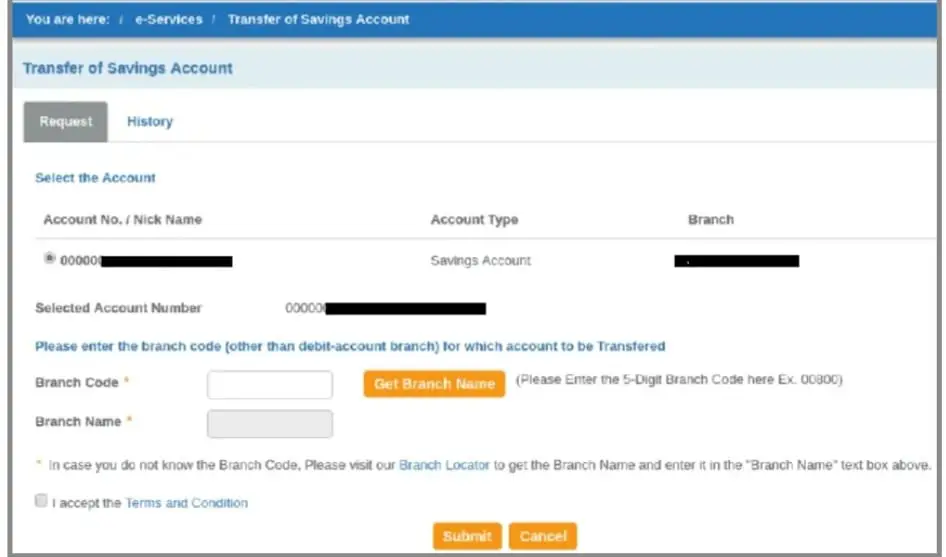
8. Enter the name of the new branch in the specified space. Read the terms and conditions and click on submit.
9. Now all the details you have filled will be shown. Then click on confirm.
10. After confirming the details, a high security password will come on the registered mobile number in the bank.
11. Enter the high security password and click on confirm.
12. In the last, the message of registering the request for change of savings account will be shown along with all the details.
13. A new page will appear showing Congrats, your State Bank of India account transfer request has been successfully submitted.
BoS of ICAI is all set to launch its ICAI-BOS mobile app enabling students to get interactive learning & coaching. App will soon be accessible on both android and iOS play stores.
The Defence Research and Development Organisation (DRDO’s) new anti COVID drug, approved by the Drug Controller General of India (DCGI). DRDO scientists said it is effective against different variants of the coronavirus and helps in bringing out patients out of oxygen support.
As per the scientist at the DRDO’s Institute of Nuclear Medicine and Allied Sciences, “In the Phase 3 trial for 2- deoxy-D-glucose (2-DG), a large number of patients were tested and it was found that many patients are coming out of oxygen support. The mechanism of action is very unique and as per the basic principles of this drug, it will be very effective on different variants of the SARS- CoV-2 virus.”
In a statement DRDO informed that the clinical trial results have shown that this molecule helps in faster recovery of hospitalized patients and reduces supplemental oxygen dependence. A higher proportion of patients treated with 2-DG showed RT-PCR negative conversion in Covid patients. The drug will be of immense benefit to the people suffering from Covid-19 in the ongoing pandemic. This comes as a promising development amid the devastating second wave of Covid-19 pandemic, which has brought the country’s healthcare infrastructure to its knees.
Central Board of Secondary Education (CBSE) has launched a new mobile application for psycho social wellness of students and parents. The new app namely CBSE Dost for Life has been designed for students of classes 9 to 12 and it can be used for counselling sessions from 10th May.
Making a departure from the existing practice of counselling through toll free numbers across the country, the board has designed this facility for the ease, convenience and utility of students and parents within the safe home environment. Through this app, live counselling sessions will be conducted free of cost on Monday, Wednesday and Friday by the trained counsellors.
The students and parents can choose any of the two time slots – 9.30 AM to 1.30 PM or 1.30 PM to 5.30 PM and connect through a chat box as per their convenience. The app will also provide students information on suggestive course guides after ten plus two, tips on mental health and well-being, a corona guide and rap songs.
Students can download the app from the Google Play Store:-
https://play.google.com/store/apps/details?id=com.cbse.it.CBSEDOST_FOR_LIFE
As per the official statement from the central government, the company wise supply plan of Remdesivir for the period of April 21 to May 16 has been issued to states and union territories. The plan has been prepared in consultation with the marketing companies. The companies have been instructed to ensure timely supplies to all states and union territories strictly as per the supply plan. This development comes in continuation to the allocation of Remdesivir to states and union territories done on Friday.
Union Minister of Chemical and Fertilizers D V Sadananda Gowda informed on Friday, that allocation of Remdesivir vials to the state has been made up to May 16 in the wake of Covid pandemic. He tweeted, “Considering the requirement of Remdesivir in every state and ensuring its adequate availability, allocation of Remdesivir has been made up to 16th May 2021. This will ensure smooth supply of Remdesivir across the country so that no patient faces difficulty in this pandemic time.” He also shared an official notification with a list which stated 5,30,0000 vials of Remdesivir have been allocated to states between April 21 and up to May 16.
Ad hoc Exemption Order No. 4/2021-Customs dated 3 May, 2021 (said Order) exempting IGST on imports of specified COVID-19 relief material subject to conditions – regarding
The Company-wise supply plan of Remdesivir for the period 21st April to 16th May 2021 has been issued to States/UTs. The plan has been prepared in consultation with the marketing companies. The companies have been instructed to ensure timely supplies to all states/ UTs strictly as per the supply plan.
This is in continuation to the allocation of Remdesivir to states/UTs done yesterday.

Investment in stock market has increased manifold in recent times. India’s total active demat accounts stood at 56.9 million as of 30 April, up from 40.8 million at the end of 31 March 2020 and 35.9 million in 31 March 2019. A strong rally in the equity markets in the past year and new investment opportunities in the form of initial public offerings (IPOs) lured retail investors. The market share of individual investors increased sharply by 12 percentage points to 45% in FY21 from 33% in FY16, offsetting the decline in the share of FIIs and public and private corporates during the same period. Retail investors are now Big Bulls of Indian equity markets.
Statistics related to number of tax payers – The number of taxpayers in India is reportedly 1.46 crore, as confirmed by the Central Board of Direct Taxes. This is a small number when you take the total population of 130 crore into perspective. CBDT further clarified that one crore taxpayer reported income between the range of Rs 5-10 lakh, while only 46 lakh reported over Rs 10 lakh.
“If you look at the above active retail participation numbers, the yearly active customers are just ~1% of India’s population. This if you would compare to developed markets, is ~ 20%.People who can invest or trade in the markets need to have money to trade or invest. There were only 5.78 crore people who filed income tax returns last year. Out of that, 75% earned less than ₹5L/year. While there still exists a substantial parallel economy where income isn’t declared, it is difficult for such money to flow into capital markets. With this data in mind, if you looked at the target market size, it would seem like it has to be a subset of 5.78 crores. At 1.3 crores active investors, that is an almost ~20% penetration of the realistically addressable market and not ~1%.”- Nithin Kamath,CEO,Zerodha
By such an increase in Retail Individuals in Indian Markets, we felt the need for TAX LITERACY.
An investment in knowledge pays the best interest.” — Benjamin Franklin
Taxation plays a major role in your Investment journey. In order to increase return on investment, one cannot ignore the tax aspect in every Investment decision. So we tried to simplify tax for you by explaining the provisions in layman’s terms. We have only confined to taxation of stock market transactions by Resident Individual.
Income tax in India is levied vide Income tax Act, 1961. Levy of income tax is based on the type of income you earn. Heads of income under Income tax are broadly classified as –
In this post we will be discussing taxation of Stock market gains from both Investor and trader’s perspective. We have started this initiative as we observed that people ignore tax aspects while taking their financial decisions. Out of them –Some regret at the year-end while filing return by paying more taxes and some are non-compliant. If you are either of them, this series is for you.
You can go through this series and learn taxation aspects while taking financial decisions (Significance of such consideration is explained by an example – If you sell a share holding it for 364 days then such gain is taxable at 15% and if you sell the same after 365 days you are not required to pay tax up to gain of 1 lakh). One may argue that they have their financial or tax consultant for this, but you have to be aware of the basics of taxation as you are going to submit your statement of transactions to your consultant at the year end but by then all the transactions are done and they cannot be modified.
For Non Complier’s – It’s high time you have to disclose your earnings and pay tax dues genuinely. In this digital era, everything is being tracked on real-time basis and it is highly impossible to escape from paying taxes and day by day the regulations are being more stringent. You can consider many recent improvements such as SFT Filing, Mandatory return for Individual paying electric bill above 1lakh etc. Government has access to all your stock market holdings and transactions, so rather than receiving notices from Department, it is better to you file your returns voluntarily.
In this series, rather than using jargons, we will keep it simple and understandable by describing in such a way that a layman can understand.
In order to determine the amount of tax liability on your stock markets transactions, you have to go through some basic concepts of Income tax.
We will explain these in four parts –
Residential status of an individual determines the amount of tax that an individual is liable to pay. If an individual is a Resident of India as per Income-tax rules, then he is liable to pay income tax on Global Income. So, if you are a resident of India, you will be liable to pay income tax on your income derived from Indian holdings and foreign holdings (Ex – Dividend from Google Inc). If you are a Non-Resident of India, you will only be liable to pay tax on Indian Holdings.
We will confine this article assuming that the tax payer to be resident. If tax payer is a Non-resident, he is eligible to certain exemptions. We will discuss Non-Resident taxation in our future articles.
To make it simple assume that if your stay in India is for more than 183 days in the previous year (April to March) that you considered to be a resident.
Tax Slabs –
Individual Age – less than Or equal to 60 years
| Income | Tax Rate |
| 0 to 2.5 Lakh* | 0 |
| 2.5 to 5 Lakh | 5% |
| 5 to 10 Lakh | 20% |
| Above 10 Lakh | 30% |
Individual age above 60 years
| Income | Tax Rate |
| 0 to 3 Lakh | 0 |
| 3 to 5 lakh | 5% |
| 5 to 10 lakh | 20% |
| Above 10 lakh | 30% |
Individual age above 80 years –
| Income | Tax Rate |
| 0 to 5 Lakh | 0 |
| 5 to 10 lakh | 20% |
| Above 10 lakh | 30% |
Above tax rates are normal rates of tax chargeable to Individual. However capital gains are chargeable at a concessional rate in order to encourage Investing in Financial Markets.
Individual earns three types of Income from Stock market –
Capital Appreciation (Capital Gain)
Business Income
Dividend (Income)
Every classification above has different treatment for their taxation. We will discuss each head separately.
As discussed above capital gains are taxed at low rates when compared to Business Income (Normal Slab rates). So, every Individual wants to classify his income as Capital Gain to earn the benefit of being taxed at low rates. However, it’s not that simple. This is always a matter of contention between the department and tax payer regarding the classification of earnings from stock market. In order to clarify on the above issue, government has given two-point criteria.
However, this is still an open issue which is a matter of disagreement between tax payer and the department. The various judicial pronouncements have given conflicting judgements. the
It is further clarified that FIFO method is to be considered while determining the Cost of Acquisition. (Assume that you bought 1 Yes Bank share at 155 on 05 Feb 2016 and one at 323 on 14 Sep 2018. Your average cost is 239.You sold one share at 268 on 12th April 2019. What is your capital gain? It is not 29 (Rs268-Rs239), it is Rs 113 (268-155).)
Taxation of Capital Gains –
Long Term Capital Gains –
Capital Gain = Sale Value – Purchase Value (Expense such as brokerage, GST etc., on purchase and sale are also allowed as deduction).
However, STT is not allowed as deduction.
Capital gain above 1 lakh is chargeable at a rate of 10%. So, if you have a capital gain of 2 lakh in a year then 1 lakh is not chargeable to tax and 1 lakh is chargeable at the rate of 10%. This exemption is only available for listed shares. As this article is confined to taxation on listed shares and derivatives, we have not discussed the other rates of tax for unlisted shares, debentures etc.
Capital gains are exempt (not chargeable) from tax irrespective of amount of gain till FY 2017-18. However, in Budget 2018 the limit of 1 lakh was imposed (Post this amendment market has fallen 3000 points between the period Feb-March2018). It would be unfair to bring such a sudden change, hence Government decided to provide relief to tax payers who are holding stocks as on 31.01.2018 to consider market price [Highest Price (Imagine an upper circuit on that day and you would be benefited) on such date as their cost of acquisition. If your cost is more than the market price as on 31.01.2018 then you can continue to consider your actual cost as your cost of acquisition (For example ITC is trading around 275 on 31.01.2018, if you have purchased ITC during June 2017 your Cost of acquisition would be 310+. In such cases you can consider your original cost as Cost of acquisition].
Govt has issued FAQ’s regarding the amendment(change). Extract of the same (modified for clear understating) is given below –
Q 4. What is the method for calculation of long-term capital gains?
Ans 4. The long-term capital gains will be computed by deducting the cost of acquisition from the full value of consideration on transfer of the long-term capital asset.
Q 5. How do we determine the cost of acquisition for assets acquired on or before 31st January, 2018?
Ans 5. The cost of acquisition for the long-term capital asset acquired on or before 31st of January, 2018 will be the actual cost. However, if the actual cost is less than the market value of such asset as on 31st of January, 2018, the market value will be deemed to be the cost of acquisition. Further, if the full value of consideration on transfer is less than the fair market value, then such full value of consideration or the actual cost, whichever is higher, will be deemed to be the cost of acquisition.
Q 6. How will the market value be determined?
Ans 6. In case of a listed equity share,
Market value means the highest price of such share or unit quoted on a recognized stock exchange on 31st of January, 2018.
However, if there is no trading on 31st January, 2018, the fair market value will be the highest price quoted on a date immediately preceding 31st of January, 2018, on which it has been traded.
Q 7. Please provide illustrations for computing long-term capital gains in different scenarios, in the light of answers to questions 5 and 6.
Ans 7. The computation of long-term capital gains in different scenarios is illustrated as under – Scenario 1 – An equity share is acquired on 1st of January, 2017 at Rs. 100, its fair market value is Rs. 200 on 31st of January, 2018 and it is sold on 1st of April, 2018 at Rs. 250. As the actual cost of acquisition is less than the fair market value as on 31st of January, 2018, the fair market value of Rs. 200 will be taken as the cost of acquisition and the long-term capital gain will be Rs. 50 (Rs. 250 – Rs. 200).
Scenario 2 – An equity share is acquired on 1st of January, 2017 at Rs. 100, its fair market value is Rs. 200 on 31st of January, 2018 and it is sold on 1st of April, 2018 at Rs. 150. In this case, the actual cost of acquisition is less than the fair market value as on 31st of January, 2018. However, the sale value is also less than the fair market value as on 31st of January, 2018. Accordingly, the sale value of Rs. 150 will be taken as the cost of acquisition and the long-term capital gain will be NIL (Rs. 150 – Rs. 150).
Scenario 3 – An equity share is acquired on 1st of January, 2017 at Rs. 100, its fair market value is Rs. 50 on 31st of January, 2018 and it is sold on 1st of April, 2018 at Rs. 150. In this case, the fair market value as on 31st of January, 2018 is less than the actual cost of acquisition, and therefore, the actual cost of Rs. 100 will be taken as actual cost of acquisition and the long-term capital gain will be Rs. 50 (Rs. 150 – Rs. 100).
Scenario 4 – An equity share is acquired on 1st of January, 2017 at Rs. 100, its fair market value is Rs. 200 on 31st of January, 2018 and it is sold on 1st of April, 2018 at Rs. 50. In this case, the actual cost of acquisition is less than the fair market value as on 31st January, 2018. The sale value is less than the fair market value as on 31st of January, 2018 and also the actual cost of acquisition. Therefore, the actual cost of Rs. 100 will be taken as the cost of acquisition in this case. Hence, the long-term capital loss will be Rs. 50 (Rs. 50 – Rs. 100) in this case.
Q 10. What will be the tax treatment of accrued gains up to 31st January 2018?
Ans 10. As the fair market value on 31st January, 2018 will be taken as cost of acquisition (except in some typical situations explained in Ans 7.), the gains accrued up to 31st January, 2018 will continue to be exempt.
Q 12. What will be the tax treatment of transfer made on or after 1st April 2018? Ans 12. The long-term capital gains exceeding Rs. 1 Lakh arising from transfer of these asset made on after 1st April, 2018 will be taxed at 10 per cent. However, there will be no tax on gains accrued up to 31st January, 2018 as explained in Ans 10.
Q13. What is the date from which the holding period will be counted?
Ans 13. The holding period will be counted from the date of acquisition. (Holding period is relevant to determine whether gain is chargeable as long term (10%) or short term (15%) –will be discussed subsequently)
Q21. What will be the cost of acquisition in the case of bonus shares acquired before 1 st February 2018?
Ans 21. Market value of the bonus shares as on 31st January, 2018 will be taken as cost of acquisition (except in some typical situations explained in Ans 7), and hence, the gains upto 31st January, 2018 will continue to be exempt.
Cost of acquisition of bonus shares is NIL. As you have not paid any consideration for such shares there is no cost of acquisition.
Q 22. What will be the cost of acquisition in the case of right share acquired before 1st February 2018?
Ans 22. Market value of right share as on 31st January, 2018 will be taken as cost of acquisition (except in some typical situations explained in Ans 7), and hence, the gains accrued upto 31st January, 2018 will continue to be exempt.
Q 24. What will be the treatment of long-term capital loss arising from transfer made on or after 1st April, 2018?
Ans 24. Long-term capital loss arising from transfer made on or after 1st April, 2018 will be allowed to be set-off and carried forward in accordance with existing provisions of the Act. Therefore, it can be set-off against any other long-term capital gains and unabsorbed loss can be carried forward to subsequent eight years for set-off against long-term capital gains.
When you are paying taxes on your gains, then what about the cases in which you incur losses. Will the government refund your tax which you have paid in the previous year! Unfortunately, No. However, you have an option to carry forward such loss to future years so that if you have profit in future years, you can pay less tax by adjusting your losses pertaining to the previous years. – we will discuss rules regarding these subsequently.
So, the key takeaways are –
To be continued…..
This post is published in association with Stox N Tax (Personal Investment & Taxation Blog).
https://stoxntax.wordpress.com/
Got questions? Just ask-taxconcept4@gmail.com,anilteneti6@gmail.com.
also read
The Union Health Ministry has introduced a new 4 digit security code feature in the CoWIN portal. The ‘4 digit security code’ to minimise errors for online bookings/ appointments operational from May 8. The step was taken after it came to notice that some citizens , who had booked their appointment for COVID-19 vaccination through the CoWIN portal but did not actually go for the vaccination on the scheduled date, received SMS notification saying that a vaccine dose has been administered to them.
The Health Ministry stated, “upon examination it has been found to occur largely on account of the vaccinator wrongly marking the citizen as vaccinated, an instance of data entry error by the vaccinator.” The Ministry said. “ In order to minimize such errors and the subsequent inconvenience caused to the citizens, the CoWIN system is introducing a new feature of 4 digit security code in the CoWIN application from May 8. Now, after verification, if the beneficiary has been found as eligible, before administering the vaccine dose, the verifier/vaccinator will ask the beneficiary about his/her 4 digit code and then enter the same in the CoWIN system to correctly record the vaccination status.”
The Ministry further said, this new feature will be applicable only for citizens who have done online booking for a vaccination slot. The 4 digit security code will be printed in the appointment acknowledgement slip and will not be known to the vaccinator. The four digit code will also be sent in the confirmation SMS sent to the beneficiary after successful booking of appointment. The Appointment Acknowledgement slip can also be saved and shown from the mobile.
payment received in cash during 01.04.2021 to 31.05.2021, on obtaining the PAN or AADHAAR of the patient and the payee and the relationship between the patient and the payee
MINISTRY OF FINANCE
(Department of Revenue)
(CENTRAL BOARD OF DIRECT TAXES)
NOTIFICATION
New Delhi, the 7th May, 2021
(INCOME-TAX)
S.O. 1803(E).—The Central Government, in exercise of powers conferred by clause (iii) of Proviso to Section 269ST of the Income-tax Act, 1961, hereby specifies Hospitals, Dispensaries, Nursing Homes, Covid Care Centres or similar other medical facilities providing Covid treatment to patients for the purpose of Section 269ST of the Income-tax Act,1961 for payment received in cash during 01.04.2021 to 31.05.2021, on obtaining the PAN or AADHAAR of the patient and the payee and the relationship between the patient and the payee by such Hospitals, Dispensaries, Nursing Homes, Covid Care Centres or similar other medical facilities.
also read
NFC-enabled transactions are more intuitive and convenient. Many fintech companies are working on NFC payments as it allows transactions without the use of an Internet connection.
Given the need for social distancing in the midst of the Corona crisis, Google Pay is launching NFC based payments for its users. NFC based payment does not require users to swipe cards at the place of purchase. Instead, the user can pay without touching his device by bringing it closer to the point of sale machine.
With the help of NFC, the user can make contactless payments, in which the users do not need to swipe the card. Users need to keep the NFC enabled device with the swipe machine and authorize the transaction. In the midst of Corona crisis, this service is considered very important because it does not require contact and the risk of infection is very low. This feature will soon be added to your Google pay account.
Good news. The central bank RBI has asked all the banks not to freeze the bank account of anyone till 31 December 2021 in case there is no KYC updte i.e. the worries of the bank account freezing due to not having the KYC update by the end of this year. happened.
Get KYC updates done at home
Apart from this, State Bank of India (SBI), the country’s largest bank, gave a big relief to the account holders for updating the KYC. SBI has approved updating KYC by sending documents to the account holders via post or registered e-mail. Now SBI account holders do not need to go to the bank branch to update KYC.
According to the information given by SBI, some banking services of SBI were disrupted due to maintenance activities from 10:15 pm on Friday, May 7 to 01:45 pm on May 8 (ie at 2 pm after 12 pm today). Will stay. According to the information given by the bank, Internet banking, YONO, YONO Lite and UPI services of SBI will remain closed during this period, i.e. if any important financial transaction is to be done, then settle it before 10:15 PM tonight.
THE COMPANIES ACT, 2013
The Asian Development Bank has launched a hub to create an open and inclusive platform to promote strategic policy dialogue, improve knowledge sharing and strengthen coordination on tax policy and administration among ADB members and development partners. The Asia Pacific tax hub will maximize regional and international resources to strengthen domestic resource mobilisation and international tax cooperation in ADB’s developing member countries.
ADB President Masatsugu Asakawa said,” Domestic resource mobilisation has emerged as a major strategic priority for our developing member countries at this moment. It will be vital in the effort to address debt sustainability and to achieve the Sustainable Development Goals.” He further said, the lack of pan-tax regional community has been a unique and significant shortcoming for Asia and the Pacific.
The hub will support developing member countries on three main building blocks like preparation of medium term revenue strategies, roadmap for automation of tax administration and proactive participation in international tax initiatives. Through the hub, ADB will coordinate closely with the International Monetary Fund (IMF) to support developing member countries as they formulate country specific medium term revenue strategies. It will conduct need assessments to prepare roadmaps for the automation of tax administration in developing member countries, and support their implementation in collaboration with developing partners and leading countries.
The hub will facilitate policy dialogue with the Organization for Economic Cooperation and Development (OECD) and stimulate proactive participation of domestic member countries in the inclusive framework on Base Erosion and Profit Shifting and the Global Forum on Transparency and Exchange of Information for Tax Purposes. Besides, it will apply financial instruments like policy based and project lending and technical assistance to promote domestic resource mobilisation, adoption of international tax standards and strengthened technology investment by revenue agencies. The hub will organize a first high level conference by the fourth quarter of 2021.


