The Goods and Services Tax Network (GSTN) has implemented multiple changes in Table 12 of GSTR-1 return starting from the January 2025 tax period. The deadline to file GSTR-1 for January 2025 tax period is February 11, 2025. This means on or before February 11, 2025 when you file GSTR-1 the specified new rules will have to be followed otherwise the return will be considered faulty. Needless to say if the supplier’s GSTR-1 is faulty then the buyer’s GSTR-2B will get populated with wrong details.
Also, a buyer can’t take input tax credit (ITC) on such faulty return and will thus have to wait for the seller to make the necessary corrections.
Read below to find out what GST registered suppliers need to do now for filing a correct and compliant GSTR-1 return.
What did GSTN say about new rules for filing GSTR-1?
According to the advisory by GSTN dated January 9, 2025, after successful implementation of Phase-I & Phase-II now Phase-III regarding Table 12 of GSTR-1 & 1A is being implemented, from the return period of January 2025.
Changes in GSTR-1 reporting-Phase 3
According to the advisory, “In this phase manual entry of HSN has been replaced by choosing the correct HSN from the given Drop down. Also, Table-12 has been bifurcated into two tabs namely B2B and B2C, to report these supplies separately.
Further, validation regarding values of the supplies and tax amounts involved in the same, have also been introduced for both the tabs of Table-12.
Here’s a summary of the changes in GSTR-1 reporting
According to the advisory by GSTN here are the details:
A customized description mentioned in HSN master will auto-populate in a new field called “Description as per HSN Code”
In Table-12 validation with regards to value of the supplies have also been introduced.
“These validations will validate the value of B2B supplies shown in different Tables viz: 4A, 4B, 6B, 6C, 8 (recipient registered), 9A, 9B (registered), 9C (registered), 15 (recipient registered), 15A (recipient registered) with the value of B2B supplies shown in table-12.
Similarly, validations will validate the value of B2C supplies shown in different tables viz: 5A, 6A, 7A, 7B, 8 (recipient unregistered), 9A (export), 9A (B2CL), 9B (unregistered), 9C (unregistered), 10, 15 (recipient unregistered), 15A (recipient unregistered) with the value of B2C supplies shown in Table-12.
In case of amendments, only the differential value will be taken for the purpose of validation.”
For the first few months no adverse impact will happen as GSTN will let you go with a warning. This means failing the validation will not be a blocker for filling of GSTR-1 & 1A.
GSTN said: “However, initially these validations have been kept in warning mode only, that means warning or alert message shall be shown in case of mismatch in values, whereas taxpayers will be able to file GSTR-1 in such cases. Further, in case B2B supplies are reported in other tables of GSTR-1, in that case the B2B tab of Table-12 cannot be left empty.”
“If B2B Supplies have taxable value of Rs 1000 and SGST CGST Value is Rs 180-180. Then the taxpayer has to be careful to report B2B supplies HSN details in the B2B Table and B2C supplies HSN details in the B2C Table in HSN tile. If such will not match then the GST portal gives red marks, in the same manner whenever the Taxpayer enters RCM Credit in Table 4.”
What might be the impact of implementation of phase 3 of table 12 GSTR-1 reporting
ET Wealth Online has asked various experts about what might be the impact of this implementation for GST registered persons. Here’s a summary of what they said:
Buyer’s input tax credit will now be streamlined as chances of supplier’s errors are reduced
“Now the GST portal itself will validate the HSN code inputted by the seller. Earlier this was a manual process of entering the HSN code. Now sellers have to type in the description of the goods and the HSN code will come down in the drop down menu. This will reduce the instances of wrong HSN code entries by the seller and thereby enabling the buyer to claim his input tax credit on time. Overall the process will be streamlined,” says Chartered Accountant Bimal Jain, founder, A2Z Taxcorp LLP.
Chartered Accountant Hrishikesh A. Wandrekar, partner, Wandrekar and company, agrees with Jain and adds: “The selection of the HSN Code from a drop-down list will now bring uniformity in the reporting data. The GSTIN has also introduced validation of the HSN Codes which will potentially reduce reporting errors.”
Seller now has more responsibility to file a correct GSTR-1 return
Jain says now sellers have to be careful about reporting the correct HSN codes. “If the supplier makes any mistake in inputting the correct description of goods and then selects the correct HSN code subsequently then this will result in incorrect GSTR-1 return. Such an incorrect return needs to be amended by the seller. This will result in delayed claims for input tax credit for buyers as the buyer can’t accept the invoice on the IMS portal if the data in his GSTR-2B and invoice is different.”
Jain says this situation will arise if the supplier inputs a lower GST rate product in his GSTR-1 while showing a higher GST rate product in the invoice. As a result, the GSTR-2B return will show mismatched data. “GSTR-2B is an auto-drafted input tax credit statement which is generated for every taxpayer on the basis of the information furnished by his suppliers in their respective GSTR-1 return,” he says.
Wandrekar says now suppliers will need to configure their reporting systems & software to comply with the new requirements. “Any bona fide errors in the reporting can be rectified through the amendments tab. Suppliers will now have to double-check their HSN Codes to ensure that the appropriate Code and the appropriate rate of GST has been charged on the supplies made,” he says.
Buyer needs to pay interest on input tax credit due to fault of seller
Wandrekar due to error in reporting of the HSN code by the seller in his GSTR-1 return the buyer will not face any immediate problem. However, when the seller will amend his GSTR-1 return, then at that time the buyer will be uimpacted.
He says, “Any consequent amendments have the potential of inflicting an additional tax liability on the part of the supplier as well as the buyer.
Example: If the supplier amends the sales invoice reducing the tax liability, the buyer would be deemed to have claimed a higher ITC, thus potentially resulting in interest & penalty implications (for no apparent fault of his) in addition to the increase in his tax liability.”
Wrong HSN codes in GSTR-1 may not impact buyer’s input tax credit
Singla says: If a supplier makes errors in GSTR-1, it can impact the buyer’s ability to claim Input Tax Credit (ITC). Accurate reporting in GSTR-1 is essential because the details uploaded by the supplier are reflected in the buyer’s IMS and subsequently in GSTR-2B. Any discrepancies or errors in the supplier’s filing can lead to mismatches, which may result in the buyer’s ITC claim being delayed, reduced, or even denied until the mismatches are resolved. However, if we focus only on this Advisory and impact on buyer’s ITC w.r.t. wrong reporting of HSN codes by supplier in Table 12, please note that HSN codes in Table 12 of GSTR-1/1A are meant for statistical purposes and compliance but do not directly impact the financial aspects of ITC claims. ITC eligibility for buyers is determined based on the details furnished in the B2B Invoicing Table of GSTR-1 by the supplier.
The critical data for ITC claims includes invoice details such as GSTIN, invoice number, date, taxable value, and tax amount.
Errors in reporting HSN codes in Table 12 do not directly affect the buyer’s ITC claims since ITC is not calculated based on HSN codes but on the tax amounts reported in the B2B table. As long as the supplier accurately reports the taxable value and GST in the B2B Invoicing Table, the buyer’s ITC should remain unaffected.
While incorrect HSN reporting may not impact ITC directly, it could raise compliance concerns during audits or scrutiny. Accurate HSN codes are essential for proper classification and may influence the perception of the transaction’s legitimacy during regulatory reviews.
Singla explains some Pros and cons of this advisory:Pros: 1. Bifurcation of HSN details into B2B and B2C supplies leads to more precise reporting. 2. The introduction of a downloadable HSN Codes List and the searchable “Product Name as in My Master” feature simplifies the process of finding and entering accurate HSN codes.
Cons: 1. For some taxpayers, especially small businesses, the bifurcation of B2B and B2C – HSN summary wise and additional details might increase the complexity of filing GSTR-1/1A, leading to overcompliance and errors. 2. Maintaining separate records for B2B and B2C supplies and ensuring accurate HSN code mapping might require additional effort and robust data management systems. 3. Errors in HSN code reporting can lead to mismatches in GST returns, affecting compliance and reconciliation efforts.
Singla says: This bifurcation of HSN reporting into B2B and B2C supplies in Table 12 of GSTR-1/1A only raises concerns about the increasing complexity of GST compliance. While the government may argue that this change enhances data accuracy and transparency, the practicality and utility of such detailed bifurcation are questionable.”
Singla adds: “Previously, a consolidated HSN summary was deemed sufficient for compliance and statistical purposes. The new requirement not only adds to the administrative burden for businesses, particularly small and medium enterprises, but also consumes valuable time and resources that could be better utilized in core business activities. The increased complexity does not seem to provide any tangible benefit to the taxpayer, yet it imposes additional compliance costs.Moreover, given that HSN codes are qualitative data primarily used for classification, their bifurcation into B2B and B2C categories appears redundant. ITC claims and other critical aspects of GST returns rely on the accurate reporting of taxable value and tax amounts, not the HSN code classification. Therefore, this move seems more aligned with gathering granular data for governmental analysis rather than serving the immediate needs of businesses.”
In the year 2024, the Central Board of Direct Taxes (CBDT) and Central Board of Indirect taxes and Customs (CBIC), under the Department of Revenue, Ministry of Finance, have continued their citizen-centric initiatives, driving significant reforms to enhance taxpayer experience.
The CBDT maintained its focus on taxpayer outreach and assistance through active helpdesks and embraced faceless processes, reinforcing its commitment to transparency and efficiency. Speedy processing of returns and refunds remained a priority, with over Rs. 2.35 lakh crore refunded and more than 3.87 crore Income Tax Returns (ITRs) processed within 7 days. Innovations like TIN 2.0, pre-filling of ITRs, and updated returns continued to streamline processes, resulting in 47.52 lakh updated returns filed.
The CBIC continued to review and reform initiatives towards enhancing the efficiency and integrity of the Goods and Services Tax (GST) system in its seventh year. The CBIC leveraged advanced data analytics and artificial intelligence to further strengthened its registration processes by refining the risk rating system for applicants, ensuring rigorous verification to prevent fraud. Initiatives such as geo-tagging of business locations, system-based suspension of registrations for non-filers, and risk-based refund processing continued to demonstrate CBIC’s commitment to curbing malpractices.
To simplify compliance, the sequential filing of GSTR-1 and GSTR-3B was enforced, promoting timely returns and seamless availability of input tax credits. Special drives against fake registrations, automated intimation of mismatches, and a dedicated functionality for unregistered persons to apply for temporary registrations highlighted CBIC’s proactive compliance measures.
Additionally, initiatives supporting businesses included the transfer of balances in electronic cash ledgers, exemptions for small taxpayers, and facilitation of intra-state supply through e-commerce operators. The extension of GST exemptions for satellite launch services and further simplification of late fee structures were also noteworthy.
On the Customs front, the CBIC introduced regulatory and policy reforms, such as rationalisation of Customs duty rates and steps toward decriminalisation. Technological advancements like ICEGATE 2.0 and the Anonymised Escalation Mechanism continued to modernise tax administration. Infrastructural upgrades, including pre-gate processing facilities and modernisation of control laboratories, enhanced operational efficiency. These efforts collectively reinforced CBIC’s commitment to transparency, Ease of Doing Business, and robust compliance frameworks in the year 2024.
Besides these, the Department of Revenue also continued to contribute towards strengthening financial intelligence gathering and enabling enforcement through multiple measures. One major highlight of the FIU was India achieving a high-level of technical compliance across the Financial Action task Force (FATF) recommendations to tackle illicit finance.
Major achievements of 2024 by Financial Intelligence Unit (FIU) under the Department of Revenue, Ministry of Finance.
Financial Intelligence Unit-India (FIU-IND) is a central nodal agency that acts as an interface between the financial section and Law Enforcement Agency (LEAs).
FIU collects, analyses and disseminates information to LEAs about suspicious financial transactions pertaining to money laundering, terrorism and proliferation financing.
The intelligence shared by FIU-IND with the LEAs has led to:
Rs. 983.40 crore worth of Assets attached
Rs 2,763.30 crore worth of criminal proceeds identified
Rs. 10,998 crore undisclosed income detected
461 kg Narcotics/Psychotropic substances seized
211 compliance orders with Rs 39.14 crore penalty levied: Regulatory action on Reporting Entities by FIU
184 arrested in Money Laundering and Terrorist Financing (ML/TL) and other predicate offences.
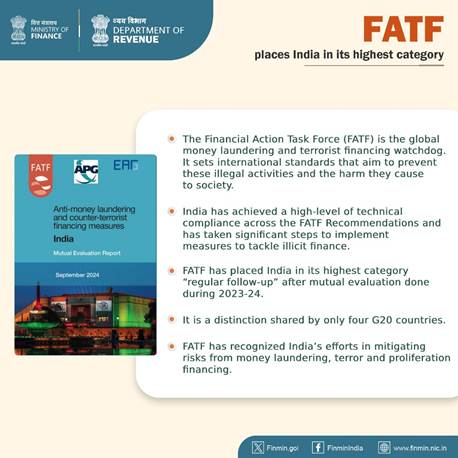
FATF PLACES INDIA IN ITS HIGHEST CATEGORY
The Financial Action Task Force (FATF) is the global money laundering and terrorist financing watchdog. It sets international standards that aim to prevent these illegal activities and the harm they cause to society.
India has achieved a high-level of technical compliance across the FATF Recommendations and has taken significant steps to implement measures to tackle illicit finance.
FATF has placed India in its highest category “regular follow-up” after mutual evaluation done during 2023-24.
It is a distinction shared by only four G20 countries.
FATF has recognized India’s efforts in mitigating risks from money laundering, terror and proliferation financing.
BROAD ACHIEVEMENTS UNDER THE CENTRAL BOARD OF DIRECT TAXES (CBDT) IN 2024:
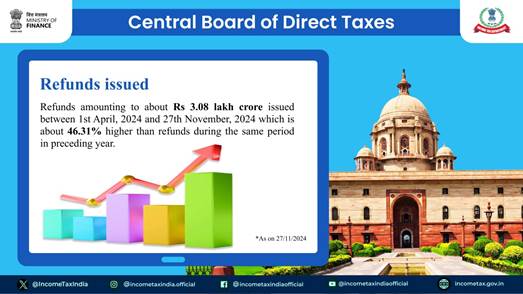
REFUNDS ISSUED
Refunds amounting to about Rs 3.08 lakh crore issued between 1st April, 2024 and 27th November, 2024 which is about 46.31% higher than refunds during the same period in preceding year.
ITR filing per second (Max): 917 (at 8:13:54 AM on 17th July, 2024)
ITR filing per minute (Max): 9,367 (at 8:08 PM on 31st July, 2024)
ITR Filing per hour (Max): 5.07 lakh (between 7PM to 8PM on 31st July, 2024)
About 98.35% of ITRS filed till 22.11.2024 have been e-verified.
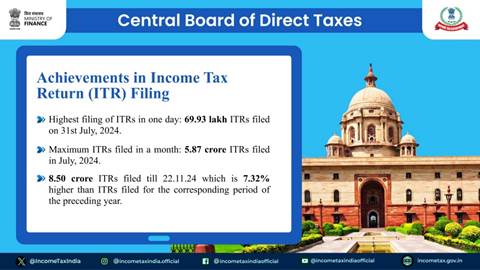
Highest filing of ITRS in one day: 69.93 lakh ITRS filed on 31st July, 2024.
Maximum ITRS filed in a month: 5.87 crore ITRS filed in July, 2024.
8.50 crore ITRS filed till 22.11.24 which is 7.32% higher than ITRs filed for the corresponding period of the preceding year.
SPEEDY PROCESSING
More than 1.62 crore ITRS filed during F.Y. 2024-25 were processed in a single day.
Approximately 21% of the ITR were processed in a single day during the
F.Y. 2024-25.
Approximately 26.35% of ITRS were processed within a week of filing during F.Y. 2024-25 in comparison to 22.56% in F.Y. 2023-24.
GREATER TRANSPARENCY WITH IMPROVED TAXPAYER FACILITATION
To encourage wider use and analysis of data, ITR statistics for different categories of taxpayers for AY 2022-23 and AY 2023-24 released.
Awareness Campaign launched to assist taxpayers in accurately completing Schedule Foreign Assets (Schedule FA) and reporting income from foreign sources (Schedule FSI) in their ITRs.
SWACHHATA HI SEWA
The CBDT has successfully met the goals of #SpecialCampaign4.0, a month-long initiative focused on cleanliness in government offices and addressing pending matters.
Cleared out 3,20,000 physical files, freeing up 1.75 lakh sq. ft. of office space.
Generated Rs 43 lakh from the disposal of scrap materials.
Conducted over 1450 cleanliness campaigns across India.
Enhanced the reclaimed space for a more conducive work environment.
Resolved 53,000 public grievances.
Implemented unique and innovative “Best Practices” throughout the campaign.
FACILITATION TO THE TAXPAYERS
The validation introduced at the upload level of the ITRS is another move to nudge or to take relook at the possible inconsistencies and to facilitate correction before filing of the ITRS.
This resulted in reduction of filing of revised return, rectification request and grievance.
The ITR forms for A.Y. 2024-2025 with all associated functions were rolled out on 1st April, 2024 on the E- filing portal.
More than 76 crore emails & SMSS were sent under E- campaign to popularize the EVC mode during the year under consideration.
As a result 96% of ITR filers adopted the EVC mode for verification of ITRS in A.Y. 2024-25.
ESTABLISHMENT OF DEMAND MANAGEMENT FACILITATION CENTRE (DFC)
During the period 01.01.24 to 13.10.2024, 1,31,180 number of demands amounting to Rs 5,00,224 cr. have been reduced/resolved.
The DFC currently consists of 170 agents who work 6 days a week.
Scheduled calls are made to the tax payers and JAOS for the purpose of resolution of demand.
BROAD ACHIEVEMENTS UNDER THE CENTRAL BOARD OF INDIRECT TAXES AND CUSTOMS(CBIC) IN 2024:
Recent measures for simplification, trade facilitation and Ease of Doing Business under GST:
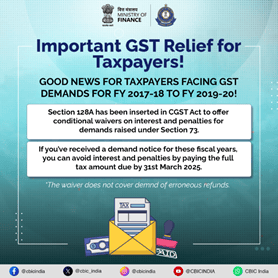
Insertion of section 128A in CGST Act, 2017 has been carried out to provide for conditional waiver of interest or penalty or both relating to demands raised under Section 73, for FY 2017-18 to FY 2019-20 : Considering the difficulties faced by the taxpayers, during the initial years of implementation of GST, amendments have been made in the CGST Act, to provide for continued waiver of interest and penalties for demand notices issued under Section 73 of the CGST Act for the fiscal years 2017-18, 2018- 19 and 2019-20, in cases where the taxpayer pays the full amount of tax demanded in the notice upto 31.03.2025.
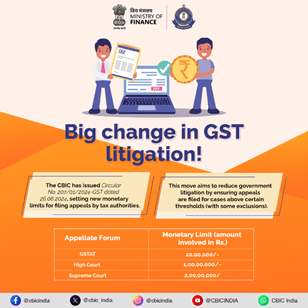
Reduction of Government Litigation by Fixing monetary limits for filing appeals under GST. The CBIC has issued Circular No. 207/01/2024-GST dated 26.06.2024 to prescribe monetary limits, subject to certain exclusions, for filing of appeals in GST by the department before GST Appellate Tribunal, High Court, and Supreme Court, to reduce government litigation.
·://taxconcept.net/judgement/writ-petition-maintainable-despite-alternative-appeal-remedy-benefit-of-loan-waiver-considered-as-monetary-karnataka-high-court/” title=”Writ Petition Maintainable Despite Alternative Appeal Remedy: Benefit of Loan Waiver Considered as Monetary: Karnataka High Court ” data-wpil-keyword-link=”linked” data-wpil-monitor-id=”96112″>appeal with the appellate authority has been reduced from Rs. 25 crores CGST and Rs. 25 crores SGST to Rs. 20 crores CGST and Rs. 20 crores SGST. Further, the amount of pre-deposit for filing appeal with the Appellate Tribunal has been reduced from 20% with a maximum amount of Rs. 50 crores CGST and Rs. 50 crores SGST to 10 % with a maximum of Rs. 20 crores CGST and Rs. 20 crores SGST.
Reduction in rate of TCS to be collected by the ECOs for supplies being made through them: Electronic Commerce Operators (ECOs) are required to collect Tax Collected at Source (TCS) on net taxable supplies under Section 52(1) of the CGST Act. The Central Government has issued Notification No. 15/2024-Central Tax dated 10.07.2024 (notified w.e.f. 10.07.2024), Notification No. 01/2024-Union Territory Tax dated 10.07.2024 (notified w.e.f. 10.07.2024) & Notification No. 01/2024-Integrated Tax dated 10.07.2024 (notified w.e.f. 10.07.2024) to reduce the TCS rate from present 1% (0.5% CGST + 0.5% SGST/ UTGST, or 1% IGST) to 0.5 % (0.25%
CGST + 0.25% SGST/UTGST, or 0.5% IGST), to ease the financial burden on the suppliers making supplies through such ECOs.
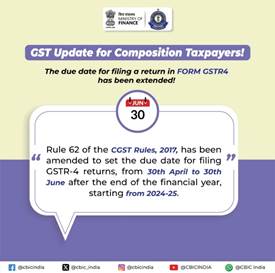
·. The same would give more time to the taxpayers who opt to pay tax under composition levy to furnish the said return.
Amendments of Section 16(4) of CGST Act, to be made effective from July 1st, 2017,to relax condition of section 16(4) of the CGST Act in respect of initial years of implementation of GST, i.e. financial years 2017-18, 2018-19, 2019-20 and 2020-21: Considering the difficulties faced by the taxpayers during the initial years of implementation of GST, based on the recommendations of the GST Council, retrospective amendment has been made in Section 16(4) of CGST Act to relax the time limit to avail input tax credit in respect of any invoice or debit note under Section 16(4) of CGST Act, through any GSTR 3B return filed upto 30.11.2021 for the financial years 2017-18, 2018-19, 2019-20 and 2020-21, may be deemed to be 30.11.2021. This would benefit a large number of taxpayers, especially smaller ones, who could not file returns in a timely manner in the initial years of GST, due to various reasons by which time, the time limit for availment of Input tax credit, under section 16(4) of CGST Act had already expired, which has led to issuance of demands denying them the benefit of input tax credit.
Amendment of Rule 88B of CGST Rules, 2017 in respect of interest under Section 50 of CGST Act on delayed filing of returns, in cases where the credit is available in Electronic Cash Ledger (ECL) on the due date of filing the said return:-The Central Government has issued Notification No. 12/2024-Central Tax dated 10.07.2024 for amendment in rule 88B (w.e.f. 10.07.2024) of CGST Rules to provide that an amount which is available in the Electronic Cash Ledger on the due date of filing of return in FORM GSTR-3B, and is debited while filing the said return, shall not be included while calculating interest under section 50 of the CGST Act in respect of delayed filing of the said return. This will reduce interest burden on such taxpayers.
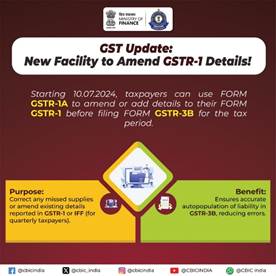
Provision of new optional facility for taxpayers to amend the details in GSTR-1: The Central Government has provided for a new optional facility by way of FORM GSTR-1A (w.e.f. 10.07.2024) to facilitate the taxpayers to amend the details in FORM GSTR-1 for a tax period and/ or to declare additional details, if any, before filing of return in FORM GSTR-3B for the said tax period. This will facilitate taxpayer to add any particulars of supply of the current tax period missed out in reporting in FORM GSTR-1 of the said tax period or to amend any particulars already declared in FORM GSTR-1 of the current tax period (including those declared in IFF, for the first and second months of a quarter, if any, for quarterly taxpayers), to ensure that correct liability is auto-populated in FORM GSTR-3B.
A consolidated guidelines dated 30.03.2024 were issued to all CGST Zones in respect of Ease of Doing Business (EODB) to be followed during investigations of cases against regular taxpayers
Besides, based on the recommendations of the GST Council, a large number of notifications and circulars have been issued on contentious issues, so as to avoid legal disputes.
GST Council recommended reduction in GST rate on Fortified Rice Kernel (FRK), classifiable under 1904, to 5% .
GST council also recommended to fully exempt GST on gene therapy.
GST Council recommended exemption of GST on contributions by general insurance companies from third-party motor vehicle premiums for Motor Vehicle Accident Fund.
GST Council recommended no GST on transaction of vouchers as they are neither supply of goods nor supply of services. The provisions related to vouchers is also being simplified.
GST Council clarified that no GST is payable on ‘penal charges’ levied and collected by banks and NBFCs from borrowers for non-compliance with loan terms.
GST Council recommended reduction of payment of pre-deposit for filing an appeal before the Appellate Authority in respect of an order passed which involves only penalty amount.
GST rate on extruded or expanded products, salted or savoury, reduced from 18% to 12%, aligning them with GST rate on namkeens, bhujia, mixture, and similar ready-to-consume items.
GST rate on cancer drugs such as Trastuzumab Deruxtecan, Osimertinib, and Durvalumab reduced from 12% to 5%.
Reverse Charge Mechanism introduced on the supply of metal scrap by unregistered persons to registered persons. A Tax Deducted at Source (TDS) of 2% applies to B2B supply of metal scrap by registered persons.
Duties & Exemptions
Export duty on various varieties of rice has been reduced.
A Group of Ministers (GoM) has been constituted to holistically look into the issues pertaining to GST on the life insurance and health insurance.
It has been recommended to notify GST @ 5% on the transport of passengers by helicopters on seat share basis and also to regularise the GST for past period on ‘as is where is’ basis.
It has been recommended to clarify by way of a circular that the approved flying training courses conducted by DGCA approved Flying Training Organizations (FTOs) are exempt from the levy of GST.
It has been recommended to exempt supply of research and development services by a Government Entity; or a research association, university, college or other institution, notified under clauses (ii) or (iii) of sub-section (1) of section 35 of the Income Tax Act, 1961 using Government or private grants. It has also been recommended to regularize past demands on ‘as is where is’ basis.
It has been recommended to clarify that location charges or Preferential Location Charges (PLC) paid along with the consideration for the construction services of residential/commercial/industrial complex before issuance of completion certificate forms part of composite supply where supply of construction services is the main service and PLC is naturally bundled with it and are eligible for same tax treatment as the main supply that is, construction service.
It has been recommended to clarify that affiliation services provided by educational boards like CBSE are taxable. It has also been recommended to exempt affiliation services provided by State/Central educational boards, educational councils and other similarly placed bodies to Government Schools prospectively. The issue for the past period between 01.07.2017 to 17.06.2021 is recommended to be regularized on ‘as is where is’ basis.
It has been recommended to clarify by way of circular that the affiliation services provided by universities to their constituent colleges are not covered within the ambit of exemptions provided to educational institutions in the notification No. 12/2017-CT(R) dated 28.06.2017 and GST at the rate of 18% is applicable on the affiliation services provided by the universities.
It has been recommended to exempt import of services by an establishment of a foreign airlines company from a related person or any of its establishment outside India, when made without consideration. The council also recommended to regularise the past period on ‘as is where is’ basis.
It has been recommended to bring renting of commercial property by unregistered person to a registered person under Reverse Charge Mechanism (RCM) to prevent revenue leakage.
It has been recommended to clarify that when ancillary/intermediate services are provided by GTA in the course of transportation of goods by road and GTA also issues consignment note, the service will constitute a composite supply and all such ancillary/intermediate services like loading/unloading, packing/unpacking, transshipment, temporary warehousing etc. will be treated as part of the composite supply. If such services are not provided in the course of transportation of goods and invoiced separately, then these services will not be treated as composite supply of transport of goods.
It has been recommended to regularise the GST liability for the past period prior to 01.10.2021 on ‘as is where is’ basis, where the film distributor or sub- distributor acts on a principal basis to acquire and distribute films.
It has been recommended to exempt supply of services such as application fees for providing electricity connection, rental charges against electricity meter, testing fees for meters/ transformers/capacitors, labour charges from customers for shifting of meters/service lines, charges for duplicate bills etc. which are incidental, ancillary or integral to the supply of transmission and distribution of electricity by transmission and distribution utilities to their consumers, when provided as a composite supply. It has also been recommended to regularize GST for the past period on ‘as is where is’ basis.
Uniform Integrated GST (IGST) rate of 5% on imports of parts, components, testing equipment, tools, and tool-kits of aircraft, regardless of their HS classification to stimulate Maintenance, Repair, and Overhaul (MRO) activities in the aviation sector, subject to specified conditions.
All milk cans made of steel, iron, or aluminium will attract a GST rate of 12%, irrespective of their intended use.
The GST rate on cartons, boxes, and cases made of both corrugated and non-corrugated paper or paperboard (HS codes 4819 10 and 4819 20) has been reduced from 18% to 12%.
solar cookers, whether single or dual energy source, will attract a GST rate of 12%.
The existing entry covering poultry keeping machinery attracting 12% GST has been amended to specifically include “parts of poultry keeping machinery,” regularizing past practices due to interpretational issues.
All types of sprinklers, including fire water sprinklers, will attract a GST rate of 12%, and past practices will be regularized.
IGST exemption on imports of specified items for defense forces has been extended for an additional five years until 30th June 2029.
IGST exemption has been extended to imports of research equipment and buoys under the Research Moored Array for African-Asian-Australian Monsoon Analysis and Prediction (RAMA) programme, subject to specified conditions.
Compensation Cess on imports into Special Economic Zones (SEZ) by SEZ units or developers for authorized operations is exempted retrospectively from 1st July 2017.
Compensation Cess is exempted on the supply of aerated beverages and energy drinks to authorized customers by Unit Run Canteens under the Ministry of Defense.
An ad-hoc IGST exemption is provided on imports of technical documentation for AK-203 rifle kits imported for the Indian Defense forces.
Measures for Facilitation of Trade
Section 9(1) of the CGST Act, 2017, is amended to explicitly exclude rectified spirit or ENA from the scope of GST when supplied for manufacturing alcoholic liquor for human consumption.
Services provided by Indian Railways to general public, namely, sale of platform tickets, facility of retiring rooms/waiting rooms, cloak room services and battery-operated car services and Intra-Railway transactions have been exempted [vide Notification No. 04/2024-CTR dated 12.07.2024 w.e.f., 15.07.2024]. The issue for the past period has also been regularized [Circular No. 228/22/2024-GST dated 15.07.2024].
Services provided by Special Purpose Vehicles (SPV) to Indian Railway by way of allowing Indian Railway to use infrastructure built & owned by SPV during the concession period and maintenance services supplied by Indian Railways to SPV have been exempted [vide Notification No. 04/2024-CTR dated 12.07.2024 w.e.f., 15.07.2024]. The issue for the past has also been [Circular No. 228/22/2024-GST dated 15.07.2024];
A separate entry has been created in notification No. 12/2017- CTR 28.06.2017 under heading 9963 to exempt accommodation services having value of supply of accommodation up to Rs. 20,000/- per month per person subject to the condition that the accommodation service is supplied for a minimum continuous period of 90 days [vide Notification No. 04/2024-CTR dated 12.07.2024 w.e.f., 15.07.2024]. Similar benefit has been extended for past cases [Circular No. 228/22/2024-GST dated 15.07.2024];
Co-insurance premium apportioned by lead insurer to the co-insurer for the supply of insurance service by lead and co-insurer to the insured in coinsurance agreements, has been declared as no supply under Schedule III of the CGST Act, 2017 and past cases have been regularized on ‘as is where is’ basis [Circular No. 228/22/2024-GST dated 15.07.2024].
Transaction of ceding commission/re-insurance commission between insurer and re-insurer has been declared as no supply under Schedule III of CGST Act, 2017 and past cases have been regularized on ‘as is where is’ basis [Circular No. 228/22/2024-GST dated 15.07.2024].
GST liability on reinsurance services of specified insurance schemes covered by Sr. Nos. 35 & 36 of notification No. 12/2017-CT (Rate) dated 28.06.2017 have been regularized on ‘as is where is’ basis for the period from 01.07.2017 to 24.01.2018 [Circular No. 228/22/2024-GST dated 15.07.2024].
GST liability on reinsurance services of the insurance schemes for which total premium is paid by the Government that are covered under Sr. No. 40 of notification No. 12/2017-CTR dated 28.06.2017 have been regularized on ‘as is where is’ basis for the period from 01.07.2017 to 26.07.2018 [Circular No. 228/22/2024-GST dated 15.07.2024].
Clarification has been issued that retrocession is ‘re-insurance of re- insurance’ and therefore, eligible for the exemption under Sl. No. 36A of the notification No. 12/2017-CTR dated 28.06.2017 [Circular No. 228/22/2024- GST dated 15.07.2024].
Clarification has been issued that statutory collections made by Real Estate Regulatory Authority (RERA) are exempt from GST as they fall within the scope of entry 4 of No.12/2017-CTR dated 28.06.2017 [Circular No. 228/22/2024-GST dated 15.07.2024].
Clarification has been issued that further sharing of the incentive by acquiring bank with other stakeholders, where the sharing of such incentive is clearly defined under Incentive scheme for promotion of RuPay Debit Cards and low value BHIM-UPI transactions and is decided in the proportion and manner by NPCI in consultation with the participating banks is not taxable [Circular No. 228/22/2024-GST dated 15.07.2024].
CUSTOMS
Budget 2024-25- major announcements:
Basic Customs Duty (BCD) on shea nuts reduced from 30% to 15%.
BCD reduced to nil on critical minerals such as Antimony, Beryllium, Bismuth, Cobalt, Copper, Gallium, Germanium, and others. BCD reduced to 2.5% on minerals like Graphite, Silicon Quartz, and Silicon Dioxide.
BCD on prawn and shrimp feed and fish feed reduced to 5%. BCD on live Specific Pathogen Free (SPF) Vannamei shrimp and Black Tiger shrimp broodstock reduced to 5%. BCD reduced on various inputs like mineral and vitamin premixes, krill meal, fish lipid oil, and others, subject to IGCR conditions.
BCD increased on ammonium nitrate from 7.5% to 10%.
BCD on PVC flex films increased to 25%.
Customs duty exempted on cancer drugs-Trastuzumab Deruxtecan, Osimertinib, and Durvalumab.
Issuance of Instruction No. 06/2024-Customs dt. 23.03.24
· Smooth and fair elections require coordinated and focused attention, including proper sharing of information by various LEA’s. To this effect, vide Instructions No. 06/2024-Customs dt. 23.03.24 a detailed Standard Operating Procedure was issued for all formations under CBIC to curb the flow of suspicious cash, illicit liquor, drugs/narcotics, freebies and smuggled goods during elections. It includes instructions regarding reporting of major seizures (more than Rs.1 crore) during election & implementation of ESMS for reporting interceptions/seizures made by various enforcement agencies on real-time basis.
Handing over of Antiquities seized by Customs to ASI
Consequent to repatriation of a 16th century stolen idol of Maa Kotrakshi, in presence of Hon’ble Minister of Education and Skill Development & Entrepreneurship; a project for handing over of antiquities seized pan India by Customs to ASI was undertaken. A handing over ceremony was organized on 29.02.2024 chaired by the Hon’ble Finance Minister and 101 such antiquities were handed over to ASI. A handbook titled ‘Puravshesh ke Prahari’ describing the historical importance of these antiquities and role of Customs in preserving our cultural heritage was also released on the occasion.
DGFT extended the RoDTEP Scheme to include good exported from EOU and SEZ sector. To give effect to this, CBIC issued notification nos. 20/2024- Customs (NT) dated 11.03.2024 and 50/2024 -Customs (N.T.) dated 19.07.2024, respectively.
Notification No. 33/2024-Customs (N.T.) dated 30.04.2024. was issued for amendment in Notification No. 77/2023-Customs (N.T.) dated 20.10.2023 relating to All Industry Rates (AIRs) of Duty Drawback including defence goods.
Circular No. 04/2024-Customs dated 07.05.2024 was issued regarding changes made in All Industry Rates (AIRs) of duty Drawback notified vide Notification No77/2023-Customs (N.T.) dated 20.10.2023 and 33/2024- Customs (N.T.) dated30.04.2024.
For disbursal of All Industry Rates (AIR) of duty drawback, CBIC has moved from manually issued physical Cheque (to the nodal bank) based process to end-to-end automated PFMS based disbursal of duty drawback amount directly to exporter’s bank accounts since 05.06.2024. For this CBIC issued Instruction No.15/2024-Customs dated 29.05.2024. This paperless functionality is expected to expedite credit of AIR of drawback amount to exporters’ accounts and increase transparency.
Notification No. 55/2024-Customs (N.T.) on August 23.08.2024, was issued for revising the All-Industry Rates (AIR) of duty drawback for gold and silver jewellery and articles of silver. This notification amends the earlier Notification No. 77/2023-Customs (N.T.) dated October 20, 2023.
Drawback Division of CBIC assisted the RoDTEP Committee-2023 for reviewing RoDTEP Rates for various eligible goods, including defence goods, for exports from DTA, AA, EOU & SEZ units. Based on Committee’s recommendations, revised RODTEP rates have been notified by DOC effective from 10.10.2024.
Indian Customs has always been at the forefront when it comes to adopting cutting edge technology for providing better services. In this regard, Board has launched the Exchange Rate Automation Module and the modalities has been explained in Circular 07/2024-Cus dated 25.06.2024. The exchange rates shall be published on ICEGATE website at 6:00 p.m. twice a month (i.e. 1st & 3rd Thursdays of every month) and shall be accessible for public viewing on ICEGATE website. Thus, the automated system has now replaced the manual process of publication of exchange rates.
CBIC vide Notification No. 60/2024-Customs (NT) dated 12.09.2024 amended the Courier Imports and Exports (Electronic Declaration and Processing) Regulations, 2010 to allow export incentives viz. Drawback,
RoDTEP (Remission of Duties and Taxes on Exported Products), RoSCTL (Rebate of State and Central Levies and Taxes) to exports through Courier. Circular No. 15/2024-Customs dated 12.09.2024 explaining the said amendments and informing the stakeholders about extending the export benefits to courier exports has also been issued.
CBIC and the Department of Posts (DoP) have jointly developed a “hub and spoke” system to facilitate export through postal route. The system leverages digital technology and the vast postal network for creating a paperless, contactless and intermediary-free environment for enhancing exports through postal mode. In continuation of the already authorized 1001 booking post offices, CBIC vide Circular No. 01/2024 dated 01.02.2024 has further authorized an additional 14 booking post offices taking the total number of booking post offices covered under the automated system to a total of 1015. Further, the project for automation of IGST refund on postal exports made using the DNK portal has been implemented with effect from 17th September, 2024.
Agreement between the Government of the Republic of India and the Government of the Republic of Madagascar on Cooperation and Mutual Administrative Assistance in Customs Matters signed on 27.06.2024 on the side-lines of WCO Council Meeting in Brussels.
Agreement between the Government of the Republic of India and the Government of the Republic of Belarus on Cooperation and Mutual Assistance in Customs Matters was signed on 28.06.2024 on the side-lines of WCO Council Meeting in Brussels.
MoU between the CBIC and General Department of Viet Nam Customs on Capacity Building was signed on 31.07.2024
Cooperative Arrangement between the Central Board of Indirect Taxes and Customs of the Government of the Republic of India and the New Zealand Customs Service in Customs Matter was signed on 06.08.2024
For providing connectivity to landlocked developing country Bhutan, CBIC in February this year-2024 has issued a Standard Operating Procedure allowing transit of goods between Bhutan and Bangladesh using riverine route through India with the entry/exit points at Jogighopa and Pandu ports in Assam.
CBIC hosted the 5th Joint Group of Customs Meeting between India & Bhutan from 6th -7th May, 2024 in Leh, India.
Circular No. 09/2024-Customs dated 09.07.2024 has been issued amending circular No. 29/2020- Customs dated 22.6.2020 for allowing transshipment of Bangladesh export cargo to third Countries through Air Cargo Complex, Kempegowda International Airport Bengaluru.
Recently, CBIC lead Capacity Building Program on “Advancing Bhutan-India Trade and Economic, Partnership” at Thimpu, Phuentsholing, Gelephu and Samdrup from 29th July- 01st August, 2024.
4th National Conference on the Functioning of Land Customs Stations (LCSs) was organized on 28th and 29th August, 2024.
Circular No. 19/2024-Customs dated 30.09.2024 has been issued regarding Digitization of Customs Bonded Warehouse Procedures relating to obtaining Warehouse license, Bond to Bond Movement of Warehoused goods, and uploading of Monthly Returns.
Indian Customs Electronic Commerce/Electronic Data Interchange (ICEGATE) 2.0:
ICEGATE 2.0 website is a complete bilingual website which has been designed to provide contemporary user interface for enhanced user experience. New feature “widget” is also being provided to show important information such as Message filing status, details of tickets, refunds, and duty payments etc. in personalised dashboard without going for enquiries. Data available in the widgets is also downloadable. Customized notifications facility is being provided to the registered users to choose the events for which they want to receive notifications. Registered users can file their documents themselves using online Web forms on ICEGATE as well which is advancement from earlier offline webforms.
USE of ICETABs for efficient examination and clearance process:
The ICETAB is part of the CBIC’s ongoing initiatives to simplify trade procedures. The ICETAB is a mobile tablet designed to facilitate the quick and real-time upload of examination reports, enabling Customs Officers to enhance efficiency while on the go. The ICETAB has an exclusive Mobile Application to enable examining officers to view RMS Instructions, Examination Order and Bill of Entry (BE) details along with other supporting documents, capture images of cargo examination for integration with the Bill of Entry and submit examination report immediately on completion of the cargo examination. The ICETAB by Customs Officers is aimed at enhancing transparency and efficiency in customs processes for speedy examination of import consignments with capability to attach photographs with geo- referencing and no requirement for any paper documents for the purpose of examination. This will also facilitate quick upload of the examination report on the go in real time basis and making the examination process transparent and faster. The detailed guidelines for the use of ICETAB are outlined in CBIC Circular No. 10/2024-Customs dated 20.08.2024.
Exchange Rate Automation Module:
· Indian Customs has always been at the forefront when it comes to adopting cutting edge technology for providing better services. In this regard, Board has launched the Exchange Rate Automation Module and the modalities has been explained in Circular 07/2024-Customs dated 25.06.2024 and its amendment Circular No. 17/2024-Customs dated 18.09.2024. The exchange rates shall be published on ICEGATE website at 6:00 p.m. twice a month (i.e. 1st & 3rd Thursdays of every month) and shall be accessible for public viewing on ICEGATE website. Thus, the automated system has now replaced the manual process of publication of exchange rates.
Encouraging Women participation in International Trade: The Zones have been instructed by the Board Circular No. 2/2024-Customs, dated March 8, 2024 to promote women’s representation and support within customs and trade activities by:
ensuring women’s representation in PTFC and CCFC meetings, preferably through women’s associations; ensuring women’s representation in PTFC and CCFC meetings, preferably through women’s associations;
including at least one agenda point from women perspective;
encouraging Trade bodies/ custodians to establish dedicated help desks and processing mechanisms for women traders and women logistics service providers;
supporting the upskilling women logistics service providers, freight forwarders and custom brokers by offering relevant trainings for women.
This initiative highlights the importance of gender equality in trade (be it as traders, customs house agents, freight forwarders, or customs brokers) advocating for active efforts from Partner Government Agencies and trade bodies to support the increasing participation of women across various roles in the logistics sector. The detailed guidelines for encouraging Women participation in International Trade are outlined in CBIC Circular No. 2/2024-Customs dated 08.03.2024.
Mandatory additional qualifiers in import/export declarations in respect of Synthetic or Reconstructed Diamonds w.e.f., 01.12.2024:
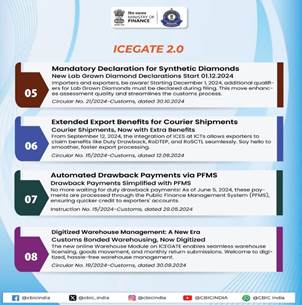
As per the Bill of Entry (Electronic Integrated Declaration and Paperless Processing) Regulations, 2018 and Shipping Bill (Electronic Integrated Declaration and Paperless Processing) Regulations, 2019, it will be mandatory to be declare additional qualifiers/identifiers for Lab Grown Diamond at the time of filing of import/export declarations with effect from 01.12.2024. Declaration of additional qualifiers would improve quality of assessment and streamline intervention and enhance facilitation. The detailed instructions in this regard are outlined in CBIC Circular No. 21/2024-Customs dated 30.10.2024.
Extended export related benefits for exports made through courier mode:
Until now, the Express Cargo Clearance System (ECCS) was used for handling courier import and export shipments at the notified International Courier Terminals (ICTs). However, due to limitations in the system’s architecture, certain export- related payments, such as Duty Drawback, RoDTEP, and RoSCTL, could not be processed through ECCS. To address this issue, it has been decided to implement the Indian Customs EDI System (ICES) at the International Courier Terminals for processing these payments, effective from 12.09.2024. The modalities for this implementation have been outlined in Circular No. 15/2024-Customs, dated 12.09.2024.
Disbursal of Drawback amounts into the exporters’ account through PFMS:
With effect from 5h June, 2024; payment of Drawback amounts into the exporters’ accounts post scroll out, will be facilitated through the Public Finance Management System (PFMS). The scrolls generated at different locations will be automatically processed by the Customs automated system (CAS) for onward transmission to the Central Nodal e-DDO and the nominated central nodal e-DDO shall forward the consolidated scroll to the nodal e-PAO. After approval from the nodal e-PAO, duty drawback amounts shall be credited into the exporters’ bank accounts linked with PFMS. The detailed instructions have been issued through Instruction No. 15/2024-Customs dated 29.05.2024.
Digitization of Customs Bonded Warehouse procedures relating to obtaining Warehouse License, Bond to Bond Movement of warehoused goods, and uploading of Monthly Returns:
The CBIC has launched a Warehouse Module on ICEGATE for Customs Bonded Warehouses, enabling: (i) online filing of applications for obtaining a Warehouse License; (ii) online submission and processing of requests to transfer warehoused goods to another person and/ or warehouse; and (iii) uploading Monthly returns for Customs Bonded Warehouses. The Directorate General of Systems (DG Systems) has issued comprehensive User Manuals for both trade members and departmental officers. Detailed procedures are outlined in Circular No. 19/2024- Customs, dated 30.09.2024.
Performance of ongoing schemes/ programs:
India’s overall trade facilitation score in the Global Survey on Digital and Sustainable Trade Facilitation conducted by the UNESCAP, 2023, increased from 78.49% in 2019 to 93.55% in 2023, indicating a marked improvement in the efficiency of cross-border trade procedures. (Source: CBIC Circular No. 10/2024- Customs dated 20.08.2024)
India’s Score in UN Trade Facilitation survey on “women in Trade Facilitation” has increased from 0% in 2019 to 66% in 2021 and this has resulted in overall improvement in India ranking in UN Trade Facilitation survey.
Provisioning services to SEZ Units at ICEGATE:
EDI Enablement of SEZ Sites was successfully completed. Some key services like Registration of SEZ Users, Child User Registration, Amendment in Registration, filing services, Inter and Intra Goods Movement, DTA Procurement, ETP Webform and facilitating DSC Amendment for SEZ users were provisioned for the SEZ users at ICEGATE.
Launch of module for SCMTR (Sea Cargo Manifest and Transhipment Regulations):
The SCMTR also specifies changes to the formats and timelines for filing manifest declarations. Some of the features of the SCMTR include:
Requesting additional details about each cargo, such as the invoice value and HSN
Advancing the time of reporting to the port of departure Ensuring track and trace of reported cargo
Including features for moving vessels within India
Capturing details electronically, such as crew lists, instead of manually.
Document Download Utility:
A utility developed at ICEGATE to allow users to download various documents like BE, SB, LEO, OOC, Gatepass for OOC, Gatepass for LEO in the e-Copy functionality at ICEGATE.
Revamp of ICEGATE 2.0 Website:
ICEGATE website was made more informative and user- friendly.
AI-based interactive Chatbot (Vaani):
This has been launched for trade at the ICEGATE website to help users with information to access various services of ICEGATE.
Exchange Rate Automation Module:
A module was launched to automate the integration of Exchange Rates of various Currency codes used in the Customs System. This involved API based integration with SBI to receive the Exchange Rates of the currency codes. These rates are automatically updated on the website as well as the application for the purpose of trade without any manual intervention.
Tracking the details of NOC/Release Order Issuance details from the PGAs
A facility has been enabled on the dashboard of the users to provide the tracking details of the NOC/Release Order issued by the respective PGA (FSSAI, AQCS and PQMS) on the ICEGATE website against the Bill of entry filed by the user.
API integration with Custodians (Sea and Land):
The existing MFTP based integration was migrated to API based integration with CONCOR and Adani Land and Sea Ports respectively. This has facilitated the exchange of data between ICEGATE application and Custodians to share the data on a real time basis.
Integration with Department of Post:
There has been an integration with Department of Post to claim IGST refund for the concerned Shipping Bills filed and claim other export benefits.
IGST Refund for Export through Dak Niryat Kendra (DNK):
A module has been launched on ICEGATE to enable IGST Refund for export through Dak Niryat Kendra (DNK).
Integration with ECCS for SB filing, Custodian Registration and Message Exchange with ICEGATE:
There has been an integration with ECCS to claim various export benefits against the Shipping Bills filed.
Export benefits (RoDTEP, RoSCTL & Drawback) to goods exports through Courier mode:
Export benefits (RoDTEP, RoSCTL& Drawback) extended for exports through the Courier mode.
Warehouse Licensing Code, Warehouse to warehouse goods movement and digitizing the monthly return for warehouse:
A module has been launched on ICEGATE to provision the generation of Warehouse Licensing Code for Warehouse users. This module also facilitates the goods movement from warehouse to warehouse. There is also a facility to digitize the filing of monthly returns for Warehouse.
Launch of Mobile Application for Internal and External Users over Android Platform:
Services of ICEGATE like Filing, e-Payment, accessing various enquiries over Android based mobile have been launched. This will soon be available on iOS platform.
Migration of critical functionalities like Integration with eSeal Vendors, eScrip, Customs E- payment Platform, Integration with DGFT, Examination Module, Integration with GSTN, Container Scanning Module from ICEGATE 1.0 to ICEGATE 2.0. The former being based on legacy-based architecture was migrated to a micro services-based architecture.
Integration with FSSAI, PQMS, AQCS under Single Sign On services:
A facility has been provided to the registered users to access the respective portal of the agencies like FSSAI, AQCS and PQMS from the ICEGATE website without any login at the respective PGA portal. This will be made live with other PGAs as well in the future.
Integration with BIS:
API based integration between BIS and ICEGATE to share the license details of the manufacturer for reference to the officer.
Integration with DGFT for RCMC details:
API based integration between DGFT and ICEGATE to share the RCMC details of the user from DGFT. These details are shown to the user on the dashboard at ICEGATE.
Export benefits to courier
Export incentives (Drawback, RoDTEP, RoSCTL) to the exports of goods where the value of consignment is less than rupees 10 lakh made through courier and in order to claim export incentives, for e-commerce shipments through ICT, shipping bill would be filed at ICEGATE/ICES.
Scroll will be generated automatically and there would be no manual intervention.
The scrips will be generated at ICEGATE portal.
IGST Refund for DAK Niryat
A mechanism for refund of IGST on exports through post is developed, wherein, the exporters will provide the details for seeking IGST refund at the time of filing postal bill of exports, and such details shall be pushed to the ICES System after physical export of goods, for GST verification with GSTN, and for preparation of scrolls.
The IGST refunds would be processed in a manner similar to that being done for exports through courier/ ECCS.
Post EGM Amendment Module
A functionality for allowing the officer to amend the shipping bill after filing of EGM has been developed. Once a shipping bill is amended, the export incentives would be processed again and the benefits would be paid to the exporter as per the existing functionalities.
Hand carriage of cargo
A functionality is being developed after which an exporter can export goods to be carried by foreign bound passengers authorized by the exporter in his behalf as personal baggage.
ICETAB
Access to examinee officer to ICES at examination shed Instant report submission in Realtime
Reduction in dwell time
Help in storing date and time of picture including Latitude and Longitude of place where picture taken
Access to RMS instruction, e-Sanchit, BE details at examination shed.
Newly launched development
Launch of ICETAB for field officers for doing faster examination at the time of Export/Import in August 2024.
Provisioning of exports benefits (RoDTEP, RoSCTL and Drawback) to commercial exports being processed through the integrated Courier Terminals (ICT) launched on 13.09.2024.
IGST refund for exports through Dak Niryat Kendras (DNK) rolled out on 17.09.2024.
4. 273 SEZ sites launched in ICES on 01.07.2024.
Upcoming development
Amendment in a shipping bill Post EGM.
Hand carriage of Cargo (New automation of manual process)
GST taxpayers who do not furnish bank account details to GST authorities will be barred from filing outward supply return GSTR-1 from September 1, GST Network (GSTN) has said in an advisory.
As per GST Rule 10A, a taxpayer is required to furnish details of a valid bank account within a period of 30 days from the date of grant of registration, or before furnishing the details of outward supplies of goods or services or both in Form GSTR-1or using Invoice Furnishing Facility (IFF), whichever is earlier.
“From 1st September, 2024 this rule is being enforced. Therefore, for the tax period August-2024 onwards, the taxpayer will not be able furnish GSTR-01/IFF as the case may be, without furnishing the details of a valid bank account in their registration details on GST portal,” GSTN said in an advisory dated August 23.
The GST Council in its meeting in July last year, had approved amendment to Rule 10A to strengthen the registration process and to effectively deal with the menace of fake and fraudulent registrations in goods and services tax (GST).
As per the amendment, a registered taxpayer was required to furnish the details of bank account having his name and PAN within 30 days of grant of registration or before filing of statement of outwards supply in Form GSTR-1/IFF (invoice furnishing facility), whichever is earlier.
…in absence of a valid bank account details in GST registration, you will not be able to file GSTR-1 or IFF as the case may, be from August 2024 return period,” the GSTN advisory added.
Advisory for furnishing bank account details before filing GSTR-1/IFF Notification No. 38/2023 – Central Tax New Delhi, the 4th August, 2023
1. As per Rule 10A of Central Goods and Services Tax Rules, 2017 notified vide notification no. 31/2019 dated 28.06.2019, a taxpayer is required to furnish details of a valid Bank Account within a period of 30 days from the date of grant of registration, or before furnishing the details of outward supplies of goods or services or both in FORM GSTR-1or using Invoice Furnishing Facility (IFF), whichever is earlier.
2. Advisory and various communications have already been issued time to time to inform the taxpayers regarding furnishing the details of a valid Bank Account detail in the GST Registration.
3. Now, from 01st September, 2024 this rule is being enforced. Therefore, for the Tax period August-2024 onwards, the taxpayer will not be able furnish GSTR-01/IFF as the case may be, without furnishing the details of a valid Bank Account in their registration details on GST Portal.
4. Therefore, all the taxpayers who have not yet furnished the details of a valid Bank Account details are hereby requested to add their bank account information in their registration details by visiting Services > Registration > Amendment of Registration Non – Core Fields tabs on GST Portal.
5. It is informed that in absence of a valid bank account details in GST registration, you will not be able to file GSTR-1 or IFF as the case may, be from August-2024 return period.
Due date for deposit of Tax deducted/collected by an office of the government for the month of March, 2024. However, all sum deducted by an office of the government shall be paid to the credit of the Central Government on the same day where tax is paid without production of an Income-tax Challan
Quarterly statement in respect of foreign remittances (to be furnished by authorized dealers) in Form No. 15CC for quarter ending March, 2024
15.04.2024
7
Due date for furnishing statement in Form no. 3BB by a stock exchange in respect of transactions in which client codes been modified after registering in the system for the month of March, 2024
15.04.2024
8
Due date for furnishing of Form 24G by an office of the Government where TDS/TCS for the month of March, 2024 has been paid without the production of a challan
Due date for furnishing of challan-cum-statement in respect of tax deducted under section 194-IB in the month of March, 2024
30.04.2024
11
Due date for furnishing of challan-cum-statement in respect of tax deducted under section 194M in the month of March, 2024
30.04.2024
12
Due date for furnishing of challan-cum-statement in respect of tax deducted under section 194S (by specified person) in the month of March, 2024
30.04.2024
13
Due date for deposit of Tax deducted by an assessee other than an office of the Government for the month of March, 2024
30.04.2024
14
Due date for e-filing of a declaration in Form No. 61 containing particulars of Form No. 60 received during the period October 1, 2023 to March 31, 2024
30.04.2024
15
Due date for uploading declarations received from recipients in Form. 15G/15H during the quarter ending March, 2024
30.04.2024
16
Due date for deposit of TDS for the period January 2024 to March 2024 when Assessing Officer has permitted quarterly deposit of TDS under section 192, 194A, 194D or 194H
Due Date for filling GSTR – 3B return for the month of Mar., 2023 for the taxpayer with Aggregate turnover upto INR 5 crores during previous year and who has opted for Quarterly filing of GSTR-3B
Group A States: Chhattisgarh, Madhya Pradesh, Gujarat, Maharashtra, Karnataka, Goa, Kerala, Tamil Nadu, Telangana, Andhra Pradesh, Daman & Diu and Dadra & Nagar Haveli, Puducherry, Andaman and Nicobar Islands, Lakshadweep
1. GST Filing of returns by registered person with aggregate turnover exceeding INR 5 Crores during preceding year. 2. Registered person, with aggregate turnover of less then INR 5 Crores during preceeding year, opted for monthly filing of return under QRMP.
Due Date of payment of GST for a taxpayer with Aggregate turnover up to INR 5 crores during the previous year and who has opted for Quarterly filing of return under QRMP.
25.04.2024
G. GSTR 11: Statement of inward supply of goods or services or both received by UIN holders – due date 28.04.2024
GSTR-11 is the return to be filed by the persons who have been issued a Unique Identity Number and claims a refund of the taxes paid on their inward supplies.
Due date:Must be filed by the 28th of the month following the month in which inward supply is received by the UIN holders.
H. Monthly Payment of GST – CMP-08:
Compliance Particular
Due Date
Form GST CMP-08 is used to declare the details or summary of self-assessed tax payable by taxpayers who have opted for a composition levy. Period: Jan – Mar, 2024
Disclaimer: Every effort has been made to avoid errors or omissions in this material. In spite of this, errors may creep in. Any mistake, error or discrepancy noted may be brought to our notice which shall be taken care of in the next edition. In no event the author shall be liable for any direct, indirect, special or incidental damage resulting from or arising out of or in connection with the use of this information.
Advisory on introduction of new Tables 14 & 15 in GSTR-1: As per Notification No. 26/2022 – Central Tax dated 26th December 2022 two new tables Table 14 and Table 15 were added in GSTR-1 to capture the details of the supplies made through e-commerce operators (ECO) on which e-commerce operators are liable to collect tax under section 52 of the Act or liable to pay tax u/s 9(5). These tables have now been made live on the GST common portal. These two new tables will be available in GSTR-1/IFF from January-2024 tax periods onwards. Please click here for the complete advisory.
Advisory on GSTR-1/IFF: Introduction of New 14 and 15 tables
Notification No.: 26/2022 – Central Tax dated December 26, 2022
Purpose: The purpose of this advisory is to make taxpayers aware of the new Table 14 and 15 in FORM GSTR-1 and IFF. These tables are relevant for only those taxpayers who either supply through E-Commerce operator (ECO) or are themselves liable to pay tax under Section 9(5) of the GST Act.
Introduction: As per Notification No. 26/2022 – Central Tax dated 26th December 2022 two new tables Table 14 and Table 15 were added in GSTR-1 to capture the details of the supplies made through e-commerce operators (ECO) on which e-commerce operators are liable to collect tax under section 52 of the Act or liable to pay tax u/s 9(5). These tables have now been made live on the GST common portal. These two new tables will be available in GSTR-1/IFF from January-2024 tax periods onwards.
Table Wise Details
Table Details
Description
14. (a) Details of the supplies made through e-commerce operators on which e- commerce operators are liable to collect tax under section 52 of the Act [Supplier to report]
– The ECO-GSTIN wise summary of the supplies made through ECO on which ECO is liable to collect tax at sources (TCS) and liability on which has already been reported in any table 4 to 10 of GSTR-1, shall be reported by the supplier in this section. – No taxable value or tax liabilities will be auto- populated from this table to GSTR-3B. – Amendments to be reported in 14A(a).
14. (b) Details of the supplies made through e-commerce operators on which e- commerce operators are liable to pay tax u/s 9(5) [Supplier to report]
– In this section the summary details of the supplies made through ECO on which ECO is liable to pay tax u/s 9(5) is to be reported by the supplier. Tax on such supplies shall be paid by the ECO and not by the supplier. This is to be reported net of credit / debit note (if any). – Such values will be auto-populated to Table 3.1.1(ii) of GSTR-3B. – Amendments to be reported in 14A(b).
15. Details of the supplies made through e-commerce operators on which e-commerce operator is liable to pay tax u/s 9(5) [e- commerce operator to report]
– Eco shall report the supplies on which they are liable to pay tax u/s 9(5) in Table 15. Such supplies shall not be reported anywhere else in GSTR-1/IFF. – Registered Supplier and Registered Recipient (B2B)– In this section the details of such supplies where both the supplier and receiver of supplies are registered person, is to be reported by ECOs at invoice level. This will be available in IFF also. Debit Note / credit note (if any) to be reported in Table 9B. – Registered Supplier and Unregistered Recipient (B2C)– In this section the supplier level details along with POS and rate wise detail of the supplies related to the transaction where the supply is being made from a registered supplier to unregistered recipient need to be reported by e-commerce operator. This will not be available in IFF. This is to be reported net of credit / debit note (if any). – Unregistered Supplier and Registered Recipient (URP2B)– In this section the document level details of the supplies made from unregistered supplier to registered recipient through ECO needs to be reported by the e-commerce operator. The detail to furnish will include the document detail and GSTIN of recipient. This will be available in IFF also. Debit Note / credit note (if any) to be reported in Table 9B. – Unregistered Supplier and Unregistered Recipient (URP2C)– In this section the POS and rate wise detail of the supplies to be reported by e-commerce operator related to the transaction of such supplies from an unregistered supplier to unregistered recipient through ECO. This will be not be available in IFF. This is to be reported net of credit / debit note (if any). – The values shall be auto-populated in Table 3.1.1(i) of corresponding GSTR-3B and such liabilities is to be paid by the ECOs in GSTR-3B in cash. – Amendments to be reported in Table 15A(I) & 15A(II).
4. Other Salient Features :-
Taxable value along with tax liabilities from all the above four sections i.e., B2B, B2C, URP2B and URP2C of table 15 will be auto-populated to table 3.1.1(i) of GSTR-3B.
There will be no auto-population of e-invoice in Table -15. E-invoices reported for 9(5) supplies will be populated in FORM GSTR-1 as per existing functionality. E-commerce operator are advised to examine and add such records in table 15 related to 9(5) supplies.
5. Step to report details in Table 14/15:
To view Table 14/15, taxpayer can navigate to Returns Dashboard > Selection of Period > Details of outward supplies of goods or services GSTR-1 > Prepare Online
Taxpayers can access the Table 14(a) & 14(b) by clicking the Liable to collect tax u/s 52
(TCS) and Liable to pay tax u/s 9(5) respectively available at the top of table 14 page.
Similarly, the different section of Table 15 can be accessed using the respective tab available at top of the table 15 page.
After adding the records taxpayers can file their GSTR-1 as per the existing process.
Introduction of new table ECO Documents in GSTR-2B
The taxpayers are also being provided a facility to pass input tax credit (ITC) to the registered taxpayers who are receiving the supplies u/s 9(5) through ECO. Such ITC will be available to the registered recipient in newly introduce section in GSTR-2B. A new table “ECO – Documents” is being added under all other ITC section in GSTR-2B. In this table, the registered recipient can view the document details of the supplies received through e-commerce operator on which e-commerce operator is liable to pay tax under section 9(5) of the Act.
The values will be auto populated from Registered Supplier and Registered Recipient (B2B) and Unregistered Supplier and Registered Recipient (URP2B) section of table 15 to this new ECO – Documents table of GSTR-2B.
To view the ECO-Documents table, taxpayer can navigate to Returns Dashboard > Selection of Period > Auto- drafted ITC Statement for the month GSTR 2B > View
5. To view the records in ECO-Documents table, taxpayer can navigate to Returns Dashboard > Selection of Period > Auto- drafted ITC Statement for the month GSTR 2B > View > ECO Documents
The Goods and Services Tax (GST) landscape in India is ever-evolving, and businesses need to stay informed about the latest updates. In a recent development, the GST Portal has introduced a significant change that will impact the filing process for taxpayers.
Effective immediately, the GSTR-3B tab on the GST Portal will no longer be accessible before the filing of GSTR-1. This change aims to streamline the GST filing process and ensure accurate reporting of sales and outward supplies.
Previously, taxpayers had the flexibility to fill out their GSTR-3B returns before finalizing their GSTR-1 details. However, with this new policy in place, businesses will be required to submit their GSTR-1 information first before being able to access the GSTR-3B tab. This change will necessitate timely and accurate filing of GSTR-1 returns to avoid any delays or penalties.
GSTR-1 is the monthly or quarterly return that captures details of outward supplies made by a taxpayer. It includes information such as the nature of supply, quantity, value, taxable value, and applicable tax rates. Once the GSTR-1 is filed, businesses can proceed with the filing of GSTR-3B, which summarizes the overall tax liability, input tax credit, and payment details.
By implementing this change, the authorities aim to enhance the accuracy of GST filings, minimize errors, and improve compliance. It ensures that businesses provide complete and accurate details of outward supplies before reporting their tax liability.
Taxpayers are advised to stay updated with the latest announcements from the GST Portal and ensure prompt filing of their GSTR-1 returns. Failure to comply with the new guidelines may result in penalties or other legal consequences.
As with any changes, it may take some time for businesses to adapt to this new requirement. However, with proper planning and implementation, taxpayers can navigate the updated process smoothly and ensure compliance with GST regulations.
This change reflects the government’s commitment to simplifying the GST system and creating a more transparent and efficient tax environment. Stay tuned for further updates on the GST Portal, and make sure to stay compliant with the latest regulations to avoid any disruptions in your business operations.
Remember, it’s always a good idea to consult with a tax professional or a qualified GST.
Vide Circular No. 170/02/2022- GST, Dated 6th July 2022, the CBIC has issued clarifications on mandatory furnishing of correct and proper information of inter-State supplies and amount of ineligible/ blocked Input Tax Credit and reversal thereof in return in FORM GSTR-3B and statement in FORM GSTR-1.
Circular is as under:
The process of return filing has been simplified over a period of time. With effect from December 2020, FORM GSTR-3B is getting auto-generated on the portal by way of autopopulation of input tax credit (ITC) from FORM GSTR-2B (auto-generated inward supply statement) and auto-population of liabilities from FORM GSTR-1 (Outward supply statement), with an editing facility to the registered person. However, it has been observed that there still are some infirmities in information being furnished by the registered person in relation to inter-State supplies effected to unregistered person, registered person paying tax under section 10 of the Central Goods and Services Tax Act, 2017 (composition taxable persons) and UIN holders. Also, there appears to be lack of clarity regarding reporting of information about reversal of Input Tax Credit (hereinafter referred to as the “ITC”) as well as ineligible ITC in Table 4 of FORM GSTR-3B.
2.) It is desirable that correct reporting of information is done by the registered person in FORM GSTR-3B and FORM GSTR-1 so as to ensure correct accountal and accurate settlement of funds between the Central and State Governments. Accordingly, in order to ensure uniformity in return filing, the Board, in exercise of its powers conferred under subsection (1) of section 168 of the Central Goods and Services Tax Act, 2017 (hereinafter referred to as the “CGST Act”), hereby clarifies various issues in succeeding paragraphs.
3.) Furnishing of information regarding inter-State supplies made to unregistered persons, composition taxable persons and UIN holders:
3.1) It has been noticed that a number of registered persons are not reporting the correct details of inter-State supplies made to unregistered persons, to registered person paying tax under section 10 of the CGST Act (composition taxable persons) and to UIN holders, as required to be declared in Table 3.2 of FORM GSTR-3B, under the notion that the taxable value of the same along with tax payable has already been reported in Table 3.1 of the said FORM. In certain cases, it has also been noticed that the address of unregistered person are captured incorrectly by the supplier, especially those belonging to banking, insurance, finance, stock broking, telecom, digital payment facilitators, OTT platform services providers and Ecommerce operators, leading to wrong declaration of Place of Supply (PoS) in both the invoices issued under section 31 of the CGST Act, as well as in Table 3.2 of FORM GSTR3B.
3.2) In this context, it may be noted that the information sought in Table 3.2 of FORM GSTR-3B is required to be furnished, place of supply-wise, even though the details of said supplies are already part of the supplies declared in Table 3.1 of the said FORM. For assisting the registered persons, Table 3.2 of FORM GSTR-3B is being auto-populated on the portal based on the details furnished by them in their FORM GSTR-1.
3.3) Accordingly, it is hereby advised that the registered persons making inter-State supplies –
(i) to the unregistered persons, shall also report the details of such supplies, place of supply-wise, in Table 3.2 of FORM GSTR-3B and Table 7B or Table 5 or Table 9/10 of FORM GSTR-1, as the case may be;
(ii) to the registered persons paying tax under section 10 of the SGST/CGST Act (composition taxable persons) and to UIN holders, shall also report the details of such supplies, place of supply-wise, in Table 3.2 of FORM GSTR-3B and Table 4A or 4C or 9 of FORM GSTR-1, as the case may be, as mandated by the law.
(iii) shall update their customer database properly with correct State name and ensure that correct PoS is declared in the tax invoice and in Table 3.2 of FORM GSTR-3B while filing their return, so that tax reaches the Consumption State as per the principles of destination-based taxation system.
3.4) It is further advised that any amendment carried out in Table 9 or Table 10 of FORM GSTR-1 or any entry in Table 11 of FORM GSTR-1 relating to such supplies should also be given effect to while reporting the figures in Table 3.2 of FORM GSTR-3B.
4.) Furnishing of information regarding ITC availed, reversal thereof and ineligible ITC in Table 4 of GSTR-3B
4.1) Table 4(A) of the FORM GSTR-3B is getting auto-populated from various entries of FORM GSTR-2B. However, various reversals of ITC on account of rule 42 and 43 of the CGST Rules or for any other reasons are required to be made by the registered person, on his own ascertainment, in Table 4(B) of the said FORM. It has been observed that different practices are being followed to report ineligible ITC as well as various reversals of ITC in FORM GSTR-3B.
4.2) It may be noted that the amount of Net ITC Available as per Table 4(C) of FORM GSTR-3B gets credited into the electronic credit ledger (ECL) of the registered person. Therefore, it is important that any reversal of ITC or any ITC which is ineligible under any provision of the CGST Act should not be part of Net ITC Available in Table 4(C) and accordingly, should not get credited into the ECL of the registered person.
4.3) In this context, it is pertinent to mention that the facility of static month-wise autodrafted statement in FORM GSTR-2B for all registered persons has been introduced from August, 2020. The statement provides invoice-wise total details of ITC available to the registered person including the details of the ITC on account of import of goods. Further, details of the said statement are auto-populated in Table 4 of return in FORM GSTR-3B which are editable in the hands of registered person. It may be noted that the entire set of data that is available in FORM GSTR-2B is carried to the table 4 in FORM GSTR-3B, except for the details regarding ITC that is not available to the registered person either on account of limitation of time period as delineated in sub-section (4) of section 16 of the CGST Act or where the recipient of an intra-State supply is located in a different State / UT than that of place of supply. It is pertinent to mention that the ineligible ITC, which was earlier not part of calculation of eligible/available ITC, is now part of calculation of eligible/available ITC in view of auto-population of Table 4(A) of FORM GTSR-3B from various tables of FORM GTSR-2B. Thereafter, the registered person is required to identify ineligible ITC as well as the reversal of ITC to arrive at the Net ITC available, which is to be credited to the ECL. In light of the above, the procedure to be followed by registered person is being detailed hereunder for correct reporting of information in the return:
A.) Total ITC (eligible as well as ineligible) is being auto-populated from statement in FORM GSTR-2B in different fields of Table 4A of FORM GSTR-3B (except for the ineligible ITC on account of limitation of time period as delineated in subsection (4) of section 16 of the CGST Act or where the recipient of an intra-State supply is located in a different State/ UT than that of place of supply).
B.) Registered person will report reversal of ITC, which are absolute in nature and are not reclaimable, such as on account of rule 38 (reversal of credit by a banking company or a financial institution), rule 42 (reversal on input and input services on account of supply of exempted goods or services), rule 43 (reversal on capital goods on account of supply of exempted goods or services) of the CGST Rules and for reporting ineligible ITC under section 17(5) of the CGST Act in Table 4 (B) (1).
C.) Registered person will report reversal of ITC, which are not permanent in nature and can be reclaimed in future subject to fulfilment of specific conditions, such as on account of rule 37 of CGST Rules (non-payment of consideration to supplier within 180 days), section 16(2)(b) and section 16(2)(c) of the CGST Act in Table 4 (B) (2). Such ITC may be reclaimed in Table 4(A)(5) on fulfilment of necessary conditions. Further, all such reclaimed ITC shall also be shown in Table 4(D)(1). Table 4 (B) (2) may also be used by registered person for reversal of any ITC availed in Table 4(A) in previous tax periods because of some inadvertent mistake.
D.) Therefore, the net ITC Available will be calculated in Table 4 (C) which is as per the formula (4A – [4B (1) + 4B (2)]) and same will be credited to the ECL of the registered person.
E.) As the details of ineligible ITC under section 17(5) are being provided in Table 4(B), no further details of such ineligible ITC will be required to be provided in Table 4(D)(1).
F.) ITC not available, on account of limitation of time period as delineated in subsection (4) of section 16 of the CGST Act or where the recipient of an intraState supply is located in a different State / UT than that of place of supply, may be reported by the registered person in Table 4D (2). Such details are available in Table 4 of FORM GSTR-2B.
4.4) Accordingly, it is clarified that the reversal of ITC of ineligible credit under section 17(5) or any other provisions of the CGST Act and rules thereunder is required to be made under Table 4(B) and not under Table 4(D) of FORM GSTR3B.
4.5) For ease of understanding, the manner of reversals is being elucidated in the illustrations enclosed as Annexure to this Circular.
5.) It is requested that suitable trade notices may be issued to publicize the contents of this Circular.
6.) Difficulty if any, in the implementation of this Circular may be brought to the notice of the Board. Hindi version will follow.
It may be noted that 6% tax rate has been added in the item details section of all the tables of form GSTR-1, except HSN table 12. In case your outward supplies attracts 6% tax rate, you are required to upload the details against 6% tax rate in the item details section.
In respect to HSN table 12 of form GSTR-1, 6% tax rate shall be added shortly. Meanwhile, you may report the HSN details of supplies attracting 6% tax rate under tax rate 5% by updating the values/tax amounts as per the actual supplies made by you.
GSTN has posted an advisory on 15th May 2022 that GSTR-2B for April 2022 is not showing the invoices related to April 2022. Technical team is working on it.
But as a temporary measure, taxpayers can avail ITC from GSTR-2A as per self-assessment basis.
Points to Keep in Mind While Availing ITC From GSTR-2A
As per section 16(2)(aa) of the CGST Act w.e.f. 1st January 2022, ITC of invoices uploaded by the suppliers till the due date of GSTR-1/ IFF can be claimed. ITC of invoices uploaded after the due date of GSTR-1/ IFF can not be claimed while filing that month’s GSTR-3B return.
It means when we will claim ITC from GSTR-2A, then we should note down GSTR-1/ IFF filing date of every supplier.
If GSTR-1/ IFF of supplier is filed till 11th May 2022 (for April 2022 month), then we can claim ITC because 11th May 2022 is the due date for filing GSTR-1 of April 2022 for taxpayers who have opted monthly returns filing.
But if GSTR-1/ IFF is filed between 12th May 2022 to 13th May 2022 (for April 2022 month) then we should confirm that the particular party is in QRMP Scheme or not. If the party is in QRMP scheme then we can claim ITC because due date for filing IFF of April 2022 is 13th May 2022. But if the same party is not in QRMP Scheme then we can not claim ITC because Non-QRMP parties are required to file GSTR-1 return for April 2022 and that due date is 11th May 2022.
A new tax rate of 6% IGST or 3% CGST+ 3% SGST has been introduced on certain goods vide Notification No. 02/2022 dated 31st March 2022. Changes are being made on the GST portal to include this rate in GSTR-1. As a temporary measure, taxpayers who have to report goods at this rate may do so by reporting the entries in the 5% heading and then manually increasing the system computed tax amount to 6%. This can be done by entering the value in the ‘Taxable value’ column next to 5% tax-rate and then increasing the system computed tax-amount to 6% IGST or 3% CGST + 3% SGST in the ‘Amount of Tax’ column under the relevant Table, namely B2B, B2C or Export, as applicable. This will ensure that correct tax amount is reported in GSTR-1. Meanwhile, this rate will be made available on the GST portal shortly.
GSTN regrets any inconvenience caused in this regard.
Vide Instruction No. 02/2022- GST, Dated 22nd March 2022, CBIC has issued SOP for scrutiny of returns for F.Y. 2017-18 and F.Y. 2018-19.
Let us tell you that Section 61 of the CGST Act and Rule 99 of the CGST Rules are dealing with scrutiny of returns.
Section 61 of CGST Act
(1) The proper officer may scrutinize the return and related particulars furnished by the registered person to verify the correctness of the return and inform him of the discrepancies noticed, if any, in such manner as may be prescribed and seek his explanation thereto.
(2) In case the explanation is found acceptable, the registered person shall be informed accordingly and no further action shall be taken in this regard.
(3) In case no satisfactory explanation is furnished within a period of thirty days of being informed by the proper officer or such further period as may be permitted by him or where the registered person, after accepting the discrepancies, fails to take the corrective measure in his return for the month in which the discrepancy is accepted, the proper officer may initiate appropriate action including those under section 65 or section 66 or section 67, or proceed to determine the tax and other dues under section 73 or section 74.
Rule 99 of CGST Rules
(1) Where any return furnished by a registered person is selected for scrutiny, the proper officer shall scrutinize the same in accordance with the provisions of section 61 with reference to the information available with him, and in case of any discrepancy, he shall issue a notice to the said person in FORM GST ASMT-10, informing him of such discrepancy and seeking his explanation thereto within such time, not exceeding thirty days from the date of service of the notice or such further period as may be permitted by him and also, where possible, quantifying the amount of tax, interest and any other amount payable in relation to such discrepancy.
(2) The registered person may accept the discrepancy mentioned in the notice issued under sub-rule (1), and pay the tax, interest and any other amount arising from such discrepancy and inform the same or furnish an explanation for the discrepancy in FORM GST ASMT- 11 to the proper officer.
(3) Where the explanation furnished by the registered person or the information submitted under sub-rule (2) is found to be acceptable, the proper officer shall inform him accordingly in FORM GST ASMT-12.
Generation of e-invoice is mandatory for certain class of taxpayers, as notified by the Government. These taxpayers are required to prepare & issue their e-invoices by reporting their invoice data in the prescribed format (e-invoice schema in FORM GST INV-01) and reporting the same on the Invoice Registration Portal (IRP). Invoices reported successfully on the IRP are given a unique Invoice Reference Number (IRN). The documents (invoices, debit notes, credit notes) reported on the IRP are then transmitted electronically to the GST system and are auto-populated in the respective tables of GSTR-1.
For a detailed advisory regarding auto-population of e-invoice data into GSTR-1 tables, please click here.
1.) A new clause to Section 16(2) of CGST Act, 2017 is inserted to provide that Input tax Credit with respect to a supply can be availed only if such credit is not restricted by the GSTR 2A/2B returns. Further, Section 16(4) of CGST Act 2017, is amended to provide that the time limit to claim ITC shall be extended from due date of GSTR 3B of September to 30th November of the following financial year to which invoice pertains.
2.) Clause (b) of Section 29(2) of CGST Act, 2017 is proposed to be amended to give the effect that, proceedings for cancellation of registration can be initiated by Proper Officer against the return defaulters for not filing the GST return:
(a) in case of composition tax-payers, if the GST return for a Financial Year is not filed beyond three months from the due date of the said return,
(b) and in case of regular tax-payers, a cumulative time limit shall be
3.) The time limit to issue a credit note under section 34(2) of CGST Act, 2017 is proposed to be extended from the due date of GSTR 3B of September to 30th November of the following financial year in which such supply is made.
4.) The first proviso to section 37(1) of CGST Act 2017 and Section 37(2) of CGST Act, 2017 is proposed to be omitted to amend the conditions and restrictions provided under the section 37 for furnishing details of Outward supplies in form GSTR 1 and to delete the process of accepting/rejecting the details communicated among the supplier and recipient.
5.) Further, Sub-section 3 of Section 37 of CGST Act 2017 is omitted in such a way that the last date for making rectification or correction in the Form GSTR 1 is extended to 30th day of November of the following financial year and a new sub-section 4 to section 37 of CGST Act 2017 is inserted, which puts restriction on filing of GSTR 1 unless previous month’s GSTR 1 is duly filed.
6.) The provisions of section 38 of CGST Act, 2017 is proposed to be modified to provide that an auto-generated statement in Form GSTR 2A/2B will be made available to the recipient, containing details of inward supplies in respect of which ITC shall be available.
7.) An amendment to Section 39(5) of CGST Act, 2017 is proposed to provide that the GST return by a Non-Resident Taxable Persons can be filed on or before the 13th day of the following Further, first proviso of sub-section 7 is proposed to be amended to introduce the new facility to pay any other amount in addition to the regular tax liability during the month through GSTR 3B subject to the conditions and restrictions as may be prescribed. The section is further amended to provide the rectification of any detail furnished in GSTR 3B that can be made up to 30th November of the following financial year. Section 39(10) of CGST Act is proposed to be amended to provide restriction on filing of GSTR 3B for any tax period unless GSTR 1 for the said tax period is not filed.
8.) The late fee for 100 per day is proposed to be inserted in section 47 of CGST Act, 2017 for delay in furnishing of TCS statement.
9.) Section 48 of the CGST Act, 2017 is proposed to eliminate the requirement of furnishing details of inward supplies in form GSTR 2 by the GST taxpayer. Further, section 168 of CGST Act 2017 is proposed to be amended to remove the reference of section 38(2) of CGST Act 2017, which states the power of commissioner to issue direction for furnishing timely details of inward supplies in form GSTR-2.
10.) Section 49(10) of CGST Act, 2017 is proposed to be substituted in such a way that widens the scope of Form PMT-09 for transfer of electronic cash ledger balance among distinct person u/s 25(4) and 25(5) (branch/units registered with same PAN) subject to the conditions as may be prescribed and said transfer shall be deemed to have been Further, sub-section 12 of section 49 is proposed to be amended to impose restrictions on utilization of electronic credit ledger balance and to prescribe the maximum proportion of output tax liability which may be discharged through electronic credit ledger.
11.) The provision of section 50(3) of CGST Act, 2017 is proposed to be substituted retrospectively e.f. 01st July 2017 for levy of interest where the input tax credit has been wrongly availed and utilized. The rate of interest is proposed to be reduced from 24% to 18%. The retrospective changes are also proposed to be made in the respective IGST Act, 2017 and UTGST Act, 2017.
12.) The proviso to Section 52(6) of CGST Act, 2017 is proposed to be amended to provide that any rectification of error/omission in the particulars furnished in TCS return by Electronic Commerce Operators can be made earlier of the two dates (i) 30th day of November of following financial year or (ii) the date of filing of Annual Return.
13.) An amendment to section 54(1) of the CGST Act, 2017 is proposed to explicitly provide the form and manner to file the refund claim of any balance in Electronic cash ledger.
14.) Further, section 54(2) of the CGST Act, 2017 is proposed to extend the time limit to claim refund of tax paid on inward supplies from six month to 2 Years where the application of refund is filed by specialized agency of the UNO or any MFIO, Consulate or Embassy of foreign countries or any other notified class of person.
15.) Furthermore, section 54(10) of the CGST Act, 2017 is proposed to extend the scope of withholding of or recovery from refunds in respect of all types of refunds.
16.) A new clause (ba) to clause (2) of the explanation of Section 54 of CGST Act is proposed to be inserted to provide the clarity regarding the relevant date for filing refund claim in respect of supplies made to SEZ unit or developer.
17.) Section 146 of CGST Act, 2017 notifies the gst.gov.in as common GST electronic portal for facilitating registration, payment of tax, and all functions provided under CGST Rules, 2017. Additionally, for generation of e-way bills and preparation of e-invoices different respective portals are notified.
18.) The retrospective effect of notification dated 30th September 2019 is proposed which notifies to exclude the service by way of grant of alcoholic liquor license, against consideration in the form of license fee or application fee or by whatever name called, by the State Governments in which they are engaged as public authorities from the definition of Supply u/s 7 of CGST Act, 2017 and no refund will be granted for the tax wrongly collected prior The retrospective effect is also proposed to be made in respective IGST Act, 2017 and UTGST Act.
19.) The retrospective exemption from Central Tax is proposed for supply of unintended waste generated during the production of fish meal (falling under heading 2301), except for fish oil, during the period commencing from the 1st day of July 2017 and ending with the 30th day of September 2019 and no refund will be granted for the tax wrongly collected prior The retrospective effect is also proposed to be made in respective IGST Act 2017 and UTGST Act, 2017.
20.) The provisions related to section 42, 43 and 43A of CGST Act, 2017 is proposed to be removed which states the process of accepting/rejecting the details communicated among the supplier and recipient.
We hope you found this article useful. Please feel free to write to us on any of the email ids mentioned below, should you need any more information:
The government is tightening the screws on taxpayers who are reporting turnover in GSTR-1 but not paying tax through GSTR-3B or claiming more input tax credit as available in GSTR-2A/ 2B.
In this series, the government has now incorporated the facility in GST portal to view individual month difference and cumulative difference in output tax (tax on sales) declared and paid as well as input tax credit (tax on purchases) available and claimed, so that tax officers can easily issue notices to defaulters by using this comparison.
To view this comparison, please follow these steps:
Login to GST portal
Navigate to Services > Returns > Tax Liabilities and ITC Comparison and select the financial year.
Following tables as shown in picture will be available in next window:
Due to a new exploit of GST Network (GSTN), businessmen are facing new problems. GSTN made a mistake in calculating the late fee charged from the traders in the past. Now he is demanding arrears by sending notices to the businessmen. In the last few days, lakhs of traders have received this notice. Not only this, the formula for calculating the arrears for which the demand is coming, has not been told.
At the time of filing the return, the portal of GST Network automatically calculates the late fee, if any, and shows the demand. The taxpayer does not have the option to change it. Only after paying it the next return can be filed. Now the problem is that if the businessmen do not pay it, they will not be able to file the return. Tax consultant Abhishek Kalda says, the GST system calculated the late fee and the dealers paid the same and filed the next return.
According to the rules, if this late fee is not paid, then the dealers are not able to file their next return. The calculation was done by the system not by the dealers. Now saying that the calculation of the system was wrong. In such a situation, when the system has made a mistake, then it is wrong to ask for the remaining late fees from the traders. The new demand has not been loaded on the portal yet. This means that those who have received this notice will be able to file the next return now. But after this they will not be able to file the return till the dues are paid.
Attention Taxpayers who are under QRMP Scheme in GST.
Today is the last date to file your GSTR-1 Return for the quarter October, 2021 to December, 2021.
If you will not file your GSTR-1 return for the said quarter today, then corresponding ITC will not be available to buyers in their GSTR-2B as per section 16(2)(aa) of CGST Act. So, it is very important to file GSTR-1 return for the quarter October, 2021 to December, 2021 by today.
The GST department is going to take strict action on those people who make mistakes in giving their tax information. GST authorities can take direct recovery action from January 1 against businesses that show excess sales in their monthly returns GSTR-1 but report under-reports while making tax payments in GSTR-3B.
Fake billing will be curbed
This step of the government will put a check on those who do fake billing. There is a complaint that sellers claim more input tax credit by showing more sales in GSTR-1, but showing less sales in their GSTR-3B to reduce their GST liability.
Under the GST law, till now such businesses, whose difference in GSTR-1 and GSTR-3B were found, were first issued show cause notices and only after that, in such cases of mismatch in GSTR-1 and GSTR-3B, recovery would be made.
Rule brought from Finance Act
The government brought this change as part of the Finance Act passed by Parliament earlier this year. The Central Board of Indirect Taxes and Customs (CBIC) notified it on December 21 by stating that on January 1, 2022, this provision will come into force under the GST law.
Through the Finance Act, the government has inserted an explanation in sub-section (12) of section 75 of the CGST Act, which specifies “self-assessed tax”.
AMRG & Associates senior partner Rajat Mohan said this is a “drastic provision” that gives the GST department exclusive powers to initiate tax collection proceedings.
It will now be mandatory for businesses that GSTR-3B and GSTR-1 match with each other and there should not be any difference irrespective of any reason.
1. Clarifications Regarding E-commerce Operators Liable To Pay GST On Restaurant Services:
CBIC clarified that the e-commerce operators are liable to pay GST on restaurant services. The GST Council in its 45th meeting held on 17th September, 2021 recommended to notify‚ ‘Restaurant Service’ under section 9(5) of the CGST Act, 2017. Accordingly, the tax on supplies of restaurant service supplied through e- commerce operators shall be paid by the e-commerce operator. Vide circular 167/2021 clarification has been given
2. Bill of Entry (BE) Regulations amended to ensure faster clearances of Imports:
BE to be filed in advance as per the following time-limits:
Latest by end of the day of arrival of the Vessel/Aircraft/ Vehicle
1. Imports from Bangladesh. Maldives, Myanmar, Pakistan and Sri Lanka at all Sea Ports
2. All imports at all Air Cargo Complexes
3. All imports at all Land Customs Stations (LCS)
Latest by end of the day preceding the day of arrival of the Vessel/Aircraft/Vehicle
1. Imports from all countries other than those mentioned above at all Sea Ports
2. All imports at all Inland Container Depots (ICD)
Advance BE can be filed on the strength of either an MBL/MAWB or the HBL/HAWB or both. Details of MBL/MAWB in BE can be updated later, on auto-approval mode (no approval from Customs is required)
3. Judicial Decision:
(i) Decision of Hon’ble SC Regarding GSTR-3B is a ‘Return’ specified u/s 39 of GST Act: Supreme Court reverses Gujarat HC’s order
The Supreme Court has reversed the Gujarat High Court’s judgment wherein the High Court observed that GSTR-3B is not a return specified under section 39 of the Central and State Goods and Services Acts. In the year 2019, the Gujarat High Court held that Section 39(1) of the CGST/GGST Act provides that every taxpayer, except a few special categories of persons, shall furnish a monthly return in such form and manner as may be prescribed. Rule 61 of the CGST Rules/GGST Rules prescribe the form and manner of submission of monthly return. Sub-rule 1 of Rule 61 of the CGST Rules/GGST Rules provides that the return required to be filed in terms of Section 39(1) of the CGST/GGST Act is to be furnished in Form GSTR-3B. The High Court further held that It would be apposite to state that initially it was decided to have three returns in a month, i.e. return for outward supplies i.e. GSTR-1 in terms of Section 37, return for inward supplies in terms of Section 38, i.e. GSTR-2 and a combined return in Form GSTR-3. However, considering technical glitches in the GSTN portal as well as the difficulty faced by the taxpayers it was decided to keep filing of GSTR-2 and GSTR-3 in abeyance. Therefore, in order to ease the burden of the taxpayer for some time, it was decided in the 18th GST Council meeting to allow the filing of a shorter return in Form GSTR-3B for the initial period. It was not introduced as a return in lieu of return required to be filed in Form GSTR-3.
Disclaimer:
This publication contains information for general guidance only. It is not intended to address the circumstances of any particular individual or entity. Although the best of endeavour has been made to provide the provisions in a simpler and accurate form, there is no substitute to detailed research with regard to the specific situation of a particular individual or entity. We do not accept any responsibility for loss incurred by any person for acting or refraining to act as a result of any matter in this publication.
A functionality has been introduced for taxpayers to withdraw their application for cancellation of registration, filled in Form REG-16
Effective date of Suspension will be displayed on Portal.
Refunds, Registration, Returns and Payment: –
Earlier companies were mandatorily required to use DSC on the GST Portal now the facility of using EVC has been extended to such taxpayers.
Refunds: –
Change in the undertaking to be submitted by taxpayer for issuance of Form PMT 03 by Tax officer.
Appeals: –
To allow the applicant to file Appeal for interest on delayed grant of refund, the earlier validation on value of the interest and penalty amounts to not exceed the claimed amount/amounts in the original order, has been removed from the Appeal form APL-01.
Enforcement: –
Now Demand type will be shown in case of order/rectification order, if issued in Form GST MOV-09/11.
Orders in Forms MOV-09/11 have been provided with a hyperlink ‘Request for rectification’ by clicking which, the details of relevant order will get auto populated and taxpayer will be able to choose the reason for rectification and upload attachments, if needed, verify and submit the same.
Recovery: –
Registered person to file an application in FORM GST DRC-20, seeking extension of time for payment of taxes or any amount due or for allowing payment of such taxes or amount in installments in accordance with the provisions of section 80.
Commissioner can issue an order in FORM GST DRC-21 allowing the taxable person further time to make payment or to pay in installments, not exceeding twenty-four.
The taxpayer will now be able to file an application seeking extension of time for payment or request for allowing payments in installments provided the demand is not less than Rs. 25000.
Features of the new tax information portal launched by CBIC:
CBIC has launched a revamped tax information portal https://taxinformation.cbic.gov.in/. With the help of this portal, all indirect tax legislations, rules, regulations and forms will be available for the easy reference of taxpayers. CBIC will continuously update and expand this portal in a phased manner.
Categories
In this website, information under all categories such as Customs Law, GST Law, Central Excise Law, and even the erstwhile Service Tax Law will be available.
Feedback
CBIC has also issued an email feedback.taxinfo@icegate.gov.in, where the user can send his feedback, if he comes across any anomaly or error in content provided in this portal.
Search & Filter
For smooth search of contents, we can search anything relating to the indirect tax by entering keyword in this search box, and filtering our content by different indirect tax laws such Central Excise, Customs, GST, and Services. A filter has been provided in the website which helps us to narrow our search by giving us an option whether we want to search the content in Act, Rules, Regulations, or Forms. It also provides another filter which contains an alphabetical list of various other options through which we can filter our content.
Latest Updates
The Portal also has a Section called Latest Updates (Notifications and Circulars) which contains links to Circulars, Notifications, Rate Notifications, Circulars, and Orders relating to GST, Customs, Central Excise & Service Tax.
3. Analysis summary of change in GST rate of the construction sector provided to the govt authority & entityw.e.f 01.01.2022:
Government sector rate changes (services) applicable from 01.01.2022 (Notification No. 15 & 16/2021-CT (Rate) dt. 18.11.2021
Sr. No.
SAC
Description
Old rate
New rate
1
9954
Composite supply of works contract as defined in clause (119) of section 2 of the Central Goods and Services Tax Act, 2017, supplied to the Governmental Authority or a Government Entity by way of construction, erection, commissioning, installation, completion, fitting out, repair, maintenance, renovation, or alteration of, – (a) a historical monument, archaeological site or remains of national importance, archaeological excavation, or antiquity specified under the Ancient Monuments and Archaeological Sites and Remains Act, 1958 (24 of 1958); (b) canal, dam or other irrigation works; (c) pipeline, conduit or plant for (i) water supply (ii) water treatment, or (iii) sewerage treatment or disposal.
12%
18%
2
9954
Composite supply of works contract as defined in clause (119) of section 2 of the Central Goods and Services Tax Act, 2017, {other than that covered by items (i) Construction of affordable residential apartments by a promoter in a RREP, (ia) Construction of residential apartments other than affordable residential apartments by a promoter in an RREP, (ib) Construction of commercial apartments (shops, offices, godowns, etc.) by a promoterin an RREP, (ic) Construction of affordable residential apartments by a promoter in a REP other than RREP, (id) Construction of residential apartments other than affordable residential apartments by a promoter in a REP other than a RREP, (ie) Construction of an apartment in an ongoing project under any of the schemes specified in sub-item (b), sub-item (c), subitem(d), sub-item (da) and sub-item (db) of item (iv); subitem (b), sub-item (c), sub-item(d) and sub-item (da) of item (v); and sub-item (c) of item (vi), against serial number 3 of the Table and (if) Construction of a complex, building, civil structure or a part thereof, including,— (i) commercial apartments (shops, offices, godowns, etc.) by a promoter in a REP other than RREP; (ii) residential apartments in an ongoing project, other than affordable residential apartments, in respect of which the promoter has exercised option to pay central tax on construction of apartments at the rates as specified for this item in the manner prescribed herein, but excluding supply by way of services specified at items (i), (ia), (ib), (ic), (id) and (ie) above intended for sale to a buyer, wholly or partly,} to the Governmental Authority or a Government Entity by way of construction, erection, commissioning, installation, completion, fitting out, repair, maintenance, renovation, or alteration of – (a) a civil structure or any other original works meant predominantly for use other than for commerce, industry, or any other business or profession; (b) a structure meant predominantly for use as (i) an educational, (ii) a clinical, or(iii) an art or cultural establishment; or (c) a residential complex predominantly meant for self-use or the use of their employees or other persons specified in paragraph 3 of the Schedule III of the Central Goods and Services Tax Act, 2017.
12%
18%
3
9954
Composite supply of works contract as defined in clause (119) of section 2 of the Central Goods and Services Tax Act, 2017 provided by a sub-contractor to the main contractor providing services specified above (Sr. No. 1 & 2) to the Governmental Authority or a Government Entity.
12%
18%
4
9954
Composite supply of works contract as defined in clause (119) of section 2 of the Central Goods and Services Tax Act, 2017, involving predominantly earth work (that is, constituting more than 75 per cent. of the value of the works contract) provided to the Governmental Authority or a Government Entity.
5%
18%
5
9954
Composite supply of works contract as defined in clause (119) of section 2 of the Central Goods and Services Tax Act, 2017 provided by a sub-contractor to the main contractor providing services specified above (Sr. No. 4) to the Governmental Authority or a Government Entity.
5%
18%
6
99
Pure services (excluding works contract service or other composite supplies involving supply of any goods) provided to the Governmental authority or a Government Entity by way of any activity in relation to any function entrusted to a Panchayat under article 243G of the Constitution or in relation to any function entrusted to a Municipality under article 243W of the Constitution.
Nil
18%
7
99
Composite supply of goods and services in which the value of supply of goods constitutes not more than 25 per cent. of the value of the said composite supply provided to the Governmental authority or a Government Entity by way of any activity in relation to any function entrusted to a Panchayat under article 243G of the Constitution or in relation to any function entrusted to a Municipality under article 243W of the Constitution.
Nil
18%
4. MP Govt. mandates E-Way Bill on 41 Goods including Article of Apparel and Clothing Accessories:
The Madhya Pradesh Government has mandated the E-Way Bill on 41 goods including Article of Apparel and Clothing Accessories. The goods on which the E-Way Bill has been mandated are Articles of apparel and clothing accessories, knitted or crocheted/ CHAP not knitted or crocheted, Motor Vehicles and Accessories, Rubber and articles thereof, All types of Scraps including Ferrous and non-ferrous, All types of Utensil, Cement and Cement products, All types of Stone incaling Marble & Granite Copper, Bruss and its products, Non Alcoholic Beverage, Fireworks & Explimine, All types of Crockery, All types of Comics and Talliet, Plastics and articles thereof, All types of Packing including Ropes, Sanitary Goods, Pesticides, Coal, Bitumen, Diesel, Dry Fruits, Kirana Goods, Oil Seeds, Paints and Putty, Molasses resulting from extraction or refining of sugar, Betel Nut Product, Mouth Freshener, Mineral water and aerated water, Chocolate, etc.
Disclaimer:
This publication contains information for general guidance only. It is not intended to address the circumstances of any particular individual or entity. Although the best of endeavour has been made to provide the provisions in a simpler and accurate form, there is no substitute to detailed research with regard to the specific situation of a particular individual or entity. We do not accept any responsibility for loss incurred by any person for acting or refraining to act as a result of any matter in this publication.
A revamped & enhanced version of GSTR-1/IFF is being made available on the GST Portal to improve the taxpayer experience. These enhancements, would enable the Saving of the GSTR-1 details on the GST Portal efficient and user friendly. Further, changes are being implemented incrementally in a gradual manner, to leverage the familiarity of taxpayer so as to ensure that taxpayers can adapt to the changes smoothly. The changes would be implemented in two phases, to ensure that disruption to the taxpayers is minimal, and valuable feedback received is accounted for in subsequent phase. This advisory covers the changes being brought in Phase -1 while the advisory about Phase -2 changes would follow.
GSTR-1 can be viewed as usual by navigating from Returns Dashboard > Selection of Period > Details of outward supplies of goods or services GSTR-1 > Prepare Online.
The following provides an overview of the updated functionality and their benefits in Phase 1:
(1.) Reorganized GSTR-1 Dashboard – Taxpayers will now experience an enhanced online user interface in GSTR-1/IFF with the following changes:
(i.) GSTR-1/IFF has been grouped in two sections namely ADD RECORD DETAILS and AMEND RECORD DETAILS.
(ii.) All the tables/tiles for new details addition shall be available under ADD RECORD DETAILS section while all the tables/tiles for amending previously filed details shall be available under AMEND RECORD DETAILS Re-arrangement of tables/tiles shall ensure that taxpayers can navigate in an easy manner to add or amend record details in the GSTR 1/IFF.
(iii.) By default, ADD RECORD DETAILS section shall be in expanded form (visible) and AMEND RECORD DETAILS section shall be in collapsed form (hidden). Taxpayers can expand or collapse these sections as per the As it has been observed that only around 1% of details added are amended by taxpayers, that it why it will be in collapsed mode.
(iv.) E-invoice advisory and help buttons have been moved to the top of the dashboard page for ease of access. It also is notable that e-invoice provisions are applicable only to selected taxpayers, having aggregate turnover above a particular threshold.
(2.) Table/Tile Document Counts– The document count for each tile (table) has been made more informative with color coding. The status of uploaded (Saved, Pending, Errored) documents with their count will also be made available. Taxpayer can now ascertain if there are any pending or errored records in any of the tables of GSTR-1/IFF from the dashboard itself. System shall update the count of records in the tiles on real time basis which will help in easy reconciliation. In case any record added by taxpayer is errored out, then the tile will be highlighted in red A sample image of the same is mentioned below for information.
(3.) Enhancement in B2B and CDNR table/tile – Taxpayers will now be able to view a new record details table with the details of the recipient -wise count of records. Record details table will have the following columns:
(i.) Taxpayer type – Type of recipient taxpayer (Regular, SEZ, and Composition) shall be displayed in this column.
(ii.) Processed invoice – Number of processed invoices will be available in this column with On clicking it, the taxpayer will navigate to document details page to view all the records added for the respective recipient(s).
(iii.) Pending/errored invoice – Number of pending invoices will be available in this column with On click of it, taxpayer can navigate to pending/errored records details page to view all the records which are in pending or errored status for the respective recipient(s).
(iv.) Add Invoice – Taxpayer can add new records for the selected recipient. On click of + symbol, add page shall open with pre-filled recipient GSTIN. On click of save, add page will reopen so that taxpayers can continue to add multiple
(v.) Search – A general search functionality has been added in Document details page. Using this, taxpayer can now search specific record pertaining to a specific This will help taxpayer to search added records seamlessly.
(4.) Records per page feature – System will now provide the records per page feature in all the tables under ADD RECORD DETAILS section leading to ease of This feature will allow the taxpayers to customized number of records to be viewed on per page. By default, the Records per page will be set at 10 records per page and can be increased to view 50 records per page.
(5.) Steps to file GSTR-1/IFF – A new check has been introduced in the system which will check that whether the taxpayer has added new records after generating the summary. Taxpayers may please note that there would be changed flow in such a situation. In case new records have been added, the SUBMIT and PREVIEW buttons will be disabled till a new summary has been generated after updating records. This check will ensure that filing of GSTR-1/IFF always happens with the correct & update summary only, and no mistake happens in this regard.
Taxpayer can upload details of outward supplies and file GSTR-1/IFF by following the steps enumerated below:
(a) Taxpayer can add or amend records in respective tables of GSTR-1/IFF.
(b) Once the records are saved, taxpayer shall click on GENERATE SUMMARY button.
(c) After the summary is successfully generated, system will enable PREVIEW and SUBMIT
(d) If the taxpayer intends to verify summary of GSTR-1/IFF, taxpayer can click PREVIEW button to download summary PDF.
(e) Taxpayer can make necessary changes before SUBIT/FILE of GSTR-1/IFF. However, if any new records are added after generating the summary, the SUBMIT and PREVIEW buttons will be disabled till a new summary has been generated by clicking GENERATE SUMMARY button after updating
(f) Taxpayer will also be informed to generate new summary, in case the latest summary is not available/generated.
(g) After the changes done in GSTR-1/IFF, taxpayer shall click on Generate summary button and can submit/file GSTR-1/IFF.
The next phase of the GSTR-1 enhancement will provide the taxpayers with an enhanced GSTR-1 online summary view, recipient(s) wise summary PDF and remove need of SUBMIT before FILE. The details regarding the same will also be informed to the taxpayers in due course.
Sub.: Request for extension of due dates for filing GSTR-1/ IFF for the month of October 2021 due to festivals like Dhanteras, Deepawali and Chhath Puja.
Respected Madam/ Sir,
Tax Concept is a well known platform formed for the professionals. The platform is educating 2.5 million professionals through its website.
The aim of the platform is to educate and serve professionals in a better way.
Representation started…
The nation was busy in celebrating the auspicious festivals Dhanteras and Deepawali from 2nd November to 5th November 2021.
After these festivals, Chhath Puja will be celebrated in the states of Bihar, Jharkhand, Odisha, West Bengal and Uttar Pradesh.
Due to these festivals, taxpayers and professionals are not able to file GSTR-1/ IFF on time. Also, late filing of GSTR-1 attracts late fees and IFF cannot be filed after due date. So, to save the registered taxpayers from paying unnecessary late fees and for seamless flow of credit, your good self are kindly requested to extend the due dates for filing GSTR-1/ IFF for the month of October 2021.
With TallyPrime, you can file GSTR-1 in three easy ways: by generating JSON from TallyPrime, by using the GST Offline tool, or by filing directly on the GST portal. GSTR-1 includes the details of all outward supplies made in a given period. TallyPrime exports GSTR-1 returns in the latest format compatible with latest version of validation APIs used in offline tool.
Prerequisites for filing GSTR-1
GSTR-3B filing: Ensure that GSTR-3B returns are filed regularly. If GSTR-3B is not filed for the previous two return periods, then GSTN will block the filing of GSTR-1 as well.
Internet connectivity: This is required for uploading the JSON file, downloading the offline tool, and filing returns.
Microsoft Office: For exporting data to MS Excel, GSTN recommends MS Excel 2007 or later (if you are using the GST Offline Tool and MS Excel for filing returns).
To comply with GST rules and file accurate returns, ensure that the tax values of sales are equal to or greater than the computed values.
As per Rule 59(6) and Advisory on HSN & GSTR 1-filing given by GSTN, HSN Summary is mandatory for filing returns, and no field of HSN Summary can be left blank. The provision of a complete HSN summary is handled in TallyPrime Rel. 2.0
Tax liability on advance receipts
For businesses with an annual turnover of up to Rs. 1.5 crores, there is no need to pay tax on advance receipts from customers.
The values of tax liabilities on advance receipt from customers will not be included in the GSTR-1 returns by default. Such transactions will appear under Not relevant for returns in the GSTR-1 report.
For businesses with turnovers above Rs. 1.5 crores, you can enable the option Enable tax liability on advance receipts in the Company GST Details screen.
Generate the JSON file from TallyPrime
Generate GSTR-1 returns in the JSON format
Gateway of Tally > Display More Reports> Statutory Reports > GST > GSTR-1. Alternatively, press Alt+G (Go To) > type or search GSTR-1 > press Enter.
F2: Period: Select the period for which returns need to be filed.
Press Alt+E and select E-Return from the menu.
Select JSON (Data Interchange) as the FileFormat.
Specify the folder path to save the e-return in the File path field.
File Name is auto-filled retain the name and press Enter.
Set the option Export Document Summary to Yes.
Press Enter
Click Send to export the e-return.
Upload the JSON file generated from TallyPrime to the portal for filing returns.
Upload of GSTR-1 JSON file fails when HSN summary has negative quantity
If the HSN summary of GSTR-1 has negative quantity, the upload of JSON generated from offline tool or from TallyPrime is failing. Until the issue is resolved by GSTN, you can do the following:
Open the JSON generated from TallyPrime. You can open it in Notepad.
Go to the section “hsn”.
Go to the tag “qty” and remove the negative sign. Repeat this for each “qty” that has a negative sign for taxable value and tax amount.
Save the JSON.
Upload it to portal.
In the portal, go the section HSN Summary.
Add the negative sign against each of the quantities that has taxable value and tax amount (which was removed from JSON).
You can import the Excel or CSV files generated from Tally into the GST offline tool. For this, as mentioned in the prerequisites, you need to download GST offline tool, and then install the offline tool.
Gateway of Tally > Display More Reports> Statutory Reports > GST > GSTR-1. Alternatively, press Alt+G (Go To) > type or search GSTR-1 > press Enter.
F2: Period: Select the period for which returns need to be filed.
Press Alt+E and select E-Return from the menu.
Select Excel (Spreadsheet) or CSV (Comma Delimited) as the FileFormat.
Specify the folder path to save the e-return in the File path field.
Set the option Export Document Summary to Yes and press Enter.
Click Send to export the e-return.
If you have selected the CSV format, TallyPrime will create separate CSV files for each table in GSTR-1. These files need to be imported into the GST Offline Tool.
Note: If $ symbol appears in the data exported to MS Excel, generate your data in the CSV format. If you want to continue in the MS Excel format, go to the Trust Center Settings in MS Excel, and add the location where TallyPrime is installed on your computer.
For more details on the information captured in each column of the e-return template, click here.
Businesses that default on filing summary return and paying monthly GST will not be able to file GSTR-1 sales return of the succeeding month from January 1 next year.
GST Council, in its meeting, has taken many decisions relating to important aspects of GST. Here is the compilation of 11 decisions which every professional should read.
The Council felt it was not time to bring petrol and diesel under GST, Sitharaman said. The decision will now be conveyed to the court, the minister said.
The interested candidates can send their applications to the Income Tax Officer (Hq)(Admn), Office of the Principal Chief Commissioner of Income Tax, UP (East), Aaykar Bhawan, 5, Ashok Marg, Lucknow – 226001.
Food safety watchdog FSSAI has suspended the licences of 15 food business operators in Kerala as they failed to comply with the requisite mandatory safety audits despite repeated reminders.
GST Council, in its 45th meeting, has recommended that when Section 16(2)(aa) of the CGST Act will be notified, then Rule 36(4) of the CGST Rules will be amended to provide that ITC of only invoices/ debit notes is allowed which are uploaded by the supplier in his GSTR-1/ IFF and are communicated to the registered person in GSTR-2B.
Here are two points which need attention and proper guidance:
First: This recommendation is talking about Section 16(2)(aa) which says that ITC of invoices/ debit notes will not be allowed which are not uploaded by the supplier in his GSTR-1/ IFF.
Second: GSTR-2B has been mentioned by the GST Council in this recommendation. It simply means that buyer will be allowed to claim ITC of invoices which are uploaded by the supplier till the due date of GSTR-1/ IFF.
By going through point no. First and Second, we can conclude that when this recommendation will be notified by the CBIC, taxpayers will be able to claim ITC on Invoices which are uploaded by the supplier in his GSTR-1/ IFF within the due date.
So, it is now very important for buyers to communicate with suppliers for timely filing of GSTR-1/ IFF so that they can claim full ITC and can avoid paying extra GST.
GST Council in its 45th meeting, has recommended that Rule 59(6) of the CGST Rules 2017 to be amended w.e.f. 01.01.2022 to provide that a registered person shall not be allowed to file GSTR-1, if he has not file GSTR-3B for the preceding month (previous month).
Because of this amendment, a taxpayer will not be able to file GSTR-1 if he has not filed GSTR-3B return of preceding month.