MINISTRY OF FINANCE (Department of Revenue) NOTIFICATION New Delhi, the 1st September, 2026 No. 46/2026-Central Excise
G.S.R. 768.(E). In exercise of the powers conferred by Section 5A of the Central Excise Act, 1944 (1 of 1944) read with Section 147 of Finance Act, 2002 (20 of 2002), the Central Government, being satisfied that it is necessary in the public interest so to do, hereby makes the following further amendments in the notification of the Government of India in the Ministry of Finance (Department of Revenue), No. 06/2026-Central Excise, dated the 26th March, 2026, published in the Gazette of India, Extraordinary, Part II, Section 3, Sub-section (i), vide number G.S.R. 205(E), dated the 26th March, 2026, namely:-
In the said notification, in the Table, against serial number 1, in column (4), for the entry, the entry “Rs. 1.5 per litre” shall be substituted.
2. This notification shall come into force on the date of its publication in the Official Gazette.
Note.- The principal notification No. 06/2026-Central Excise, dated the 26th March, 2026 was published in the Gazette of India, Extraordinary, Part II, Section 3, Sub-section (i), vide number G.S.R. 205(E), dated the 26th March, 2026 and last amended by notification No. 43/2026-Central Excise dated 14th August, 2026 published in the Gazette of India, Extraordinary, Part II, Section 3, Sub-section (i), vide number G.S.R. 733(E), dated 14th August, 2026.
NOTIFICATION
No. 47/2026-Central Excise
G.S.R.769(E). In exercise of the powers conferred by Section 5A of the Central Excise Act, 1944 (1 of 1944) read with Section 147 of Finance Act, 2002 (20 of 2002), the Central Government, being satisfied that it is necessary in the public interest so to do, hereby makes the following further amendments in the notification of the Government of India in the Ministry of Finance (Department of Revenue), No. 08/2026-Central Excise, dated the 26th March, 2026, published in the Gazette of India, Extraordinary, Part II, Section 3, Sub-section (i), vide number G.S.R. 207 (E), dated the 26th March, 2026, namely:-
In the said notification, in the Table, against serial number 1, in column (4), for the entry, the entry “Rs. 19 per litre” shall be substituted.
2. This notification shall come into force on the date of its publication in the Official Gazette.
Note.- The principal notification No. 08/2026-Central Excise, dated the 26th March, 2026 was published in the Gazette of India, Extraordinary, Part II, Section 3, Sub-section (i), vide number G.S.R. 207 (E), dated the 26th March, 2026 and last amended by notification No. 44/2026-Central Excise dated 14th August, 2026 published in the Gazette of India, Extraordinary, Part II, Section 3, Sub-section (i), vide number G.S.R. 734 (E), dated 14th August, 2026
NOTIFICATION
No. 48/2026-Central Excise
G.S.R. 770(E). In exercise of the powers conferred by Section 5A of the Central Excise Act, 1944 (1 of 1944) read with Section 112 of Finance Act, 2018 (13 of 2018), the Central Government, being satisfied that it is necessary in the public interest so to do, hereby makes the following further amendments in the notification of the Government of India in the Ministry of Finance (Department of Revenue), No. 11/2026-Central Excise, dated the 26th March, 2026, published in the Gazette of India, Extraordinary, Part II, Section 3, Sub-section (i), vide number G.S.R. 210 (E), dated the 26th March, 2026, namely:-
In the said notification, in the Table, against serial number 2, in column (4), for the entry, the entry “Rs. 1 per litre” shall be substituted.
2. This notification shall come into force on the date of its publication in the Official Gazette.
Note.- The principal notification No. 11/2026-Central Excise, dated the 26th March, 2026 was published in the Gazette of India, Extraordinary, Part II, Section 3, Sub-section (i), vide number G.S.R 210 (E), dated the 26th March, 2026 and last amended by Notification No. 45/2026-Central Excise dated 14th August, 2026 published in the Gazette of India, Extraordinary, Part II, Section 3, Sub-section (i), vide number G.S.R. 735(E), dated 14th August, 2026.
Ms. T.C.A. Kalyani, a 1991-batch officer of the Indian Civil Accounts Service (ICAS), has assumed charge as the new Controller General of Accounts (CGA) in the Department of Expenditure, Ministry of Finance. She is the 29th officer to hold this prestigious position.
Throughout her career, Ms. Kalyani has served in key ministries including Defence, Telecom, Fertilizers, Finance, Social Justice & Empowerment, Information & Broadcasting, and Home. Ms. Kalyani has consistently championed transparency and efficiency in public service delivery through the adoption of technology. Notably, her leadership was pivotal in initiating the Direct Benefit Transfer (DBT) scheme to farmers for fertilizer purchase assistance from the Government of India.
Before assuming charge as CGA, Ms. Kalyani served as the Principal Chief Controller of Accounts (Pr. CCA), Ministry of Home Affairs, where she oversaw the budgeting and accounting of one of the largest Ministries of the Government of India.
With her wealth of experience and proven leadership, Ms. Kalyani is expected to further strengthen the country’s Public Financial Management systems and continue driving innovation and transparency in government accounting.
Concerning the proposed income tax legislation for 2025, the central government has garnered over 60,000 suggestions from citizens, according to Union Finance Minister Nirmala Sitharaman.
During a recent post-budget event, the Finance Minister highlighted that the review of the Income Tax Act of 1961 is a significant aspect of Prime Minister Narendra Modi’s principle of ‘Jan Bhagidari.’
“Following the Covid-19 pandemic, the government’s focus has centered on channeling funds into public expenditure for infrastructure development. The belief that there has been a shift from expenditure to consumption is inaccurate. We have increased capital expenditure (Capex) while also offering relief in Personal Income Tax,” she stated.
Last week, she presented the new income tax bill for 2025 in the Lok Sabha as part of tax reforms aimed at simplifying provisions to make them easier to understand and reducing the potential for statutory disputes.
Additionally, the Finance Minister expressed gratitude to PM Modi for his consideration in providing relief to taxpayers earning up to Rs 12 lakh annually.
She noted, “We are steadfast in our commitment to the fiscal deficit trajectory outlined in the July Budget, targeting a deficit below 4.5 percent.”
The goal of these reforms is to bolster manufacturing, enhance the ease of doing business, and upgrade social infrastructure.
She further remarked, “I anticipate that state governments will also take the initiative to promote the Ease of Doing Business.”
Sectoral allocations within the budget remain unchanged, with the projected effective capital expenditure for the upcoming financial year estimated at Rs 19.08 lakh crore, as reported by FM Sitharaman.
She highlighted that the effective capital expenditure represents 4.3% of GDP in the 2025-26 budget, with a projected financial deficit of 4.4%.
In the year 2024, the Central Board of Direct Taxes (CBDT) and Central Board of Indirect taxes and Customs (CBIC), under the Department of Revenue, Ministry of Finance, have continued their citizen-centric initiatives, driving significant reforms to enhance taxpayer experience.
The CBDT maintained its focus on taxpayer outreach and assistance through active helpdesks and embraced faceless processes, reinforcing its commitment to transparency and efficiency. Speedy processing of returns and refunds remained a priority, with over Rs. 2.35 lakh crore refunded and more than 3.87 crore Income Tax Returns (ITRs) processed within 7 days. Innovations like TIN 2.0, pre-filling of ITRs, and updated returns continued to streamline processes, resulting in 47.52 lakh updated returns filed.
The CBIC continued to review and reform initiatives towards enhancing the efficiency and integrity of the Goods and Services Tax (GST) system in its seventh year. The CBIC leveraged advanced data analytics and artificial intelligence to further strengthened its registration processes by refining the risk rating system for applicants, ensuring rigorous verification to prevent fraud. Initiatives such as geo-tagging of business locations, system-based suspension of registrations for non-filers, and risk-based refund processing continued to demonstrate CBIC’s commitment to curbing malpractices.
To simplify compliance, the sequential filing of GSTR-1 and GSTR-3B was enforced, promoting timely returns and seamless availability of input tax credits. Special drives against fake registrations, automated intimation of mismatches, and a dedicated functionality for unregistered persons to apply for temporary registrations highlighted CBIC’s proactive compliance measures.
Additionally, initiatives supporting businesses included the transfer of balances in electronic cash ledgers, exemptions for small taxpayers, and facilitation of intra-state supply through e-commerce operators. The extension of GST exemptions for satellite launch services and further simplification of late fee structures were also noteworthy.
On the Customs front, the CBIC introduced regulatory and policy reforms, such as rationalisation of Customs duty rates and steps toward decriminalisation. Technological advancements like ICEGATE 2.0 and the Anonymised Escalation Mechanism continued to modernise tax administration. Infrastructural upgrades, including pre-gate processing facilities and modernisation of control laboratories, enhanced operational efficiency. These efforts collectively reinforced CBIC’s commitment to transparency, Ease of Doing Business, and robust compliance frameworks in the year 2024.
Besides these, the Department of Revenue also continued to contribute towards strengthening financial intelligence gathering and enabling enforcement through multiple measures. One major highlight of the FIU was India achieving a high-level of technical compliance across the Financial Action task Force (FATF) recommendations to tackle illicit finance.
Major achievements of 2024 by Financial Intelligence Unit (FIU) under the Department of Revenue, Ministry of Finance.
Financial Intelligence Unit-India (FIU-IND) is a central nodal agency that acts as an interface between the financial section and Law Enforcement Agency (LEAs).
FIU collects, analyses and disseminates information to LEAs about suspicious financial transactions pertaining to money laundering, terrorism and proliferation financing.
The intelligence shared by FIU-IND with the LEAs has led to:
Rs. 983.40 crore worth of Assets attached
Rs 2,763.30 crore worth of criminal proceeds identified
Rs. 10,998 crore undisclosed income detected
461 kg Narcotics/Psychotropic substances seized
211 compliance orders with Rs 39.14 crore penalty levied: Regulatory action on Reporting Entities by FIU
184 arrested in Money Laundering and Terrorist Financing (ML/TL) and other predicate offences.
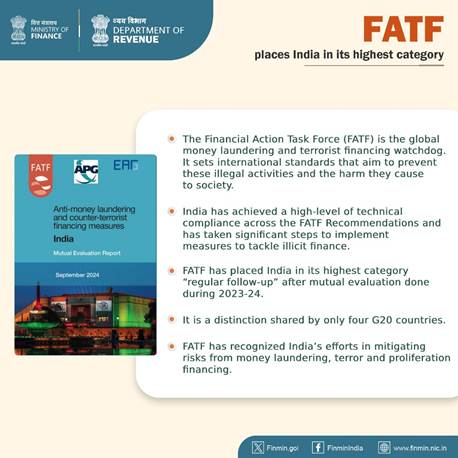
FATF PLACES INDIA IN ITS HIGHEST CATEGORY
The Financial Action Task Force (FATF) is the global money laundering and terrorist financing watchdog. It sets international standards that aim to prevent these illegal activities and the harm they cause to society.
India has achieved a high-level of technical compliance across the FATF Recommendations and has taken significant steps to implement measures to tackle illicit finance.
FATF has placed India in its highest category “regular follow-up” after mutual evaluation done during 2023-24.
It is a distinction shared by only four G20 countries.
FATF has recognized India’s efforts in mitigating risks from money laundering, terror and proliferation financing.
BROAD ACHIEVEMENTS UNDER THE CENTRAL BOARD OF DIRECT TAXES (CBDT) IN 2024:
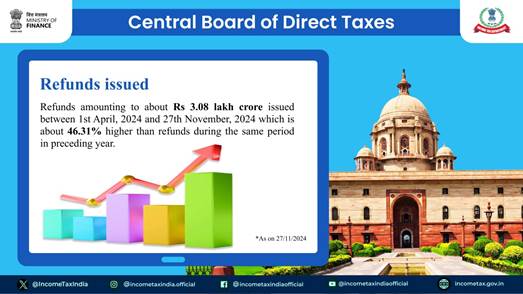
REFUNDS ISSUED
Refunds amounting to about Rs 3.08 lakh crore issued between 1st April, 2024 and 27th November, 2024 which is about 46.31% higher than refunds during the same period in preceding year.
ITR filing per second (Max): 917 (at 8:13:54 AM on 17th July, 2024)
ITR filing per minute (Max): 9,367 (at 8:08 PM on 31st July, 2024)
ITR Filing per hour (Max): 5.07 lakh (between 7PM to 8PM on 31st July, 2024)
About 98.35% of ITRS filed till 22.11.2024 have been e-verified.
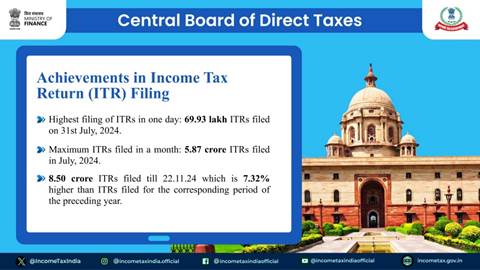
Highest filing of ITRS in one day: 69.93 lakh ITRS filed on 31st July, 2024.
Maximum ITRS filed in a month: 5.87 crore ITRS filed in July, 2024.
8.50 crore ITRS filed till 22.11.24 which is 7.32% higher than ITRs filed for the corresponding period of the preceding year.
SPEEDY PROCESSING
More than 1.62 crore ITRS filed during F.Y. 2024-25 were processed in a single day.
Approximately 21% of the ITR were processed in a single day during the
F.Y. 2024-25.
Approximately 26.35% of ITRS were processed within a week of filing during F.Y. 2024-25 in comparison to 22.56% in F.Y. 2023-24.
GREATER TRANSPARENCY WITH IMPROVED TAXPAYER FACILITATION
To encourage wider use and analysis of data, ITR statistics for different categories of taxpayers for AY 2022-23 and AY 2023-24 released.
Awareness Campaign launched to assist taxpayers in accurately completing Schedule Foreign Assets (Schedule FA) and reporting income from foreign sources (Schedule FSI) in their ITRs.
SWACHHATA HI SEWA
The CBDT has successfully met the goals of #SpecialCampaign4.0, a month-long initiative focused on cleanliness in government offices and addressing pending matters.
Cleared out 3,20,000 physical files, freeing up 1.75 lakh sq. ft. of office space.
Generated Rs 43 lakh from the disposal of scrap materials.
Conducted over 1450 cleanliness campaigns across India.
Enhanced the reclaimed space for a more conducive work environment.
Resolved 53,000 public grievances.
Implemented unique and innovative “Best Practices” throughout the campaign.
FACILITATION TO THE TAXPAYERS
The validation introduced at the upload level of the ITRS is another move to nudge or to take relook at the possible inconsistencies and to facilitate correction before filing of the ITRS.
This resulted in reduction of filing of revised return, rectification request and grievance.
The ITR forms for A.Y. 2024-2025 with all associated functions were rolled out on 1st April, 2024 on the E- filing portal.
More than 76 crore emails & SMSS were sent under E- campaign to popularize the EVC mode during the year under consideration.
As a result 96% of ITR filers adopted the EVC mode for verification of ITRS in A.Y. 2024-25.
ESTABLISHMENT OF DEMAND MANAGEMENT FACILITATION CENTRE (DFC)
During the period 01.01.24 to 13.10.2024, 1,31,180 number of demands amounting to Rs 5,00,224 cr. have been reduced/resolved.
The DFC currently consists of 170 agents who work 6 days a week.
Scheduled calls are made to the tax payers and JAOS for the purpose of resolution of demand.
BROAD ACHIEVEMENTS UNDER THE CENTRAL BOARD OF INDIRECT TAXES AND CUSTOMS(CBIC) IN 2024:
Recent measures for simplification, trade facilitation and Ease of Doing Business under GST:
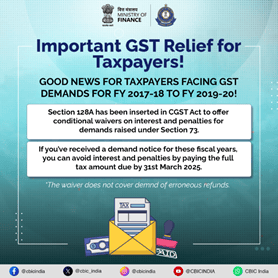
Insertion of section 128A in CGST Act, 2017 has been carried out to provide for conditional waiver of interest or penalty or both relating to demands raised under Section 73, for FY 2017-18 to FY 2019-20 : Considering the difficulties faced by the taxpayers, during the initial years of implementation of GST, amendments have been made in the CGST Act, to provide for continued waiver of interest and penalties for demand notices issued under Section 73 of the CGST Act for the fiscal years 2017-18, 2018- 19 and 2019-20, in cases where the taxpayer pays the full amount of tax demanded in the notice upto 31.03.2025.
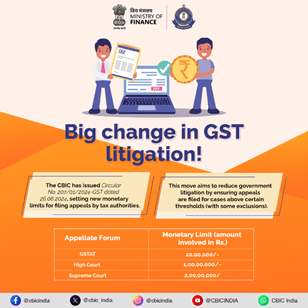
Reduction of Government Litigation by Fixing monetary limits for filing appeals under GST. The CBIC has issued Circular No. 207/01/2024-GST dated 26.06.2024 to prescribe monetary limits, subject to certain exclusions, for filing of appeals in GST by the department before GST Appellate Tribunal, High Court, and Supreme Court, to reduce government litigation.
·://taxconcept.net/judgement/writ-petition-maintainable-despite-alternative-appeal-remedy-benefit-of-loan-waiver-considered-as-monetary-karnataka-high-court/” title=”Writ Petition Maintainable Despite Alternative Appeal Remedy: Benefit of Loan Waiver Considered as Monetary: Karnataka High Court ” data-wpil-keyword-link=”linked” data-wpil-monitor-id=”96112″>appeal with the appellate authority has been reduced from Rs. 25 crores CGST and Rs. 25 crores SGST to Rs. 20 crores CGST and Rs. 20 crores SGST. Further, the amount of pre-deposit for filing appeal with the Appellate Tribunal has been reduced from 20% with a maximum amount of Rs. 50 crores CGST and Rs. 50 crores SGST to 10 % with a maximum of Rs. 20 crores CGST and Rs. 20 crores SGST.
Reduction in rate of TCS to be collected by the ECOs for supplies being made through them: Electronic Commerce Operators (ECOs) are required to collect Tax Collected at Source (TCS) on net taxable supplies under Section 52(1) of the CGST Act. The Central Government has issued Notification No. 15/2024-Central Tax dated 10.07.2024 (notified w.e.f. 10.07.2024), Notification No. 01/2024-Union Territory Tax dated 10.07.2024 (notified w.e.f. 10.07.2024) & Notification No. 01/2024-Integrated Tax dated 10.07.2024 (notified w.e.f. 10.07.2024) to reduce the TCS rate from present 1% (0.5% CGST + 0.5% SGST/ UTGST, or 1% IGST) to 0.5 % (0.25%
CGST + 0.25% SGST/UTGST, or 0.5% IGST), to ease the financial burden on the suppliers making supplies through such ECOs.
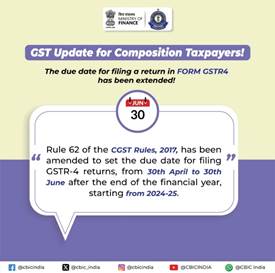
·. The same would give more time to the taxpayers who opt to pay tax under composition levy to furnish the said return.
Amendments of Section 16(4) of CGST Act, to be made effective from July 1st, 2017,to relax condition of section 16(4) of the CGST Act in respect of initial years of implementation of GST, i.e. financial years 2017-18, 2018-19, 2019-20 and 2020-21: Considering the difficulties faced by the taxpayers during the initial years of implementation of GST, based on the recommendations of the GST Council, retrospective amendment has been made in Section 16(4) of CGST Act to relax the time limit to avail input tax credit in respect of any invoice or debit note under Section 16(4) of CGST Act, through any GSTR 3B return filed upto 30.11.2021 for the financial years 2017-18, 2018-19, 2019-20 and 2020-21, may be deemed to be 30.11.2021. This would benefit a large number of taxpayers, especially smaller ones, who could not file returns in a timely manner in the initial years of GST, due to various reasons by which time, the time limit for availment of Input tax credit, under section 16(4) of CGST Act had already expired, which has led to issuance of demands denying them the benefit of input tax credit.
Amendment of Rule 88B of CGST Rules, 2017 in respect of interest under Section 50 of CGST Act on delayed filing of returns, in cases where the credit is available in Electronic Cash Ledger (ECL) on the due date of filing the said return:-The Central Government has issued Notification No. 12/2024-Central Tax dated 10.07.2024 for amendment in rule 88B (w.e.f. 10.07.2024) of CGST Rules to provide that an amount which is available in the Electronic Cash Ledger on the due date of filing of return in FORM GSTR-3B, and is debited while filing the said return, shall not be included while calculating interest under section 50 of the CGST Act in respect of delayed filing of the said return. This will reduce interest burden on such taxpayers.
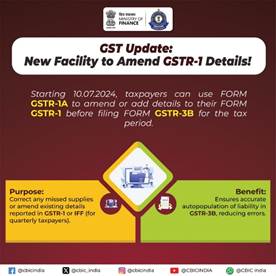
Provision of new optional facility for taxpayers to amend the details in GSTR-1: The Central Government has provided for a new optional facility by way of FORM GSTR-1A (w.e.f. 10.07.2024) to facilitate the taxpayers to amend the details in FORM GSTR-1 for a tax period and/ or to declare additional details, if any, before filing of return in FORM GSTR-3B for the said tax period. This will facilitate taxpayer to add any particulars of supply of the current tax period missed out in reporting in FORM GSTR-1 of the said tax period or to amend any particulars already declared in FORM GSTR-1 of the current tax period (including those declared in IFF, for the first and second months of a quarter, if any, for quarterly taxpayers), to ensure that correct liability is auto-populated in FORM GSTR-3B.
A consolidated guidelines dated 30.03.2024 were issued to all CGST Zones in respect of Ease of Doing Business (EODB) to be followed during investigations of cases against regular taxpayers
Besides, based on the recommendations of the GST Council, a large number of notifications and circulars have been issued on contentious issues, so as to avoid legal disputes.
GST Council recommended reduction in GST rate on Fortified Rice Kernel (FRK), classifiable under 1904, to 5% .
GST council also recommended to fully exempt GST on gene therapy.
GST Council recommended exemption of GST on contributions by general insurance companies from third-party motor vehicle premiums for Motor Vehicle Accident Fund.
GST Council recommended no GST on transaction of vouchers as they are neither supply of goods nor supply of services. The provisions related to vouchers is also being simplified.
GST Council clarified that no GST is payable on ‘penal charges’ levied and collected by banks and NBFCs from borrowers for non-compliance with loan terms.
GST Council recommended reduction of payment of pre-deposit for filing an appeal before the Appellate Authority in respect of an order passed which involves only penalty amount.
GST rate on extruded or expanded products, salted or savoury, reduced from 18% to 12%, aligning them with GST rate on namkeens, bhujia, mixture, and similar ready-to-consume items.
GST rate on cancer drugs such as Trastuzumab Deruxtecan, Osimertinib, and Durvalumab reduced from 12% to 5%.
Reverse Charge Mechanism introduced on the supply of metal scrap by unregistered persons to registered persons. A Tax Deducted at Source (TDS) of 2% applies to B2B supply of metal scrap by registered persons.
Duties & Exemptions
Export duty on various varieties of rice has been reduced.
A Group of Ministers (GoM) has been constituted to holistically look into the issues pertaining to GST on the life insurance and health insurance.
It has been recommended to notify GST @ 5% on the transport of passengers by helicopters on seat share basis and also to regularise the GST for past period on ‘as is where is’ basis.
It has been recommended to clarify by way of a circular that the approved flying training courses conducted by DGCA approved Flying Training Organizations (FTOs) are exempt from the levy of GST.
It has been recommended to exempt supply of research and development services by a Government Entity; or a research association, university, college or other institution, notified under clauses (ii) or (iii) of sub-section (1) of section 35 of the Income Tax Act, 1961 using Government or private grants. It has also been recommended to regularize past demands on ‘as is where is’ basis.
It has been recommended to clarify that location charges or Preferential Location Charges (PLC) paid along with the consideration for the construction services of residential/commercial/industrial complex before issuance of completion certificate forms part of composite supply where supply of construction services is the main service and PLC is naturally bundled with it and are eligible for same tax treatment as the main supply that is, construction service.
It has been recommended to clarify that affiliation services provided by educational boards like CBSE are taxable. It has also been recommended to exempt affiliation services provided by State/Central educational boards, educational councils and other similarly placed bodies to Government Schools prospectively. The issue for the past period between 01.07.2017 to 17.06.2021 is recommended to be regularized on ‘as is where is’ basis.
It has been recommended to clarify by way of circular that the affiliation services provided by universities to their constituent colleges are not covered within the ambit of exemptions provided to educational institutions in the notification No. 12/2017-CT(R) dated 28.06.2017 and GST at the rate of 18% is applicable on the affiliation services provided by the universities.
It has been recommended to exempt import of services by an establishment of a foreign airlines company from a related person or any of its establishment outside India, when made without consideration. The council also recommended to regularise the past period on ‘as is where is’ basis.
It has been recommended to bring renting of commercial property by unregistered person to a registered person under Reverse Charge Mechanism (RCM) to prevent revenue leakage.
It has been recommended to clarify that when ancillary/intermediate services are provided by GTA in the course of transportation of goods by road and GTA also issues consignment note, the service will constitute a composite supply and all such ancillary/intermediate services like loading/unloading, packing/unpacking, transshipment, temporary warehousing etc. will be treated as part of the composite supply. If such services are not provided in the course of transportation of goods and invoiced separately, then these services will not be treated as composite supply of transport of goods.
It has been recommended to regularise the GST liability for the past period prior to 01.10.2021 on ‘as is where is’ basis, where the film distributor or sub- distributor acts on a principal basis to acquire and distribute films.
It has been recommended to exempt supply of services such as application fees for providing electricity connection, rental charges against electricity meter, testing fees for meters/ transformers/capacitors, labour charges from customers for shifting of meters/service lines, charges for duplicate bills etc. which are incidental, ancillary or integral to the supply of transmission and distribution of electricity by transmission and distribution utilities to their consumers, when provided as a composite supply. It has also been recommended to regularize GST for the past period on ‘as is where is’ basis.
Uniform Integrated GST (IGST) rate of 5% on imports of parts, components, testing equipment, tools, and tool-kits of aircraft, regardless of their HS classification to stimulate Maintenance, Repair, and Overhaul (MRO) activities in the aviation sector, subject to specified conditions.
All milk cans made of steel, iron, or aluminium will attract a GST rate of 12%, irrespective of their intended use.
The GST rate on cartons, boxes, and cases made of both corrugated and non-corrugated paper or paperboard (HS codes 4819 10 and 4819 20) has been reduced from 18% to 12%.
solar cookers, whether single or dual energy source, will attract a GST rate of 12%.
The existing entry covering poultry keeping machinery attracting 12% GST has been amended to specifically include “parts of poultry keeping machinery,” regularizing past practices due to interpretational issues.
All types of sprinklers, including fire water sprinklers, will attract a GST rate of 12%, and past practices will be regularized.
IGST exemption on imports of specified items for defense forces has been extended for an additional five years until 30th June 2029.
IGST exemption has been extended to imports of research equipment and buoys under the Research Moored Array for African-Asian-Australian Monsoon Analysis and Prediction (RAMA) programme, subject to specified conditions.
Compensation Cess on imports into Special Economic Zones (SEZ) by SEZ units or developers for authorized operations is exempted retrospectively from 1st July 2017.
Compensation Cess is exempted on the supply of aerated beverages and energy drinks to authorized customers by Unit Run Canteens under the Ministry of Defense.
An ad-hoc IGST exemption is provided on imports of technical documentation for AK-203 rifle kits imported for the Indian Defense forces.
Measures for Facilitation of Trade
Section 9(1) of the CGST Act, 2017, is amended to explicitly exclude rectified spirit or ENA from the scope of GST when supplied for manufacturing alcoholic liquor for human consumption.
Services provided by Indian Railways to general public, namely, sale of platform tickets, facility of retiring rooms/waiting rooms, cloak room services and battery-operated car services and Intra-Railway transactions have been exempted [vide Notification No. 04/2024-CTR dated 12.07.2024 w.e.f., 15.07.2024]. The issue for the past period has also been regularized [Circular No. 228/22/2024-GST dated 15.07.2024].
Services provided by Special Purpose Vehicles (SPV) to Indian Railway by way of allowing Indian Railway to use infrastructure built & owned by SPV during the concession period and maintenance services supplied by Indian Railways to SPV have been exempted [vide Notification No. 04/2024-CTR dated 12.07.2024 w.e.f., 15.07.2024]. The issue for the past has also been [Circular No. 228/22/2024-GST dated 15.07.2024];
A separate entry has been created in notification No. 12/2017- CTR 28.06.2017 under heading 9963 to exempt accommodation services having value of supply of accommodation up to Rs. 20,000/- per month per person subject to the condition that the accommodation service is supplied for a minimum continuous period of 90 days [vide Notification No. 04/2024-CTR dated 12.07.2024 w.e.f., 15.07.2024]. Similar benefit has been extended for past cases [Circular No. 228/22/2024-GST dated 15.07.2024];
Co-insurance premium apportioned by lead insurer to the co-insurer for the supply of insurance service by lead and co-insurer to the insured in coinsurance agreements, has been declared as no supply under Schedule III of the CGST Act, 2017 and past cases have been regularized on ‘as is where is’ basis [Circular No. 228/22/2024-GST dated 15.07.2024].
Transaction of ceding commission/re-insurance commission between insurer and re-insurer has been declared as no supply under Schedule III of CGST Act, 2017 and past cases have been regularized on ‘as is where is’ basis [Circular No. 228/22/2024-GST dated 15.07.2024].
GST liability on reinsurance services of specified insurance schemes covered by Sr. Nos. 35 & 36 of notification No. 12/2017-CT (Rate) dated 28.06.2017 have been regularized on ‘as is where is’ basis for the period from 01.07.2017 to 24.01.2018 [Circular No. 228/22/2024-GST dated 15.07.2024].
GST liability on reinsurance services of the insurance schemes for which total premium is paid by the Government that are covered under Sr. No. 40 of notification No. 12/2017-CTR dated 28.06.2017 have been regularized on ‘as is where is’ basis for the period from 01.07.2017 to 26.07.2018 [Circular No. 228/22/2024-GST dated 15.07.2024].
Clarification has been issued that retrocession is ‘re-insurance of re- insurance’ and therefore, eligible for the exemption under Sl. No. 36A of the notification No. 12/2017-CTR dated 28.06.2017 [Circular No. 228/22/2024- GST dated 15.07.2024].
Clarification has been issued that statutory collections made by Real Estate Regulatory Authority (RERA) are exempt from GST as they fall within the scope of entry 4 of No.12/2017-CTR dated 28.06.2017 [Circular No. 228/22/2024-GST dated 15.07.2024].
Clarification has been issued that further sharing of the incentive by acquiring bank with other stakeholders, where the sharing of such incentive is clearly defined under Incentive scheme for promotion of RuPay Debit Cards and low value BHIM-UPI transactions and is decided in the proportion and manner by NPCI in consultation with the participating banks is not taxable [Circular No. 228/22/2024-GST dated 15.07.2024].
CUSTOMS
Budget 2024-25- major announcements:
Basic Customs Duty (BCD) on shea nuts reduced from 30% to 15%.
BCD reduced to nil on critical minerals such as Antimony, Beryllium, Bismuth, Cobalt, Copper, Gallium, Germanium, and others. BCD reduced to 2.5% on minerals like Graphite, Silicon Quartz, and Silicon Dioxide.
BCD on prawn and shrimp feed and fish feed reduced to 5%. BCD on live Specific Pathogen Free (SPF) Vannamei shrimp and Black Tiger shrimp broodstock reduced to 5%. BCD reduced on various inputs like mineral and vitamin premixes, krill meal, fish lipid oil, and others, subject to IGCR conditions.
BCD increased on ammonium nitrate from 7.5% to 10%.
BCD on PVC flex films increased to 25%.
Customs duty exempted on cancer drugs-Trastuzumab Deruxtecan, Osimertinib, and Durvalumab.
Issuance of Instruction No. 06/2024-Customs dt. 23.03.24
· Smooth and fair elections require coordinated and focused attention, including proper sharing of information by various LEA’s. To this effect, vide Instructions No. 06/2024-Customs dt. 23.03.24 a detailed Standard Operating Procedure was issued for all formations under CBIC to curb the flow of suspicious cash, illicit liquor, drugs/narcotics, freebies and smuggled goods during elections. It includes instructions regarding reporting of major seizures (more than Rs.1 crore) during election & implementation of ESMS for reporting interceptions/seizures made by various enforcement agencies on real-time basis.
Handing over of Antiquities seized by Customs to ASI
Consequent to repatriation of a 16th century stolen idol of Maa Kotrakshi, in presence of Hon’ble Minister of Education and Skill Development & Entrepreneurship; a project for handing over of antiquities seized pan India by Customs to ASI was undertaken. A handing over ceremony was organized on 29.02.2024 chaired by the Hon’ble Finance Minister and 101 such antiquities were handed over to ASI. A handbook titled ‘Puravshesh ke Prahari’ describing the historical importance of these antiquities and role of Customs in preserving our cultural heritage was also released on the occasion.
DGFT extended the RoDTEP Scheme to include good exported from EOU and SEZ sector. To give effect to this, CBIC issued notification nos. 20/2024- Customs (NT) dated 11.03.2024 and 50/2024 -Customs (N.T.) dated 19.07.2024, respectively.
Notification No. 33/2024-Customs (N.T.) dated 30.04.2024. was issued for amendment in Notification No. 77/2023-Customs (N.T.) dated 20.10.2023 relating to All Industry Rates (AIRs) of Duty Drawback including defence goods.
Circular No. 04/2024-Customs dated 07.05.2024 was issued regarding changes made in All Industry Rates (AIRs) of duty Drawback notified vide Notification No77/2023-Customs (N.T.) dated 20.10.2023 and 33/2024- Customs (N.T.) dated30.04.2024.
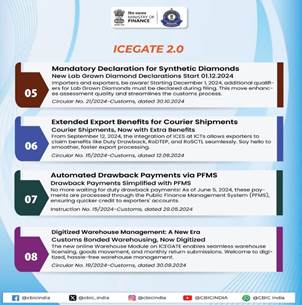
For disbursal of All Industry Rates (AIR) of duty drawback, CBIC has moved from manually issued physical Cheque (to the nodal bank) based process to end-to-end automated PFMS based disbursal of duty drawback amount directly to exporter’s bank accounts since 05.06.2024. For this CBIC issued Instruction No.15/2024-Customs dated 29.05.2024. This paperless functionality is expected to expedite credit of AIR of drawback amount to exporters’ accounts and increase transparency.
Notification No. 55/2024-Customs (N.T.) on August 23.08.2024, was issued for revising the All-Industry Rates (AIR) of duty drawback for gold and silver jewellery and articles of silver. This notification amends the earlier Notification No. 77/2023-Customs (N.T.) dated October 20, 2023.
Drawback Division of CBIC assisted the RoDTEP Committee-2023 for reviewing RoDTEP Rates for various eligible goods, including defence goods, for exports from DTA, AA, EOU & SEZ units. Based on Committee’s recommendations, revised RODTEP rates have been notified by DOC effective from 10.10.2024.
Indian Customs has always been at the forefront when it comes to adopting cutting edge technology for providing better services. In this regard, Board has launched the Exchange Rate Automation Module and the modalities has been explained in Circular 07/2024-Cus dated 25.06.2024. The exchange rates shall be published on ICEGATE website at 6:00 p.m. twice a month (i.e. 1st & 3rd Thursdays of every month) and shall be accessible for public viewing on ICEGATE website. Thus, the automated system has now replaced the manual process of publication of exchange rates.
CBIC vide Notification No. 60/2024-Customs (NT) dated 12.09.2024 amended the Courier Imports and Exports (Electronic Declaration and Processing) Regulations, 2010 to allow export incentives viz. Drawback,
RoDTEP (Remission of Duties and Taxes on Exported Products), RoSCTL (Rebate of State and Central Levies and Taxes) to exports through Courier. Circular No. 15/2024-Customs dated 12.09.2024 explaining the said amendments and informing the stakeholders about extending the export benefits to courier exports has also been issued.
CBIC and the Department of Posts (DoP) have jointly developed a “hub and spoke” system to facilitate export through postal route. The system leverages digital technology and the vast postal network for creating a paperless, contactless and intermediary-free environment for enhancing exports through postal mode. In continuation of the already authorized 1001 booking post offices, CBIC vide Circular No. 01/2024 dated 01.02.2024 has further authorized an additional 14 booking post offices taking the total number of booking post offices covered under the automated system to a total of 1015. Further, the project for automation of IGST refund on postal exports made using the DNK portal has been implemented with effect from 17th September, 2024.
Agreement between the Government of the Republic of India and the Government of the Republic of Madagascar on Cooperation and Mutual Administrative Assistance in Customs Matters signed on 27.06.2024 on the side-lines of WCO Council Meeting in Brussels.
Agreement between the Government of the Republic of India and the Government of the Republic of Belarus on Cooperation and Mutual Assistance in Customs Matters was signed on 28.06.2024 on the side-lines of WCO Council Meeting in Brussels.
MoU between the CBIC and General Department of Viet Nam Customs on Capacity Building was signed on 31.07.2024
Cooperative Arrangement between the Central Board of Indirect Taxes and Customs of the Government of the Republic of India and the New Zealand Customs Service in Customs Matter was signed on 06.08.2024
For providing connectivity to landlocked developing country Bhutan, CBIC in February this year-2024 has issued a Standard Operating Procedure allowing transit of goods between Bhutan and Bangladesh using riverine route through India with the entry/exit points at Jogighopa and Pandu ports in Assam.
CBIC hosted the 5th Joint Group of Customs Meeting between India & Bhutan from 6th -7th May, 2024 in Leh, India.
Circular No. 09/2024-Customs dated 09.07.2024 has been issued amending circular No. 29/2020- Customs dated 22.6.2020 for allowing transshipment of Bangladesh export cargo to third Countries through Air Cargo Complex, Kempegowda International Airport Bengaluru.
Recently, CBIC lead Capacity Building Program on “Advancing Bhutan-India Trade and Economic, Partnership” at Thimpu, Phuentsholing, Gelephu and Samdrup from 29th July- 01st August, 2024.
4th National Conference on the Functioning of Land Customs Stations (LCSs) was organized on 28th and 29th August, 2024.
Circular No. 19/2024-Customs dated 30.09.2024 has been issued regarding Digitization of Customs Bonded Warehouse Procedures relating to obtaining Warehouse license, Bond to Bond Movement of Warehoused goods, and uploading of Monthly Returns.
Indian Customs Electronic Commerce/Electronic Data Interchange (ICEGATE) 2.0:
ICEGATE 2.0 website is a complete bilingual website which has been designed to provide contemporary user interface for enhanced user experience. New feature “widget” is also being provided to show important information such as Message filing status, details of tickets, refunds, and duty payments etc. in personalised dashboard without going for enquiries. Data available in the widgets is also downloadable. Customized notifications facility is being provided to the registered users to choose the events for which they want to receive notifications. Registered users can file their documents themselves using online Web forms on ICEGATE as well which is advancement from earlier offline webforms.
USE of ICETABs for efficient examination and clearance process:
The ICETAB is part of the CBIC’s ongoing initiatives to simplify trade procedures. The ICETAB is a mobile tablet designed to facilitate the quick and real-time upload of examination reports, enabling Customs Officers to enhance efficiency while on the go. The ICETAB has an exclusive Mobile Application to enable examining officers to view RMS Instructions, Examination Order and Bill of Entry (BE) details along with other supporting documents, capture images of cargo examination for integration with the Bill of Entry and submit examination report immediately on completion of the cargo examination. The ICETAB by Customs Officers is aimed at enhancing transparency and efficiency in customs processes for speedy examination of import consignments with capability to attach photographs with geo- referencing and no requirement for any paper documents for the purpose of examination. This will also facilitate quick upload of the examination report on the go in real time basis and making the examination process transparent and faster. The detailed guidelines for the use of ICETAB are outlined in CBIC Circular No. 10/2024-Customs dated 20.08.2024.
Exchange Rate Automation Module:
· Indian Customs has always been at the forefront when it comes to adopting cutting edge technology for providing better services. In this regard, Board has launched the Exchange Rate Automation Module and the modalities has been explained in Circular 07/2024-Customs dated 25.06.2024 and its amendment Circular No. 17/2024-Customs dated 18.09.2024. The exchange rates shall be published on ICEGATE website at 6:00 p.m. twice a month (i.e. 1st & 3rd Thursdays of every month) and shall be accessible for public viewing on ICEGATE website. Thus, the automated system has now replaced the manual process of publication of exchange rates.
Encouraging Women participation in International Trade: The Zones have been instructed by the Board Circular No. 2/2024-Customs, dated March 8, 2024 to promote women’s representation and support within customs and trade activities by:
ensuring women’s representation in PTFC and CCFC meetings, preferably through women’s associations; ensuring women’s representation in PTFC and CCFC meetings, preferably through women’s associations;
including at least one agenda point from women perspective;
encouraging Trade bodies/ custodians to establish dedicated help desks and processing mechanisms for women traders and women logistics service providers;
supporting the upskilling women logistics service providers, freight forwarders and custom brokers by offering relevant trainings for women.
This initiative highlights the importance of gender equality in trade (be it as traders, customs house agents, freight forwarders, or customs brokers) advocating for active efforts from Partner Government Agencies and trade bodies to support the increasing participation of women across various roles in the logistics sector. The detailed guidelines for encouraging Women participation in International Trade are outlined in CBIC Circular No. 2/2024-Customs dated 08.03.2024.
Mandatory additional qualifiers in import/export declarations in respect of Synthetic or Reconstructed Diamonds w.e.f., 01.12.2024:
As per the Bill of Entry (Electronic Integrated Declaration and Paperless Processing) Regulations, 2018 and Shipping Bill (Electronic Integrated Declaration and Paperless Processing) Regulations, 2019, it will be mandatory to be declare additional qualifiers/identifiers for Lab Grown Diamond at the time of filing of import/export declarations with effect from 01.12.2024. Declaration of additional qualifiers would improve quality of assessment and streamline intervention and enhance facilitation. The detailed instructions in this regard are outlined in CBIC Circular No. 21/2024-Customs dated 30.10.2024.
Extended export related benefits for exports made through courier mode:
Until now, the Express Cargo Clearance System (ECCS) was used for handling courier import and export shipments at the notified International Courier Terminals (ICTs). However, due to limitations in the system’s architecture, certain export- related payments, such as Duty Drawback, RoDTEP, and RoSCTL, could not be processed through ECCS. To address this issue, it has been decided to implement the Indian Customs EDI System (ICES) at the International Courier Terminals for processing these payments, effective from 12.09.2024. The modalities for this implementation have been outlined in Circular No. 15/2024-Customs, dated 12.09.2024.
Disbursal of Drawback amounts into the exporters’ account through PFMS:
With effect from 5h June, 2024; payment of Drawback amounts into the exporters’ accounts post scroll out, will be facilitated through the Public Finance Management System (PFMS). The scrolls generated at different locations will be automatically processed by the Customs automated system (CAS) for onward transmission to the Central Nodal e-DDO and the nominated central nodal e-DDO shall forward the consolidated scroll to the nodal e-PAO. After approval from the nodal e-PAO, duty drawback amounts shall be credited into the exporters’ bank accounts linked with PFMS. The detailed instructions have been issued through Instruction No. 15/2024-Customs dated 29.05.2024.
Digitization of Customs Bonded Warehouse procedures relating to obtaining Warehouse License, Bond to Bond Movement of warehoused goods, and uploading of Monthly Returns:
The CBIC has launched a Warehouse Module on ICEGATE for Customs Bonded Warehouses, enabling: (i) online filing of applications for obtaining a Warehouse License; (ii) online submission and processing of requests to transfer warehoused goods to another person and/ or warehouse; and (iii) uploading Monthly returns for Customs Bonded Warehouses. The Directorate General of Systems (DG Systems) has issued comprehensive User Manuals for both trade members and departmental officers. Detailed procedures are outlined in Circular No. 19/2024- Customs, dated 30.09.2024.
Performance of ongoing schemes/ programs:
India’s overall trade facilitation score in the Global Survey on Digital and Sustainable Trade Facilitation conducted by the UNESCAP, 2023, increased from 78.49% in 2019 to 93.55% in 2023, indicating a marked improvement in the efficiency of cross-border trade procedures. (Source: CBIC Circular No. 10/2024- Customs dated 20.08.2024)
India’s Score in UN Trade Facilitation survey on “women in Trade Facilitation” has increased from 0% in 2019 to 66% in 2021 and this has resulted in overall improvement in India ranking in UN Trade Facilitation survey.
Provisioning services to SEZ Units at ICEGATE:
EDI Enablement of SEZ Sites was successfully completed. Some key services like Registration of SEZ Users, Child User Registration, Amendment in Registration, filing services, Inter and Intra Goods Movement, DTA Procurement, ETP Webform and facilitating DSC Amendment for SEZ users were provisioned for the SEZ users at ICEGATE.
Launch of module for SCMTR (Sea Cargo Manifest and Transhipment Regulations):
The SCMTR also specifies changes to the formats and timelines for filing manifest declarations. Some of the features of the SCMTR include:
Requesting additional details about each cargo, such as the invoice value and HSN
Advancing the time of reporting to the port of departure Ensuring track and trace of reported cargo
Including features for moving vessels within India
Capturing details electronically, such as crew lists, instead of manually.
Document Download Utility:
A utility developed at ICEGATE to allow users to download various documents like BE, SB, LEO, OOC, Gatepass for OOC, Gatepass for LEO in the e-Copy functionality at ICEGATE.
Revamp of ICEGATE 2.0 Website:
ICEGATE website was made more informative and user- friendly.
AI-based interactive Chatbot (Vaani):
This has been launched for trade at the ICEGATE website to help users with information to access various services of ICEGATE.
Exchange Rate Automation Module:
A module was launched to automate the integration of Exchange Rates of various Currency codes used in the Customs System. This involved API based integration with SBI to receive the Exchange Rates of the currency codes. These rates are automatically updated on the website as well as the application for the purpose of trade without any manual intervention.
Tracking the details of NOC/Release Order Issuance details from the PGAs
A facility has been enabled on the dashboard of the users to provide the tracking details of the NOC/Release Order issued by the respective PGA (FSSAI, AQCS and PQMS) on the ICEGATE website against the Bill of entry filed by the user.
API integration with Custodians (Sea and Land):
The existing MFTP based integration was migrated to API based integration with CONCOR and Adani Land and Sea Ports respectively. This has facilitated the exchange of data between ICEGATE application and Custodians to share the data on a real time basis.
Integration with Department of Post:
There has been an integration with Department of Post to claim IGST refund for the concerned Shipping Bills filed and claim other export benefits.
IGST Refund for Export through Dak Niryat Kendra (DNK):
A module has been launched on ICEGATE to enable IGST Refund for export through Dak Niryat Kendra (DNK).
Integration with ECCS for SB filing, Custodian Registration and Message Exchange with ICEGATE:
There has been an integration with ECCS to claim various export benefits against the Shipping Bills filed.
Export benefits (RoDTEP, RoSCTL & Drawback) to goods exports through Courier mode:
Export benefits (RoDTEP, RoSCTL& Drawback) extended for exports through the Courier mode.
Warehouse Licensing Code, Warehouse to warehouse goods movement and digitizing the monthly return for warehouse:
A module has been launched on ICEGATE to provision the generation of Warehouse Licensing Code for Warehouse users. This module also facilitates the goods movement from warehouse to warehouse. There is also a facility to digitize the filing of monthly returns for Warehouse.
Launch of Mobile Application for Internal and External Users over Android Platform:
Services of ICEGATE like Filing, e-Payment, accessing various enquiries over Android based mobile have been launched. This will soon be available on iOS platform.
Migration of critical functionalities like Integration with eSeal Vendors, eScrip, Customs E- payment Platform, Integration with DGFT, Examination Module, Integration with GSTN, Container Scanning Module from ICEGATE 1.0 to ICEGATE 2.0. The former being based on legacy-based architecture was migrated to a micro services-based architecture.
Integration with FSSAI, PQMS, AQCS under Single Sign On services:
A facility has been provided to the registered users to access the respective portal of the agencies like FSSAI, AQCS and PQMS from the ICEGATE website without any login at the respective PGA portal. This will be made live with other PGAs as well in the future.
Integration with BIS:
API based integration between BIS and ICEGATE to share the license details of the manufacturer for reference to the officer.
Integration with DGFT for RCMC details:
API based integration between DGFT and ICEGATE to share the RCMC details of the user from DGFT. These details are shown to the user on the dashboard at ICEGATE.
Export benefits to courier
Export incentives (Drawback, RoDTEP, RoSCTL) to the exports of goods where the value of consignment is less than rupees 10 lakh made through courier and in order to claim export incentives, for e-commerce shipments through ICT, shipping bill would be filed at ICEGATE/ICES.
Scroll will be generated automatically and there would be no manual intervention.
The scrips will be generated at ICEGATE portal.
IGST Refund for DAK Niryat
A mechanism for refund of IGST on exports through post is developed, wherein, the exporters will provide the details for seeking IGST refund at the time of filing postal bill of exports, and such details shall be pushed to the ICES System after physical export of goods, for GST verification with GSTN, and for preparation of scrolls.
The IGST refunds would be processed in a manner similar to that being done for exports through courier/ ECCS.
Post EGM Amendment Module
A functionality for allowing the officer to amend the shipping bill after filing of EGM has been developed. Once a shipping bill is amended, the export incentives would be processed again and the benefits would be paid to the exporter as per the existing functionalities.
Hand carriage of cargo
A functionality is being developed after which an exporter can export goods to be carried by foreign bound passengers authorized by the exporter in his behalf as personal baggage.
ICETAB
Access to examinee officer to ICES at examination shed Instant report submission in Realtime
Reduction in dwell time
Help in storing date and time of picture including Latitude and Longitude of place where picture taken
Access to RMS instruction, e-Sanchit, BE details at examination shed.
Newly launched development
Launch of ICETAB for field officers for doing faster examination at the time of Export/Import in August 2024.
Provisioning of exports benefits (RoDTEP, RoSCTL and Drawback) to commercial exports being processed through the integrated Courier Terminals (ICT) launched on 13.09.2024.
IGST refund for exports through Dak Niryat Kendras (DNK) rolled out on 17.09.2024.
4. 273 SEZ sites launched in ICES on 01.07.2024.
Upcoming development
Amendment in a shipping bill Post EGM.
Hand carriage of Cargo (New automation of manual process)
The Economic Survey tabled by the Union Minister of Finance and Corporate Affairs, Smt. Nirmala Sitharaman in Parliament today, highlights the importance of the MSME sector in the Indian economy with an all-India manufacturing output of 35.4 percent.
According to the survey, Gross Value Added (GVA) per worker increased from ₹1,38,207 to ₹1,41,769 and Gross Value of Output (GVO) per establishment increased from ₹3,98,304 to ₹4,63,389 showing increased productivity and labour efficiency. The Survey highlights the success of the Udyam Registration portal that has received 4.69 Crore registrations as of 05 July 2024, playing an instrumental role in formalizing MSMEs by providing a simple, online, and free registration process based on self-declaration. The Survey notes that there has been significant growth between FY20 to FY24 in the amount and number of guarantees for MSMEs with Union Budget 2023-24 allocating ₹9,000 Crore to the Credit Guarantee Fund Trust, aiming to enable an additional ₹2 Lakh Crore in credit with reduced costs.
According to Survey, keeping in view India’s vision of becoming ‘Aatmanirbhar’, Production Linked Incentive (PLI) Schemes for 14 key sectors were announced with an outlay of ₹1.97 Lakh Crore to enhance India’s manufacturing capabilities and exports. Further survey states that over ₹1.28 Lakh Crore of investment was reported until May 2024, which has led to production/sales of ₹10.8 Lakh Crore and employment generation (direct & indirect) of over 8.5 Lakh. Survey states export boosted by ₹4 Lakh Crore, with significant contributions from sectors such as large-scale electronics manufacturing, pharmaceuticals, food processing, and telecom & networking products.
Survey highlights, to give an impetus to the One District One Product (ODOP) initiative, the Union Budget of FY24 announced that states would be encouraged to set up a “Unity Mall” in their capitals or most prominent tourism centre or the financial capital for the promotion and sale of their ODOPs. Survey also states that “PM-Ekta Malls” aims to link the artisans of ODOP and consumers. Survey states that these malls are creating a vibrant marketplace for the nation’s unique products, aiming at both domestic and foreign markets. In addition to this survey ‘ODOP Sampark’ workshops were conducted in 15 States to facilitate collaboration between the Centre and local sellers and revive indigenous industries. According to the survey, ODOP showcased India to the world at the G20 events organised across the country during India’s G20 Presidency, where the artisans, sellers and weavers got visibility on the global stage.
ICAI sends representation to CBDT Finance Ministry of India for concerns related to 26AS, AIS, TIS & e-filing of Forms
Sub: Concerns in relation to Form 26AS/TIS/AIS and in e-filing the ITR Forms
The Institute of Chartered Accountants of India (ICAl), being a partner in nation building plays a pivotal role in strengthening the relationship between the taxpayers and the Department; by bringing to the notice of the Department, genuine hardship being faced by the taxpayers so that the same can be resolved timely for effective tax compliance. In this direction, we bring to your kind notice issues faced by taxpayers with respect to accessing Form 26AS/TIS/AIS and preparing and filing their returns of income.
As you are kindly aware, section 139(1) of the Act provides for the statutory timeline of 31st July, 2024 for filing of returns of income of for the A.Y. 2024-25 of individuals, HUFs, firms who are not subject to tax audit. Many of the taxpayers are facing difficulty in relation tor Form 26AS/AIS/TIS due to glitches in the income-tax e filing portal.
The recent GST Council meeting has created anticipation for potential changes in GST rates on various products. Sources have revealed that the Council may refer the issue of GST rates on cigarettes and bidis to the Rate Rationalisation Committee. This move aims to potentially notify a maximum tax rate of 20% under CGST and 20% under SGST, compared to the current 28% rate.
Notably, state Finance Ministers are expected to propose changes to the indirect tax system for the upcoming Union Budget during the forthcoming meeting, reinstating the significance of this upcoming discussion.
Furthermore, there are expectations for significant adjustments in GST rates for multiple products. The Fitment Committee might propose reducing the GST rate from 18% to 5% for aircraft parts/components in aircraft maintenance. Additionally, the GST Council is anticipated to consider reducing the GST rate on carton boxes for packaging apples from 18% to 12%, as well as the GST on solar cookers from 18% to 5%.
Another potential adjustment includes the law committee’s suggestion to exempt the compensation cess of 12% on aerated beverages, indicating a potential shift in this aspect of the tax system.
Additionally, there is growing curiosity among consumers and industry experts about the future of the GST Compensation Cess, initially intended for the first five years of the GST regime starting in July 2017. Talks during the recent meeting, led by the Finance Minister, hinted at a future strategy to introduce an additional cess or surcharge post March 2026, following the expiration of the GST Compensation Cess.
These potential changes and discussions signify an important phase in the evolution of the GST system, reflecting the ongoing efforts to streamline and optimize the indirect tax structure for the benefit of all stakeholders.
Time Series data of Direct Taxes shows improved Taxpayer compliance
ITRs filed by individual taxpayers register increase of 90% from 3.36 crore in Assessment Year (AY) 2013-14 to 6.37 crore in AY 2021-22
Average gross total income for individual taxpayers registers an increase of 56% from AY 2013-14 to AY 2021-22
In an indication of widening tax base subsequent to various reforms measures, 7.41 crore ITRs filed for AY 2023-24 till date, including 53 lakh new first time filers
295% increase in ITRs filed by individual taxpayers with gross total income of Rs. 5 lakh to Rs. 10 lakh from AY 2013-14 to AY 2021-22
291% increase in ITRs filed by individual taxpayers with gross total income of Rs. 10 lakh to Rs. 25 lakh from AY 2013-14 to AY 2021-22
Data further indicates increase in net direct tax collections from Rs. 6.38 lakh crore in FY 2013-14 to Rs. 16.61 lakh crore in FY 2022-23
The Income Tax Department has, over the years, focused on several measures to ensure ease in compliance of taxpayers and transparent tax administration. In line with transparency in its functioning, the Department had released the Time Series Data of Direct Taxes and Income Tax Return statistics, in various tranches, from time to time.
The data shows that the number of ITR filings has shown a consistent upswing over the last few years. The returns filed by individual taxpayers have increased from 3.36 crore in Assessment Year (AY) 2013-14 to 6.37 crore in AY 2021-22 registering an overall increase of 90%.During the current fiscal too, 7.41 crore returns have been filed for AY 2023-24 till date, including 53 lakh new first time filers. This is an indication of the widening of tax base subsequent to various reform measures put in place by the Department.
In fact, while the overall number of returns of individual taxpayers has shown an increase over the years, there is also an increase in number of returns filed by individual taxpayers across various ranges of gross total income.
In the range of gross total income upto Rs. 5 lakh, the number of returns filed by individual taxpayers has increased from 2.62 crore in AY 2013-14 to 3.47 crore in AY 2021-22 registering an increase of 32%. This range of income includes individuals having income below taxable limit who may not be filing returns.
In the range of gross total income of Rs. 5 lakh to Rs. 10 lakh, and Rs. 10 lakh to Rs. 25 lakh, the number of returns filed by individual taxpayers from AY 2013-14 to AY 2021-22 has registered an increase of 295% and 291% respectively.
The proportionate contribution of gross total income of bottom 25% individual taxpayers vis-à-vis all individual taxpayers has increased from 8.3% in AY 2013-14 to 8.4% in AY 2021-22.
The proportion of gross total income of middle 74% group of individual taxpayers increased from 75.8% to 77% in the above period.
The average gross total income for individual taxpayers increased from about Rs. 4.5 lakh in AY 2013-14 to about Rs. 7 lakh in AY 2021-22 representing an increase of 56%. The increase in average gross total income for top 1% individual taxpayers is 42% while that for bottom 25% individual taxpayers is 58%.
The above data is clearly indicative of a robust growth in the gross total income of individuals across different income groups subsequent to AY 2013-14. The overall impact has been reflected in increase in net direct tax collections from Rs.6.38 lakh crore in FY 2013-14 to Rs. 16.61 lakh crore in FY 2022-23. This has been made possible due to the taxpayer friendly and taxpayer oriented progressive policies adopted by the Government. The Department is committed to ensure transparency in processes, efficiency in administration and concerted efforts at building trust with taxpayers and stakeholders.
Vide Notification Dated 18th April 2022 by the Ministry of Finance, the Central Government has notified sale reissue of government securities as mentioned in the notification.
Government said in the notification that GoI will have the option to retain additional subscription up to 2,000 crore against each security mentioned above. The sale will be subject to the terms and conditions spelt out in this notification (called Specific Notification). The Securities will be sold through Reserve Bank of India, Mumbai Office, Fort, Mumbai- 400 001 as per the terms and conditions specified in the General Notification F.No.4(2)–W&M/2018, dated March 27, 2018 issued by Government of India.
A pension of Rs 1,000 is not enough for the subscribers of Employees’ Provident Fund Organization (EPFO). It needs to be increased. A committee of Parliament on Tuesday said that giving Rs 1,000 as minimum monthly pension to subscribers under EPFO’s pension scheme is too low. In such a situation, it is necessary that the Ministry of Labor takes forward the proposal to increase the pension amount.
Parliament’s Standing Committee on Labor in its report tabled in Parliament on Demands for Grants 2022-23 said that the monthly pension of Rs 1,000 fixed eight years ago is now too low. There are many reasons for this. Inflation has increased continuously in eight years, according to which the monthly pension should also increase. Earlier, the committee in its report had also recommended that the minimum monthly pension for members/ widow/ widow pensioners be increased to Rs. 2,000. Necessary annual budgetary provision should be made for this. However, the finance ministry had not agreed to increase the minimum monthly pension from Rs 1,000.
Clarifying the government’s stand on Tuesday, sources in the finance ministry said the central government has no plans to reform the capital gains tax structure at present. Sources have rubbished media reports that the government wants to reform the capital gains tax structure to increase its earnings and increase spending on welfare schemes.
In a report quoting two officials related to the matter, it was said that in a proposal presented before the Finance Ministry in this regard, it has been said that the tax on income from capital market should not be less than the tax on income from business.
Ministry of Finance, Department of Economic Affairs
The notification reads as under:
It is hereby notified that the deposits made under the Special Deposit Scheme for Non Government Provident, Superannuation and Gratuity Funds, announced in the Ministry of Finance (Department of Economic Affairs) Notification No. F. 16(1) PD/75 dated 30th June, 1975, shall with effect from 1st January, 2022 to 31st March, 2022 bear interest at 7.1% (seven point one percent). This rate will be in force w.e.f. 1st January, 2022.
Finance Ministry meeting with Infosys on glitches in e-filing portal of Income Tax Department
Union Minister for Finance & Corporate Affairs Smt. Nirmala Sitharaman took a meeting with Mr. Salil Parekh, MD & CEO, Infosys here today afternoon to convey the deep disappointment and concerns of the Government and the taxpayers about the continuing glitches in the e-filing portal of the Income Tax Department even after two and half months since its launch, which was also delayed. Smt. Sitharaman sought an explanation from Infosys for the repeated issues faced by taxpayers.
The Ministry of Finance emphasised that there is a need for putting in more resources and efforts on the part of Infosys so that the much delayed delivery of agreed services is ensured. Mr. Parekh was also sensitised on the difficulties that the taxpayers were facing and the problems that are arising on account of the delays in the functioning of the portal.
The Finance Minister demanded that the issues faced by taxpayers on current functionalities of the portal should be resolved by the team by 15th September, 2021 so tha taxpayers and professionals can work seamlessly on the portal
Mr. Parekh explained that he and his team are doing everything to ensure the smooth functioning of the portal. Further, Mr. Parekh said that over 750 team members are working on this project and Mr. Pravin Rao COO of Infosys, is personally overseeing this project. Mr. Parekh also assured that Infosys is working expeditiously to ensure a glitch-free experience to the taxpayers on the portal.
This is with reference to the news report published in certain section of media regarding the advertisement given by Institute of Banking Personnel Selection(IBPS) for holding an examination for recruitment in the clerical cadre of Public Sector Banks (PSBs) only in two languages i.e. English and Hindi, despite the fact that 22 languages were recognized by the Constitution of India. The news report cites a statement made by the UnionFinance Minister in 2019 when she had assured of holding banking exams in local languages.
In the above context, it may be clarified that the Finance Minister’s statement referred to above was made in the context of Regional Rural Banks (RRBs) only. With a view to provide a level playing field to the local youths for availing employment opportunities, the Government in 2019 decided that for recruitment of Office Assistant and Officer Scale I in RRBs , examination will be held in 13 regional languages including Konakani and Kannada, besides Hindi and English. Since then, examination for these recruitments are being conducted in regional languages also.
In order to look into the demand for holding examination for clerical cadre in Public Sector Banks (PSBs) in local/regional languages, a Committee has been constituted to look into the matter in its entirety. The Committee will give its recommendations within 15 days. The ongoing process of holding the examination initiated by IBPS will be kept on hold until the recommendations of the Committee are made available.
India and the United Kingdom (UK) held the inaugural meeting of the India-UK Financial Markets Dialogue (‘the Dialogue’) virtually late evening yesterday. The Dialogue was established at the 10th Economic and Financial Dialogue (EFD) in October 2020 to deepen bilateral ties in the financial sector.
The Dialogue was led by senior officials from the Indian side by the Ministry of Finance and from UK, Her Majesty’s Treasury, with participation from Indian and UK independent regulatory agencies, including the Reserve Bank of India, the Securities and Exchange Board of India, International Financial Services Centre Authority, Insurance Regulatory and Development Authority of India, the Bank of England, and the Financial Conduct Authority.
Discussions during the Dialogue were focused on four themes:
GIFT (Gujarat International Finance Tec-City) City, India’s flagship international financial centre,
banking and payments,
insurance, and
capital markets
Following the government-to-government discussion on these issues, private sector partners were invited to the discussion. The City of London Corporation’s Capital Markets Working Group presented their work on the Indian corporate bond market, and the India-UK Financial Partnership presented their recommendations on the UK-India financial services relationship, particularly on development of GIFT City as global services hub.
As two services driven economies, both sides agreed that there is significant scope for strengthening the financial services cooperation between India and the UK. They also concurred to continue to engage bilaterally on these areas in the coming months, in the run up to the next EFD and the beginning of negotiations for a future India-UK FTA, both expected to take place later this year.
Central Board of Indirect Taxes & Customs (CBIC) Chairman Shri M. Ajit Kumar here today inaugurated the online filing of Authorised Economic Operators (AEO) T2 and T3 applications. The AEO web application is accessible at URL www.aeoindia.gov.in. The new version (V 2.0) of the web application is designed to ensure continuous real-time and digital monitoring of physically filed AEO T2 and AEO T3 applications for timely intervention and expedience.
The AEO application processing for AEO T1 on the web-based portal www.aeoindia.gov.in has been functional since December 2018. To take this endeavour for digitisation forward, in line with the government’s Digital India initiative, the CBIC Board has launched a new version (V2.0) for on-boarding of AEO T2 and AEO T3 applicants for online filing, real-time monitoring, and digital certification. For further details, refer to CBIC Circular No. 13/2021-Customs dated 01.07.2021.
The gross GST revenue collected in the month of June’ 2021 is₹92,849 crore of which CGST is ₹16,424 crore, SGST is ₹20,397, IGST is ₹49,079 crore (including ₹25,762 crore collected on import of goods) and Cess is ₹6,949 crore (including ₹809 crore collected on import of goods).The above figure includes GST collection from domestic transactions between 5thJune to 5th July 2021 since taxpayers were given various relief measures in the form of waiver/reduction in interest on delayed return filing for 15 days for the return filing month June’21 for the taxpayers with the aggregate turnover upto Rs. 5 crore in the wake of covid pandemic second wave.
During this month the government has settled ₹ 19,286 crore to CGST and ₹ 16,939 crore to SGST from IGST as regular settlement. The revenues for the month of June 2021 are 2% higher than the GST revenues in the same month last year.
GST collection after posting above Rs. 1 lakh crore mark for eight months in a row, the collection in June 2021 dropped below Rs. 1 lakh crore. The GST collection for June 2021 is related to the business transactions made during May’2021. During May’2021, most of the States/UTs were under either complete or partial lock down due to COVID. The e-way bill data for the month of May 2021 shows that during the month, 3.99 crore e-way bills were generated as compared to 5.88 crore in the month of April 2021, down by more than 30%.
However, with reduction in caseload and easing of lockdowns, the e-way bills generated during June 2021 is 5.5 crore which indicates recovery of trade and business. The daily average generation of e-way bill for the first two weeks of April 2021 was 20 lakh, which came down to 16 lakh in last week of April 2021 and further to 12 lakh in the two weeks between 9th to 22nd May. Thereafter, the average generation of e-way bills has been increasing and has reached again to 20 lakh level since the week beginning 20th June. Therefore, it is expected that while the GST revenues have dipped during the month of June, the revenues will see an increase again from July 2021 onwards.
The Government of India (GoI) has announced the Sale (Issue / re-issue) of
(i) ‘4.26% Government Security, 2023’ for a notified amount of Rs 3,000 crore (nominal) through price based auction, (ii) ‘New Government Security, 2031’ for a notified amount of Rs 14,000 crore (nominal) through yield based auction, and (iii) ‘6.76% Government Security 2061’ for a notified amount of Rs 9,000 crore (nominal) through price based auction. GoI will have the option to retain additional subscription up to Rs 6,000 crore against above security/securities. The auctions will be conducted by the Reserve Bank of India, Mumbai Office, Fort, Mumbai on July 09, 2021 (Friday) usinguniform price method for 4.26% GS 2023, New GS 2031 and multiple price method for 6.76% GS 2061.
Up to 5% of the notified amount of the sale of the Securities will be allotted to eligible individuals and Institutions as per the Scheme for Non-Competitive Bidding Facility in the Auction of Government Securities.
Both competitive and non-competitive bids for the auction should be submitted in electronic format on the Reserve Bank of India Core Banking Solution (E-Kuber) system on July 09, 2021. The non-competitive bids should be submitted between 10.30 a.m. and 11.00 a.m. and the competitive bids should be submitted between 10.30 a.m. and 11.30 a.m.
The result of the auctions will be announced on July 09, 2021 (Friday) and payment by successful bidders will be on July 12, 2021 (Monday).
The Securities will be eligible for “When Issued” trading in accordance with the guidelines on ‘When Issued transactions in Central Government Securities’ issued by the Reserve Bank of India vide circular No. RBI/2018-19/25 dated July 24, 2018 as amended from time to time.
During Quarter 4 of FY21, the Central Government issued dated securities worth Rs 3,20,349 crore as against Rs 76,000 crore in Q4 of FY20, while repayments were at Rs 29,145 crore. The weighted average yield of primary issuances increased to 5.80 per cent in Q4 FY21 from 5.68 percent in Q3 of FY21. The weighted average maturity of new issuances of dated securities was lower at 13.36 years in Q4 of FY21 as compared to 14.96 years in Q3 of FY21.
During January – March 2021, the Central Government did not raise any amount through the Cash Management Bills. The Reserve Bank conducted nine special and normal Open Market Operations involving simultaneous purchase and sale of government securities during the quarter. The net daily average liquidity absorption by RBI under Liquidity Adjustment Facility (LAF) including Marginal Standing Facility and Special Liquidity Facility was at Rs 3,35,651 crore during the quarter.
Total liabilities (including liabilities under the ‘Public Account’) of the Government, as per provisional data, increased to Rs 1,16,21,781 crore at end-March 2021 from Rs 1,09,26,322 crore at end-December 2020. This represented a quarter-on-quarter increase of 6.36 percent in Q4 FY21. Public debt accounted for 88.10 per cent of total outstanding liabilities at end-March 2021. Nearly 29.33 per cent of the outstanding dated securities had a residual maturity of less than 5 years. The ownership pattern indicates the share of commercial banks at 37.8 percent and at 25.3 percent for insurance companies at end- March 2021.
The yields on Government securities hardened in the secondary market due to increase in supply of G-secs during the quarter. Further, hardening of yields was more on the short end of the curve due to increase in weekly borrowing and also announcement of resumption of normal liquidity operations by the Reserve Bank. However, the yields were supported by decision of MPC meetings held on 5th February, 2021, wherein MPC kept the Policy repo rate unchanged at 4 percent and reiterated to continue with accommodative stance, at least during the current financial year and into the next financial year – to revive growth on a durable basis and mitigate the impact of COVID-19 pandemic on the economy, while ensuring that inflation remains within the target going forward.
Since April-June (Q1) 2010-11, Public Debt Management Cell (PDMC), Budget Division, Department of Economic Affairs, Ministry of Finance, has been bringing out a quarterly report on debt management on a regular basis.
Finance Minister Nirmala Sitharaman chaired the 44th meeting of the GST Council through video conferencing. giving information about the decisions taken in this-
GST on electric furnaces and temperature checking equipment has been reduced to 5 per cent and on ambulances to 12 per cent. These rates will be valid till September. GoM had recommended reduction in these by August: Finance Minister Nirmala Sitharaman.
No GST will be levied on Amphotericin, an antifungal drug used in the treatment of black fungus: Sitharaman.
No change in GST on corona vaccine: Finance Minister Nirmala Sitharaman.
The GST Council has approved the proposal to reduce the GST on Corona’s drug Remdesivir from 12 percent to 5 percent. Tocilizumab will not attract any tax: Sitharaman.
GST Council cuts GST on medicines of black fungus and other items needed in the war against Covid
The Department of Expenditure, Ministry of Finance released the 3rd monthly installment of Post Devolution Revenue Deficit (PDRD) Grant of Rs. 9,871 crore for the year 2021-22 to 17 States.
With the release of the 3rd installment, a total amount of Rs. 29, 613 crore has been released in the first three months of the current financial year as Post Devolution Revenue Deficit Grant to the states. The Centre provides the Post Devolution Revenue Deficit Grant to the States under Article 275 of the Constitution. The grants are released as per the recommendations of the Finance Commission in monthly installments to meet the gap in Revenue Accounts of the States post devolution. The 15th Finance Commission has recommended Post Devolution Release Deficit grants to 17 States.
The States recommended for Post Devolution Revenue Deficit Grant are: Andhra Pradesh, Assam, Haryana, Himachal Pradesh, Karnataka, Kerala, Manipur, Meghalaya, Mizoram, Nagaland, Punjab, Rajasthan, Sikkim, Tamil Nadu, Tripura, Uttarakhand and West Bengal.
The eligibility of States to receive this grant and the quantum of grant was decided by the Commission based on the gap between assessment of revenue and expenditure of the State. Assessed devolution for the financial year 2021-22 was also taken into account by the Commission.
The 15th Finance Commission has recommended a total Post Devolution Revenue Deficit Grant of Rs. 1,18,452 crore to 17 States in the financial year 2021-22. The grant is released to the States in 12 monthly installments.
Government of India Ministry of Finance (Department of Revenue) Central Board of Indirect Taxes and Customs New Delhi
Notification No. 26/2021 – Central Tax- Dated 1st June, 2021
G.S.R. 370(E).—In exercise of the powers conferred by section 168 of the Central Goods and Services Tax Act, 2017 (12 of 2017) and sub-rule (3) of rule 45 of the Central Goods and Services Tax Rules, 2017 the Commissioner, with the approval of the Board, hereby makes the following amendment in the notification of the Government of India in the Ministry of Finance (Department of Revenue), No.11/2021-Central Tax, dated 1st may, 2021 published in the Gazette of India, Extraordinary, Part II, Section 3, Sub-section (i) vide number G.S.R. 307(E), dated the 1st May, 2021, namely: —
In the said notification, in the first paragraph, for the figures, letters and words “31st day of May, 2021”, the figures, letters and words “30th day of June, 2021” shall be substituted.
2. This notification shall be deemed to have come into force with effect from the 31st day of May, 2021.
[F. No. CBIC-20001/5/2021] RAJEEV RANJAN, Under Secy.
The Monthly Account of the Union Government of India upto the month of April 2021 has been consolidated and reports published. As per the PIB press release, highlights are given below:-
Receipt:- The Government of India has received Rs. 1,47,991 crore (7.49% of corresponding BE 21-22 of Total Receipts) for April 2021 comprising Rs. 1,30,811 crore Tax Revenue (Net to Centre), Rs. 16,808 crore of Non Tax Revenue and Rs. 372 crore of Non Debt Capital Receipts. Non Debt Capital Receipts consist of Recovery of Loans.
Transferred to State Government:- .Rs. 39,175 crore has been transferred to State Governments as Devolution of Share of Taxes by Government of India upto this period which is Rs. 6,864 crore lower than the previous year.
Expenditure:- Total Expenditure incurred by Government of India is Rs. 2,26,690 crore (6.51% of corresponding BE 21-22), out of which Rs. 1,79,564 crore is on Revenue Account and Rs. 47,126 crore is on Capital Account. Out of the Total Revenue Expenditure, Rs. 29,671 crore is on account of Interest Payments and Rs. 37,369 crore is on account of Major Subsidies.
The Unaudited Accounts of the Union Government of India for the Financial Year 2020-21 has been consolidated and reports published. As per the PIB press release following are the highlights of the accounts:
Receipts:- The Government of India has received Rs. 16,89,720 crore (105.50% of corresponding RE 20-21 of Total Receipts) during 2020-21 comprising Rs 14,24,035 crore Tax Revenue (Net to Centre), Rs. 2,08,059 crore of Non Tax Revenue and Rs. 57,626 crore of Non Debt Capital Receipts. Non Debt Capital Receipts of Rs. 57, 626 crore consist of Recovery of Loans (Rs. 19,729 crore) and Disinvestment Proceeds (Rs. 37,897 crore).
Transferred to State Government:- Rs. 5,94,997 crore has been transferred to State Governments as Devolution of Share of Taxes by Government of India upto this period which is Rs. 55,680 crore lower than the previous year.
Expenditure:- Total Expenditure incurred by Government of India is Rs. 35,11,181 crore (101.76% of corresponding RE 20-21), out of which Rs. 30,86,360 crore is on Revenue Account and Rs 4,24,821 crore is on Capital Account. Out of the Total Revenue Expenditure, Rs. 6,82,079 crore is on account of Interest Payments and Rs 6,89,545 crore is on account of Major Subsidies.
The Finance Minister had in her Budget Speech this year announced that the Customs (Import of Goods at Concessional Rate of Duty) Rules, 2017 (IGCR, 2017) would be amended to boost trade facilitation. Accordingly, the Central Board of Customs and Indirect Taxes( CBIC) had immediately enhanced the scope of these rules on 2nd February 2021.
The CBIC has now issued a Circular No.10/2021-Customs, dated 17th May 2021 in order to assist the trade in understanding the improvements in the IGCR, 2017 so that they may make full use of the new facilities. Kindly click here to see the Circular
The IGCR, 2017 lay down the procedures and manner in which an importer can avail the benefit of a concessional Customs duty on import of goods required for domestic production of goods or providing services. One major change that accommodates the needs of trade and industry is that the imported goods have been permitted to be sent out for ‘job work’. The absence of this facility had earlier constrained the industry especially those in the MSME sector which did not have the complete manufacturing capability in-house.
Importantly, even importers who do not have any manufacturing facility can now avail the IGCR, 2017 to import goods at concessional Customs duty and get the final goods manufactured entirely on job work basis.However, some sectors such as gold, jewellery, precious stones and metals have been excluded.
Another major incentive now provided is to allow those who import capital goods at a concessional Customs duty to clear them in the domestic market on payment of duty and interest, at a depreciated value. This was not allowed earlier and manufacturers were stuck with the imported capital goods after having used them as they could not be easily re-exported.
Further, the procedure for availing the concessional Customs duty under these rules have been reviewed and rationalized. The required intimations and records can be sent by email to the jurisdictional Customs officer thereby obviating any physical interface.
PF threshold limit raised to Rs. 5 lakhs for tax-free interest
PF threshold limit raised to Rs 5 lakh for tax-free interest where there is no contribution by employer. In the Union Budget 2021, FM had provided that interest on employee contributions to provident fund over Rs 2.5 lakh per annum would be taxed from 1st April, 2021.
FM had capped the tax-free interest earned on provident fund contribution by employees and employers together to a maximum of Rs 2.5 lakh in a year in an attempt to dissuade high earners from parking their surplus in what is supposed to be common man’s retirement fund.
Exemption is Conditional
This exemption, however, is subject to condition that the up to Rs 5 lakh contribution does not include employer’s contribution beyond the statutory limit of up to 12 per cent of the basic pay.
Source: News Articles
Disclaimer:Every effort has been made to avoid errors or omissions in this material. In spite of this, errors may creep in. Any mistake, error or discrepancy noted may be brought to our notice which shall be taken care of in the next edition. In no event the author shall be liable for any direct, indirect, special or incidental damage resulting from or arising out of or in connection with the use of this information.
Rajasthan has become the 5thState in the country to successfully undertake Urban Local Bodies (ULB) reforms stipulated by the Department of Expenditure, Ministry of Finance and has thus become eligible for additional reform linked borrowing. Accordingly, the State has been granted permission by the Department of Expenditure to mobilise additional financial resources of Rs.2,731crore through Open Market Borrowings.