Understanding the Tax Implications of Unit-Linked Insurance Plans (ULIPs) Under Finance Bill 2025
The recent highlights from the Finance Bill 2025, shared by the Central Board of Direct Taxes (CBDT), reveal significant changes regarding the taxation of Unit-Linked Insurance Plans (ULIPs). With these updates, it’s essential for investors to understand how ULIPs will be treated from a tax perspective, particularly in relation to equity-oriented funds.
Taxation of ULIPs
According to the new regulations, ULIPs will be taxed as an equity-oriented fund if they do not meet the criteria for tax exemption under Section 10(10D). This section specifies that the exemption is available on insurance policies where the annual premium does not exceed 10% of the sum assured. If the premium surpasses this limit, tax exemption is voided, and ULIPs will be treated as capital gains, akin to capital gains from equity-oriented mutual funds.
Capital Gains Tax on Equity-Oriented Funds
Currently, short-term capital gains from equity funds are taxed at a flat rate of 20%, while long-term gains are taxed at 12.5%. Notably, long-term gains up to ₹1.25 lakh are exempt from tax, which can be beneficial for investors looking to minimize their tax liabilities.
Key Changes in Finance Bill 2025
The Finance Bill 2025 introduces two main revisions concerning the taxation of ULIPs:
1. Inclusion of ULIPs as Capital Assets
The CBDT has clarified that ULIPs not qualifying for exemption under Section 10(10D) will be recognized as capital assets. Therefore, the income generated from these ULIPs will be taxed as capital gains.
An important amendment will remove the phrase “on account of the applicability of the fourth and fifth provisos thereof” from sub-clause (c) of Section 2(14) to enhance its applicability to ULIPs in every instance where the exemption under Section 10(10D) is unavailable. Essentially, all ULIPs failing to meet the exemption criteria will be classified as capital assets.
2. ULIPs Treated as Equity-Oriented Funds
The Finance Bill proposes that ULIPs, which do not qualify for exemption under Section 10(10D), will be included in the definition of an equity-oriented fund. This means these products will be subjected to the same tax treatment as other equity funds.
Previously, the second proviso to Clause (a) of the Explanation stated that for ULIPs lacking exemption under Section 10(10D), a minimum investment requirement of 90% or 65% (as applicable) had to be maintained throughout the policy’s term. The new amendment will modify these clauses to apply uniformly to all ULIPs seeking the alteration in classification.
The CBDT emphasized, “Therefore, ULIPs that do not qualify for exemption under Section 10(10D) shall be included in the definition of an equity-oriented fund.”
Conclusion
These changes under the Finance Bill 2025 mark a significant shift in how ULIPs are treated for tax purposes. Investors in ULIPs should be aware of these modifications, as they may influence investment strategies and overall tax liabilities. As tax regulations evolve, staying informed ensures that investors can make educated decisions concerning their financial future.
Income Tax Department sends notices for various reasons, including non-filing of returns, discrepancies in tax returns, incomplete information, underreported income, tax evasion suspicions, reassessment, and statute of limitations. In cases where a return is not filed or the income tax department requires additional information regarding the disclosures made, they issue a notice under section 142(1).
Purpose of Notice under section 142(1) of Income Tax Act
Notice u/s 142(1) can be issued by the Income Tax Department for the following reasons:
If the assessee has not filed a return within the specified period of time or before the end of the relevant assessment year, then the assessee might receive notice u/s 142(1) asking to file the return.
Note: The taxpayer must e-verify the return within 30 days of filing the income tax return. Failure to do so within the specified time limit will result in the return being considered an Invalid Return. Moreover, in such a case, it will be deemed that the taxpayer has not even filed their return for the relevant financial year.
2. Producing specific accounts and documents:
If the assessee has already filed an income tax return, the Assessing Officer (AO) may ask the assessee to produce such specific accounts and documents as required by them. For example, the department can ask the assessee to provide evidence of deductions claimed, invoices of expenses claimed under business incomes, etc.
3. Any other information, notes,or workings as desired by the AO:
The Central Board of Direct Taxes (CBDT) has launched the ‘Faceless Assessment Scheme, 2019‘ to carry out all income tax assessments in a faceless manner, with a few exceptions. Therefore, if the Assessing Officer (AO) is not satisfied with the response given in reply to the notice issued under section 142(1), they will move ahead with a scrutiny assessment under this scheme.
You may receive a notice under section 142(1) in two circumstances. One is when you fail to file an income tax return, in which case you need to file the return. The second circumstance is when you have filed a return but AO wants to verify the accounts or documents. In such a case, you need to submit documents as asked by AO.
What can I expect after the submission of my ITR u/s 142(1)?
Once you submit the return, the processing department will process it. If the AO finds your response satisfactory, they will move forward with processing the ITR. And no further action is required. However, if the AO is not satisfied with your reply, they may issue a notice under section 143(2) for scrutiny assessment.
In this case, you will fall under “Best Judgement Assessment.” The assessing officer will evaluate all the relevant information available and make an assessment based on their best judgment.
What is the difference between notice u/s 142(1) and 143(2)?
When an AO needs to verify specific accounts and documents, they issue a notice under section 142(1) which is also termed as an inquiry before the assessment. If there are any doubts regarding the accuracy of the documents, then the AO will issue a notice under section 143(2) for scrutiny assessment.
The Central Board of Direct Taxes (CBDT) has made changes to the rules for filing Form 49C, which is used by non-resident individuals and entities to report their income earned in India. These changes aim to improve tax compliance among non-residents and ensure accurate reporting of their income.
The Central Board of Direct Taxes (CBDT) has issued Notification No. 14/2025, amending the Income-tax Rules, 1962, to enhance compliance and reporting requirements for non-resident entities operating liaison offices in India.
The key amendment is related to Form No. 49C, which must now be filed within eight months from the end of the relevant financial year. Previously, the deadline for submission was not explicitly defined in this manner
Revised Reporting Timelines:
Non-resident entities with liaison offices must file Form No. 49C within eight months from the financial year-end.
The Annual Activity Certificate (AAC) must also be submitted to the Reserve Bank of India (RBI) within the same timeframe.
Financial Reporting for Non-Resident Entities:
Details of all transactions involving purchases, sales, and services with Indian parties, including transactions outside the liaison office’s scope.
Comprehensive financial data, including receipts and expenses from India.
Implications for Non-Resident Entities
Increased Compliance Burden: Non-resident businesses with liaison offices in India must streamline their record-keeping and ensure timely submission of Form No. 49C.
Enhanced Transparency: The amendment aims to curb tax evasion by improving transparency in cross-border transactions.
Penalties for Non-Compliance: Any failure to file the revised Form 49C on time may attract penalties under the Income-tax Act, 1961.
While the exact details of the amendments may vary, they could include changes to the information required in the form, the process for filing it, or the supporting documents needed. These updates are likely intended to make the filing process more efficient and transparent, while also helping the tax authorities to better track and verify the income of non-residents.
Non-residents who earn income in India should stay informed about these changes and ensure they comply with the updated rules for filing Form 49C to avoid any penalties or issues with their tax filings.
Disclaimer: Every effort has been made to avoid errors or omissions in this material. In spite of this, errors may creep in. Any mistake, error or discrepancy noted may be brought to our notice which shall be taken care of in the next edition. In no event the author shall be liable for any direct, indirect, special or incidental damage resulting from or arising out of or in connection with the use of this information.
Income Tax Department sends notices for various reasons, including non-filing of returns, discrepancies in tax returns, incomplete information, underreported income, tax evasion suspicions, reassessment, and statute of limitations. In cases where a return is not filed or the income tax department requires additional information regarding the disclosures made, they issue a notice under section 142(1).
Purpose of Notice under section 142(1) of Income Tax Act
Notice u/s 142(1) can be issued by the Income Tax Department for the following reasons:
If the assessee has not filed a return within the specified period of time or before the end of the relevant assessment year, then the assessee might receive notice u/s 142(1) asking to file the return.
Note: The taxpayer must e-verify the return within 30 days of filing the income tax return. Failure to do so within the specified time limit will result in the return being considered an Invalid Return. Moreover, in such a case, it will be deemed that the taxpayer has not even filed their return for the relevant financial year.
2. Producing specific accounts and documents:
If the assessee has already filed an income tax return, the Assessing Officer (AO) may ask the assessee to produce such specific accounts and documents as required by them. For example, the department can ask the assessee to provide evidence of deductions claimed, invoices of expenses claimed under business incomes, etc.
3. Any other information, notes,or workings as desired by the AO:
The Central Board of Direct Taxes (CBDT) has launched the ‘Faceless Assessment Scheme, 2019‘ to carry out all income tax assessments in a faceless manner, with a few exceptions. Therefore, if the Assessing Officer (AO) is not satisfied with the response given in reply to the notice issued under section 142(1), they will move ahead with a scrutiny assessment under this scheme.
You may receive a notice under section 142(1) in two circumstances. One is when you fail to file an income tax return, in which case you need to file the return. The second circumstance is when you have filed a return but AO wants to verify the accounts or documents. In such a case, you need to submit documents as asked by AO.
What can I expect after the submission of my ITR u/s 142(1)?
Once you submit the return, the processing department will process it. If the AO finds your response satisfactory, they will move forward with processing the ITR. And no further action is required. However, if the AO is not satisfied with your reply, they may issue a notice under section 143(2) for scrutiny assessment.
In this case, you will fall under “Best Judgement Assessment.” The assessing officer will evaluate all the relevant information available and make an assessment based on their best judgment.
What is the difference between notice u/s 142(1) and 143(2)?
When an AO needs to verify specific accounts and documents, they issue a notice under section 142(1) which is also termed as an inquiry before the assessment. If there are any doubts regarding the accuracy of the documents, then the AO will issue a notice under section 143(2) for scrutiny assessment.
In the year 2024, the Central Board of Direct Taxes (CBDT) and Central Board of Indirect taxes and Customs (CBIC), under the Department of Revenue, Ministry of Finance, have continued their citizen-centric initiatives, driving significant reforms to enhance taxpayer experience.
The CBDT maintained its focus on taxpayer outreach and assistance through active helpdesks and embraced faceless processes, reinforcing its commitment to transparency and efficiency. Speedy processing of returns and refunds remained a priority, with over Rs. 2.35 lakh crore refunded and more than 3.87 crore Income Tax Returns (ITRs) processed within 7 days. Innovations like TIN 2.0, pre-filling of ITRs, and updated returns continued to streamline processes, resulting in 47.52 lakh updated returns filed.
The CBIC continued to review and reform initiatives towards enhancing the efficiency and integrity of the Goods and Services Tax (GST) system in its seventh year. The CBIC leveraged advanced data analytics and artificial intelligence to further strengthened its registration processes by refining the risk rating system for applicants, ensuring rigorous verification to prevent fraud. Initiatives such as geo-tagging of business locations, system-based suspension of registrations for non-filers, and risk-based refund processing continued to demonstrate CBIC’s commitment to curbing malpractices.
To simplify compliance, the sequential filing of GSTR-1 and GSTR-3B was enforced, promoting timely returns and seamless availability of input tax credits. Special drives against fake registrations, automated intimation of mismatches, and a dedicated functionality for unregistered persons to apply for temporary registrations highlighted CBIC’s proactive compliance measures.
Additionally, initiatives supporting businesses included the transfer of balances in electronic cash ledgers, exemptions for small taxpayers, and facilitation of intra-state supply through e-commerce operators. The extension of GST exemptions for satellite launch services and further simplification of late fee structures were also noteworthy.
On the Customs front, the CBIC introduced regulatory and policy reforms, such as rationalisation of Customs duty rates and steps toward decriminalisation. Technological advancements like ICEGATE 2.0 and the Anonymised Escalation Mechanism continued to modernise tax administration. Infrastructural upgrades, including pre-gate processing facilities and modernisation of control laboratories, enhanced operational efficiency. These efforts collectively reinforced CBIC’s commitment to transparency, Ease of Doing Business, and robust compliance frameworks in the year 2024.
Besides these, the Department of Revenue also continued to contribute towards strengthening financial intelligence gathering and enabling enforcement through multiple measures. One major highlight of the FIU was India achieving a high-level of technical compliance across the Financial Action task Force (FATF) recommendations to tackle illicit finance.
Major achievements of 2024 by Financial Intelligence Unit (FIU) under the Department of Revenue, Ministry of Finance.
Financial Intelligence Unit-India (FIU-IND) is a central nodal agency that acts as an interface between the financial section and Law Enforcement Agency (LEAs).
FIU collects, analyses and disseminates information to LEAs about suspicious financial transactions pertaining to money laundering, terrorism and proliferation financing.
The intelligence shared by FIU-IND with the LEAs has led to:
Rs. 983.40 crore worth of Assets attached
Rs 2,763.30 crore worth of criminal proceeds identified
Rs. 10,998 crore undisclosed income detected
461 kg Narcotics/Psychotropic substances seized
211 compliance orders with Rs 39.14 crore penalty levied: Regulatory action on Reporting Entities by FIU
184 arrested in Money Laundering and Terrorist Financing (ML/TL) and other predicate offences.
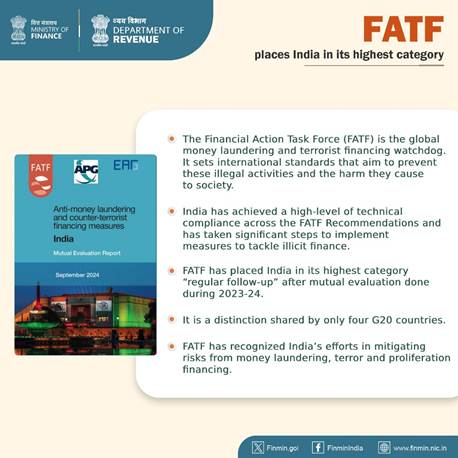
FATF PLACES INDIA IN ITS HIGHEST CATEGORY
The Financial Action Task Force (FATF) is the global money laundering and terrorist financing watchdog. It sets international standards that aim to prevent these illegal activities and the harm they cause to society.
India has achieved a high-level of technical compliance across the FATF Recommendations and has taken significant steps to implement measures to tackle illicit finance.
FATF has placed India in its highest category “regular follow-up” after mutual evaluation done during 2023-24.
It is a distinction shared by only four G20 countries.
FATF has recognized India’s efforts in mitigating risks from money laundering, terror and proliferation financing.
BROAD ACHIEVEMENTS UNDER THE CENTRAL BOARD OF DIRECT TAXES (CBDT) IN 2024:
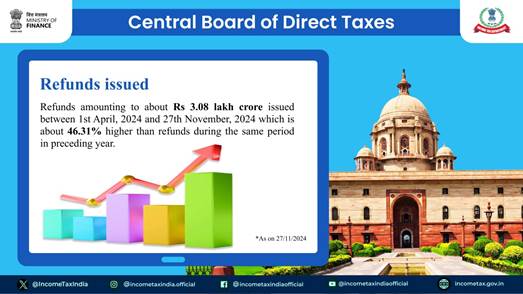
REFUNDS ISSUED
Refunds amounting to about Rs 3.08 lakh crore issued between 1st April, 2024 and 27th November, 2024 which is about 46.31% higher than refunds during the same period in preceding year.
ITR filing per second (Max): 917 (at 8:13:54 AM on 17th July, 2024)
ITR filing per minute (Max): 9,367 (at 8:08 PM on 31st July, 2024)
ITR Filing per hour (Max): 5.07 lakh (between 7PM to 8PM on 31st July, 2024)
About 98.35% of ITRS filed till 22.11.2024 have been e-verified.
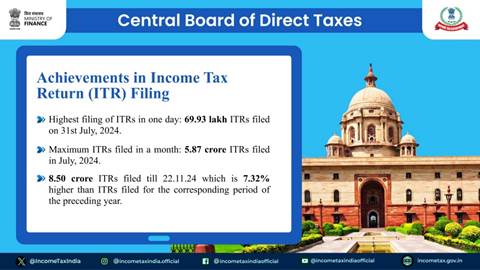
Highest filing of ITRS in one day: 69.93 lakh ITRS filed on 31st July, 2024.
Maximum ITRS filed in a month: 5.87 crore ITRS filed in July, 2024.
8.50 crore ITRS filed till 22.11.24 which is 7.32% higher than ITRs filed for the corresponding period of the preceding year.
SPEEDY PROCESSING
More than 1.62 crore ITRS filed during F.Y. 2024-25 were processed in a single day.
Approximately 21% of the ITR were processed in a single day during the
F.Y. 2024-25.
Approximately 26.35% of ITRS were processed within a week of filing during F.Y. 2024-25 in comparison to 22.56% in F.Y. 2023-24.
GREATER TRANSPARENCY WITH IMPROVED TAXPAYER FACILITATION
To encourage wider use and analysis of data, ITR statistics for different categories of taxpayers for AY 2022-23 and AY 2023-24 released.
Awareness Campaign launched to assist taxpayers in accurately completing Schedule Foreign Assets (Schedule FA) and reporting income from foreign sources (Schedule FSI) in their ITRs.
SWACHHATA HI SEWA
The CBDT has successfully met the goals of #SpecialCampaign4.0, a month-long initiative focused on cleanliness in government offices and addressing pending matters.
Cleared out 3,20,000 physical files, freeing up 1.75 lakh sq. ft. of office space.
Generated Rs 43 lakh from the disposal of scrap materials.
Conducted over 1450 cleanliness campaigns across India.
Enhanced the reclaimed space for a more conducive work environment.
Resolved 53,000 public grievances.
Implemented unique and innovative “Best Practices” throughout the campaign.
FACILITATION TO THE TAXPAYERS
The validation introduced at the upload level of the ITRS is another move to nudge or to take relook at the possible inconsistencies and to facilitate correction before filing of the ITRS.
This resulted in reduction of filing of revised return, rectification request and grievance.
The ITR forms for A.Y. 2024-2025 with all associated functions were rolled out on 1st April, 2024 on the E- filing portal.
More than 76 crore emails & SMSS were sent under E- campaign to popularize the EVC mode during the year under consideration.
As a result 96% of ITR filers adopted the EVC mode for verification of ITRS in A.Y. 2024-25.
ESTABLISHMENT OF DEMAND MANAGEMENT FACILITATION CENTRE (DFC)
During the period 01.01.24 to 13.10.2024, 1,31,180 number of demands amounting to Rs 5,00,224 cr. have been reduced/resolved.
The DFC currently consists of 170 agents who work 6 days a week.
Scheduled calls are made to the tax payers and JAOS for the purpose of resolution of demand.
BROAD ACHIEVEMENTS UNDER THE CENTRAL BOARD OF INDIRECT TAXES AND CUSTOMS(CBIC) IN 2024:
Recent measures for simplification, trade facilitation and Ease of Doing Business under GST:
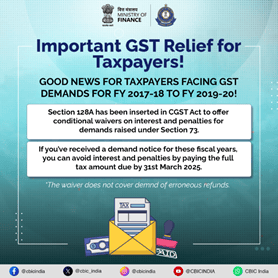
Insertion of section 128A in CGST Act, 2017 has been carried out to provide for conditional waiver of interest or penalty or both relating to demands raised under Section 73, for FY 2017-18 to FY 2019-20 : Considering the difficulties faced by the taxpayers, during the initial years of implementation of GST, amendments have been made in the CGST Act, to provide for continued waiver of interest and penalties for demand notices issued under Section 73 of the CGST Act for the fiscal years 2017-18, 2018- 19 and 2019-20, in cases where the taxpayer pays the full amount of tax demanded in the notice upto 31.03.2025.
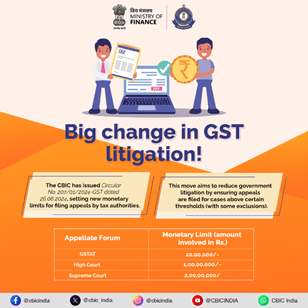
Reduction of Government Litigation by Fixing monetary limits for filing appeals under GST. The CBIC has issued Circular No. 207/01/2024-GST dated 26.06.2024 to prescribe monetary limits, subject to certain exclusions, for filing of appeals in GST by the department before GST Appellate Tribunal, High Court, and Supreme Court, to reduce government litigation.
·://taxconcept.net/judgement/writ-petition-maintainable-despite-alternative-appeal-remedy-benefit-of-loan-waiver-considered-as-monetary-karnataka-high-court/” title=”Writ Petition Maintainable Despite Alternative Appeal Remedy: Benefit of Loan Waiver Considered as Monetary: Karnataka High Court ” data-wpil-keyword-link=”linked” data-wpil-monitor-id=”96112″>appeal with the appellate authority has been reduced from Rs. 25 crores CGST and Rs. 25 crores SGST to Rs. 20 crores CGST and Rs. 20 crores SGST. Further, the amount of pre-deposit for filing appeal with the Appellate Tribunal has been reduced from 20% with a maximum amount of Rs. 50 crores CGST and Rs. 50 crores SGST to 10 % with a maximum of Rs. 20 crores CGST and Rs. 20 crores SGST.
Reduction in rate of TCS to be collected by the ECOs for supplies being made through them: Electronic Commerce Operators (ECOs) are required to collect Tax Collected at Source (TCS) on net taxable supplies under Section 52(1) of the CGST Act. The Central Government has issued Notification No. 15/2024-Central Tax dated 10.07.2024 (notified w.e.f. 10.07.2024), Notification No. 01/2024-Union Territory Tax dated 10.07.2024 (notified w.e.f. 10.07.2024) & Notification No. 01/2024-Integrated Tax dated 10.07.2024 (notified w.e.f. 10.07.2024) to reduce the TCS rate from present 1% (0.5% CGST + 0.5% SGST/ UTGST, or 1% IGST) to 0.5 % (0.25%
CGST + 0.25% SGST/UTGST, or 0.5% IGST), to ease the financial burden on the suppliers making supplies through such ECOs.
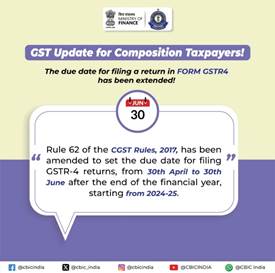
·. The same would give more time to the taxpayers who opt to pay tax under composition levy to furnish the said return.
Amendments of Section 16(4) of CGST Act, to be made effective from July 1st, 2017,to relax condition of section 16(4) of the CGST Act in respect of initial years of implementation of GST, i.e. financial years 2017-18, 2018-19, 2019-20 and 2020-21: Considering the difficulties faced by the taxpayers during the initial years of implementation of GST, based on the recommendations of the GST Council, retrospective amendment has been made in Section 16(4) of CGST Act to relax the time limit to avail input tax credit in respect of any invoice or debit note under Section 16(4) of CGST Act, through any GSTR 3B return filed upto 30.11.2021 for the financial years 2017-18, 2018-19, 2019-20 and 2020-21, may be deemed to be 30.11.2021. This would benefit a large number of taxpayers, especially smaller ones, who could not file returns in a timely manner in the initial years of GST, due to various reasons by which time, the time limit for availment of Input tax credit, under section 16(4) of CGST Act had already expired, which has led to issuance of demands denying them the benefit of input tax credit.
Amendment of Rule 88B of CGST Rules, 2017 in respect of interest under Section 50 of CGST Act on delayed filing of returns, in cases where the credit is available in Electronic Cash Ledger (ECL) on the due date of filing the said return:-The Central Government has issued Notification No. 12/2024-Central Tax dated 10.07.2024 for amendment in rule 88B (w.e.f. 10.07.2024) of CGST Rules to provide that an amount which is available in the Electronic Cash Ledger on the due date of filing of return in FORM GSTR-3B, and is debited while filing the said return, shall not be included while calculating interest under section 50 of the CGST Act in respect of delayed filing of the said return. This will reduce interest burden on such taxpayers.
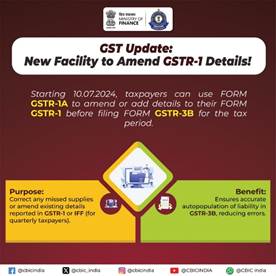
Provision of new optional facility for taxpayers to amend the details in GSTR-1: The Central Government has provided for a new optional facility by way of FORM GSTR-1A (w.e.f. 10.07.2024) to facilitate the taxpayers to amend the details in FORM GSTR-1 for a tax period and/ or to declare additional details, if any, before filing of return in FORM GSTR-3B for the said tax period. This will facilitate taxpayer to add any particulars of supply of the current tax period missed out in reporting in FORM GSTR-1 of the said tax period or to amend any particulars already declared in FORM GSTR-1 of the current tax period (including those declared in IFF, for the first and second months of a quarter, if any, for quarterly taxpayers), to ensure that correct liability is auto-populated in FORM GSTR-3B.
A consolidated guidelines dated 30.03.2024 were issued to all CGST Zones in respect of Ease of Doing Business (EODB) to be followed during investigations of cases against regular taxpayers
Besides, based on the recommendations of the GST Council, a large number of notifications and circulars have been issued on contentious issues, so as to avoid legal disputes.
GST Council recommended reduction in GST rate on Fortified Rice Kernel (FRK), classifiable under 1904, to 5% .
GST council also recommended to fully exempt GST on gene therapy.
GST Council recommended exemption of GST on contributions by general insurance companies from third-party motor vehicle premiums for Motor Vehicle Accident Fund.
GST Council recommended no GST on transaction of vouchers as they are neither supply of goods nor supply of services. The provisions related to vouchers is also being simplified.
GST Council clarified that no GST is payable on ‘penal charges’ levied and collected by banks and NBFCs from borrowers for non-compliance with loan terms.
GST Council recommended reduction of payment of pre-deposit for filing an appeal before the Appellate Authority in respect of an order passed which involves only penalty amount.
GST rate on extruded or expanded products, salted or savoury, reduced from 18% to 12%, aligning them with GST rate on namkeens, bhujia, mixture, and similar ready-to-consume items.
GST rate on cancer drugs such as Trastuzumab Deruxtecan, Osimertinib, and Durvalumab reduced from 12% to 5%.
Reverse Charge Mechanism introduced on the supply of metal scrap by unregistered persons to registered persons. A Tax Deducted at Source (TDS) of 2% applies to B2B supply of metal scrap by registered persons.
Duties & Exemptions
Export duty on various varieties of rice has been reduced.
A Group of Ministers (GoM) has been constituted to holistically look into the issues pertaining to GST on the life insurance and health insurance.
It has been recommended to notify GST @ 5% on the transport of passengers by helicopters on seat share basis and also to regularise the GST for past period on ‘as is where is’ basis.
It has been recommended to clarify by way of a circular that the approved flying training courses conducted by DGCA approved Flying Training Organizations (FTOs) are exempt from the levy of GST.
It has been recommended to exempt supply of research and development services by a Government Entity; or a research association, university, college or other institution, notified under clauses (ii) or (iii) of sub-section (1) of section 35 of the Income Tax Act, 1961 using Government or private grants. It has also been recommended to regularize past demands on ‘as is where is’ basis.
It has been recommended to clarify that location charges or Preferential Location Charges (PLC) paid along with the consideration for the construction services of residential/commercial/industrial complex before issuance of completion certificate forms part of composite supply where supply of construction services is the main service and PLC is naturally bundled with it and are eligible for same tax treatment as the main supply that is, construction service.
It has been recommended to clarify that affiliation services provided by educational boards like CBSE are taxable. It has also been recommended to exempt affiliation services provided by State/Central educational boards, educational councils and other similarly placed bodies to Government Schools prospectively. The issue for the past period between 01.07.2017 to 17.06.2021 is recommended to be regularized on ‘as is where is’ basis.
It has been recommended to clarify by way of circular that the affiliation services provided by universities to their constituent colleges are not covered within the ambit of exemptions provided to educational institutions in the notification No. 12/2017-CT(R) dated 28.06.2017 and GST at the rate of 18% is applicable on the affiliation services provided by the universities.
It has been recommended to exempt import of services by an establishment of a foreign airlines company from a related person or any of its establishment outside India, when made without consideration. The council also recommended to regularise the past period on ‘as is where is’ basis.
It has been recommended to bring renting of commercial property by unregistered person to a registered person under Reverse Charge Mechanism (RCM) to prevent revenue leakage.
It has been recommended to clarify that when ancillary/intermediate services are provided by GTA in the course of transportation of goods by road and GTA also issues consignment note, the service will constitute a composite supply and all such ancillary/intermediate services like loading/unloading, packing/unpacking, transshipment, temporary warehousing etc. will be treated as part of the composite supply. If such services are not provided in the course of transportation of goods and invoiced separately, then these services will not be treated as composite supply of transport of goods.
It has been recommended to regularise the GST liability for the past period prior to 01.10.2021 on ‘as is where is’ basis, where the film distributor or sub- distributor acts on a principal basis to acquire and distribute films.
It has been recommended to exempt supply of services such as application fees for providing electricity connection, rental charges against electricity meter, testing fees for meters/ transformers/capacitors, labour charges from customers for shifting of meters/service lines, charges for duplicate bills etc. which are incidental, ancillary or integral to the supply of transmission and distribution of electricity by transmission and distribution utilities to their consumers, when provided as a composite supply. It has also been recommended to regularize GST for the past period on ‘as is where is’ basis.
Uniform Integrated GST (IGST) rate of 5% on imports of parts, components, testing equipment, tools, and tool-kits of aircraft, regardless of their HS classification to stimulate Maintenance, Repair, and Overhaul (MRO) activities in the aviation sector, subject to specified conditions.
All milk cans made of steel, iron, or aluminium will attract a GST rate of 12%, irrespective of their intended use.
The GST rate on cartons, boxes, and cases made of both corrugated and non-corrugated paper or paperboard (HS codes 4819 10 and 4819 20) has been reduced from 18% to 12%.
solar cookers, whether single or dual energy source, will attract a GST rate of 12%.
The existing entry covering poultry keeping machinery attracting 12% GST has been amended to specifically include “parts of poultry keeping machinery,” regularizing past practices due to interpretational issues.
All types of sprinklers, including fire water sprinklers, will attract a GST rate of 12%, and past practices will be regularized.
IGST exemption on imports of specified items for defense forces has been extended for an additional five years until 30th June 2029.
IGST exemption has been extended to imports of research equipment and buoys under the Research Moored Array for African-Asian-Australian Monsoon Analysis and Prediction (RAMA) programme, subject to specified conditions.
Compensation Cess on imports into Special Economic Zones (SEZ) by SEZ units or developers for authorized operations is exempted retrospectively from 1st July 2017.
Compensation Cess is exempted on the supply of aerated beverages and energy drinks to authorized customers by Unit Run Canteens under the Ministry of Defense.
An ad-hoc IGST exemption is provided on imports of technical documentation for AK-203 rifle kits imported for the Indian Defense forces.
Measures for Facilitation of Trade
Section 9(1) of the CGST Act, 2017, is amended to explicitly exclude rectified spirit or ENA from the scope of GST when supplied for manufacturing alcoholic liquor for human consumption.
Services provided by Indian Railways to general public, namely, sale of platform tickets, facility of retiring rooms/waiting rooms, cloak room services and battery-operated car services and Intra-Railway transactions have been exempted [vide Notification No. 04/2024-CTR dated 12.07.2024 w.e.f., 15.07.2024]. The issue for the past period has also been regularized [Circular No. 228/22/2024-GST dated 15.07.2024].
Services provided by Special Purpose Vehicles (SPV) to Indian Railway by way of allowing Indian Railway to use infrastructure built & owned by SPV during the concession period and maintenance services supplied by Indian Railways to SPV have been exempted [vide Notification No. 04/2024-CTR dated 12.07.2024 w.e.f., 15.07.2024]. The issue for the past has also been [Circular No. 228/22/2024-GST dated 15.07.2024];
A separate entry has been created in notification No. 12/2017- CTR 28.06.2017 under heading 9963 to exempt accommodation services having value of supply of accommodation up to Rs. 20,000/- per month per person subject to the condition that the accommodation service is supplied for a minimum continuous period of 90 days [vide Notification No. 04/2024-CTR dated 12.07.2024 w.e.f., 15.07.2024]. Similar benefit has been extended for past cases [Circular No. 228/22/2024-GST dated 15.07.2024];
Co-insurance premium apportioned by lead insurer to the co-insurer for the supply of insurance service by lead and co-insurer to the insured in coinsurance agreements, has been declared as no supply under Schedule III of the CGST Act, 2017 and past cases have been regularized on ‘as is where is’ basis [Circular No. 228/22/2024-GST dated 15.07.2024].
Transaction of ceding commission/re-insurance commission between insurer and re-insurer has been declared as no supply under Schedule III of CGST Act, 2017 and past cases have been regularized on ‘as is where is’ basis [Circular No. 228/22/2024-GST dated 15.07.2024].
GST liability on reinsurance services of specified insurance schemes covered by Sr. Nos. 35 & 36 of notification No. 12/2017-CT (Rate) dated 28.06.2017 have been regularized on ‘as is where is’ basis for the period from 01.07.2017 to 24.01.2018 [Circular No. 228/22/2024-GST dated 15.07.2024].
GST liability on reinsurance services of the insurance schemes for which total premium is paid by the Government that are covered under Sr. No. 40 of notification No. 12/2017-CTR dated 28.06.2017 have been regularized on ‘as is where is’ basis for the period from 01.07.2017 to 26.07.2018 [Circular No. 228/22/2024-GST dated 15.07.2024].
Clarification has been issued that retrocession is ‘re-insurance of re- insurance’ and therefore, eligible for the exemption under Sl. No. 36A of the notification No. 12/2017-CTR dated 28.06.2017 [Circular No. 228/22/2024- GST dated 15.07.2024].
Clarification has been issued that statutory collections made by Real Estate Regulatory Authority (RERA) are exempt from GST as they fall within the scope of entry 4 of No.12/2017-CTR dated 28.06.2017 [Circular No. 228/22/2024-GST dated 15.07.2024].
Clarification has been issued that further sharing of the incentive by acquiring bank with other stakeholders, where the sharing of such incentive is clearly defined under Incentive scheme for promotion of RuPay Debit Cards and low value BHIM-UPI transactions and is decided in the proportion and manner by NPCI in consultation with the participating banks is not taxable [Circular No. 228/22/2024-GST dated 15.07.2024].
CUSTOMS
Budget 2024-25- major announcements:
Basic Customs Duty (BCD) on shea nuts reduced from 30% to 15%.
BCD reduced to nil on critical minerals such as Antimony, Beryllium, Bismuth, Cobalt, Copper, Gallium, Germanium, and others. BCD reduced to 2.5% on minerals like Graphite, Silicon Quartz, and Silicon Dioxide.
BCD on prawn and shrimp feed and fish feed reduced to 5%. BCD on live Specific Pathogen Free (SPF) Vannamei shrimp and Black Tiger shrimp broodstock reduced to 5%. BCD reduced on various inputs like mineral and vitamin premixes, krill meal, fish lipid oil, and others, subject to IGCR conditions.
BCD increased on ammonium nitrate from 7.5% to 10%.
BCD on PVC flex films increased to 25%.
Customs duty exempted on cancer drugs-Trastuzumab Deruxtecan, Osimertinib, and Durvalumab.
Issuance of Instruction No. 06/2024-Customs dt. 23.03.24
· Smooth and fair elections require coordinated and focused attention, including proper sharing of information by various LEA’s. To this effect, vide Instructions No. 06/2024-Customs dt. 23.03.24 a detailed Standard Operating Procedure was issued for all formations under CBIC to curb the flow of suspicious cash, illicit liquor, drugs/narcotics, freebies and smuggled goods during elections. It includes instructions regarding reporting of major seizures (more than Rs.1 crore) during election & implementation of ESMS for reporting interceptions/seizures made by various enforcement agencies on real-time basis.
Handing over of Antiquities seized by Customs to ASI
Consequent to repatriation of a 16th century stolen idol of Maa Kotrakshi, in presence of Hon’ble Minister of Education and Skill Development & Entrepreneurship; a project for handing over of antiquities seized pan India by Customs to ASI was undertaken. A handing over ceremony was organized on 29.02.2024 chaired by the Hon’ble Finance Minister and 101 such antiquities were handed over to ASI. A handbook titled ‘Puravshesh ke Prahari’ describing the historical importance of these antiquities and role of Customs in preserving our cultural heritage was also released on the occasion.
DGFT extended the RoDTEP Scheme to include good exported from EOU and SEZ sector. To give effect to this, CBIC issued notification nos. 20/2024- Customs (NT) dated 11.03.2024 and 50/2024 -Customs (N.T.) dated 19.07.2024, respectively.
Notification No. 33/2024-Customs (N.T.) dated 30.04.2024. was issued for amendment in Notification No. 77/2023-Customs (N.T.) dated 20.10.2023 relating to All Industry Rates (AIRs) of Duty Drawback including defence goods.
Circular No. 04/2024-Customs dated 07.05.2024 was issued regarding changes made in All Industry Rates (AIRs) of duty Drawback notified vide Notification No77/2023-Customs (N.T.) dated 20.10.2023 and 33/2024- Customs (N.T.) dated30.04.2024.
For disbursal of All Industry Rates (AIR) of duty drawback, CBIC has moved from manually issued physical Cheque (to the nodal bank) based process to end-to-end automated PFMS based disbursal of duty drawback amount directly to exporter’s bank accounts since 05.06.2024. For this CBIC issued Instruction No.15/2024-Customs dated 29.05.2024. This paperless functionality is expected to expedite credit of AIR of drawback amount to exporters’ accounts and increase transparency.
Notification No. 55/2024-Customs (N.T.) on August 23.08.2024, was issued for revising the All-Industry Rates (AIR) of duty drawback for gold and silver jewellery and articles of silver. This notification amends the earlier Notification No. 77/2023-Customs (N.T.) dated October 20, 2023.
Drawback Division of CBIC assisted the RoDTEP Committee-2023 for reviewing RoDTEP Rates for various eligible goods, including defence goods, for exports from DTA, AA, EOU & SEZ units. Based on Committee’s recommendations, revised RODTEP rates have been notified by DOC effective from 10.10.2024.
Indian Customs has always been at the forefront when it comes to adopting cutting edge technology for providing better services. In this regard, Board has launched the Exchange Rate Automation Module and the modalities has been explained in Circular 07/2024-Cus dated 25.06.2024. The exchange rates shall be published on ICEGATE website at 6:00 p.m. twice a month (i.e. 1st & 3rd Thursdays of every month) and shall be accessible for public viewing on ICEGATE website. Thus, the automated system has now replaced the manual process of publication of exchange rates.
CBIC vide Notification No. 60/2024-Customs (NT) dated 12.09.2024 amended the Courier Imports and Exports (Electronic Declaration and Processing) Regulations, 2010 to allow export incentives viz. Drawback,
RoDTEP (Remission of Duties and Taxes on Exported Products), RoSCTL (Rebate of State and Central Levies and Taxes) to exports through Courier. Circular No. 15/2024-Customs dated 12.09.2024 explaining the said amendments and informing the stakeholders about extending the export benefits to courier exports has also been issued.
CBIC and the Department of Posts (DoP) have jointly developed a “hub and spoke” system to facilitate export through postal route. The system leverages digital technology and the vast postal network for creating a paperless, contactless and intermediary-free environment for enhancing exports through postal mode. In continuation of the already authorized 1001 booking post offices, CBIC vide Circular No. 01/2024 dated 01.02.2024 has further authorized an additional 14 booking post offices taking the total number of booking post offices covered under the automated system to a total of 1015. Further, the project for automation of IGST refund on postal exports made using the DNK portal has been implemented with effect from 17th September, 2024.
Agreement between the Government of the Republic of India and the Government of the Republic of Madagascar on Cooperation and Mutual Administrative Assistance in Customs Matters signed on 27.06.2024 on the side-lines of WCO Council Meeting in Brussels.
Agreement between the Government of the Republic of India and the Government of the Republic of Belarus on Cooperation and Mutual Assistance in Customs Matters was signed on 28.06.2024 on the side-lines of WCO Council Meeting in Brussels.
MoU between the CBIC and General Department of Viet Nam Customs on Capacity Building was signed on 31.07.2024
Cooperative Arrangement between the Central Board of Indirect Taxes and Customs of the Government of the Republic of India and the New Zealand Customs Service in Customs Matter was signed on 06.08.2024
For providing connectivity to landlocked developing country Bhutan, CBIC in February this year-2024 has issued a Standard Operating Procedure allowing transit of goods between Bhutan and Bangladesh using riverine route through India with the entry/exit points at Jogighopa and Pandu ports in Assam.
CBIC hosted the 5th Joint Group of Customs Meeting between India & Bhutan from 6th -7th May, 2024 in Leh, India.
Circular No. 09/2024-Customs dated 09.07.2024 has been issued amending circular No. 29/2020- Customs dated 22.6.2020 for allowing transshipment of Bangladesh export cargo to third Countries through Air Cargo Complex, Kempegowda International Airport Bengaluru.
Recently, CBIC lead Capacity Building Program on “Advancing Bhutan-India Trade and Economic, Partnership” at Thimpu, Phuentsholing, Gelephu and Samdrup from 29th July- 01st August, 2024.
4th National Conference on the Functioning of Land Customs Stations (LCSs) was organized on 28th and 29th August, 2024.
Circular No. 19/2024-Customs dated 30.09.2024 has been issued regarding Digitization of Customs Bonded Warehouse Procedures relating to obtaining Warehouse license, Bond to Bond Movement of Warehoused goods, and uploading of Monthly Returns.
Indian Customs Electronic Commerce/Electronic Data Interchange (ICEGATE) 2.0:
ICEGATE 2.0 website is a complete bilingual website which has been designed to provide contemporary user interface for enhanced user experience. New feature “widget” is also being provided to show important information such as Message filing status, details of tickets, refunds, and duty payments etc. in personalised dashboard without going for enquiries. Data available in the widgets is also downloadable. Customized notifications facility is being provided to the registered users to choose the events for which they want to receive notifications. Registered users can file their documents themselves using online Web forms on ICEGATE as well which is advancement from earlier offline webforms.
USE of ICETABs for efficient examination and clearance process:
The ICETAB is part of the CBIC’s ongoing initiatives to simplify trade procedures. The ICETAB is a mobile tablet designed to facilitate the quick and real-time upload of examination reports, enabling Customs Officers to enhance efficiency while on the go. The ICETAB has an exclusive Mobile Application to enable examining officers to view RMS Instructions, Examination Order and Bill of Entry (BE) details along with other supporting documents, capture images of cargo examination for integration with the Bill of Entry and submit examination report immediately on completion of the cargo examination. The ICETAB by Customs Officers is aimed at enhancing transparency and efficiency in customs processes for speedy examination of import consignments with capability to attach photographs with geo- referencing and no requirement for any paper documents for the purpose of examination. This will also facilitate quick upload of the examination report on the go in real time basis and making the examination process transparent and faster. The detailed guidelines for the use of ICETAB are outlined in CBIC Circular No. 10/2024-Customs dated 20.08.2024.
Exchange Rate Automation Module:
· Indian Customs has always been at the forefront when it comes to adopting cutting edge technology for providing better services. In this regard, Board has launched the Exchange Rate Automation Module and the modalities has been explained in Circular 07/2024-Customs dated 25.06.2024 and its amendment Circular No. 17/2024-Customs dated 18.09.2024. The exchange rates shall be published on ICEGATE website at 6:00 p.m. twice a month (i.e. 1st & 3rd Thursdays of every month) and shall be accessible for public viewing on ICEGATE website. Thus, the automated system has now replaced the manual process of publication of exchange rates.
Encouraging Women participation in International Trade: The Zones have been instructed by the Board Circular No. 2/2024-Customs, dated March 8, 2024 to promote women’s representation and support within customs and trade activities by:
ensuring women’s representation in PTFC and CCFC meetings, preferably through women’s associations; ensuring women’s representation in PTFC and CCFC meetings, preferably through women’s associations;
including at least one agenda point from women perspective;
encouraging Trade bodies/ custodians to establish dedicated help desks and processing mechanisms for women traders and women logistics service providers;
supporting the upskilling women logistics service providers, freight forwarders and custom brokers by offering relevant trainings for women.
This initiative highlights the importance of gender equality in trade (be it as traders, customs house agents, freight forwarders, or customs brokers) advocating for active efforts from Partner Government Agencies and trade bodies to support the increasing participation of women across various roles in the logistics sector. The detailed guidelines for encouraging Women participation in International Trade are outlined in CBIC Circular No. 2/2024-Customs dated 08.03.2024.
Mandatory additional qualifiers in import/export declarations in respect of Synthetic or Reconstructed Diamonds w.e.f., 01.12.2024:
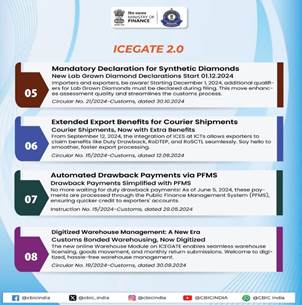
As per the Bill of Entry (Electronic Integrated Declaration and Paperless Processing) Regulations, 2018 and Shipping Bill (Electronic Integrated Declaration and Paperless Processing) Regulations, 2019, it will be mandatory to be declare additional qualifiers/identifiers for Lab Grown Diamond at the time of filing of import/export declarations with effect from 01.12.2024. Declaration of additional qualifiers would improve quality of assessment and streamline intervention and enhance facilitation. The detailed instructions in this regard are outlined in CBIC Circular No. 21/2024-Customs dated 30.10.2024.
Extended export related benefits for exports made through courier mode:
Until now, the Express Cargo Clearance System (ECCS) was used for handling courier import and export shipments at the notified International Courier Terminals (ICTs). However, due to limitations in the system’s architecture, certain export- related payments, such as Duty Drawback, RoDTEP, and RoSCTL, could not be processed through ECCS. To address this issue, it has been decided to implement the Indian Customs EDI System (ICES) at the International Courier Terminals for processing these payments, effective from 12.09.2024. The modalities for this implementation have been outlined in Circular No. 15/2024-Customs, dated 12.09.2024.
Disbursal of Drawback amounts into the exporters’ account through PFMS:
With effect from 5h June, 2024; payment of Drawback amounts into the exporters’ accounts post scroll out, will be facilitated through the Public Finance Management System (PFMS). The scrolls generated at different locations will be automatically processed by the Customs automated system (CAS) for onward transmission to the Central Nodal e-DDO and the nominated central nodal e-DDO shall forward the consolidated scroll to the nodal e-PAO. After approval from the nodal e-PAO, duty drawback amounts shall be credited into the exporters’ bank accounts linked with PFMS. The detailed instructions have been issued through Instruction No. 15/2024-Customs dated 29.05.2024.
Digitization of Customs Bonded Warehouse procedures relating to obtaining Warehouse License, Bond to Bond Movement of warehoused goods, and uploading of Monthly Returns:
The CBIC has launched a Warehouse Module on ICEGATE for Customs Bonded Warehouses, enabling: (i) online filing of applications for obtaining a Warehouse License; (ii) online submission and processing of requests to transfer warehoused goods to another person and/ or warehouse; and (iii) uploading Monthly returns for Customs Bonded Warehouses. The Directorate General of Systems (DG Systems) has issued comprehensive User Manuals for both trade members and departmental officers. Detailed procedures are outlined in Circular No. 19/2024- Customs, dated 30.09.2024.
Performance of ongoing schemes/ programs:
India’s overall trade facilitation score in the Global Survey on Digital and Sustainable Trade Facilitation conducted by the UNESCAP, 2023, increased from 78.49% in 2019 to 93.55% in 2023, indicating a marked improvement in the efficiency of cross-border trade procedures. (Source: CBIC Circular No. 10/2024- Customs dated 20.08.2024)
India’s Score in UN Trade Facilitation survey on “women in Trade Facilitation” has increased from 0% in 2019 to 66% in 2021 and this has resulted in overall improvement in India ranking in UN Trade Facilitation survey.
Provisioning services to SEZ Units at ICEGATE:
EDI Enablement of SEZ Sites was successfully completed. Some key services like Registration of SEZ Users, Child User Registration, Amendment in Registration, filing services, Inter and Intra Goods Movement, DTA Procurement, ETP Webform and facilitating DSC Amendment for SEZ users were provisioned for the SEZ users at ICEGATE.
Launch of module for SCMTR (Sea Cargo Manifest and Transhipment Regulations):
The SCMTR also specifies changes to the formats and timelines for filing manifest declarations. Some of the features of the SCMTR include:
Requesting additional details about each cargo, such as the invoice value and HSN
Advancing the time of reporting to the port of departure Ensuring track and trace of reported cargo
Including features for moving vessels within India
Capturing details electronically, such as crew lists, instead of manually.
Document Download Utility:
A utility developed at ICEGATE to allow users to download various documents like BE, SB, LEO, OOC, Gatepass for OOC, Gatepass for LEO in the e-Copy functionality at ICEGATE.
Revamp of ICEGATE 2.0 Website:
ICEGATE website was made more informative and user- friendly.
AI-based interactive Chatbot (Vaani):
This has been launched for trade at the ICEGATE website to help users with information to access various services of ICEGATE.
Exchange Rate Automation Module:
A module was launched to automate the integration of Exchange Rates of various Currency codes used in the Customs System. This involved API based integration with SBI to receive the Exchange Rates of the currency codes. These rates are automatically updated on the website as well as the application for the purpose of trade without any manual intervention.
Tracking the details of NOC/Release Order Issuance details from the PGAs
A facility has been enabled on the dashboard of the users to provide the tracking details of the NOC/Release Order issued by the respective PGA (FSSAI, AQCS and PQMS) on the ICEGATE website against the Bill of entry filed by the user.
API integration with Custodians (Sea and Land):
The existing MFTP based integration was migrated to API based integration with CONCOR and Adani Land and Sea Ports respectively. This has facilitated the exchange of data between ICEGATE application and Custodians to share the data on a real time basis.
Integration with Department of Post:
There has been an integration with Department of Post to claim IGST refund for the concerned Shipping Bills filed and claim other export benefits.
IGST Refund for Export through Dak Niryat Kendra (DNK):
A module has been launched on ICEGATE to enable IGST Refund for export through Dak Niryat Kendra (DNK).
Integration with ECCS for SB filing, Custodian Registration and Message Exchange with ICEGATE:
There has been an integration with ECCS to claim various export benefits against the Shipping Bills filed.
Export benefits (RoDTEP, RoSCTL & Drawback) to goods exports through Courier mode:
Export benefits (RoDTEP, RoSCTL& Drawback) extended for exports through the Courier mode.
Warehouse Licensing Code, Warehouse to warehouse goods movement and digitizing the monthly return for warehouse:
A module has been launched on ICEGATE to provision the generation of Warehouse Licensing Code for Warehouse users. This module also facilitates the goods movement from warehouse to warehouse. There is also a facility to digitize the filing of monthly returns for Warehouse.
Launch of Mobile Application for Internal and External Users over Android Platform:
Services of ICEGATE like Filing, e-Payment, accessing various enquiries over Android based mobile have been launched. This will soon be available on iOS platform.
Migration of critical functionalities like Integration with eSeal Vendors, eScrip, Customs E- payment Platform, Integration with DGFT, Examination Module, Integration with GSTN, Container Scanning Module from ICEGATE 1.0 to ICEGATE 2.0. The former being based on legacy-based architecture was migrated to a micro services-based architecture.
Integration with FSSAI, PQMS, AQCS under Single Sign On services:
A facility has been provided to the registered users to access the respective portal of the agencies like FSSAI, AQCS and PQMS from the ICEGATE website without any login at the respective PGA portal. This will be made live with other PGAs as well in the future.
Integration with BIS:
API based integration between BIS and ICEGATE to share the license details of the manufacturer for reference to the officer.
Integration with DGFT for RCMC details:
API based integration between DGFT and ICEGATE to share the RCMC details of the user from DGFT. These details are shown to the user on the dashboard at ICEGATE.
Export benefits to courier
Export incentives (Drawback, RoDTEP, RoSCTL) to the exports of goods where the value of consignment is less than rupees 10 lakh made through courier and in order to claim export incentives, for e-commerce shipments through ICT, shipping bill would be filed at ICEGATE/ICES.
Scroll will be generated automatically and there would be no manual intervention.
The scrips will be generated at ICEGATE portal.
IGST Refund for DAK Niryat
A mechanism for refund of IGST on exports through post is developed, wherein, the exporters will provide the details for seeking IGST refund at the time of filing postal bill of exports, and such details shall be pushed to the ICES System after physical export of goods, for GST verification with GSTN, and for preparation of scrolls.
The IGST refunds would be processed in a manner similar to that being done for exports through courier/ ECCS.
Post EGM Amendment Module
A functionality for allowing the officer to amend the shipping bill after filing of EGM has been developed. Once a shipping bill is amended, the export incentives would be processed again and the benefits would be paid to the exporter as per the existing functionalities.
Hand carriage of cargo
A functionality is being developed after which an exporter can export goods to be carried by foreign bound passengers authorized by the exporter in his behalf as personal baggage.
ICETAB
Access to examinee officer to ICES at examination shed Instant report submission in Realtime
Reduction in dwell time
Help in storing date and time of picture including Latitude and Longitude of place where picture taken
Access to RMS instruction, e-Sanchit, BE details at examination shed.
Newly launched development
Launch of ICETAB for field officers for doing faster examination at the time of Export/Import in August 2024.
Provisioning of exports benefits (RoDTEP, RoSCTL and Drawback) to commercial exports being processed through the integrated Courier Terminals (ICT) launched on 13.09.2024.
IGST refund for exports through Dak Niryat Kendras (DNK) rolled out on 17.09.2024.
4. 273 SEZ sites launched in ICES on 01.07.2024.
Upcoming development
Amendment in a shipping bill Post EGM.
Hand carriage of Cargo (New automation of manual process)
CAG Report Highlights Revenue Losses in Income Tax and GST Compliance
The Comptroller and Auditor General (CAG) of India, in its latest report tabled in Parliament, highlighted widespread lapses in income tax assessments and GST compliance, causing a potential revenue loss of ₹18,509.8 crore.
Key Findings
Income Tax Errors: The CAG identified 504 audit observations resulting in a tax effect of ₹5,728.8 crore. These errors stemmed from:
The report criticized weak internal controls within the tax department, leading to irregular refunds and erroneous tax assessments.
GST Compensation Fund: The report flagged the government for failing to submit Goods and Services Tax (GST) compensation fund accounts for the last four years, despite statutory obligations and repeated CAG recommendations.
Tax Evasion in Breweries and Distilleries: The audit uncovered significant tax evasion in the distilleries and breweries sector, leading to a revenue loss of ₹12,781 crore.
Recommendations
The CAG urged the Central Board of Direct Taxes (CBDT) to:
Strengthen mechanisms for reconciling assessment records.
The CAG’s observations underline the urgent need for reforms in tax administration to plug revenue leakages. The government is expected to address these lapses to ensure robust tax collection and compliance mechanisms. This report serves as a wake-up call for tax authorities to enhance accountability and streamline processes, ensuring greater transparency and revenue protection for the exchequer.
The Direct Tax Vivad se Vishwas Scheme (DTVSV), 2024, is an initiative introduced under Chapter IV of the Finance (No. 2) Act, 2024, to resolve income tax disputes efficiently. With Circular No. 19/2024 issued on December 16, 2024, the CBDT provided detailed guidance for implementing this scheme.
The Vivad se Vishwas Scheme, 2024, is a significant step toward reducing tax litigation and ensuring smoother compliance. Taxpayers are encouraged to evaluate their disputes and take advantage of this scheme before the deadlines. For further details, refer to Circular No. 19/2024 or consult your tax advisor.
Over the past 20 months, the Income Tax Department has collected Rs 37,000 crore from individuals who had taxable income but failed to file their returns, according to officials. The department’s concerted efforts involved the analysis of data on substantial transactions dating back to 2019-20, which included purchases of gems, jewellery, property, and luxury holidays paid in cash.
“These are the cases where people were not filing tax returns despite making large purchases. The department had reached out to them over the past 20 months,” a senior official informed the Economic Times (ET). The intensified scrutiny has been made possible through an expanded and stricter tax collection and Tax Deducted at Source (TDS) system, enabling officials to uncover significant transactions that had previously gone unnoticed.
The official also noted that some individuals had submitted returns claiming zero income, despite having made substantial expenditures and having tax obligations. From the total Rs 37,000 crore recovered, Rs 1,320 crore came specifically from individuals involved in high-value transactions.
Income Tax Department Crackdown
The department is actively conducting a major initiative to reach out to taxpayers whose spending patterns do not align with their declared income. Since the fiscal year 2021, the Income Tax Department has employed data analytics and the Non-Filer Monitoring System to identify non-compliant individuals.
“Data from multiple sources is being tapped and synchronised… This makes it easy for the department to identify such evasion and nab evaders,” the official stated.
Official data revealed that direct tax collections for April to November increased by 15.4% to Rs 12.10 lakh crore, consisting of Rs 5.10 lakh crore in corporate tax and Rs 6.61 lakh crore in non-corporate tax. The ongoing efforts underscore the department’s commitment to enhancing tax compliance and ensuring that tax obligations are met by all individuals.
Income tax return can be either filed voluntarily under Section 139 or on demand by the income tax department under Section 142(1). It is necessary to understand what happens after the taxpayer has filed the return of income.
The process of examining the return filed by the taxpayer by the income tax department is termed assessment. The IT department carries out a preliminary assessment of all the returns filed and informs taxpayers of the result of such preliminary assessment. This assessment primarily includes arithmetical errors, internal inconsistencies, tax calculation and verification of tax payment. The preliminary evaluation process is fully computerised (automated), and is delegated to the Central Processing Centre (CPC).
Thereafter, the system generates the intimation under Section 143(1), which generally indicates obvious errors identified by the mainframe system.
As mentioned above, it is an automated system-driven process that verifies the arithmetical accuracy, information available with the department, details available in return, and the provision of income tax law, and it generates the comparison report. Such an automated process eliminates the manual job of the income tax officer to a great extent.
Therefore, the Finance Act, 2008 empowered the Central Board of Direct Taxes (CBDT) to make a scheme for the centralised processing of returns with a view to expeditiously determine the tax payable by, or the refund due to the taxpayers. Based on the recommendations of the Technical Advisory Group, the department adopted the strategy that CPC at Bangalore would process paper and e-returns without any interface with taxpayers and in a jurisdiction free manner.
CPC project envisaged benefits for the citizens as well as the tax department. For citizens, it led to faster and hassle-free preliminary processing of their returns and also relieved the department from the burden of preliminary assessment that can be computerised, enabling them to concentrate on hardcore activities.
Initial processing of returns by CPC is completely automated and Section 143(1) Intimation is also a computer generated record. CPC validates data provided in each tax return with details available with the income tax department’s own record (such as Form 26AS generated through details provided by collecting banks, TDS returns, etc.) and this notice usually only points out apparent mistakes found out by the mainframe system.
Deductions under Chapter VIA (80C, 80D, etc.), and
Tax deducted at source, and tax paid by taxpayers in the form of advance tax and self assessment tax
Appropriate adjustments are made to income as computed under Section 143(1) and final tax liability or refund is arrived at
The adjustments are carried out only after giving an intimation to the taxpayer of the proposed adjustments either in writing or electronic mode i.e., to the email id provided in the income tax return filed
Response received from the taxpayer within 30 days from the issuance date of intimation will be considered before making the final adjustment and in case no response is received within such period, adjustments arrived at initially will be incorporated.
After arriving at final tax liability, the same is adjusted against TDS and tax payments and other relief under Section 90/91, if any.
An intimation shall be prepared and sent to the taxpayer. Kind of intimations possible are discussed below:
Intimation determining demand – Issued in case of adjustments made under Section 143(1) due to a discrepancy found and tax liability is arrived at.
Intimation determining refund – Issued where any tax is found to be refundable either where no discrepancy in the return filed or after making adjustments as referred to in Section 143(1) and after giving credit to the taxes and interest paid by the taxpayer.
Total income or loss is computed under Section 143(1) after making the following adjustments:
Arithmetical error in the return
Any incorrect claim which is apparent from any information in the return where incorrect claim which may include the following:
The claim of an item in the return which is inconsistent with another entry of the same or some other item in such return – for example, income from other sources are deducted from business income but not declared under income from other sources.
Disallowance of set-off of loss in the financial year which is carried forward from previous years in which return was filed beyond the specified due date
Disallowance of expenditure is indicated in the audit report but not indicated in the return of income.
Time Limit for Issue of 143(1)
Section 143(1) intimation has to be sent within nine months from the end of the financial year in which the return is being filed. For eg: if the taxpayer has filed return pertaining to the financial year 2023-24 in July 2024, intimation can be sent any time till 31 December 2025. If a taxpayer does not receive any intimation within such period, it simply means there are no adjustments carried out to the return filed by the taxpayer and no change in tax liability/refund, and the acknowledgement filed itself is deemed to be Section 143(1) intimation.
What is the Password for Intimation u/s 143(1)?
The intimation received under Section 143(1) is password protected. The ITR intimation password will be your PAN (in lowercase) followed by your date of birth in DDMMYYYY format without giving any space.
Action to be Taken by the Taxpayer after Receiving a 143(1)
As a first step, review certain things in Section 143(1) intimation to ensure the document pertains to your return itself and the data provided pertain to the same financial year as mentioned in Section 143(1) intimation.
In case you are able to identify the mistakes you have made while filing your return from the 143(1) intimation, and they can be rectified by filing a revised return, please do so by logging into the income tax e-filing website. Please refer our article on how you can go about revising your return online.
However, if no mistakes have been made and you do not agree with the adjustments made by CPC/computerised system, you can file an online rectification application under Section 154(1) intimating the correction of mistake appearing in the Section 143(1) intimation. Refer our article on filing rectification application.
Also, submit your response in the e-filing portal where there is a tax demand- whether you agree or disagree with the same.
In case you are not satisfied with the processing of your rectification return by CPC, you can also file online grievances or contact your assessing officer. In case of no satisfactory action from CPC/assessing officer, you can file a complaint to the income tax ombudsman.
However, if taxpayer agrees to the tax demand raised by income tax department after carrying out adjustments as above, taxpayer is required to pay such taxes. Refer our article on OLTAS challan payment on how to pay taxes. However, while paying tax on demand raised under this Section, please choose ‘Tax on regular assessment (400)’ under ‘Type of payment’ field in the challan. If you wish to pay challan physically, the pre-filled challan is attached with the intimation as below.
Important
What if I do not receive my intimation under section 143(1) even after the end of the specified period?
The acknowledgement of the return shall be deemed to be the intimation in a case where no sum is payable by or refundable to, the taxpayer and where no adjustment has been made.
First of all, verify the reason for tax liability and if you agree with the tax demand, you are required to pay the tax. Choose the Tax on regular assessment (400) under type of payment in the challan. If you don’t agree with the demand, submit a response for the same.
What is the reason for the difference in TDS as per taxpayer and as computed u/s 143(1)?
The difference in TDS as per taxpayer and as computed u/s 143(1) is because the TDS reflected in 26AS is different from that of the TDS claimed in your tax return. If the TDS claimed in your tax return is correct, then you can file an online rectification application under section 154(1) for mistakes in intimation order under section 143(1).
If I have a disagreement with the refund mentioned in the intimation order, what can be done?
If you disagree with the reduced refund calculated by the CPC in the intimation order, you will either be required to file a revised or rectification return. A revised return can be filed for any mistakes committed in your original return. A rectification return can be filed only if you find any error in the order passed by the Income Tax Department.
If you have not received an intimation order till the expiry of one year, then it means that there is no tax liability nor there is a refund due to you. In such a case, ITR filed is deemed to be your intimation.
How to file rectification for intimation u/s 143?
Filing rectification for intimation u/s 143, Log into your account, and go to ‘My Account’ and select ‘Rectification’ and provide the required details and click on submit.
What is the password for intimation received under section 143 (1)?
You will receive the intimation under section 143(1) password protected. You have to enter your PAN in lowercase and followed by your date of birth without giving space.
CBDT specifies monetary limits for reduction or waiver of interest paid or payable under section 220(2)
SECTION 119, READ WITH SECTION 220 OF THE INCOME-TAX ACT, 1961 – CENTRAL BOARD OF DIRECT TAXES – INSTRUCTIONS TO SUB-ORDINATE AUTHORITIES – FIXING MONITORY LIMIT OF INCOME-TAX AUTHORITIES IN RESPECT OF REDUCTION OR WAIVER OF INTEREST PAID OR PAYABLE UNDER SECTION 220(2)
Section 220(2) of the Income-tax Act (‘the Act’) deals with the consequences of non-payment of income tax by a taxpayer. As per Section 220(2) of the Act, if a taxpayer fails to pay the amount specified in any notice of demand under section 156 of the Act. she shall be liable to pay simple interest at the rate of 1 % per month or part of the month for the period of delay in making the payment. Further, section 220(2A) of the Act empowers the Principal Chief Commissioner (Pr. CCIT) or Chief Commissioner (CCIT) or Principal Commissioner (Pr. CIT) or Commissioner (CIT) for reduction or waiver of the amount paid or payable under section 220(2) of the Act in the circumstances specified therein.
2. In accordance with the powers vested with the income-tax authorities specified in section 220(2A) of the Act in respect of reduction or waiver of the interest paid or payable under section 220(2) of the Act, the Central Board of Direct Taxes, for the proper administration of the Act, hereby specifies the following monetary limits as under:
Sl. No.
Income-tax Authority
Monetary Limits for reduction or waiver of interest
3. The powers of reduction or waiver of the interest paid or payable under section 220(2) of the Act in respect of any income-tax authority shall continue to be subject to satisfaction of all the following conditions specified under section 220(2A) of the Act—
default in the payment of the amount on which interest has been paid or was payable under the said sub-section was due to circumstances beyond the control of the assessee; and
the assessee has co-operated in any inquiry relating to the assessment or any proceeding for the recovery of any amount due from him.
4. The above shall come into effect from the date of issue of this Circular.
CBDT launches Compliance-Cum-Awareness Campaign for AY 2024-25 to assist taxpayers in accurately completing Schedule Foreign Assets and reporting income from foreign sources in ITR
The Central Board of Direct Taxes (CBDT) has launched a Compliance-Cum-Awareness Campaign for Assessment Year (AY) 2024-25 to assist taxpayers in accurately completing Schedule Foreign Assets (Schedule FA) and reporting income from foreign sources (Schedule FSI) in their Income Tax Returns (ITR). Compliance with Schedule FA and FSI is mandatory under the Black Money (Undisclosed Foreign Income and Assets) and Imposition of Tax Act, 2015, which requires the full disclosure of foreign assets and income.
As part of this campaign, informational messages will be sent via SMS and email to resident taxpayers who have already submitted their ITR for AY 2024-25. These messages are intended for individuals identified through information received under bilateral and multilateral agreements, suggesting that they may hold foreign accounts or assets, or have received income from foreign jurisdictions. The purpose is to remind and guide those who may not have fully completed Schedule Foreign Assets in their submitted ITR for AY 2024-25, especially in cases involving high-value foreign assets.
The CBDT expects all eligible taxpayers to take advantage of this opportunity to fulfil their tax responsibilities and contribute to the nation’s economic development. This effort not only is in line with the government’s vision for a developed India but also fosters a culture of transparency, accountability, and voluntary compliance.
For a detailed, step-by-step guide on completing Schedule Foreign Assets, taxpayers are encouraged to visit the official Income Tax Department website www.incometax.gov.in where resources and support are readily available to assist them.
The Income Tax Department has recently received a significant number of suggestions from stakeholders, totaling 6,500 within the past month, regarding the review of the Income Tax Act. This initiative is part of a comprehensive review process announced in the Budget by Finance Minister Nirmala Sitharaman.
On Monday, the Finance Minister chaired a meeting focused on this crucial review, which was attended by various key officials, including Revenue Secretary Sanjay Malhotra and Chairman of the Central Board of Direct Taxes (CBDT), Ravi Agarwal, along with other senior CBDT officials.
In a post shared on X (formerly Twitter), the Finance Ministry highlighted that Malhotra informed the Finance Minister about the establishment of 22 specialized sub-committees dedicated to examining different aspects of the Income Tax Act. These sub-committees have been actively engaging in discussions, utilizing both in-person and virtual meetings with domain experts to collaboratively explore and recommend enhancements to the legislation.
The Revenue Secretary also updated FM Sitharaman on the substantial feedback received through the public input portal, which was opened on October 6, 2024. The feedback reflects active public participation aimed at simplifying the provisions of the Income Tax Act.
The internal committee of the CBDT had, last month, invited public inputs as part of their efforts to review the six-decade-old Income Tax Act. The focus areas for the review include simplifying the language, reducing litigation, lowering compliance requirements, and addressing obsolete provisions within the Act.
Following the Budget announcement made by Sitharaman, the CBDT put together an internal committee tasked with overseeing the review process. The goal is to make the Income Tax Act more concise, clearer, and easier to understandfor taxpayers, which is expected to reduce disputes and litigation while providing greater certainty to taxpayers.
Overall, public inputs and suggestions were sought in four main categories: simplification of language, litigation reduction, compliance reduction, and the removal of redundant or obsolete provisions. This collaborative approach aims to modernize the Income Tax Act and enhance the taxpayer experience in India.
The due date for assessees under clause (a) of Explanation 2 to Sub Section (1) of Section 139 has been extended from October 31, 2024, to November 15, 2024.
Purpose of Notice under section 142(1) of Income Tax Act
Notice u/s 142(1) can be issued by the Income Tax Department for the following reasons:
1. To ask the assessee to file the Income Tax Return:
If the assessee has not filed a return within the specified period of time or before the end of the relevant assessment year, then the assessee might receive notice u/s 142(1) asking to file the return.
If the assessee has already filed an income tax return, the Assessing Officer (AO) may ask the assessee to produce such specific accounts and documents as required by them. For example, the department can ask the assessee to provide evidence of deductions claimed, invoices of expenses claimed under business incomes, etc.
3. Any other information, notes,or workings as desired by the AO:
The Assessing Officer may require the assessee to furnish in writing and in the prescribed manner the information, notes, or workings on specific points as required by him which may or may not form part of books of accounts. For example, A statement of assets and liabilities.
Sample Notice under section 142(1) of Income Tax Act
Consequences of non-compliance
If a taxpayer receives a notice under section 142(1), they must respond to it. Failing to do so can lead to the following consequences:
It may result in Best Judgment Assessment u/s 144.
The Central Board of Direct Taxes (CBDT) has launched the ‘Faceless Assessment Scheme, 2019‘ to carry out all income tax assessments in a faceless manner, with a few exceptions. Therefore, if the Assessing Officer (AO) is not satisfied with the response given in reply to the notice issued under section 142(1), they will move ahead with a scrutiny assessment under this scheme.
You may receive a notice under section 142(1) in two circumstances. One is when you fail to file an income tax return, in which case you need to file the return. The second circumstance is when you have filed a return but AO wants to verify the accounts or documents. In such a case, you need to submit documents as asked by AO.
Once you submit the return, the processing department will process it. If the AO finds your response satisfactory, they will move forward with processing the ITR. And no further action is required. However, if the AO is not satisfied with your reply, they may issue a notice under section 143(2) for scrutiny assessment.
In this case, you will fall under “Best Judgement Assessment.” The assessing officer will evaluate all the relevant information available and make an assessment based on their best judgment.
What is the time limit to issue the notice under section 142(1)?
What is the difference between notice u/s 142(1) and 143(2)?
When an AO needs to verify specific accounts and documents, they issue a notice under section 142(1) which is also termed as an inquiry before the assessment. If there are any doubts regarding the accuracy of the documents, then the AO will issue a notice under section 143(2) for scrutiny assessment.
New TCS Rules for Parents: Claim Education Credits
The Central Board of Direct Taxes (CBDT) has recently revised income tax regulations to allow individuals other than the primary taxpayer to claim Tax Collected at Source (TCS) credits. This update provides parents with more options for managing the tax responsibilities associated with their children studying abroad. They can now claim TCS credits against their taxable income, which may help in reducing their overall tax bill.
“This modification is especially beneficial for those covering expenses related to overseas studies. Previously, the TCS credit could only be claimed by the student; however, now parents or guardians paying TCS on tuition fees for their children abroad can transfer this credit to their own tax returns. To do so, the payer must submit a declaration to the tax authority, indicating that the TCS credit should be allocated to another person’s PAN,” explained Kunal Savani, Partner at Cyril Amarchand Mangaldas.
Ritika Nayyar, Partner at Singhania & Co., elaborates on how tax calculations will work. For instance, if Suresh pays Rs 20 lakhs in tuition fees for his daughter’s foreign education, TCS deducted at 5 percent amounts to Rs 1 lakh. Under the previous regulations, Suresh would have needed to obtain a TCS certificate from the foreign university and claim that credit in his income tax return. However, with the updated guidelines, he can directly claim the Rs 1 lakh TCS credit in his return, thus lowering his taxable income and potentially saving on taxes.
Form 12BAA is designed to improve the disclosure of non-salary income and the details of Tax Collected at Source (TCS). This initiative aligns with the guidelines established in the Union Budget 2024.
How to claim TCS credit?
The individual who made the payment (the collectee) must provide you with a declaration. This declaration should specify that the TCS credit is to be applied to your PAN (Permanent Account Number).
The following information is required in the declaration:
Your full name and address as recorded in your PAN details.
Your PAN number, which is crucial for your identification as the recipient of the TCS credit.
Once you receive this declaration from the collectee, you should submit it to the tax collector, which may be a bank or any institution that collected the TCS.
Income tax department on Thursday issued revised guidelines for compounding offences under the Income Tax law by simplifying the process and lowering the charges.
In conformity with the Finance Minister’s budget announcement on simplification and rationalisation of the compounding procedure, the Central Board of Direct Taxes (CBDT) issued revised guidelines for compounding of offences under the Income-tax Act, 1961.
Supersede All Existing Guidelines
CBDT said that the revised guidelines supersede all existing guidelines on the subject and would apply to pending as well as new applications, from the date of its issue. The revised guidelines are an additional step towards simplification of procedures aimed at promoting ease of compliance.
Reduction of Complexities and Simplification of Procedures
The guidelines are expected to facilitate the stakeholders by reducing complexities arising out of existing multiple guidelines, simplifying the compounding procedure and lowering the compounding charges.
The guidelines have been simplified inter-alia by eliminating the categorisation of offences, removing the limit on a number of occasions for filing applications, allowing fresh application upon curing of defects which was not permissible under earlier guidelines, allowing compounding of offences under section 275A and 276B of the Act, removing the existing time limit for applying viz 36 months from the date of filing of the complaint, etc.
Facilitating Companies and HUFs in Compounding Offences
To facilitate the compounding of offences by companies and HUFs, the requirement of the main accused applying has been dispensed with.
Compounding of Offences by Main Accused and Co-Accused
The offences of the main accused as well as any or all co-accused can be compounded on payment of relevant compounding charges by the main accused and/or any of the co-accused, under the revised guidelines.
Rationalisation of Compounding Charges
The compounding charges have also been rationalised by abolishing interest chargeable on delayed payment of compounding charges, reducing rates for various offences such as for TDS defaults, multiple rates of 2%, 3% and 5% have been reduced to a single rate of 1.5% per month and basis for calculation of compounding charges for non-filing of return has been simplified.
Other Simplification Measures
Other simplification measures include the removal of the charge of a separate compounding fee from the co-accused.
CBDT Notifies Amendments in Income-tax Rules for Ease in Claiming Credit for TCS Collected/TDS Deducted for Salaried Employees and for claiming TCS Credit of Minors in the Hands of Parents.
Rule 37-I of the Income-tax Rules amended to allow credit of tax collected at Source to a person other than the collectee, in whose hands the income of the collectee is assessable.
The Central Board of Direct Taxes (CBDT) has formed an internal committee to comprehensively review the Income-tax Act, 1961. The committee will examine the entire Act and suggest amendments to make it more taxpayer-friendly, effective, and aligned with the current economic landscape.
In addition to the review of the Income-tax Act, the CBDT has also invited suggestions from taxpayers on the tax e-filing portal. The board is keen on improving the user experience and making the portal more efficient and user-friendly.
The Central Board of Direct Taxes (CBDT) has established an internal committee to supervise an extensive review of the Income-tax Act, 1961 (Act), following the announcement made in the Union Budget 2024–25 on July 23 by the finance minister Nirmala Sitharaman.
According to a Press Information Bureau (PIB) release issued on October 7, 2024: The committee invites public inputs and suggestions in four categories:
The CBDT has not provided a timeline for the completion of the review process. However, it is expected that the committee will submit its recommendations to the government in the coming months.
Disclaimer: Every effort has been made to avoid errors or omissions in this material. In spite of this, errors may creep in. Any mistake, error or discrepancy noted may be brought to our notice which shall be taken care of in the next edition. In no event the author shall be liable for any direct, indirect, special or incidental damage resulting from or arising out of or in connection with the use of this information.
New Guidelines on Condoning Delays in Filing Income Tax Returns
The Central Board of Direct Taxes (CBDT) has taken a significant step forward by issuing Circular No. 11/2024 on October 1, 2024. This circular introduces new guidelines for condoning delays in filing income tax returns (ITRs) that claim refunds or carry forward losses, as per Section 119(2)(b) of the Income-tax Act, 1961. This update supersedes all previous instructions and sets a structured approach to managing delay-related claims based on defined monetary thresholds.
Key Highlights of the Circular
Monetary Limits for Authorities
Principal Commissioners of Income Tax (Pr. CsIT/CsIT): Authorized to handle claims of delay in filing ITRs up to ₹1 crore.
Chief Commissioners of Income Tax (CCsIT): Responsible for claims between ₹1 crore and ₹3 crores.
Principal Chief Commissioners of Income Tax (Pr. CCsIT): Manage claims exceeding ₹3 crores.
Condonation of Delay in Verification
The Central Processing Centre (CPC), located in Bengaluru, is now empowered to process applications for condoning delays in the verification of ITRs.
5-Year Deadline for Claims
Applications for condonation of delay will not be accepted if filed beyond five years from the end of the relevant assessment year. This provision is applicable to all applications submitted from October 1, 2024, onwards.
Six-Month Timeframe
Authorities must dispose of applications within six months of their receipt, ensuring a prompt resolution for taxpayers.
Supplementary Claims and Court-Ordered Delays
The circular outlines specific conditions for handling supplementary refund claims and those delayed due to court orders, enhancing clarity and transparency in the process.
The Board retains the right to review grievances related to the application of these guidelines, emphasizing a commitment to a fair and efficient process for taxpayers seeking delayed ITR refunds or loss carry-forward approvals.
Claims Management: The circular provides comprehensive guidelines concerning the acceptance or rejection of applications claiming refunds or loss carry forward under section 119(2)(b) of the Income-tax Act.
Authority Powers:
Pr. CsIT/CsIT handle claims up to ₹1 crore.
CCsIT manage claims over ₹1 crore but below ₹3 crores.
Pr. CCsIT address claims above ₹3 crores.
CPC in Bengaluru can condone delays in verification.
Filing Timelines:
Applications must be submitted within five years from the end of the assessment year.
This circular marks a pivotal change in the handling of delayed ITR submissions, aiming to ensure a more efficient and taxpayer-friendly process moving forward. The guidelines simplify the application procedure and clarify the roles of various authorities in managing claims related to delays in filing income tax returns.
Lesser Settlement Amounts for Tax Filers Before December 31
The Income Tax Department announced the launch of the Vivad Se Vishwas Scheme 2.0, which offers reduced settlement amounts for taxpayers who submit their declarations by December 31, 2024, compared to those who file later.
In her budget speech, Finance Minister Nirmala Sitharaman introduced the Direct Tax Vivad Se Vishwas Scheme 2024, aimed at addressing pending appeals related to income tax disputes. This scheme will be effective from October 1, 2024, and the necessary Rules and Forms have also been released.
This scheme differentiates between ‘new appellants’ and ‘old appellants,’ providing lesser settlement amounts for the former. Additionally, taxpayers who file their declarations by December 31, 2024, will benefit from reduced settlement amounts compared to late filers, according to a statement from the Central Board of Direct Taxes (CBDT).
Four specific Forms have been issued:
Form-1: Declaration and undertaking by the declarant
It is required that Form-1 be submitted for each dispute individually; however, if both the appellant and the income tax authority have appealed the same order, a single Form-1 can be filed in that instance.
Intimation of payment must be made using Form-3 and submitted to the Designated Authority along with proof of withdrawal of any related appeal, objection, application, writ petition, special leave petition, or claim. Both Forms 1 and 3 should be submitted electronically by the declarant.
These forms will be accessible on the Income Tax Department’s e-filing portal, signifying a move towards better litigation management.
Currently, around 2.7 crore direct tax demands amounting to approximately Rs 35 lakh crore are under dispute in various legal forums. Deloitte India Partner Karishma R. Phatarphekar emphasized the importance for companies to assess their pending income tax litigations from both cost-benefit and broader non-tax perspectives, especially since tax payment rates under the Vivad Se Vishwas 2.0 scheme are set to increase by 10 percent starting January 1, 2025.
In light of the limited timeframe, stakeholders are urged to make informed decisions regarding participation in the scheme promptly.
Income Tax Department Hikes Appeal Filing Thresholds
New Delhi, Sep 18 (PTI) — The income tax department has announced an increase in the minimum thresholds for filing appeals in tribunals, high courts, and the Supreme Court. According to a recent circular from the Central Board of Direct Taxes (CBDT), tax authorities may now file appeals before the Income Tax Appellate Tribunal (ITAT), high courts, and the Supreme Court if the disputed tax demand exceeds Rs 60 lakh, Rs 2 crore, and Rs 5 crore, respectively.
In 2019, the government set the previous thresholds for filing appeals at ITAT (Rs 50 crore), high courts (Rs 1 crore), and the Supreme Court (Rs 2 crore). The CBDT clarified that the new monetary limits will apply to all cases, including those related to Tax Deducted at Source (TDS) and Tax Collected at Source (TCS). It also stated that Special Leave Petitions (SLPs) or appeals pending before the Supreme Court, high courts, and tribunals that are below the prescribed threshold should be withdrawn.
As a step towards management of litigation, it has been decided by the Board to revise the monetary limits for filing appeals in income tax cases,” the CBDT stated. The circular emphasized that an appeal should not be filed merely due to the tax effect in a case exceeding the prescribed limits but should instead be determined based on the merits of the case.
The circular urged the concerned officers to keep in mind the overarching objective of reducing unnecessary litigation and providing certainty to taxpayers when considering whether to file an appeal.
Finance Minister Nirmala Sitharaman had announced the increase in monetary limits for filing appeals related to direct taxes, excise, and service tax in tax tribunals, high courts, and the Supreme Court during her Budget speech on July 23.
Rajat Mohan, Executive Director at Moore Singhi, welcomed these higher limits, stating that they reduce the likelihood of prolonged litigation and promote quicker resolutions at earlier stages. He noted, “While these changes are a welcome shift, the true impact will depend on how judiciously the tax authorities exercise their discretion in deciding which cases to escalate. This policy could lead to a more balanced and efficient litigation environment, where both sides can avoid unnecessary delays and focus on significant legal issues.”
Sandeep Jhunjhunwala, Partner at Nangia Andersen LLP, expressed that this revision in monetary limits is expected to ease the burden on judicial bodies significantly, allowing for more efficient adjudication of larger tax disputes. He remarked, “By formalizing the increase in monetary limits for filing appeals, the government signals its intent to adopt a more pragmatic approach to tax litigation.
Jhunjhunwala further elaborated that the circular maintains exceptions outlined in previous CBDT communications, allowing the Revenue department to pursue appeals in cases that fall below the revised monetary thresholds, especially those involving TDS/TCS, undisclosed foreign income or assets, tax evasion, and instances where courts have issued specific directions.
In March, the CBDT had issued a circular allowing income tax authorities to file appeals irrespective of the monetary threshold in cases involving TDS/TCS, undisclosed foreign income, or information received from investigating agencies like the Enforcement Directorate (ED) and GST Intelligence.
Lastly, the circular stated that the prescribed monetary limits would not apply in cases where prosecution has been initiated by the department and is pending trial or if a conviction order has been issued that has not yet been compounded. Currently, there are approximately 2.7 crore direct tax demands, totaling about Rs 35 lakh crore, being disputed across various legal forums.
How to use new electronic system to resolve Income Tax disputes
The Central Board of Direct Taxes (CBDT) has launched the e-Dispute Resolution Scheme (e-DRS) for taxpayers to resolve matters related to Income Tax assessments. The scheme was notified in 2022 and will minimise litigation and provide a more efficient resolution mechanism.
The e-DRS system enables taxpayers to electronically submit applications for dispute resolution to the Dispute Resolution Committees (DRCs) in 18 jurisdictions across India.
These DRCs will assist taxpayers in resolving disputes related to ‘specified orders, providing an alternative to prolonged legal proceedings. (Orders by whom?)
Pending appeals: For appeals already filed and pending before the Commissioner of Income-tax (Appeals), applications can be submitted until September 30, 2024.
Time-bound resolution: DRCs are mandated to pass orders within six months from the end of the month in which the application is admitted.
Implementation timeline
– For specified orders passed on or before August 31, 2024, where the appeal filing deadline hasn’t lapsed, applications can be submitted until September 30, 2024.
In a significant move aimed at streamlining the dispute resolution process and reducing the burden on taxpayers, the Central Board of Direct Taxes (CBDT) has launched a new online mechanism for resolving income tax disputes. This innovative platform is designed to provide a more efficient and transparent avenue for taxpayers to address their concerns.
The new online mechanism offers several key features:
Online dispute filing: Taxpayers can now file their disputes directly online, eliminating the need for physical visits to tax offices. This simplifies the process and saves time for both taxpayers and tax officials.
Real-time tracking: Taxpayers can track the progress of their dispute cases online, ensuring transparency and accountability. This feature empowers taxpayers to stay informed about the status of their cases.
Online communication: The platform facilitates online communication between taxpayers and tax officials, reducing the need for physical meetings and minimizing delays. This promotes efficient and timely resolution of disputes.
Automated notifications: The system automatically sends notifications to taxpayers regarding updates and developments in their cases. This ensures that taxpayers are always kept in the loop and can respond promptly to any requests or queries.
The CBDT’s initiative is expected to have a positive impact on the tax administration system. By providing a convenient and efficient online platform, the government aims to reduce the overall burden on taxpayers and improve the overall taxpayer experience.
Disclaimer: Every effort has been made to avoid errors or omissions in this material. In spite of this, errors may creep in. Any mistake, error or discrepancy noted may be brought to our notice which shall be taken care of in the next edition. In no event the author shall be liable for any direct, indirect, special or incidental damage resulting from or arising out of or in connection with the use of this information.
Good news for taxpayers: CBDT launches online mechanism to address income tax disputes
Here comes a big relief for the taxpayers. The Central Board of Direct Taxes (CBDT) has launched an e-Dispute Resolution Scheme (e-DRS) to address litigation and provide relief to eligible taxpayers. It should be noted that the Section 245MA of the Income Tax Act also provides for the constitution of Dispute Resolution Committees (DRC).
What is e-DRS?
The CBDT said the e-DRS enables the taxpayers to file an application electronically for dispute resolution to the Dispute Resolution Committees (DRC) designated for the region of Principal Chief Commissioner of Income Tax having jurisdiction over the taxpayer.
How does e-DRS function?
The CBDT said the taxpayer can opt for e-Dispute Resolution against the ‘specified order’ as defined in clause (b) of section 245MA of the Act, which includes an order in which the aggregate sum of variations proposed or made does not exceed Rs 10 lakh and returned income for the relevant assessment year does not exceed Rs 50 lakh. Moreover, such order should not be based on search/surveys or information received under an agreement referred to under section 90 or 90A of the Act.
As per the e-DRS, a DRC may make modification to the variations in the specified order and decide to grant reduction/waiver of penalty and prosecution in accordance with the provision of rule 44DAC of the Income-tax Rules, 1962.
How to file application for e-DRS?
The taxpayers can file application for e-DRS in Form No. 34BC referred in rule 44DAB of the Rules, on the e-filing portal of the Income Tax Department, within one month from the date of receipt of specified order. If the appeal has already been filed and is pending before the Commissioner of Income-tax (Appeals), the application for e-DRS, is to be filed on or before September 30, 2024. if any specified order has been passed on or before August 31, 2024 and the time for filing appeal against such order before CIT (Appeals) has not lapsed, the application for dispute resolution can be filed on or before September 30, 2024.
The e-Dispute Resolution Scheme (e-DRS) for Taxpayers in India
The Central Board of Direct Taxes (CBDT) has introduced the e-Dispute Resolution Scheme (e-DRS) to facilitate the resolution of Income Tax assessment-related matters. Launched in 2022, this scheme aims to streamline the resolution process and minimize litigation, providing taxpayers with a more efficient mechanism for resolving disputes.
Under the e-DRS system, taxpayers can electronically submit applications for dispute resolution to the Dispute Resolution Committees (DRCs) located in 18 jurisdictions across India. These DRCs are designed to assist taxpayers in resolving disputes related to specified orders, offering an alternative to prolonged legal proceedings.
The scheme applies to orders where the aggregate sum of variations does not exceed Rs 10 lakh, and the returned income for the relevant assessment year does not exceed Rs 50 lakh. Orders based on search/surveys or information received under international agreements are excluded from the scheme.
Taxpayers can file applications electronically through Form No. 34BC on the Income Tax department’s e-filing portal. It’s important to note that the application deadline is within one month from the receipt of the specified order. Additionally, for appeals already filed and pending before the Commissioner of Income-tax (Appeals), applications can be submitted until September 30, 2024.
Time-Bound Resolution
The DRCs are mandated to pass orders within six months from the end of the month in which the application is admitted. For specified orders passed on or before August 31, 2024, where the appeal filing deadline hasn’t lapsed, applications can be submitted until September 30, 2024.
To access the e-DRS module, taxpayers should follow these steps:
Log in to the Income Tax portal at https://eportal.incometax.gov.in using your PAN or TAN as the user ID.
Navigate through the following path: Dashboard -> e-File -> Income Tax Forms -> File Income Tax Forms.
Select the option for ‘Dispute Resolution Committee in Certain Cases (Form 34BC).
Fill out Form No. 34BC, ensuring all details are accurate.
Review the details and proceed to e-verify the form using one of the following methods: Aadhar OTP, EVC (Electronic Verification Code), or DSC (Digital Signature Certificate).
The Central Board of Direct Taxes (CBDT) has introduced a new e-DRS (Electronic Dispute Resolution Scheme) to streamline the process of resolving income tax disputes. This initiative aims to reduce litigation and provide a faster, more efficient, and cost-effective solution for taxpayers.
Online Platform: The scheme operates entirely online, making it convenient for taxpayers to access and participate in the dispute resolution process.
Dispute Resolution Committees (DRCs): The scheme involves DRCs, which are constituted to adjudicate on tax disputes. These committees consist of experienced tax professionals.
Reduced Litigation: By providing an efficient alternative to traditional litigation, the e-DRS scheme can help reduce the burden on the judiciary.
Benefits of the e-DRS Scheme:
Faster Resolution: The e-DRS scheme can significantly reduce the time it takes to resolve tax disputes.
Cost-Effective: It can be more cost-effective for taxpayers compared to traditional litigation.
Reduced Stress: The streamlined process can reduce the stress and anxiety associated with tax disputes.
Improved Taxpayer Experience: The scheme can enhance the overall taxpayer experience by providing a more efficient and fair dispute resolution process.
How to Apply:
Log in to the Income Tax portal at e-portal.incometax.gov.in.
Use PAN/TAN for login.
Navigate to Dashboard → e-File → Income Tax Forms → File Income Tax Forms.
Select ‘Dispute Resolution Committee in Certain Cases (Form 34BC).
Overall, the e-DRS scheme is a positive development that can help alleviate the burden of tax disputes for taxpayers.
Disclaimer: Every effort has been made to avoid errors or omissions in this material. In spite of this, errors may creep in. Any mistake, error or discrepancy noted may be brought to our notice which shall be taken care of in the next edition. In no event the author shall be liable for any direct, indirect, special or incidental damage resulting from or arising out of or in connection with the use of this information.
CBDT rolls out Dispute Resolution Scheme (e-DRS), 2022, to minimise litigation
Dispute Resolution Committees (DRCs) constituted in all 18 jurisdictional Pr. CCIT regions across the country
As per e-DRS, a taxpayer can opt for e-Dispute Resolution against the ‘specified order’ under certain conditions
e-DRS application must be filed within one month from the date of receipt of specified order
If appeal is pending, e-DRS application is to be filed on or before 30.09.2024
Posted On: 30 AUG 2024 8:10PM by PIB Delhi
In pursuance of section 245MA in the Income-tax Act, 1961 (hereinafter referred to as “the Act”), the Central Board of Direct Taxes (CBDT) had notified the e-Dispute Resolution Scheme, 2022 (e-DRS) with the aim to reduce litigation and provide relief to eligible taxpayers. Section 245MA of the Act also provides for the constitution of Dispute Resolution Committees (DRC).
The e-DRS enables the taxpayer, who fulfils certain specified conditions as stipulated in section 245MA of the Act, to file an application electronically for dispute resolution to the DRC designated for the region of Principal Chief Commissioner of Income-tax having jurisdiction over the taxpayer. To this end, DRCs have been constituted in all 18 jurisdictional Pr. CCIT regions across the country. The list of such DRCs along with their e-mail addresses is available on:
As per e-DRS, a taxpayer can opt for e-Dispute Resolution against the ‘specified order’ as defined in clause (b) of the Explanation to section 245MA of the Act, which includes an order in which the aggregate sum of variations proposed or made does not exceed Rs.10 lakh and returned income for the relevant assessment year does not exceed Rs. 50 lakh. Further, such order should not be based on search/surveys or information received under an agreement referred to under section 90 or 90A of the Act.
According to e-DRS, a DRC may make modification to the variations in the specified order and decide to grant reduction/waiver of penalty and prosecution in accordance with the provision of rule 44DAC of the Income-tax Rules, 1962 (hereinafter referred to as “the Rules”). The DRC is mandated to pass its order within six months from the end of month in which application for dispute resolution is admitted by it.
The application for e-DRS is to be filed in Form No. 34BC referred in rule 44DAB of the Rules, on the e-filing portal of the Income Tax Department, within one month from the date of receipt of specified order. In cases where appeal has already been filed and is pending before the Commissioner of Income-tax (Appeals), the application for e-DRS, is to be filed on or before 30.09.2024. In cases where the specified order has been passed on or before 31.08.2024 and the time for filing appeal against such order before CIT (Appeals) has not lapsed, the application for dispute resolution can be filed on or before 30.09.2024.
The Tax Payer can access e-DRS module by login on income tax portal https://eportal.incometax.gov.in. Login to your account using PAN / TAN as user ID ->Go to Dashboard ->e-File ->Income Tax Forms ->File Income Tax Forms -> under tab ‘Persons not dependent on any source of Income (Source of Income not relevant)> Dispute Resolution Committee in Certain Cases (Form 34BC) -> Fill Form No. 34BC -> Review the details -> E-Verify the Form No. 34BC using Aadhar OTP, EVC or DSC.
This is another initiative by the Government towards minimising litigation.
CBDT action plan for FY25: I-T Dept asked to widen tax base by 10%, recover 60% of arrears | Key details
The Central Board of Direct Taxes (CBDT) has released the central action plan (CAP) for financial year 2024-25, asking the Income Tax Department to widen the number of tax filers by around 10% during the fiscal year ending March 31, 2025, news agencies reported.
The CAP, which is yet to be released in public domain, reportedly sets a target before the taxation body to recover 60% of the total pending tax arrears.
FY25 target
The Board said the tax department has been given a target to add in the current fiscal 10% more tax return filers to what the filer base was at the end of 2023-24.
The CBDT also informed the I-T authorities that “new opportunities for identification of potential taxpayers have opened up due to data mining and data analytics” and effective use of such data may result in “identification of a large number of potential taxpayers.
The case of non-filers and those whose ITRs (income tax returns) do not match with financial transactions done by them are selected based on rules through management information system and taken up for e-Verification. The outcome of e- Verification results in widening and deepening of taxpayer base,” news agency PTI quoted it as saying.
Recovery of tax arrears
The Board declared in the action plan that a “special team” headed by a Principal Commissioner of I-T be formed in each region by September end to act and recover tax arrears from the top 5,000 cases — about 60% of the total demand of over ₹43 lakh crore, the report said.
The CBDT also expressed concern over the figures of arrear demand “increasing” over the past years, saying it has gone up from ₹24,51,099 crore, as on April 1, 2023, to ₹43,00,232 crore on April 1, 2024, it added.
Keeping in view the past trends of the arrear demand and cash collections, it is imperative that concerted efforts continue to be made to reverse the trend of increasing arrear demand and to initiate the process of reducing the figure to more manageable levels,” it added.
Senior officials told PTI that transactions over ₹2 lakh in cash were required to be reported through a statement of financial transaction (SFT) by financial institutions but that was not happening.
While examining such reports, it is noticed that the circumvention of these provisions is widely prevalent,” the Board told the I-T department.
Further, although section 139A requires PAN (permanent account number) to be provided or obtained in specified transactions, there is no reporting/verification mechanism for determining the compliance with this obligation,” it said.
In any case, it said, “high value” consumption expenditure needs to be verified with information about the taxpayer and therefore, it is imperative to identify the sources which could be involved in possible circumvention.
The department identified some of the businesses, such as hotels, banquet halls, luxury brand retailers, IVF clinics, hospitals, designer clothing stores, and NRI quota medical college seats, where the non-adherence to these rules and large cash transactions was being found.
Such sources will have to be identified and a verification exercise could be conducted by calling for information in a non-intrusive manner,” the CBDT reportedly directed the tax department.
Section 230 (1A) of the Income-tax Act, 1961(the ‘Act’) relates to obtaining of a tax clearance certificate, in certain circumstances,by persons domiciled in India. The said provision, as it stands, came on the statute through the Finance Act, 2003 w.e.f. 1.6.2003. The Finance (No.2) Act, 2024 has made only an amendment in Section 230(1A) of the Act, vide which, reference of the Black Money (Undisclosed Foreign Income and Assets) and Imposition of Tax Act, 2015 (the ‘Black Money Act’) has been inserted in the said Section. This insertion has been made to also cover the liabilities under the Black Money Act in the same manner as the liabilities under the Income-tax Act,1961 and other Acts dealing with direct taxes for the purpose of Section 230(1A) of the Income-tax Act,1961.
There appears to be a mis-information about the said amendment emanating from incorrect interpretation of the amendment. It is being erroneously reported that all Indian citizens must obtain income-tax clearance certificate (ITCC) before leaving the country. This position is factually incorrect.
As per section 230 of the Act, every person is not required to obtain a tax clearance certificate. Only certain persons, in respect of whom circumstances exist which make it necessary to obtain a tax clearance certificate,are required to obtain the said certificate. This position has been in the statute since 2003 and remains unchanged even with the amendments vide Finance (No. 2) Act, 2024.
In this context, the CBDT, vide its Instruction No. 1/2004, dated 05.02.2004, has specified that the tax clearance certificate under Section 230(1A) of the Act, may be required to be obtained by persons domiciled in India only in the following circumstances:
where the person is involved in serious financial irregularities and his presence is necessary in investigation of cases under the Income-tax Act or the Wealth-tax Act and it is likely that a tax demand will be raised against him, or
where the person has direct tax arrears exceeding Rs. 10 lakh outstanding against him which have not been stayed by any authority.
Further, a person can be asked to obtain a tax clearance certificate only after recording the reasons for the same and after taking approval from the Principal Chief Commissioner of Income-tax or Chief Commissioner of Income-tax.
In view thereof, it is reiterated that the ITCC under Section 230(1A) of the Act, is needed by residents domiciled in India, only in rare cases, such as (a) where a person is involved in serious financial irregularities or (b) where a tax demand of more than Rs. 10 lakh is pending which is not staye
To make the tax system more effective, transparent and easy for taxpayers, CBDT has prepared its action plan. According to exclusive information received by CNBC TV18, CBDT has prepared a detailed Central Action Plan for the financial year 2024-25. The goal of this action plan is to make the tax system easier for taxpayers as well as more effective and transparent than before. According to this, policies should be made accordingly keeping economic growth and fiscal stability in mind. Along with this, the goal of this action plan is also to prepare a roadmap for the Income Tax Department for 2047.
What is special in the action plan- The proposals given in the action plan include initiatives to enhance tax administration, steps to increase revenue collection, reduce arrears demand and improve taxpayer services. Apart from this, strict timelines have been proposed for achieving budget targets, reducing arrears demand, managing court cases, standards for providing services and redressal of grievances.
The action plan proposes to move forward by setting targets for managing tax demands, focusing on the top 5,000 arrears cases, which account for 60 per cent of the total demand of Rs 43 lakh crore, and creating a special team in each jurisdiction to analyse these cases.