India’s central and state governments collected a total of ₹1.86 trillion as goods and services tax (GST) in August, reflecting a 6.5% increase from the same month last year. This marks the second slowest growth rate so far this fiscal year, attributed to uncertainties surrounding US tariffs and diminished consumer demand during the rainy season.
After accounting for refunds, the net GST revenue stood at ₹1.67 trillion, which is 10.7% higher than the equivalent figure from a year ago. Businesses received ₹19,359 crore in tax refunds in August, nearly 20% lower than the refunds issued during the same period last year. Previous months had witnessed a surge in tax refunds; for instance, in July, refunds had spiked 67% compared to the previous year.
In August, the central government collected ₹31,474 crore as Central GST, while state governments amassed ₹39,736 crore as State GST. Moreover, taxes on inter-state sales and imports distributed between the central government and the consuming states reached ₹83,964 crore, with revenue from GST compensation cess amounting to ₹11,792 crore.
Despite the slowdown in GST collections for August—indicative of sales from July—the monthly average revenue collection so far this fiscal year has been robust at ₹2 trillion, suggesting a solid foundation for GST collections.
As authorities review the GST framework, discussions are anticipated about simplifying the tax system, providing relief to consumers, and enhancing compliance. The GST Council, which oversees federal indirect taxes, is set to convene later this week to deliberate on related proposals.
Economic Insights
The continuous upward trajectory in gross domestic GST collections signals India’s economic resilience, according to Saurabh Agarwal, Tax Partner at EY. He noted, however, that the notable decrease in export refunds points to the influence of global tariffs on India’s export sector. Agarwal emphasized the urgency of implementing proposed rate rationalizations, stating that any delay could lead to a “wait-and-watch” attitude among consumers, potentially resulting in a decline in collections. He reiterated the importance of timely policy actions to maintain the momentum.
Following a mere 1.7% growth in net GST revenue in July, August’s double-digit growth—despite geopolitical challenges—offers a positive outlook, remarked Pratik Jain, a partner at Price Waterhouse & Co LLP. He noted that anticipated GST reductions on numerous products later this month should lead to closer monitoring of collections in the following months.
Goods and Services Tax (GST) refunds are essential for taxpayers to recover excess GST payments. A refund process ensures taxpayers reclaim their rightful dues, whether they have deposited excessive cash in the electronic cash ledger, paid tax by mistake, or accumulated input tax credits (ITCs) due to zero-rated sales or an inverted tax structure.
The refund application process depends on the type of refund being claimed. For example, IGST refunds on exports are claimed by filing details in GSTR-1 and GSTR-3B forms, while refunds for excess cash in the ledger are obtained through Form RFD-01. Accordingly, the procedure and forms vary based on the type of GST refund sought.
In this article, we provide a complete guide showing how to file different types of GST refunds in a way that ensures taxpayers understand their rights and follow the correct procedure.
Latest Updates on GST Refunds
10th November 2022
Circular Clarification on Refund Amendments: On this date, a new circular was introduced to clarify that any changes related to GST refunds will be applied prospectively. This ensures that refund rules or process modifications won’t impact past claims, providing clarity and ease for taxpayers moving forward.
5th July 2022
COVID-19 Exclusion Period: Taxpayers received relief through an exclusion period for GST refund claims. The duration between 1st March 2020 and 28th February 2022 can now be omitted when calculating the deadline for submitting refund applications under Sections 54 and 55 of the CGST Act. This decision was made in light of the disruptions caused by the COVID-19 pandemic, offering much-needed flexibility to businesses.
1st February 2022 – Budget 2022 Highlights
Amendment to Refund Procedure: Section 54 of the CGST Act was amended to require refund claims for electronic cash ledger balances to follow a prescribed process, simplifying the procedure for taxpayers. Extended Timeframe for UN Agencies: The window for UN agencies to claim refunds has been increased from six months to two years, counted from the end of the quarter when the supply was received. Wider Restrictions on Refunds: The restriction that previously prevented refunds for unutilised Input Tax Credit (ITC) due to tax defaults now applies to all types of refunds, adding a compliance layer for taxpayers. Clarification on SEZ Refund Claims: A new sub-clause was added, clarifying the timelines for submitting refund claims related to supplies made to Special Economic Zones (SEZ).
1st May 2021
Extended Time Limits for Refund Orders: The time limit to issue orders for fully or partially rejecting refund claims was extended in response to the ongoing pandemic. If the deadline fell between 15th April and 30th May 2021, the new timeline for the issuance of orders would be determined as the later of the following:
To streamline the refund process under GST, taxpayers must first file a refund pre-application form, which provides vital business details. This form captures information such as the nature of the business, Aadhaar number, income tax records, export data, and other essential financial details. It is mandatory for all GST refund types. It must be submitted carefully, as it cannot be edited once filed.
Here are the two key steps involved in submitting the GST refund pre-application form:
Step 1: Access the GST Portal: Log in to your GST account, navigate to the ‘Services‘ tab, click ‘Refunds,’ and select the ‘Refund pre-application form’ option.
Step 2: Complete and Submit the Form: Fill in all required fields on the pre-application form page, including business details and income data. After completing the form, click ‘Submit.’ A confirmation message will be displayed, indicating successful submission.
Capital Expenditure: Include information on capital expenditure and investments made during FY 2018-2019.
Refund Process for IGST Paid on Export of Goods (With Tax Payment)
Exports under GST are treated as zero-rated supplies, meaning exporters can claim a refund on the IGST (Integrated Goods and Services Tax) and cess paid at the time of export. No separate application through Form RFD-01 is required for such refunds, simplifying the process for exporters.
Here’s the process to claim an IGST refund on the export of goods:
Filing in GSTR-1 and GSTR-3B: Exporters must ensure that the shipping bill details are filled in Table 6A of GSTR-1 and that the corresponding summary of tax payment is reported in item 3.1(b) of GSTR-3B. Both returns should be filed by their due dates as prescribed by GST law.
Accurate Shipping Details: Export invoice data in Table 6A of GSTR-1 should include the complete Shipping Bill number, date, and port code. These details must align with the corresponding tax period for which they are filed in GSTR-1 and GSTR-3B.
GST-ICEGATE Integration: The GST system treats the shipping bill as an application for a refund. Export details from GSTR-1 are shared with the Indian Customs Electronic Gateway (ICEGATE) system. The refund process begins once the matching is done with the Export General Manifest (EGM).
Confirmation and Payment: Upon validation, the refund payment is processed by ICEGATE and credited to the taxpayer’s account. The GST portal will confirm this transaction via SMS and email.
Exporters must ensure that the IGST and cess amounts reported in Table 3.1 of GSTR-3B equal or exceed the amounts in Tables 6A and 6B of GSTR-1 to avoid mismatches that may delay the refund.
Steps to Apply for GST Refunds Using Form RFD-01
Taxpayers seeking a refund under GST for specific cases must submit Form RFD-01. This form is essential for claiming refunds across various scenarios, such as excess tax payments, unutilised Input Tax Credit (ITC), and refunds related to SEZ or deemed exports. Here are the types of GST refund claims where filing Form RFD-01 is necessary:
Refunds on Assessments or Appeals: Refund claims arising from assessments, provisional assessments, appeals, or other legal orders.
Refunds on Any Other Ground: Miscellaneous refund claims not covered by the above categories. Refund Claims by Unregistered Taxpayers: Unregistered taxpayers can also claim refunds under specific conditions using Form RFD-01.
Filing Accurate Information
Taxpayers must ensure that the details declared in GSTR-1 and RFD-01 are accurate and complete. Incorrect or incomplete information may delay or deny the refund claim. Additionally, for certain types of refunds, a certificate from a chartered or cost accountant must be submitted to validate the claim.
By following these steps and ensuring accurate filings, taxpayers can successfully claim their GST refunds using Form RFD-01.
Steps to File a Refund Application in Form RFD-01
To successfully file a refund application under GST, taxpayers must follow the steps outlined below using Form RFD-01:
Step 1: Log in to the GST Portal – Begin by logging into the GST portal using your credentials. Once logged in, navigate to the ‘Services’ tab, click ‘Refunds‘ and select ‘Application for Refund‘.
Step 2: Select the Refund Type – On the next page, select the appropriate reason for the refund or the specific type you are applying for. Once the reason is selected, click ‘Create Refund Application‘ to proceed.
Step 3: Choose the Refund Period – You will now be prompted to choose the period for which the refund is claimed. You will also be asked if you wish to file a nil refund. Select ‘Yes‘ or ‘No‘ accordingly.
This step is not required for refund types such as excess cash balance in the ledger, refunds for intrastate supplies later categorized as interstate (or vice versa), or refunds arising from assessments, appeals, provisional assessments, or orders.
Step 4: Enter Refund-Specific Details – Based on the refund type selected, a relevant page will be displayed where you must provide the necessary details, such as invoice numbers, tax amounts, and supporting documents. Ensure that all information is accurate and complete before submitting the form.
By following these steps, taxpayers can efficiently submit their refund applications under GST using Form RFD-01. It is essential to ensure accuracy and thoroughness to avoid delays or complications in the refund process.
Types of GST Refunds and Filing Details
Type 1: Excess Cash Balance in the Electronic Cash Ledger
Enter the refund amount corresponding to the excess balance held in the electronic cash ledger.
Type 2: Excess Tax Paid through GSTR-3B
Provide the details of the GSTR-3B return in which the excess tax was paid using cash.
Type 3: Accumulated ITC Due to Exports Without Payment of Tax
Step a: Download Statement 3 and enter the details of the export invoices for which the refund is claimed.
Step b: Generate and upload the JSON file on the GST portal. Validate any errors.
Step c: Enter values such as aggregate turnover, adjusted total turnover, and net input tax credit in the Computation of Refund Statement (3A).
Type 4: Accumulated ITC Due to Supplies to SEZ Units/Developers (Without Payment of Tax)
The procedure is similar to Type 3 but requires Statement 5 to be uploaded. You can upload a CSV file instead of a JSON file.
Type 5: ITC Accumulated Due to Inverted Tax Structure
Follow the steps outlined for Type 3 using Statement 1A. Enter turnover, tax payable, adjusted total turnover, and net ITC.
Type 6: Refund by the Recipient of Deemed Exports
If the recipient of deemed exports paid taxes and claimed ITC, they may apply for a refund. Follow the steps in Type 3 using Statement 5B.
Type 7: Tax Paid on Supplies to SEZ Units/Developers (With Payment of Tax)
The same process as Type 3 applies, using Statement 4. The refund amount will be auto-populated based on the statement uploaded.
Type 8: Tax Paid on Intrastate Supply Later Classified as Interstate (or Vice Versa)
Use the same process as Type 3 but with Statement 6. The refund amount will be auto-calculated.
Type 9: Refund by the Supplier of Deemed Exports
Follow the same procedure as Type 3, using Statement 5B. The refund amount will be auto-populated.
Type 10: Refund of IGST Paid on Export of Services (With Tax Payment)
The process remains the same as Type 3, using Statement 2. The refund amount will be auto-calculated based on the information provided.
Type 11: Refunds Due to Assessments, Provisional Assessments, or Appeals
Choose the type of assessment or appeal and provide the relevant details.
Type 12: Refunds on ‘Any Other Ground’
For cases such as excess interest paid via GSTR-3B, specify the reason for the refund in 200 characters and provide the refund amount.
Step 5: Enter Bank Details and Upload Documents – Provide your bank account details, upload necessary supporting documents (up to 10 files, with a maximum size of 5 MB each), and complete the declaration. Preview your application and click ‘Save’. The saved application will remain available for 15 days.
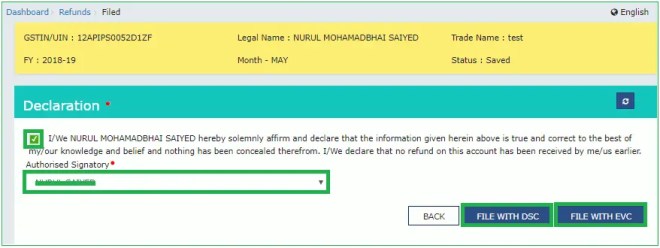
Step 6: File the Application – File your refund application using DSC or EVC. Once submitted, an Application Reference Number (ARN) will be generated and displayed. You will also receive the ARN via email and SMS.
Post-Submission: What Happens Next?
After submitting your application, it is assigned to a refund processing officer. The refund status will be updated periodically, and taxpayers can track the progress using their ARN.
Refund Claim by Unregistered Person
Unregistered persons who wish to claim a GST refund must first obtain GST registration. Once registered, they can apply for the refund by filing Form RFD-01. For this, they must submit Statement 8, a supplier certificate, and relevant supporting documents.
GST Refund Process for Embassies and International Organisations
Embassies and international organisations can claim GST refunds using one of two methods:
Method 1: Using GSTR-11 to Generate RFD-10
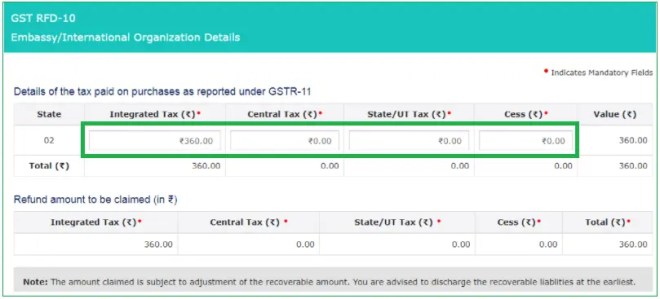
Generate the Application: Log into the GST portal and select the relevant tax period or quarter in GSTR-11. Click on the ‘Generate RFD-10’ button to proceed.
Select the Entity: Choose the ‘Embassy/Organisation’ radio button, then click ‘Create’. The table titled ‘Details of the Tax Paid on Purchases as Reported Under GSTR-11’ will auto-populate with amounts from the filed return, which can be edited if necessary.
Submit the Refund Application: Preview the information, then submit the application using DSC or EVC.
Method 2: Using the GST Portal Dashboard
Access Refund Application: After logging into the GST portal, navigate to the ‘Services’ tab, then select ‘Refunds’ followed by ‘Application for Refund’.
Select Embassy/International Organisation: On the next page, choose ‘Embassy/International Organisation’ as the refund option, and click ‘Create’.
Auto-Populated Tax Details: The tax-paid details eligible for a refund will auto-populate from the GSTR-11 return already filed. Verify the details and make any necessary adjustments.
Submit the Refund Application: Once the information is reviewed and edited (if required), preview and submit the application using DSC or EVC.
In both methods, the auto-populated data from GSTR-11 helps streamline the refund process, ensuring that embassies and international organisations can efficiently claim refunds for eligible purchases.
What Happens After the GST Refund is Applied?
Once the taxpayer submits a GST refund application, it appears as a pending item on the tax officer’s or refund processing officer’s dashboard. The officer is responsible for reviewing and scrutinising the application and any supporting documents to ensure it meets all necessary requirements.
Taxpayers can track the status of their applications by using the ‘Track Application Status’ feature under the Refunds section on the GST portal. After completing the verification process, the approved refund amount will be credited directly to the taxpayer’s bank account.
Actions Taken by the Officer:
Provisional Refund (Form RFD-04): For certain types of refunds, a provisional refund can be granted within 7 days from the date of acknowledgement. At least 90% of the claimed refund amount will be granted provisionally.
Acknowledgement (Form RFD-02): Suppose the application is complete in all respects. In that case, an acknowledgement in Form RFD-02 will be issued within 15 days of filing the refund application.
Application Withdrawal (Form RFD-01W): Applicants have the option to withdraw their refund application using Form RFD-01W. Once withdrawn, any amount debited to the taxpayer’s electronic cash or credit ledger will be re-credited to the respective ledger.
Deficiency Memo (Form RFD-03): If there are deficiencies in the application, the officer may issue a Deficiency Memo in Form RFD-03 within the same time limit. If the refund had been debited to the taxpayer’s ledger during filing, the amount would have been automatically re-credited to the ledger. The taxpayer must submit a fresh application after rectifying the deficiencies.
Clarification Notice (Form RFD-08): In cases where the application needs further clarification or is subject to rejection, the officer may issue a Notice in Form RFD-08. The taxpayer must respond to the notice within 15 days using Form RFD-09.
Withholding of Refund (Form RFD-07, Part B): In certain cases, the officer may issue an order to withhold the refund using Form RFD-07 (Part B). RFD-05 is not issued when this occurs, and the refund remains withheld.
Re-Credit Order (Form PMT-03):
Suppose the refund is rejected or a provisional refund was previously granted. In that case, the officer may pass an order in Form PMT-03 to re-credit the refund to the taxpayer’s electronic cash or credit ledger.
Due date for deposit of Tax deducted/collected by an office of the government for the month of March, 2024. However, all sum deducted by an office of the government shall be paid to the credit of the Central Government on the same day where tax is paid without production of an Income-tax Challan
Quarterly statement in respect of foreign remittances (to be furnished by authorized dealers) in Form No. 15CC for quarter ending March, 2024
15.04.2024
7
Due date for furnishing statement in Form no. 3BB by a stock exchange in respect of transactions in which client codes been modified after registering in the system for the month of March, 2024
15.04.2024
8
Due date for furnishing of Form 24G by an office of the Government where TDS/TCS for the month of March, 2024 has been paid without the production of a challan
Due date for furnishing of challan-cum-statement in respect of tax deducted under section 194-IB in the month of March, 2024
30.04.2024
11
Due date for furnishing of challan-cum-statement in respect of tax deducted under section 194M in the month of March, 2024
30.04.2024
12
Due date for furnishing of challan-cum-statement in respect of tax deducted under section 194S (by specified person) in the month of March, 2024
30.04.2024
13
Due date for deposit of Tax deducted by an assessee other than an office of the Government for the month of March, 2024
30.04.2024
14
Due date for e-filing of a declaration in Form No. 61 containing particulars of Form No. 60 received during the period October 1, 2023 to March 31, 2024
30.04.2024
15
Due date for uploading declarations received from recipients in Form. 15G/15H during the quarter ending March, 2024
30.04.2024
16
Due date for deposit of TDS for the period January 2024 to March 2024 when Assessing Officer has permitted quarterly deposit of TDS under section 192, 194A, 194D or 194H
Due Date for filling GSTR – 3B return for the month of Mar., 2023 for the taxpayer with Aggregate turnover upto INR 5 crores during previous year and who has opted for Quarterly filing of GSTR-3B
Group A States: Chhattisgarh, Madhya Pradesh, Gujarat, Maharashtra, Karnataka, Goa, Kerala, Tamil Nadu, Telangana, Andhra Pradesh, Daman & Diu and Dadra & Nagar Haveli, Puducherry, Andaman and Nicobar Islands, Lakshadweep
1. GST Filing of returns by registered person with aggregate turnover exceeding INR 5 Crores during preceding year. 2. Registered person, with aggregate turnover of less then INR 5 Crores during preceeding year, opted for monthly filing of return under QRMP.
Due Date of payment of GST for a taxpayer with Aggregate turnover up to INR 5 crores during the previous year and who has opted for Quarterly filing of return under QRMP.
25.04.2024
G. GSTR 11: Statement of inward supply of goods or services or both received by UIN holders – due date 28.04.2024
GSTR-11 is the return to be filed by the persons who have been issued a Unique Identity Number and claims a refund of the taxes paid on their inward supplies.
Due date:Must be filed by the 28th of the month following the month in which inward supply is received by the UIN holders.
H. Monthly Payment of GST – CMP-08:
Compliance Particular
Due Date
Form GST CMP-08 is used to declare the details or summary of self-assessed tax payable by taxpayers who have opted for a composition levy. Period: Jan – Mar, 2024
Disclaimer: Every effort has been made to avoid errors or omissions in this material. In spite of this, errors may creep in. Any mistake, error or discrepancy noted may be brought to our notice which shall be taken care of in the next edition. In no event the author shall be liable for any direct, indirect, special or incidental damage resulting from or arising out of or in connection with the use of this information.
Annual return on Foreign Liabilities and Assets is required to be submitted by all the India resident companies which have received FDI and/ or made overseas investment in any of the previous year(s), including current year by July 15th every year.
Not later than 30 days from the date of issue of Capital instrument
FC-GPR is a form filed when the Indian company receives the Foreign Direct Investment and the company allots shares to a person resident outside India.
Form FC-GPR
FEMA ACT 1999
With in 60 days of receipt/ remittance of funds or transfer of capital instruments whichever is earlier.
Reporting of transfer of shares and other eligible securities between residents and non-residents and vice- versa is to be made in Form FC-TRS. The onus of reporting shall be on the resident transferor/ transferee.
Form FC-TRS.
FEMA ACT 1999
Within 30 days from the date of receipt of the amount of consideration.
A Limited Liability Partnership receiving amount of consideration and acquisition of profit shares is required to submit a report in the Form FDI LLP-1
Form FDI LLP-I
FEMA ACT 1999
within 60 days from the date of receipt of funds in
A Limited liability Partnership shall report disinvestment/ transfer of capital contribution or profit share between a resident and a non resident (or vice versa)
Form FDI LLP-II
FEMA ACT 1999
within 30 days from the date of allotment of capital instruments
The domestic custodian shall report the issue/ transfer/ of sponsored/ unsponsored depository receipts
Downstream statement -Form DI & reporting at FIFP too
Types of Accounts
Capital Account and Current Account – The purpose of the capital account is to adjust the assets and liabilities of individuals outside India to persons residing in India. Thus any transaction that results in a change of the overseas assets and liabilities in India of an Indian residing outside India or transactions overseas of a person residing in India will be considered under the capital account. All other transactions fall under the category of the current account.
NRI Bank Accounts
There is option for the Non-Resident Indians to set up various bank accounts in India, like FCNR, NRE and NRO Accounts.
RBI Circulars / Notifications: June, 2023
Sl.
Particulars of the Circulars
Link
1
Conference for the Directors on the Boards of Private Sector Banks
Premature redemption under Sovereign Gold Bond (SGB) Scheme – Redemption Price for premature redemption due on June 03, 2023 (June 04, 2023 being a Sunday) (Series X of SGB 2017-18)
Due date for deposit of Tax deducted/collected for the month of June, 2023. However, all sum deducted/collected by an office of the government shall be paid to the credit of the Central Government on the same day where tax is paid without production of an Income-tax Challan.
07.07.2023
2.
Due date for deposit of TDS for the period April 2023 to June 2023 when Assessing Officer has permitted quarterly deposit of TDS under section 192, 194A, 194D or 194H
07.07.2023
3
Due date for issue of TDS Certificate for tax deducted under section 194-IA in the month of May, 2023
15.07.2023
4
Due date for issue of TDS Certificate for tax deducted under section 194-IB in the month of May, 2023
15.07.2023
5
Due date for issue of TDS Certificate for tax deducted under section 194M in the month of May, 2023
15.07.2023
6
Due date for issue of TDS Certificate for tax deducted under section 194S in the month of May, 2023 Note: Applicable in case of specified person as mentioned under section 194S
15.07.2023
7
Quarterly statement in respect of foreign remittances (to be furnished by authorized dealers) in Form No. 15CC for quarter ending June, 2023
15.07.2023
8
Quarterly statement of TCS deposited for the quarter ending 30 June, 2023
15.07.2023
9
Upload the declarations received from recipients in Form No. 15G/15H during the quarter ending June, 2023
15.07.2023
10
Due date for furnishing statement in Form no. 3BB by a stock exchange in respect of transactions in which client codes been modified after registering in the system for the month of June, 2023
15.07.2023
11
Quarterly TCS certificate in respect of tax collected by any person for the quarter ending June 30, 2023
15.06.2023
12
Due date for furnishing of challan-cum-statement in respect of tax deducted under section 194-IA for the month of June, 2023
30.07.2023
13
Due date for furnishing of challan-cum-statement in respect of tax deducted under section 194-IB for the month of June, 2023
30.07.2023
14
Due date for furnishing of challan-cum-statement in respect of tax deducted under section 194M for the month of June, 2023
30.07.2023
15
Due date for furnishing of challan-cum-statement in respect of tax deducted under section 194S in the month of June, 2023 Note: Applicable in case of specified person as mentioned under section 194S
30.07.2023
16
Quarterly statement of TDS deposited for the quarter ending June 30, 2023
31.07.2023
17
Return of income for the assessment year 2023-24 for all assessee other than (a) corporate-assessee or (b) non-corporate assessee (whose books of account are required to be audited) or (c) partner of a firm whose accounts are required to be audited or the spouse of such partner if the provisions of section 5A applies or (d) an assessee who is required to furnish a report under section 92E.
31.07.2023
18
Quarterly return of non-deduction of tax at source by a banking company from interest on time deposit in respect of the quarter ending June 30, 2023.
31.07.2023
19
Statement by scientific research association, university, college or other association or Indian scientific research company as required by rules 5D, 5E and 5F (if due date of submission of return of income is July 31, 2023)
31.07.2023
20
Intimation in Form 10BBB by a pension fund in respect of each investment made in India for quarter ending June, 2023
31.07.2023
21
Intimation in Form II by Sovereign Wealth Fund in respect of investment made in India for quarter ending June, 2023
31.07.2023
Centre Announces 3-Month Extension For Implementing Revised TCS Rates
Increased TCS rates to apply from 1st October, 2023: The increase in TCS rates; which were to come into effect from 1st July, 2023 shall now come into effect from October 1, 2023. Source: Click Here
Important Notifications – For the month of June – 2023:
Sl.
Particulars of the Notification(s)
File No. / Circular No.
Link(s)
1.
Condonation of delay in filing refund claim and claim of carry forward of losses under Section 119(2)(b) of the Income-tax Act, 1961
a) Taxpayers having aggregate turnover > Rs. 5 Cr. in preceding FY
Tax period
Due Date
Particulars
June, 2023
20th July, 2023
Due Date for filling GSTR – 3B return for the month of June, 2023 for the taxpayer with Aggregate turnover exceeding INR 5 crores during previous year.
b). Taxpayers having aggregate turnover upto Rs. 5 crores in preceding FY (Group A)
Tax period
Due Date
Particulars
June, 2023
22nd July, 2023
Due Date for filling GSTR – 3B return for the month of June, 2023 for the taxpayer with Aggregate turnover upto INR 5 crores during previous year and who has opted for Quarterly filing of GSTR-3B
Group A States: Chhattisgarh, Madhya Pradesh, Gujarat, Maharashtra, Karnataka, Goa, Kerala, Tamil Nadu, Telangana, Andhra Pradesh, Daman & Diu and Dadra & Nagar Haveli, Puducherry, Andaman and Nicobar Islands, Lakshadweep
c). Taxpayers having aggregate turnover upto Rs. 5 crores in preceding FY (Group B)
Tax period
Due Date
Particulars
June, 2023
24th July, 2023
Annual Turnover Up to INR 5 Cr in Previous FY But Opted Quarterly Filing
Group B States: Himachal Pradesh, Punjab, Uttarakhand, Haryana, Rajasthan, Uttar Pradesh, Bihar, Sikkim, Arunachal Pradesh, Nagaland, Manipur, Mizoram, Tripura, Meghalaya, Assam, West Bengal, Jharkhand, Odisha, Jammu and Kashmir, Ladakh, Chandigarh, Delhi
B. Filing Form GSTR-1:
Tax period
Due Date
Remarks
Monthly return (June, 2023)
11.07.2023
1. GST Filing of returns by registered person with aggregate turnover exceeding INR 5 Crores during preceding year. 2. Registered person, with aggregate turnover of less then INR 5 Crores during preceeding year, opted for monthly filing of return under QRMP.
C. Non Resident Tax Payers, ISD, TDS & TCS Taxpayers
Return for Tax Deducted at source to be filed by Tax Deductor
10th of succeeding month
10.07.2023
GSTR -8
E-Commerce operator registered under GST liable to TCS
10th of succeeding month
10.07.2023
D. GSTR – 1 QRMP monthly / Quarterly return
Form No.
Compliance Particulars
Timeline
Due Date
Details of outward supply-IFF & Summary of outward supplies by taxpayers who have opted for the QRMP scheme.
GST QRMP monthly return due date for the month of April, 2022 (IFF). Applicable for taxpayers with Annual aggregate turnover up to Rs. 1.50 Crore. Summary of outward supplies by taxpayers who have opted for the QRMP scheme.
13th of succeeding month – Monthly Quarterly Return
13.07.2023
E. GST Refund:
Form No.
Compliance Particulars
Due Date
RFD -10
Refund of Tax to Certain Persons
18 Months after the end of quarter for which refund is to be claimed
F. Monthly Payment of GST – PMT-06:
Compliance Particular
Due Date
Due Date of payment of GST for a taxpayer with Aggregate turnover up to INR 5 crores during the previous year and who has opted for Quarterly filing of return under QRMP.
25.07.2023
G. Monthly Payment of GST – CMP-08:
Compliance Particular
Due Date
Form GST CMP-08 is used to declare the details or summary of self-assessed tax payable by taxpayers who have opted for a composition levy. Period: April – June, 2023
18.07.2023
GST UPDATES – June, 2023:
Sl.
Notification Particulars
Notification No.
Link (s)
1.
Advisory on Filing of Declaration In Annexure V by Goods Transport Agency (GTA) opting to pay tax under forward charge mechanism
Seeks to extend the due date for furnishing FORM GSTR-1 for April and May, 2023 for registered persons whose principal place of business is in the State of Manipur
Seeks to extend the due date for furnishing FORM GSTR-3B for April and May, 2023 for registered persons whose principal place of business is in the State of Manipur.
Seeks to extend the due date for furnishing FORM GSTR-7 for April and May, 2023 for registered persons whose principal place of business is in the State of Manipur.
Compliance Requirement under SEBI (Listing Obligations and Disclosure Requirements) (LODR) Regulations, 2015
A. Quarterly Compliances:
Sl. No.
Regulation reference(Reg.)
Compliance Particulars
Timeline / Due Date(For the Quarter Ended December, 2022)
Due Dates
1
27(2)
Corporate Governance Report
21 days from end of quarter
21.07.2023
2
13(3)
Statement of Investor Complaints
21 days from end of quarter
21.07.2023
3
31 (1) (b)
Shareholding Pattern
21 days from end of quarter
21.07.2023
4
33
Financial Results
45 days/60 days from end of quarter
14.08.2023
B. Half Yearly Compliances:
Sl. No.
Regulation No.
Compliance Period(Due Date)
Due Date
1.
Regulation 23(9) Related party transactions.
a) Provided further that the listed entity shall make such disclosures every six months within 15 days from the date of publication of its standalone and consolidated financial results: b) Disclosure of Related Party Transactions as per Regulation 23(9) needs to be filed on the same day on which financial results are published to stock exchange.
a) within 15 days from the date of publication b) disclosures every six months on the date of publication of its standalone and consolidated financial results (w.e.f. 01.04.2023)
C. Regular / Annual Compliances:
REG NO
REGULATION NO
PARTICULARS
TIMELINE
47 Advertisements in Newspapers.
47 (3) Advertisements in Newspapers
Financial results at 47 clause (b) of sub-regulation (1), shall be published within 48 hours of conclusion of the meeting of board of directors at which the financial results were approved.
48 HOURS
46 Website
46(2)(s)
The listed entity shall disseminate the following information under a separate section on its website separate audited financial statements of each subsidiary of the listed entity in respect of a relevant financial year, uploaded at least 21 days prior to the date of the annual general meeting which has been called to inter alia consider accounts of that FY.]
21 days prior 1 days prior to the date of AGM
Annual Disclosure requirements for large entities
Circular No. SEBI/HO/DDHS/CIR/P/2018/144
Annual Disclosure to be made by an entity identified as a Large Corporates (To be submitted to the Stock Exchange(s) within 45 days of the end of the FY) (Applicable for FY 2020 and 2021)
Within 45 days of the end of the FY
D. Other Quarterly compliance which included half year compliance except FR (Financial Results)
Reg No
Regulation No
Particulars
Timeline
Intimation
Reg 29 read with Reg 33
intimation regarding item specified in clause 29(1) (a) to be discussed at the meeting of board of directors shall be given at least five days in advance (excluding the date of the intimation and date of the meeting), and such intimation shall include the date of such meeting of board of directors
at least 5 working days in advance, excluding the date of the intimation and date of the meeting
Intimations and Disclosure of events or information to Stock Exchanges.
87B: Intimations and Disclosure of events or information to Stock Exchanges. READ WITH PART E OF Schedule III
The listed entity shall first disclose to stock exchange(s) of all events or information, as specified in Part E of Schedule III, as soon as reasonably possible but not later than twenty four hours from occurrence of the event or information:
24 HOURS
Valuation, Rating and NAV disclosure.
87C(1) (iii)
An issuer whose security receipts are listed on a stock exchange shall ensure that: the net asset value is calculated on the basis of such independent valuation and the same is declared by the asset reconstruction company within 15 days of the end of quarter.
15 Days
– Certificate from Practicing Company Secretary. .
Regulation 40 (9) (Regulation 40 (10)- certificate mentioned at sub-regulation (9), shall befiled with the stock exchange(s) simultaneously.)
The listed entity shall ensure that the share transfer agent and/or the in-house share transfer facility, as the case may be, produces a certificate from a practicing company secretary within 30 days from the end of the financial year, certifying that all certificates have been issued within thirty days of the date of lodgement for transfer, subdivision, consolidation, renewal, exchange or endorsement of calls/ allotment monies.
Within 30 days from the end of the financial year.
Indian Depository Receipt holding pattern & Shareholding details.
69(1)
The listed entity shall file with the stock exchange the Indian Depository Receipt holding pattern on a quarterly basis within fifteen days of end of the quarter in the format specified by the Board.
15 days from end of each quarter
E. Event based Compliances
Reg No
Regulation No
Particulars
Timeline
30 Disclosure of events or information.
30(6) AND Part A of Schedule III
The listed entity shall first disclose to stock exchange(s) of all events, as specified in Part A of Schedule III, or information as soon as reasonably possible and not later than twenty four hours from the occurrence of event or information
24 HOURS
30 Disclosure of events or information.
30(6) AND sub-para 4 of Para A of Part A of Schedule III
The listed entity shall disclose to the Exchange(s), within 30 minutes of the closure of the meeting held to consider the following: a) dividends and/or cash bonuses recommended or declared or the decision to pass any dividend and the date on which dividend shall be paid/dispatched; b) any cancellation of dividend with reasons thereof; c) the decision on buyback of securities; d) the decision with respect to fund raising proposed to be undertaken e) increase in capital by issue of bonus shares through capitalization including the date on which such bonus shares shall be credited/dispatched; f) reissue of forfeited shares or securities, or the issue of shares or securities held in reserve for future issue or the creation in any form or manner of new shares or securities or any other rights, privileges or benefits to subscribe to; g) short particulars of any other alterations of capital, including calls; h) financial results; i) decision on voluntary delisting by the listed entity from stock exchange(s).
30 MINUTES
31A: Conditions for re-classification of any person as promoter / public
31A(8)
The following events shall deemed to be material events and shall be disclosed by the listed entity to the stock exchanges as soon as reasonably possible and not later than twenty four hours from the occurrence of the event: (a) receipt of request for re-classification by the listed entity from the promoter(s) seeking re-classification; (b) minutes of the board meeting considering such request which would include the views of the board on the request; (c) submission of application for re-classification of status as promoter/public by the listed entity to the stock exchanges; (d) decision of the stock exchanges on such application as communicated to the listed entity;
24 HOURS
34 Annual Report.
34(1)(b)
In the event of any changes to the annual report, the revised copy along with the details of and explanation for the changes shall be sent not later than 48 hours after the annual general meeting.]
48 HOURS
44 Meetings of shareholders and voting
44(3)
The listed entity shall submit to the stock exchange, within forty eight hours of conclusion of its General Meeting, details regarding the voting results in the format specified by the Board.
48 HOURS
47 Advertisements in Newspapers.
47 (3) Advertisements in Newspapers
The listed entity shall publish the information specified in 47(1) in the newspaper simultaneously with the submission of the same to the stock exchange(s). The same is reproduced below 47(1) (a) notice of meeting of the board of directors where financial results shall be discussed (c )statements of deviation(s) or variation(s) as specified in sub-regulation (1) of regulation 32 on quarterly basis, after review by audit committee and its explanation in directors report in annual report; (d) notices given to shareholders by advertisement
Simultaneously
–
SCHEDULE III PART PART A 7(A)
resignation of the auditor of the listed entity, detailed reasons for resignation of auditor, as given by the said auditor, shall be disclosed by the listed entities to the stock exchanges as soon as possible but not later than twenty four hours of receipt of such reasons from the auditor
24 HOURS
–
SCHEDULE III PART PART A 7(B)
In case of resignation of an independent director of the listed entity, within seven days from the date of resignation, the following disclosures shall be made to the stock exchanges by the listed entities: i. Detailed reasons for the resignation of independent directors as given by the said director shall be disclosed by the listed entities to the stock exchanges. ii. The independent director shall, along with the detailed reasons, also provide a confirmation that there is no other material reasons other than those provided. iii. The confirmation as provided by the independent director above shall also be disclosed by the listed entities to the stock exchanges along with the detailed reasons as specified in sub-clause (i) above.]
7 days from the date of resignation
7 Share Transfer Agent.
Reg 7(4) & (5) Share Transfer Agent.
The listed entity shall intimate any change or appointment of a new share transfer agent, to the stock exchange(s) within seven days of entering into the agreement.
7 DAYS
29
Reg 29(1)
The intimation required under 29 (1), shall be given at least two working days in advance, excluding the date of the intimation and date of the meeting Reg 29(1) is reproduced below: (b) proposal for buyback of securities ; (c) proposal for voluntary delisting by the listed entity from the stock exchange(s); (d) fund raising by way of further public offer, rights issue, American Depository Receipts/Global Depository Receipts/Foreign Currency Convertible Bonds, qualified institutions placement, debt issue, preferential issue or any other method and for determination of issue price: Provided that intimation shall also be given in case of any annual general meeting or extraordinary general meeting or postal ballot that is proposed to be held for obtaining shareholder approval for further fund raising indicating type of issuance. (e) declaration/ recommendation of dividend, issue of convertible securities including convertible debentures or of debentures carrying a right to subscribe to equity shares or the passing over of dividend. (f) the proposal for declaration of bonus securities where such proposal is communicated to the board of directors of the listed entity as part of the agenda papers:
at least 2 working days in advance, excluding the date of the intimation and date of the meeting
31 Holding of specified securities and shareholding pattern.
Reg 31 (1)(a)
The listed entity shall submit to the stock exchange(s) a statement showing holding of securities and shareholding pattern separately for each class of securities, in the format specified by the Board from time to time – one day prior to listing of its securities on the stock exchange(s);
1 day prior to listing of its securities on the stock exchange(s
31
Reg 31 (1 (c)
within ten days of any capital restructuring of the listed entity resulting in a change exceeding two per cent of the total paid-up share capital:
within 10 days of any capital restructuring
31A Conditions for re-classification of any person as promoter / public
Reg 31A
an application for re-classification of a promoter/ person belonging to promoter group to public to the stock exchanges has to be made by the listed entity consequent to the following procedures and not later than thirty days from the date of approval by shareholders in general meeting
30 days from the date of approval by shareholders in general meeting
37 Draft Scheme of Arrangement & Scheme of Arrangement.
37(1)
Draft Scheme of Arrangement & Scheme of Arrangement before for obtaining Observation Letter or No-objection letter, before filing such scheme with any Court or Tribunal, in terms of requirements specified by the Board or stock exchange(s) from time to time.
Before filling the same with any court or tribunal
39 Issuance of Certificates or Receipts/Letters/Advices for securities and dealing with unclaimed securities.
39(2)
The listed entity shall issue certificates or receipts or advices, as applicable, of subdivision, split, consolidation, renewal, exchanges, endorsements, issuance of duplicates thereof or issuance of new certificates or receipts or advices, as applicable, in cases of loss or old decrepit or worn out certificates or receipts or advices, as applicable within a period of thirty days from the date of such lodgement.
30 Days
39 Issuance of Certificates or Receipts/Letters/Advices for securities and dealing with unclaimed securities
39(3)
The listed entity shall submit information regarding loss of share certificates and issue of the duplicate certificates, to the stock exchange within two days of its getting information.
2 days of its getting information.
40 Transfer or transmission or transposition of securities.
40 (3)
On receipt of proper documentation, the listed entity shall register transfers of its securities in the name of the transferee(s) and issue certificates or receipts or advices, as applicable, of transfers; or issue any valid objection or intimation to the transferee or transferor, as the case may be, within a period of fifteen days from the date of such receipt of request for transfer
15 days
40 Transfer or transmission or transposition of securities.
40 (3)
the listed entity shall ensure that transmission requests are processed for securities held in dematerialized mode within seven days after receipt of the specified documents:
7 Days
40 Transfer or transmission or transposition of securities.
40 (3)
the listed entity shall ensure that transmission requests are processed for securities held in physical mode within twenty one days after receipt of the specified documents:
21 Days
–
SCHEDULE VII: TRANSFER OF SECURITIES (PART B (1))
In case of minor differences in the signature of the transferor(s), the listed entity shall follow the following procedure for registering transfer of securities: (a) the listed entity shall promptly send to the first transferor(s), via speed post an intimation of the aforesaid defect in the documents and inform the transferor(s) that objection, supported by valid proof, is not lodged by the transferor(s) with the listed entity within fifteen days of receipt of the listed entity’s letter, then the securities shall be transferred
15 Days
42 Record Date or Date of closure of transfer books.
42(2)
The listed entity shall give notice in advance of atleast seven working days (excluding the date of intimation and the record date) to stock exchange(s) of record date specifying the purpose of the record date:
7 working days advance intimation excluding the date of the intimation and date of the meeting
42 Record Date or Date of closure of transfer books.
42(2)
in the case of rights issues, the listed entity shall give notice in advance of atleast three working days (excluding the date of intimation and the record date).]
3 working days advance intimation excluding the date of the intimation and date of the meeting
42 Record Date or Date of closure of transfer books.
42(3)
The listed entity shall recommend or declare all dividend and/or cash bonuses at least five working days (excluding the date of intimation and the record date) before the record date fixed for the purpose.
5 working days advance intimation excluding the date of the intimation and date of the meeting
46 Website
46 (3)(b)
The listed entity shall update any change in the content of its website within two working days from the date of such change in content.
2 working days
50 Intimation to stock exchange(s).
50(1)
The listed entity shall give prior intimation to the stock exchange(s) at least eleven working days before the date on and from which the interest on debentures and bonds, and redemption amount of redeemable shares or of debentures and bonds shall be payable.
11 working days
50 Intimation to stock exchange(s).
50(3)
The listed entity shall intimate to the stock exchange(s), at least two working days in advance, excluding the date of the intimation and date of the meeting, regarding the meeting of its board of directors, at which the recommendation or declaration of issue of non-convertible debt securities or any other matter affecting the rights or interests of holders of non- convertible debt securities or non – convertible redeemable preference shares is proposed to be considered.
2 working days advance intimation excluding the date of the intimation and date of the meeting
52 Financial Results.
52 (4) & (5)
The listed entity shall, within seven working days from the date of submission of the information required under sub- regulation (4), submit to stock exchange(s), a certificate signed by debenture trustee that it has taken note of the contents
7 working days
52 Financial Results.
52 (4) & (8)
The listed entity shall, within two calendar days of the conclusion of the meeting of the board of directors, publish the financial results and statement referred to in reg 52 (4), in at least one English national daily newspaper circulating in the whole or substantially the whole of India.
two calendar days of the conclusion of the meeting
57 Other submissions to stock exchange(s).
57(1)
The listed entity shall submit a certificate to the stock exchange within two days of the interest or principal or both becoming due that it has made timely payment of interests or principal obligations or both in respect of the non convertible debt securities
within 2 days
60 Record Date
60(2)
The listed entity shall give notice in advance of at least seven working days (excluding the date of intimation and the record date) to the recognised stock exchange(s) of the record date or of as many days as the stock exchange(s) may agree to or require specifying the purpose of the record date.
7 working days advance intimation excluding the date of the intimation and date of the meeting
78 Record Date.
78(2)
The listed entity shall give notice in advance of at least four working days to the recognised stock exchange(s) of record date specifying the purpose of the record date
notice in advance of at least 4 working days
82 Intimation and filings with stock exchange(s).
82(2)
The listed entity shall intimate to the stock exchange(s), at least two working days in advance, excluding the date of the intimation and date of the meeting, regarding the meeting of its board of trustees, at which the recommendation or declaration of issue of securitized debt instruments or any other matter affecting the rights or interests of holders of securitized debt instruments is proposed to be considered.
2 working days in advance, excluding the date of the intimation and date of the meeting,
82 Intimation and filings with stock exchange(s).
82(3)
The listed entity shall submit such statements, reports or information including financial information pertaining to Schemes to stock exchange within seven days from the end of the month/ actual payment date, either by itself or through the servicer, on a monthly basis in the format as specified by the Board from time to time: Provided that where periodicity of the receivables is not monthly, reporting shall be made for the relevant periods.
within 7 days
87 Record Date.
87(2)
The listed entity shall give notice in advance of atleast seven working days (excluding the date of intimation and the record date) to the recognised stock exchange(s) of the record date or of as many days as the Stock Exchange may agree to or require specifying the purpose of the record date
7 working days advance intimation excluding the date of the intimation and date of the meeting
87E Record Date.
87E(2)
The listed entity shall give notice in advance of at least seven working days (excluding the date of intimation and the record date) to the stock exchange(s) of the record date or of as many days as the stock exchange may agree to or require specifying the purpose of the record date.
6. SEBI (Substantial Acquisition of Shares and Takeovers) Regulations, 2011
Securities and Exchange Board of India (SEBI) vide notification / Circular No. SEBI/HO/CFD/DCR1/CIR/P/2020/49 issued and publish dated 27th March 2020, has published Relaxation from compliance with certain provisions of the SEBI (Substantial Acquisition of Shares and Takeovers) Regulations, 2011 due to the COVID-19 pandemic”.
Sl. No.
Regulation No.
Compliance Particular
Compliance Period(Due Date)
1
Regulation 30(1)
Every person, who together with persons acting in concert with him, holds shares or voting rights entitling him to exercise 25% or more of the voting rights in a target company, shall disclose their aggregate shareholding and voting rights as of the 31st day of March, in such target company in such form as may be specified.
Omitted through introduction of SEBI (Substantial Acquisition of Shares and Takeovers) (Second Amendment) Regulations, 2021 Applicable w.e.f. 01.04.2022
2
Regulation 30(2)
The promoter of every target company shall together with persons acting in concert with him, disclose their aggregate shareholding and voting rights as of the thirty-first day of March, in such target company in such form as may
The promoter of every listed company shall specifically disclose detailed reasons for encumbrance if the combined encumbrance by the promoter along with PACs with him equals or exceeds: a) 50% of their shareholding in the company; or b) 20% of the total share capital of the company.
within 2 (two) working days (Provision Insertion: “Provided that the aforesaid disclosure requirement shall not be applicable where such encumbrance is undertaken in a depository”)
4.
Regulation 31(4)
Disclosure of encumbered shares
Promoter of every target company shall together with persons acting in concert with him, disclose their aggregate shareholding and voting rights as of the 31st March, in such target company in such form as may be specified.
7. SEBI (Prohibition of Insider Trading) Regulations, 2015
Sl. No.
Regulation No.
Compliance Particular
Compliance Period(Due Date)
1
Regulation 7(2)“Continual Disclosures”
Every promoter, employee and director of every company shall disclose to the company the number of such securities acquired or disposed of within two trading days of such transaction if the value of the securities traded, whether in one transaction or a series of transactions over any calendar quarter, aggregates to a traded value in excess of ten lakh rupees (10,00,000/-) or such other value as may be specified;
Every company shall notify; within two trading days of receipt of the disclosure or from becoming aware of such information
8. SEBI (Issue of Capital and Disclosure Requirements) Regulations, 2018
Sl. No.
Regulation No.
Compliance Particular
Compliance Period(Due Date)
1
Schedule XIX – Para (2) of ICDR Read with Reg 108 of SEBI LODR
“The issuer shall make an application for listing from the date of allotment, within such period as may be specified by the Board from time to time, to one or more recognized stock exchange(s)”. In regard to above, it is specified that Issuer shall make an application to the exchange/s for listing in case of further issue of equity shares from the date of allotment within 20 days (unless otherwise specified).
Within 20 days from the date of allotment
2
Regulation 162
The tenure of the convertible securities of the issuer shall not exceed eighteen months from the date of their allotment.
Application for trading approval to the stock exchange Listed entities shall make an application for trading approval to the stock exchange/s within 7 working days from the date of grant of listing approval by the stock exchange/s.
Within 7 working days from grant of date of listing approval
4
Regulation 76 Application for rights issue
The issuer along with lead managers and other parties related to the issue shall constitute an optional mechanism (non-cash mode only) to accept the applications of the shareholders to apply to rights issue subject to ensuring that no third-party payments shall be allowed in respect of any application.
5.
Regulation 77 Service of Documents
In case if the company fails to adhere to modes of dispatch through registered post or speed post or courier services due to Covid-19 conditions it will not be treated as non-compliance during the said period. The issuers shall publish required & necessary documents on the websites of the company, registrar, stock exchanges and the lead managers to the rights issue.
6
Regulation 84 Advertisement
Issuer has the flexibility to publish the advertisement in additional newspapers above those required in Regulation 84. The advertisement should also be made available on: A. Website of the Issuer, Registrar, Lead Managers, and Stock Exchanges. B. Television channels, radio, the internet, etc. to spread information related to the process.
9. SEBI (Buyback of Securities) Regulations, 2018 (Buyback Regulations)
Sl.
Regulation No.
Compliance Particular
Compliance Period(Due Date)
1
Regulation 11 and 24(iv)
Extinguishment of equity shares in connection with Buyback The particulars of the security certificates extinguished and destroyed shall be furnished by the company to the stock exchanges where the shares or other specified securities of the company are listed within seven days of extinguishment and destruction of the certificates.
7 days of extinguishment and destruction of the certificates
10. SEBI (Depositories and Participants) Regulations 2018)
Sl. No.
Particulars
Due Date
1.
Regulation 76 -Reconciliation of Shares and Capital Audit
Within 30 days from end of quarter.
2.
Regulation 74 (5): Processing of demat requests form by Issuer/RTAs – Certificate Received from Registrar
Within 15 days from the end of each quarter.
SEBI Circulars Tracker: June, 2023
Sl.
Particulars
Link
1.
Updates for Implementation of Section 51A of UAPA, 1967: Updates to UNSC’s 1267/ 1989 ISIL (Da’esh) & Al-Qaida Sanctions List: Amendment in 1 entry
Informal Guidance Letter to Vidli Restaurants Ltd. with regard to Regulation 10(1)(a)(i) of SEBI (Substantial Acquisition of Shares and Takeovers) Regulations, 2011 (Takeover Regulations).
Interim Order-cum-Show Cause Notice in case of market manipulation of shares of five small cap companies through circulation of Bulk SMSs to induce Investors
Adherence to provisions of regulation 51A of SEBI (Issue and Listing of Non-Convertible Securities) Regulations, 2021 by Online Bond Platform Providers on product offerings on Online Bond Platforms
Amendment to Guidelines on Anti-Money Laundering (AML) Standards and Combating the Financing of Terrorism (CFT) /Obligations of Securities Market Intermediaries under the Prevention of Money Laundering Act, 2002 and Rules framed there under
Consultation Paper on framework for mandating additional disclosures from Foreign Portfolio Investors (FPIs) that fulfil certain objective criteria, to 1) guard against possible circumvention of Minimum Public Shareholding (“MPS”), and 2) to guard against possible misuse of the FPI route to circumvent the requirements of Press Note 3 (“PN3”)
Request for Informal Guidance by way of an ‘interpretative letter’ under Securities and Exchange Board of India (Informal Guidance) Scheme, 2003 regarding the applicability of Business Responsibility and Sustainability Reporting (BRSR)
Informal Guidance request received from NTPC Limited with respect to Related Party Transactions (RPTs) under Regulation 23 of the Securities and Exchange Board of India (Listing Obligations and Disclosure Requirements) Regulations, 2015 (‘LODR Regulations’).
Extension of timeline for submission of public comments on the consultation paper on Institutional Mechanism for Asset Management Companies for deterrence of possible market abuse and fraudulent transactions
Extension of timeline for submission of public comments on the consultation paper on Review of Total Expense Ratio charged by Asset Management Companies (AMCs) to unitholders of schemes of Mutual Funds to facilitate greater transparency and accrual of interest of economies of scale to investors
11. Compliance Requirement UNDER Companies Act, 2013 and Rules made thereunder;
Applicable Laws/Acts
Due Dates
Compliance Particulars
Forms / Filing mode
Companies Act, 2013
Within 180 Days From The Date Of Incorporation Of The Company (one time compliance only)
As per Section 10 A (Commencement of Business) of the Companies Act, 2013, inserted vide the Companies (Amendment) Ordinance, 2018 w.e.f. 2nd November, 2018, a Company Incorporated after the ordinance and having share capital shall not commence its business or exercise any borrowing powers unless a declaration is filed by the Director within 180 days from the date of Incorporation of the Company with the ROC.
MCA E- Form INC 20A(one time compliance)
Companies Act, 2013
First declaration within 90 days from the date of notification Dt. 08.02.2019
A person having Significant beneficial owner shall file a declaration to the reporting company http://www.mca.gov.in/Ministry/pdf/CompaniesOwnersAmendmentRules_08020219.pdf i.e. within 90 days of the commencement of the Companies (Significant Beneficial Owners) Amendment Rules, 2019 i.e. 08.02.2019 In case Subsequent Acquisition of the title of Significant Beneficial Owner / Any Change therein a declaration in Form No. BEN-1 required to be filed to the reporting company, within 30 days of acquiring such significant beneficial ownership or any change therein.
The Ministry in its General Circular No. 12/2018 dated 13th December, 2018 clarified that filing of Form NFRA-1 is applicable only for Bodies Corporate and ruled out filing by Companies as defined under sub-section (20) of Section 2 the Act.
E – FormNFRA -1
Companies Act, 2013
Within 30 days of the board meeting
Filing of resolutions with the ROC regarding Board Report and Annual Accounts. The details of the resolutions passed should be filed.
MGT-14 (Filing of resolution with MCA)
Companies Act, 2013
One Time compliances
Registration of Entities for undertaking CSR activities – Trust/ Society/ Section 8 Company need to file before Acceptance of Donation as CSR w.e.f. 01st April 2021.
E-Form CSR-1
Companies Act, 2013
30th April (for Oct.2022 to March 2023)
Pursuant to Order dated 22 January, 2019 issued under Section 405 of the Companies Act, 2013, specified companies shall submit a half yearly return to MCA in respect of outstanding payments to Micro or Small Enterprises exceeding 45 days.
MSME Form 1
Companies Act, 2013
Annual Compliance (file on or after 01.04.2023)
Last date for filing DIR-3 KYC for Financial year 2022-23 is 30th September, 2023.For Every DIN / DPIN Holders.Penalty after due date is Rs. 5000/-(one time)
DIR – 3 KYC / DIR 3 Web- KYC
Companies Act, 2013
Within 60 (sixty) days from the conclusion of each half year.
Reconciliation of Share Capital Audit Report (Half-yearly) Pursuant to sub-rule Rule 9A (8) of Companies (Prospectus and Allotment of Securities) Rules, 2014
E-Form PAS – 6(please file with penalty after due date)
Companies Act, 2013
30th June, 2022 Extended till 31.07.2023
Every company must file DPT 3 for outstanding loans annually. The Companies (Acceptance of Deposits) Amendment Rules, 2019.
E-Form DPT – 3
Companies Act, 2013
within a period of 60 days after the holding of AGM
IEPF Authority (Accounting, Audit, Transfer and Refund) Second Amendment Rules, 2019 Statement of unclaimed and unpaid amounts. This e-form shall be filed within a period of 60 days after the holding of AGM or the date on which it should have been held as per the provisions of section 96 of the Act, whichever is earlier.
Stakeholders please note excel file download and upload functionality has been enabled in Form 11 LLP in which all the existing data of the Partners and Designated Partners of the LLP will get pre-filled. Stakeholders are requested to read the instruction kit before filing the form.
Stakeholders please note that in order to provide hassle-free filing experience of Form 3 LLP, excel download and upload functionality has been provided in the form in which all the existing data of the Partners and Designated Partners of the LLP will get pre-filled. Stakeholders are requested to read the instruction kit before filing the form
Stakeholders please note excel file download and upload functionality has been enabled in Form 11 LLP in which all the existing data of the Partners and Designated Partners of the LLP will get pre-filled. Stakeholders are requested to read the instruction kit before filing the form
Stakeholder may please note that last date for filing of DPT-3 form for the F.Y. 2022-23 (without paying additional fee) is 30th June 2023. Kindly complete your filing without postponing it to the last day
Chairman of the National Level Committee for drafting New National Cooperation Policy document Shri Suresh Prabhu, makes a presentation to Union Home Minister and Cooperation Minister Shri Amit Shah in New Delhi
Cabinet approves Constitution and Empowerment of an Inter-Ministerial Committee (IMC) for Facilitation of “World’s Largest Grain Storage Plan in Cooperative Sector”
IEC stands for Importer-Exporter Code which is key business identification number and is mandatory for export from India or Import to India.
The Director-General of Foreign Trade (DGFT) through Notification No. 58/2015-2020, dated 12th February, 2021 has directed that all Import Export Code (IEC) holders are now legally required to update their IEC details every year from April to June online, even if there are no changes. An IEC shall be deactivated, if it is not updated within the prescribed time. IEC so de-activated may be activated, on its successful updation. An IEC may be also be flagged for scrutiny. IEC holder(s) are required to know that any risks flagged by the system is timely addressed; failing which the IEC shall be deactivated.
IEC holders has to update IEC code annually between the period of April-June
Last due date to update IEC: 30th June, 2023
Importers will not be allowed to import commodities if they do not have the Import Export Code, and exporters will not be able to claim export benefits from the Director General of Foreign Trade unless they have an Import Export Code.
————————————————————————————————————-
This Calendar / Compliance Tracker is updated till 30th June, 2023 with all Laws / Regulations and their respective amendments.
———————————————-THE END—————————————————-
Disclaimer:Every effort has been made to avoid errors or omissions in this material. In spite of this, errors may creep in. Any mistake, error or discrepancy noted may be brought to our notice which shall be taken care of in the next edition. In no event the author shall be liable for any direct, indirect, special or incidental damage resulting from or arising out of or in connection with the use of this information. Many sources have been considered including newspapers (ET, BS & HT etc.).
REFUND TO UNREGISTERED PERSON ON CANCELLATION OF AGREEMENT OR CONTRACT FOR SUPPLY OF SERVICE
[ RULE 89(2)(KA), 188/20/2022-GST DT 27TH DEC 2017 ]
Who can claim Refund under this? :
Unregistered buyer, upon cancellation/termination of agreement for supply of service (and where time limit for adjustment by credit note is over for supplier of over as per Sec 34(1) of CGST Act 2017) can claim refund of GST amount paid to supplier.
2. Procedure to claim Refund of GST by such unregister buyer
New functionality has been made available on the common portal which allows unregistered persons to take a temporary GST registration
The unregistered person, who wants to file an application for refund shall obtain a temporary GST registration on the common portal using his PAN
While doing so, the unregistered person shall select the same state/UT where his/her supplier.
Thereafter, the unregistered person would be required to undergo Aadhaar authentication in terms of provisions of rule 10B of the CGST Rules.
Further, the unregistered person would be required to enter his bank account details in which he seeks to obtain the refund of the amount claimed.
3. Refund application is to be filed in which Form? and What document is required?
Apply for refund in Form RFD 01 under the category ‘Refund for Unregistered person’ along with Statement 8 details asked therein and document mentioned in below para.
Statement containing the details of invoices ( viz. number, date, value, tax paid and details of payment), in respect of which refund is being claimed
Copy of such invoices, proof of making such payment to the supplier, the copy of agreement or registered agreement or contract, as applicable, entered with the supplier for supply of service, the letter issued by the supplier for cancellation or termination of agreement or contract for supply of service, details of payment received from the supplier against cancellation or termination of such agreement along with proof thereof.
Certificate issued by the supplier to the effect that he has paid tax in respect of the invoices on which refund is being claimed by the applicant; that he has not adjusted the tax amount involved in these invoices against his tax liability by issuing credit note; and also, that he has not claimed and will not claim refund of the amount of tax involved in respect of these invoices.
Separate applications for refund have to be filed in respect of invoices issued by different suppliers
4. What is Time limit for claiming Refund?
Time limit for claiming Refund
5. Refund is allowed of which amount?
The refund amount claimed shall not exceed the total amount of tax declared on the invoices in respect of which refund is being claimed.
In cases where the amount paid back by the supplier to the unregistered person on cancellation/termination of agreement/contract for supply of services is less than amount paid by such unregistered person to thesupplier, only the proportionate amount of tax involved in such amount paid back shall be refunded to the unregistered person.
6. Refund is not allowed in case of – Refund claim can be filed by the unregistered persons only in those cases where at the time of cancellation/termination of agreement/contract for supply of services, the time period for issuance of credit note under section 34 of the CGST Act has already expired If such period is not expired, then refund application can not be filed and After scrutiny of refund application, proper officer shall also upload a detailed speaking order along with the refund sanction order in FORM GST RFD-06
From the FY 21-22, Form 3CD is required to be filed prior to ITR. After introducing this mechanism, there are many instances where 143(1) notices are received immediately after filing of return for mismatch between form 3CD & ITR. One such instance is non-disclosure of GST refunds as income u/s 26 of Income tax act.
Reporting GST Refund in Tax Audit report –
GST refunds are to be reported under 3 clauses in Tax audit report –
Clause 16 (b) – Amounts not credited to the profit and loss account, being, – the proforma credits, drawbacks, refunds of duty of customs or excise or service tax or refunds of sales tax or value added tax or Goods & Services Tax, where such credits, drawbacks or refunds are admitted as due by the authorities concerned;
Clause 27 –Amount of Central Value Added Tax Credits/ Input Tax Credit(ITC) availed of or utilised
during the previous year and its treatment in profit and loss account and treatment of outstanding Central Value Added Tax Credits/Input Tax Credit(ITC) in accounts.
Clause 41 –
Please furnish the details of demand raised or refund issued during the previous year under any tax laws other than Income-tax Act, 1961 and Wealth-tax Act, 1957 alongwith details of relevant proceedings
Clause 16 (b) requires reporting where the refunds are admitted as due by the respective department whereas clause 41 required reporting in case the refund are issued during the year. Reporting under clause is as part of the reconciliation of input tax credit.
Notice under Sec 143(1) for not reporting amounts stated under Clause 16 in ITR-
On combined reading of Clause 16(a) & 16(b), there can be an interpretation stating that those amounts which are to be offered to income under Sec 28 but not credited to P&L are to be reported under Sec 16(b). GST refunds are only taxable in current year if they are claimed as an expense/capitalised to asset in any of the Previous year. And hence if it is not taxable, it is not required to be reported under Clause 16. On the contrary, as per guidance note of ICAI, refunds needs to be disclosed under this clause irrespective of its taxability.
Below extract of Guidance Note on Tax Audit with respect to clause 16(b) on reporting of refund amounts not credited to Profit and Loss.
Extract –
“ The details of the following claims, if admitted as due by the concerned authorities but not credited to the profit and loss account, are to be stated under sub-clause (b).
(i) Pro forma credits
(ii) Drawback
(iii) Refund of duty of customs
(iv) Refund of excise duty
(v) Refund of service tax
(vi) Refund of sales tax or value added
(vii) Refund of Goods and Services Tax
(viii) Others
In respect of items falling under sub-clause (b), the tax auditor should examine all relevant correspondence, records, assessee’s particulars on portal of the departments and evidence in order to determine whether any
particular refund/claim has been admitted as due and accepted during the relevant financial year.
The words ‘admitted by the concerned authorities’ would mean ‘admitted by the authorities within the relevant previous year’.
28.7 The system of accounting followed in respect of these particular items may also be brought out in appropriate cases. If the assessee is following cash basis of accounting, it should be clearly brought out, since the
admittance of claims during the relevant previous year without actual receipt has no significance in cases where cash method of accounting is followed.
Credits/claims which have been admitted as due after the relevant previous year need not be reported here.
Where such amounts have not been credited in the profit and loss account but netted against the relevant expenditure/income heads, such fact should be clearly brought out. “
Conclusion
If reported under Clause 16 –
In case notice under 143(1) is received, Assesse has to reply to the department stating the facts of the case that the refund is not taxable as the same is not claimed as an expense in any of the PY. (or)
Amend the ITR by including refund under Sec 28 and claim expense under Sec 37 as other expenses.
Going forward, The Assesse can include a clarificatory note as part of the Form 3CD to clarify the nature of the transaction as an annexure to Form 3CD or consider the option of not disclosing the refunds under Clause 16 and only report them under Clause 41.
Subject: Prescribing manner of filing an application for refund by unregistered persons -re
Procedure for GST Refund to unregistered buyer in respect of under constructed flat/building booked but cancelled
✅Apply in online Form RFD-01 ✅Apply within 2 yr from date of issuance of letter of cancellation ✅Documents as per Rule-89(2) ✅Maxi refund = Tax paid ✅Mini refund = 1k ✅In proportion to value refunded by the developer
GST Council in its 47th Meeting has provided relief to taxpayers claiming GST refund.
The press release states:
Time period from 01.03.2020 to 28.02.2022 to be excluded from calculation of the limitation period for filing refund claim by an applicant under section 54 and 55 of CGST Act, as well as for issuance of demand/ order (by proper officer) in respect of erroneous refunds under section 73 of CGST Act. Further, limitation under section 73 for FY 2017-18 for issuance of order in respect of other demands linked with due date of annual return, to be extended till 30th September, 2023.
The office of Pr. CCA, CBIC has setup a ‘GST Refund Help Desk’ for addressing payment related problems faced by the taxpayers. Contact details of the Help Desk is as under:
Name of Nodal Officer: Ms Anita Rawat, Accounts Officer
Toll Free Helpline Number: 1800-11-1424
Mail ID: gstrefunds-helpdesk@gov.in
For payment/disbursement related issues in their refund application, the taxpayers are informed to contact this GST Refund helpdesk.
Circular No. 166/22/2021-GST, Dated 17th November 2021
Issue: Whether the provisions of sub section (1) of section 54 of the CGST Act regarding time period, within which an application for refund can be filed, would be applicable in cases of refund of excess balance in electronic cash ledger?
Clarification: No, the provisions of sub section (1) of section 54 of the CGST Act regarding time period, within which an application for refund can be filed,would not be applicable in cases of refund of excess balance in electronic cash ledger.
Generation of ARN: – ARN is Application Reference Number. Once the application of refund is submitted successfully, ARN is generated. Refund Status is tracked by ARN.
How to check the status with ARN: – It can be checked with ARN either with login or without login on GST Portal in the following 3 manner:-
DISCLAIMER: This publication is merely a general guide meant for knowledge purposes only. All the references or content are for educational purposes only and do not constitute a legal advice. We do not accept any liabilities whatsoever for any losses caused directly or indirectly by the use/reliance of any information or conclusion contained in this publication. Prior to acting upon this publication, you’re suggested to seek the advice. This work is entirely in the interest of profession and to contribute into my beloved subject of GST.
The author can be reached at gstwebinars@gmail.com