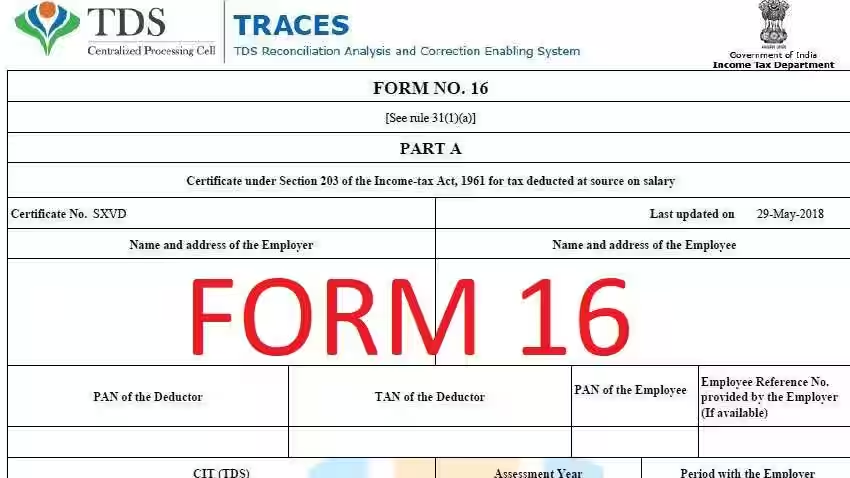
Income Tax: The last date to file income tax return (ITR) of September 15 is drawing closer. This is the time to hurry through your return filing process but carefully. While filing your income tax return, in case you noticed that the TDS details in form 26AS and Form 16 do not match – then it is important to cross verify the information.
Form 16: It is a TDS (tax deducted at source) certificate issued by the employer to employees detailing information pertaining to tax deducted at source (TDS).
Form 26AS: It is a statement which provides details of any amount deducted as TDS or TCS from various sources of income of a taxpayer. It also shows details of advance tax/self-assessment tax paid, and high-value transactions entered into by the taxpayer.
Annual Information Statement (AIS): It is a statement which provides complete information about the prepaid taxes and prescribed financial transactions entered into by taxpayer for a particular financial year
These are some of the steps you can take to fix this.+
II. If the mismatch happend because of errors in Form 16, ask employer to issue a revised Form 16 with the correct TDS details. “This happens when there is problem with TDS return filing at the employer’s side. Taxpayer should first reach out to the employer about the difference and ask for revision in TDS return. Once the revision is correctly done, the difference is cleared. In case the TDS return revision is not possible, then the employee should file the return with help of available data like salary slips, amount credit in bank and document all the proofs,” says Pratibha Goyal, a Delhi-based chartered accountant and partner of PD Gupta & Company.
III. But if the revision in form 16 is not posssible, then employee should file the return with help of available data such as salary slips, amount credit in bank and document all the proofs.
IV. Taxpayer can also contact the income tax department to make necessary changes in case there are discrepancies in AIS and 26AS.
Form 16 is a TDS certificate that shows the salary earned and the TDS deducted from your salary. It is issued by the employer before June 15th every year, after the end of the financial year in which the income was earned. Keep in mind that you should receive Form 16 from all the employers you have worked with.
Form 16 plays a very important role when it comes to filing income tax returns for salaried individuals. It has two components: Part A and Part B.
Part A of Form 16
Part A of Form 16 provides details of TDS deducted and deposited quarterly details of PAN and TAN of the employer and other information. An employer can generate and download this part of Form 16 through the TRACES (https://www.tdscpc.gov.in/app/login.xhtml) portal. The employer should authenticate the certificate’s contents before issuing it. It is important to note that if you change your job in one financial year, each employer will issue a separate Part A of Form 16 for the period of employment. Some of the components of Part A are:
Name and address of the employer
TAN and PAN of employer
PAN of the employee
Quarterly summary of total salary payments for the concerned financial year
Summary of tax deducted and deposited quarterly, which is certified by the employer
Part B of Form 16
Part B of Form 16 is an Annexure to Part A. Part B is to be prepared by the employer for its employees and contains details of the breakup of salary and deductions approved under Chapter VI-A. If you change your job in one financial year, you should take Form 16 from both employers. Some of the components of Part B notified newly are:
Tax calculated, surcharge, education and heath cess charged, relief under section 89.
Difference Between Form 16, Form 16A and Form 16B
Form 16 – Form 16 is a TDS certificate issued by the employer as proof of tax deducted from the employee’s salary income. It serves as proof that tax has been deducted at source from the employee’s salary income and deposited with the government. It is essential for filing income tax returns.
Form 16A – Form 16A is a TDS certificate issued not by the employer but by financial institutions on your income other than your salary. For example, a Form 16A shall be issued to you – when a bank deducts TDS on your interest income from fixed deposits, for TDS deducted on insurance commission, for TDS deducted on your rent receipts.
Form 16B – Form 16B is issued for TDS deducted on payments made for the purchase of property under section 194-IA of the Income Tax Act, 1961. The buyer of the property is responsible for deducting TDS at the rate of 1% before making payment to the seller. Subsequently, the buyer needs to furnish Form 16B to the seller as proof of TDS deduction.
When will Form 16 be Available for FY 2023-24?
The due date to issue Form 16 is 15th June 2024. If your employer deducted TDS from April ‘23 – March ’24, then Form 16 must be issued by 15th June ’24. If you lose your Form 16, you can request a duplicate from your employer.
What are the Eligibility Criteria for Form 16?
According to the regulations issued by the Finance Ministry of the Indian Government, every salaried individual whose income falls under the taxable bracket is eligible for Form 16.
If an employee’s income does not fall within the tax brackets set, they will not need to have Tax Deducted at Source (TDS). Hence, in these cases, the company is not obligated to provide Form 16 to the employee.
Many banks and financial institutions demand Form 16 to verify the person’s credentials while applying for loans.
Each salaried employee can obtain Form 16 from the employer on or before June 15th. If any employer delays or fails to issue Form 16 by the specified date, the employer is liable to pay a penalty of Rs.100 per day until the default continues.
What are the Differences between Form 16 and 16A?
In the following table, we have provided the differences between Form 16 and Form 16a based on several criteria,
This table concisely summed up the Form 16 and Form 16A differences.
How to Download Form 16?
TRACES (TDS Reconciliation Analysis and Correction Enabling System) is an online website by the Income Tax Department of India. It is used to manage TDS-related activities and provides services to employers, taxpayers, and other stakeholders. This platform allows employers to download Form 16 Part A & B. To download Form 16 from TRACES, follow these steps:
Step 2: If you are already registered, enter your PAN card number (User ID) and Password to log in. For new users, complete the registration process and create a new account.
Step 3: Navigate to the ‘Downloads’ tab and select ‘Form 16.’
Step 4: Choose the Form type and select the financial year for which Form 16 is required.
If any of the details is mentioned incorrectly, one should immediately reach out to the organisation’s HR/Payroll/Finance department and get the same corrected.
Our software automatically extracts all the relevant information from your Form 16 and prepares your tax return. You do not need to enter anything manually.
What is the Password of Form 16 and How to Open It?
Form 16 password is configured by your employer. You can refer to the email sent by your employer to check the format of the password.
Form 16 password is usually configured in the below combination.
Your PAN (Lower or uppercase).
Your Date of birth in DDMMYYYY format or DD/MM/YYY format.
Combination of your PAN (Lowercase or uppercase) and Date of birth.
Form 16 Password Example
Let’s say your PAN is AAAAA0000A and your date of birth is February 9, 1990, then, your password will be AAAAA09021990.
How to Remove the Form 16 Password?
Since Form 16 is password protected, you need to enter a password each time you open it, to avoid that, you can follow these steps-
Right-click on the PDF file and open the file with Google Chrome.
Enter the password in the above-specified format and click on the submit button.
The screen printer option will appear in the upper right corner; click on it or press Ctrl + P.
Now, the print window will appear with an option to change the destination
Change the destination to Save as PDF.
Click on the Save button below and choose the desired location to save the PDF
The password is now removed from Form 16.
How to validate the digital signature on your Form 16?
Step 1: Check the validity of the digital signature. In a case, the validation fails, the ‘Signature Validation Status’ will display that the validity is unknown. You will see the below information:
Step 2: You should perform further validations by clicking on ‘Signature Properties’, and then click on ‘Show Signer’s Certificate’. When you click on ‘Show Signer’s Certificate’, a certificate viewer window appears. In the ‘Summary’ tab, you can see the details of the digital signature. Further, in the ‘Details’ tab, you can view the details of the signer such as name and email address of the signer. You can also see the digital signature certifying authority. CCA India is the official certifying body for digital signatures in India.
Step 3: The CCA is not part of the list of digital certificates. You can add CCA India to your trusted list of digital certificates. You click on the tab ‘Trust’, and click on ‘Add to Trusted Certificates’. A security message will pop-up. Click ‘OK’, and next, it will open ‘Import Contact Settings’. Select ‘Use this certificate as a trusted root’. Please note that when you add the certificate to your trusted list, you should make sure that the ‘Certified Documents’ option is selected. Click on ‘OK’ and return to the ‘Certificate Viewer’ window. Now CCA India is part of your trusted certificates.
Step 4: Hence, you can re-validate the digital signature by returning to the ‘Signature Properties’ window. You can re-validate by clicking on the ‘Verify Certificate’ or ‘Validate Signature’ button. The digital signature is now valid. Click on ‘Close’ and your Form 16 validation is complete.
Any person responsible for paying a salary must deduct TDS before making payment. The Income Tax Act lays down that every person who deducts TDS from a payment must furnish a certificate with TDS deducted & deposited details. An employer in specific is compulsorily required to furnish a certificate in the format of Form 16.
If no Form 16 has been issued to me, does it mean I don’t have to pay tax or file a return?
While the onus of deducting tax on salaries and providing Form 16 is on the employer, the onus of paying income tax and filing an income tax return is on you. If your aggregate income from all sources goes above the minimum tax slab, you must pay tax, whether or not your employer has deducted TDS. Even when he fails to issue you a Form 16, you must file an income tax return and pay off the due taxes.
Can you use TRACES to get Form 16 from your employers?
Employees cannot use TRACES to get Form 16. They do not have information of the TDS receipt number and the total tax deducted. They have to get it from their employers directly.
How employer can download Form 16 from TRACES?
Employer can download Form 16 from the TRACES website, the steps to follow is given above.
How can I open my Form 16?
You can use your Form 16 password to open this password-protected PDF. The password is the first five characters of your PAN followed by your date of birth in the format DDMMYYYY.
What is the penalty for not furnishing Form 16 by the employer?
The employer will have to pay a sum of Rs. 500 per day for every day the default continues.
What is the difference between Form 16 and Form 16A?
While Form 16 is a TDS certificate for only salary income, Form 16A is applicable for TDS on ‘Income Other than Salary’.
For example, a Form 16A shall be issued to you – when a bank deducts TDS on your interest income from fixed deposits, for TDS deducted on insurance commission, for TDS deducted on your rent receipts. In fact, when TDS is deducted from any other income you receive, that is liable for such deduction.
Is Form 16 and Income Tax Return the same?
No, Form 16 is not the same as an Income Tax Return (ITR). Form 16 is a TDS certificate issued by the employer, whereas an ITR is a form filed by the taxpayer with the income tax department declaring their income and taxes.
What should i do if there is error in my Form 16?
If you notice any discrepancies or errors in Form 16, you should bring it to the attention of your employer immediately for correction.
How long does it take to get Form 16?
The employer deducting tax should issue Form 16 by 15th June after the end of the financial year in which tax is deducted.
How to check the authenticity of my Form 16?
Your Form 16 is digitally signed by or on behalf of your employer. In addition to checking the details of your salary, tax deductions, tax calculations you should also check the form to make sure that the digital signature is validated and the form is authentic. The validation of a digital signature ensures that there is no tampering with the Form 16 after signing.
Is it mandatory to issue Form 16?
Yes, it is mandatory for every employer who has deducted any tax at source to issue Form 16 to the employees. It is a vital document for the employees to file their income tax returns.
Form 16 is an official document in India that is issued by an employer to its employee. It contains details about the employee’s income earned during a financial year and the amount of tax deducted at source (TDS) by the employer on behalf of the employee. Form 16((incometaxindia.gov.in) has two parts, Form 16A and Form 16B and both together provide an exhaustive report about the computation of taxes applicable to the respective employee.
Form 16?
It is a certificate issued by the employer to the employees to deduct tax at the source (TDS). It is a form issued by employers to salaried individuals in India. It mentions the tax amount deducted by the employer and is submitted to the Income Tax (IT) department.
If an individual has worked with more than one organization in the course of a financial year or worked with more than one employer at a given point in time, and tax has been deducted by all the employers, the individual has to ideally, obtain Form-16 individually from every such employer. However, if the income was below the taxable limit the employer may not issue Form-16.
Parts in Form 16
Part A
Form 16 is like a report card for your taxes deducted at source (TDS). It comes in two parts, and Part A focuses on the tax game between you and your employer. Here’s what you’ll find in this section:
Employer Identity: This includes your employer’s name, address, and unique identification numbers (TAN and PAN).
Your Tax Details: Part A shows your PAN, the key that links your tax information.
Salary Breakdown (Quarterly): This section provides a quarterly breakdown of your total salary for the financial year.
TDS Tracking: Here’s the nitty-gritty! Part A summarises the tax deducted from your salary each quarter, along with confirmation from your employer that this amount has been deposited with the government.
Key Point: If you switch jobs during the year, you’ll receive a separate Part A from each employer, reflecting your pay and tax details for the time you were with them.
Part B
Part B dives deeper into your income picture. Think of it as the ‘behind-the-scenes’ details of your salary and taxes. Here’s what you can expect to find:
Part in Form 16A Encompasses the Following Details
Details of the employer and the employee like the name and residential address
TAN and PAN details of the employer and the employee
Details pertaining to the tax deducted and deposited quarterly which is duly certified by the employer.
Part in Form16A also mentions the amount of the tax deducted and the date on which it was deposited and other details such as the challan issued by the government etc.
Part in Form 16B of the form is the annexure attached to Part A. Part B has to be issued by the employer and should enlist the breakup of the salary and tax deductions of the employee.
Form 16B predominantly explains the computation of taxes taking into consideration the investment declaration made by the employee at the beginning of the financial year and the proof submitted to corroborate the same. Details pertaining to the allowances awarded by the employer to the employee are also enclosed in this section. Other particulars such as rent paid, medical bills, EMIs (Equated Monthly Installments) towards home loans, and other tax exemptions shall be enclosed in Part B.
Form-16B of the Form Comprises the Following Details
Comprehensive details pertaining to the breakup of the salary
Details pertaining to the exempted allowances under the Income Tax Act, 1965
Deductions including PPF (Public Provident Fund), housing loans, national saving certificate, life insurance schemes, and other investments and saving schemes
Deductions under other sections include but are not limited to NPS (National Pension Scheme), mediclaim policies, donations, etc
Tax computed on the total income of the employee
Cess levied if any
Rebate on tax if any
Surcharges, if applicable.
Form 16 Eligibility
Form-16 is like a tax receipt for salaried individuals. But who qualifies to receive one? Here’s a breakdown:
Tax Filing Threshold: Generally, if your income falls under the taxable bracket and you need to file an income tax return, you’ll be eligible for Form-16. This ensures your employer reports the deducted tax to the government.
Not Mandatory for Everyone: If your income falls below the taxable limit and you don’t need to file a return, you technically aren’t eligible for Form-16. However…
Good Practice for Employers: Many employers still provide Form-16 to all employees, even those below the tax filing threshold. This acts as a record of your earnings and can be helpful for future loan applications or other purposes.
Why Form-16 is Required?
It is required for filing income tax returns (ITR) by salaried individuals. It is a certificate issued by an employer to their employees, which contains details of the salary paid, tax deducted at source (TDS), and other relevant information. It is proof of the TDS deducted by the employer on behalf of the employee.
When Form 16 will be Released?
It is issued by the employer to the employee by 15th June of the financial year following the year in which the income was paid and tax deducted. For example, if you have worked for a company in the financial year 2024-25, and your employer is required to issue Form 16 to you by 15th June.
Differences Between Form-16A and Form-16B
While both parts discuss TDS, the difference lies in the authority that issues the respective forms. For instance, Form-16A is issued by financial institutions for interests earned on fixed deposits, insurance commissions etc. Form-16B is issued for TDS for income earned through the immovable property. It is issued by the buyer to the seller.
Advantages of Form 16 Filing
The form acts as evidence for the deposition of the TDS amount by the employer with the Central government. Apart from this, there are a number of advantages Form 16 have to offer as depicted below:
Form-16 acts as an ‘income from salary’ statement
Acts as proof of income
Clearly shows how the tax was computed
Records all tax-saving investments
Aids in loan assessment and approval
Acts as proof for visa issuance
While switching jobs guides the next employer to compute taxes based on how the previous employer had ascertained the same
As the document is associated with the tax credit, employees can check if taxes are overpaid inadvertently, and can claim a refund appropriately.
How to File ITR with Form 16
There are certain bits of information that are required when filing your ITR. These details can be found on Form 16. They include the following:
Allowances that are exempt under Section 10 of the Income Tax Act
A breakup of the deductions under Section 16 of the Income Tax Act
Income from house property provided for TDS
Income from other sources provided for TDS
Taxable salary
A breakup of the deductions under Chapter VI-A of the Income Tax Act covering the deductions under Section 80C, Section 80CCC, Section 80CCD(1), Section 80CCD(1B), Section 80CCD(2), Section 80D and Section 80E of the Income Tax Act
Aggregate of deductible amount under Chapter VI-A of the Income Tax Act covering the deductions under Section 10(a), Section 10(b), Section 10(c), Section 10(d), Section 10(e), Section 10(f), Section 10(g), Section 10(h), Section 10(i), Section 10(j), and Section 10(l) of the Income Tax Act
Step 2: To log in to the portal, enter your user ID and password.
Step 3: Enter your PAN card number as well as other requested information.
Step 4: Provide other important details like your date of birth, address mobile number, etc.
Step 5: Upon entering all the details, you can submit the income tax return for verification.
Can I File ITR Without Form 16
According to Section 272A(2)(g) of the I-T Act, it is the employer’s responsibility to deduct tax from employees’ salaries and provide a certificate of TDS.
Failure to do so will result in a fine of Rs.100 per day of default.
If an organisation or employer refuses to issue the certificate despite repeated requests, there could be a chance that the deductor has not deposited the tax with the relevant government department.
After the employee informs the concerned Assessing Officer, they will take the appropriate corrective action and start the penalty proceedings against the employer.
However, it is the responsibility of the individual to pay income taxes and file returns.
Income tax returns can be filed by using alternative documents like Form 26AS, rent receipts, TDS Certificates from the bank, proofs of tax-saving investments, and salary slips.
Lost your Form 16? Here’s what you can do
Form 16 is a highly important document that must be preserved carefully.
However, in case you have lost your Form 16, you can go through your mail and find it (if you received it via mail).
In case you received a hard copy from your employer and lost it, you can request your employer to issue another form.
How to Calculate your Salary Income if you have not received Form 16?
Sometimes, employers do not provide Form 16 to employees whose annual salary is lower than the minimum taxable limit (Rs.2.5 lakh).
In case you wish to file your income tax returns without Form 16, you will have to refer to your bank statements, payslips, home loan or education loan certificates, tax-saving investment proofs, Form 26AS, etc.
Your payslips will contain information regarding your basic salary as well as allowances, while Form 26AS will have the information regarding all the taxes you have paid and the taxes that have been deducted.
Given below is an example for how tax is calculated in case you do not receive the Form 16:
Basic Pay: Rs.30,000 per month (Rs.3.60 lakh per year)
Transport Allowance: Rs.1,400 per month (16,800 per year)
Deductions: Rs.30,000 (Since, tax exemption of Rs.1,600 per month is allowed, no tax will need to be paid on the allowance.)
Once the employer issues Form 16, the receiver must make sure that all the information on it is accurate.
Besides checking personal information and details regarding the TDS and income, the receiver must also check the PAN number.
If the PAN is stated incorrectly, it must be rectified immediately by contacting the company’s HR, payroll, or finance department.
The employer will provide the employee with a corrected and updated Form 16.
Form-16 is one of the most crucial documents required to file IT returns. The form can be filed online or offline. Once Form-16 is filed online, the returns can be verified by generating the e-verification code (EVC). The form can also be verified by printing an ITR-V (Income Tax Returns – Verification) and by signing and furnishing the copy physically to the CPC (Central Processing Centre).
However, it might be interesting to note that ITR (Income Tax Returns) can also be filed without Form 16. But the respective individual has to furnish all the details mentioned in Part A and Part B separately. For instance, details pertaining to the salary, deductions, allowances, TDS, PAN, and TAN details of the employer, documents relating to investment, etc have to be submitted independently. Thus, Form 16 greatly streamlines the process of filing the ITR for salaried employees and also acts as proof of income to salaried employees.
Income Tax Return: This month, employers are scheduled to issue the Form 16 every year on or before June 15. Following this, salaried individuals can expedite the income tax return filing process. Form 16 is one of the several
Form 16 is a crucial document that plays an instrumental role in filing income-tax returns (ITR), especially for salaried individuals. It is the responsibility of employers to provide their employees with Form 16 at the conclusion of every fiscal year. This significant document details the quantity of tax deducted from an employee’s pay, which has also been consequently submitted to the government on behalf of the said employee.
“Form 16 acts as a crucial piece of documentation for filing your income tax return (ITR). The information in this form pre-populates sections of your ITR, saving you time and effort. It also serves as proof that your employer deducted and deposited the tax on your behalf,” said Avinash Godkhindi, CEO & MD, Zaggle Prepaid Ocean Services.
Form 16 and ITR filing
Form-16 streamlines income tax filing for employees, offering a comprehensive overview of their earnings and deductions. It enables taxpayers to precisely declare income and avail deductions during income tax return (ITR) filing.
It contains:
> Salary Income Details: Form 16 provides a comprehensive breakdown of your salary income for the previous financial year. This includes your basic salary, allowances, deductions claimed, and any other taxable components.
There are two parts of the Form 16. Form 16-A summarises an employee’s tax deductions made by the employer and sent to the I-T department. It represents the employee’s tax situation but should not be mistaken for Form 16. Both Form 16 and Form 16-A serve different purposes.
Form 16-B consolidates financial details like salary, deductions, and additional income for an employee. It includes data from both the employee and the employer, offering a comprehensive overview of the individual’s financial situation.
> Part A: Focuses solely on TDS information, including the deducted tax amount and challan details (payment slips) used for depositing the TDS with the government.
> Part B: Provides a detailed breakup of your salary income, including allowances, deductions claimed, and other tax-related details.
5 steps to consider as soon as you get your Form 16 for FY24
After you get the Form 16, Godkhindi said one should:
> Review and Verify the information: Carefully examine Form 16 to ensure all details are accurate. This includes your personal information, employer details, income breakup, deductions claimed, Tax Deducted at Source (TDS) information, etc.
> Compare with Form 26AS: Download your Form 26AS from the Income Tax Department’s website. This form provides a consolidated view of your tax deducted at source (TDS) by all deductors (including your employer). Compare the TDS information in both forms to identify any discrepancies.
> Address Discrepancies (if any): If there are any mismatches between Form 16 and Form 26AS, reach out to your employer’s HR or finance department to rectify the errors. They can file a revised TDS return to correct the information. Once done, you’ll receive an updated Form 16.
> Prepare for Income Tax Filing: With a verified Form 16, you can start preparing to file your income tax return (ITR). Gather all necessary documents like bank statements, investment proofs for tax deductions, etc.
> File Your Income Tax Return (ITR): Use the details mentioned in Form 16 to fill out the appropriate ITR form on the Income Tax Department’s e-filing portal. The form will pre-populate income details based on Form 16 information.
Form 16 plays a crucial role in accurate filing of income-tax returns (ITR) by taxpayers. This form, issued by employers, shows the tax deducted at source (TDS).
“According to Rule 31 of the Income-Tax (I-T) Rules, employers must annually issue Form 16 to employees by June 15 of the following financial year. For example, Form 16 for the financial year 2023–24 should be given by June 15, 2024,” says Suresh Surana, founder, RSM India.
Form 16 contains details of salary income, deductions, and exemptions.
“Section 203 of the I-T Act, 1961, mandates every employer acting as a tax deductor to provide employees or deductees with a certificate stating the deducted tax amount, rate, payment date, salary computation, etc.,” says Surana.
If you have multiple Form 16s
When an employee changes jobs in a year and has multiple Form 16s, she should share her previous salary details with the new employer to ensure accurate tax calculation.
“If not done, the employee will have to pay taxes while filing the ITR,” says Alay Razvi, partner, Accord Juris.
All You Need to Know About Form 16 Filing for the 2024 Income Tax Return
Form 16 plays a crucial role in filing the Income Tax Return (ITR) for a specific financial year, especially for individuals earning a salary. It serves as a detailed record of Tax Deducted at Source (TDS), providing a comprehensive overview of an employee’s earnings, including salary, allowances, and additional perks, throughout the year.
If an individual earns more than Rs 2.5 lakhs per annum, their employer should issue Form 16. Employers typically issue Form 16 around mid-June, specifically before June 15. For the assessment year 2024-25 (financial year 2023-24), Form 16 should be issued by June 15, 2024.
The deadline to file ITRs for a given financial year is usually July 31, unless extended by the ruling government. Consequently, if a company issues Form 16 on June 15, the taxpayer has 45 days to file their tax returns.
Understanding Form 16
Form 16 comprises two distinct sections. Part A provides a summary of the employer’s tax deductions on behalf of the employee, reported to the Income Tax Department. Part B elaborates on various financial aspects, offering a detailed view of the individual’s financial status.
Distinguishing Form 16, Form 16A, and Form 16B
Form 16 and Form 16A are crucial for taxpayers and should not be confused. Form 16 is a certificate furnished by employers, confirming the deduction and remittance of tax from the employee’s salary. In contrast, Form 16A provides an overview of tax deductions from the salary and its remittance to the I-T department.
Form 16-B presents a consolidated statement of diverse financial details associated with an employee’s income.
Key Considerations
Form 16 holds significance beyond tax return filing, as it is often required by banks and financial institutions to assess an individual’s financial status. Additionally, when changing jobs within a financial year, obtaining Form 16 from each employer is essential for accurately calculating taxable salary and ensuring compliance with tax regulations.
It is crucial to maintain clear communication and documentation when transitioning between employers to accurately assess income for tax purposes, thus avoiding potential discrepancies and penalties.
The Ultimate Guide to Understanding and Using Form 16
Form 16 is a crucial document provided by employers to employees at the end of each financial year. It contains details required for filing income tax returns and acts as proof of TDS deposited with the Income Tax department. The document includes information about salary, tax-saving instruments, and allows for correction of errors. It can be used as income proof and is necessary for filing ITR. It is issued by the employer by 31 May of the assessment year, and is essential for those earning a salary and filing tax returns. The form consists of two parts: Part A, with employer details and quarterly tax deductions, and Part B, which includes a detailed salary breakup, allowances, and relief provided under the Income Tax Act. Different types of Form 16 exist, including Form 16A and Form 16B, each applicable to specific income sources and transactions. Form 16 is vital for banks and financial institutions when individuals seek loans. The article also explains the process of downloading Form 16 online, details the difference between Form 16, Form 16A, and Form 16B, and provides information on filing ITR with Form 16, and how to proceed if Form 16 is lost. Additionally, it outlines the details required for filing income tax returns and provides steps for filing ITR online with Form 16. If an individual doesn’t receive Form 16, alternative documents can be used to file tax returns. The summary also includes a procedure for calculating salary income if Form 16 is not received and lists the details receivers must check in Form 16, emphasizing the importance of accurate information and the correct PAN number.
Form 16 is a document that contains all details required to file the income tax returns. The employers will need to provide Form 16 to employees at the end of every financial year.
According to the Income Tax Act, every employer is required to deduct TDS when paying salaries. This is calculated based on the income tax slab rates in effect for that financial year.
Form 16 – When is it Issued?
Form 16 must be given by the employer by 31 May of the assessment year. This gives the employee sufficient time to file the ITR before the last date.
Benefits of Form 16
The main benefits of Form 16 are mentioned below:
Refunds can be claimed (if applicable).
All tax-saving instruments can be viewed.
In the case of any errors, information can be corrected.
Step 2: On the Right End, Click on ‘Menu‘ and Select ‘Forms/Downloads‘ section.
Step 3: Now, you will find the ‘Income Tax Forms‘ option under Forms/Downloads section.
Step 4: Scroll down the page you will see Form 16 Under Income Tax Forms.
Step 4: Next, you will find the ‘PDF‘ and ‘Fillable Form‘ options available under ‘Form 16‘.
Step 5: Click on the relevant option. You will be able to download the form on the next page.
Types of Form 16
The two types of Form-16 are:
Form 16-A
Form 16A is a TDS certificate used for TDS on income besides salary.
When your bank deducts TDS from your interest income from fixed deposits, TDS on insurance commissions, TDS from rent payments, or any other income that is subject to such deduction, for instance, you get a Form 16A.
Information about the income earned, the TDS deducted from it, and the TDS deposited is provided in Form 16A.
Additionally, it includes the deductor’s/deductee’s name, address, PAN information, challan information for TDS deposits, and the deductor’s TAN information.
Form 16-B
The TDS certificate for TDS deducted during the sale of immovable property is Form 16B.
It serves as proof that the TDS deducted on selling property has been submitted to the government.
The two different Parts of Form 16 are mentioned below:
Part A of Form 16
Part B of Form 16
Part A of Form 16
Before the certificate can be provided, authentication must be provided by the employer. In case you move to a new job, the new employer must provide a Form 16 as well. Each new employer must provide Form 16. The main components of Part A are mentioned below:
Employer’s name and address
Employer’s PAN and TAN
Employee’s PAN
Details of the tax deducted and deposited on a quarterly basis
Part B of Form 16
An annexure to the first part of Form 16, Part B has the below-mentioned components:
Salary breakup (detailed)
Breakup of the allowances under Section 10 of the Income Tax Act in detail
Any individual who is earning a salary and must file tax returns are eligible for Form 16.
In case individuals need not file tax returns, it is not mandatory for them to submit Form 16.
However, employers issue the certificate so that a track of their earnings can be maintained.
Why Form 16 is Needed?
Form 16 can be a crucial document for the following reasons:
It works as a proof that your employer has deducted tax from your salary and deposited it with the government
It helps in the income tax returns efiling process
It is usually requested by banks and financial institutions when you approach them for loans.
Demystifying Form 16 for the Common Man
Watch the video and get complete information about Form 16 and its working process:
How to File ITR with Form 16
There are certain bits of information that are required when filing your ITR. These details can be found on Form 16. They include the following:
Allowances that are exempt under Section 10 of the Income Tax Act
A breakup of the deductions under Section 16 of the Income Tax Act
Income from house property provided for TDS
Income from other sources provided for TDS
Taxable salary
A breakup of the deductions under Chapter VI-A of the Income Tax Act covering the deductions under Section 80C, Section 80CCC, Section 80CCD(1), Section 80CCD(1B), Section 80CCD(2), Section 80D and Section 80E of the Income Tax Act
Aggregate of deductible amount under Chapter VI-A of the Income Tax Act covering the deductions under Section 10(a), Section 10(b), Section 10(c), Section 10(d), Section 10(e), Section 10(f), Section 10(g), Section 10(h), Section 10(i), Section 10(j), and Section 10(l) of the Income Tax Act
Step 2: To log in to the portal, enter your user ID and password.
Step 3: Enter your PAN card number as well as other requested information.
Step 4: Provide other important details like your date of birth, address mobile number, etc.
Step 5: Upon entering all the details, you can submit the income tax return for verification.
Can I File ITR Without Form 16
According to Section 272A(2)(g) of the I-T Act, it is the employer’s responsibility to deduct tax from employees’ salaries and provide a certificate of TDS.
Failure to do so will result in a fine of Rs.100 per day of default.
If an organisation or employer refuses to issue the certificate despite repeated requests, there could be a chance that the deductor has not deposited the tax with the relevant government department.
After the employee informs the concerned Assessing Officer, they will take the appropriate corrective action and start the penalty proceedings against the employer.
However, it is the responsibility of the individual to pay income taxes and file returns.
Income tax returns can be filed by using alternative documents like Form 26AS, rent receipts, TDS Certificates from the bank, proofs of tax-saving investments, and salary slips.
Lost your Form 16? Here’s what you can do
Form 16 is a highly important document that must be preserved carefully.
However, in case you have lost your Form 16, you can go through your mail and find it (if you received it via mail).
In case you received a hard copy from your employer and lost it, you can request your employer to issue another form.
How to Calculate your Salary Income if you have not received Form 16?
Sometimes, employers do not provide Form 16 to employees whose annual salary is lower than the minimum taxable limit (Rs.2.5 lakh).
In case you wish to file your income tax returns without Form 16, you will have to refer to your bank statements, payslips, home loan or education loan certificates, tax-saving investment proofs, Form 26AS, etc.
Your payslips will contain information regarding your basic salary as well as allowances, while Form 26AS will have the information regarding all the taxes you have paid and the taxes that have been deducted.
Given below is an example for how tax is calculated in case you do not receive the Form 16:
Basic Pay: Rs.30,000 per month (Rs.3.60 lakh per year)
Transport Allowance: Rs.1,400 per month (16,800 per year)
Deductions: Rs.30,000 (Since, tax exemption of Rs.1,600 per month is allowed, no tax will need to be paid on the allowance.)
The deadline for filing the Income Tax Return (ITR) is quickly approaching, increasing the risk of making mistakes due to rushing through important income details. With each passing day, tax experts advise against last-minute delays or issues to avoid potential challenges, such as discrepancies between the Annual Information Statement (AIS), Form 26AS, and Form 16.
Filing the ITR form often leads taxpayers to encounter variations in the information presented in the AIS, Form 26AS, and Form 16, which can lead to unnecessary delays. These discrepancies may arise from filing errors, delayed or incorrect reporting by employers, or dealing with multiple deductions.
Mismatched details in Form 16 or Form 26AS, especially with the Permanent Account Number (PAN) or Tax Deduction and Collection Account Number (TAN), can cause setbacks. Additionally, missing tax deducted at source (TDS) entries in Form 26AS and the AIS may result from employers’ failure to report these details to the tax department or delays in updating the information.
It is crucial to ensure timely reconciliation of TDS details and to provide accurate information in the ITR to facilitate a smooth income tax filing process, reducing the likelihood of receiving notices or facing scrutiny from the Income Tax Department.
When discrepancies between TDS and other information in Form 16, Form 26AS, and the AIS arise, it is advisable to take the following necessary steps:
Cross-check the details: Carefully compare TDS details across all three documents, focusing on any variations causing the mismatch.
Contact the tax officials: Reach out to the income tax department to inform them about discrepancies in Form 26AS and the AIS. Seek guidance on necessary steps to rectify the issue and ensure accurate reporting of TDS.
File a complaint: If the employer(s) or the income tax department does not address your grievances, consider filing a complaint through the department’s e-filing portal or by submitting a written complaint, providing relevant details and supporting documents.
Most discrepancies occur at the base level, emphasizing the importance of verifying details of various forms and TDS before filing the ITR within the stipulated period. Taxpayers must take specific steps to avoid mistakes and subsequent penalties while filing their ITRs on time.
Key actions to take include:
Verifying details in Form 26AS before filing the ITR, addressing any discrepancies with the employer(s) and tax department promptly.
Ensuring the timely filing of the ITR after confirming TDS details in Form 26AS and Form 16 to prevent penalties and comply with tax regulations.
Swiftly addressing any inconsistencies is essential to accurately report TDS and avoid potential issues during income tax assessments or refund procedures. Despite measures to reduce mismatches between Form 16 and Form 26AS, maintaining thorough documentation and records is essential.
Form 16 is a crucial document provided by employers to employees at the end of each financial year. It contains details required for filing income tax returns and acts as proof of TDS deposited with the Income Tax department. The document includes information about salary, tax-saving instruments, and allows for correction of errors. It can be used as income proof and is necessary for filing ITR. It is issued by the employer by 31 May of the assessment year, and is essential for those earning a salary and filing tax returns. The form consists of two parts: Part A, with employer details and quarterly tax deductions, and Part B, which includes a detailed salary breakup, allowances, and relief provided under the Income Tax Act. Different types of Form 16 exist, including Form 16A and Form 16B, each applicable to specific income sources and transactions. Form 16 is vital for banks and financial institutions when individuals seek loans. The article also explains the process of downloading Form 16 online, details the difference between Form 16, Form 16A, and Form 16B, and provides information on filing ITR with Form 16, and how to proceed if Form 16 is lost. Additionally, it outlines the details required for filing income tax returns and provides steps for filing ITR online with Form 16. If an individual doesn’t receive Form 16, alternative documents can be used to file tax returns. The summary also includes a procedure for calculating salary income if Form 16 is not received and lists the details receivers must check in Form 16, emphasizing the importance of accurate information and the correct PAN number.
Form 16 serves as proof of the TDS that the employer or organisation has deposited with the Income Tax department.
What is Form 16?
Form 16 is a document that contains all details required to file the income tax returns. The employers will need to provide Form 16 to employees at the end of every financial year.
According to the Income Tax Act, every employer is required to deduct TDS when paying salaries. This is calculated based on the income tax slab rates in effect for that financial year.
Form 16 – When is it Issued?
Form 16 must be given by the employer by 31 May of the assessment year. This gives the employee sufficient time to file the ITR before the last date.
Benefits of Form 16
The main benefits of Form 16 are mentioned below:
Refunds can be claimed (if applicable).
All tax-saving instruments can be viewed.
In the case of any errors, information can be corrected.
Step 2: On the Right End, Click on ‘Menu‘ and Select ‘Forms/Downloads‘ section.
Step 3: Now, you will find the ‘Income Tax Forms‘ option under Forms/Downloads section.
Step 4: Scroll down the page you will see Form 16 Under Income Tax Forms.
Step 4: Next, you will find the ‘PDF‘ and ‘Fillable Form‘ options available under ‘Form 16‘.
Step 5: Click on the relevant option. You will be able to download the form on the next page.
Types of Form 16
The two types of Form-16 are:
Form 16-A
Form 16A is a TDS certificate used for TDS on income besides salary.
When your bank deducts TDS from your interest income from fixed deposits, TDS on insurance commissions, TDS from rent payments, or any other income that is subject to such deduction, for instance, you get a Form 16A.
Information about the income earned, the TDS deducted from it, and the TDS deposited is provided in Form 16A.
Additionally, it includes the deductor’s/deductee’s name, address, PAN information, challan information for TDS deposits, and the deductor’s TAN information.
Form 16-B
The TDS certificate for TDS deducted during the sale of immovable property is Form 16B.
It serves as proof that the TDS deducted on selling property has been submitted to the government.
The two different Parts of Form 16 are mentioned below:
Part A of Form 16
Part B of Form 16
Part A of Form 16
Before the certificate can be provided, authentication must be provided by the employer. In case you move to a new job, the new employer must provide a Form 16 as well. Each new employer must provide Form 16. The main components of Part A are mentioned below:
Employer’s name and address
Employer’s PAN and TAN
Employee’s PAN
Details of the tax deducted and deposited on a quarterly basis
Part B of Form 16
An annexure to the first part of Form 16, Part B has the below-mentioned components:
Salary breakup (detailed)
Breakup of the allowances under Section 10 of the Income Tax Act in detail
Any individual who is earning a salary and must file tax returns are eligible for Form 16.
In case individuals need not file tax returns, it is not mandatory for them to submit Form 16.
However, employers issue the certificate so that a track of their earnings can be maintained.
Why Form 16 is Needed?
Form 16 can be a crucial document for the following reasons:
It works as a proof that your employer has deducted tax from your salary and deposited it with the government
It helps in the income tax returns efiling process
It is usually requested by banks and financial institutions when you approach them for loans.
Demystifying Form 16 for the Common Man
Watch the video and get complete information about Form 16 and its working process:
How to File ITR with Form 16
There are certain bits of information that are required when filing your ITR. These details can be found on Form 16. They include the following:
Allowances that are exempt under Section 10 of the Income Tax Act
A breakup of the deductions under Section 16 of the Income Tax Act
Income from house property provided for TDS
Income from other sources provided for TDS
Taxable salary
A breakup of the deductions under Chapter VI-A of the Income Tax Act covering the deductions under Section 80C, Section 80CCC, Section 80CCD(1), Section 80CCD(1B), Section 80CCD(2), Section 80D and Section 80E of the Income Tax Act
Aggregate of deductible amount under Chapter VI-A of the Income Tax Act covering the deductions under Section 10(a), Section 10(b), Section 10(c), Section 10(d), Section 10(e), Section 10(f), Section 10(g), Section 10(h), Section 10(i), Section 10(j), and Section 10(l) of the Income Tax Act
Step 2: To log in to the portal, enter your user ID and password.
Step 3: Enter your PAN card number as well as other requested information.
Step 4: Provide other important details like your date of birth, address mobile number, etc.
Step 5: Upon entering all the details, you can submit the income tax return for verification.
Can I File ITR Without Form 16
According to Section 272A(2)(g) of the I-T Act, it is the employer’s responsibility to deduct tax from employees’ salaries and provide a certificate of TDS.
Failure to do so will result in a fine of Rs.100 per day of default.
If an organisation or employer refuses to issue the certificate despite repeated requests, there could be a chance that the deductor has not deposited the tax with the relevant government department.
After the employee informs the concerned Assessing Officer, they will take the appropriate corrective action and start the penalty proceedings against the employer.
However, it is the responsibility of the individual to pay income taxes and file returns.
Income tax returns can be filed by using alternative documents like Form 26AS, rent receipts, TDS Certificates from the bank, proofs of tax-saving investments, and salary slips.
Lost your Form 16? Here’s what you can do
Form 16 is a highly important document that must be preserved carefully.
However, in case you have lost your Form 16, you can go through your mail and find it (if you received it via mail).
In case you received a hard copy from your employer and lost it, you can request your employer to issue another form.
How to Calculate your Salary Income if you have not received Form 16?
Sometimes, employers do not provide Form 16 to employees whose annual salary is lower than the minimum taxable limit (Rs.2.5 lakh).
In case you wish to file your income tax returns without Form 16, you will have to refer to your bank statements, payslips, home loan or education loan certificates, tax-saving investment proofs, Form 26AS, etc.
Your payslips will contain information regarding your basic salary as well as allowances, while Form 26AS will have the information regarding all the taxes you have paid and the taxes that have been deducted.
Given below is an example for how tax is calculated in case you do not receive the Form 16:
Basic Pay: Rs.30,000 per month (Rs.3.60 lakh per year)
Transport Allowance: Rs.1,400 per month (16,800 per year)
Deductions: Rs.30,000 (Since, tax exemption of Rs.1,600 per month is allowed, no tax will need to be paid on the allowance.)
TDS certificates are an important component to prove the TDS credit and to claim at the time of IT Filing. Learn more on Form 16, 16A, 16B, 16C, 16D, 16E, 27D
TDS certificates are the certificates of deduction of tax at source by the employers or other than employers. These certificates provide the details of TDS/TCS for various transactions between the deductor and deductee. It is mandatory for the persons who is deducting the TDS (deductor’s) to issue the TDS Certificates.
Types of TDS certificates: TDS certificates are of different types and issued for various types of transactions.
1. Form 16
What is Form 16 ?
Form 16 given by the employer to the employees as a proof of deduction of tax.
Download the Form 16 pdf converter utility and import the above ZIP files, give the password as TAN of deductor and give the destination folder and click on proceed.NOTE : You can also affix DSC while generating Form 16 pdf’s
Form 16 Part A and Part B will be saved as pdf’s in destination folder
2. Form 16A
What is Form 16A ?
It is given by the person’s other than employer to the persons other than employees as proof of deduction of tax
Refer & TDS On Payments to Non-Resident Indians & TDS on Payments Other than Salaries for more information on payments other than salary and NRI payments in Form 26Q and 27Q
Click on Bulk PAN download and select the relevant financial year and quarter and click on Go.
Click on submit if the details of authorized person to be printed on form 27D is okay.
Click on Normal KYC Validation (without Digital Signature) and click on proceed.
Enter the token number, challan details and corresponding collectee details (PAN and amount of TCS) of last processed TCS return and click on proceed.
The request for Form 27D is generated and Form 27D will be available in requested downloads in some time.
Go to requested downloads after some time and click on view all or give the request number or date.
Select the Form 27D and click on HTTP download.
Zip files will be downloaded for Form 27D.
Download the Form 27D pdf converter utility and import the above ZIP files, give the password as TAN of collector and give the destination folder and click on proceed.NOTE : You can also affix DSC while generating Form 27D pdf’s
Form 27D will be saved as pdfs in destination folder
4. What is Form 16B ?
It is given by the residentbuyer to the resident seller of the property.
Select the form type as 26QB/26QC/26QD, select the assessment year, enter the ack number of form 26QB/26QC/26QD and enter the PAN of seller for 26QB, PAN of landlord for 26QC and PAN of payee for 26QD and click on proceed
The request for Form 16B/16C/16D is placed and the forms will be available under requested downloads in some time
Go to requested downloads and select the row and click on HTTP download.
Files will be downloaded in ZIP File and the password for opening file is date of birth of Buyer in case of Form 26QB, Date of birth of tenant in case of form 26QC and date of birth of payee in case of Form 26QD
It is important to have the original copy of Form 16, and employers have to issue this before the due date of filling the return.
Technically, Form 16 is a certificate issued by an employer to an employee that lists the total salary paid to the employee during a financial year, as well as the amount of tax that was withheld (deducted) from the employee’s salary by the employer.
Form 16 is important for an employee because it serves as proof of income and tax paid, and is required when an employee files his/her income tax return.
“The form contains important information, such as the employee’s permanent account number (PAN), the employer’s tax deduction and collection account number (TAN), and the employee’s salary details, including any deductions that have been made under various sections of the Income-tax Act, 1961,” says Suneel Dasari, founder, CEO, EZTax.in, an online income tax filing portal.
Things To Keep In Mind For Form16
Verify that the form is authentic: It is important to make sure that the form issued by your employer is correct in all respects, including the TAN and PAN number mentioned on the form, which should also match the employer’s details.
Check the dates on the form: The Form 16 should be for the financial year for which you are filing your income tax return. For example, if you are filing your return for the financial year 2022-2023, the form should have the dates April 1, 2022 to March 31, 2023.
Ensure the total amount of tax paid matches: The total amount of tax paid by the employer should match with the amount of tax paid by you. If there is a difference, reach out to your employer to clarify the discrepancy.
Check if all the deductions are mentioned: Make sure that all deductions, such as house rent allowance (HRA) and standard deduction, are included in the form.
Check details of all tax deductions: The form should have the details of all the tax deductions, such as those under Section 80C for investments in specified schemes, and 80D for medical insurance.
Keep the original copy: Keep the original copy of Form 16 safe, as that will help you file the return correctly.
Due date of filing: The Form 16 should be issued by your employer well in advance, so that you are able to file your return before the due date, which is usually July 31.
Form 26AS has two parts – Part A and Part B.
Part A contains details of taxes that have been paid or deducted by various deductors, such as employers, banks, and other financial institutions. It includes information on taxes that have been deducted at source (TDS), as well as taxes that have been collected at source (TCS).
Part B contains information on taxes paid by the taxpayer through self-assessment or advance tax, as well as any refunds that have been issued to the taxpayer by the income tax department.
Importance of Form 26AS: It is important to check Form 26AS before filing the income tax return, as it contains important information that is required to be filled in the income tax return.
Adds Bajaj: “If there is any discrepancy between the TDS/TCS/advance tax as shown in Form 26AS and what is filled in the return, then it may lead to a notice from the income tax department for the same. It will also help the taxpayer to verify whether tax has been deducted by the employers or tax deductors, where one has multiple sources of income.”
Form 16 is one of these documents. Form 16 is one of the most important documents used to fill ITR.
Form 16 is given to Employees from a company. In Form 16, there is complete information about Employee’s salary and taxed tax. Apart from this, if you have invested in different places and you have got tax benefit, then its information is also in the form 16. Tell that the form is divided into two parts.
First part of Form 16
Let us know that in the first part of the form 16, there is information about the taxed tax on salaries. The first part of the form 16 is generated and downloaded from the job giving institution. In the first part of the form 16, the name and address of the employer, the job giving, and Tan also includes the information like the PAN number of the employee. Apart from this, Form 16 also includes the amount related to the employee or the amount of tax deduction on the credit amount and source.
Second part of Form 16
In the second part of the form 16, your salary is detailed details. In the second part of the form 16, there are all information from tax to tax to the deduction. Apart from this, all the information till the exemption limit of income tax law is also included in it.
Know everything about Form 16 & 16A of Tax Deducted at Source
Introduction
Let’s discuss the importance of one of India’s most crucial paperwork for taxes. Under section 203 of income tax deducted at source, there are three different types of forms that are filed. Form 16, Form 16A, and Form 16B, are the three different kinds of forms which is been filed.
What is Form 16?
Form 16 is an income tax form that organizations use to tell their employees about the taxes deducted. The proof filing of income tax returns by the employer to the government is known as Form 16. If an employee exceeds the limit decided by the government then the employer needs to deduct a certain amount from the employee’s salary as a form of TDS (Tax Deducted at Source). Employees can claim Form 16, from the employer.
How to download Form 16?
Visit the income tax department website
Login to the website
Go to the download tab
Select Form 16
Select the appropriate financial year for which Form 16 is needed
Enter PAN, click on Add and click on go to proceed
Click on submit for downloading Form 16
What is Form 16A?
Form 16A is used for the deduction of the income other than salary. Income earned as a form of commission, Interest, mutual funds, and dividends, which are non-salary income, and are subjected to the TDS deduction.
The process to download Form 16A
Login to TRACES – Enter details regarding PAN, TAN, and other details which is been needed
Navigate to Form 16A – After login, go to the download option and select Form 16A.
Select financial year and PAN – Need to select a financial year for which TDS certificate is needed. Through Bulk PAN or Search PAN deductor can request for Form 16A
Details of Authorised person – Preview related to the profile information is generated, information will be printed out and click on submit.
Select one of the KYC validation – There are two options related to the KYC a user needs to select one of the options.
Success page – After completion of the KYC validation, a succes page is generated, along with 2 request number that one can download from site.
Navigate to requested download – Enter the Request Number, Request Date, or View All to see all of the requests. Choose the appropriate row. Click the download button if the status is ‘Available.’
Download TRACES utility – Select HTTP Download from the drop-down menu. The file is downloaded as a zip file. It is not necessary to extract the file. To access requested downloads, go to Downloads > Requested Downloads. To get started, use the ‘Click here’ button.
Enter Verification code – To download utility for form 16A, click on TRACES
Enter the zip file and open the JAR file – Enter all the details which are needed to download form 16A.
Differences between Form 16 and Form 16A
Form 16
Form 16A
It is a certificate for the employee on the tax deducted on there salary.
A TDS certificate is generated for the income earned from other sources, which is not considered a salary.
This one only implicates to the salaried employee
Applicable to any individual who has earned income from mutual funds, commission, or any other kind of income except salary.
This certificate is generated by an employer for employee
This is generated by a person or institution
It is issued yearly
It is issued annually or quarterly
Employers can deduct TDS if employee salary exceeds 2,50,000 in a financial year
TDS must be deducted from the income earned if the limit exceeds 50,000.
FAQs on Form 16 & Form 16A
1. What are the benefits of Form 16 and Form 16A?
The data of TDS and income will help taxpayers at the time of filing for income tax returns and for calculating tax for the income.
2. Is it necessary for salaried personnel to complete Form 16?
Form 16 is one of the most necessary documents for salaried individuals to file their income tax returns.
3. What is the difference between Form 16 and Form 16A?
Form 16 is only used by salaried people, whereas Form 16A is used by anyone with income that isn’t in the form of a salary.
4. For which period Form 16 is issued?
For every financial year Form 16 is been issued by an employer to the employee.
5. For which period Form 16A is issued?
Every quarterly Form 16A is been generated, and the due date for Form 16A is every 15th of the month.
Conclusion
At the time of tax calculation Form 16 and Form 16A is useful, it will be useful for the smoothly filing of an income tax return. With knowledge of Form 16 and Form 16A, taxpayers will be capable of understanding their importance and applying them appropriately.
The government on Friday extended deadlines for various income tax compliances, including Form No.16, which is required to be furnished to the employee. The certificate of Tax Deducted at Source or TDS in Form No.16, required to be furnished to the employee by the employer has been extended till July 31, from July 15, 2021.
Income tax return, tax audit due date & Other dates extended
Circular No. 9 of 2021
F.No.225/49/2021 -ITA-II Government of India Ministry of Finance Department of Revenue Central Board of Direct Taxes New Delhi,
Dated 20th May, 2021
Subject: Extension of time limits of certain compliances to provide relief to taxpayers in view of the severe pandemic
The Central Board of Direct Taxes, in exercise of its power under section 119 of the Income-tax Act, 1961 (hereinafter referred to as “the Act”) provides relaxation in respect of the following compliances:
1) The Statement of Financial Transactions (SFT) for the Financial Year 202021, required to be furnished on or before 315t May 2021 under Rule 114E of the Income-tax Rules, 1962 (hereinafter referred to as “the Rules”) and various notifications issued thereunder, may be furnished on or before 30th June 2021;
2) The Statement of Reportable Account for the calendar year 2020, required to be furnished on or before 31st May 2021 under Rule 114G of the Rules, may be furnished on or before 30th June 2021;
3) The Statement of Deduction of Tax for the last quarter of the Financial Year 2020-21, required to be furnished on or before 31st May 2021 under Rule 31A of the Rules, may be furnished on or before 30th June 2021;
4) The Certificate of Tax Deducted at Source in Form No 16, required to be furnished to the employee by 15th June 2021 under Rule 31 of the Rules, may be furnished on or before 15th July 2021;
5) The TDS/TCS Book Adjustment Statement in Form No 24G for the month of May 2021, required to be furnished on or before 15th June 2021 under Rule 30 and Rule 37CA of the Rules, may be furnished on or before 30th June 2021;
6) The Statement of Deduction of Tax from contributions paid by the trustees of an approved superannuation fund for the Financial Year 2020-21, required to be sent on or before 31st May 2021 under Rule 33 of the Rules, may be sent on or before 30th June 2021;
7) The Statement of Income paid or credited by an investment fund to its unit holder in Form No 64D for the Previous Year 2020-21, required to be furnished on or before 15th June 2021 under Rule 12CB of the Rules, may be furnished on or before 30th June 2021;
8) The Statement of Income paid or credited by an investment fund to its unit holder in Form No 64C for the Previous Year 2020-21, required to be furnished on or before 30th June 2021 under Rule 12CB of the Rules, may be furnished on or before 15th July 2021;
9) The due date of furnishing of Return of Income for the Assessment Year 2021-22, which is 31st July 2021 under sub-section (1) of section 139 of the Act, is extended to 30th September 2021;
10) The due date of furnishing of Report of Audit under any provision of the Act for the Previous Year 2020-21, which is 30th September 2021, is extended to 31st October 2021;
11) The due date of furnishing Report from an Accountant by persons entering into international transaction or specified domestic transaction under section 92E of the Act for the Previous Year 2020-21, which is 31st October 2021, is extended to 30th November 2021;
12) The due date of furnishing of Return of Income for the Assessment Year 2021-22, which is 31st October 2021 under sub-section (1) of section 139 of the Act, is extended to 30th November 2021;
13) The due date of furnishing of Return of Income for the Assessment Year 2021-22, which is 30th November 2021 under sub-section (1) of section 139 of the Act, is extended to 318t December 2021;
14) The due date of furnishing of belated/revised Return of Income for the Assessment Year 2021-22, which is 31st December 2021 under sub-section (4)/sub-section (5) of section 139 of the Act, is extended to 31st January 2022.
Clarification 1: It is clarified that the extension of the dates as referred to in clauses (9), (12) and (13) above shall not apply to Explanation 1 to section 234A of the Act, in cases where the amount of tax on the total income as reduced by the amount as specified in clauses (i) to (vi) of sub-section (1) of that section exceeds one lakh rupees.
Clarification 2: For the purpose of Clarification 1, in case of an individual resident in India referred to in sub-section (2) of section 207 of the Act, the tax paid by him under section 140A of the Act within the due date (without extension under this Circular) provided in that Act, shall be deemed to be the advance tax.